Volume 8, No. 3, March – April 2017
International Journal of Advanced Research in Computer Science RESEARCH PAPER
Available Online at www.ijarcs.info
Requirement Negotiation Methods in Requirements Engineering
Mulugu Narendhar
Associate Professor & CSE HoD Scient Institute of Technology JNTU-H, Hyderabad, T.S, India
Dr.K.Anuradha
Professor in CSE Department GRIET, JNTU-H Hyderbad, T.S, India
Abstract: Requirements engineering is a fundamental part of the software engineering process. When the stakeholders of the software project disagree on the requirements, requirements negotiation methods can be used to reach that agreement. This avoids rework and extra costs. A number of new requirements negotiation methods are created by researchers over the last years. This paper provides a review on which negotiation method can be used under which circumstances. Such a review is relevant for both practitioners and researchers. Practitioners could use the results to make decisions on which method might be the best choice for their project contexts. To researchers, it would help them see trends in the requirements negotiation field. In this paper more attention is given to create new requirements negotiation methods than before and the methods also cover more types of requirement conflicts now than they did in the past. We also found that requirements contradiction conflicts and quality attribute conflicts are getting more attention now than they were getting before, while resource conflicts and feasibility conflicts still are getting almost no attention at all. Furthermore, we found that almost all requirements negotiation methods are suitable for resolving viewpoint conflicts. Finally, Theory W (WinWin approach) [2] is still very popular for use in the design of requirements negotiation methods.
Keywords: Software Requirements Negotiation, Negotiation Techniques, Conflict Resolution, Scrum
I. INTRODUCTION
Literature review of various requirements negotiation and stakeholder collaboration Project Management is surfacing rapidly; it encapsulates two broad line concepts attributed to software engineering i.e. software product development and software project management. To ensure overall effective project management and product development; there is another dimension, which needs to be addressed and i.e. project triple constraint management and specifically core functions of project management like scope, because scope identifies the estimates for other core functions like cost, time and quality. Scope management constitutes the concept of requirements engineering. Requirements engineering evolved as an independent process addressing the two different dimensions i.e. Requirements Development & Requirements Management. Requirements development constitutes elicitation, analysis, specification & validation while requirements management is a composite of negotiation, collaboration, change control, verification & stakeholder sets. Requirements negotiation and stakeholder collaboration both exist in two dimensions i.e. synchronous and asynchronous. Once the stakeholders are working together and negotiating and collaborating in a real time it is inferred as synchronous and once they are not co-located and are spread over various time zones and performing negotiations and collaborations in a distributed environment of the sort, it can be inferred as asynchronous negotiation and communication process. Both the dimensions are overlapping and iterative in nature.
Requirements negotiations is an iterative and continual process that spans over both the dimensions of requirements engineering process i.e. requirements management and development[4][5]. It goes alongside stakeholder collaborations. Requirement negotiations
and stakeholder collaborations was reviewed and then analyzed to comprehend and understand models related to both collaborations and negotiations for probable reasons of project failures and deficiencies. Analysis revealed that there is no existence of a unified process model for collaborations and negotiations. Requirements negotiations and stakeholder collaborations are synonymous to each other as negotiations only take place between the stakeholders. So, to increase the success rate of software projects there is a gap which needs to be filled? To bridge that gap following negotiation models were studied and explored.
II. REQUIREMENTS NEGOTIATION THEORIES BASED ON THEORY W
Table.1.Different Type’s of Requirements Negotiation
Requirements negotiation practice
Underlying theory
Scrum with Win-Win Theory W
GRNS Theory W
Winbook Theory W +
social networking
JSPWikiWinWin Theory W
A.Theory W
other participants in the software process: superiors, subordinates, customers, users, maintainers, etc. This principle is particularly relevant in the software field, which is a highly people intensive area whose products are often unfamiliar with user and management concerns. Making everyone a winner may seem like an unachievable objective. Most situations tend to be zero-sum, win-lose situations. Nevertheless, win-win situations exist, and often they can be created by careful attention to people’s interests and expectations. The best work on creating them has been done in the field of negotiation. The book “Getting to Yes” is a classic in the area. Its primary thesis is that successful negotiations are not achieved by haggling from preset negotiation positions, but by following a four-step approach whose goal is basically to create a win-win situation for the negotiating parties:
(1) Separate the people from the problem, (2) focus on interests, not positions, (3) Invent options for mutual gain, (4) Insist on using objective criteria.
Theory W approach to software project management expands on these four steps to establish a set of win-win preconditions, and some further conditions for structuring the software process and the resulting software product.
B .How does the WinWin negotiation model work
Key activities of WinWin negotiation model include (1) the identification of success-critical stakeholders; (2) the elicitation of the success-critical stakeholders’ primary win conditions;
(3) the negotiation of mutually satisfactory win-win situation packages (requirements, architectures, plans, critical components, etc.); and
(4) value-based monitoring and control of a win-win equilibrium throughout the development process. The WinWin negotiation model has four main conceptual artifacts:
Win condition: capturing the desired objectives and
constraints of the stakeholder;
Issue: capturing the conflict between win conditions
and their associated risks and uncertainties;
Option: capturing a decision choice for resolving an
issue;
Agreement: capturing the agreed upon set of win
conditions which satisfy stakeholder win conditions and/or capturing the agreed options for resolving issues. The negotiation model guides success-critical stakeholders in elaborating mutually satisfactory agreements. Stakeholders express their goals as win conditions. If everyone concurs, the win conditions become agreements. When stakeholders do not concur, they identify their conflicted win conditions and register their conflicts as issues. In this case, stakeholders invent options for mutual gain and explore the option trade-offs. Options are iterated and turned into agreements when all stakeholders concur. It is important to notice that open, unresolved issues represent potential project risks or conflicts that need to be addressed.
[image:2.595.317.539.117.259.2]Additionally, domain taxonomy is used to organize WinWin artifacts [3][9], and a glossary captures the domain’s important terms. The stakeholders are in a WinWin equilibrium state when the agreements cover all of the win conditions and there are no outstanding issues (See Fig 1).
Fig 1 .The WinWin Negotiation Model
The negotiation proceeds until all of the stakeholders’ win conditions are entered and the WinWin equilibrium state is achieved, or until the stakeholders agree that the project should be disbanded because some issues are irresolvable. In such situations, it is much preferable to determine this before rather than after developing the system
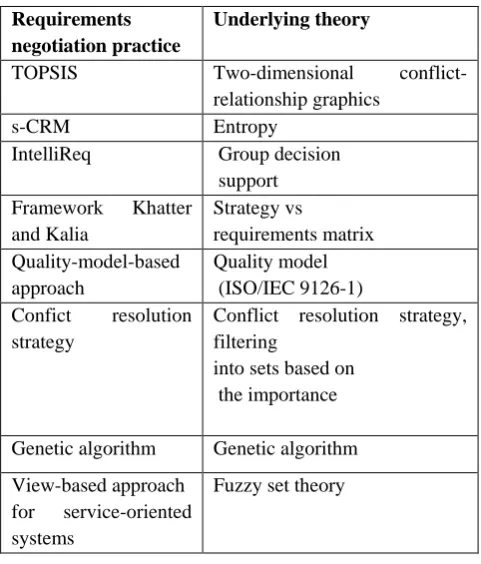
III. SOME OF THE OTHER REQUIREMENTS NEGOTIATION THEORIES
Table.2. Some of the Other Requrements Negotiation Theories
Requirements negotiation practice
Underlying theory
TOPSIS Two-dimensional
conflict-relationship graphics
s-CRM Entropy
IntelliReq Group decision
support Framework Khatter and Kalia
Strategy vs
requirements matrix Quality-model-based
approach
Quality model (ISO/IEC 9126-1) Confict resolution
strategy
Conflict resolution strategy, filtering
into sets based on the importance
Genetic algorithm Genetic algorithm
View-based approach for service-oriented systems
[image:2.595.310.551.482.764.2]IV. REQUIREMENTS NEGOTIATION THEORIES BASED ON THEORY W INTEGRATED SCRUM IN THE WIN-WIN
REQUIREMENTS MODEL
• This approach leverages [3] [4] the fact that Scrum uses daily meetings and that it divides projects and huge tasks into sub tasks called `negotiable sprints', which are typically two till four weeks in duration
• Due to the daily meetings and the negotiable sprints, re-negotiation and late changes are possible
• he perceived benefits of using scrum in the Win-Win model are the perceived increase of collaboration among stakeholders, the improvement in software productivity and the reduction of project failure risk. The authors of the approach consider it applicable to both small and large systems.
The WinWin negotiation model aims at coordinating decision-making activities made by various stakeholders in the software development process.
It guides success-critical stakeholders through a process of eliciting, elaborating, prioritizing, and negotiating requirements. It also provides the support for future changes by keeping the traceability of the artifacts and their rationale.
The negotiation process supports the engineering and management ac-tivities of rationale capture. The artifacts and their rationale captured dur-ing requirements negotiation shapes the decision made through the soft-ware development. In addition, the artifacts provide additional information to check the project status and manage the project risks. The higher num-ber of issues identified and resolved helps reduce risks early in a project and the chances of it derailing later.
The rationale capture during negotiation improves the communication between stakeholders and the quality of the products. Rationale on the ne-gotiation results supports communication between all success-critical stakeholders.
A. The Groupware Requirements Negotiation System
(GRNS).
• T
This is an all-in-one requirements negotiation process model [6]. It solves requirements negotiation problems by integrating Easy WinWin, quality as-assurance methods, multi-criteria preference methods and Bayes theorem all into one model
• D
Due to these combination methods, the authors of the method expect to achieve the following benefits: clear requirements will be elicited,
structured communication among stakeholders will be pro-vided, defects will be reduced, agreements will be achieved and the severity level of the requirements will be decreased.
•
In experiments is proved that the GRNS reduces defects by 78.5%.
B. Win book.
•
This is a method represented as an avatar of the Win-Win framework.
•
It is based on the way people collaborate with each other on Face book and the way people organize their email with Gmail.
•
cause of this, Winbook is very easy to use, even for non-technical stakeholders.
•
The Winbook environment allows win conditions to be captured on a virtual wall (similar to a user's wall on Facebook) that all members in a project team can review and update.
•
The posts (win conditions, issues, options, comments) are displayed with the corresponding user’s avatar (as selected during the sign-up process) to maintain the social networking look and feel.
•
The wall serves as a virtual whiteboard for documenting user needs as win conditions.
•
With the use of Win book all the stakeholders can agree on the requirements faster.
•
Another advantage is that stakeholders are more involved in the definition and prioritization of requirements.
C.JSPWikiWinWin.
•
It is grounded on the WinWintheory and is built on the JSPWiki framework [18].
•
JSPWikiWinWin is the successor of TWikiWinWin, which is built on the TWiki framework.
•
Compared to the TWiki frame-work, the JSPWiki
security.JSPWikiWinWin has some other advantages compared toTWikiWinWin.
• O
One of them is the improved speed of stakeholders' responding to requirements changes.
• J
JSP-WikiWinWin sends emails with notifications and due to this, stakeholders check JSPWikiWinWin more often than they did using TWikiWinWin.
• T
This makes JSPWikiWin-Win time-saving: when there are changes in the requirements, this is instantly known by the stakeholders, who can stop doing their task.
• W
With TWikiWinWin they saw these changes after they finished their tasks.
• T
The inter-face of JSPWikiWinWin is also easier to use than the old interface of TWikiWinWin.
V. SOME OF THE OTHER REQUIREMENTS NEGOTIATION THEORIES
A.Technique for Order of Preference by Similarity to Ideal Solution (TOPSIS)
• T
this is a goal-based multi-criteria decision analysis technique for deter-mining the best solution.
• “
”Best" is identified by means of a weighted normalized decision matrix that has to be made while applying the technique.
• The best solution has the shortest distance to the ideal solution and the farthest distance to the so-called `negative-ideal' solution (this is the solution that is the exact opposite of the ideal solution).
• T
TOPSIS has been designed to work for non-functional requirements.
B.The Stakeholder Conflict Resolution Model(s-CRM)
• It is designed to help identifying [7] the key stakeholders of the project and giving a resolution for conflicts between the requirements of those stakeholders.
• S-CRM does this by first measuring the
entropy between the requirements and the identified stakeholders. After that the conflict resolution takes place.
C.IntelliReq:
•
This is a group decision support environment that
supports the group decision process in
requirements negotiation. •
It is used by computer science students of the Graz University of Technology.
•
IntelliReq helps the students deciding which requirements should be implemented within the scope of their project.
•
The functionalities implemented in IntelliReq are: add/change personal preferences, show and comment on preferences of group members, show group recommendations, edit a cur-rent group decision, and evaluate IntelliReq.
•
It is found that the perceived usability and the quality of decision support can be improved by using IntelliReq.
D.The framework Khatter and Kalia for identification and analysis of conflicts in non-functional requirements.
•
It uses a matrix with the strategies versus the requirements to detect conflicts between non-functional requirements based on the relationship between the requirements and the system's architecture[10].
•
When there is a conflict in high-level non-functional requirements, these requirements are then transformed into lower-level non-functional requirements.
•
This decomposition process would continue until there are no high-level conflicts any-more. The authors use a conflict tree to understand these semantics of the conflicts.
E. The quality-model-based approach of Carvallo andFranch
•
It supports the negotiation of initial and emergent requirements and helps stakeholder reconcile their concerns[17].. The approach is based on the Quality Model ISO/IEC 9126-1, a popular standard in the fields of soft-ware engineering, and in particular in RE.
•
starts an identification of the underlying software architecture behind a solution that will be developed in a project, and proceeds with the construction of quality models that are derived from the ISO/IEC standard.
• T
These models are then used in the evaluation of alternative components of the underlying architecture.
F. The Conflict Resolution Strategy framework of Buttet al.
• I
It structures elicited requirements into three categories: mandatory requirements, essential requirements and optional requirements.
• O
Once this is done, the method checks if
requirements are conflicting with each other.
• T
The conflicts are then solved by using a
number of techniques, such as conflict prevention, conflict detection and removal or conflict containment.
• T
The Conflict Resolution Strategy works for both non-functional and functional requirements.
G. Requirements negotiation using the Genetic Algorithm approach
• I
It borrows ideas of computational intelligence and uses a fitness function from the field of genetic algorithms, to resolve stakeholders' requirements conflicts.
• I
It starts with giving a weight to all of the requirements by all of the clients. Crossover and mutation process then takes place, which resolves conflicts.
• A
A new weight is then given by the clients to the resolved conflicts.
• N
Next, the average weight of the conflicting requirements is compared against the total of the sum of the resolved conflicts.
• I
If this total is greater than the average weight of the conflicting requirements, then this means that the conflicts resolved. Otherwise, the process should be repeated for a suitable requirement.
H.The view-based approach to quality requirements negotiation for service-oriented systems.
•
It is grounded for defining requirements as goals and acknowledges that in service-oriented systems there are static and dynamic requirements (dynamic are those that are determined at runtime).
•
The proposal in includes a model for resolving conflicts in quality requirements (such as service interoperability, recoverability, and fault tolerance) from the viewpoints of consumersof services and designers of services, as stakeholders.
•
Their solution mechanism used by the authors is based on concepts of fuzzy set theory. These concepts of fuzzy set theory.
VI. CONCLUSION
This paper helps practitioners to choose which requirements negotiation method is useful under a certain requirement conflict type and also shows researchers where gaps exist between requirements negotiation methods and requirement conflicts and therefore shows them for what type of requirement conflicts they can create new requirements negotiation methods. Theory W (WinWin approach) is still very popular [2][3], because resource conflicts and feasibility conflicts still are getting almost no attention at all. Almost all requirements negotiation methods are suitable for viewpoint conflicts.
VII. FUTURE WORK
There are almost no requirements negotiation methods to resolve resource conflicts and feasibility conflicts. This gap could be closed by creating requirements negotiation methods which resolve those types of requirements conflicts
VIII. REFERENCES
[1] S. Ahmad, N. A. Muda, A. K. Muda, and Z. Othman. Requirements Negotiation: Does Consensus Reduce Software Development Cost? International Journal of Digital Content Technology and its Applications, 6(December):46{55, 2012. [2] B. Boehm and H. Kitapci. The WinWin Approach: Using a
Requirements Negotiation Tool for Rationale Capture and Use. Rationale Management in Software Engineering, pages 173{190, 2006.
[3] B. W. Boehm and R. Ross. Theory-W Software Project Management: Principles and Examples.IEEE Transactions on Software Engineering, 15(7):902{916, 1989.
[4] W. H. Butt, S. Amjad, and F. Azam. Requirement Conflicts Resolution: Using Requirement Filtering and Analysis. In Lecture Notes in Computer Science, volume 6786, pages 383{397. 2011.
[5] J. P. Carvallo and X. Franch. Requirements Negotiation for Multilayer System Components. In 2011 IEEE 19th International Requirements Engineering Conference, pages 285{290. IEEE, Aug. 2011.
Support for Requirements Negotiation. In Lecture Notes in Computer Science, volume 7138, pages 105{116.2012.
[7] C. K. Jeon, N. H. Kim, D. H. Lee, T. Lee, and H. P.In. Stakeholder Conflict Resolution Model (S-CRM) Based On Supervised Learning. KSII Transactionson Internet and Information Systems,6(11):2813{2826, 2012. [8] M. J_rgensen and K. Mol_kken-_stvold. How large are
software cost overruns? A review of the 1994 CHAOS report. Information and SoftwareTechnology, 48:297{301, 2006.
[9] U. Z. Khan, F. Wahab, and S. Saeed. Integration ofScrum with Win-Win Requirements Negotiation Model. Middle-East Journal of Scientific Research,19(1):101{104, 2014.
[10] K. Khatter and A. Kalia. An Integrated Approach to Capture Semantics of Requirement Conflicts. InCommunications in Computer and Information Science, volume CCIS 250, pages 826{831, 2011. [11] B. Kitchenham. Procedures for Performing Systematic
Reviews. Technical report, 2004.
[12] N. Kukreja and B. Boehm. Process Implications of Social Networking-Based Requirements Negotiation Tools Nupul. In 2012 International Conference on
Software and System Process, ICSSP 2012 -Proceedings, pages 68{72. IEEE, June 2012.
[13] A. Lupeikiene and A. Caplinskas. Requirements Engineering for Service- Oriented Enterprise Systems: Quality Requirements Negotiation. In Frontiers in Arti_cial Intelligence and Applications,volume 270, pages 27{40. IOS Press, 2014.
[14] D. Mairiza, D. Zowghi, and V. Gervasi. Utilizing TOPSIS: A Multi Criteria Decision Analysis Technique for Non-Functional Requirements Conflicts. Communications in Computer and Information Science, CCIS 432:31{44, 2014. [15] M. Ramzan, M. Qasim Khan, M. Amjad Iqbal, M. Aasem, A.
Ja_ar, S. Anwar, A. Adnan, A. Tamleek, M. Ali, and M. Alam. A genetic algorithms based approach for conicts resolution in requirement. International Journal of Physical Sciences, 6(4):828{836, 2011.
[16] S. Riaz, N. Ikram, M. Niazi, and A. Q. Gill. A Systematic Literature Review of Software Requirements Negotiation Practices. Technicalreport, Riphah International University, 2010.
[17] H. B. So_an, S. S. Binti Salim, and S. R. Shahamiri.A Requirements Negotiation Process Model that Integrates EasyWinWin with Quality Assurance and Multi-Criteria Preference Techniques. Arabian Journal for Science and Engineering, 39:4667{4681,2014.
[18] P. Wan, S. Huang, J. Li, D. Yang, and Y. Yang. Balancing Load of Shaper in WikiWinWin Requirements Negotiation Environment: An Empirical Evaluation. In Proceedings of the 11th
[21 ] E.Terpstra- A.Sysmatic Literature Review of Requirements Negotation Methods from 200 till 2015.
International Conference on Product Focused Software, pages 8{11, 2010.
[19] R. Wieringa. Empirical research methods for technology validation: Scaling up to practice. Journal of Systems and Software, 95:19{31, 2013.