Mining a Lexicon of Technical Terms and Lay Equivalents
Noemie Elhadad and Komal Sutaria Computer Science Department The City College of New York
New York, NY 10031
[email protected], [email protected]
Abstract
We present a corpus-driven method for building a lexicon of semantically equiva-lent pairs of technical and lay medical terms. Using a parallel corpus of abstracts of clin-ical studies and corresponding news sto-ries written for a lay audience, we identify terms which are good semantic equivalents of technical terms for a lay audience. Our method relies on measures of association. Results show that, despite the small size of our corpus, a promising number of pairs are identified.
1 Introduction
The field of health literacy has garnered much at-tention recently. Studies show that most docu-ments targeted at health consumers are ill-fitted to the intended audience and its level of health liter-acy (Rudd et al., 1999; McCray, 2005). While there are many components involved in health literacy that are specific to the reader (e.g., reading level and cul-tural background), we investigate what can be done from the standpoint of the text to adapt it to the liter-acy level of a given reader. As such, we set ourselves in the context of a text-to-text generation system, where a technical text is edited to be more compre-hensible to a lay reader. An essential resource for such an editing tool is a lexicon of paraphrases, or semantically equivalent terms. In this paper, we in-vestigate a corpus-driven method for building such a lexicon. We focus on terms that are recognized by the UMLS (UMLS, 1995), both for technical and lay candidate terms for equivalence.
Because we have lay audiences in mind, our defi-nition of semantic equivalence must be broader than a notion of strict medical equivalence utilized by medical experts. Thus, while a medical dictionary
like UMLS assigns different concept unique identi-fiers (CUIs) to two particular terms, such as percu-taneous transluminal coronary angioplasty and an-gioplasty, these terms should be considered
seman-tically equivalent for the purposes of lay readers. Besides enabling a text tailoring system to adapt technical texts for a lay audience, a lexicon of semantically equivalent technical/lay terms would benefit other tools as well. For instance, the Con-sumer Health Vocabulary initiative1is a comprehen-sive list of UMLS terms familiar to lay readers. Our lexicon could help augment the terms with equiva-lence links to technical terms. While much research of late has been devoted to identifying terms incom-prehensible to lay readers, such research has not es-tablished links between technical terms and equiva-lent lay terms beyond their CUI information (Zeng et al., 2005; Elhadad, 2006).
The key points of our approach are: (1) the use of combined measures of association to identify pairs of semantically equivalent terms, and (2) a knowledge-based heuristic which acts as a powerful filter for identifying semantically equivalent pairs. Our method does not rely on human labeling of se-mantically equivalent term pairs. As such, it is un-supervised, and achieves results that are promising considering the small size of the corpus from which the results are derived.
This paper is organized as follows. The next sec-tion describes our parallel corpus of paired techni-cal/lay documents. The Methods section describes the different measures of association we experi-mented with, how we combine them to leverage their complimentary strengths, and our semantic filter. The Results section reports the evaluation against our gold standard and a discussion of our results.
2 Data Description
Because our ultimate goal is to learn, in a data-driven fashion, semantic equivalents of terms that are too technical for lay readers, we can benefit from having instances of texts which relay similar infor-mation but are conveyed in different styles. We collect a corpus similar in structure to those used in the field of statistical machine translation. But, instead of having two collections in different lan-guages, we collect texts written for two different au-diences: medically trained readers (technical collec-tion) and health consumers (lay colleccollec-tion).
The lay collection is composed of news stories from the ReutersHealth E-line newsfeed2 summariz-ing research in the medical field. Reuters journalists take technical publications and report the main find-ings and methods and, on occasion, include inter-views with the authors of the scientific publication. The stories are targeted at a lay audience with a 12th-grade reading level. Furthermore, every story in our collection contains a reference to the original scien-tific publication. Thus, it is possible to gather the original texts, which convey similar information but were written for a technical audience. The stories draw upon studies from reputable medical journals, such as Annals of Internal Medicine, New England Journal of Medicine and Lancet.
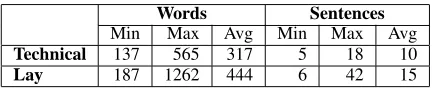
The technical collection in our corpus is com-posed of the original scientific articles correspond-ing to each news story in the lay collection. Accord-ingly, the lay and technical collections contain the same number of documents and are parallel at the document level. That is, each technical document has a lay equivalent and vice-versa. Because a lay document is a summary of a technical article and is, hence, much shorter than the original scientific ar-ticle, we decided to include only the abstract of the technical document in our collection. This way, the technical and lay documents are comparable in con-tent and length. It should be noted, however, that the content in a technical/lay document pair is not parallel, but comparable (McEnery and Xiao, 2007): there is no natural sentence-to-sentence correspon-dence between the two texts. This is to be expected: technical abstracts contain many technical details, while lay stories, to provide background, introduce
2http://www.reutershealth.com
Words Sentences
Min Max Avg Min Max Avg
[image:2.612.315.534.50.94.2]Technical 137 565 317 5 18 10 Lay 187 1262 444 6 42 15 Table 1: Statistics for the Technical and Lay collec-tions. Each contains 367 documents.
information entirely absent from abstracts. In addi-tion, the lay stories drastically rearrange the order in which information is typically conveyed in technical abstracts. For these reasons, our corpus is not paral-lel at the sentence level and, thus, differs from other bilingual parallel corpora used in machine transla-tion.
To ensure that some significant number of terms appears with sufficient frequency in our corpus in order to induce equivalent pairs automatically, we focused on articles and stories in a single domain: cardiology. We identified the original scientific ar-ticle manually, as the lay document only contains a reference, not an actual link. For this reason, only a relatively small amount of data could be collected: 367 pairs of documents (see Table 1 for statistics).
3 Methods
3.1 Data Processing
Preven-Corresponding lay doc. contains
lay term
Corresponding lay doc. does not con-tainlay term
Technical doc. contains
tech term
a b
Technical doc. does not con-taintech term
c d
Table 2: Contingency table for (tech term, lay term).
tive Procedure,” on the other hand, were considered terms. For instance, both the termsPTCAand percu-taneous transluminal coronary angioplastyhave the
same CUI C0002997, as they are considered syn-onyms by UMLS. The termballoon angioplastyhas
the CUI C0002996. Both C0002997 and C0002996 have the semantic type “Therapeutic or Preventive Procedure.”
3.2 Contingency Table
We call (tech term, lay term) a term pair, where tech term is a term occurring in one or more
tech-nical documents and lay term is a term present
in at least one of the corresponding lay docu-ments.3 For any such pair, we can compute a contingency table based on co-occurrence. Our definition of co-occurrence is slightly unusual:
tech term andlay term co-occur in one document
pair iftech term appears at least once in the
techni-cal document andlay term appears at least once in
the corresponding lay document. Our unit of content is document frequency for a CUI,i.e., the number of
documents in which a given CUI appears. For in-stance, in our data, the contingency table for the term pair(MI, heart attack) shows the following counts:
the document frequency of the CUI corresponding to MI in the technical collection is 98; the
docu-ment frequency of the CUI corresponding to heart attackin the lay collection is 161. Among these
doc-uments, there are 84 technical/lay document pairs (out of the total of 367 paired documents) in which the CUI forMI occurs on the technical side and the
CUI forheart attack occurs on the lay side. Hence,
the contingency table for this term pair is, following
3This means that iftech term andlay term have no
tech-nical/lay document in common,lay term is not considered a
possible candidate for semantic equivalence fortech term.
the notations of Table 2: a = 84, b = 98-84 = 14, c = 161-84 = 77, and d = 367-98-161+84 = 192.
At this stage of processing, lexical terms are ab-stracted by their CUIs. We do this to maximize the possible evidence that two terms co-occur. For in-stance, the document frequency forMI in our
tech-nical collection is 20, while the document frequency for its corresponding CUI is 98. Section 3.7 de-scribes how we proceed from identifying equivalent terms at the CUI level to finding lexical equivalents.
3.3 Gold Standard
To evaluate the validity of our approach, we col-lected all possible term pairs at the CUI level in our corpus (that is, all the term pairs for which a con-tingency table is computed). We then whittled this set down to those pairs where each CUI occurs in at least two documents. This resulted in 2,454 pairs of CUIs. We asked our medical expert, an internist in practice who interacts with patients on a daily ba-sis, to indicate for each pair whether the terms were equivalent from a medical standpoint in the con-text of communicating with a patient.4 An
opera-tional test for testing the equivalence of two terms is whether he would use one term for the other when talking to a patient. We indicated to our expert that the terms should be equivalent out of context. So,
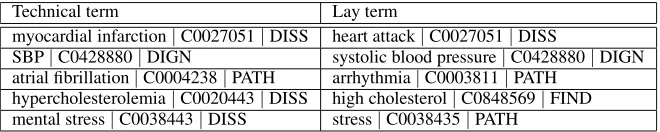
for instance, while the pair (myocardial infarction, complication) could be deemed equivalent in certain specific contexts, these terms are not generally con-sidered equivalent. Table 3 shows examples of pairs annotated as semantic equivalents for lay readers.5 The list of terms contained only the actual lexical terms and no information from the UMLS to avoid biasing our expert.
Out of the 2,454 CUI pairs provided to our medi-cal expert, 152 pairs were labeled as equivalent. Out of the 152 pairs, only 8 (5.3%) had different seman-tic types. Interestingly, 84 pairs (55.3%) had differ-ent CUIs. This confirms our intuition that the notion of semantic equivalence for lay readers is looser than for medically knowledgeable readers.
4While it is in some ways counterintuitive to rely on a
tech-nical expert to identify lay semantic equivalents, this expertise helps us validate equivalences from a medical standpoint.
5In the table, DIGN stands for “Diagnostic Procedure,”
Technical term Lay term
myocardial infarction|C0027051|DISS heart attack|C0027051|DISS
SBP|C0428880|DIGN systolic blood pressure|C0428880|DIGN
atrial fibrillation|C0004238|PATH arrhythmia|C0003811|PATH
hypercholesterolemia|C0020443|DISS high cholesterol|C0848569|FIND
[image:4.612.139.469.51.117.2]mental stress|C0038443|DISS stress|C0038435|PATH
Table 3: Examples from the gold standard of term pairs considered equivalent.
3.4 Measures of Association
Given a term pair (tech term,lay term) and its
cor-responding contingency table, we want to determine whether lay term is a valid semantic equivalent of tech term from the standpoint of a lay reader. We
rely on three alternative measures of association in-troduced in the Statistics literature: the χ2
statis-tic, the λ measure, and odds ratio. All of these
measures are computed as a function of the contin-gency table, and do not rely on any human labeling for equivalence. Measures of association have been used traditionally to identify collocations (Manning and Sch¨utze, 1999). Here we investigate their use for building a lexicon.
3.4.1 Theχ2 Statistic
The standard chi-square statistic (χ2) is used
to determine whether the deviation of observed data from an expected event occurs solely by chance (Goodman and Kruskal, 1979). Our null hypothesis for this task is that the presence of
lay term in a lay document is independent of the
presence of tech term in its correspondent
techni-cal document. Thus, any pair of terms for which the
χ2 is above the critical value at a given level of
sig-nificance are considered semantic equivalents. One important constraint for the measures to be valid is that the observed data be large enough (more than five observations per cell in the contingency table).
The χ2 statistic for our 2x2 contingency table,
and with N being the total number of document pairs, is calculated as follows:
χ2 = N(ad−bc)
2
(a+b)(a+c)(c+d)(b+d)
Sinceχ2 is a true statistic, we can rely on critical
values to filter out pairs with low associative power. In our case, we set the significance level at .001 (with a critical value forχ2 of 10.83).
C0011847 ¬C0011847 Sum
C0011849 a = 13 b = 8 21
¬C0011849 c = 40 d = 306 346
Sum 53 314 367
Table 4: Contingency table for (C0011849, C0011847).
3.4.2 Theλ andλ* Measures
The lambda measure (λ) assesses the extent to
which we can predict the presence oflay term in a
lay document by knowing whether the original tech-nical document containedtech term(Goodman and
Kruskal, 1979). λ is an asymmetrical measure of
association. Since a lay document is always writ-ten based on an original technical document, it is a plausible assumption that the presence of a spe-cific term in the technical document influenced the lexical choices of the author of the lay document. Thus, we consider the presence of tech term in a
technical document the antecedent to the presence oflay term in the corresponding lay document, and,
accordingly, operate in the setting of predicting the presence oflay term.
We present the intuition behindλ in the context
of the following example. Consider the contingency table for the technical CUI C0011849 (diabetes mel-litus) and C0011847 (diabetes) in Table 4. The task
is, given a random lay document, to predict which of two available categories it belongs to: either it con-tains the lay CUI (in our example, CUI C0011847 for diabetes) or it does not. There are two
possi-ble cases: either (1) we do not have any knowl-edge about the original technical document, or (2) we know the original technical document and, there-fore, we know whether it contains the antecedent (in our example, CUI C0011849 fordiabetes mellitus).
probabil-ity. The probability of error in case (1) isPerr1 = N−M ax(a+c,b+d)
N .
In our example, the safest bet is¬C0011847, with
a raw count of 314 documents, and a probability of error ofPerr1 = 0.1444.
If we have prior knowledge about the original technical document (case (2)), then our safest pre-diction differs. If we know that the technical doc-ument contains the CUI C0011849 (diabetes melli-tus), then our safest prediction is the category with
the highest probability: C0011847, with a raw count of 13 documents. If, on the other hand, we know that the technical document does not contain the CUI C0011849, our safest prediction is the category
¬C0011847, with a raw count of 306 documents.
Thus, overall the probability of error in case (2) is
Perr2 = N−(M ax(a,bN)+M ax(c,d)).
In our example, knowledge about the original tech-nical document lowers the probability of error to
Perr2 = 0.1308.
Theλ measure is defined as the relative decrease
in probability of error in guessing the presence of
lay term in a lay documentλ= Perr1−Perr2
Perr1
which, using our notation for contingency tables, can be expressed as
λ= M ax(a, b) +M ax(c, d)−M ax(a+c, b+d) N−M ax(a+c, b+d)
In our example, λ= 0.094. λ ranges between 0
and 1. A value of 1 means that knowledge about the presence of tech term in the original
techni-cal document completely specifies the presence of
lay term in its corresponding lay document. A value
of 0 means that knowledge about the presence of
tech term in the original technical document does
not help in predicting whetherlay term is present in
its corresponding lay document.
The λ measure is not a test of significance like χ2. For instance, while two independent variables
necessarily have aλ of 0, the opposite is not
neces-sarily true: it is possible for two dependent variables to have aλ of 0. In our setting in particular, any
contingency table where a=b will provide aλ of 0.
Sinceλ is computed as a function of maxima of
rows and columns,λ can easily be biased toward the
original proportions in the antecedent. In our exam-ple, for instance, a very large proportion of technical
documents has no occurrence of C0011849,diabetes mellitus (94.3% of the technical documents). But
for our purposes, such contingencies should not af-fect our measure of association, as the proportion of technical documents happening not to contain a par-ticular term is just an artificial consequence of cor-pus collection.λ* is a variant ofλ also proposed by
Goodman and Kruskal (1979) and is able to take this fact into account. It is computed using the same for-mula asλ, but the elements of the contingency table
are modified so that each category of the antecedent is equally likely. In our case, this means: N*=1, a*=0.5a/N(a+b), b*=0.5b/N(a+b), c*=0.5c/N(c+d), and d*=0.5d/N(c+d). Going back to our example of
diabetes mellitusand diabetes, we now findλ∗ = 0.324, which is much higher than the original λ of
0.094, and which indicates a strong association. We focus on λ* as a measure of association for
semantic equivalence of term pairs. Sinceλ andλ*
are not true statistics, there is no significance level we can rely on to set a threshold for them. Instead, we estimate an optimal threshold from the perfor-mance of λ* on a development set. The
develop-ment set was obtained in the same manner as the gold standard and contains 50 term pairs. This is a small number of pairs, but the term pairs in the development set were carefully chosen to contain mostly semantically equivalent pairs. In our experi-ments, the optimal value forλ* was 0.3. Thus,λ* is
used as a binary test for our purposes:tech term and lay term are considered semantically equivalent if
theirλ* is above 0.3.
3.4.3 Odds Ratio
Odds ratio is a measure of association that focuses on the extent to which one category in the contin-gency table affects another (Fleiss et al., 2003). For our contingency table, the odds ratio is expressed as follows:
OR= ad bc
For instance, given the contingency table of Ta-ble 4, the odds ratio for the pair(diabetes mellitus, diabetes) is 12.43, which means that a lay
docu-ment is 12.43 times more likely to contain the CUI C0011847, fordiabetes, if its original technical
Like λ*, odds ratio is not a true statistic and,
therefore, does not have any critical value for sta-tistical significance. We estimated the optimal value of a threshold for OR based on the same develop-ment set described above. The threshold for OR is set to 6. Thus, OR is used as a binary test for our purposes: tech term and lay term are considered
semantically equivalent if their OR is above 6.
3.5 Combining the Measures of Association
Each of the measures of association described above leverages different characteristics of the contingency tables, and similarly, each has its limitations. For instance, χ2 cannot be computed when there are
not sufficient observations, andλ* can equal 0, even
when there is a strong association between the two terms. We combine measures of association in the following fashion: two terms are considered equiva-lent if at least one of the measures determined so.
3.6 Semantic Filtering
The measures of association described above and their combination provide information solely based on corpus-derived data. Since all our counts are based on co-occurrence, a measure of association by itself can encompass many types of semantic rela-tions. For instance, the pair for (stroke, brain) tests
positive with our three measures of association. In-deed, there is a strong semantic association between the two terms: strokes occur in the brain. These terms, however, do not fit our definition of seman-tic equivalence.
We rely on knowledge provided by the UMLS, namely semantic types, to help us filter equiv-alent types of associations among the candidate term pairs. One can assume that sharing semantic types is a necessary condition for semantic equiva-lence. Our semantic filter consists of testing whether
tech term and lay term share the same semantic
types, as identified by our tool TermFinder.
3.7 Lexical Choice
So far, term pairs are at the CUI level. The measures of association and the semantic filter provide a way to identify candidates for semantic equivalence. We still have to figure out which particular lexical items among the different lexical terms of a given CUI are appropriate for a lay reader. For instance, the pair
(C0027051, C0027051) is considered a good candi-date for semantic equivalence. In the technical col-lection, the lexical terms contributing to the CUI are
AMI,AMIs,MI,myocardial infarction, myocardial infarctand myocardial necrosis. In the lay
collec-tion, however, the lexical terms contributing to the same CUI are heart attack, heart attacks, and my-ocardial infarction. Clearly, not all lexical items for
a given CUI are appropriate for a lay reader.
To select an appropriate lay lexical term, we rely on the term frequency of each lexical item in the lay collection (Elhadad, 2006). In our example, the lexical term “heart attack” has the highest term fre-quency in the lay collection among all the variants with the same CUI. Thus, we chose it as a semantic equivalent of any lexical term of the CUI C0027051 in the technical collection.
If a technical term has several candidate semantic equivalents at the CUI level, the lexical lay term is chosen among all the lay terms. For instance, (ad-verse effect, side effect)and(adverse effect, compli-cations) are two valid equivalents, but side effects
has a term frequency of 16 in our lay collection, and
complicationshas a lay term frequency of 35. Thus, complicationis selected as the lay equivalent for ad-verse effect.
4 Results
We report on the two steps of our system: (1) find-ing semantic equivalents at the CUI level, and (2) finding an appropriate lay lexical equivalent.
Finding Semantic Equivalents at the CUI Level
Table 5 shows the precision, recall and F-measure (computed as the harmonic mean between precision and recall) against our gold standard for the three alternative measures of association, including dif-ferent combinations of these, and also adding the semantic filter. In addition, we report results for a competitive baseline based solely on CUI informa-tion, wheretech term and lay term are considered
equivalent if they have the same CUI.
Method P R F Method P R F Method P R F lam 40.8 20.4 27.2 chi,odds 20.6 78.3 32.6 CUI 100 44.7 61.8 chi 38.7 23.7 29.4 chi,lam,odds 20.6 80.3 32.8 sem,odds 57.8 71.1 63.7 sem,lam 76.3 19.1 30.5 sem,chi 81.8 23.7 36.7 sem,lam,odds 57.4 73.7 64.6 odds 20.4 74.3 32 chi,lam 38.2 39.5 38.8 sem,chi,odds 58.5 75 65.7 lam,odds 20.5 77 32.3 sem,chi,lam 79.5 38.2 51.6 sem,chi,lam,odds 57.9 77 66.1
Table 5: Precision, Recall and F measures for different variants of the system.
Relying on only one measure of association with-out any semantic filtering to determine semantic equivalents is not a good strategy: λ* (lam in
Ta-ble 5),χ2(chi) and OR (odds), by themselves, yield
the worst F measures. Interestingly, the measures of association identify different equivalent pairs in the pool of candidate pairs. Thus, combining them increases the coverage (or recall) of the system. For instance, λ* by itself has a low recall of 20.4
(lam). When combined with OR, it improves the re-call from 74.3 (odds) to 77 (lam,odds); when com-bined withχ2, it improves the recall from 23.7 (chi)
to 39.5 (chi,lam). Combining the three measures of association (chi,lam,odds) yields the best recall (80.3), confirming our hypothesis that the measures are complementary and identify pairs with different characteristics in our corpus.
While combining measures of association im-proves recall, the semantic filter is very effective in filtering inaccurate pairs and, therefore, improving precision: λ*, for instance, improves from a
pre-cision of 40.8 (lam) to 76.3 (sem,lam) when the filter is added, with very little change in recall. The best variant of our system in terms of F sure is, not surprisingly, combining the three mea-sures of association and adding the semantic filter (sem,chi,lam,odds in Table 5).
The results of these experiments are surprisingly good, considering that the contingency tables are built from a corpus of only 367 document pairs and rely on document frequency (not term frequency). These quantities are much smaller than those used in machine translation, for instance.
Finding Lay Lexical Equivalents We evaluate
our strategy for finding an appropriate lay lexical item on the list of 152 term pairs identified by our medical expert as semantic equivalents. Our strat-egy achieves an accuracy of 86.7%.
5 Related Work
Our work belongs to the field of paraphrase identi-fication. Much work has been done to build lexi-cons of semantically equivalent phrases. In gener-ation systems, a lexicon is built manually (Robin, 1994) or by relying on an electronic thesaurus like WordNet (Langkilde and Knight, 1998) and setting constraints on the type of accepted paraphrases (for instance, accepting only synonyms as paraphrases, and not hypernyms). Building paraphrase lexicons from a corpus has also been investigated. Jacquemin and colleagues (1997) identify morphological and syntactic variants of technical terms. Barzilay and McKeown (2001) identify multi-word paraphrases from a sentence-aligned corpus of monolingual par-allel texts. One interesting finding of this work is that the mined paraphrases were distributed across different semantic links in WordNet: some para-phrases had a hypernym relation, while others were synonyms, and others had no semantic links at all. The composition of our gold standard confirms this finding, since half of the semantically equivalent terms had different CUIs (see Table 3 for examples of such pairs).
sen-tence alignment. Of course, our task is easier than the one of machine translation, since we focus on “translating” only technical terms, rather than every single word in a technical document.
Gale and Church (1991) do not follow the EM model, but rather find French translations of English words using aχ2-like measure of association. Their
corpus is the parallel, sentence-aligned Hansard cor-pus. Our method differs from theirs, as we do build the contingency table based on document frequen-cies. Gale and Church employ sentence-level fre-quencies. Our corpus is much smaller, and the sen-tences are not aligned (for comparison, we have 367 document-pairs, while they have nearly 900,000 sentence pairs). Another difference between our ap-proach and theirs is our use of the semantic filter based on UMLS. We can afford to have such a filter because we focus on finding semantic equivalents of UMLS terms only.
6 Conclusions and Future Work
We presented an unsupervised method for identi-fying pairs of semantically equivalent technical/lay terms. Such a lexicon would benefit research in health literacy. In particular, it would benefit a sys-tem which automatically adapts a medical technical text to different levels of medical expertise.
We collected a corpus of pairs of technical/lay documents, where both documents convey similar information, but each is written for a different au-dience. Based on this corpus, we designed a method based on three alternative measures of association and a semantic filter derived from the UMLS. Our experiments show that combining data-driven statis-tics and a knowledge-based filter provides the best results.
Our method is concerned specifically with pairs of terms, as recognized from UMLS. While UMLS provides high coverage for technical terms, that is not the case for lay terms. In the future, we would like to extend our investigation to pairs consisting of a technical term and any noun phrase which is sufficiently frequent in our lay collection. Finding such pairs would have the side effect of augmenting UMLS, a primarily technical resource, with mined lay terms. One probable step towards this goal will be to increase the size of our corpus of paired
tech-nical and lay documents.
References
R. Barzilay and K. McKeown. 2001. Extracting para-phrases from a parallel corpus. InProc. ACL’01, pages 50–57.
N. Elhadad. 2006. Comprehending technical texts: Predicting and defining unfamiliar terms. In Proc. AMIA’06, pages 239–243.
J. Fleiss, B. Levin, and M.C. Paik. 2003. Statistical Methods for Rates and Proportions. Wiley.
W. Gale and K. Church. 1991. Identifying word cor-respondences in parallel texts. InProc. Speech and Natural Language Workshop, pages 152–157. L. Goodman and W. Kruskal. 1979.Measures of
Associ-ation for Cross ClassificAssoci-ations. Springler Verlag. C. Jacquemin, J. Klavans, and E. Tzoukermann. 1997.
Expansion of multi-word terms for indexing and re-trieval using morphology and syntax. In Proc. ACL’97, pages 24–31.
I. Langkilde and K. Knight. 1998. Generation that ex-ploits corpus-based statistical knowledge. In Proc. COLING-ACL’98, pages 704–710.
C. Manning and H. Sch¨utze. 1999. Foundations of Sta-tistical Natural Language Processing. MIT Press. A. McCray. 2005. Promoting health literacy. JAMA,
12(2):152–163.
A. McEnery and Z. Xiao. 2007. Parallel and comparable corpora: What is happening? InIncorporating Cor-pora. The Linguist and the Translator. Clevedon.
National Library of Medicine, Bethesda, Maryland, 1995. Unified Medical Lan-guage System (UMLS) Knowledge Sources.
http://www.nlm.nih.gov/research/umls/.
J. Robin. 1994. Revision-Based Generation of Natu-ral Language Summaries Providing Historical Back-ground. Ph.D. thesis, Columbia University.
R. Rudd, B. Moeykens, and T. Colton. 1999.Annual Re-view of Adult Learning and Literacy, chapter 5. Health and literacy: a review of medical and public health lit-erature. Jossey Bass.
S. Teufel and N. Elhadad. 2002. Collection and Lin-guistic Processing of a Large-scale Corpus of Medical Articles. InProc. LREC’02, pages 1214–1218. Q. Zeng, E. Kim, J. Crowell, and T. Tse. 2005. A text