Toward Opinion Summarization: Linking the Sources
Veselin Stoyanov and Claire Cardie Department of Computer Science
Cornell University Ithaca, NY 14850, USA
{ves,cardie}@cs.cornell.edu
Abstract
We target the problem of linking source mentions that belong to the same entity (source coreference resolution), which is needed for creating opinion summaries. In this paper we describe how source coref-erence resolution can be transformed into standard noun phrase coreference resolu-tion, apply a state-of-the-art coreference resolution approach to the transformed data, and evaluate on an available corpus of manually annotated opinions.
1 Introduction
Sentiment analysis is concerned with the extrac-tion and representaextrac-tion of attitudes, evaluaextrac-tions, opinions, and sentiment from text. The area of sentiment analysis has been the subject of much recent research interest driven by two primary mo-tivations. First, there is a desire to provide appli-cations that can extract, represent, and allow the exploration of opinions in the commercial, gov-ernment, and political domains. Second, effec-tive sentiment analysis might be used to enhance and improve existing NLP applications such as in-formation extraction, question answering, summa-rization, and clustering (e.g. Riloff et al. (2005), Stoyanov et al. (2005)).
Several research efforts (e.g. Riloff and Wiebe (2003), Bethard et al. (2004), Wilson et al. (2004), Yu and Hatzivassiloglou (2003), Wiebe and Riloff (2005)) have shown that sentiment information can be extracted at the sentence, clause, or indi-vidual opinion expression level (fine-grained opin-ion informatopin-ion). However, little has been done to develop methods for combining fine-grained opin-ion informatopin-ion to form a summary representa-tion in which expressions of opinions from the
same source/target1 are grouped together, multi-ple opinions from a source toward the same tar-get are accumulated into an aggregated opinion, and cumulative statistics are computed for each source/target. A simple opinion summary2 is shown in Figure 1. Being able to create opinion summaries is important both for stand-alone ap-plications of sentiment analysis as well as for the potential uses of sentiment analysis as part of other NLP applications.
In this work we address the dearth of ap-proaches for summarizing opinion information. In particular, we focus on the problem ofsource coreference resolution, i.e. deciding which source mentions are associated with opinions that belong to the same real-world entity. In the example from Figure 1 performing source coreference resolution amounts to determining thatStanishev,he, andhe
refer to the same real-world entities. Given the associated opinion expressions and their polarity, this source coreference information is the critical knowledge needed to produce the summary of Fig-ure 1 (although the two target mentions,Bulgaria
andour country, would also need to be identified as coreferent).
Our work is concerned with fine-grained ex-pressions of opinions and assumes that a system can rely on the results of effective opinion and source extractors such as those described in Riloff and Wiebe (2003), Bethard et al. (2004), Wiebe and Riloff (2005) and Choi et al. (2005). Presented with sources of opinions, we approach the prob-lem of source coreference resolution as the closely
1We usesourceto denote an opinion holder andtargetto
denote the entity toward which the opinion is directed.
2For simplicity, the example summary does not contain
any source/target statistics or combination of multiple opin-ions from the same source to the same target.
“[TargetDelaying of Bulgaria’s accession to the EU]would be a serious mistake” [Source Bulgarian Prime Minister Sergey Stanishev]said in an interview for the German daily Suddeutsche Zeitung. “[Target Our country] serves as a model and encouragescountries from the region to follow despite the difficulties”,[Sourcehe]added.
[Target Bulgaria]iscriticizedby[Sourcethe EU]because of slow reforms in the judiciary branch, the newspaper notes.
Stanishev was elected prime minister in 2005. Since then,
[Source he] has been a prominent supporter of [Target his country’s accession to the EU].
Stanishev Accession
EU Bulgaria
Delaying
+
− −
+
+
Figure 1: Example of text containing opinions (above) and a summary of the opinions (below). In the text, sources and targets of opinions are marked and opinion expressions are shown in italic. In the summary graph, + stands for positive opinion and - for negative.
related task of noun phrase coreference resolu-tion. However, source coreference resolution dif-fers from traditional noun phrase (NP) coreference resolution in two important aspects discussed in Section 4. Nevertheless, as a first attempt at source coreference resolution, we employ a state-of-the-art machine learning approach to NP coreference resolution developed by Ng and Cardie (2002). Using a corpus of manually annotated opinions, we perform an extensive evaluation and obtain strong initial results for the task of source coref-erence resolution.
2 Related Work
Sentiment analysis has been a subject of much re-cent research. Several efforts have attempted to automatically extract opinions, emotions, and sen-timent from text. The problem of sensen-timent ex-traction at the document level (sentiment classifi-cation) has been tackled as a text categorization task in which the goal is to assign to a document either positive (“thumbs up”) or negative (“thumbs down”) polarity (e.g. Das and Chen (2001), Pang et al. (2002), Turney (2002), Dave et al. (2003), Pang and Lee (2004)). In contrast, the problem of fine-grained opinion extraction has concentrated on recognizing opinions at the sentence, clause,
or individual opinion expression level. Recent work has shown that systems can be trained to rec-ognize opinions, their polarity, and their strength at a reasonable degree of accuracy (e.g. Dave et al. (2003), Riloff and Wiebe (2003), Bethard et al. (2004), Pang and Lee (2004), Wilson et al. (2004), Yu and Hatzivassiloglou (2003), Wiebe and Riloff (2005)). Additionally, researchers have been able to effectively identify sources of opin-ions automatically (Bethard et al., 2004; Choi et al., 2005; Kim and Hovy, 2005). Finally, Liu et al. (2005) summarize automatically generated opin-ions about products and develop interface that al-lows the summaries to be vizualized.
Our work also draws on previous work in the area of coreference resolution, which is a rela-tively well studied NLP problem. Coreference resolution is the problem of deciding what noun phrases in the text (i.e.mentions) refer to the same real-world entities (i.e.are coreferent). Generally, successful approaches have relied machine learn-ing methods trained on a corpus of documents annotated with coreference information (such as the MUC and ACE corpora). Our approach to source coreference resolution is inspired by the state-of-the-art performance of the method of Ng and Cardie (2002).
3 Data set
We begin our discussion by describing the data set that we use for development and evaluation.
As noted previously, we desire methods that work with automatically identified opinions and sources. However, for the purpose of developing and evaluating our approaches we rely on a corpus of manually annotated opinions and sources. More precisely, we rely on the MPQA corpus (Wilson and Wiebe, 2003)3, which contains 535 manu-ally annotated documents. Full details about the corpus and the process of corpus creation can be found in Wilson and Wiebe (2003); full details of the opinion annotation scheme can be found in Wiebe et al. (2005). For the purposes of the dis-cussion in this paper, the following three points suffice.
First, the corpus is suitable for the domains and genres that we target – all documents have oc-curred in the world press over an 11-month period, between June 2001 and May 2002. Therefore, the
3The MPQA corpus is available at
corpus is suitable for the political and government domains as well as a substantial part of the com-mercial domain. However, a fair portion of the commercial domain is concerned with opinion ex-traction from product reviews. Work described in this paper does not target the genre of reviews, which appears to differ significantly from news-paper articles.
Second, all documents are manually annotated with phrase-level opinion information. The an-notation scheme of Wiebe et al. (2005) includes phrase level opinions, their sources, as well as other attributes, which are not utilized by our ap-proach. Additionally, the annotations contain in-formation that allows coreference among source mentions to be recovered.
Finally, the MPQA corpus contains no corefer-ence information for general NPs (which are not sources). This might present a problem for tradi-tional coreference resolution approaches, as dis-cussed throughout the paper.
4 Source Coreference Resolution
In this Section we define the problem of source coreference resolution, describe its challenges, and provide an overview of our general approach. We definesource coreference resolution as the problem of determining which mentions of opin-ion sources refer to the same real-world entity. Source coreference resolution differs from tradi-tional supervised NP coreference resolution in two important aspects. First, sources of opinions do not exactly correspond to the automatic extrac-tors’ notion of noun phrases (NPs). Second, due mainly to the time-consuming nature of corefer-ence annotation, NP corefercorefer-ence information is in-complete in our data set: NP mentions that are not sources of opinion are not annotated with coref-erence information (even when they are part of a chain that contains source NPs)4. In this pa-per we address the former problem via a heuris-tic method for mapping sources to NPs and give statistics for the accuracy of the mapping process. We then apply state-of-the-art coreference resolu-tion methods to the NPs to which sources were
4
This problem is illustrated in the example of Figure 1 The underlinedStanishevis coreferent with all of the Stan-ishev references marked as sources, but, because it is used in an objective sentence rather than as the source of an opin-ion, the reference would be omitted from theStanishevsource coreference chain. Unfortunately, this proper noun might be critical in establishing coreference of the final source refer-encehewith the other mentions of the sourceStanishev.
Single Match Multiple Matches No Match
Total 7811 3461 50
Exact 6242 1303 0
Table 1: Statistics for matching sources to noun phrases.
mapped (source noun phrases). The latter prob-lem of developing methods that can work with in-complete supervisory information is addressed in a subsequent effort (Stoyanov and Cardie, 2006).
Our general approach to source coreference res-olution consists of the following steps:
1. Preprocessing:We preprocess the corpus by running NLP components such as a tokenizer, sentence split-ter, POS tagger, parser, and a base NP finder. Sub-sequently, we augment the set of the base NPs found by the base NP finder with the help of a named en-tity finder. The preprocessing is done following the NP coreference work by Ng and Cardie (2002). From the preprocessing step, we obtain an augmented set of NPs in the text.
2. Source to noun phrase mapping: The problem of mapping (manually or automatically annotated) sources to NPs is not trivial. We map sources to NPs using a set of heuristics.
3. Coreference resolution:Finally, we restrict our atten-tion to the source NPs identified in step 2. We extract a feature vector for every pair of source NPs from the preprocessed corpus and perform NP coreference reso-lution.
The next two sections give the details of Steps 2 and 3, respectively. We follow with the results of an evaluation of our approach in Section 7.
5 Mapping sources to noun phrases
This section describes our method for heuristically mapping sources to NPs. In the context of source coreference resolution we consider a noun phrase to correspond to (or match) a source if the source and the NP cover the exact same span of text. Un-fortunately, the annotated sources did not always match exactly a single automatically extracted NP. We discovered the following problems:
Measure Overall Method and Instance B3 MUC Positive Identification Actual Pos. Identification rank parameters selection score Prec. Recall F1 Prec. Recall F1
B3 1 svm C10γ0.01 none 81.8 71.7 80.2 43.7 56.6 57.5 62.9 60.2
400 5 ripper asc L2 soon2 80.7 72.2 74.5 45.2 56.3 55.1 62.1 58.4
Training MUC Score 1 svm C10γ0.01 soon1 77.3 74.2 67.4 51.7 58.5 37.8 70.9 49.3
Documents 4 ripper acs L1.5 soon2 78.4 73.6 68.3 49.0 57.0 40.0 69.9 50.9
Positive 1 svm C10γ0.05 soon1 72.7 73.9 60.0 57.2 58.6 37.8 71.0 49.3 identification 4 ripper acs L1.5 soon1 78.9 73.6 68.8 48.9 57.2 40.0 69.9 50.9 Actual pos. 1 svm C10γ0.01 none 81.8 71.7 80.2 43.7 56.6 57.5 62.9 60.2
identification 2 ripper asc L4 soon2 73.9 69.9 81.1 40.2 53.9 69.8 52.5 60.0
B3 1 ripper acs L4 none 81.8 67.8 91.4 32.7 48.2 72.0 52.5 60.6
9 svm C10γ0.01 none 81.4 70.3 81.6 40.8 54.4 58.4 61.6 59.9 200 MUC Score 1 svm C1γ0.1 soon1 74.8 73.8 63.2 55.2 58.9 32.1 74.4 44.9
Training 5 ripper acs L1 soon1 77.9 0.732 71.4 46.5 56.3 37.7 69.7 48.9
Documents Positive 1 svm C1γ0.1 soon1 74.8 73.8 63.2 55.2 58.9 32.1 74.4 44.9 identification 4 ripper acs L1 soon1 75.3 72.4 69.1 48.0 56.7 33.3 72.3 45.6 Actual pos. 1 ripper acs L4 none 81.8 67.8 91.4 32.7 48.2 72.0 52.5 60.6
identification 10 svm C10γ0.01 none 81.4 70.3 81.6 40.8 54.4 58.4 61.6 59.9
Table 2: Performance of the best runs. For SVMs,γ stands for RBF kernel with the shownγparameter.
2. Multiple NP match. For 3461 of the 11322 source mentions more than one NP overlaps the source. In roughly a quarter of these cases the multiple match is due to the presence of nested NPs (introduced by the NP augmentation process introduced in Section 3). In other cases the multiple match is caused by source an-notations that spanned multiple NPs or included more than only NPs inside its span. There are three gen-eral classes of such sources. First, some of the marked sources are appositives such as “the country’s new pres-ident, Eduardo Duhalde”. Second, some sources con-tain an NP followed by an attached prepositional phrase such as “Latin American leaders at a summit meeting in Costa Rica”. Third, some sources are conjunctions of NPs such as “Britain, Canada and Australia”. Treat-ment of the latter is still a controversial problem in the context of coreference resolution as it is unclear whether conjunctions represent entities that are distinct from the conjuncts. For the purpose of our current work we do not attempt to address conjunctions.
3. No matching NP.Finally, for 50 of the 11322 sources there are no overlapping NPs. Half of those (25 to be exact) included marking of the word “who” such as in the sentence “Carmona named new ministers, including two military officers whorebelled against Chavez”. From the other 25, 19 included markings of non-NPs including question words, qualifiers, and ad-jectives such as “many”, “which”, and “domestically”. The remaining six are rare NPs such as “lash” and “taskforce” that are mistakenly not recognized by the NP extractor.
Counts for the different types of matches of sources to NPs are shown in Table 1. We deter-mine the match in the problematic cases using a set of heuristics:
1. If a source matches any NP exactly in span, match that source to the NP; do this even if multiple NPs overlap the source – we are dealing with nested NP’s.
2. If no NP matches matches exactly in span then:
• If a single NP overlaps the source, then map the source to that NP. Most likely we are dealing with differently marked spans.
• If multiple NPs overlap the source, determine whether the set of overlapping NPs include any
non-nested NPs. If all overlapping NPs are nested with each other, select the NP that is closer in span to the source – we are still dealing with differently marked spans, but now we also have nested NPs. If there is more than one set of nested NPs, then most likely the source spans more than a single NP. In this case we select the outermost of the last set of nested NPs before any preposition in the span. We prefer: the outermost NP because longer NPs contain more informa-tion; the last NP because it is likely to be the head NP of a phrase (also handles the case of expla-nation followed by a proper noun); NP’s before preposition, because a preposition signals an ex-planatory prepositional phrase.
3. If no NP overlaps the source, select the last NP before the source. In half of the cases we are dealing with the wordwho, which typically refers to the last preceding NP.
6 Source coreference resolution as coreference resolution
Once we isolate the source NPs, we apply corefer-ence resolution using the standard combination of classification and single-link clustering (e.g. Soon et al. (2001) and Ng and Cardie (2002)).
We compute a vector of 57 features for every pair of source noun phrases from the preprocessed corpus. We use the training set of pairwise in-stances to train a classifier to predict whether a source NP pair should be classified as positive (the NPs refer to the same entity) or negative (different entities). During testing, we use the trained clas-sifier to predict whether a source NP pair is pos-itive and single-link clustering to group together sources that belong to the same entity.
7 Evaluation
and a test set consisting of the remaining 135 doc-uments. We use the same test set for all evalua-tions, although not all runs were trained on all 400 training documents as discussed below.
The purpose of our evaluation is to create a strong baseline utilizing the best settings for the NP coreference approach. As such, we try the two reportedly best machine learning techniques for pairwise classification – RIPPER (for peated Incremental Pruning to Produce Error Re-duction) (Cohen, 1995) and support vector ma-chines (SVMs) in the SV Mlight implementation (Joachims, 1998). Additionally, to exclude pos-sible effects of parameter selection, we try many different parameter settings for the two classifiers. For RIPPER we vary the order of classes and the positive/negative weight ratio. For SVMs we vary
C(the margin tradeoff) and the type and parameter of the kernel. In total, we use 24 different settings for RIPPER and 56 forSV Mlight.
Additionally, Ng and Cardie reported better re-sults when the training data distribution is bal-anced through instance selection. For instance selection they adopt the method of Soon et al. (2001), which selects for each NP the pairs with the n preceding coreferent instances and all in-tervening non-coreferent pairs. Following Ng and Cardie (2002), we perform instance selection with
n = 1(soon1in the results) andn = 2(soon2). With the three different instance selection algo-rithms (soon1,soon2, and none), the total number of settings is 72 for RIPPER and 168 for SVMa. However, not all SVM runs completed in the time limit that we set – 200 min, so we selected half of the training set (200 documents) at random and trained all classifiers on that set. We made sure to run to completion on the full training set those SVM settings that produced the best results on the smaller training set.
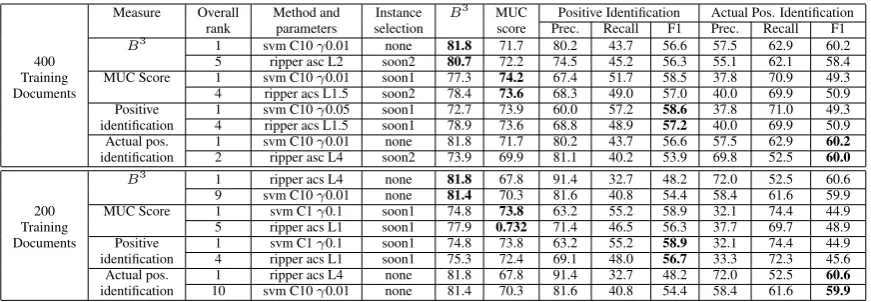
Table 2 lists the results of the best performing runs. The upper half of the table gives the re-sults for the runs that were trained on 400 docu-ments and the lower half contains the results for the 200-document training set. We evaluated us-ing the two widely used performance measures for coreference resolution – MUC score (Vilain et al., 1995) andB3 (Bagga and Baldwin, 1998). In ad-dition, we used performance metrics (precision, recall and F1) on the identification of the posi-tive class. We compute the latter in two different ways – either by using the pairwise decisions as
the classifiers outputs them or by performing the clustering of the source NPs and then considering a pairwise decision to be positive if the two source NPs belong to the same cluster. The second option (markedactualin Table 2) should be more repre-sentative of a good clustering, since coreference decisions are important only in the context of the clusters that they create.
Table 2 shows the performance of the best RIP-PER and SVM runs for each of the four evaluation metrics. The table also lists the rank for each run among the rest of the runs.
7.1 Discussion
The absolute B3 and MUC scores for source coreference resolution are comparable to reported state-of-the-art results for NP coreference resolu-tions. Results should be interpreted cautiously, however, due to the different characteristics of our data. Our documents contained 35.34 source NPs per document on average, with coreference chains consisting of only 2.77 NPs on average. The low average number of NPs per chain may be produc-ing artificially high score for the B3 and MUC scores as the modest results on positive class iden-tification indicate.
From the relative performance of our runs, we observe the following trends. First, SVMs trained on the full training set outperform RIPPER trained on the same training set as well as the correspond-ing SVMs trained on the 200-document traincorrespond-ing set. The RIPPER runs exhibit the opposite be-havior – RIPPER outperforms SVMs on the 200-document training set and RIPPER runs trained on the smaller data set exhibit better performance. Overall, the single best performance is observed by RIPPER using the smaller training set.
Another interesting observation is that the B3
8 Conclusions
As a first step toward opinion summarization we targeted the problem of source coreference resolu-tion. We showed that the problem can be tackled effectively as noun coreference resolution.
One aspect of source coreference resolution that we do not address is the use of unsupervised infor-mation. The corpus contains many automatically identified non-source NPs, which can be used to benefit source coreference resolution in two ways. First, a machine learning approach could use the unlabeled data to estimate the overall distributions. Second, some links between sources may be real-ized through a non-source NPs (see the example of figure 1). As a follow-up to the work described in this paper we developed a method that utilizes the unlabeled NPs in the corpus using a structured rule learner (Stoyanov and Cardie, 2006).
Acknowledgements
The authors would like to thank Vincent Ng and Art Munson
for providing coreference resolution code, members of the Cornell NLP group (especially Yejin Choi and Art Munson) for many helpful discussions, and the anonymous reviewers
for their insightful comments. This work was supported by the Advanced Research and Development Activity (ARDA), by NSF Grants IIS-0535099 and IIS-0208028, by gifts from
Google and the Xerox Foundation, and by an NSF Graduate Research Fellowship to the first author.
References
A. Bagga and B. Baldwin. 1998. Entity-based cross-document coreferencing using the vector space model. In Proceedings of COLING/ACL.
S. Bethard, H. Yu, A. Thornton, V. Hativassiloglou, and D. Jurafsky. 2004. Automatic extraction of opinion propositions and their holders. In2004 AAAI Spring Sym-posium on Exploring Attitude and Affect in Text.
Y. Choi, C. Cardie, E. Riloff, and S. Patwardhan. 2005. Iden-tifying sources of opinions with conditional random fields and extraction patterns. InProceedings of EMNLP.
W. Cohen. 1995. Fast effective rule induction. In Proceed-ings of ICML.
S. Das and M. Chen. 2001. Yahoo for amazon: Extracting market sentiment from stock message boards. In Proceed-ings of APFAAC.
K. Dave, S. Lawrence, and D. Pennock. 2003. Mining the peanut gallery: Opinion extraction and semantic classifi-cation of product reviews. InProceedings of IWWWC.
T. Joachims. 1998. Making large-scale support vector machine learning practical. In A. Smola B. Sch¨olkopf, C. Burges, editor,Advances in Kernel Methods: Support Vector Machines. MIT Press, Cambridge, MA.
S. Kim and E. Hovy. 2005. Identifying opinion holders for question answering in opinion texts. InProceedings of AAAI Workshop on Question Answering in Restricted Do-mains.
B. Liu, M. Hu, and J. Cheng. 2005. Opinion observer: An-alyzing and comparing opinions on the web. In Proceed-ings of International World Wide Web Conference.
V. Ng and C. Cardie. 2002. Improving machine learning approaches to coreference resolution. InProceedings of ACL.
B. Pang and L. Lee. 2004. A sentimental education: Senti-ment analysis using subjectivity summarization based on minimum cuts. InProceedings of ACL.
B. Pang, L. Lee, and S. Vaithyanathan. 2002. Thumbs up? Sentiment classification using machine learning tech-niques. InProceedings of EMNLP.
E. Riloff and J. Wiebe. 2003. Learning extraction patterns for subjective expressions. InProceesings of EMNLP.
E. Riloff, J. Wiebe, and W. Phillips. 2005. Exploiting sub-jectivity classification to improve information extraction. InProceedings of AAAI.
W. Soon, H. Ng, and D. Lim. 2001. A machine learning approach to coreference resolution of noun phrases. Com-putational Linguistics, 27(4).
V. Stoyanov and C. Cardie. 2006. Partially supervised coreference resolution for opinion summarization through structured rule learning. InProceedings of EMNLP.
V. Stoyanov, C. Cardie, and J. Wiebe. 2005. Multi-Perspective question answering using the OpQA corpus. InProceedings of EMNLP.
P. Turney. 2002. Thumbs up or thumbs down? Semantic ori-entation applied to unsupervised classification of reviews. InProceedings of ACL.
M. Vilain, J. Burger, J. Aberdeen, D. Connolly, and L. Hirschman. 1995. A model-theoretic coreference scor-ing scheme. InProceedings of MUC-6.
J. Wiebe and E. Riloff. 2005. Creating subjective and objec-tive sentence classifiers from unannotated texts. In Pro-ceedings of CICLing.
J. Wiebe, T. Wilson, and C. Cardie. 2005. Annotating ex-pressions of opinions and emotions in language. Lan-guage Resources and Evaluation, 1(2).
T. Wilson and J. Wiebe. 2003. Annotating opinions in the world press. 4th SIGdial Workshop on Discourse and Di-alogue (SIGdial-03).
T. Wilson, J. Wiebe, and R. Hwa. 2004. Just how mad are you? Finding strong and weak opinion clauses. In Pro-ceedings of AAAI.