Learning Alignments and Leveraging Natural Logic
Nathanael Chambers, Daniel Cer, Trond Grenager, David Hall, Chloe Kiddon Bill MacCartney, Marie-Catherine de Marneffe, Daniel Ramage
Eric Yeh, Christopher D. Manning Computer Science Department
Stanford University Stanford, CA 94305
{natec,dcer,grenager,dlwh,loeki,wcmac,mcdm,dramage,yeh1,manning}@stanford.edu
Abstract
We describe an approach to textual infer-ence that improves alignments at both the typed dependency level and at a deeper se-mantic level. We present a machine learning approach to alignment scoring, a stochas-tic search procedure, and a new tool that finds deeper semantic alignments, allowing rapid development of semantic features over the aligned graphs. Further, we describe a complementary semantic component based on natural logic, which shows an added gain of 3.13% accuracy on the RTE3 test set.
1 Introduction
Among the many approaches to textual inference, alignment of dependency graphs has shown utility in determining entailment without the use of deep understanding. However, discovering alignments requires a scoring function that accurately scores alignment and a search procedure capable of approx-imating the optimal mapping within a large search space. We address the former requirement through a machine learning approach for acquiring lexical feature weights, and we address the latter with an approximate stochastic approach to search.
Unfortunately, the most accurate aligner can-not capture deeper semantic relations between two pieces of text. For this, we have developed a tool, Semgrex, that allows the rapid development of de-pendency rules to find specific entailments, such as familial or locative relations, a common occurence in textual entailment data. Instead of writing code by
hand to capture patterns in the dependency graphs, we develop a separate rule-base that operates over aligned dependency graphs. Further, we describe a separate natural logic component that complements our textual inference system, making local entail-ment decisions based on monotonic assumptions.
The next section gives a brief overview of the sys-tem architecture, followed by our proposal for im-proving alignment scoring and search. New coref-erence features and the Semgrex tool are then de-scribed, followed by a description of natural logic.
2 System Overview
Our system is a three stage architecture that con-ducts linguistic analysis, builds an alignment be-tween dependency graphs of the text and hypothesis, and performs inference to determine entailment.
Linguistic analysis identifies semantic entities, re-lationships, and structure within the given text and hypothesis. Typed dependency graphs are passed to the aligner, as well as lexical features such as named entities, synonymity, part of speech, etc. The alignment stage then performs dependency graph alignment between the hypothesis and text graphs, searching the space of possible alignments for the highest scoring alignment. Improvements to the scorer, search algorithm, and automatically learned weights are described in the next section.
the development dataset. We do not describe the fea-tures here; the reader is referred to de Marneffe et al. (2006a) for more details. A novel component that leverages natural logic is also used to make the final entailment decisions, described in section 6.
3 Alignment Model
We examine three tasks undertaken to improve the alignment phase: (1) the construction of manu-ally aligned data which enables automatic learning of alignment models, and effectively decouples the alignment and inference development efforts, (2) the development of new search procedures for finding high-quality alignments, and (3) the use of machine learning techniques to automatically learn the pa-rameters of alignment scoring models.
3.1 Manual Alignment Annotation
While work such as Raina et al. (2005) has tried to learn feature alignment weights by credit assign-ment backward from whether an item is answered correctly, this can be very difficult, and here we fol-low Hickl et al. (2006) in using supervised gold-standard alignments, which help us to evaluate and improve alignment and inference independently.
We built a web-based tool that allows annotators to mark semantic relationships between text and hy-pothesis words. A table with the hyhy-pothesis words on one axis and the text on the other allows re-lationships to be marked in the corresponding ta-ble cell with one of four options. These relation-ships include text to hypothesis entailment, hypothe-sis to text entailment, synonymy, and antonymy. Ex-amples of entailment (from the RTE 2005 dataset) include pairs such as drinking/consumption, coro-navirus/virus, and Royal Navy/British. By distin-guishing between these different types of align-ments, we can capture some limited semantics in the alignment process, but full exploitation of this infor-mation is left to future work.
We annotated the complete RTE2 dev and RTE3 dev datasets, for a total of 1600 aligned text/hypothesis pairs (the data is available at
http://nlp.stanford.edu/projects/rte/).
3.2 Improving Alignment Search
In order to find “good” alignments, we define both a formal model for scoring the quality of a proposed
alignment and a search procedure over the alignment space. Our goal is to build a model that maximizes the total alignment score of the full datasetD, which we take to be the sum of the alignment scores for all individual text/hypothesis pairs(t, h).
Each of the text and hypothesis is a semantic de-pendency graph; n(h) is the set of nodes (words) ande(h)is the set of edges (grammatical relations) in a hypothesish. An alignmenta:n(h) 7→ n(t)∪ {null} maps each hypothesis word to a text word or to a null symbol, much like an IBM-style ma-chine translation model. We assume that the align-ment scores(t, h, a)is the sum of two terms, the first scoring aligned word pairs and the second the match between an edge between two words in the hypoth-esis graph and the corresponding path between the words in the text graph. Each of these is a sum, over the scoring function for individual word pairsswand
the scoring function for edge path pairsse:
s(t, h, a) = X
hi∈n(h)
sw(hi, a(hi))
+ X
(hi,hj)∈e(h)
se((hi, hj),(a(hi), a(hj)))
The space of alignments for a hypothesis withm
words and a text with n words contains (n+ 1)m possible alignments, making exhaustive search in-tractable. However, since the bulk of the alignment score depends on local factors, we have explored several search strategies and found that stochastic local searchproduces better quality solutions.
Stochastic search is inspired by Gibbs sampling and operates on a complete state formulation of the search problem. We initialize the algorithm with the complete alignment that maximizes the greedy word pair scores. Then, in each step of the search, we seek to randomly replace an alignment for a single hypothesis wordhi. For each possible text wordtj
(includingnull), we compute the alignment score if we were to alignhiwithtj. Treating these scores as
the sampling distribution as a function of time. This allows us to initially explore the space widely, but later to converge to a local maximum which is hope-fully the global maximum.
3.3 Learning Alignment Models
Last year, we manually defined the alignment scor-ing function (de Marneffe et al., 2006a). However, the existence of the gold standard alignments de-scribed in section 3.1 enables the automatic learning of a scoring function. For both the word and edge scorers, we choose a linear model where the score is the dot product of a feature and a weight vector:
sw(hi, tj) =θw·f(hi, tj),and
se((hi, hj),(tk, t`)) =θe·f((hi, hj),(tk, t`)).
Recent results in machine learning show the ef-fectiveness of online learning algorithms for struc-ture prediction tasks. Online algorithms update their model at each iteration step over the training set. For each datum, they use the current weight vector to make a prediction which is compared to the correct label. The weight vector is updated as a function of the difference. We compared two different up-date rules: theperceptron updateand theMIRA up-date. In the perceptron update, for an incorrect pre-diction, the weight vector is modified by adding a multiple of the difference between the feature vector of the correct label and the feature vector of the pre-dicted label. We use the adaptation of this algorithm to structure prediction, first proposed by (Collins, 2002). TheMIRA updateis a proposed improvement that attempts to make the minimal modification to the weight vector such that the score of the incorrect prediction for the example is lower than the score of the correct label (Crammer and Singer, 2001).
We compare the performance of the perceptron and MIRA algorithms on 10-fold cross-validation on the RTE2 dev dataset. Both algorithms improve with each pass over the dataset. Most improve-ment is within the first five passes. Table 1 shows runs for both algorithms over 10 passes through the dataset. MIRA consistently outperforms perceptron learning. Moreover, scoring alignments based on the learned weights marginally outperforms our hand-constructed scoring function by1.7%absolute.
A puzzling problem is that our overall per-formance decreased 0.87% with the addition of
Perfectly aligned
Individual words Text/hypothesis pairs
Perceptron 4675 271
MIRA 4775 283
Table 1: Perceptron and MIRA results on 10-fold cross-validation on RTE2 dev for 10 passes.
RTE3 dev alignment data. We believe this is due to a larger proportion of “irrelevant” and “relation” pairs. Irrelevant pairs are those where the text and hypothesis are completely unrelated. Relation pairs are those where the correct entailment judgment re-lies on the extraction of relations such as X works forY,X is located inY, orXis the wife ofY. Both of these categories do not rely on alignments for en-tailment decisions, and hence introduce noise.
4 Coreference
In RTE3, 135 pairs in RTE3 dev and 117 in RTE3 test have lengths classified as “long,” with 642 personal pronouns identified in RTE3 dev and 504 in RTE3 test. These numbers suggest that re-solving pronomial anaphora plays an important role in making good entailment decisions. For exam-ple, identifying the first “he” as referring to “Yunus” in this pair from RTE3 dev can help alignment and other system features.
P: Yunus, who shared the 1.4 million prize Friday with the Grameen Bank that he founded 30 years ago, pioneered the con-cept of “microcredit.”
H: Yunus founded the Grameen Bank 30 years ago.
Indeed, 52 of the first 200 pairs from RTE3 dev were deemed by a human evaluator to rely on ref-erence information. We used the OpenNLP1 pack-age’s maximum-entropy coreference utility to per-form resolution on parse trees and named-entity data from our system. Found relations are stored and used by the alignment stage for word similarity.
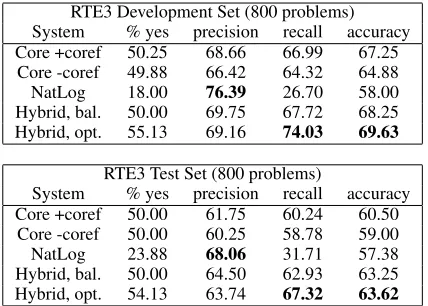
We evaluated our system with and without coref-erence over RTE3 dev and RTE3 test. Results are shown in Table 3. The presence of reference infor-mation helped, approaching significance on the de-velopment set (p < 0.1, McNemar’s test, 2-tailed), but not on the test set. Examination of alignments and features between the two runs shows that the alignments do not differ significantly, but associated
weights do, thus affecting entailment threshold tun-ing. We believe coreference needs to be integrated into all the featurizers and lexical resources, rather than only with word matching, in order to make fur-ther gains.
5 Semgrex Language
A core part of an entailment system is the ability to find semantically equivalent patterns in text. Pre-viously, we wrote tedious graph traversal code by hand for each desired pattern. As a remedy, we wrote Semgrex, a pattern language for dependency graphs. We use Semgrex atop the typed dependen-cies from the Stanford Parser (de Marneffe et al., 2006b), as aligned in the alignment phase, to iden-tify both semantic patterns in a single text and over two aligned pieces of text. The syntax of the guage was modeled after tgrep/Tregex, query lan-guages used to find syntactic patterns in trees (Levy and Andrew, 2006). This speeds up the process of graph search and reduces errors that occur in com-plicated traversal code.
5.1 Semgrex Features
Rather than providing regular expression match-ing of atomic tree labels, as in most tree pattern languages, Semgrex represents nodes as a (non-recursive) attribute-value matrix. It then uses regular expressions for subsets of attribute values. For ex-ample, {word:run;tag:/ˆNN/} refers to any node that has a valuerunfor the attributeword and atagthat starts withNN, while{}refers to any node in the graph.
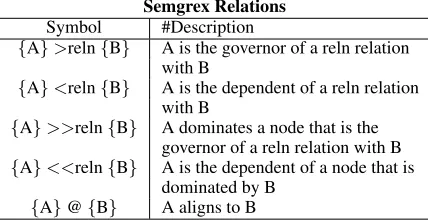
However, the most important part of Semgrex is that it allows you to specify relations between nodes. For example, {} <nsubj {} finds all the depen-dents ofnsubjrelations. Logical connectives can be used to form more complex patterns and node naming can help retrieve matched nodes from the patterns. Four base relations, shown in figure 1, al-low you to specify the type of relation between two nodes, in addition to an alignment relation (@) be-tween two graphs.
5.2 Entailment Patterns
A particularly useful application of Semgrex is to create relation entailment patterns. In particular, the IE subtask of RTE has many characteristics that are
Semgrex Relations Symbol #Description
{A}>reln{B} A is the governor of a reln relation with B
{A}<reln{B} A is the dependent of a reln relation with B
{A}>>reln{B} A dominates a node that is the governor of a reln relation with B
{A}<<reln{B} A is the dependent of a node that is dominated by B
{A}@{B} A aligns to B
Figure 1: Semgrex relations between nodes.
not well suited to the core alignment features of our system. We began integrating Semgrex into our sys-tem by creating semantic alignment rules for these IE tasks.
T: Bill Clinton’s wife Hillary was in Wichita today, continuing her campaign.
H: Bill Clinton is married to Hillary. (TRUE) Pattern:
({}=1
<nsubjpass ({word:married} >pp to {}=2)) @ ({} >poss ({lemma:/wife/} >appos {}=3))
This is a simplified version of a pattern that looks for marriage relations. If it matches, additional pro-grammatic checks ensure that the nodes labeled 2 and 3 are either aligned or coreferent. If they are, then we add a MATCH feature, otherwise we add a MISMATCH. Patterns included other familial rela-tions and employer-employee relarela-tions. These pat-terns serve both as a necessary component of an IE entailment system and as a test drive of Semgrex.
5.3 Range of Application
Our rules for marriage relations correctly matched six examples in the RTE3 development set and one in the test set. Due to our system’s weaker per-formance on the IE subtask of the data, we ana-lyzed 200 examples in the development set for Sem-grex applicability. We identified several relational classes, including the following:
• Work: works for, holds the position of
• Location: lives in, is located in
• Relative: wife/husband of, are relatives
• Membership: is an employee of, is part of
• Business: is a partner of, owns
• Base: is based in, headquarters in
6 Natural Logic
We developed a computational model of natural logic, the NatLog system, as another inference en-gine for our RTE system. NatLog complements our core broad-coverage system by trading lower recall for higher precision, similar to (Bos and Markert, 2006). Natural logic avoids difficulties with translat-ing natural language into first-order logic (FOL) by forgoing logical notation and model theory in favor of natural language. Proofs are expressed as incre-mental edits to natural language expressions. Edits represent conceptual contractions and expansions, with truth preservation specified natural logic. For further details, we refer the reader to (S´anchez Va-lencia, 1995).
We define an entailment relation v between nouns (hammer v tool), adjectives (deafening v
loud), verbs (sprint v run), modifiers, connectives and quantifiers. In ordinary (upward-monotone) contexts, the entailment relation between compound expressions mirrors the entailment relations be-tween their parts. Thus tango in Paris v dance in France, sincetango vdance andin Paris vin France. However, many linguistic constructions cre-ate downward-monotone contexts, including nega-tion (didn’t singvdidn’t yodel), restrictive quanti-fiers (few beetlesvfew insects) and many others.
NatLog uses a three-stage architecture, compris-ing lcompris-inguistic pre-processcompris-ing, alignment, and entail-ment classification. In pre-processing, we define a list of expressions that affect monotonicity, and de-fine Tregex patterns that recognize each occurrence and its scope. Thismonotonicity marking can cor-rectly account for multiple monotonicity inversions, as inno soldier without a uniform, and marks each token span with its final effective monotonicity.
In the second stage, word alignments from our RTE system are represented as a sequence ofatomic edits over token spans, as entailment relations are described across incremental edits in NatLog. Aligned pairs generatesubstitution edits, unaligned premise words yield deletion edits, and unaligned hypothesis words yieldinsertion edits. Where pos-sible, contiguous sequences of word-level edits are collected into span edits.
In the final stage, we use a decision-tree classi-fier to predict theelementary entailment relation
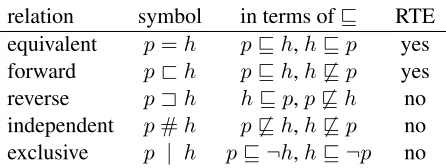
(ta-relation symbol in terms ofv RTE
equivalent p=h pvh,hvp yes forward p<h pvh,h6vp yes
reverse p=h hvp,p6vh no
independent p#h p6vh,h6vp no exclusive p | h pv ¬h,hv ¬p no
Table 2: NatLog’s five elementary entailment relations. The last column indicates correspondences to RTE answers.
ble 2) for each atomic edit. Edit features include the type, effective monotonicity at affected tokens, and their lexical features, including syntactic cate-gory, lemma similarity, and WordNet-derived mea-sures of synonymy, hyponymy, and antonymy. The classifier was trained on a set of 69 problems de-signed to exercise the feature space, learning heuris-tics such asdeletion in an upward-monotone context yields<,substitution of a hypernym in a downward-monotone context yields =, and substitution of an antonym yields|.
To produce a top-level entailment judgment, the atomic entailment predictions associated with each edit are composed in a fairly obvious way. Ifris any entailment relation, then(=◦r)≡r, but(#◦r)≡
#.<and=are transitive, but(<◦=)≡#, and so on.
We do not expect NatLog to be a general-purpose solution for RTE problems. Many problems depend on types of inference that it does not address, such as paraphrase or relation extraction. Most pairs have large edit distances, and more atomic edits means a greater chance of errors propagating to the final output: given the entailment composition rules, the system can answeryesonly if all atomic-level pre-dictions are either<or=. Instead, we hope to make reliable predictions on a subset of the RTE problems. Table 3 shows NatLog performance on RTE3. It makes positive predictions on few problems (18% on development set, 24% on test), but achieves good precision relative to our RTE system (76% and 68%, respectively). For comparison, the FOL-based sys-tem reported in (Bos and Markert, 2006) attained a precision of 76% on RTE2, but made a positive pre-diction in only 4% of cases. This high precision sug-gests that superior performance can be achieved by hybridizing NatLog with our core RTE system.
Man-ID Premise(s) Hypothesis Answer 518 The French railway company SNCF is cooperating in
the project.
The French railway company is called SNCF. yes
601 NUCOR has pioneered a giant mini-mill in which steel is poured into continuous casting machines.
Nucor has pioneered the first mini-mill. no
Table 4: Illustrative examples from the RTE3 test suite
RTE3 Development Set (800 problems) System % yes precision recall accuracy Core +coref 50.25 68.66 66.99 67.25
Core -coref 49.88 66.42 64.32 64.88
NatLog 18.00 76.39 26.70 58.00
Hybrid, bal. 50.00 69.75 67.72 68.25 Hybrid, opt. 55.13 69.16 74.03 69.63
RTE3 Test Set (800 problems)
System % yes precision recall accuracy Core +coref 50.00 61.75 60.24 60.50
Core -coref 50.00 60.25 58.78 59.00
NatLog 23.88 68.06 31.71 57.38
Hybrid, bal. 50.00 64.50 62.93 63.25 Hybrid, opt. 54.13 63.74 67.32 63.62 Table 3: Performance on the RTE3 development and test sets.
% yesindicates the proportion ofyespredictions made by the system. Precision and recall are shown for theyeslabel.
ning, 2007) for more details on NatLog.
7 System Results
Our core system makesyes/nopredictions by thresh-olding a real-valued inference score. To construct a hybrid system, we adjust the inference score by +xif NatLog predictsyes,−xotherwise. xis cho-sen by optimizing development set accuracy when adjusting the threshold to generate balanced predic-tions (equal numbers of yes and no). As another experiment, we fix x at this value and adjust the threshold to optimize development set accuracy, re-sulting in an excess of yespredictions. Results for these two cases are shown in Table 3. Parameter values tuned on development data yielded the best performance. The optimized hybrid system attained an absolute accuracy gain of 3.12% over our RTE system, corresponding to an extra 25 problems an-swered correctly. This result is statistically signifi-cant (p <0.01, McNemar’s test, 2-tailed).
The gain cannot be fully attributed to NatLog’s success in handling the kind of inferences about monotonicity which are the staple of natural logic. Indeed, such inferences are quite rare in the RTE
data. Rather, NatLog seems to have gained primarily by being more precise. In some cases, this precision works against it: NatLog answersnoto problem 518 (table 4) because it cannot account for the insertion ofcalled. On the other hand, it correctly rejects the hypothesis in problem 601 because it cannot account for the insertion of first, whereas the less-precise core system was happy to allow it.
Acknowledgements
This material is based upon work supported in part by the Disruptive Technology Office (DTO)’s AQUAINT Phase III Program.
References
Johan Bos and Katja Markert. 2006. When logical inference helps determining textual entailment (and when it doesn’t). InProceedings of the Second PASCAL RTE Challenge. Michael Collins. 2002. Discriminative training methods for
hidden markov models: Theory and experiments with per-ceptron algorithms. InProceedings of EMNLP-2002. Koby Crammer and Yoram Singer. 2001. Ultraconservative
online algorithms for multiclass problems. InProceedings of COLT-2001.
Marie-Catherine de Marneffe, Bill MacCartney, Trond Grena-ger, Daniel Cer, Anna Rafferty, and Christopher D. Manning. 2006a. Learning to distinguish valid textual entailments. In
Second Pascal RTE Challenge Workshop.
Marie-Catherine de Marneffe, Bill MacCartney, and Christo-pher D. Manning. 2006b. Generating typed dependency parses from phrase structure parses. In5th Int. Conference on Language Resources and Evaluation (LREC 2006). Andrew Hickl, John Williams, Jeremy Bensley, Kirk Roberts,
Bryan Rink, and Ying Shi. 2006. Recognizing textual entail-ment with LCC’s GROUNDHOG system. InProceedings of the Second PASCAL RTE Challenge.
Roger Levy and Galen Andrew. 2006. Tregex and Tsurgeon: tools for querying and manipulating tree data structures. In
Proceedings of the Fifth International Conference on Lan-guage Resources and Evaluation.
Bill MacCartney and Christopher D. Manning. 2007. Natu-ral logic for textual inference. InACL Workshop on Textual Entailment and Paraphrasing.
Rajat Raina, Andrew Y. Ng, and Christopher D. Manning. 2005. Robust textual inference via learning and abductive reason-ing. InAAAI 2005, pages 1099–1105.