S. Werner (ed.),Proceedings of the 15th NODALIDA conference, Joensuu 2005, Ling@JoY 1, 2006, pp. 1–7
approaches for processing extra-grammatical sentences
Marita Ailomaa
1and
Vladimír Kadlec
2and
Martin Rajman
1and
Jean-Cédric Chappelier
1 1Artificial Intelligence Laboratory (LIA)
Ecole Polytechnique Fédérale de Lausanne (EPFL)
1015 Lausanne, Switzerland
2
Faculty of Informatics, Masaryk University
Botanická 68a, 602 00 Brno, Czech Republic
{
marita.ailomaa,jean-cedric.chappelier,martin.rajman
}
@epfl.ch
,
Abstract
This paper compares two tech-niques for robust parsing of extra-grammatical natural language. Both are based on well-known approaches; one selects the optimal combination of partial analyses, the other relaxes grammar rules. Both techniques use a stochastic parser to select the “best” solution among multiple analyses. Experimental results show that re-gardless of the grammar, the best results are obtained by sequentially combining the two techniques, by first relaxing the rules and only when that fails by then selecting a combination of partial analyses.
1 Introduction
Formal grammars are often used in NLP appli-cations to describe well-formed sentences. But when used in practice, the grammars usually describe only a subset of a NL, and in addition NL sentences are not always well-formed, espe-cially in speech recognition applications. NLP applications that rely exclusively on such gram-mars cannot be practically used in a large scale because of the large fraction of sentences that will receive no analysis at all. This problem is called undergeneration and has given birth to a field called robust parsing, where the goal is to find domain-independent and practical pars-ing technique that returns a correct or usefully “close” analysis for almost all (say 90%) of the input sentences (Carroll and Briscoe, 1996). In order to achieve such a high performance,
one has to handle not only the problems of un-dergeneration but also the increased ambiguity which is usually a consequence of the robustifi-cation of the parser.
In previous work, a variety of approaches have been proposed to robustly handle nat-ural language. Some techniques are based on modifying the input sentence, for exam-ple by removing words that disturb the flu-ency (Bear et al., 1992; Heeman and Allen, 1994), more recent approaches are based on selecting the right sequence of partial analy-ses (Worm and Rupp, 1998; van Noord et al., 1999). Minimum Distance Parsing is a third approach based on relaxing the formal gram-mar, allowing rules to be modified by inser-tions, deletions and substitutions (Hipp, 1992). For most of the approaches it is important to make the distinction between ungrammaticality and extra-grammaticality. Ungrammatical sen-tences contain speech errors, hesitations etc. while extra-grammatical sentences are linguis-tically correct sentences that are not covered by the grammar.
This paper presents two approaches that fo-cus on extra-grammatical sentences. The first approach is based on the selection of a most optimal coverage with partial analyses and the second on controlled grammar rule relaxation. The aim of the paper is to compare these two approaches and to investigate if they present differences in behavior when given the same grammar and the same test data.
con-T
1T
2T
4T
3T
1'
T
3'
[image:2.595.122.478.83.213.2]w
1w
2w
3w
4w
5w
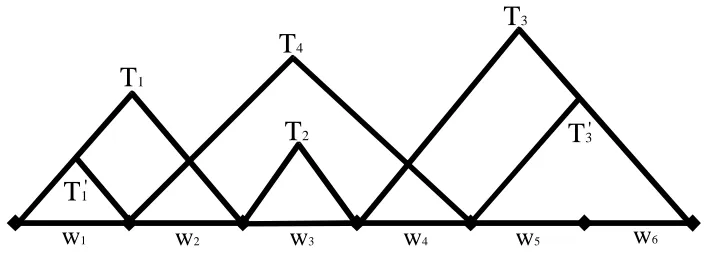
6Figure 1: Partial derivation trees. Some of them (e.g. T1, T2, T3 and T
′
1, T4, T
′
3) can be composed
into a coverage.
cept of “holes”. In section 4 the data and methodology for the experiments are presented and section 5 gives a summary of the results. Finally, in section 6 we give a brief conclusion and outline the direction for future work.
2 Selecting the most probable
optimal maximum coverage
This section briefly describes the first approach to robust parsing that we tested in our com-parative experiments. It is based on selecting partial analyses and gluing them together into an artificial full tree (Kadlec et al., 2005). This technique provides at least one analysis for all input sentences (in the most trivial case, a set of lexical trees).
To describe the technique we will start with the notion of coverage. For any given gram-mar G and any given input sentence, a cover-age is a sequence of non-overlapping, possibly partial derivation trees that cover the whole in-put. Since the derivation trees can overlap fully or partially, there can be several distinct cover-ages for the same input sentence.
A maximum coverage is one that consists of maximum derivation trees, i.e. trees that are not subtrees of other ones covering the same subsequence. If a sentence can be analyzed by a single parse tree, the number of maximum coverages is the same as the number of com-plete parse trees.
Provided that a quality measure is available for coverages, an optimal maximum coverage (OMC) is then a maximum coverage with the highest quality among all maximum coverages derived for the given input sentence. In our ex-periments, we use a quality measure that favors
a coverage with partial analyses of largest av-erage width.
If the used grammar and parsing algorithm can be probabilized, the most probable OMC is the one that is associated with the highest probability. Finding the most probable OMC for stochastic context-free grammars can eas-ily be achieved using a usual bottom-up chart parser (Chappelier and Rajman, 1998).
3 Deriving trees with holes
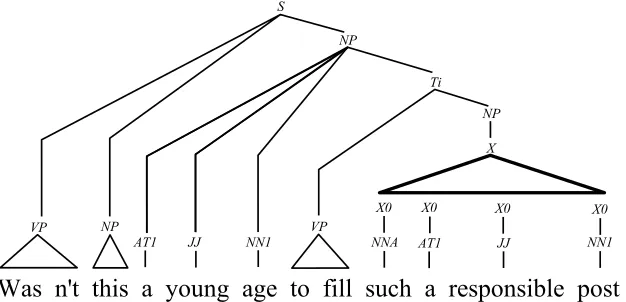
Our second approach to robust parsing is based on the assumption that extra-grammatical sen-tences are structurally similar to sensen-tences that the grammar is able to describe. The under-lying idea is that, in the case of a rule-based parser, the reason why the parser fails to an-alyze a given (extra-grammatical) sentence is that one or several rules are missing in the grammar. If a rule relaxation mechanism is available (i.e. a mechanism that can derive additional rules from the ones present in the grammar), it can be used to cope with situa-tions where rules are missing, and in this case, the goal of the robust parser is to derive a full tree where the subtrees corresponding to the used relaxed rules are represented as “holes”. (See figure 3).
The main difficulty with this approach is to determine how the hole should be derived. Sim-ple rules allowing holes at any position in the tree are too general and will produce a high number of unacceptable analyses.
T
1T
2T
4T
3 [image:3.595.124.474.81.235.2]w
1w
2w
3w
4w
5w
6Figure 2: An illustration of maximum coverage. C1 = (T3) and C2 = (T4) are m-coverages but
C3= (T1, T2)is not.
Figure 3: A tree with a hole representing a missingN P ruleN P →N N A AT1 J J N N1.
Indeed, the higher the number of such rules is, the higher is the variety of possible construc-tions for the given category and therefore the higher is the probability that some of these con-structions are missing in the grammar. NP, VP and S are examples of syntactic categories that are heavily represented in grammars, whereas PPs are not. Consequently, a hole is more likely to have a root of category NP, VP or S than for example PP.
The second issue is how to produce a hole with appropriate leaves. Here we use the prin-ciple called Minimum Distance Parsing which has been used in earlier robust parsing appli-cations (Hipp, 1992). The idea is to relax rules in the grammar by inserting, deleting or substi-tuting elements in their right hand side (RHS). Derivation trees are ranked by the number of modifications that have been applied to achieve a complete analysis. The problem is that when
all the rules are allowed to be relaxed the num-ber of analyses increases dramatically. It be-comes difficult to select a good analysis among all the unacceptable ones. Therefore, in its un-constrained form, the method works well only for small grammars (Rosé and Lavie, 2001).
[image:3.595.143.456.291.442.2]the missing rule was insertion. Therefore we limit the relaxation to only this type of modifica-tion. The inserted element is hereafter referred to as a filler.
A further refinement of the algorithm is to specify where in the RHS of a rule the filler can appear and what syntactic category that filler is allowed to have. These two restric-tions are linguistically motivated. Most phrases are constructed according to a general pattern, e.g. in English NPs are composed of deter-miners, adjectives and other elements followed by a head, typically a noun, and some com-plements, e.g. PPs. Finite-state parsing (Ait-Mokhtar and Chanod, 1997) is an example of how such patterns have been successfully used to implement general-purpose robust parsers. In our approach, the elements in the RHS of a rule are considered as belonging to one of three types: (1) elements preceding the head, (2) the head itself, and (3) elements following the head. The reason for this distinction is that, again in English, there are syntactic categories that frequently occur in one part of the phrase but not in another. PPs for instance are often complements of NPs but are less likely to oc-cur before the head. The decision of inserting or not a filler into a RHS is therefore a mat-ter of deciding whether the syntactic category of the filler is appropriate, i.e. whether there is a rule in the grammar in which the category appears in the correct position with respect to the head. As an example, assume that we have a simple grammar with the following NP rules (The head is indicated with underlined syntac-tic categories):
R1 :N P →ADJ N R2 :N P →P OS N
According to this grammar “successful broth-ers” and “your brother” are syntactically cor-rect NPs while “your successful brother” is not. In order to parse the last one, some NP rule needs to be relaxed. We select the second one, R2 (though both are possible candidates). If the filler that needs to be inserted is ADJ (in this case “successful”), then the relaxed NP rule is expressed as:
R3 :∼N P →P OS@ ADJf iller N@
We use the category ∼NP instead of NP to
distinguish relaxed rules from initial ones, the “filler” subscripts to identify the fillers in the RHS in the relaxed rule, and the @ to label the
ATIS Susanne
Sentences 1,381 3,981
CF rules 1,029 8,810
Non-terminals 40 469
Terminals 1,167 10,247
PoS tags 38 122
Average sentence length 12,5 12,9
Av. nb of CF rules/sent 23,3 23,8
[image:4.595.309.523.74.195.2]Max depth 17 17
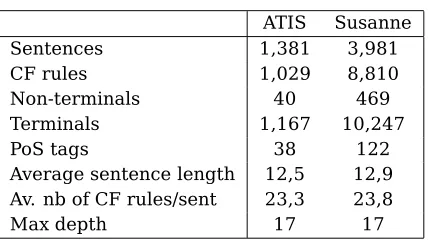
Table 1: Some characteristics of the two cor-pora used for the experiments
original RHS elements. The decision of allow-ing an insertion of an ADJ as filler is based on whether ADJ is a possible element before the head or not. Since there is a rule in the gram-mar where an ADJ exists before the head (R1), the insertion is appropriate.
4 Data and methodology
The goal of this paper is to compare the two ro-bust parsing approaches described in Section 2 and 3 and to analyze differences in their be-havior. In both approaches the sentences are parsed with a probabilistic CFG, which means that the produced analyses have probabilistic scores that allow the selection of the most prob-able one (or ones).
The probabilistic grammar is extracted and trained from a treebank, which contains parsed sentences representative of the type of sen-tences that the parser should be able to handle. In our comparative tests we use subsets of two treebanks, ATIS and Susanne, which have very different characteristics (Marcus et al., 1994). The purpose is to study if the characteristics of the grammar have some impact on the per-formance of the robust parsing techniques mea-sured in terms of accuracy and coverage. Some of the possible characteristics are given in Ta-ble 1.
In addition, we also considered characteris-tics such as the number and syntactic category of rules that are missing in the grammar to de-scribe the test sentence.
These sentences represent the “true” test set for our experiments, as we only want to process the sentences that the initial grammar fails to describe.
Once the test sentences have been processed with each of the two robust techniques, the most probable analysis is manually character-ized as good, acceptable or bad. The cate-gorization is based on the comparison of the produced parse tree with the reference one that can be extracted out of the treebank. A good analysis has a close match to the ref-erence tree; an acceptable one can have some more substantial differences with respect to the phrase segmentation but has to correspond to a useful semantic interpretation. A bad ana-lysis corresponds to an incorrect segmentation that cannot lead to any useful semantic inter-pretation. Notice that it may be argued that the definition of a “useful” semantic analysis might not be decidable only by observing the syntactic tree. Although we found this to be a quite us-able hypothesis during our experiments, some more objective procedure should be defined. In a concrete application, the usefulness might for example be determined by the next actions that the system performs based on the received syn-tactic analysis. Therefore, from this point of view, the results that we obtain have to be con-sidered as preliminary and a future step is to integrate the implemented techniques in some application, e.g. an automatic translator, and to compare the results.
5 Experimental results
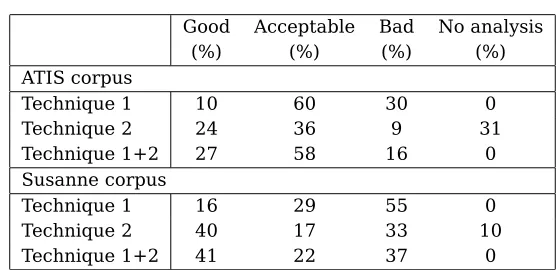
This section presents the experimental results of the two robust parsing techniques described in section 2 and 3, using the methodology de-scribed in section 4. The number of test sen-tences is not the same for the two corpora, 89 for ATIS and 250 for Susanne, due to the size and characteristics of each corpus. We parsed the sentences first with technique 1 and technique 2 separately and then with a com-bined approach where we started with the rule-relaxation technique and only when that failed selected the most probable OMC. All the sen-tences from ATIS were parsed and analyzed by hand; from Susanne a subset consisting of 134 sentences was chosen. The results of the robust parsing are presented in table 2.
When observing only the number of good
analyses, one can see that for both grammars technique 2 performs better than technique 1. But when including all analyses, there is a dif-ference related to the grammars. With ATIS, technique 1 provides acceptable analyses in the majority of cases whereas technique 2 badly suffers from undergeneration. With Susanne, technique 1 produces bad analyses for more than half of the test sentences; on the other hand technique 2 has a good coverage and overall better results than technique 1.
One indicator to why the techniques produce bad analyses, or no analysis at all, is that in more than half of the cases, three or more rules are missing in the grammar to derive the refer-ence tree.
For technique 2 the undergeneration can be explained by the characteristics of the two grammars. ATIS is a very homogeneous cor-pus, which means that the same rules appear often. A division of 10% learning set and 90% test set was necessary to achieve the desired level of undergeneration (≃10%). With such a small learning corpus, the extracted grammar will have very few rules. There-fore the lists of possible fillers and rules that can be relaxed be-come very small. (Notice that we refer to two cases of undergeneration; the one mentioned here relates to the preparation of the data for the tests. The other case is when we speak of the results received from the robust parser).
Susanne suffers from the opposite problem. The corpus is very heterogeneous, and the learning set has to be larger in order to keep the undergeneration down to ≃10%. The lists of possible fillers and rules to relax are long, but for a sentence that has no analysis, the missing rule is often of some other category than the ones heavily represented in the gram-mar (NP, VP or S). This is because the number of non-terminals in the corpus is large (469) compared to ATIS (40), and that 77% of the rules appear only once in the corpus.
Here we need to consider if the restrictions we applied on the relaxation of rules are too strong. It is possible that different types of restrictions are appropriate for different types
of grammars. Some more experimenting is
Good Acceptable Bad No analysis
(%) (%) (%) (%)
ATIS corpus
Technique 1 10 60 30 0
Technique 2 24 36 9 31
Technique 1+2 27 58 16 0
Susanne corpus
Technique 1 16 29 55 0
Technique 2 40 17 33 10
[image:6.595.157.437.72.207.2]Technique 1+2 41 22 37 0
Table 2: Experimental results. Percentage of good, acceptable and bad analyses with technique 1 (optimal coverage), technique 2 (tree with holes) and with the combined approach.
is that the probabilistically best analysis is not the linguistically best one. This is a non-trivial problem related to all types of natural language parsing, not only for robust parsers.
In short, we conclude that technique 2 is more accurate than technique 1 but cannot stand alone as a robust parser, not being able to provide full coverage. In particular it tends to be less suitable for simple grammars describing small variation of syntactic structures. What we can state is that when the sentences are pro-cessed sequentially with both techniques, the advantage of each approach is taken into ac-count and the performance is better than when either technique stands alone.
6 Conclusions
The aim of this paper was to compare two robust parsing techniques based on different principles. The method we chose was to pro-vide them with the same grammar and test data and to analyze differences in performance. Ex-perimental results show that a combination of the techniques gives a better performance than each technique alone, because the first one guarantees full coverage while the second has a higher accuracy. The richness of the syntac-tic structures defined in the grammar tends to have some impact on the performance in the second approach but less on the first one. This can be linked to the restrictions in technique 2 that were chosen for the relaxation of the gram-mar rules. These restrictions were based on observations of a relatively small set of extra-grammatical sentences and cannot be consid-ered as final.
A future experiment is to test different lev-els of flexibility for technique 2 and to see how this affects accuracy and coverage. Another
im-portant issue is to integrate the parsing tech-niques into some target application so that we have more realistic ways of measuring the use-fulness of the produced robust analyses.
As a final remark, we would like to point out that this paper has addressed the problem of extra-grammaticality but did not address un-grammaticality, which is an equally important phenomenon in robust parsing, particularly if the target application deals with spoken lan-guage.
References
Marita Ailomaa. 2004. Two approaches to
robust stochastic parsing. Master’s thesis, Ecole Polytechnique Federale de Lausanne (EPFL), Lausanne, Switzerland.
Salah Ait-Mokhtar and Jean-Pierre Chanod. 1997. Incremental finite-state parsing. In Proceedings of the ANLP97, pages 72–79, Washington.
John Bear, John Dowding, and Elizabeth
Shriberg. 1992. Integrating multiple knowl-edge sources for the detection and correction of repairs in human-computer dialogue. In Proceedings of the 30th ACL, pages 56–63, Newark, Delaware.
John Carroll and Ted Briscoe. 1996. Robust parsing — a brief overview. In John Carroll, editor, Proceedings of the Workshop on Ro-bust Parsing at the 8th European Summer School in Logic, Language and Information (ESSLLI’96), Report CSRP 435, pages 1–7, COGS, University of Sussex.
J.-C. Chappelier and M. Rajman. 1998. A gen-eralized cyk algorithm for parsing stochastic
cfg. In TAPD98 Workshop, pages 133–137,
Peter A. Heeman and James F. Allen. 1994. Detecting and correcting speech repairs. In Proceedings of the 32th ACL, pages 295–302, Las Cruces, New Mexico.
Dwayne R. Hipp. 1992. Design and
develop-ment of spoken natural language dialog pars-ing systems. Ph.D. thesis, Duke University.
Vladimír Kadlec, Marita Ailomaa, Jean-Cedric Chappelier, and Martin Rajman. 2005. Ro-bust stochastic parsing using optimal maxi-mum coverage. InProc. of International Con-ference on Recent Advances in Natural Lan-guage Processing (RANLP), pages 258–263, Borovets, Bulgaria.
Michell P. Marcus, Beatrice Santorini, and
Mary Ann Marcinkiewicz. 1994. Building
a large annotated corpus of english: The penn treebank. Computational Linguistics, 19(2):313–330.
C. Rosé and A. Lavie. 2001. Balancing robust-ness and efficiency in unification-augmented contextfree parsers for large practical appli-cations. In G. van Noord and J. C. Junqua, editors,Robustness in Language and Speech Technology. Kluwer Academic Press.
Gertjan van Noord, Gosse Bouma, Rob Koeling, and Mark-Jan Nederhof. 1999. Robust gram-matical analysis for spoken dialogue systems. Natural Language Engineering, 5(1):45–93.