pISSN 2320-1770 | eISSN 2320-1789
Research Article
Acceptance of non-invasive prenatal testing by cell free foetal DNA for
foetal aneuploidy in a developing country: experience at a tertiary care
centre in India
Namrata Kashyap
1*, Mandakini Pradhan
1, Piyush Kumar
2, Neeta Singh
3INTRODUCTION
Non-invasive prenatal testing (NIPT) is a relatively newer technique which is deepening its root all over the world. It utilizes cell free foetal DNA from the plasma of pregnant women and offers tremendous potential as a screening tool for foetal aneuploidy. Circulating cell free foetal DNA, which comprises approximately 3-13% of the total cell free maternal DNA, is expected to be
derived primarily from the placenta, and is cleared from the maternal blood within hours after childbirth.1 Cell free foetal DNA analysis is now an available non-invasive option for diagnosis for women at increased risk of foetal aneuploidy which avoids the risk of spontaneous abortion associated with the invasive tests. The American College
of Obstetricians and Gynecologists (ACOG)
recommends2 that women, be offered prenatal assessment for aneuploidy either by screening or invasive prenatal
1Department of Obstetrics & Gynaecology, Sanjay Gandhi Post Graduate Institute of Medical Sciences Lucknow, Uttar
Pradesh, India
2Department of Pediatric Surgery King George’s Medical University Lucknow, Uttar Pradesh, India 3
Department of Maternal & Reproductive Health Sanjay Gandhi Post Graduate Institute of Medical Sciences Lucknow, Uttar Pradesh, India
Received: 02 January 2016
Revised: 10 February 2016
Accepted: 29 February 2016
*Correspondence:
Dr.Namrata Kashyap,
E-mail: [email protected]
Copyright: © the author(s), publisher and licensee Medip Academy. This is an open-access article distributed under the terms of the Creative Commons Attribution Non-Commercial License, which permits unrestricted non-commercial use, distribution, and reproduction in any medium, provided the original work is properly cited.
ABSTRACT
Background: Non-invasive prenatal testing is a new technique which is deepening its root all over the world. Its tremendous potential lies in its ability of using cell free fetal DNA from the plasma of pregnant women. However, to what extent the technology has reached to a common person is also to be given a thought. hence the study was planned to assess the acceptability of non-invasive prenatal testing in Indian settings, to study about the awareness and baseline knowledge about Down’s syndrome, to study the correlation between various indications of prenatal testing for aneuploidy and results of noninvasive prenatal testing.
Methods: Noninvasive cell free fetal NA testing for aneuploidy was an informed patient choice after pre-test counseling. Patients with a positive test result were offered invasive prenatal diagnosis for confirmation of test results.
Results: The diagnostic potential of cell free DNA for fetal aneuploidy matched equally with invasive tests avoiding slight but yet considerable risk of invasive tests. However, we found that, 90 % of patients in a tertiary centre hospital in India were not aware of trisomy 21 and various options available for prenatal screening for aneuploidy.
Conclusions: Newer genomic technology involving cell free maternal DNA is a new storm in prenatal diagnosis. Its application in clinical practice is the need of the hour, however, the lack of awareness, high cost and unavailability of the test in the country appears to be a major limiting factor for its poor acceptability.
diagnosis regardless of maternal age. Cell free foetal DNA is one option that can be used as a primary screening test in women at increased risk of aneuploidy (Table 1).
Table 1: ACOG-indications for considering the use of cell free foetal DNA.
Maternal age 35 years or older at delivery
Foetal ultrasonography findings indicating an increased risk of aneuploidy
History of a prior pregnancy with a trisomy Positive test result for aneuploidy, including first trimester, sequential, or integrated screen, or a quadruple screen.
Parental balanced robertsonian translocation with increased risk of foetal trisomy 13 or trisomy 21
We are following a prenatal screening program for down syndrome at our centre in form of serum screening (Nuchal thickness and Double marker in first trimester or quadruple test between 15-20 weeks), although it still remains an optional test offered to all pregnant women, in accordance with ACOG guidelines after counseling. Noninvasive prenatal testing was introduced in India in 2013 and since then it is trying to establish itself into clinical practice.
But even with indications and recommendations by the experts, present status of the disease, there is existence of a huge lacuna of knowledge, awareness and financial restrictions. Henceforth, this study, one of its kinds, was planned to study the present status of this hike in technology of cell free DNA in a tertiary care centre in a developing country like India. To our knowledge this is the first study which evaluated the awareness and acceptability of non-invasive prenatal testing in a developing country.
METHODS
This retrospective observational study was conducted in the department of Maternal and Reproductive Health, SGPGIMS, Lucknow over a period of 1 year from May 2014 to May 2015. The study was planned with the aim primarily to assess the acceptability Non Invasive Prenatal Testing in Indian women and secondarily to study about the awareness and baseline knowledge about trisomy 21, to study the correlation between various indications of prenatal testing for aneuploidy and results of NIPT.
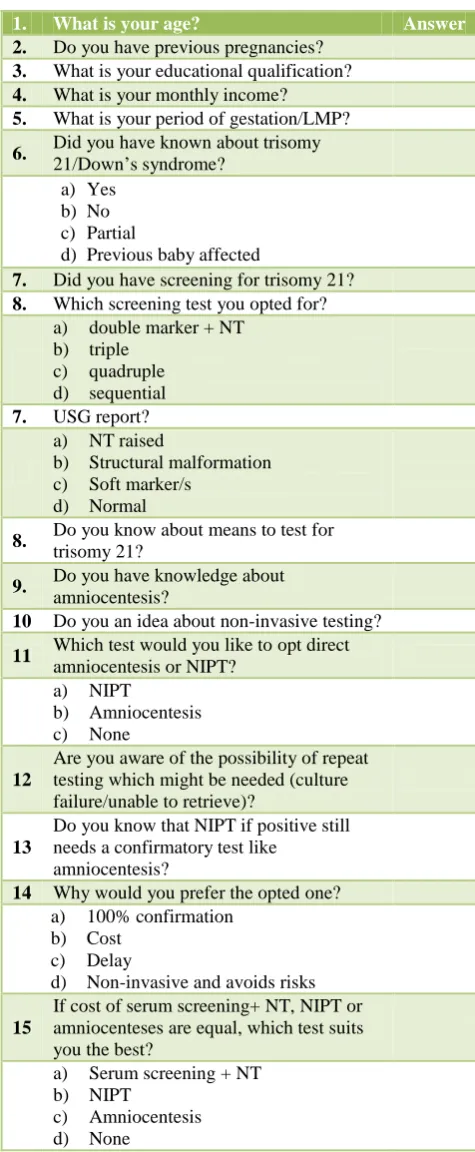
Inclusion criteria were those specified in ACOG committee statement 2012 (Table 1). Exclusion criteria were advance gestational age more than 24 weeks, major malformation in sonography or additional indications requiring amniotic fluid or foetal sample for testing. Patients were given a questionnaire (Table 2) to fill and then explained about the situation, all possible risks and
[image:2.595.311.549.179.756.2]consequences of the situation with an oral and written pre-test counseling (Table 3) particularly focusing on Down’s syndrome, its detection, finance involved and possible consequences and outcomes. They were informed about all the available options and then going ahead with noninvasive free foetal DNA testing for aneuploidy was an informed patient choice.
Table 2: Questionnaire for NIPT.
1. What is your age? Answer
2. Do you have previous pregnancies?
3. What is your educational qualification?
4. What is your monthly income?
5. What is your period of gestation/LMP?
6. Did you have known about trisomy 21/Down’s syndrome?
a) Yes
b) No
c) Partial
d) Previous baby affected
7. Did you have screening for trisomy 21?
8. Which screening test you opted for?
a) double marker + NT
b) triple
c) quadruple
d) sequential
7. USG report?
a) NT raised
b) Structural malformation c) Soft marker/s
d) Normal
8. Do you know about means to test for
trisomy 21?
9. Do you have knowledge about
amniocentesis?
10 Do you an idea about non-invasive testing?
11 Which test would you like to opt direct
amniocentesis or NIPT?
a) NIPT
b) Amniocentesis
c) None
12
Are you aware of the possibility of repeat testing which might be needed (culture failure/unable to retrieve)?
13
Do you know that NIPT if positive still needs a confirmatory test like
amniocentesis?
14 Why would you prefer the opted one?
a) 100% confirmation
b) Cost
c) Delay
d) Non-invasive and avoids risks
15
If cost of serum screening+ NT, NIPT or amniocenteses are equal, which test suits you the best?
a) Serum screening + NT
b) NIPT
c) Amniocentesis
Table 3: Pre-test counseling.
What is TRISOMY 21/ Down syndrome?
TRISOMY 21 or Down’s syndrome is a condition which occurs due to an extra copy of chromosome 21. They can be de novo (for the first time) or familial. Majority of Down syndrome are de novo and are due to meiotic nondysjunction. Down’s syndrome is one of the most common causes of mental retardation. These children are short stature, have mongoloid faces, depressed nasal bridge, epicanthal folds, protruding tongue. They frequently suffer from major congenital malformations like structural cardiac defect, duodenal atresia, Hirsch sprung, hypothyroidism, leukaemia, atlantoaxial joint subluxation.
Why do I need to consider about risk for trisomy 21?
It can be diagnosed and you can prevent birth of child with mental retardation and malformation.
Are there any risk factors known?
Yes. Known risk factors are increasing maternal age, previous baby with down’s syndrome, down syndrome in family (if translocation present), either of the parent carrier of translocation 14; 21, 15,21; 22,21.
Can ultrasound diagnose all Down’s foetuses?
No. USG can diagnose only 60 % of down’s foetuses.
What are the other means to screen?
You can have screening test in form of nuchal thickness (11-14 weeks) along with first trimester serum screening
(maternal blood) which has the best sensitivity (80-90%). If you are beyond 14 weeks, you can have quadruple test (15- 20 weeks) from maternal blood (70-80%).
What if these test show high risk, do I need to terminate?
No. High risk in these test does not means baby is affected with Down’s syndrome, they are only meant to screen, and they have good sensitivity but not positive predictive value. If you come as high risk, confirmation needs to be done. You can go for NIPT or amniocentesis.
What is the cost?
NT scan – 300 INR, Double marker – 2000 INR, Quadruple test 3250 INR
What is NIPT?
It is non-invasive prenatal testing, which is done with maternal blood (5 ml). Foetal cells are found in maternal circulation are can be retrieved.
At which gestational age can I have the test done?
After 10 weeks.
What if NIPT is negative?
It is highly reassuring. The detection rate is more than 99.98%. However, theoretically, a negative cell free foetal DNA test result does not ensure an unaffected pregnancy .Studies available in literature show a detection rate of 100%, false
negative rate 0%, Specificity 99.97- 100%, false positive 0-0.029%, positive predictive rate 98.4-100%.
What if the test is positive?
Although it is a highly sensitive test , but the gold standard test to confirm trisomy 21 is still foetal karyotype which should be done before going for termination.
Can the test fail?
Yes, the failure rates are extremely less, yet it is ability to retrieve foetal cells, if adequate amount is not met, the test would be indeterminate.
What would I do if the test fails?
Depending on the gestational age, would might give the sample again or directly go for amniocentesis.
What is the cost?
INR 25000.
By what time, report comes?
It takes 14 days to get the report.
What is amniocentesis?
A means with which a needle is inserted in the uterus trans abdominally and fluid around the foetus is taken out to get the culture of foetal cells.
What is the risk?
0.5 % risk of spontaneous abortion. Minimal risk of premature rupture of membranes and chorioamnionitis.
At what gestational age can get amniocentesis done?
Earliest it can be done by 16 weeks, it can be done any time thereafter although limit for termination is 20 weeks.
By what time I can get the report?
within 10 days; however karyotype still needed to confirm which is available by 4 weeks.
What is the cost for amniocentesis?
Procedure charge 500 INR, FISH-5000 INR, Karyotype-2500 INR, Collection charge-50 INR ( Total-8050 INR)
Can direct foetal sample be taken prior to 16 weeks/ prior to time before amniocentesis? How?
Yes. Chorionic villous sampling can be done. All the facts are similar to amniocentesis except that it has a slight higher rate of abortions (1-2 %). However, studies suggest that in expert hands, it is similar to amniocentesis.
What advantage do I get with non-invasive testing?
Invasive testing (Amniocentesis/ CVS) can be avoided if NIPT is negative even if screening test show high risks.
Can I directly go for NIPT avoiding serum screening?
Yes, if maternal age is 35 years or older at delivery, foetal ultrasonography findings indicate an increased risk of aneuploidy, history of a prior pregnancy with a trisomy, parental balanced robertsonian translocation.
Maternal blood sample was taken (5 ml) and was sent to lab NIFTY (BGI), China where foetal aneuploidy testing was done using massive parallel sequencing. For patients choosing invasive testing, amniocentesis or CVS was done at Sanjay Gandhi Post Graduate Institute of Medical Sciences. Data was analysed thereafter, focusing on the status of acceptability of non-invasive prenatal testing amongst the patients. Patients with a positive test in NIPT result were offered invasive prenatal diagnosis for confirmation of test results followed by termination of pregnancy once confirmed.
RESULTS
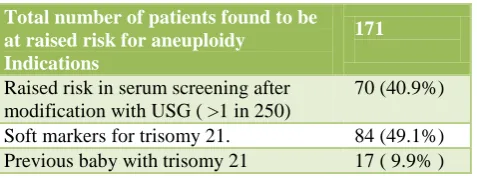
[image:4.595.309.551.295.463.2]A total of 171 patients were analysed after meeting the inclusion and exclusion criteria.
Table 4: Indications for testing for aneuploidy.
Total number of patients found to be at raised risk for aneuploidy
Indications
171
Raised risk in serum screening after modification with USG ( >1 in 250)
70 (40.9%)
Soft markers for trisomy 21. 84 (49.1%) Previous baby with trisomy 21 17 ( 9.9% )
Almost 90 % of the patients were not aware about the situation, consequences and tests available during pre-test counseling. Various indications for testing for foetal aneuploidy are shown in table 3. Majority, 121 patients refused for NIPT (Table 4). Twenty patients amongst them did not accept for any further testing despite foetal trisomy 21 risk affection of higher than 1 in 250 and were not considered in analysis. One hundred and one patients opted for invasive testing.
Major cause of refusal (66%) was high cost (25,000 INR versus 8000 INR for amniocentesis). Other causes were delayed results (14 days versus 7days in fluorescent in situ hybridization), sensitivity (99.9% versus 100% in invasive testing), discomfort with risk of test failure and possibility of repeat sample, sample sent outside the country and specific modality being requested by
referring doctor. Fifty patients accepted to undergo NIPT (Table 5).
Table 5: Causes of refusal for NIPT.
Patient refused for NIPT 121 Causes of removal
Cost (three times more than that of amniocentesis)
80 (66.1%)
Delayed results (14 days versus 7 days in FISH)
6 (4.9 %)
Feeling of less confirmatory test and
inability to see complete karyotype 10 (8%) Discomfort with risk of test failure and
possibility of repeat sample
10 (8%)
Sample sent outside the country 10 (8 % ) Modality not being requested by referring
doctor
5 (4.1%)
Table 6: Indications of testing in patients who accepted NIPT.
Raised risk in trisomy 21 in serum
screening 35 (70%)
Soft markers in USG 11 (22%)
On patient request due to advanced
maternal age and bad obstetric history 2 (4%)
Early onset IUGR 2 (4%)
DISCUSSION
[image:4.595.49.288.461.550.2]Another study group has described a more targeted approach, using chromosome selective sequencing to detect trisomy 18 and trisomy 21.8 Using archived blood samples from women who were undergoing prenatal diagnosis and were at increased risk of aneuploidy, several large-scale validation studies have demonstrated detection rates for foetal trisomy 13, trisomy 18, and trisomy 21 of greater than 98% with very low
false-positive rates (less than 0.5%).7-14 Although no
prospective trials of this technology are yet available, cell free foetal DNA appears to be the most effective screening test for aneuploidy in high-risk women as of now.
Majority of the patients in our study were neither aware about the disease nor about the measures to screen it. This is a situation prevalent in low and middle income countries. The myth remains that the possibility of the disease like Down’s are to be thought only when patient is over 40 years. Counseling remained a very important aspect in the study. It was only after extensive counseling, majority of the patients got clear picture of the situation.
We see that counseling regarding the limitations of cell free foetal DNA testing should include a discussion that as yet the screening test provides information regarding only trisomy 21, trisomy 18 and trisomy 13. It does not replace the precision obtained with diagnostic tests, such as chorionic villous sampling (CVS) or amniocentesis, and currently does not offer other genetic information. Other limitations of cell free foetal DNA includes the lack of outcome data for low-risk populations and therefore, cell free foetal DNA testing is not currently recommended for low-risk women. Preliminary data available on twins demonstrate accuracy in a very small cohort, but more information is needed before use of this test can be recommended in multiple gestations.15 Lastly, in a small percentage of cases, a cell free foetal DNA is difficult to retrieve and test failures can occur.
The use of a cell free foetal DNA test should be an active, informed choice and not part of routine prenatal laboratory testing as was done in our study. The family history was reviewed in each case to determine if the patient needs be offered other forms of screening or prenatal diagnosis for a particular disorder. A baseline ultrasound examination was done in each case to confirm viability, a singleton gestation, gestational dating, as well as to rule out obvious anomalies. In high-risk population, we did a second-trimester ultrasound examination to evaluate pregnancies for structural anomalies. In patients in whom a structural foetal anomaly is identified, invasive diagnostic testing was offered because a cell free foetal DNA test can only detect trisomy 13, trisomy 18, and trisomy 21. Maternal serum alpha-fetoprotein screening is not routinely carried out at our centre but we do a vigorous ultrasonography evaluation for spinal defects. Because false-positive test results can occur, confirmation with amniocentesis or CVS was done in
patient with positive report. Patients were also made aware that a negative test result does not ensure an unaffected pregnancy; false-negative test results can occur as well knowing the fact the technology is a relatively new one.
In today’s time, screening for aneuploidy is moving from the second trimester to the first trimester and future appears to lie in noninvasive diagnostic testing. Majority of world bodies have already accepted and displayed it being 99.9% sensitive. This was very much comparable to our study where we found it be 98 % sensitive. Out of 171, only 50 patients opted for non-invasive prenatal testing (Table 6), out of which 35 had raised risk for trisomy 21 in triple test; 11 had soft markers in USG, two each for advanced maternal age more than 40 years with bad obstetric history and early onset IUGR. Majority of these patients were elderly gravida, IVF conception or precious pregnancies not willing to take slightest risk for abortion. Out had them, only three patients (6%) had positive test result in NIPT which was reconfirmed with invasive prenatal testing which was not significantly different from the group which opted for invasive testing (7.9%). Eight patients (7.9%) amongst those opted for invasive testing (101) showed positive test result for trisomy 21, 18 and 13 after invasive testing. Hence noninvasive testing could have been the primary modality in these patients. Three samples were uninformative due to insufficient isolation of cell free foetal DNA making a 6% failure rate of NIPT. This does not reach a good significance because of limited number of patients and also the failure rate with invasive testing is comparable. However, there were test reports in invasive testing, which showed abnormalities other than aneuploidy in patients (7%) which might have been missed in NIPT. Seven patients showed other chromosomal abnormalities with invasive testing which included turners, deletions, unbalanced translocations and inversion (6.5%). We found that that although diagnostic potential for aneuploidy matched equally with invasive tests avoiding the slight but yet considerable risk associated with invasive tests but still further more work is required to assess the efficacy of NIPT in situations where the chromosomal abnormalities appear dubious and might be other than aneuploidy.
identified on ultrasound examination, invasive prenatal diagnosis should be offered. A negative cell free foetal DNA test result does not ensure an unaffected pregnancy. A patient with a positive test result should be referred for genetic counseling and offered invasive prenatal diagnosis for confirmation of test results. Whether Cell free foetal DNA testing can be offered to low-risk women or women with multiple gestations is still a question and studies are coming up. As yet it has not been sufficiently evaluated in these groups.
Newer genomic technology involving cell free maternal DNA is a new storm in prenatal diagnosis. Its application in clinical practice is the need of the hour, however, its cost and unavailability in the country appears to be a major limiting factor for its poor acceptability. Cell free foetal DNA is although a game changer but it does not replace the accuracy and diagnostic precision of prenatal diagnosis with CVS or amniocentesis, which are still the gold standard methods.
Funding: No funding sources Conflict of interest: None declared Ethical approval: Not required
REFERENCES
1. Lo YM, Corbetta N, Chamberlain PF, Rai V, Sargent IL, Redman CW et al. Presence of foetal DNA in maternal plasma and serum. Lancet. 1997;350:485-7. 2. ACOG Committee opinion number 545, December
2012. Non-invasive foetal testing for foetal aneuploidy. Obstet Gynecol. 2012;120:1532-4. 3. Lo YM, Tsui NB, Lau TK, Leung TN, Heung MM,
Gerovassili A et al. Plasma placental RNA allelic ratio permits noninvasive prenatal chromosomal aneuploidy detection. Nat Med. 2007;13(2):218-23. 4. Tong YK, Chiu RW, Akolekar R, Leung TY, Lau
TK, Nicolaides KH et al. Epigenetic-genetic chromosome dosage approach for foetal trisomy 21 detection using an autosomal genetic reference marker. PLoS One. 2010;5:e15244 .
5. Papageorgiou EA, Karagrigoriou A, Tsaliki E, Velissariou V, Carter NP, Patsalis PC. Foetal-specific DNA methylation ratio permits noninvasive prenatal diagnosis of trisomy 21. Nat Med. 2011;17:510-3.
6. Fan HC, Blumenfeld YJ, Chitkara U, Hudgins L, Quake SR. Noninvasive diagnosis of foetal aneuploidy by shotgun sequencing DNA from maternal blood. Proc Natl Acad Sci USA. 2008;105:16266-71.
7. Chiu RW, Akolekar R, Zheng YW, Leung TY, Sun H, Chan KC et al. Non-invasive prenatal assessment of trisomy 21 by multiplexed maternal plasma DNA sequencing: large scale validity study. BMJ. 2011;342:7401.
8. Ehrich M, Deciu C, Zwiefelhofer T, Tynan JA, Cagasan L, Tim R, Lu V et al. Noninvasive detection of foetal trisomy 21 by sequencing of DNA in maternal blood: a study in a clinical setting. Am J Obstet Gynecol. 2011;204(3):205.
9. Sparks AB, Wang ET, Struble CA, Barrett W, Stokowski R, McBride C et al. Selective analysis of cell-free DNA in maternal blood for evaluation of foetal trisomy. Prenat Diagn. 2012;32:3-9.
10. Palomaki GE, Kloza EM, Lambert-Messerlian GM, Haddow JE, Neveux LM, Ehrich M et al. DNA sequencing of maternal plasma to detect Down syndrome: an international clinical validation study. Genet Med. 2011;13:913-20.
11. Palomaki GE, Deciu C, Kloza EM, Lambert-Messerlian GM, Haddow JE, Neveux LM et al. DNA sequencing of maternal plasma reliably identifies trisomy 18 and trisomy 13 as well as Down syndrome: an international collaborative study. Genet Med. 2012;14:296-305.
12. Chen EZ, Chiu RW, Sun H, Akolekar R, Chan KC, Leung TY et al. Noninvasive prenatal diagnosis of foetal trisomy 18 and trisomy 13 by maternal plasma DNA sequencing. PLoS ONE. 2011;6:e21791. 13. Bianchi DW, Platt LD, Goldberg JD, Abuhamad AZ,
Sehnert AJ, Rava RP. Genome-wide foetal aneuploidy detection by maternal plasma DNA sequencing. Obstet Gynecol. 2012;119:890-901. 14. Norton ME, Brar H, Weiss J, Karimi A, Laurent LC,
Caughey AB et al. Non-Invasive Chromosomal Evaluation (NICE) study: results of a multicenter, prospective, cohort study for detection of foetal trisomy 18. Am J Obstetric Gynecology. 2012;207(2):137.
15. Canick JA, Kloza EM, Lambert-Messerlian GM, Haddow JE, Ehrich M, van den Boom D et al. DNA sequencing of maternal plasma to identify Down syndrome and other trisomies in multiple gestations. Prenat Diagn. 2012;32(8):730-4.