Volume 1, No. 5, Sept-Oct 2011
International Journal of Advanced Research in Computer Science
CASE STUDY AND REPORTS
Available Online at www.ijarcs.info
ISSN No. 0976-5697
Application of Process Mining in Automobile: A Case Study for MG Motors
Saravanan .M.S
Research Scholar in R & D Centre, Bharathiar University, Coimbatore & Asst. Professor in the Dept. of IT in VEL TECH
Dr. RR & Dr. SR Technical University, Avadi, Tamil Nadu, INDIA.
Rama Sree .R.J
Research Supervisor in R & D Centre, Bharathiar University, Coimbatore &
Professor & Head in the Department of Computer Science, Rashtriya Sanskrit Vidyapeetha,
Tirupati, Andhra Pradesh, INDIA. [email protected]
Abstract: To gain competitive advantage, automobile shops try to streamline their processes. In order to do so, it is essential to have an accurate view of the “careflows” under consideration. In this paper, we apply process mining techniques to obtain meaningful knowledge about these flows, e.g., to discover typical paths followed by particular groups of Motor Cycles. This is a non-trivial task given the dynamic nature of automobile processes. The paper demonstrates the applicability of process mining using a real case of a Hero Honda Motor Cycle process in a MG Motors automobile company located at Chennai in India. Using a variety of process mining techniques, we analyzed the automobile process using the control flow perspective. In order to do so we extracted relevant event logs from the automobile shop information system and analyzed these logs using the ProM framework. The control flow perspective algorithm Heuristics Miner (HM) algorithm of the ProM and Weka Library were used to predict the knowledge from the automobile log. The results show that process mining can be used to provide new insights that facilitate the improvement of existing careflows.
Keywords: Process mining, careflows, automobile log, ProM framework, control flow, Weka, Knowledge.
I. INTRODUCTION
In a competitive automobile industry, the trouble shooting process for a Motor cycle has to be focused on ways to streamline their processes in order to deliver high quality assembling and repairing while at the same time reducing costs [1]. Furthermore, also on the governmental side and on the side of the pollution control organizations, more and more pressure is put on automobile industries to work in the most efficient way as possible, whereas in the future, an increase in the demand for care is expected.
A complicating factor is that automobile unit is characterized by highly complex and extremely flexible repairing processes, also referred to as “control flows”. Moreover, many disciplines are involved for which it is found that they are working in isolation and hardly have any idea about what happens within other disciplines. Another issue is that within automobile unit or healthcare sector many autonomous, independently developed applications are found [2]. A consequence of this all is that it is not known what happens in the automobile unit process for a group of repairs with the same process. The concept of process mining provides an interesting opportunity for providing a solution to this problem. Process mining [3] aims at extracting process knowledge from so called “event logs” which may originate from all kinds of systems, like enterprise information systems or Motor Cycle processing system or hospital information systems or automobile repairing process systems, etc. Typically, these event logs contain information about the start or completion of process steps together with related context data for example actors and resources. Furthermore, process mining is a very broad area both in terms of (1) applications (from banks to embedded systems) and (2) techniques.
This paper focuses on the applicability of process mining in the automobile unit domain. Process mining has already been successfully applied in the service industry [4]. In this paper, we demonstrated the applicability of process mining in automobile unit domain. We will show how process mining can be used for obtaining insights related to control flows, for example, the identification of control paths and strong comparison between different trouble shooting methods of repairs to minimize the processing time. We will use several process mining techniques which will also show the diversity of process mining techniques but in this paper we will discuss about control flow discovery.
In this paper, we have taken a case study of automobile repair processing system to discuss about the control flow aspects of process mining of the MG Motors automobile unit a big Hero Honda automobile sales and service unit at Tamil Nadu, India. The raw data contains data about a group of fifty trouble shooting methods of motor cycle repair and for which all deep analysis and treatment activities have been recorded to analyze the mined process model and basic performance analysis for better recovery process. Note that we did not use any Apriori knowledge about the control process of this group of repairs.
process mining. In Section three will show the applicability of process mining in the automobile unit using data obtained for a group of four trouble shooting methods of repair. Section four concludes the paper.
II. PROCESSMINING
Process mining is applicable to a wide range of systems. These systems may be pure information systems (e.g., ERP systems) or systems where the hardware plays a more prominent role (e.g., embedded systems). The only requirement is that the system produces event logs, thus recording (parts of) the actual behavior. Interesting classes of information systems that produce event logs are the so called Process-Aware Information Systems (PAISs) [6]. Examples are classical workflow management systems (e.g. Staffware), enterprise resource planning systems (e.g. SAP), case handling systems (e.g. FLOWer), product data management systems (e.g. Windchill), customer relationship management systems (e.g. Microsoft Dynamics CRM), middleware (e.g., IBM's WebSphere), hospital information systems (e.g., Chipsoft), etc. These systems provide very detailed information about the activities that have been executed.
However, not only PAISs are recording events. Also, in a typical automobile there is a wide variety of systems that record events. For example, in a trouble shooting process, a system can record that, which trouble shooting a repair undergoes and also it can record occurring of repair difference or complications for a repair of a motor cycle. For a new motor cycle the whole process depends on minor repairs. This information was recorded till the end of the troubleshooting process. In order for these systems to work properly, information from different systems needs to be collected, so that it is clear which activities have been performed in the control process of a repair. In this way, these systems within the automobile unit can contain information about processes within one department but also across departments. This information can be used for improving processes within departments itself or improving the services offered to customers for various repairs of the same or different groups.
The goal of process mining is to extract information (e.g., process models) from these logs, i.e., process mining describes a family of a-posteriori analysis techniques exploiting the information recorded in the event logs. Typically, these approaches assume that it is possible to sequentially record events such that each event refers to an activity (i.e., a well defined step in the process) and is related to a particular case (i.e., a process instance). Furthermore, some mining techniques use additional information such as the performer or originator of the event (i.e., the person or resource executing or initiating the activity), the timestamp of the event, or data elements recorded with the event (e.g., the size of an order). Process mining addresses the problem that most of the processes have limited information about what is actually happening. In practice, there is often a significant gap between what is prescribed or supposed to happen, and what actually happens. Only a concise assessment of reality, which process mining strives to deliver, can help in verifying
process models, and ultimately be used in system or process redesign efforts. The idea of process mining is to discover, monitor and improve real processes (i.e., not assumed processes) by extracting knowledge from event logs. We consider three basic types of process mining (Figure 1): (1) discovery, (2) conformance, and (3) extension.
a. Discovery: Traditionally, process mining has been
focusing on discovery, i.e., deriving information about the original process model, the organizational context, and execution properties from enactment logs. An example of a technique addressing the control flow perspective is the α-algorithm [7] which constructs a Petri net model describing the behavior observed in the event log. It is important to mention that there is no apriori model, that is based on an event log some model is constructed. However, process mining is not limited to process models (i.e., control flow) and recent process mining techniques are more and more focusing on other perspectives, e.g., the organizational perspective, performance perspective or the data perspective. For example, there are approaches to extract social networks from event logs and analyze them using social network analysis [8]. This allows organizations to monitor how people, groups, or software or system components are working together. Also, there are approaches to visualize performance related information, e.g. there is an approach which graphically shows the bottlenecks and all kinds of performance indicators, e.g., average or variance of the total flow time or the time spent between two activities.
b. Conformance: There is an Apriori model. This model is
used to check if reality conforms to the model. For example, there may be a process model indicating that purchase orders of more than one million Rupees require two checks. Another example is the checking of the so called “four eyes” principle. Conformance checking may be used to detect deviations, to locate and explain these deviations, and to measure the severity of these deviations.
c. Extension: There is an Apriori model. This model is
extended with a new aspect or perspective that is the goal is not to check conformance but to enrich the model with the data in the event log. An example is the extension of a process model with performance data, that is some Apriori process model is used on which bottlenecks are projected.
At this point of time there are mature tools such as the ProM framework [9], featuring an extensive set of analysis techniques which can be applied to real life logs while supporting the whole spectrum depicted in Figure 1.
III. AUTOMOBILEUNITPROCESS
In every process, there should be an input; in this case the motor cycle has taken as input of raw data to process the motor cycle processes. The motor cycle repair process is first start with the registration and then the repair type such as simple or complex or moderate, etc. Then this motor study, we taken fifty different trouble shooting processes, these are requiring various mechanisms to fix and get repair. After the trouble shooting, a treatment called testing process has been started and produced respective final good. It is clear that every motor cycle has, its own trouble shooting fix process, hence the different repairs may have a same group of trouble shootings of different motor cycle in the automobile unit processes need to be identified using clustering technique.
The automobile unit process needs to be compared between different trouble shooting methods of repairs to minimize the processing time and to reduce the repair activities and to identify the difference between each group of repairing of the motor cycle trouble shooting unit. Consequently, these kinds of systems contain motor cycle process related information of the automobile unit. Hence, these processes are therefore an interesting motor cycle problem or repair data collected from the customer to apply various mining algorithms using ProM framework.
To this end, a case study for showing the applicability of process mining in automobile repair unit, we use raw data collected by the automobile shop for motor cycle of the MG Motors automobile unit. This raw data contains information about a group of fifty trouble shooting methods of repair for which all steps of Motor Cycle process have been recorded.
For this data set, we have extracted event logs from the Motor Cycle databases, where each event refers to a different trouble shooting of repair. As the data is coming from a treatment system, we have to face the interesting problem that for each trouble shooting of repairing the motor cycle has similar treatment of fixing and little additional repairing is identified and recorded using the event logs. These event logs will show how these and process are undergone various steps or activities of same group of trouble shooting methods of a repair.
In additional we have some information about the actual timestamps of the start and completion of the each task or activity of automobile repairing process. Consequently, the processing of each processes need to be executed as per the event log generated by the system. In this case, the log
contains 50 cases and 828 different events, which indicate that we are dealing with a non-trivial control flow process.
In the remainder of this section we will focus on obtaining, in an explorative way, insights into the trouble shooting process of automobile unit process. So, we will only focus on the discovery of process mining, instead of the conformance and extension part. Furthermore, obtaining these insights should not be limited to one perspective only. Therefore, in section three, we focus on the discovery of control paths followed by mechanics. This also demonstrates the homogenous repair fix for various repairs. However, it was discussed in the previous section. Hence, we first need to perform some preprocessing before being able to present information on the right level of detail.
A. Preprocessing of Logs:
The log of the Automobile unit contains a large amount of distinct activities, of which many are rather low level activities, that is events at a low abstraction level. In this study, new motor cycles has preliminary or simple activities are at a too low abstraction level, e.g. determination of oil change, etc. We would like to consider all these low level fittings process as a single fitting process. Mining a log that contains many distinct activities would result in a too detailed spaghetti-like model that is difficult to understand. Hence, we first apply some preprocessing on the logs to obtain interpretable results during mining. During preprocessing we want to “simplify” the log by removing the excess of low level activities. In addition, our goal is to consider only events at the trouble shooting methods of the repair level. Hence, we can focus on control paths and interactions between different trouble shooting methods of the repairs.
B. Mining:
In this section, we present some results obtained through a detailed analysis of the automobile repair processing systems for every event log generated for the treatment or trouble shooting process. We concentrate on the discovery part to show actual situations, for example control flows in the automobile unit.
a. Converting the raw data into MXML format
b. Control flow Perspective:
One of the most promising mining techniques is control flow mining which automatically derives process models from process logs. The generated process model reflects the actual process as observed through real process executions. If we generate process models from automobile unit process logs, they give insight into control paths for motor cycle repair process. The control flow perspective in process mining has several process mining algorithms such as the α-mining algorithm, heuristic α-mining algorithm, region α-mining algorithm, etc [7][10][11].
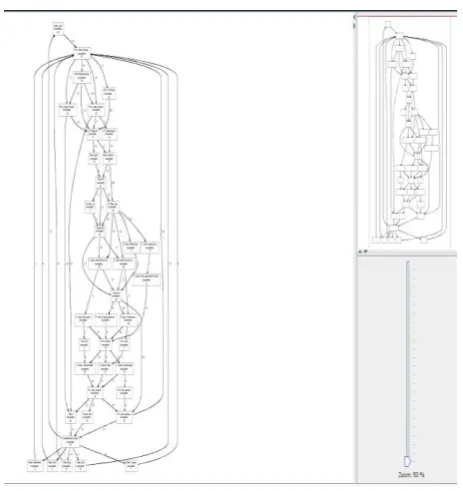
In this paper, we use the Heuristics mining algorithm, since it can deal with noise and exceptions, and enables users to focus on the main process flow instead of on every detail of the behavior appearing in the process log [10]. Figure 3 shows the process model for all cases obtained using the Heuristics Miner. Despite its ability to focus on the most frequent paths, the process, depicted in Figure 3, is still spaghetti-like and too complex to understand.
Since, processes in the automobile unit do not have a single kind of flow but a lot of variants based on different trouble shooting methods of the repairs. Therefore using the figure 3, we can understand the similar repairs and different repairs for each trouble shooting by comparing each trouble shooting on the motor cycle from event logs.
It is surprising that the derived process model is spaghetti or complex and convoluted. One of the methods for handling this problem is breaking down a log into two or more sub logs until these become simple enough to be analyzed clearly. We apply clustering techniques to divide a process log into several groups (i.e. clusters), where the cases in the same cluster have similar properties. Clustering can be conducted using cluster mining algorithm from ProM framework is used for this case study. Hence, the ProM framework is very useful for mining applications.
The figure 3 has 30 different trouble shooting methods of repairs; each has combination of repair fix. The trouble shooting 1 has the repair fix of clutch adjustment, break adjustment, etc. The trouble shooting 2 has the repair fix of tube change, oil change, mileage check, engine corporate cleaning, etc. A portion of the treatment process called “repair fix” are shown in the process model in figure 3 has 30 different trouble shooting methods. Hence, this model operations, identifies the different activity with various combination of repair fix. These operations are useful for the benefit of identifying the various trouble shooting methods, which is used for the parallel activities. The system of motor cycle process is always useful for the process model, which is developed using any one of the process mining algorithm using mining tool. A mechanic in the automobile unit always create the concept of the motor for motor cycle process, because it may consume more time and cost. The repairing of the process with automation and better mined process model will lead the mechanic in a better way to proceed.
In view of time, the figure 3 shows the various time taken for each event is recorded. The taken for waiting and working is calculated for each activity, so the average, minimum and maximum time limit for each activity or event in the motor cycle process will bring better process, instead the normal methods followed by the mechanics. The figure 2 shows the event log, which is derived from the original element name, which is “Register” as shown in the figure 2. The Second one represents workflow element type such as “start” or “complete”. The third one represents the timestamp that is time taken to complete the activity or event. The fourth one represents the originator of the process instance or case, which is known as event creator.
The process instance for every case has the audit trail entry. The audit trail entry is the key component for each entry, because the transaction of every activity will takes place with time and originator. When the instance has completed the event type stores the data in the event log as “complete” or “start”. “Start” of the event represents the event starting. “Complete” of the event represents the event ending. Therefore, the Motor Cycle process can be mined thoroughly for the betterment of automobile units.
The complex process model generated by the HM process mining algorithm is not easy to understand and to follow. Hence, alternative approaches need to be identified. Therefore, one of the classical data mining technique, association rule mining algorithms were useful to predict the failure of the motor cycle without more testing and cost. The association rule mining algorithm FPGrowth algorithm is used to simplify the process.
Figure. 2 A Part of MXML log with 30 Cases and 828 Event logs
Figure.3 Process model for 50 cases of motor cycle processes with 828 event logs using HM algorithm
Figure.4 Associator process model using FPGrowth algorithm for automobile repair unit processes
IV. CONCLUSION
In this paper, we have focused on the applicability of process mining in the automobile unit domain. For our case study, we have used data coming from non-trivial trouble shooting methods of motor cycle process of the MG Motors automobile unit. We focused on obtaining insights into the control flow by looking at the control flow perspective. For this perspective, we presented some initial results. We have shown that it is possible to mine complex automobile unit repair processes giving insights into the process. In addition, with existing techniques we were able to derive understandable mined process models for large groups of repairs to identify the same and different motor cycle process. The results are not derived by human thinking, it goes as per the recorded information and hence the automated mined process model helps the mechanic, well sufficient for the better motor cycle process.
Furthermore, we compared our mined process model with a process model before mining of the automobile unit process. Normally a top down approach had been used for creating the process model and obtaining the logistical data [12]. With regard to the before mining process model, comparable results have been obtained. These types of knowledge help in many ways for the mechanic in the automobile repairing unit process. However, a lot of effort was needed for creating the process model and obtaining the logistical data, where with process mining there is the opportunity to obtain these kind of data in a semi automatic way.
Unfortunately, traditional process mining approaches have problems dealing with unstructured processes such as motor cycle applications and healthcare etc. Future work will focus on both developing new mining techniques and on using existing techniques in an innovative way to obtain understandable, high level information instead of “spaghetti-like” models showing all details. Obviously, we will plan to evaluate these results in automobile unit organizations such as the MG Motors automobile unit.
V. REFERENCES
Software Engineering, Volume 01, publisher IEEE Computer Society, Washington, DC, USA, 2008, ISBN: 978-0-7695-3336-0.
[2] Lenz, R., Elstner, T., Siegele, H., and Kuhn, K., A Practical Approach to Process Support in Health In-formation Systems. Journal of the American Medical Informatics Association, 2002, 9(6), pp 571–585.
[3] van der Aalst, W., van Dongen, B., Herbst, J., Maruster, L., Schimm, G., and Weijters, A., Workflow Mining: A survey of Issues and Approaches. IEEE Journal of the Data and Knowledge Engineering, 2003, 47(2).
[4] van der Aalst, W., Reijers, H., Weijters, A., van Dongen, B., de Medeiros, A. A., Song, M., and Verbeek, H., Business process mining : an industrial application. Journal of the Information Systems, 2007, 32(5).
[5] Snezana, S., Violeta, M., Business Intelligence tools of Statistical Analysis. 32nd International Conference on Information Technology Interfaces (ITI) by the University of St.Kliment Ohridski Bitola, Bitola, Macedonia and published in IEEE Journal, 2010, Vol: 21-24 June, pp 199-204.
[6] Dumas, M., van der Aalst, W., and ter Hofstede, A., Process-Aware Information Systems: Bridging People and Software through Process Technology. Published by Wiley & Sons, 2005.
[7] van der Aalst, W., Weijters, A., and Maruster, L., Workflow Mining: Discovering Process Models from Event Logs. IEEE Transactions on Knowledge and Data Engineering, 2004, 16(9), pp 1128–1142.
[8] van der Aalst, W., Reijers, H., and Song, M., Discovering Social Networks from Event Logs. Published in Computer Supported Cooperative Work, 2005, Vol 14(6), pp 549–593.
[9] van der Aalst, W., van Dongen, B., Gunther,¨ C., Mans, R., de Medeiros, A. A., Rozinat, A., Rubin, V., Song, M., Verbeek, H., and Weijters, A. ProM 4.0: Comprehensive Support for Real Process Analysis. In Kleijn, J. and Yakovlev, A., editors, Application and Theory of Petri Nets and Other Models of Concurrency (ICATPN 2007), Published by Springer-Verlag, Berlin, 2007, Vol 4546 of Lecture Notes in Computer Science, pp 484–494.
[10]Weijters, A. and van der Aalst, W., Rediscovering Workflow Models from Event-Based Data using Little Thumb. Published in Integrated Computer-Aided Engineering, 2003, Vol 10(2), pp 151–162.
[11]van Dongen, B., Busi, N., Pinnaand, G., and van der Aalst, W., An Iterative Algorithm for Applying the Theory of Regions in Process Mining. BETA Working Paper Series, WP 195, Eindhoven University of Technology, Eindhoven, 2007.
[12]Elhuizen, S., Burger, M., Jonkers, R., Limburg, M., Klazinga, N., and Bakker, P. Using Business Process Redesign to Reduce Wait Times at a University Hospital in the Netherlands. The Joint Commission Journal on Quality and Patient Safety, 2007, Vol 33(6), pp 332–341.
Short Biodata of the Author
Saravanan. M.S received B.Sc degree in computer science from Madras University in 1996, the MCA degree from Bharathidasan University in 2001, the M.Phil degree from Madurai Kamaraj University in 2004, M.Tech degree from IASE University in 2005. And now pursuing PhD degree in Bharathiar University. His current research interests include Process Mining, Business Process modeling, Workflow management systems and Exception handling etc. He is an Assistant professor in the Department of Information Technology in VEL TECH Dr, RR & Dr. SR Technical University, Avadi, Chennai, India. M.S. Saravanan has published twenty two international publications and presented ten research papers in international and national conferences, having 13 years of teaching experience in various institutions in India.
Rama Sree. R.J received M.S degree in computer science from BITS Pilani University in 1996 and PhD degree in S.P. Mahila University, Tirupati. She is a Reader in Department of Computer Science in Rashtriya Sanskrit Vidyapeetha, Tirupati. Dr. Rama Sree has published three books and sixteen international publications and ten national publications, having 19 years of teaching experience.