Volume 5, No. 8, Nov-Dec 2014
International Journal of Advanced Research in Computer Science
RESEARCH PAPER
Available Online at www.ijarcs.info
ISSN No. 0976-5697
An Advanced Motion Detection Algorithm with Video Quality Analysis for Video
Surveillance Systems
Shivendra Yadav
PG Student,Deptt.of Electronics& communication Engg, Oriental Institute of Science and Technology
Bhopal (M.P.),India
Prof. Rahul Dubey
Deptt. Of Electronics & Communication Engg; Oriental Institute of Science & Technology
Bhopal (M.P.) ,India
Prof. M.Ahmed
HOD Deptt. Of Electronics & Communication Engg; Oriental Institute of Science & Technology
Bhopal (M.P.) ,India
Abstract: Motion detection is the first important process in the mining of information concerning moving objects and makes use of stabilization in efficient areas, such as tracking, organization, identification, and so on. In this paper, we propose a new and perfect approach to motion detection for the automatic video surveillance system. Our method achieves total detection of moving objects by concerning three significant proposed modules: a background modeling (BM) module, block based module, and a human detection module.
In the proposed work our method of quality detection uses wavelet threshold algorithms. The analyses show that our proposed method has a considerably higher scale of efficiency, outperforming other methods by a confusion matrix accuracy rate of up to 65%.
Keywords: Motion Detection, Background Modeling (BM), Block Based, Human Detection, Wavelet Threshold Algorithm, Confusion Matrix
I. INTRODUCTION
Motion detection is the process of finding alters in location of an individual comparative to its background or alters in the background comparative to an individual. Motion detection can be attended by equally mechanical and electronic methods. When motion detection is accomplished by ordinary organisms, it is called motion perception. Motion detection is a computer skill linked to computer vision and image processing that deals with detecting instances of targeted objects belonging to positive class (such as humans, buildings, or cars) in digital images and videos. Well-researched domains of object detection include face and pedestrian detection. Object detection has execution in lots of areas of computer vision, counting image retrieval and video surveillance. [1]
A. Motion Detection:
Motion detection in significant images is nothing but an effort to the detection of the moving object in the view. In video surveillance, motion detection is subjected to the prospective of the surveillance system to detect motion and detain the movement. Motion detection is generally software-based monitoring algorithms which will indicate the controlling camera to begin capturing the incident as it detects motions. This is also called incident detection [1].
B. Shadow Detection:
Shadow detection in any project, a camera set to its base has been positioned and is set as an observer at the open-air for inspection. Any little faction with an intensity of tolerance it picks is detected as motion. Distant from the natural utility of being able to subdivision video streams into moving and background components, detecting moving
components provides a focus of attention for identification, organization, and activity analysis, making these later on processes more efficient since only “moving” pixels require be considered [2]. There are three conservative approaches to moving object detection:
a. Temporal differencing b. Background subtraction and c. Optical flow.
Background subtraction: This technique is used in our proposed method. It provides the most absolute feature data, but is particularly sensitive to dynamic scene changes due to lighting and inappropriate events.
C. Video Motion Detection:
Video motion detection is essential in numerous video surveillance strategies. On the other hand, in open air scenes where incongruous lighting and insignificant, yet irritating, background activities are available, it is an unpredictable issue. In real time environment where sight is not under control circumstance is much shoddier and loud. Light may change at whatever time which cause framework yield less critical to manage. Late research has molded a considerable amount of background modeling, in view of image differencing, that reveal real-time performance and lofty accuracy for certain course of scene [3].
bearings for improving the toughness of motion identification procedures for open air feature observation frameworks. Movement in indoor and different circumstances are considered and examined also.
Figure. 1: Motion Detector [1]
II. LITERATURE REVIEW
Shih-Chia Huang (2011) reported in his examination work "An Advanced Motion Detection Algorithm with Video Quality Analysis for Video Surveillance Systems" that Motion identification is the first key process in the extraction of data in regards to moving objects and makes use of adjustment in functional regions, for example, tracking, organization, identification, etc. In this work, he proposed a novel and exact methodology to movement location for the motion detection for the automatic video surveillance system. Our technique attains complete identification of moving objects by including three critical proposed modules: background modeling (BM) module, an alarm trigger (AT) module, and an object extraction (OE) module. The analysis demonstrates that our PRO strategy has a considerably higher level of adequacy, outperforming different systems by a metric accuracy rate of up to 53.43% [4].
M. Shehata and W. Badawy (2009) reported in their examination work "A robust video-based algorithm for detecting snow movement" that video-based Automatic Incident Detection (AID) frameworks are generally conveyed in numerous urban areas for identifying traffic incidents to give smoother, more secure and blockage free movement stream. Though, the exactness of an AID framework working in an open air environment experiences high false alert rates because of natural variables. These variables incorporate snow development, static shadow and static glare on the streets. In this research work, a vigorous continuous algorithm is proposed to recognize snow development in video streams to enhance the rate of identification. This is carried out by having the AID framework diminishing its sensitivity in the regions that have snow developments [5].
S. Dasgupta, C. H. Papadimitriou, and U. V. Vazirani (2008) reported in his examination work "A Fast Algorithm of Temporal Median Filter for Background Subtraction" that temporal median filter is one of most mainstream background subtraction strategies. In any case, median
operation is exceptionally time intensive which constrains its applications. This research introduces a quick algorithm to diminish the processing time of the temporal median operation. By using the qualities of high connection of nearby edges, the quick algorithm plans basic component to check whether the average of the current frame is equivalent to that of the past edge. The proposed algorithm decreases the figuring recurrence of average operations essentially, and trial results show it is quicker than the past algorithm [6].
Simon Perreault and Patrick Hebert (2007) reported in his examination work "Median Filtering in Constant Time" that the Median filter is one of the essential building pieces in numerous picture processing circumstances. In any case, its utilization has long been hampered by its algorithmic complexity of O(r) in the kernel radius. With the pattern to bigger pictures and relatively bigger filter kernels, the requirement for a more proficient median filtering algorithm gets to be pressing. In this correspondence, another, straightforward yet much speedier algorithm showing O (1) runtime complexity is described and analyzed. It is analyzed and benchmarked against past algorithms [7].
Wei Zhang; Xiangzhong Fang; Xiaokang Yang; Q. M. Jonathan Wu (2006) introduced in their examination work "Spatiotemporal Gaussian mixture model to identify moving objects in dynamic scenes" that the Gaussian mixture model (GMM) is a paramount metric for moving articles division and is fit to manage the continuous progressions of light and the redundant movements of scene components [8].
Figure. 2: Algorithm of GMM [8]
A spatiotemporal Gaussian mixture model (STGMM) is proposed to handle the complex movement of the background by considering each background pixel to be fluctuating both in power and in its neighboring area. Another matching principle is characterized to join the spatial data. Trial comes about on normal scenes demonstrate that STGMM can segment the moving objects effectively in complex scenes. Quantitative assessments exhibit that the proposed STGMM performs better than GMM.
III. PROBLEM STATEMENT
[image:2.595.319.556.388.563.2]moving human substance for the video surveillance system. The methodology is focused around lowest part up visual consideration model utilizing expanded Background and framing model. Our methodology incorporates three modules- Key edge extraction module, Background displaying module, and Human location module through wavelet threshold values [1, 3].
Here we propose a model which naturally identifies any moving entrance in a perception region. We have limited our work to discovery of moving substance in any specific however constrained region, yet the same idea might be applied for any organization. For our proposed work the non-movable entry and movable entity are distinguished by the background details [4].
IV. PROPOSED METHODOLOGY
A. Existing work:
In this area, we display the existing motion detection approach for static-camera surveillance situations. Existing methodology accomplishes complete location of moving protests and includes three proposed modules: a background modeling (BM) module, an AT module, and an object extraction (OE) module. At first, the proposed BM module plans an exceptional two stage background matching system utilizing quick matching emulated by precise matching to create ideal background pixels for the background mode.
Figure.3: System block diagram of existing motion detection method [4]
Exploratory results have been created for a few common video sequences by utilizing our strategy and a few other state-of-the-art techniques, and are displayed and compared in this segment. The results were analyzed in two routes as follows:
a. Through comparison of created background models and the detected qualitative binary objects masks; b. Quantitative assessment of all test groupings.
Generation of the background model without any moving objects is exceptionally advanced video surveillance systems. Some properties are indicative of a high-quality background model, including background model adaptation, maintenance, avoiding the probability of wrong associations
owing to noise, and artificial “ghost” trails caused by cluttered motion. For the last step, the object extraction module distinguished the pixels of moving objects inside the triggered alarm region to form the moving objects mask. This was fulfilled by using effective threshold algorithm [9]. Drawbacks of Existing system: The existing model detects the human entity along with many other objects and cannot distinguish them with each other. A big advantage of using this approach is that the shadow is ignored. It overcomes the problem of detection of shadow which is a disadvantage in many other approaches.
B. Proposed work:
There are three principal modules in the framework. The principal module is the background modeling module which creates the background details. The background details are passed on to the block based module which produces a saliency outline. The wavelet threshold is given as input to the human detection module which finally generates the output i.e. the moving object entry. The 3 modules are explained in detail below.
a. Background modeling:
i) Initial Background Model: The modified
moving average (MMA) is utilized to process the normal of frames 1 through K for the initial background model generation. For each pixel (x, y), the corresponding value of the current background model Bt(x, y) is calculated using the formula as follows:
Bt(x, y) = Bt−1(x, y) +1/t(It(x, y) − Bt−1(x, y)) (1)
Figure.4: System block diagram of proposed motion detection method
ii) Optimum Background Modeling: In order to
Speedily focus background candidates, emphasis is set on the first quick matching stage in optimum background modeling (OBM).Gray-level which is made out of the stable sign shaped by the significant piece of the background. Insecure signs come about just every so often and show the presence of moving object(s).
iii) Background Updating: Each optimum
Background pixel of Mt(x, y) will then be supplied to every frame of the background model Bt(x, y). Based on OBM, the best possible background pixels are then updated for the background model. The moving average formula is expressed as follows:
Bt(x, y) = Bt−1(x, y) + 1/α(It(x, y) − Bt−1(x, y)) (2)
Where α is the predefined parameter and, in this research, it is experimentally set at 8.
b) Block- based module:
After the background model is produced via the BM procedure at each frame, the absolute difference ∆t(x, y) is generated by the absolute differential estimation between the updated background model Bt(x, y) and current incoming video frame It(x, y).
Suppose that each w × w block (i, j) within the absolute difference ∆t(x, y) is composed of V discrete gray-levels and is denoted by {L0,L1,L2,L3, . . . ,LV−1}. The block-based
probability density function P(i,j)h is defined as follows:
P(i,j)h = n(i,j)h /w2 (3)
Where h (an arbitrary element of {L0,L1,L2,L3, . . .
,LV−1}) represents the arbitrary gray-level within each w × w
block (i, j) and n(i,j)h denotes the number of pixels corresponding to arbitrary gray-level h. Note that h is reset to 0 when it is smaller than τ. In this paper, w is experimentally set at 8 and τ is experimentally set at 10. The
block-based entropy evaluation function can then be expressed as follows:
(4)
After each w × w entropy block E(i, j) is calculated, the motion block A can be defined as follows:
(5) When the calculated entropy block (i, j) exceeds T, the motion block A(i, j) is labeled with “1,” denoting that it contains pixels of moving objects. Otherwise, non-active ones are labeled with “0.” By setting T equal to 1, possible motion blocks can then be detected [11].
c) Human detection module:
The saliency frame created by block based module may incorporate any salient objects that are provoked from the frame. The salient element which is human will be detected by this module. Here we are considering the open hall situation where the background scenes contain trees, wall, tables and chair, structures and other idle items. To remove background objects from the scene we are performing the aspect ratio analysis. The procedure for this analysis is as follows:
Figure.5: Human motion detection/ Video detections using wavelet threshold Motion detector
The saliency is plotted over real picture. A portion of the repetitive salient regions are removed using the 4-connected graph.eg:-walls, structures etc. Perimeter pixel coordinates(x, y) of remaining salient regions {L0,L1,L2,L3, .
. . ,LV−1} are extracted and aspect ratio of each region Ri is
calculated using the formula
Aspect_Ratio(Ri) = Δy/Δx (6)
Since we are attempting to identify the human from the scenes, the items whose aspect ratios are at the are at the higher amazing end are disregarded. Threshold factor Th is
calculated to satisfy this condition-
Th= ⅀Aspect_Ratio(Ri) / N (7)
The Aspect_Ratios(Ri) that exceed Th are considered as
most salient in our system. The regions containing Aspect_Ratios that cross this threshold Th highlighted in the
taking the open hall scenes; hence we ignore the Aspect_ratios which are less than average Aspect_ratio [12].
V RESULTS
The video sequences used for testing is sampled at a resolution 320 x 240. The typical length of video sequences is around 20 frames. Real time videos have been taken for both indoor and outdoor case. Indoor case includes windows, doors, walls pillars etc. along with humans which should be detected. Outdoor case includes trees, vehicles, gate, road, buildings along with humans. The result from the video sequences has been divided into 3 categories: - successful, partially successful and unsuccessful [11].
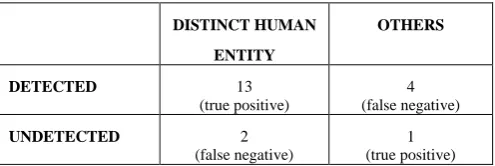
The investigation has been carried out on the premise of general execution of the framework. Here the aspect ratio of a few cases has been taken and examined to discover the rough go for human's aspect ratio. On the basis of this analysis the following results have been obtained. A total of 20 test cases were taken. Out of 20 cases: - 13 cases are tested as successful, i.e. all the distinct human entities are detected successfully; 4 cases are tested as partially successful i.e. distinct human entities are detected along with certain other objects; 3 cases are tested as unsuccessful, i.e. distinct human entity is not detected. In few cases the system considers objects with higher intensity and aspect ratio similar to humans, also as human. These are considered as unsuccessful cases. Table 1 gives the confusion matrix [12].
[image:5.595.35.283.485.568.2]Each row represents the instances in a predicted class while each column represents the instances in an actual class. In 13 cases, distinct human entity has been detected. Apart from distinct human entity, there are 4 cases where some other entities are also detected. The overall accuracy achieved is 65% which is the ratio of correct classifications to all the classifications.
Table 1: Confusion Matrix
DISTINCT HUMAN
ENTITY
OTHERS
DETECTED 13
(true positive)
4 (false negative)
UNDETECTED 2
(false negative)
1 (true positive)
Precision achieved is 20% which is the correct classifications penalized by the number of incorrect classifications. Recall is 15% which is the number of correct classifications penalized by the number of missed items.
VI CONCLUSION
In this paper, a robust video motion detection system has been proposed with improved video quality analysis. We have extended the Background and framing method using wavelet threshold analysis and have applied it for our quality analysis. Once the human entity is detected using the wavelet threshold analysis, it is applied to eliminate objects other than the human entity which were also detected in the
existing threshold selection model. The analyses show that our proposed method has a substantially higher degree of efficacy, outperforming other methods by confusion metric accuracy rate of up to 65%.The proposed work can be applied to detect any unauthorized entry in any organization for future research. In future, further work can be done for better distinction of objects having aspect ratio similar to humans. Hardware and software part can also be included where automatic alarm will be generated whenever any distinct unauthorized entity is detected.
VII REFERENCES
[1] David Moore (June, 2003). “A real world system for human motion detection and tracking”.
[2] J. Renno, N. Lazarevic-McManus, D. Makris and G.A. Jones “Evaluating Motion Detection Algorithms: Issues and Results”.
[3] Sahu Manoj Kumar, Ms. S. Jaiswal, Patnaik Sadhana, Sharma Deepak (Apr, 2012). “Survey- Visual Analysis of Human Motion”.
[4] Shih-Chia Huang (2011). “An Advanced Motion Detection Algorithm with Video Quality Analysis for Video Surveillance Systems”, IEEE TRANSACTIONS ON CIRCUITS AND SYSTEMS FOR VIDEO TECHNOLOGY, VOL. 21, NO. 1
[5] M. Shehata and W. Badawy (2009) “A robust video-based algorithm for detecting snow movement” Journal of Signal Processing Systems, vol. 56, no. 2-3, pp. 307-326
[6] S. Dasgupta, C. H. Papadimitriou, and U. V. Vazirani (2008) “A Fast Algorithm of Temporal Median Filter for Background Subtraction” McGraw-Hill, New York, USA,
[7] Simon Perreault and Patrick Hebert (2007) “Median Filtering in Constant Time” IEEE Trans Image Processing, vol. 16, no. 9, pp. 2389-2394
[8] Wei Zhang; Xiangzhong Fang; Xiaokang Yang; Q. M. Jonathan Wu (2006) “Spatiotemporal Gaussian mixture model to detect moving objects in dynamic scenes” Patt. Recog. Lett., vol. 28, pp. 320–32
[9] D. Culibrk, O. Marques, D. Socek, H. Kalva, and B. Furht, “Neural network approach to background modeling for video object segmentation,” IEEE Trans. Neural Netw., vol. 18, no. 6, pp. 1614–1627, Nov. 2007.
[10] M. Oral and U. Deniz, “Center of mass model: A novel approach to background modeling for segmentation of moving objects,” Image Vis. Comput., vol. 25, pp. 1365– 1376, Aug. 2007.
[11] L. Li, W. Huang, I. Y.-H. Gu, and Q. Tian, “Statistical modeling of complex backgrounds for foreground object detection,” IEEE Trans. Image Process., vol. 13, no. 11, pp. 1459–1472, Nov. 2004.
![Figure. 2: Algorithm of GMM [8]](https://thumb-us.123doks.com/thumbv2/123dok_us/695297.1077173/2.595.41.279.101.311/figure-algorithm-of-gmm.webp)