Original Research Article
Primary caesarean section in multigravida
Mohana Dhanapal Munusamy*, Subha Sivagami Sengodan, Kalaivarasi Umapathy Duraisamy
INTRODUCTION
Caesarean delivery defined as delivery of foetus through incision on abdominal wall and incision on intact uterine wall. Multigravida means those who have had delivered once or more after the age of viability.
Primary caesarean section in Multipara means first caesarean section done in patients who had delivered vaginally once or more. Caesarean section is one of the commonly performed surgical procedure world wide.1
Safety of caesarean section has improved over decades due to improved anaesthetic techniques which has accounted for increased rate of caesarean section in the world.2,3
The rate of caesarean section is increasing beyond the recommended level of 5-15 by WHO. Unnecessary caesarean section increases the maternal mortality.
Inspite of remarkable improvement in the safety of anaesthesia and surgical technique, caesarean section has higher risk of maternal morbidity and mortality when compared to normal vaginal delivery. There is no decrease in perinatal mortality with increase caesarean section rate.
This study was done to know the incidence of primary caesarean section in multigravida, to investigate the indication of primary caesarean section in multigravida and to study the intraoperative and post-operative complication.
ABSTRACT
Background: This study was done to analyse primary caesarean section in multigravida who had delivered vaginally.
Indications for caesarean section were studied in relation to age, gravida, maternal and foetal morbidity.
Methods: This study was conducted in Goverment Mohankumaramangalam Medical College and Hospital, Salem. It
was a retrospective study from September 2016 to August 2017.
Results: Most of cases were referred as an emergency. Most common age group was between 20-30 years. Majority
were second gravida. Among the various indications for primary caesarean section in multigravida, foetal distress (18.12%), hypertensive disorder complicating pregnancy (16.10%), CPD (15.43%), APH (12.08%), malpresentation (10.73%) were the common indications. In intraoperative complication PPH was most common (16.77%). In postoperative complication fever was the most common (20.80%). Still birth occurred in 10.06% of cases, 42 babies were admitted in NICU and babies had APGAR >7 (61.74%).
Conclusions: Implementation of standard labour management strategies can decrease primary caesarean rate without
compromising maternal and foetal safety. We must encourage early referral of high risk patient, so that the patient can reach higher centre earlier and proper management could be done before consequences become grave.
Keywords: Caesarean section, Foetal distress, Multigravida
Department of Obstetrics and Gynecology, Government Mohankumaramangalam Medical College Hospital, Salem, Tamil Nadu, India
Received: 22 December 2017
Accepted: 24 January 2018
*Correspondence:
Dr.Mohana Dhanapal Munusamy,
E-mail: [email protected]
Copyright: © the author(s), publisher and licensee Medip Academy. This is an open-access article distributed under the terms of the Creative Commons Attribution Non-Commercial License, which permits unrestricted non-commercial use, distribution, and reproduction in any medium, provided the original work is properly cited.
METHODS
It was a retrospective study, carried out at Department of
Obstetrics and Gynecology, Government
Mohankumaramangalam Medical College and Hospital, Salem, India from September 2016 to August 2017 on 149 cases. All cases of primary caesarean section with previous vaginal delivery, after satisfying the inclusion and exclusion criteria from Department of obstetrics and gynecology, was taken up for study.
Inclusion criteria
• Multigravida >28weeks (gravid two and above), Each of whom have had a previous vaginal delivery of live baby,
• Multiple pregnancy,
• Pregnancy with medical disorders.
Exclusion criteria
• Bad obstetric history
• Multigravida with previous caesarean section.
This is a retrospective study of 149 cases of primary caesarean section in multigravida admitted in Government Mohankumaramangalam Medical College and Hospital, Salem, India from September 2016 to August 2017. The obstetric theatre and labour ward records were reviewed to identify the patients who underwent caesarean section during the study period. From the case sheets the details regarding age of patient, gravida, gestational age, indications for caesarean section, intra operative and post-operative complications, sick new born admission, APGAR were noted.
Statistical analysis
All the information was gathered and the results were entered in case record form and keyed into SPSS computer software version 13.0 for windows and were analysed using statistical methods.
RESULTS
Total number of deliveries for the year September 2016 to August 2017 were 8,678. Number of LSCS were 4,472.
Table 1: Age distribution.
Age Percentage
21-25 60.2
26-30 13.0
31-35 4.6
>35 0.3
About 149 cases of primary caesarean section done in multipara during the period of one year were analysed and the results were as follows. Table 1 shows age
distribution, majority were in the age group of 20-30yr (73.2%), followed by 4.6% in the age group of 31-35yrs and we had 0.3% of patients in above 35 age group.
About 96.3% patients were booked either in our hospital or in primary health centre or private hospital. 91.7% of patients were referral cases and 8.3% were booked in our hospital. Regarding gestational age, majority were in the GA of 36-40 weeks (59.06%), 12.08% were in the 28-32 weeks GA, 32-36 weeks (17.44%), more than 40 weeks GA (11.40%).
Table 2: Gravida distribution.
GRAVIDA Percentage
G2 63.75
G3 20.13
G4 10.73
>G5 5.3
Table 2 shows gravida distribution, most of them were 2nd gravida (63.75%) and 3rd gravida (20.13%). 4th
[image:2.595.314.546.382.495.2]gravida contributed to 10.73% of patients and 5.3% were 5th gravida and above.
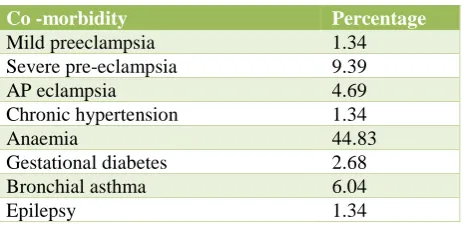
Table 3: Medical disorder.
Co -morbidity Percentage
Mild preeclampsia 1.34
Severe pre-eclampsia 9.39
AP eclampsia 4.69
Chronic hypertension 1.34
Anaemia 44.83
Gestational diabetes 2.68
Bronchial asthma 6.04
Epilepsy 1.34
[image:2.595.314.547.622.766.2]Table 3 shows co-morbid condition where anemia was the commonest around 44.83% and the same was treated by blood transfusion and Inj. Ironsucrose, followed by severe pre-eclampsia 9.39%, AP eclampsia 4.69%, gestational diabetes 2.68%, whereas mild pre-eclampsia, chronic hypertension and epilepsy showed similar incidence of 1.34%.
Table 4: Indications.
Indication %
Foetal distress 18.12
Hypertensive disorder complicating pregnancy 16.10
CPD 15.43
APH 12.08
Malpresentation 10.73
Non progression of labour 10.06
Failed induction 8.05
Multiple pregnancy 4.02
GDM 2.68
Cord prolapsed 1.34
Regarding indications foetal distress and hypertensive disorder complicating pregnancy were most common about 18.12% and 16.10 % respectively.
In hypertensive disorder complicating pregnancy, antepartum eclampsia accounted for 6.04% of cases. CPD, APH and malpresentation were 16.10%, 12.08%, 10.73% respectively.
Non-progression of labour was the indication in 15 patients (10.06%), failed induction was the indication in 12 patients (8.05%) mainly in post-dated and oligohydramnios.
Multiple pregnancy with the first twin in non-vertex presentation was contributing in 4.02% of patients.
In malpresentation breech presentation was more common in 10 patients mainly flexed breech, whereas 6 cases were transverse lie.
[image:3.595.52.286.395.458.2]In gynaec disorder complicating pregnancy we had one multiple fibroid complicating pregnancy and UV prolapse complicating pregnancy, and cord prolapse occurred in two patients.
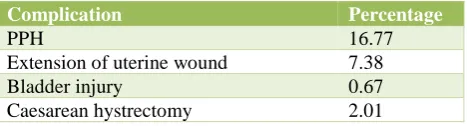
Table 5: Intra operative complications.
Complication Percentage
PPH 16.77
Extension of uterine wound 7.38
Bladder injury 0.67
Caesarean hystrectomy 2.01
In intra operative complication PPH (16.77%) was more common. The extension of uterine wound occurred in 7.3% of cases mainly in obstructed labour cases. 3 cases proceeded to caesarean hysterectomy, in this two cases done for atonic PPH which was uncontrolled by medical management and uterine artery ligation. One caesarean hysterectomy was done for placenta accreta, for the same bladder injury occurred.
Table 6: Post operative complication.
Post op complications Percentage
Fever 20.80
UTI 8.05
Wound infections 18.79
Paralytic ileus 7.38
Respiratory tract infection 4.02
Wound resuturing 9.39
Secondary PPH 2.01
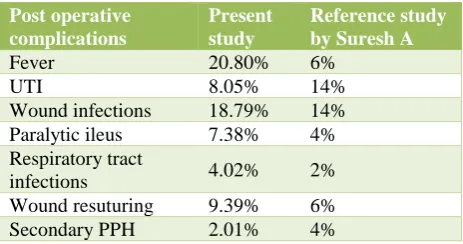
Post operative complications occurred in 70.44% of patients where as 29.56% of patients did not have any complications. Among post operative complications the fever was most common complication (20.80%) followed by wound infection (18.79%), wound resuturing done in
9.39% of patients. UTI occurred in 8.05% of cases and paralytic ileus in 7.38% of cases, respiratory tract infection and secondary PPH occurred in 4.02% and 2.01% respectively.
Table 7: Perinatal outcome.
Cases Still birth NICU admission APGAR >7
149 15 42 92
% 10.06 28.18 61.74
In present study, still birth happened in 10.06% of cases, 42 cases admitted in NICU and 61.74% of cases had APGAR >7.
DISCUSSION
About 149 cases of primary caesarean section done in multipara during the period of one year were analysed and the results were as follows.
Table 8: Perinatal outcome.
Deliveries for the one year
No. of
cases Percentage
The 8678
LSCS 4472 51.53
Primary caesarean
section in multipara 149 3.33
Our hospital is tertiary care hospital and receive a good number of high risk emergency cases with inadequate or no antenatal care, so we have increased caesarean section rate.
In this study primary section rate in multipara was 3.33% where as in study by Agrawal M et al the rate was 9.65%, and in study by Klein MD the rate was 0.51%.4
Analysis of age group shows that 73.2% of patients belong to the age group of 20-30 years, which is similar to a study by Karim et al, who showed 77% of cases in the same age group. In present study majority were emergency LSCS.
Table 9: Type of LSCS.
Type of LSCS Percentage
Emergency LSCS 93.96
Elective LSCS 6.04
In current study foetal distress was the commonest indication for primary caesarean section accounted for 18.12% of cases which is comparable to the study by Jyothi Rao, who reported foetal distress of 17.4%, in a study by Samal R et al, also reported foetal distress was the commonest indication in their study.6,7 This high rate
Hypertensive disorder complicating pregnancy was the second leading cause of caesarean section in multipara, which contributed to 16.10% of primary caesarean section. Antepartum eclampsia contributed to the 6.04% of caesarean section, whereas study by Birla S et al reported that AP eclampsia was responsible for 0.73% of cases in their study.8
CPD accounted for 15.43% of cases which is similar to study by Sharmila who reported 15.8%.9 In present study
7 cases of CPD where presented with obstructed labour and increased in maternal morbidity.
Multipara may still have CPD, since the foetus tent to increase in size. Antepartum haemorrhage was 12.08% in present study which is similar to study by Hemabindu who reported 11.2%.10 Malpresentation accounted for
10.73% of cases where as a study by Desai E reported 17.4% of cases of malpresentation.11
In present study non progression of labour accounted for 10.06% which is similar to study by Sonia Arogya Prakash, who reported 11.36%.12 8.05% of primary
caesarean section were done for failed induction.
Twin pregnancy (1st twin non-vertex) was the indication
in 4.02% of cases. GDM accounted for 2.68% of cases mainly for the patients with large baby and high doses of Insulin. Gyneac disorder complicating pregnancy (one fibroid and one prolapse) and cord prolapse with live foetus accounted for 1.34% and 1.34% respectively. Still birth happened in 10.06% of cases which is similar to study by Saluja JK who reported 12% of still birth.13
Intra operative complications happened in 26.81% of cases, out of which atonic PPH, stands out as most frequent complication (16.77%), and study by Sams S reported atonic PPH was the commonest complication in her study.14
[image:4.595.52.284.648.770.2]Extension of uterine wound 7.3% of cases mainly in obstructed labour, who were reported very late. Bladder injury occurred in one case of placenta accreta during caesarean hysterectomy. The Table 10 shows incidence of post operative complications in present study which is compared with study by Suresh A.15
Table 10: Comparison of post-operative complications.
Post operative complications
Present study
Reference study by Suresh A
Fever 20.80% 6%
UTI 8.05% 14%
Wound infections 18.79% 14%
Paralytic ileus 7.38% 4%
Respiratory tract
infections 4.02% 2%
Wound resuturing 9.39% 6%
Secondary PPH 2.01% 4%
CONCLUSION
Implementation of standard labour management
strategies can decrease primary caesarean section rate without compromising maternal and foetal safety.
Increased in caesarean section is due to referral nature of hospital, unbooked patients. There are many cases where caesarean section becomes mandatory. They are contributing to increased total caesarean rate. Patient should be planned very judiciously after critical evaluation of circumstances. Good antenatal, intrapartum care, early referral will decrease the maternal and foetal morbidity.
We must encourage early referral of high risk patient, so that the patient can reach higher centre earlier and proper management could be done before consequences become grave.
Funding: No funding sources Conflict of interest: None declared
Ethical approval: The study was approved by the Institutional Ethics Committee
REFERENCES
1. Awoyinka BS, Ayinde OA, Omigbodun AO.
Acceptability of caesarean delivery to antenatal patients in a tertiary health facility in south-west Nigeria. J Obstet Gynecol. 2006 Jan 1;26(3):208-10. 2. Adeoye SI, Kalu CA. Pregnant Nigerian women’s
view of caesarean section. Nigerian J Clin Pract. 2011;43:276-9.
3. Penna L, Arulkumaran S. Cesarean section for non‐ medical reasons. Int J Gynecol Obstet. 2003 Sep 1;82(3):399-409.
4. Agrawal M, Waydande S, Jadhav V, Bhave S. Frequency and indications of primary caesarean section inmultipara in tertiary care hospital. Int J Recent Trends Sci Tech. 2016;18(3):430-2.
5. Klein MD, Robbins R, Gabaeff L. Primary caesarean section in multipara. Am J Obstet Gynecol. 1963;87(2):242-52.
6. Rao J, Rampure N. Study of primary Caesarean
section in multiparous women. JEMDS.
2013;2(24):4414-8.
7. Samal R, Palai P, Ghose S. Clinical study of Caeserean section in Multiparous women in a tertiary care hospital. IJRCOG. 2016;5(5):1506-9.
8. Birla S, Gupta M, Birla P, Sharma J. Comparison of incidence, indication and complication of primary Caeserean section in Primigravida and Multigravida. Int J Med Sci Edu. 2016;3(3):311-7.
9. Sharmila G, Nishitha C. Study of primary caesarean section in multi gravida. Asian Pac J Health Sci. 2016;3(4):89-94.
11. Desai E, Leuva H, Leuva B, Kanani M. A study of primary Caesarean section in Multipara. Int J Reprod Contracept Obstet Gynecol. 2013;2(3):320-4. 12. Prakash SA, Vikram A, Raja Gopal K, Lavanya PS.
Primary cesearean section in multigravidas. Int J Reprod Contracept Obstet Gynecol 2016;5:3849-52. 13. Saluja JK, Roy PK, Mahadik K. Study of primary
caesarean section in multiparous women. NJIRM. 2014;5(2):27-9.
14. Sams S, Cicily TJ, Balachandran A. Institutional
study of primary caeserean section among
multigravida. J Med Sci Clini Res. 2017;5(4):20713-20.
15. Suresh DY, Suresh D. A prospective comparative study of caeserean section in multiparous and primiparous women. Int J Pharma Bio Sci. 2017 Jul;8(3):890-5.
Cite this article as: Munusamy MD, Sengodan SS,