Low–cost Named Entity Classification for Catalan: Exploiting
Multilingual Resources and Unlabeled Data
Llu´ıs M`arquez, Adri`a de Gispert, Xavier Carreras, and Llu´ıs Padr´o
TALP Research Center
Universitat Polit`ecnica de Catalunya
Jordi Girona, 1–3, E-08034, Barcelona
lluism,agispert,carreras,padro @talp.upc.es
Abstract
This work studies Named Entity Classi-fication (NEC) for Catalan without mak-ing use of large annotated resources of this language. Two views are explored and compared, namely exploiting solely the Catalan resources, and a direct training of bilingual classification models (Span-ish and Catalan), given that a large col-lection of annotated examples is available for Spanish. The empirical results ob-tained on real data point out that multi-lingual models clearly outperform mono-lingual ones, and that the resulting Cata-lan NEC models are easier to improve by bootstrapping on unlabelled data.
1
Introduction
There is a wide consensus about that Named Entity Recognition and Classification (NERC) are Natural Language Processing tasks which may improve the performance of many applications, such as Informa-tion ExtracInforma-tion, Machine TranslaInforma-tion, QuesInforma-tion An-swering, Topic Detection and Tracking, etc. Thus, interest on detecting and classifying those units in a text has kept on growing during the last years.
Previous work in this topic is mainly framed in the
Message Understanding Conferences (MUC),
de-voted to Information Extraction, which included a NERC competition task. More recent approaches can be found in the proceedings of the shared task at the 2002 and 2003 editions of the Conference
on Natural Language Learning (Tjong Kim Sang,
2002; Tjong Kim Sang and De Meulder, 2003), where several machine–learning (ML) systems were compared at the NERC task for several languages.
One remarkable aspect of most widely used ML algorithms is that they are supervised, that is, they require a set of labelled data to be trained on. This may cause a severe bottleneck when such data is not available or is expensive to obtain, which is usu-ally the case for minority languages with few pre– existing linguistic resources and/or limited funding possibilities. This is one of the main causes for the recent growing interest on developing language–
independent NERC systems, which may be trained
from small training sets by taking advantage of
un-labelled examples (Collins and Singer, 1999; Abney,
2002), and which are easy to adapt to changing do-mains (being all these aspects closely related).
When considering the training of bilingual mod-els, we take advantage of the facts that Spanish and Catalan are two Romance languages with sim-ilar syntactic structure, and that —since Spanish and Catalan social and cultural environments greatly overlap— many Named Entities appear in both lan-guages corpora. Relying on this structural and con-tent similarity, we will build our Catalan NE classi-fier on the following assumptions: (a) Named Enti-ties appear in the same contexts in both languages, and (b) Named Entities are composed by similar pat-terns in both languages.
The paper presents an extensive experimental evaluation, giving strong evidence about the advan-tage of using multilingual models for training on a language with scarce resources. Additionally, the Catalan NEC models resulting from the bilingual training are easier to improve by bootstrapping on unlabelled data.
The paper is organized as follows. Section 2 describes the Catalan and Spanish resources avail-able and the feature codification of examples. Sec-tion 3 briefly describes the learning algorithms used to train the classifiers. Section 4 is devoted to the learning of NEC modules using only Catalan re-sources, while section 5 presents and evaluates the bilingual approach. Finally, the main conclusions of the work are summarized in section 6.
2
Setting
2.1 Corpus and data resources
The experimentation of this work has been carried on two corpora, one for each language. Both corpora consist of sentences extracted from news articles of the year 2,000. The Catalan data, extracted from the Catalan edition of the daily newspaper El Peri´odico
de Catalunya, has been randomly divided into three
sets: a training set (to train a system) and a test set (to perform evaluation) for manual annotation, and a remaining set left as unlabelled. The Spanish data corresponds to the CoNLL 2002 Shared Task Span-ish data, the original source being the EFE SpanSpan-ish Newswire Agency. The training set has been used to improve classification for Catalan, whereas the test set has been used to evaluate the bilingual classi-fier. The original development set has not been used. Table 1 shows the number of sentences, words and
lang. set #sent. #words #NEs
es train. 8,322 264,715 18,797
es test 1,516 51,533 3,558
ca train. 817 23,177 1,232
ca test 844 23,595 1,338
ca unlab. 83,725 2,201,712 75,038
Table 1: Sizes of Spanish and Catalan data sets
Named Entities in each set. Although a large amount of Catalan unlabelled NEs is available, it must be ob-served that these are automatically recognised with a 91.5% accurate NER module, introducing a certain error that might undermine bootstrapping results.
Considered classes include MUC categories PER LOC and ORG, plus a fourth category MIS, includ-ing named entities such as documents, measures and taxes, sport competitions, titles of art works and oth-ers. For Catalan, we find 33.0% of PER, 17.1% of
LOC, 43.5% of ORG and 6.4% of MIS out of the 2,570 manually annotated NEs, whereas for Span-ish, out of the 22,355 labelled NEs, 22.6% arePER, 26.8% areLOC, 39.4% areORG and the remaining 11.2% areMIS.
Additionally, we used a Spanish 7,427 trigger– word list typically accompanying persons, organiza-tions, locaorganiza-tions, etc., and an 11,951 entry gazetteer containing geographical and person names. These lists have been semi-automatically extracted from lexical resources and manually enriched afterwards. They have been used in some previous works allow-ing significant improvements for the Spanish NERC task (Carreras et al., 2002; Carreras et al., 2003).
Trigger–words are annotated with the correspond-ing Spanish synsets in the EuroWordNet lexical knowledge base. Since there are translation links among Spanish and Catalan (and other languages) for the majority of these words, an equivalent ver-sion of the trigger–word list for Catalan has been automatically derived. In this work, we consider the gazetteer as a language independent resource and is indistinctly used for training Catalan and Spanish models.
2.2 Feature codification
The features that characterise the NE examples are defined in a window anchored at a word ,
a decision. In the window, each word around is
codified with a set of primitive features, requiring no linguistic pre–processing, together with its relative position to . Each primitive feature with each
rela-tive position and each possible value forms a final bi-nary feature for the classifier (e.g., “the word form at position(-2) is street”). The kind of information coded in these features may be grouped in the fol-lowing kinds:
Lexical: Word forms and their position in the
window (e.g., =“bank”), as well as word forms appearing in the named entity under con-sideration, independent from their position.
Orthographic: Word properties regarding
how it is capitalised (initial-caps, all-caps), the kind of characters that form the word (contains-digits, all-digits, alphanumeric, roman-number), the presence of punctua-tion marks (contains-dots, contains-hyphen,
acronym), single character patterns (lonely-initial, punctuation-mark, single-char), or the
membership of the word to a predefined class (functional-word1) or pattern (URL).
Affixes: The prefixes and suffixes up to 4
char-acters of the NE being classified and its internal components.
Word Type Patterns: Type pattern of
consec-utive words in the context. The type of a word is either functional (f), capitalised (C),
lower-cased (l), punctuation mark (.), quote (’) or
other (x).
Bag-of-Words: Form of the words in the
window, without considering positions (e.g., “bank” ).
Trigger Words: Triggering properties of
win-dow words, using an external list to deter-mine whether a word may trigger a certain Named Entity (NE) class (e.g., “president” may trigger class PER). Also context patterns to
the left of the NE are considered, where each word is marked with its triggering properties, or with a functional–word tag, if appropriate (e.g., the phrase “the president of United Na-tions” produces pattern f ORG f for the NE
1
Functional words are determiners and prepositions which typically appear inside NEs.
“United Nations”, assuming that “president” is listed as a possible trigger forORG).
Gazetteer Features: Gazetteer information for
window words. A gazetteer entry consists of a set of possible NE categories.
Additionally, binary features encoding the length in words of the NE being classified.
All features are computed for a -3,+3 window
around the NE being classified, except for the
Bag-of-Words, for which a -5,+5 window is used.
3
Learning Algorithms
As previously said, we compare two learning ap-proaches when learning from Catalan examples: su-pervised (using the AdaBoost algorithm), and unsu-pervised (using the Greedy Agreement Algorithm). Both of them are briefly described below.
3.1 Supervised Learning
We use the multilabel multiclass AdaBoost.MH algorithm (with confidence–rated predictions) for learning the classification models. The idea of this algorithm is to learn an accurate strong classifier by linearly combining, in a weighted voting scheme, many simple and moderately–accurate base classi-fiers or rules. Each base rule is sequentially learned by presenting the base learning algorithm a weight-ing over the examples (denotweight-ing importance of ex-amples), which is dynamically adjusted depending on the behaviour of the previously learned rules. We refer the reader to (Schapire and Singer, 1999) for details about the general algorithm, and to (Schapire, 2002) for successful applications to many areas, in-cluding several NLP tasks. Additionally, a NERC system based on the AdaBoost algorithm obtained the best results in the CoNLL’02 Shared Task com-petition (Carreras et al., 2002).
In our setting, the boosting algorithm combines several small fixed–depth decision trees. Each branch of a tree is, in fact, a conjunction of binary features, allowing the strong boosting classifier to work with complex and expressive rules.
3.2 Unsupervised Learning
classifiers from a set of hand-typed seed rules. Each classifier is a majority vote of several atomic rules, which abstains when the voting ends in a tie. The atomic rules are just mappings of a single feature into a class (e.g., if suffix “lez” then PER). When learning, the atomic rule that maximally reduces the disagreement on unlabelled data between both clas-sifiers is added to one of the clasclas-sifiers, and the process is repeated alternating the classifiers. See (Abney, 2002) for a formal proof that this algo-rithm tends to gradually reduce the classification er-ror given the adequate seed rules.
For its extreme simplicity and potentially good re-sults, this algorithm is very appealing for the NEC task. In fact, results are reported to be competitive against more sophisticated methods (DL, Co-Boost, etc.) for this specific task in (Abney, 2002).
Three important questions arise from the algo-rithm. First, what features compose each view. Sec-ond, how seed rules should be selected or whether this selection strongly affects the final classifiers. Third, how the algorithm, presented in (Abney, 2002) for binary classification, can be extended to a multiclass problem.
In order to answer these questions and gain some knowledge on how the algorithm works empirically, we performed initial experiments on the big labelled portion of the Spanish data.
When it comes to view selection, we tried two alternatives. The first, suggested in (Collins and Singer, 1999; Abney, 2002), divides into one view capturing internal features of the NE, and the other capturing features of its left-right contexts (here-after referred to as Greedy Agreement pure, orGA ).
Since the contextual view turned out to be quite lim-ited in performance, we interchanged some feature groups between the views. Specifically, we moved the Lexical features independent of their position to the contextual view, and the the Bag-of-Words fea-tures to the internal one (we will refer to this divi-sion as Greedy Agreement mixed, orGA ). The
lat-ter, containing redundant and conditionally depen-dent features, yielded slightly better results in terms of precision–coverage trade–off.
As for seed rules selection, we have tried two dif-ferent strategies. On the one hand, blindly choos-ing as many atomic rules as possible that decide at least in 98% of the cases for a class in a small
vali-dation set of labelled data, and on the other, manu-ally selecting from these atomic rules only those that might be valid still for a bigger data set. This second approach proved empirically better, as it provided a much higher starting point in the test set (in terms of precision), whereas a just slightly lower coverage value, presenting a better learning curve.
Finally, we have approached the multiclass set-ting by a one–vs–all binarization, that is, divid-ing the classification problem into four binary de-cisions (one per class), and combining the resul-tant rules. Several techniques to combine them have been tested, from making a prediction only when one classifier assigns positive for the given instance and all other classifiers assign negative (very high precision, low coverage), to much unrestrictive ap-proaches, such as combining all votes from each classifier (lower precision, higher coverage). Re-sults proved that the best approach is to sum all votes from all non-abstaining binary classifiers, where a vote of a concrete classifier for the negative class is converted to one vote for each of the other classes.
The best results obtained in terms of cover-age/precision and evaluated over the whole set of training data (and thus more significant than over a small test set) are 80.7/84.9. These results are com-parable to the ones presented in (Abney, 2002), tak-ing into account, apart from the language change, that we have introduced a fourth class to be treated the same as the other three. Results when using Catalan data are presented in section 4.
4
Using only Catalan resources
This section describes the results obtained by using only the Catalan resources and comparing the fully unsupervised Greedy Agreement algorithm with the AdaBoost supervised learning algorithm.
4.1 Unsupervised vs. supervised learning
In this experiment, we used the Catalan training set for extracting seed rules of theGAalgorithm and to train an AdaBoost classifier. The whole unlabelled Catalan corpus was used for bootstrapping the GA
algorithm. All the results were computed over the Catalan test set.
20 30 40 50 60 70 80 90 100
20 30 40 50 60 70 80 90 100
Precision
Coverage
[image:5.595.316.537.71.142.2]CA GA(p) GA(m)
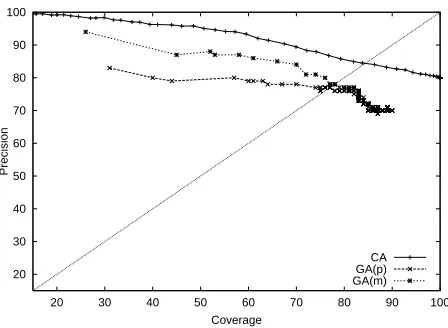
Figure 1: Precision–coverage plot ofGA ,GA , and
CAmodels trained on Catalan resources
the Greedy Agreement algorithm for the two views selections (noted GA andGA , respectively). The
curve forCAhas been computed by varying a confi-dence threshold: CAabstains when the highest pre-diction of AdaBoost is lower than this threshold.
On the one hand, it can be seen thatGA is more
precise thanGA for low values of coverage but their
asymptotic behaviour is quite similar. By stopping at the best point in the validation set, the Greedy Agreement algorithm (GA ) achieves a precision of
76.53% with a coverage of 83.62% on the test set. On the other hand, the AdaBoost classifier clearly outperforms bothGA models at all levels of
cover-age, indicating that the supervised training is prefer-able even when using really small training sets (an accuracy around 70% is obtained by training Ad-aBoost only with the 20% of the learning examples, i.e., 270 examples).
The first three rows of table 2 contain the accu-racy of these systems (i.e., precision when coverage is 100%), detailed at the NE type level (best results printed in boldface)2. The fourth row (BTS)
corre-sponds to the best results obtained when additional unlabelled Catalan examples are taken into account, as explained below.
It can be observed that the GAmodels are highly biased towards the most frequent NE types (ORGand
PER) and that the accuracy achieved on the less
rep-2
In order to obtain a 100% coverage with theGAmodels we have introduced a naive algorithm for breaking ties in favour of the most frequent categories, in the cases in which the algorithm abstains.
LOC ORG PER MIS avg.
GA 14.66 83.64 93.88 0.00 66.66
GA 20.67 95.30 76.94 4.00 68.28
CA 61.65 86.84 91.67 40.00 79.83
[image:5.595.76.300.73.237.2]BTS 65.41 87.22 91.94 37.33 80.63
Table 2: Accuracy results of all models trained on Catalan resources
resented categories is very low for LOC and
negli-gible for MIS. The MIS category is rather difficult to learn (also for the supervised algorithm), proba-bly because it does not account for any concrete NE type and does not show many regularities. Consid-ering this fact, we learned the models using only the
LOC, ORG, and PER categories and treated the MIS
as a default value (assigned whenever the classifier does not have enough evidence for any of the cate-gories). The results obtained were even worse.
4.2 Bootstrapping AdaBoost models using
unlabelled examples
Ideally, the supervised approach can be boosted by using the unlabelled Catalan examples in a kind of iterative bootstrapping procedure. We have tested a quite simple strategy for bootstrapping. The unlabelled data in Catalan has been randomly di-vided into a number of equal–size disjoint subsets
. . .
, containing 1,000 sentences each. Given the initial training set for Catalan, noted as , the
process is as follows:
1. Learn the classification model from
2. For !"!"!$# do :
(a) Classify the Named Entities in
. . .
&%
using model %('
(b) Select a subset
of previously classified examples (*),+
%
-$.
-) (c) Learn a new model
%
using as training data/10
3. Output Model
.
it. CA2$354 CA2$35476 CA2$3(4(8 XL2$35476 XL2$35478
0 79.83 79.83 79.41 82.63 82.42
1 78.48 79.58 79.46 82.69 82.29
2 78.29 79.22 80.04 82.45 82.72
3 78.13 79.87 79.95 82.89 82.74
4 78.01 79.58 79.56 82.98 82.45
5 78.73 79.08 79.11 82.79 83.42
6 78.22 79.07 79.95 83.14 82.96
7 78.25 78.93 80.63 83.73 83.12
8 77.99 79.14 79.65 82.70 83.06
9 78.17 79.57 79.17 82.37 83.34
[image:6.595.81.292.71.235.2]10 78.30 78.89 79.21 82.10 82.96
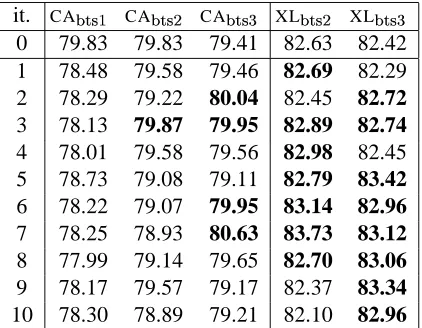
Table 3: Accuracy results of the bootstrapping pro-cedure for all models
We devised two variants for selecting the subset of labelled instances to include at each iteration. The first one consists of simply selecting all the exam-ples, and the second one consists of choosing only the most confident ones (in order to avoid the addi-tion of many training errors). For the latter, we have used a confidence measure based on the difference between the first and second highest predictions for the example (after normalization in 9;:<>=@?1$A). The
confidence parameter has been empirically set to 0.3. These two variants lead to bootstrapping algo-rithms that will be referred to asCA2$354
,CA2$35476 .
Finally, a third variant of the bootstrapping al-gorithm has been tested, consisting of training the
model using the Catalan training set plus a
set of examples (of comparable size and distribution over NE types) selected from the most confidently labelled examples by theGA model. This strategy,
which is applied in combination with theCA2$35476
se-lection scheme, will be referred to asCA2@3(4(8 .
Left–hand side of table 3 contains the results ob-tained by these bootstrapping techniques for up to 10 iterations. Figures improving the baselineCAmodel are printed in boldface.
It can be observed that, frequently, the bootstrap-ping procedure decreases the accuracy of the sys-tem. This is probably due to two main factors: the supervised learning algorithm cannot recover from the almost 20% of errors introduced by the initial
CA model, and the effect of the recognition errors (mostly in segmentation) that are present in the Cata-lan unlabelled corpus (recall that our NE recogniser
is far from perfect, achieving 91.5 ofB
measure). However, significant differences can be observed between the three variants. Firstly, the simple ad-dition of all the examples (CA2$354
) systematically decreases performance. Secondly, the selection of confident examples (CA2$35476 ) minimises the loss but
does not allow to improve results (probably because most of the selected examples do not provide new information). Finally, the addition of the examples labelled by GA in the first learning step, though
starting with a less accurate classifier, obtains bet-ter results in the majority of cases (though the boot-strapping process is certainly unstable). This seems to indicate that the information introduced by these examples is somehow complementary to that ofCA. It is worth noting thatGA examples do not cover
the most frequent cases, since if we use them to train an AdaBoost classifier, we obtain a very low accu-racy of 33%. The best result achieved by CA2@3(4(8 is
detailed in the last row of table 2.
More complex variations to the above bootstrap-ping strategy have been experimented. Basically, our direction has concentrated on selecting a right
sized set of confident examples from the unlabelled
material by considering the cases in which CAand GA models agree on the prediction. In all cases, results lead to conclusions similar to the ones de-scribed above.
5
Using Spanish resources
In this section we extend our previous work on NE recognition (Carreras et al., 2003) to obtain a bilin-gual NE classification model. The idea is to ex-ploit the large Spanish annotated corpus by learn-ing a Spanish-Catalan billearn-ingual model from the joint set of Spanish and Catalan learning examples. In order to make the model bilingual, we just have to deal with the features that are language dependent, namely the lexical ones (word forms appearing in context patterns and Bag–of–Words). All other fea-tures are left unchanged.
A translation dictionary from Spanish to Catalan and vice-versa has been automatically built for the word–form features. It contains a list of translation pairs between Spanish and Catalan words. For in-stance, an entry in a dictionary is “calleC carrer”,
English) corresponds to the Catalan word “carrer”. In order to obtain the relevant vocabulary for the NEC task, we have run several trainings on the Span-ish and Catalan training sets by varying the learning parameters, and we have extracted from the learned models all the involved lexical features. This set of relevant words contains 8,042 words (80% coming from Spanish and 20% coming from Catalan).
The translation of these words has been auto-matically done by applying the InterNOSTRUM Spanish–Catalan machine translation system devel-oped by the Software Department of the University of Alacant3. The translations have been resolved without any context information (so, the MT system is often mistaken), and the entries not recognised by InterNOSTRUM have been left unchanged. A very light posterior hand–correcting has been done in or-der to fix some minor errors coming between differ-ent segmdiffer-entations of translation pairs.
5.1 Cross–Linguistic features
In order to train bilingual classification models, we make use of what we call cross–linguistic features, instead of the monolingual word forms specified in section 2.2. This technique is exactly the same we proposed to learn a Catalan–Spanish bilingual NE recognition module (Carreras et al., 2003). Assume a feature lang which takes value es or ca, depend-ing on the language under consideration. A cross– linguistic feature is just a binary feature correspond-ing to an entry in the translation dictionary, “es wC
ca w”, which is satisfied as follows:
D&EGFGHJILKNM5O PQSR5T P&UWVYX[Z*\]
ifV^Z^_a` b
andc;dNegf Zh_i`
]
if
V^Z^jik b
andc;dNegf Zhjlk
m
otherwise
This representation allows to learn from a corpus consisting of mixed Spanish and Catalan examples. When an example, say in Spanish, is codified, each occurrence of a word form is checked in the dictio-nary and all translation pairs that match the Spanish entry are codified as cross–linguistic features.
The idea here is to take advantage of the fact that the concept of NE is mostly shared by both lan-guages, but differs in the lexical information, which we exploit through the lexical translations. With
3
The InterNOSTRUM system is freely available at the fol-lowing URL: http://www.internostrum.com.
this, we can learn a bilingual model which is able to classify NEs both for Spanish and Catalan, but that may be trained with few —or even any— data of one language, in our case Catalan.
5.2 Results
Table 4 shows accuracy by categories of the multi-lingual modelXL in comparison to the best models trained only with Catalan data, already presented in section 4. As it can be seen in rowXL, accuracy is increased by almost 3 points compared to supervised learning for Catalan,CA. Whereas improvement for the easiest categories (ORGandPER) is moderate, it
is particularly significant for LOCandMIS, achiev-ing improvements of 7.5 and 5.3 points, respectively. The multilingual classifier has also been evalu-ated with the Spanish test set (see table 1). Ad-aBoost supervised algorithm has been used to learn an Spanish classifier from Spanish training data, which achieves 87.1% average accuracy. Interest-ingly, the multilingual classifier presents just a slight reduction to 86.9%, which could be considered irrel-evant, whereas performance for Catalan is boosted by almost 3 points.
The two best–performing bootstrapping strategies for the case using only Catalan (CA2$35476 andCA2$35478 )
have also been applied to the multilingual classifier (XL2$35476 andXL2$35478 ). Table 3 presents the results for
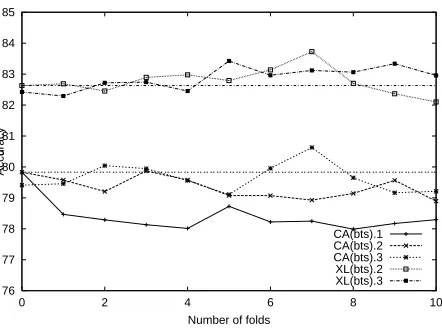
the first (the right–hand side of table), while figure 2 depicts the process graphically. It can be observed that both strategies consistently outperform the base-line bilingual modelXL as shown in boldface fig-ures. In this case,XL2@3(4(8 , again starting from a lower
accuracy point, proves more stable above the base-line. This is probably due to the fact that Catalan labelled examples introduced at iteration 0 from the unsupervised classifier do not have such big impact in a bilingual model conditioned by Spanish data
LOC ORG PER MIS avg.
CA 61.65 86.84 91.67 40.00 79.83
CA2@3(4(8 65.41 87.22 91.94 37.33 80.63
XL 69.17 88.16 92.76 45.33 82.63
XL2$35476 70.68 89.10 94.71 41.33 83.73
[image:7.595.315.539.616.686.2]76 77 78 79 80 81 82 83 84 85
0 2 4 6 8 10
Accuracy
n
Number of folds
[image:8.595.78.299.73.237.2]CA(bts).1 CA(bts).2 CA(bts).3 XL(bts).2 XL(bts).3
Figure 2: Progress of accuracy through bootstrap-ping iterations. The horizontal lines correspond to theCAandXLbaselines.
than in the CA2$35478 case. On the other hand,XL2$35476
achieves a higher peak (increasing accuracy up to 1.1 points more than multilingual baseline XL and 3.9 more than compared to model using only Cata-lan data,CA) before decreasing below baseline.
6
Conclusions
We have presented a thorough experimental work on developing low–cost Named Entity classifiers for a language with no available annotated resources. Several strategies to build a Catalan NEC system have been devised and evaluated. On the one hand, using only a small initial hand–tagged corpus, super-vised (AdaBoost) and fully unsupersuper-vised (Greedy Agreement) learning algorithms have been com-pared. On the other, using existing resources for a similar language as a starting point, a bilingual clas-sifier has been trained. In both cases, bootstrapping strategies have been tested.
The main conclusions drawn form the presented results are:
Given a small labelled data set, AdaBoost supervised learning algorithm clearly outper-forms the fully unsupervised Greedy Agree-ment algorithm, even when large unlabelled text is available.
Supervised models trained with few annotated data do not easily profit from bootstrapping strategies, even when using examples with
high–confidence for retraining. Examples la-belled with unsupervised models provide a complementary boost when bootstrapping.
Multilingual models, trained with an automat-ically derived dictionary, are able to signifi-cantly improve accuracy for the language with less annotated resources without significantly decreasing performance in the language with more data available. Retraining with unlabelled examples performs a bit better, learning a much accurate classifier than when using only Cata-lan labelled examples.
Acknowledgments
Research partially funded by the Spanish Research Depart-ment (HERMES 0335-C03-02, PETRA TIC2000-1735-C02-02, ALIADO TIC2002-04447-C02), by the Euro-pean Comission (FAME 2000-28323, MEANING IST-2001-34460), and by the Catalan Research Department (CIR-IT’s consolidated research group 2001SGR-00254 and predoc-toral research grants 2001FI-00663 and 2003FI-00433).
References
S. Abney. 2002. Bootstrapping. In Proceedings of the 40th
Annual Meeting of the Association for Computational Lin-guistics, Taipei, Taiwan.
X. Carreras, L. M`arquez, and L. Padr´o. 2002. Named En-tity Extraction Using AdaBoost. In Proceedings of
CoNLL-2002, pages 167–170. Taipei, Taiwan.
X. Carreras, L. M`arquez, and L. Padr´o. 2003. Named Entity Recognition for Catalan Using Spanish Resources. In
Pro-ceedings of EACL’03, Budapest, Hungary.
M. Collins and Y. Singer. 1999. Unsupervised Mod-els for Named Entity Classification. In Proceedings of
EMNLP/VLC-99, College Park MD, USA.
R. Schapire and Y. Singer. 1999. Improved Boosting Al-gorithms Using Confidence–rated Predictions. Machine Learning, 37(3):297–336.
R. Schapire. 2002. The Boosting Approach to Machine Learn-ing. An Overview. In Proceedings of the MSRI Workshop on
Nonlinear Estimation and Classification, Berkeley, CA.
E. Tjong Kim Sang and F. De Meulder. 2003. Introduction to the CoNLL-2003 Shared Task: Language-Independent Named Entity Recognition. In Proceedings of CoNLL-2003. Edmonton, Canada.