Biomedical Text Retrieval in Languages with a Complex Morphology
Stefan Schulza Martin Honecka Udo Hahnb
aDepartment of Medical Informatics, Freiburg University Hospital
http://www.imbi.uni-freiburg.de/medinf
bText Knowledge Engineering Lab, Freiburg University
http://www.coling.uni-freiburg.de
Abstract
Document retrieval in languages with a rich and complex morphology – par-ticularly in terms of derivation and (single-word) composition – suffers from serious performance degradation with the stemming-only query-term-to-text-word matching paradigm. We propose an alternative approach in which morpholog-ically complex word forms are segmented into relevant subwords (such as stems, named entities, acronyms), and subwords constitute the basic unit for indexing and retrieval. We evaluate our approach on a large biomedical document collection.
1 Introduction
Morphological alterations of a search term have a negative impact on the recall performance of an information retrieval (IR) system (Choueka, 1990; J¨appinen and Niemist¨o, 1988; Kraaij and Pohlmann, 1996), since they preclude a direct match between the search term proper and its morphological vari-ants in the documents to be retrieved. In order to cope with such variation, morphological analysis is concerned with the reverse processing of inflec-tion (e.g., ‘search ed’, ‘search ing’)1, derivation (e.g., ‘search er’ or ‘search able’) and composi-tion (e.g., German ‘Blut hoch druck’ [‘high blood
pressure’]). The goal is to map all occurring
mor-phological variants to some canonical base form — e.g., ‘search’ in the examples from above.
The efforts required for performing morphologi-cal analysis vary from language to language. For English, known for its limited number of inflec-tion patterns, lexicon-free general-purpose
stem-1
‘ ’ denotes the string concatenation operator.
mers (Lovins, 1968; Porter, 1980) demonstrably im-prove retrieval performance. This has been reported for other languages, too, dependent on the general-ity of the chosen approach (J¨appinen and Niemist¨o, 1988; Choueka, 1990; Popovic and Willett, 1992; Ekmekc¸ioglu et al., 1995; Hedlund et al., 2001; Pirkola, 2001). When it comes to a broader scope of morphological analysis, including derivation and composition, even for the English language only re-stricted, domain-specific algorithms exist. This is particularly true for the medical domain. From an IR view, a lot of specialized research has already been carried out for medical applications, with em-phasis on the lexico-semantic aspects of dederiva-tion and decomposidederiva-tion (Pacak et al., 1980; Norton and Pacak, 1983; Wolff, 1984; Wingert, 1985; Du-jols et al., 1991; Baud et al., 1998).
While one may argue that single-word com-pounds are quite rare in English (which is not the case in the medical domain either), this is certainly not true for German and other basically aggluti-native languages known for excessive single-word nominal compounding. This problem becomes even more pressing for technical sublanguages, such as medical German (e.g., ‘Blut druck mess ger¨at’ translates to ‘device for measuring blood pressure’). The problem one faces from an IR point of view is that besides fairly standardized nominal compounds, which already form a regular part of the sublanguage proper, a myriad of ad hoc compounds are formed on the fly which cannot be anticipated when formu-lating a retrieval query though they appear in rele-vant documents. Hence, enumerating morphological variants in a semi-automatically generated lexicon, such as proposed for French (Zweigenbaum et al., 2001), turns out to be infeasible, at least for German and related languages.
Furthermore, medical terminology is character-ized by a typical mix of Latin and Greek roots with the corresponding host language (e.g., German), of-ten referred to as neo-classical compounding (Mc-Cray et al., 1988). While this is simply irrelevant for general-purpose morphological analyzers, deal-ing with such phenomena is crucial for any attempt to cope adequately with medical free-texts in an IR setting (Wolff, 1984).
We here propose an approach to document re-trieval which is based on the idea of segment-ing query and document terms into basic subword units. Hence, this approach combines procedures for deflection, dederivation and decomposition. Sub-words cannot be equated with linguistically signif-icant morphemes, in general, since their granular-ity may be coarser than that of morphemes (cf. our discussion in Section 2). We validate our claims in Section 4 on a substantial biomedical document col-lection (cf. Section 3).
2 Morphological Analysis for Medical IR
Morphological analysis for IR has requirements which differ from those for NLP proper. Accord-ingly, the decomposition units vary, too. Within a canonical NLP framework, linguistically signif-icant morphemes are chosen as nondecomposable entities and defined as the smallest content-bearing (stem) or grammatically relevant units (affixes such as prefixes, infixes and suffixes). As an IR alterna-tive, we here propose subwords (and grammatical affixes) as the smallest units of morphological anal-ysis. Subwords differ from morphemes only, if the meaning of a combination of linguistically signifi-cant morphemes is (almost) equal to that of another nondecomposable medical synonym. In this way, subwords preserve a sublanguage-specific compos-ite meaning that would get lost, if they were split up into their constituent morpheme parts.
Hence, we trade linguistic atomicity against med-ical plausibility and claim that the latter is ben-eficial for boosting the system’s retrieval perfor-mance. For instance, a medically justified mini-mal segmentation of ‘diaphysis’ into ‘diaphys is’ will be preferred over a linguistically motivated one (‘dia phys is’), because the first can be mapped to the quasi-synonym stem ‘shaft’. Such a mapping
would not be possible with the overly unspecific morphemes ‘dia’ and ‘phys’, which occur in nu-merous other contexts as well (e.g.‘dia gnos is’,
‘phys io logy’). Hence, a decrease of the
preci-sion of the retrieval system would be highly likely due to over-segmentation of semantically opaque compounds. Accordingly, we distinguish the fol-lowing decomposition classes:
Subwords like ‘gastr’, ‘hepat’, ‘nier’, ‘leuk’,
‘di-aphys’, are the primary content carriers in a word. They can be prefixed, linked by infixes, and suffixed. As a particularity of the German medical language, proper names may appear as part of com-plex nouns (e.g., ‘Parkinson verdacht’ [‘suspicion
of Parkinson’s disease’]) and are therefore included
in this category.
Short words, with four characters or less, like
‘ion’, ‘gene’, ‘ovum’ , are classified separately ap-plying stricter grammatical rules (e.g., they cannot be composed at all). Their stems (e.g., ‘gen’ or ‘ov’) are not included in the dictionary in order to pre-vent false ambiguities. The price one has to pay for this decision is the inclusion of derived and com-posed forms in the subword dictionary (e.g.,
‘an-ion’,‘genet’,‘ovul’).
Acronyms such as ‘AIDS’, ‘ECG’, and
ab-breviations (e.g., ‘chron.’ [for ‘chronical’], ‘diabet.’
[for ‘diabetical’]) are nondecomposable entities in morphological terms and do not undergo any further morphological variation, e.g., by suffixing.
Prefixes like ‘a-’, ‘de-’, ‘in-’, ‘ent-’, ‘ver-’,
‘anti-’, precede a subword.
Infixes (e.g., ‘-o-’ in “gastr o intestinal”, or ‘-s-’ in ‘Sektion s bericht’ [‘autopsy report’]) are
used as a (phonologically motivated) ‘glue’ between morphemes, typically as a link between subwords.
Derivational suffixes such as ‘-io-’, ‘-ion-’,
‘-ie-’, ‘-ung-’, ‘-itis-’, ‘-tomie-’, usually follow a subword.
Inflectional suffixes like ‘-e’, ‘-en’, ‘-s’, ‘-idis’,
‘-ae’, ‘-oris’, appear at the very end of a com-posite word form following the subwords or deriva-tional suffixes.
Prior to segmentation a language-specific ortho-graphic normalization step is performed. It maps German umlauts ‘¨a’, ‘¨o’, and ‘¨u’ to ‘ae’, ‘oe’, and
‘ue’, respectively, translates ‘ca’ to ‘ka’, etc. The
in January 2002 incorporates a subword dictionary composed of 4,648 subwords, 344 proper names, and an affix list composed of 117 prefixes, 8 in-fixes and 120 (derivational and inflectional) sufin-fixes, making up 5,237 entries in total. 186 stop words are not used for segmentation. In terms of domain cov-erage the subword dictionary is adapted to the ter-minology of clinical medicine, including scientific terms, clinicians’ jargon and popular expressions. The subword dictionary is still in an experimental stage and needs on-going maintenance. Subword entries that are considered strict synonyms are as-signed a shared identifier. This thesaurus-style ex-tension is particularly directed at foreign-language (mostly Greek or Latin) translates of source lan-guage terms, e.g., German ‘nier’ EQLatin ‘ren’ (EQ
English ‘kidney’), as well as at stem variants. The morphological analyzer implements a simple word model using regular expressions and processes input strings following the principle of ‘longest match’ (both from the left and from the right). It per-forms backtracking whenever recognition remains incomplete. If a complete recognition cannot be achieved, the incomplete segmentation results, nev-ertheless, are considered for indexing. In case the recognition procedure yields alternative complete segmentations for an input word, they are ranked ac-cording to preference criteria, such as the minimal number of stems per word, minimal number of con-secutive affixes, and relative semantic weight.2
3 Experimental Setting
As document collection for our experiments we chose the CD-ROM edition of MSD, a German-language handbook of clinical medicine (MSD, 1993). It contains 5,517 handbook-style articles (about 2.4 million text tokens) on a broad range of clinical topics using biomedical terminology.
In our retrieval experiments we tried to cover a wide range of topics from clinical medicine. Due to the importance of searching health-related contents both for medical professionals and the general pub-lic we collected two sets of user queries, viz. expert queries and layman queries.
2
A semantic weight =2 is assigned to all subwords and
some semantically important suffixes, such as ‘-tomie’ [‘-tomy’] or ‘-itis’; =1 is assigned to prefixes and derivational suffixes;
=0 holds for inflectional suffixes and infixes.
Expert Queries. A large collection of multi-ple choice questions from the nationally standard-ized year 5 examination questionnaire for medical students in Germany constituted the basis of this query set. Out of a total of 580 questions we se-lected 210 ones explicitly addressing clinical issues (in conformance with the range of topics covered by MSD). We then asked 63 students (between the 3rd and 5th study year) from our university’s Med-ical School during regular classroom hours to for-mulate free-form natural language queries in order to retrieve documents that would help in answering these questions, assuming an ideal search engine. Acronyms and abbreviations were allowed, but the length of each query was restricted to a maximum of ten terms. Each student was assigned ten topics at random, so we ended up with 630 queries from which 25 were randomly chosen for further consid-eration (the set contained no duplicate queries).
Layman Queries. The operators of a German-language medical search engine (http://www.
dr-antonius.de/) provided us with a set of
38,600 logged queries. A random sample ( =400) was classified by a medical expert whether they con-tained medical jargon or the wording of laymen. Only those queries which were univocally classified as layman queries (through the use of non-technical terminology) ended up in a subset of 125 queries from which 27 were randomly chosen for our study. The judgments for identifying relevant documents in the whole test collection (5,517 documents) for each of the 25 expert and 27 layman queries were carried out by three medical experts (none of them was involved in the system development). Given such a time-consuming task, we investigated only a small number of user queries in our experiments. This also elucidates why we did not address inter-rater reliability. The queries and the relevance judg-ments were hidden from the developers of the sub-word dictionary.
For unbiased evaluation of our approach, we used a home-grown search engine (implemented in the PYTHON script language). It crawls text/HTML
query and a document. The search engine produces a ranked output of documents.
We also incorporate proximity data, since this in-formation becomes particularly important in the seg-mentation of complex word forms. So a distinc-tion must be made between a document containing
‘append ectomy’ and ‘thyroid itis’ and another
one containing ‘append ic itis’ and ‘thyroid ec-tomy’. Our proximity criterion assigns a higher ranking to adjacent and a lower one to distant search terms. This is achieved by an adjacency offset, , which is added to the cosine measure of each document. For a query consisting of terms,
, the minimal distance between a pair of terms in a document, ( ), is referred to by ! !"#
. The offset is then calculated as follows:
$&%(' ) *,+*.-0/1
2
3
5476 896
3
#476
/
:;=<?>!@A=: (1)
We distinguished four different conditions for the retrieval experiments, viz. plain token match, trigram match, plain subword match, and subword match in-corporating synonym expansion:
Plain Token Match (WS). A direct match be-tween text tokens in a document and those in a query is tried. No normalizing term processing (stemming, etc.) is done prior to indexing or evaluating the query. The search was run on an index covering the entire document collection (182,306 index terms). This scenario serves as the baseline for determining the benefits of our approach.3
Trigram Match (TG). As an alternative lexicon-free indexing approach (which is more robust rela-tive to misspellings and suffix variations) we con-sidered each document and each query indexed by all of their substrings with character length ‘3’.
Subword Match (SU). We created an index building upon the principles of the subword ap-proach as described in Section 2. Morphological segmentation yielded a shrunk index, with 39,315 index terms remaining. This equals a reduction rate of 78% compared with the number of text types in the collection.4
3
This is a reasonable baseline, since up to now there is no general-purpose, broad-coverage morphological analyzer for German available, which forms part of a standard retrieval en-gine.
4
The data for the English version, 50,934 text types with
Synonym-Enhanced Subword Match (SY). In-stead of subwords, synonym class identifiers which stand for several subwords are used as index terms.
The following add-ons were supplied for further parametrizing the retrieval process:
Orthographic Normalization (O). In a prepro-cessing step, orthographic normalization rules (cf. Section 2) were applied to queries and documents.
Adjacency Boost (A). Information about the po-sition of each index term in the document (see above) is made available for the search process.
Table 1 summarizes the different test scenarios.
Name of Index Orthographic Adjacency Test Made of Normalization Boost
WS Words -
-WSA Words - +
WSO Words +
-WSAO Words + +
TG Trigrams -
-SU Subwords + +
SY Synonym + +
Class Ids
Table 1:Different Test Scenarios
4 Experimental Results
The assessment of the experimental results is based on the aggregation of all 52 selected queries on the one hand, and on a separate analysis of expert vs. layman queries, on the other hand. In particular, we calculated the average interpolated precision values at fixed recall levels (we chose a continuous incre-ment of 10%) based on the consideration of the top 200 documents retrieved. Additionally, we provide the average of the precision values at all eleven fixed recall levels (11pt recall), and the average of the pre-cision values at the recall levels of 20%, 50%, and 80% (3pt recall).
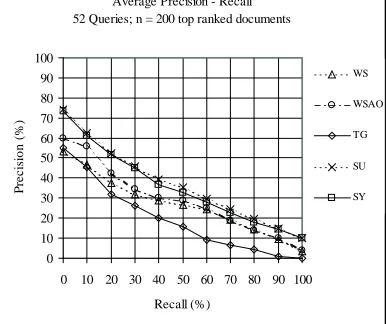
We here discuss the results from the analysis of the complete query set the data of which is given in Table 2 and visualized in Figure 1. For our base-line (WS), the direct match between query terms and document terms, precision is already poor at low re-call points (BDCFEGIH ), ranging in an interval from 53.3% to 31.9%. At high recall points (BKJMLNGIH ),
Precision (%)
Rec. WS WSA WSO WS TG SU SY
(%) AO
0 53.3 56.1 53.3 60.0 54.8 74.0 73.2
10 46.6 50.7 46.1 55.8 45.4 62.3 61.0 20 37.4 40.1 37.0 42.1 32.1 52.3 51.7 30 31.9 33.2 31.5 34.5 26.3 45.8 45.1
40 28.9 30.4 28.0 30.3 20.2 39.2 36.5 50 26.6 28.6 26.0 28.7 15.9 35.6 32.7 60 24.5 25.9 23.5 25.0 9.3 29.7 28.1 70 19.1 19.9 17.9 18.7 6.5 24.4 22.7 80 14.4 15.2 13.0 14.0 4.4 19.6 18.1
90 9.5 9.8 9.6 9.9 0.8 14.7 14.6
100 3.7 3.9 3.8 4.0 0.64 10.0 10.2
3pt 26.1 28.0 25.3 28.3 17.4 35.8 34.1 avr
[image:5.612.72.304.16.207.2]11pt 26.9 28.5 26.3 29.4 19.6 37.0 35.8 avr
Table 2:Precision/Recall Table for All Queries
precision drops from 19.1% to 3.7%. When we take term proximity (adjacency) into account (WSA), we observe a small though statistically insignificant in-crease in precision at all recall points, 1.6% on aver-age. Orthographic normalization only (WSO), how-ever, caused, interestingly, a marginal decrease of precision, 0.6% on average. When both parame-ters, orthographic normalization and adjacency, are combined (WSAO), they produce an increase of pre-cision at nine from eleven recall points, 2.5% on average compared with WS. None of these differ-ences are statistically significant when the two-tailed Wilcoxon test is applied at all eleven recall levels.
Trigram indexing (TG) yields the poorest results of all methodologies being tested. It is compara-ble to WS at low recall levels (BOCEGIH ), but at high ones its precision decreases almost dramati-cally. Unless very high rates of misspellings are to be expected (this explains the favorable results for trigram indexing in (Franz et al., 2000)) one cannot really recommend this method.
The subword approach (SU) clearly outperforms the previously discussed approaches. We compare it here with WSAO, the best-performing lexicon-free method. Within this setting, the gain in precision for
SU ranges from 6.5% to 14% (BPCQEGIH ), while for high recall values (BRJMLNGIH ) it is still in the range of 4.8% to 6%. Indexing by synonym class iden-tifiers (SY) results in a marginal decrease of overall performance compared with SU. To estimate the sta-tistical significance of the differences SU vs. WSAO and SY vs. WSAO, we compared value pairs at each
Average Precision - Recall 52 Queries; n = 200 top ranked documents
0 10 20 30 40 50 60 70 80 90 100
0 10 20 30 40 50 60 70 80 90 100
Recall (%)
P
re
c
is
io
n
(%
)
WS
WSAO
TG
SU
[image:5.612.329.522.27.189.2]SY
Figure 1:Precision/Recall Graph for All Queries
fixed recall level, using the two-tailed Wilcoxon test (for a description and its applicability for the inter-pretation of precision/recall graphs, cf. (Rijsbergen, 1979)). Statistically significant results (SUTWVH ) are in bold face in Table 2.
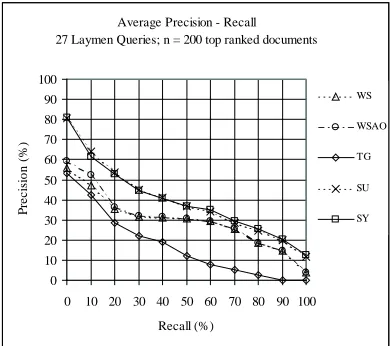
The data for the comparison between expert and layman queries is given in the Tables 3 and 4, re-spectively, and they are visualized in the Figures 2 and 3, respectively. The prima facie observation that layman recall data is higher than those of the experts is of little value, since the queries were acquired in quite different ways (cf. Section 3). The adjacency criterion for word index search (WSA) has no influ-ence on the layman queries, probably because they contain fewer search terms. This may also explain the poor performance of trigram search. A consider-ably higher gain for the subword indexing approach (SU) is evident from the data for layman queries. Compared with WSAO, the average gain in precision amounts to 9.6% for layman queries, but only 5.6% for expert queries. The difference is also obvious when we compare the statistically significant differ-ences (SXTYVH ) in both tables (bold face). This is also compatible with the finding that the rate of query result mismatches (cases where a query did not yield any document as an answer) equals zero for SU, but amounts to 8% and 29.6% for expert and laymen queries, respectively, running under the to-ken match paradigm WS* (cf. Table 5).
re-Precision (%)
Rec. WS WSA WSO WS TG SU SY
(%) AO
0 50.5 56.8 50.3 60.8 56.6 67.3 64.7 10 45.8 53.2 44.6 59.8 48.7 60.3 60.3 20 39.3 44.7 38.1 48.6 35.8 50.8 50.3 30 32.2 34.8 31.0 37.3 30.6 46.5 45.7 40 26.3 29.3 24.3 29.0 21.6 37.3 32.0 50 22.3 26.5 20.9 26.5 19.7 34.2 28.3 60 19.2 22.0 16.9 20.1 10.9 24.7 20.3
70 11.8 13.5 9.3 11.1 7.7 19.9 15.7
80 9.9 11.6 7.1 9.1 6.5 14.2 10.3
90 3.7 4.4 4.1 4.7 1.7 9.2 8.3
100 3.6 4.0 4.0 4.4 1.3 8.3 7.6
3pt 23.8 27.6 22.1 28.1 20.7 33.1 29.7 avr
11pt 24.1 27.3 22.8 28.3 21.9 33.9 31.2 avr
Table 3:Precision/Recall Table for Expert Queries
Precision (%)
Rec. WS WSA WSO WS TG SU SY
(%) AO
0 55.8 55.4 56.1 59.1 53.2 80.3 81.0
10 47.3 48.5 47.6 52.2 42.2 64.0 61.6 20 35.6 35.8 35.9 36.2 28.6 53.6 52.9
30 31.7 31.7 31.9 31.9 22.2 45.1 44.5
40 31.3 31.3 31.4 31.4 19.0 41.0 40.7
50 30.6 30.6 30.7 30.7 12.3 36.8 36.8 60 29.5 29.5 29.6 29.6 7.8 34.4 35.3 70 25.8 25.8 25.8 25.8 5.3 28.5 29.2 80 18.5 18.5 18.5 18.5 2.5 24.6 25.3 90 14.8 14.8 14.8 14.8 0.0 19.7 20.5
100 3.7 3.7 3.7 3.7 0.0 11.5 12.7
3pt 28.2 28.3 28.4 28.5 14.4 38.3 38.4 avr
[image:6.612.71.306.23.217.2]11pt 29.5 29.6 29.6 30.4 17.5 40.0 40.0 avr
Table 4:Precision/Recall Table for Layman Queries
sults partly to the lower baseline for layman queries, partly to the probably more accentuated vocabulary mismatch between layman queries and documents using expert terminology. However, this difference is below the level we expected. In forthcoming re-leases of the subword dictionary in which coverage, stop word lists and synonym classes will be aug-mented, we hope to demonstrate the added value of the subword approach more convincingly.
Generalizing the interpretation of our data in the light of these findings, we recognize a substantial in-crease of retrieval performance when query and text tokens are segmented according to the principles of the subword model. The gain is still not overwhelm-ing.
Average Precision - Recall 25 Expert Queries; n = 200 top ranked documents
0 10 20 30 40 50 60 70 80 90 100
0 10 20 30 40 50 60 70 80 90 100
Recall (%)
P
re
c
is
io
n
(%
)
WS
WSAO
TG
SU
[image:6.612.328.522.30.197.2]SY
Figure 2:Precision/Recall Graph for Expert Queries
Average Precision - Recall 27 Laymen Queries; n = 200 top ranked documents
0 10 20 30 40 50 60 70 80 90 100
0 10 20 30 40 50 60 70 80 90 100
Recall (%)
P
re
c
is
io
n
(%
)
WS
WSAO
TG
SU
SY
Figure 3:Precision/Recall Graph for Layman Queries
With regard to orthographic normalization, we expected a higher performance benefit because of the well-known spelling problems for German med-ical terms of Latin or Greek origin (such as in
‘Z¨akum’, ‘C¨akum’, ‘Zaekum’, ‘Caekum’, ‘Zaecum’, ‘Caecum’). For our experiments, however, we used
[image:6.612.327.522.231.404.2]desider-Rate of Query / Document Mismatch (%)
WS WSA WSO WSAO TG SU SY
Exp. 8.0 8.0 8.0 8.0 0.0 0.0 0.0
Lay. 29.6 29.6 29.6 29.6 0.0 0.0 0.0 All 19.2 19.2 19.2 19.2 0.0 0.0 0.0
Table 5:Query / Document Mismatch
atum for enhanced retrieval quality. The proximity (adjacency) of search terms as a crucial parameter for output ranking proved useful, so we use it as de-fault for subword and synonym class indexing.
Whereas the usefulness of Subword Indexing be-came evident, we could not provide sufficient evi-dence for Synonym Class Indexing, so far. However, synonym mapping is still incomplete in the current state of our subword dictionary. A question we have to deal with in the future is an alternative way to evaluate the comparative value of synonym class in-dexing. We have reason to believe that precision cannot be taken as the sole measure for the advan-tages of a query expansion in cases where the
sub-word approach is already superior (for all layman
and expert queries this method retrieved relevant documents, whereas word-based methods failed in 29.6% of the layman queries and 8% of the expert queries, cf. Figure 5). It would be interesting to eval-uate the retrieval effectiveness (in terms of precision and recall) of different versions of the synonym class
indexing approach in those cases where retrieval
us-ing word or subword indexes fails due to a complete mismatch between query and documents. This will become even more interesting when mappings of our synonym identifiers to a large medical thesaurus (MeSH, (NLM, 2001)) are incorporated into our sys-tem. Alternatively, we may think of user-centered comparative studies (Hersh et al., 1995).
4.1 The AltaVistaTMExperiment
Before we developed our own search engine, we used the AltaVistaTMSearch Engine 3.0 (http://
solutions.altavista.com) as our testbed, a
widely distributed, easy to install off-the-shelf IR system. For the conditions WSA, SU, and SY, we give the comparative results in Table 6. The exper-iments were run on an earlier version of the dic-tionary – hence, the different results. AltaVistaTM yielded a superior performance for all three major test scenarios compared with our home-grown en-gine. This is not at all surprising given all the tuning
Precision (%)
AltaVista Experimental
Recall WSA SU SY WSA SU SY
(%)
0 53.6 69.4 66.9 56.8 67.3 64.2 10 51.7 65.5 60.5 53.2 60.3 58.8 20 45.4 61.4 54.9 44.7 50.7 48.3 30 34.9 55.4 51.6 34.8 45.7 39.4 40 29.5 51.4 46.7 29.3 34.6 32.9 50 27.8 49.7 44.1 26.5 31.2 29.4 60 26.2 40.7 39.2 22.0 22.2 20.1 70 18.1 32.6 31.7 13.5 18.9 16.5 80 15.2 26.3 22.4 11.6 13.4 12.1
90 5.6 20.1 11.4 4.4 7.9 8.3
100 5.4 16.3 11.0 4.0 7.0 7.5
3pt 29.5 45.8 40.5 27.6 32.8 29.9 avrg
[image:7.612.317.534.21.227.2]11pt 28.5 44.4 40.0 27.3 32.6 30.7 avrg
Table 6:Precision/Recall Table for Expert Queries comparing the AltaVistaTMwith our Experimental Search Engine
efforts that went into AltaVistaTM. The data reveals
clearly that commercially available search engines comply with our indexing approach. In an exper-imental setting, however, their use is hardly justi-fiable because their internal design remains hidden and, therefore, cannot be modified under experimen-tal conditions.
The benefit of the subword indexing method is ap-parently higher for the commercial IR system. For
AltaVistaTM the average precision gain was 15.9% for SU and 11.5% for SY, whereas our simple tfidf -driven search engine gained only 5.3% for SU and 3.4% for SY. Given the imbalanced benefit for both systems (other things being equal), it seems highly likely that the parameters feeding AltaVistaTMprofit even more from the subword approach than our sim-ple prototype system.
5 Conclusions
to such lexical repositories (Krovetz, 1993; Kraaij and Pohlmann, 1996; Tzoukermann et al., 1997).
This result is particularly valid for natural lan-guages with a rich morphology — both in terms of derivation and (single-word) composition. Doc-ument retrieval in these languages suffers from se-rious performance degradation with the stemming-only query-term-to-text-word matching paradigm.
We proposed here a dictionary-based approach in which morphologically complex word forms, no matter whether they appear in queries or in docu-ments, are segmented into relevant subwords and these subwords are subsequently submitted to the matching procedure. This way, the impact of word form alterations can be eliminated from the retrieval procedure.
We evaluated our hypothesis on a large biomedi-cal document collection. Our experiments lent (par-tially statistically significant) support to the sub-word hypothesis. The gain of subword indexing was slightly more accentuated with layman queries, probably due to a higher vocabulary mismatch.
References
R. Baud, C. Lovis, A.-M. Rassinoux, and J.-R. Scherrer. 1998. Morpho-semantic parsing of medical expressions. In Proc.
of the 1998 AMIA Fall Symposium, pages 760–764.
Y. Choueka. 1990. RESPONSA: An operational full-text re-trieval system with linguistic components for large corpora. In A. Zampolli, L. Cignoni, and E. C. Peters, editors,
Com-putational Lexicology and Lexicography. Special Issue Ded-icated to Bernard Quemada. Vol. 1, pages 181–217. Pisa:
Giardini Editori E. Stampatori.
P. Dujols, P. Aubas, C. Baylon, and F. Gr´emy. 1991. Morphose-mantic analysis and translation of medical compound terms.
Methods of Information in Medicine, 30(1):30–35.
F. Ekmekc¸ioglu, M. Lynch, and P. Willett. 1995. Develop-ment and evaluation of conflation techniques for the imple-mentation of a document retrieval system for Turkish text databases. New Review of Document and Text Management, 1(1):131–146.
P. Franz, A. Zaiss, S. Schulz, U. Hahn, and R. Klar. 2000. Automated coding of diagnoses: Three methods compared. In Proc. of 2000 AMIA Fall Symposium, pages 250–254. D. Harman. 1991. How effective is suffixing? Journal of the
American Society for Information Science, 42(1):7–15.
T. Hedlund, A. Pirkola, and K. J¨arvelin. 2001. Aspects of Swedish morphology and semantics from the perspective of mono- and cross-language retrieval. Information Processing
& Management, 37(1):147–161.
W. Hersh, D. Elliot, D. Hickam, S. Wolf, A. Molnar, and C. Leichtenstien. 1995. Towards new measures of informa-tion retrieval evaluainforma-tion. In Proc. of the 18th Internainforma-tional
ACM SIGIR Conference, pages 164–170.
D. A. Hull. 1996. Stemming algorithms: A case study for detailed evaluation. Journal of the American Society for
In-formation Science, 47(1):70–84.
H. J¨appinen and J. Niemist¨o. 1988. Inflections and compounds: Some linguistic problems for automatic indexing. In Proc.
of the RIAO 88 Conference, volume 1, pages 333–342.
W. Kraaij and R. Pohlmann. 1996. Viewing stemming as recall enhancement. In Proc. of the 19th International ACM SIGIR
Conference, pages 40–48.
R. Krovetz. 1993. Viewing morphology as an inference pro-cess. In Proceedings of the 16th International ACM SIGIR
Conference, pages 191–203.
J. Lovins. 1968. Development of a stemming algorithm.
Mechanical Translation and Computational Linguistics,
11(1/2):22–31.
A. McCray, A. Browne, and D. Moore. 1988. The semantic structure of neo-classical compounds. In SCAMC’88 – Proc.
of the 12th Annual Symposium on Computer Applications in Medical Care, pages 165–168.
MSD. 1993. – Manual der Diagnostik und Therapie
[CD-ROM]. M¨unchen: Urban & Schwarzenberg, 5th edition.
NLM. 2001. Medical Subject Headings. Bethesda, MD: Na-tional Library of Medicine.
L. Norton and M. Pacak. 1983. Morphosemantic analysis of compound word forms denoting surgical procedures.
Meth-ods of Information in Medicine, 22(1):29–36.
M. Pacak, L. Norton, and G. Dunham. 1980. Morphoseman-tic analysis of -itis forms in medical language. Methods of
Information in Medicine, 19(2):99–105.
A. Pirkola. 2001. Morphological typology of languages for IR.
Journal of Documentation, 57(3):330–348.
M. Popovic and P. Willett. 1992. The effectiveness of stem-ming for natural language access to Slovene textual data.
Journal of the American Society for Information Science,
43(5):384–390.
M. Porter. 1980. An algorithm for suffix stripping. Program, 14(3):130–137.
C. J. van Rijsbergen. 1979. Information Retrieval. London: Butterworths, 2nd edition.
Gerard Salton. 1989. Automatic Text Processing. The
Transfor-mation, Analysis and Retrieval of Information by Computer.
Reading, MA: Addison-Wesley.
E. Tzoukermann, J. Klavans, and C. Jacquemin. 1997. Effec-tive use of natural language processing techniques for au-tomatic conflation of multi-word terms: The role of deriva-tional morphology, part of speech tagging, and shallow pars-ing. In Proc. of the 20th International ACM SIGIR
Confer-ence, pages 148–155.
F. Wingert. 1985. Morphologic analysis of compound words.
Methods of Information in Medicine, 24(3):155–162.
S. Wolff. 1984. The use of morphosemantic regularities in the medical vocabulary for automatic lexical coding. Methods
of Information in Medicine, 23(4):195–203.
P. Zweigenbaum, S. Darmoni, and N. Grabar. 2001. The contri-bution of morphological knowledge to French MESH map-ping for information retrieval. In Proc. of the 2001 AMIA