131
Performance Analysis of an I.C Engine Operating With
Different Honge Oil Blends
R.Girimurugan
1, A.Jayachandhru
2, G.Magudeshwaran
3, M.Prakash
4, M.Sasikumar
5Assistant Professor1, UG Scholars2,3,4,5, Department of Mechanical Engineering, Nandha College of Technology, Erode, Tamilnadu, India-638052.
Email:[email protected]1, [email protected]2, [email protected]3, [email protected]4, [email protected]5
Abstract-In this paper presents the performance analysis of an unmodified diesel engine fuelled with Honge oil and its blends with diesel. Engine tests have been conducted to get the comparative measures of Specific Fuel Consumption (SFC), Total Fuel Consumption (TFC), Heat Supply (QS), Brake Thermal Efficiency (BTE) and Indicate Thermal Efficiency (ITE). Results were compared with each other and finally best blend ratios are optimized. The present work presents the performance of diesel/Honge fuel blends in a diesel engine. Four blends were obtained by mixing diesel and Honge oil in the following proportions by volume: 95% diesel 5% Honge oil; 90% diesel 10%Honge oil; and 80% diesel 20% Honge oil. For comparison purposes, test runs were carried out for the pure diesel fuel. Experimental results show that the performance of the engine which is fuelled with honge oil blends is comparatively higher than Diesel fuel.
Index Terms- Single cylinder Diesel engine, performance analysis, honge oil blends.
1. INTRODUCTION
Fuels derived from renewable biological resources for use in diesel engines are known as biodiesel. Biodiesel is environmentally friendly liquid fuel similar to petrol-diesel in combustion properties. Increasing environmental concern, diminishing petroleum reserves and agriculture based economy of our country are the driving forces to promote biodiesel as an alternate fuel [1]. Oil content in the Jatropha and Pongamia seed is around 30- 40 %. India has about 80-100 million hectares of wasteland, which can be used for Jatropha and Pongamia plantation. India is one of the largest producer Neem oil and its seed contains 30% oil content. It is an untapped source in India [2].Experimental investigations have been carried out to examine properties, performance and emissions of different blends (B10, B20, and B40) of PME, JME and NME in comparison to diesel. Results indicated that B20 have closer performance to diesel and B100 had lower brake thermal efficiency mainly due to its high viscosity compared to diesel. However, its diesel blends showed reasonable efficiencies, lower smoke, CO and HC. Pongamia methyl ester gives better performance compared to Jatropha and Neem methyl esters [3].
2. ABOUT HONGE OIL
Honge oil is extracted from the seeds of the Honge tree. This tree is found all over India. In many places the leaves are used as green manure and the seed cake is used as fertilizer. Honge oil has fungicidal properties and is also traded as a non-edible
132 as choking of filters and high viscosities. The
suppliers of diesel engines had some reservations about the use of Honge oil earlier, but are now convinced that Honge oil can be used without any adverse impact on the engines.
3. PROBLEMS WITH VEGETABLE OILS
From previous studies, it is evident that there are various problems associated with vegetable oils being used as fuel in compression ignition (C.I.) engines, mainly caused by their high viscosity. The high viscosity is due to the large molecular mass and chemical structure of vegetable oils, which in turn leads to problems in pumping, combustion and atomization in the injector systems of a diesel engine. Due to the high viscosity, in long-term operation, vegetable oils normally introduce the development of gumming, the formation of injector deposits, ring sticking, as well as incompatibility with conventional lubricating oils. Therefore, a reduction in viscosity is of prime importance to make vegetable oils a suitable alternative fuel for diesel engines. The problem of high viscosity of vegetable oils has been approached in several ways, such as preheating the oils, blending or dilution with other fuels, trans-etherification and thermal cracking/pyrolysis.
4. TECHNIQUES IN PREPARING –
BIODIESEL
Generally the following techniques are used for preparing of Biodiesel.
(1) Micro emulsification (2) Blending
(3) Cracking (4) Pyrolysis
(5) Transesterification (6) Super Critical Method
5. TRANSESTERIFICATION PROCESS
To reduce the viscosity of the raw Honge oil, transesterification method is adopted. The procedure involved in this method is as follows: Sodium hydroxide [4g] is added to methanol [130ml] and stirred until properly dissolved. The solution thus prepared is called meth oxide which is added to raw Honge oil [850ml] and stirred at a constant rate at 600C for one hour. After the reaction is over, the solution is allowed to settle for 4-5 hours in a separating flask. The glycerin settles at the bottom and the methyl ester floats at the top (coarse biodiesel).Coarse biodiesel is separated from the glycerin and it is heated above10000C and maintained for 10-15 minutes for removing the untreated methanol. Certain impurities like sodium hydroxide (NaOH) etc are still dissolved in the coarse biodiesel. These impurities are cleaned two or three times by washing with 50 ml of petroleum ether and 100 ml of
water for 1000 ml of coarse biodiesel. This cleaned biodiesel is taken up for the study.
6. REASON TO USE HONGE OIL
(1) Physical and chemical properties of Honge oil are similar to those of diesel.
(2) Availability in India is more. (3) Harmless engine performance.
(4) No need of major modifications in Engine.
(5) Less expensive.
(6) Cake can be used as fertilizer.
(7) Tree based oil seed so the yield is more.
(8) Planting seedling a more densely than is normally required.
7. CHEMICAL AND PHYSICAL
PROPERTIES OF HONGE OIL
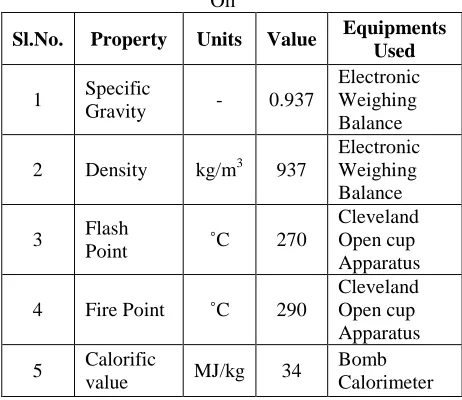
[image:2.595.305.536.375.575.2]The following table.1 shows the chemical and physical properties of transesterified honge oil were measured by various equipment in our Physics and chemistry Laboratory.
Table 1 Chemical and Physical Properties of Honge Oil
Sl.No. Property Units Value Equipments
Used
1 Specific
Gravity - 0.937
Electronic Weighing Balance
2 Density kg/m3 937
Electronic Weighing Balance
3 Flash
Point ˚C 270
Cleveland Open cup Apparatus
4 Fire Point ˚C 290
Cleveland Open cup Apparatus
5 Calorific
value MJ/kg 34
Bomb Calorimeter
8. TECHNICAL SPECIFICATIONS
Table.2 shows the technical specifications of the tested engine.Table.3 shows the technical specifications of the loading rheostat.Table.4 shows the technical specifications of the AC Generator. Table.5 shows the different measuring ranges of the Gas Analyzer.
9. EXPERIMENTAL SETUP
133 The experiments were carried out on a single
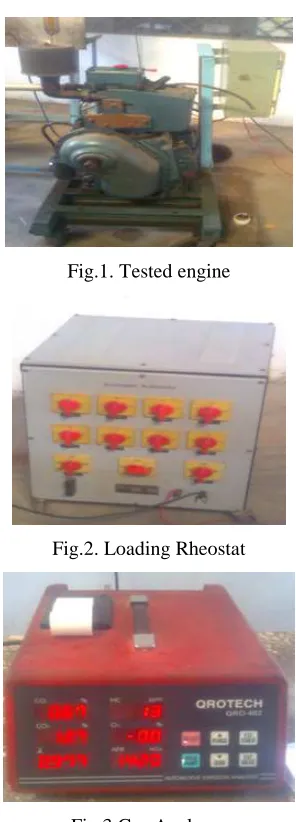
cylinder 4 stroke diesel engine of a model manufactured by Kirloskar oil engines Ltd., the largest manufacturer of portable multi-fuel engines. The Kirloskar engine is a single cylinder, vertical and air cooled diesel engine. It is coupled to a 3 phase loading rheostat. A fuel tank with a measuring burette enables the engine fuel consumption to be measured. The loading rheostat is coupled by means of rigid coupling carefully without any misalignment between axes. The proper alignment helps to damp-out any vibration that may occur during transmission.Fig.1 shows the engine which is used for our testing. Fig.2 shows the loading rheostat which is used to gives the external load to the test engine. Fig.3 shows the gas analyzerwhich is used to measure the amount of exhaust emissions in test engine.
Table 2 Technical details of the Engine
Type Four stroke, single cylinder, air cooled, vertical engine.
Made Kirloskar oil engines Ltd, Pune, India.
Loading Device Alternator with resistance load.
Speed 1500 RPM
Power 6 HP
[image:3.595.342.490.72.483.2]KW 4.4
Table 3 Technical details of the Loading Rheostat
Sl.No. Parameters Range
1 Watts 5 KW
2 Phase 3 Phase
3 Volts 230 V
Table 4 Technical Details of the AC Generator
Sl.No. Parameters Range
1 Volts 230 V
2 Frequency 50 Hz
3 Speed 1500
rpm 4 Phase Single
5 Amps 21.7 A
Table 5 Measuring Range of Gas Analyzer
Sl.No. Parameters Measuring Range
1 CO 0.00-20%
2 CO2 0.00-20%
3 HC 0-15000 ppm
4 NOX 0-5000ppm
5 O2 0.0-23.0%
6 AFR 0.0-99.0
7 Operating 0-400C
8 Power Source
AC 220V±10% 60 HZ
Fig.1. Tested engine
Fig.2. Loading Rheostat
Fig.3 Gas Analyzer
10. RESULTS AND DISCUSSIONS
The following discussions have been made based on the experimental results.
10.1.Specific Fuel Consumption (SFC)
Fig.4 shows the specific fuel consumption (SFC) value of the engine is decreasing with the increased load on the engine. Then the SFC value decreased with compare diesel value at the same time increasing Honge oil blend resulting the decreased SFC value.B20 gives the better SFC value compare than other blend value and diesel.
10.2.Total Fuel Consumption (TFC)
[image:3.595.82.282.330.759.2]134
10.3.Heat Supply (QS)
Fig.6 shows the heat supply (QS) value of the engine is increasing with the increased load on the engine. Then the QS value decreased with compare diesel value at the same time increasing Honge oil blend resulting the decreased TFC value. B20 gives the better QS value compare than other blend value and diesel.
10.4.Brake Thermal Efficiency (BTE)
Fig.7 shows that the Brake thermal efficiency of the Engine gradually increased with increasing load (up to 3.5 KW) then slightly decreases with increased load Honge oil blend B20 gives the highest Brake Thermal Efficiency(28.50 %) compared with diesel (25.27%) and other Honge oil blend value. Diesel value gives low Brake thermal efficiency compared with all Honge oil blends.
10.5.Indicate Thermal Efficiency (ITE)
Fig.8 shows that the Indicate Thermal Efficiency of the Engine gradually increased with increasing load (upto1.5 KW) then slightly decreases with increased load. At load (1.5KW) the Honge oil blend B20 gives the highest Indicate Thermal Efficiency (39.10 %) compare than diesel (35.32%).
Fig.4 Load vs specific fuel consumption at varying loading conditions
Fig.5 Load vs total fuel consumption at varying loading conditions
Fig.6 Load vs heat supply at varying loading conditions
Fig.7 Load vs brake thermal efficiency at varying loading conditions
Fig.8 Load vs indicate thermal efficiency at varying loading conditions
Summary
135 Brake thermal efficiency of B5, B10 and B20 blends
are better than diesel. Indicate thermal efficiency of B5, B10 and B20 blends are better than diesel.
REFERENCES
[1] Ramadhas, A.S; Jayaraj, S; Muraleedharan, C. (2004): Use of Vegetable Oils as I.C engine Fuels: A Review". Renewable Energy. 29, pp. (727-742). [2] Barnwal, B.K; Sharma, M.P. (2005): Prospects of
biodiesel production from vegetable oils India. Renewable and Sustainable Energy Reviews.9, pp. (363-378).