HYPERBUG: A Scalable Natural Language Generation Approach
Martin Klarner
University Erlangen-Nuremberg
[email protected]
Abstract
A scalable natural language generation (NLG) system called HYPERBUG1 embedded in an agent-based, multimodal dialog system is pre-sented. To motivate this presentation, several scenarios (including a domain shift) are iden-tified where scalability in dialog systems is really needed, and NLG is argued to be one way of easing this desired scalability. There-fore the novel approach to hybrid NLG in the HYPERBUG system is described and the scal-ability of its parts and resources is investi-gated. Concluding with a few remarks to discourse generation, we argue that NLG can both contribute to and benefit from scalability in dialog systems.
1
Introduction
Scalability in dialog systems is, of course, not only a matter of the natural language understanding (NLU) component, but also of the NLG part of the system.2 We nevertheless see a lot of the effort spent in designing and implementing spoken dialog systems go into analy-sis of speech and language; generation is often left aside or squeezed in afterwards. Therefore an NLG compo-nent must fit into the existing dialog system framework and answer to the preset priorities in dialog system de-velopment.
We present a scalable NLG system embedded in an agent-based, multimodal dialog system. To this end, we
1 The acronym stands for hybrid, pragmatically embedded
realization with bottom-up generation.
2 In fact, for a working spoken dialog system even more
components have to be scalable, including the speech recog-nizer, the speech synthesizer and, most important of all, the dialog manager. But for now we concentrate on the opposi-tion of NLU and NLG.
first address common scenarios for scalability in dialog systems and describe the role of NLG in such systems before focusing on a classification of NLG systems in general and our hybrid linguistic realization approach in particular. After giving an overview of our NLG system we will be able to show how our notion of reversibility with respect to internal and external resources and the interaction and combination of shallow and deep NLG in HYPERBUG work towards and profit from scalability in our dialog system.
2
Scalability in Dialog Systems
Scalability for spoken dialog systems is needed in sev-eral situations, including the following scenarios: 1. Enlarging the domain content modifies and extends
the thematic orientation of the domain.
2. Refining the domain language extends the linguis-tic coverage and expressibility of the domain. 3. Changing the application domain refers to usually
both of the first two and can lead to completely new requirements for a dialog system and its parts. 4. Changing the discourse domain alters the
dis-course type within the same domain.
The common consequence of these four scenarios is their impact on both NLU and NLG: If scalability is not biased between these two parts, one cannot expect the system to be scalable as a whole. Especially in the situa-tion of a domain shift, the degree of automated knowl-edge acquisition is an important issue to minimize costly (both in terms of time and money) manual efforts. If these are unavoidable for the NLU component, as it will often be the case in a real-world scenario, at least the NLG module must automatically benefit from them.
3
NLG in Dialog Systems
hy-brid approach of combining NLG and templates in the IDAS system. Generally speaking, the application of NLG techniques in a real-world system must be justified with respect to linguistic and economic requirements. If templates are used, a smart approach is needed in all scenarios mentioned in section 2 to avoid being forced to completely redesign at least the data part of the sys-tem output component. Nevertheless, fielded dialog systems often settle for a shallow generation module which relies on canned text and templates because of limited financial means and linguistic knowledge.
3.1 NLG and Dialog Management
In our spoken dialog system (Bücher et al., 2001), the dialog manager (DM) is responsible for the integration of user utterances into the discourse context. Moreover, the DM initiates system answers to user’s questions and system error messages if a user’s goal is unsatisfiable or a system task cannot be fulfilled. But these system ut-terances must be verbalized as well, i.e. translated from abstract semantic representations to natural language sentences. This task is not placed within the DM, but “outsourced” to a component with adequate linguistic competence, the NLG module. This way, the DM can be designed completely amodal, i.e. it does not need to have any linguistic knowledge. Moreover, we can see that scenario 4 in section 2 can be separated into a lin-guistic and a dialog part. The first part corresponds to scenario 2, the second is covered by the DM in our sys-tem; hence we may skip scenario 4 for the remainder of this paper.
3.2 Reversibility in dialog systems
Given a spoken dialog system in general and an NLG component in such a system in particular, we consider reversibility a central means to allow for scalability. Considering reversibility, we want to introduce two dis-tinctions: We discriminate between reversibility of al-gorithms and reversibility of data on the one hand and between static (at developing time or at compile time) and dynamic reversibility (at runtime) on the other hand. In this terminology, reversibility of data means re-using existing system resources by the NLG component. We can classify NLG resources into two groups: The language analysis part contains the (syntactic and se-mantic) lexicon, the morphology component, and the grammar, while the DM part comprises the discourse memory, the domain model, and the user model.3
3 For a different classification of knowledge resources for
text planning, see (Maier, 1999).
4
Scalability in tactical generation
We focus on a special part of generation, the tactical generation or linguistic realization, according to the classification in (Reiter and Dale, 2000)4. We are able to do so mainly because, as mentioned in 3.1, the DM is responsible for content determination in our system. This leaves the realization task for the NLG component (besides some microplanning, which has to be per-formed as well).
4.1 A taxonomy of existing systems
In this section we will classify existing tactical genera-tion systems into three groups and address problems with scalability in each one of them.
Shallow generation systems form the first group; e.g. COMRIS (Geldof, 2000). The approach taken there relies on canned text and templates, and the domain dependency of these constructs is inherent. Therefore, in scenario 3 of section Fehler! Verweisquelle konnte nicht gefunden werden., once a domain shift is pro-jected, the whole data part of the NLG component must be redesigned from scratch. In scenarios 1 and 2 the existing resources must be extended only, but even this can become a hard task if the existing template database is large enough.
Deep generation systems make up the second group, e. g. KPML (Bateman 1997); they often suffer from large overgenerating grammars and slow processing time. Also often well-founded linguistic knowledge is re-quired to create and maintain the grammars needed. Their problems with scalability arise primarily in sce-narios 1 and 2, when thematic or linguistic coverage must be increased.
The third group, “modern” generation5 systems ide-ally avoid the shortcomings of both of the above men-tioned classical approaches. We distinguish between three types here: NLG with XSLT (Wilcock, 2003), which is basically template-based generation from XML input; stochastic approaches like (Oh and Rudnicky, 2000), where the deep generation grammar is replaced by a stochastic language model, and hybrid generation approaches like D2S (Theune et al., 2000), which bridges the gap between NLG and speech synthesis by a prosody module.
4 Dale and Reiter distinguish between linguistic and
struc-ture realization, the former corresponding to the content and the latter to the structural part of tactical generation. We find this distinction somewhat artificial, because the content must be already determined for realization, but want to use it anyway to further clarify the task carried out by our system.
5 For these systems, the term “hybrid” is normally used in
4.2 Hybrid tactical generation
In our terminology, hybrid generation means the combi-nation of shallow and deep generation in a single sys-tem; therefore, hybrid systems are a special case of the “modern” approaches, which were mentioned in the preceding section and do not necessarily contain any of the two “classical” approaches. For practical needs, we focus on how to combine deep (grammar-based) and shallow (template-based) generation techniques under the term hybrid NLG. We distinguish three types of such hybrid NLG systems:
Type I: Shallow NLG with deep elements Type II: Deep NLG with shallow elements Type III: Concurring deep and shallow NLG
Here are two examples of existing systems to illustrate the classification just given: D2S fills slots in syntactic templates containing derivation trees and therefore can be classified as a type I system. (Wahlster, 2000) has separate shallow and deep generation modules resulting in a system of type III.6
5
The HYPERBUG Approach
5.1 System core functionality
Our approach to realization is to combine all three types of hybrid tactical generation mentioned in section 4.2 in a single system called HYPERBUG. The goals for its
de-sign and implementation were:
6 Type II was, though theoretically sound and possible,
dif-ficult to find in existing systems.
1. To re-use existing system resources originally de-signed for parsing
2. To generate templates at runtime rather than mere sentences
3. To dynamically reduce the workload on deep gen-eration and gradually let shallow gengen-eration take over
4. To learn the domain-dependent part of the tactical generation task while the dialog is running and, ul-timately, enable automatic adaptation to domain-shifts
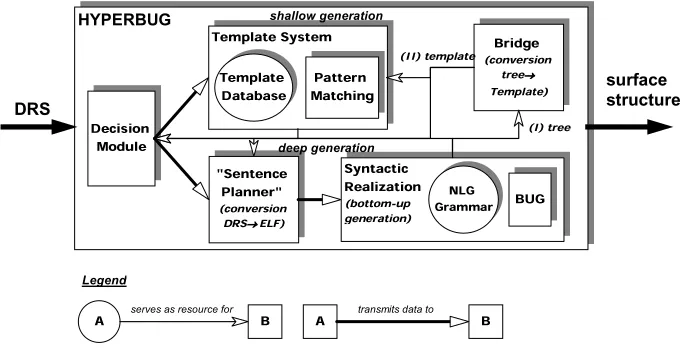
Figure 1 shows the system core of HYPERBUG. As a shallow generation component, we implemented a pow-erful template engine with recursion and embedded deep generation parts, including a lexicon, a morphol-ogy component, inflection, and constituent aggregation, resulting in a system of type I in our classification. For the deep generation branch, we decided to settle for a combination of a microplanning and a realization component: The first module, a “sentence planner”, in essence converts the input discourse representation structure (DRS, Kamp and Reyle, 1993) which is pro-vided by the DM into a different semantic representa-tion, the extended logical form (ELF)7. This ELF
structure serves as input for the second module, a modi-fied and improved version of bottom-up generation (BUG, van Noord, 1990) in Java, using a unification-based grammar with feature structures. We also incor-porated elements of shallow generation in our version of BUG: Surface text parts, e.g. proper nouns, may occur in the semantic input structure, the ELF. The
7 The extensions allowed (as compared to a conventional
LF) include syntactic functions like tense and mode, topical-ization information and subordination clause type.
Figure 1: System core of H
YPERBUGHYPERBUG
o
!
"# %$&'(*) +,(-./
01 -243/5-67 98:;&<6 %2 shallow generation
>=>=!
?
@=!
Legend
serves as resource for transmits data to A8 -)67 %)$
B?/5-)) -A <C
D-E%F oGHJI
!
B5*6K6 %J) +,5-67$L) 01 -243/5%6
"#5%675-M5-&<
8:;)675-$67$ N; %5-/O<5-67(-)
P
RQCSK
T
K! UWVKX XY>Z<[\[,Z'Y deep generation
W]_^
DRS
piled exception lexicon is searched first, whenever a proper noun occurs in the LF8. Thus, we get a type II
system.
Links between shallow and deep generation are pro-vided in two ways: At first, a decision module analyzes the input and invokes the appropriate realization branch, making HYPERBUG a system of type III. Stage 1 of this decision module is to use shallow generation as default and deep generation only as a fallback strategy. Stage 2 uses keyword spotting techniques in the input XML structure with XPATH and a lookup in an index table containing references to available canned text and tem-plates. For stage 3, a planning procedure makes use of the speech act, the discourse situation and the user model to ensure that the most appropriate processing branch is selected; in extension of the approach for text
8 Proper nouns are indicated simply by capitalizing them.
planning presented in (Stent, 2001), we have applied Conversation Acts Theory (Poesio, 1994) to linguistic realization here.
Not only do we combine all three types of hybrid reali-zation in our system, but we also interleave shallow and deep generation in another way: At last, after the com-plete utterance has been generated, a “bridge” between shallow and deep generation implements a feedback loop from BUG to the template system. This type of “bootstrapping”9 is mainly responsible for the novel
approach taken in HYPERBUG.
Figure 1 depicts, besides the system core, also the first two parts of the “bootstrapping” procedure developed in HYPERBUG.
9 We use the term “bootstrapping” mainly as an analogy to
classical bootstrapping procedures, hence the quotation marks.
HYPERBUG
!"#!%$ #!&'("#!)
*,+-
. .
/10 2
-.
34567
389::7 0 +0
* 6+0 +5 25; -
*,+- =<>8
?A@CBED9FGEHI@CJ1K9L M <N4 - O3:8 0:<
PK9Q9FR@CG
-+ ; +0 +6 4
454 -+S 6 +
4
TVUWAW,X:YX:Z
[X\U ]=^_U:`
a bAbNcedVf9gihjdekmlAnNoIkCpqgidlqril>ktsucVvxwCyzv
shallow generation
oIde}Cfmk|C9}1vrxlkisucVvxwCyzv
)%C 1"(
vh vl>gic
vl>v9gih dek9l
ktw|AcVv
Legend
serves as resource for transmits data to corresponds to
(1) KQML + DRS
(3a) sentence + wave files
(2b) DRS (2a) DRS
(2c) ELF
(3b) sentence
j =
\j
U::U
mT
TU _^j] M <z4 -
*, 0
=+ ; +0+6 =-+ + ¡#!#!&¢V' "#!)
TV
XWAW1X
deep generation
(I) BUG passes the generated derivation tree to the bridge, where it is converted into a template.
(II) The bridge sends the template to the template sys-tem where it is stored for further use and to the decision module where a reference is saved in the index table. This way, the next dialog turn with similar semantic input can be realized faster using a template without having to invoke the deep generation branch again.
5.2 Resources and reversibility
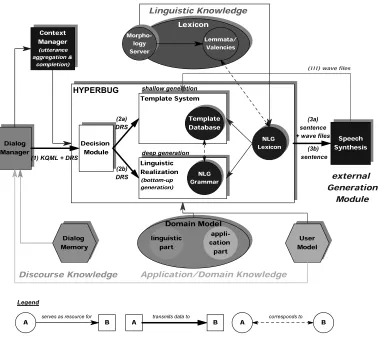
Extending our description from the core functionality explained in the previous section, we now turn our at-tention to the resources used in HYPERBUG. Figure 2
gives an overview of the internal and external resources of HYPERBUG and their usage.
The linguistic knowledge is contained in the system lexicon and the morphology component. The former can be distinguished further into a valency lexicon contain-ing case frames and a lemmata lexicon for domain ex-ceptions10. These exceptions are compiled into the NLG lexicon used by both the shallow and deep generation branch, resulting in a static reversibility of data. The morphology component is separated from the core lexi-con and implemented as a server which can both ana-lyze and generate and is consequently used for parsing and generation. As a server with a uniform query inter-face, from the outside it looks like it were algorithmi-cally reversible, but internally the algorithms for parsing and generation are implemented differently, resulting in a dynamic reversibility of data, because identical data are used and the processing direction is decided at run-time in the query sent to the server.
A separated module called context manager (CM) is responsible for sentence-spanning processing: It per-forms macro-aggregation11 and completion of underspe-cified utterances from the DM. For this task, access to the dialog memory is required, which is performed indi-rectly via a DM request12.
The templates are stored in a database which corre-sponds to the grammar in the deep generation branch. Unfortunately, the chunk grammar used for analysis is insufficient for generation13, resulting in a lack of even static reversibility: In this case, the requirements for robust parsing differ too much from the ones for vari-able NLG.
10 The domain independent lexicon entries are derived from
WORDNET synsets.
11 By this term we mean aggregation on the sentence level,
as opposed to micro-aggregation which occurs between con-stituents.
12 In the current implementation of our system, the dialog
memory is only accessible this way.
13 The chunk grammar does, of course, not contain phrase
rules up to the sentence level.
The domain model is divided into a linguistic and an application-specific part. Only the linguistic part is used in HYPERBUG, mainly for substitution of synonyms,
hyperonyms and hyponyms to enlarge variability in lexical choice, a part of microplanning also handled by our approach to NLG.
The processing steps in the system are as follows: (1) The dialog manager sends to HYPERBUG a KQML14 message with the semantic representation of the system utterance to be realized (a DRS encoded in an XML structure), enriched with pragmatic information such as sender, KQML speech act, and pragmatic dialog act. (2) The decision module determines, based on linguistic and pragmatic information (such as the speech act and the user model), whether shallow or deep generation is (more) appropriate to process the message and feeds it (a) to the template system or (b) to the deep generation branch (or to both of them, as a fall-back strategy). (3 a) The template system passes the generated surface structure with additional information15 to the speech synthesis agent16, including wave files of utterance parts which were already synthesized before.
(3 b) BUG passes the generated surface structure with additional information to the speech synthesizer. There is also a third bootstrapping aspect depicted in Figure 2:
(III) The synthesizer agent returns the synthesized wave files to the template system to enhance the stored tem-plates. This way, the synthesizer does not have to pro-cess identical utterance parts more than once, thus increasing the efficiency in synthesis and the real-time-capacity of the system. 17
5.3 Scalability in HYPERBUG
After giving an overview of our NLG system, we will now address scalability issues in its parts and resources. Template system. Templates in HYPERBUG are at least
algorithmically unproblematic: The pattern matching algorithm is linear complex with the number of entries. But normally, template systems are poorly maintainable and need to be rewritten from scratch after a domain shift. We try to overcome this difficulty by isolating a considerably large domain-independent part, such as metadialog (ambiguity, coherence state, and plan/action
14 The language KQML is currently used for agent
commu-nication in our system, but we are in the process of transition to FIPA-ACL.
15 sentence accent to influence prosody generation in the
synthesizer and deixis to synchronize textual output with the avatar in our multimodal system
16 in essence a wrapper agent around the open-source
syn-thesizer MBROLA
17 System profiling has shown a considerable amount of
state), greeting, and default messages18, avoiding much of the effort needed in scenario 3. Scenarios 1 and 2, on the other hand, are treated in our template system by using modularity via inclusion: The templates are recur-sive so that we can easily extend and refine the existing database. All in all, we can state that relatively few new entries are required for our template system in all three scenarios 1-3.
Lexicon and morphology component. The lexicon and the morphology component are also algorithmically unproblematic, as they are linear complex with the num-ber of entries. Furthermore, we were able to re-use a large part of the existing system resources initially de-signed for parsing (i.e. the exception lexicon and the morphology server). We can summarize that, for these two components, NLG automatically grows with NLU, and that no NLG-specific effort is required in the first three scenarios mentioned above.
Grammar. For the deep generation branch, the gram-mar can lead to algorithmic problems: The algorithm has exponential complexity, but only in the number of categories within the rules. However, this number is finite with a low upper bound. The algorithm has linear complexity in the number of words, just like the under-lying lexicon does. Disjunctive unification can cause problems, but not if it is restricted to simple features, as it is in our system. Anyway, a large part of the rules can be re-used in all three scenarios19, but a proper grammar organization is required for the inevitable manual main-tenance.
Hybrid approach. The central argument for the scal-ability of HYPERBUG, however, lies in its special hybrid design: The decision module before and the bridge after the two generation branches constitute the bootstrapping approach which continually improves the system per-formance in terms of efficiency and linguistic coverage at runtime (useful for scenarios 1 and 2) and enables automatic adaptation to domain shifts (scenario 3). Speech synthesis.HYPERBUG has a built-in feature ena-bling intrasentential multilingual speech synthesis20, rendering the system scalable in terms of language changes. The second aspect of scalability within speech synthesis is the other “bridge” between this external module and the template system which gradually im-proves the system response time in all three scenarios. Pragmatic resources. The pragmatic resources com-prise the dialog memory, the domain model and the user model. For the domain model, it is possible that new
18 i.e. ok and error messages, the latter tending to be rather
domain-specific, though
19 This is, of course, the inherent advantage of deep over
shallow NLG.
20 Basically, lexical information about the language of a
proper noun (e.g. a person’s name) is included in the output to the synthesizer which uses this information to switch be-tween target languages, even within a single sentence.
NLG-specific entries are required in the scenarios above. But these entries are not a critical factor in terms of scalability. The complexity of the discourse memory mainly depends on the dialog length. This is a largely domain-independent factor and not affected by our sce-narios. All we can say about the user model is that as a primarily non-linguistic resource it is not in the focus of NLG. If it needs to be enriched or refined in scenario 1 and 2 or even redefined in scenario 3, its usage in our NLG system retains its complexity.
We conclude that the external pragmatic resources can be extended and re-used without any impact on HYPERBUG and do therefore not influence the scalability of our NLG component.
Discourse generation. Finally, we want to briefly ad-dress some aspects of discourse generation as a way of scalability in terms of linguistic expressibility. Deictic expressions are currently hard-coded in special tem-plates, because they are highly domain-dependent. In our multimodal system, they must be synchronized with the other output modalities, such as the avatar perform-ing deictic gestures. The expected place for anaphora generation in our system is the CM. As a pragmatic re-source, the dialog memory is used for this task via the DM. Pronominal references are enabled by the CM which checks for appropriate discourse referents to be pronominalized; they are executed by the sentence planner which substitutes nouns by matching pronouns in the LF. The conditions for appropriate (i.e. unambi-guous) anaphora and replacements of nouns by pro-nouns are not easy to meet and check. Our current idea involves a generate-and-test approach, i.e. we want to tentatively generate an anaphor or a pronoun and use the analysis part of our dialog system to determine whether they are ambiguous or not.
6
Related Work
Generally, the method known as explanation-based gen-eralization from machine learning is comparable to the bootstrapping approach described here; but normally learning is achieved by offline training.
In (Neumann, 1997) a training phase with an appropri-ate corpus is needed, while we perform generation at runtime without such a corpus. Furthermore, Neumann extracts complex subgrammars; we generate annotated surface sentences instead, which are less expressible, but faster to instantiate. And finally, Neumann performs a static template choice as opposed to our runtime deci-sion module which can opt for deep generation based on pragmatic constraints, even if a semantically appropriate template is already available.
(Scott, 1998) can be seen as offline interface generation using a GUI and therefore as a manual version of the bootstrapping approach described here, but her system is used for content determination, not for realization.
7
Conclusion and Further Work
We have presented a hybrid NLG system that can both contribute to and benefit from the scalability in its em-bedding multimodal dialog system. Various scenarios requiring a scalable NLG system where identified and applied to our system components and resources in or-der to analyze their scalability.
A prototype of the system is implemented and used in several different domains, namely home A/V and car audio management (Bücher, 2001), B2B e-procurement (Kießling, 2001), and model train controlling (Huber and Ludwig, 2002), but we need further evaluation of the requirements for a domain shift and of the user ac-ceptance to improve the quality of our output language and speech.
What remains to do on the implementation side? Tech-nically, we still lack a fully implemented “sentence planner” with in-depth analysis of the semantic input structure (which is only processed in a shallow manner by now), and a separation of pure canned text from templates for efficiency. Also, the interface to the lin-guistic part of the domain model which is represented in description logics must be implemented using an appro-priate inference machine. Conceptually, we want to broaden the bridge between shallow and deep genera-tion, refine the specification of stage 3 in the decision module, and work out a way to access the user model directly (currently, it is accessed indirectly via the DM, just like the discourse memory).
Acknowledgements
The author wants to thank Bernd Ludwig and Peter Reiss for fruitful discussions and interesting ideas con-tributing to the research reported in this paper.
References
John Bateman. 1997. Enabling technology for
multilingual natural language generation: the KPML development environment. Journ. Natural Language Engineering 3 (1):15-55.
Kerstin Bücher et al. 2001. Discourse and Application Modeling for Dialogue Systems. Proc. KI-2001 Workshop on Applications of Description Logics. Simon Corston-Oliver. 2002. An overview of Amalgam:
A machine-learned generation module. Proc. Int. Natural Language Generation Conference, New York:33-40.
Sabine Geldof. 2000. Context-sensitivity in advisory text generation. PhD Thesis, University of Antwerp. Alexander Huber and Bernd Ludwig. 2002. A Natural
Language Multi-Agent System for Controlling Model Trains. Proc. AI, Simulation, and Planning in High Autonomy Systems (AIS-2002):145-149.
Hans Kamp and Ulrich Reyle. 1993. From Discourse To Logic. Kluwer, Boston/Dordrecht/London.
Werner Kießling et al. 2001. Design and Implementa-tion of COSIMA - A Smart and Speaking E-Sales As-sistant. Proc. 3rd International Workshop on Advanced Issues of E-Commerce and Web-Based In-formation Systems (WECWIS '01):21-30.
Günther Neumann. 1997. Applying Explanation-based Learning to Control and Speeding-up Natural Lan-guage Generation. Proc. ACL/EACL-97.
Gertjan van Noord. 1990. An Overview of Head-Driven Bottom-Up Generation. In: Robert Dale et al. Cur-rent Research in Natural Language Generation.
Springer, Berlin/Heidelberg/New York.
Alice Oh and Alexander Rudnicky: Stochastic language generation for spoken dialogue systems. Proc. ANLP/NAACL 2000 Workshop on Conversational Systems: 27-32.
Ehud Reiter. 1995. NLG vs. Templates. Proc. 5th Euro-pean Workshop on Natural Language Generation (EWNLG-1995).
Ehud Reiter and Robert Dale. 2000. Bulding Natural Language Generation Systems. Cambridge Univer-sity Press, Cambridge, UK.
Donia Scott et al. 1998. Generation as a Solution to its Own Problem. Proc. 9th Int. Workshop on Natural Language Generation (INLG-98).
Amanda J. Stent. 2001. Dialogue Systems as Conver-sational Partners: Applying Conversation Acts Theory to Natural Language Generation for Task-Oriented Mixed-Initiative Spoken Dialogue. PhD Thesis, Rochester, NJ.
Marie Theune et al. 2000. From Data to Speech: A General Approach. Natural Language Engineering 7(1):47-86.
Wolfgang Wahlster. 2000. Verbmobil: Foundations of Speech-to-Speech Translation. Springer, Berlin/Hei-delberg/New York.
Graham Wilcock. 2003. Generating Responses and