Translation Model Generalization using Probability Averaging
for Machine Translation
Nan Duan
1, Hong Sun
School of Computer Science and Technology
Tianjin University
[email protected]
[email protected]
Ming Zhou
Microsoft Research Asia
[email protected]
Abstract
Previous methods on improving transla-tion quality by employing multiple SMT models usually carry out as a second-pass decision procedure on hypotheses from multiple systems using extra fea-tures instead of using feafea-tures in existing models in more depth. In this paper, we propose translation model generalization
(TMG), an approach that updates proba-bility feature values for the translation model being used based on the model it-self and a set of auxiliary models, aiming to enhance translation quality in the first-pass decoding. We validate our approach on translation models based on auxiliary models built by two different ways. We also introduce novel probability variance features into the log-linear models for further improvements. We conclude that our approach can be developed indepen-dently and integrated into current SMT pipeline directly. We demonstrate BLEU improvements on the NIST Chinese-to-English MT tasks for single-system de-codings, a system combination approach and a model combination approach.1
1
Introduction
Current research on Statistical Machine Transla-tion (SMT) has made rapid progress in recent decades. Although differed on paradigms, such as phrase-based (Koehn, 2004; Och and Ney, 2004), hierarchical phrase-based (Chiang, 2007) and syntax-based (Galley et al., 2006; Shen et al., 2008; Huang, 2008), most SMT systems
1
This work has been done while the author was visiting Microsoft Research Asia.
low the similar pipeline and share common translation probability features which constitute the principal components of translation models. However, due to different model structures or data distributions, these features are usually as-signed with different values in different transla-tion models and result in translatransla-tion outputs with individual advantages and shortcomings.
In order to obtain further improvements, many approaches have been explored over multiple systems: system combination based on confu-sion network (Matusov et al., 2006; Rosti et al., 2007; Li et al., 2009a) develop on multiple N -best outputs and outperform primary SMT sys-tems; consensus-based methods (Li et al., 2009b; DeNero et al., 2010), on the other hand, avoid the alignment problem between translations can-didates and utilize n-gram consensus, aiming to optimize special decoding objectives for hypo-thesis selection. All these approaches act as the second-pass decision procedure on hypotheses from multiple systems by using extra features. They begin to work only after the generation of translation hypotheses has been finished.
In this paper, we propose translation model generalization (TMG), an approach that takes effect during the first-pass decoding procedure by updating translation probability features for the translation model being used based on the model itself and a set of auxiliary models. Baye-sian Model Averaging is used to integrate values of identical features between models. Our con-tributions mainly include the following 3 aspects:
probability values; yet such pairs could be disliked or even be absent in syntax-based models because of their violation on syntac-tic restrictions. We alleviate such model bias problem by using the generalized probability features in first-pass decoding, which com-puted based on feature values from all trans-lation models instead of any single one.
Alleviate the over-estimation problem based on translation models with an identical pa-radigm but different training corpora. In order to obtain further improvements by using an existing training module built for a specified model paradigm, we present a ran-dom data sampling method inspired by bag-ging (Breiman, 1996) to construct transla-tion model ensembles from a unique data set for usage in TMG. Compared to results of TMG based on models with different para-digms, TMG based on models built in such a way can achieve larger improvements.
Novel translation probability variance fea-tures introduced.
We present how to compute the variance for each probability feature based on its values in different involved translation models with prior model probabilities. We add them into the log-linear model as new features to make current SMT models to be more flexible.
The remainder of this paper is organized as follows: we review various translation models in Section 2. In Section 3, we first introduce Baye-sian Model Averaging method for SMT tasks and present a generic TMG algorithm based on it. We then discuss two solutions for constructing TM ensembles for usage in TMG. We next in-troduce probability variance features into current SMT models as new features. We evaluate our method on four state-of-the-art SMT systems, a system combination approach and a model com-bination approach. Evaluation results are shown in Section 4. In Section 5, we discuss some re-lated work. We conclude the paper in Section 6.
2
Summary of Translation Models
Translation Model (TM) is the most important component in current SMT framework. It provides basic translation units for decoders with a series of probability features for model
scoring. Many literatures have paid attentions to TMs from different aspects: DeNeefe et al.
(2007) compared strengths and weaknesses of a phrase-based TM and a syntax-based TM from the statistic aspect; Zollmann et al. (2008) made a systematic comparison of three TMs, including phrasal, hierarchical and syntax-based, from the
performance aspect; and Auli et al. (2009) made a systematic analysis of a phrase-based TM and a hierarchical TM from the search space aspect.
Given a word-aligned training corpus, we separate a TM training procedure into two phas-es: extraction phase and parameterization phase.
Extraction phase aims to pick out all valid translation pairs that are consistent with pre-defined model constraints. We summarize cur-rent TMs based on their corresponding model constraints into two categories below:
String-based TM (string-to-string): reserves all translation pairs that are consistent with word alignment and satisfy length limitation. SMT systems using such TMs can benefit from a large convergence of translation pairs.
Tree-based TM (string-to-tree, tree-to-string or tree-to-tree): needs to obey syntactic re-strictions in one side or even both sides of translation candidates. The advantage of us-ing such TMs is that translation outputs trend to be more syntactically well-formed.
Parameterization phase aims to assign a series of probability features to each translation pair. These features play the most important roles in the decision process and are shared by most cur-rent SMT decoders. In this paper, we mainly focus on the following four commonly used do-minant probability features including:
translation probability features in two direc-tions: and
lexical weight features in two directions:
and
parame-terization phase. In order to utilize translation pairs more fairly in decoding, it is desirable to use more information to measure the quality of translation pairs based on different TMs rather than totally believing any single one.
3
Translation Model Generalization
We first introduce Bayesian Model Averaging method for SMT task. Based on it, we then for-mally present the generic TMG algorithm. We also provide two solutions for constructing TM ensembles as auxiliary models. We last intro-duce probability variance features based on mul-tiple TMs for further improvements.
3.1 Bayesian Model Averaging for SMT
Bayesian Model Averaging (BMA) (Hoeting et al., 1999) is a technique designed to solve uncer-tainty inherent in model selection.
Specifically, for SMT tasks, is a source sen-tence, is the training data, is the th SMT model trained on , represents the probability score predicted by that can be translated into a target sentence . BMA pro-vides a way to combine decisions of all SMT models by computing the final translation probability score as follows:
(1)
where is the prior probability that is a true model. For convenience, we will omit all symbols in following descriptions.
Ideally, if all involved models share the same search space, then translation hypotheses could only be differentiated in prob-ability scores assigned by different SMT models. In such case, BMA can be straightly developed on the whole SMT models in either span level or sentence level to re-compute translation scores of hypotheses for better rankings. However, be-cause of various reasons, e.g. different pruning methods, different training data used, different generative capabilities of SMT models, search spaces between different models are always not identical. Thus, it is intractable to develop BMA on the whole SMT model level directly.
As a tradeoff, we notice that translation pairs between different TMs share a relatively large
convergence because of word length limitation. So we instead utilize BMA method to multiple TMs by re-computing values of probability fea-tures between them, and we name this process as translation model generalization.
3.2 A Generic BMA-based TMG Algorithm
For a translation model , TMG aims to re-compute its values of probability features based on itself and collaborative TMs . We describe the re-computation process for an arbitrary feature as follows:
(2)
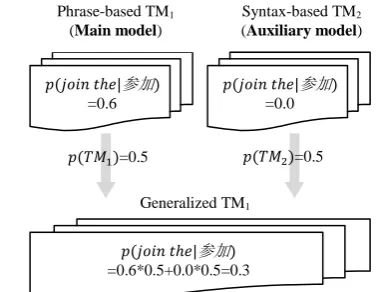
where is the feature value assigned by . We denote as the main model, and other collaborative TMs as auxiliary models. Figure 1 describes an example of TMG on two TMs, where the main model is a phrasal TM.
Equation 2 is a general framework that can be applied to all TMs. The only limitation is that the segmentation (or tokenization) standards for source (or target) training sentences should be identical for all models. We describe the generic TMG procedure in Algorithm 12.
2
In this paper, since all data sets used have relative large sizes and all SMT models have similar performances, we heuristically set all equally to .
Figure 1. TMG applied to a phrasal TM (main model) and a syntax-based TM (auxiliary mod-el). The value of a translation probability feature 参加 in TM1 is de-valued (from 0.6
to 0.3), in which ‘join the’ is absent in TM2
be-cause of its bad syntactic structure.
参加 =0.6 Phrase-based TM1
(Main model)
Syntax-based TM2 (Auxiliary model)
=0.5 =0.5
Generalized TM1
参加 =0.6*0.5+0.0*0.5=0.3
Algorithm 1: TMG for a main model 1: for the th auxiliary TM do
2: run training procedure on with specified model constraints and generate
3: end for
4: for each translation pair in do 5: for each probability feature do 6: for each translation model do 7: if is contained in then 8:
9 end if
10: end for
11: end for 12: end for
13: return the generalized for SMT decoding
3.3 Auxiliary Model Construction
In order to utilize TMG, more than one TM as auxiliary models is needed. Building TMs with different paradigms is one solution. For exam-ple, we can build a syntax-based TM as an aux-iliary model for a phrase-based TM. However, it has to re-implement more complicated TM train-ing modules besides the existtrain-ing one.
In this sub-section, we present an alternative solution to construct auxiliary model ensembles by using the existing training module with dif-ferent training data extracted from a unique data set. We describe the general procedure for con-structing auxiliary models as follows:
1) Given a unique training corpus , we ran-domly sample bilingual sentence pairs without replacement and denote them as .
is a number determined empirically; 2) Based on , we re-do word alignment and
train an auxiliary model using the exist-ing trainexist-ing module;
3) We execute Step 1 and Step 2 iteratively for times, and finally obtain auxiliary mod-els. The optimal setting of for TMG is al-so determined empirically.
With all above steps finished, we can perform TMG as we described in Algorithm 1 based on the auxiliary models generated already.
The random data sampling process described above is very similar to bagging except for it not allowing replacement during sampling. By mak-ing use of this process, translation pairs with low frequencies have relatively high probabilities to be totally discarded, and in resulting TMs, their
probabilities could be zero; meanwhile, transla-tion pairs with high frequencies still have high probabilities to be reserved, and hold similar probability feature values in resulting TMs com-paring to the main model. Thus, after TMG pro-cedure, feature values could be smoothed for translation pairs with low frequencies, and be stable for translation pairs with high frequencies. From this point of view, TMG can also be seen as a TM smoothing technique based on multiple TMs instead of single one such as Foster et al.
(2006). We will see in Section 4 that TMG based on TMs generated by both of these two solutions can improve translation quality for all baseline decoders on a series of evaluation sets.
3.4 Probability Variance Feature
The re-computed values of probability features in Equation 2 are actually the feature expecta-tions based on their values from all involved TMs. In order to give more statistical meanings to translation pairs, we also compute their cor-responding feature variances based on feature expectations and TM-specified feature values with prior probabilities. We introduce such va-riances as new features into the log-linear model for further improvements. Our motivation is to quantify the differences of model preferences between TMs for arbitrary probability features.
The variance for an arbitrary probability fea-ture can be computed as follows:
(3)
where is the feature expectation computed by Equation 2, is the feature value pre-dicted by , and is the prior probabil-ity for . Each probability feature now corres-ponds to a variance score. We extend the origi-nal feature set of with variance features add-ed in and list the updatadd-ed set below:
translation probability expectation features in two directions: and
translation probability variance features in two directions: and
lexical weight expectation features in two directions: and
4
Experiments
4.1 Data Condition
We conduct experiments on the NIST Chinese-to-English MT tasks. We tune model parameters on the NIST 2003 (MT03) evaluation set by MERT (Och, 2003), and report results on NIST evaluation sets including the NIST 2004 (MT04), the NIST 2005 (MT05), the newswire portion of the NIST 2006 (MT06) and 2008 (MT08). Per-formances are measured in terms of the case-insensitive BLEU scores in percentage numbers. Table 1 gives statistics over these evaluation sets.
MT03 MT04 MT05 MT06 MT08 Sent 919 1,788 1,082 616 691 Word 23,788 48,215 29,263 17,316 17,424
Table 1. Statistics on dev/test evaluation sets
We use the selected data that picked out from the whole data available for the NIST 2008 con-strained track of Chinese-to-English machine translation task as the training corpora, including LDC2003E07, LDC2003E14, LDC2005T06, LDC2005T10, LDC2005E83, LDC2006E26, LDC2006E34, LDC2006E85 and LDC2006E92, which contain about 498,000 sentence pairs after pre-processing. Word alignments are performed by GIZA++ (Och and Ney, 2000) in both direc-tions with an intersect-diag-grow refinement.
A traditional 5-gram language model (LM) for all involved systems is trained on the English side of all bilingual data plus the Xinhua portion of LDC English Gigaword Version 3.0. A lexi-calized reordering model (Xiong et al., 2006) is trained on the selected data in maximum entropy principle for the phrase-based system. A tri-gram target dependency LM (DLM) is trained on the English side of the selected data for the dependency-based hierarchical system.
4.2 MT System Description
We include four baseline systems. The first one (Phr) is a phrasal system (Xiong et al., 2006) based on Bracketing Transduction Grammar (Wu, 1997) with a lexicalized reordering com-ponent based on maximum entropy model. The second one (Hier) is a hierarchical phrase-based system (Chiang, 2007) based on Synchronous Context Free Grammar (SCFG). The third one (Dep) is a string-to-dependency hierarchical phrase-based system (Shen et al., 2008) with a dependency language model, which translates source strings to target dependency trees. The fourth one (Synx) is a syntax-based system (Gal-ley et al., 2006) that translates source strings to target syntactic trees.
4.3 TMG based on Multiple Paradigms
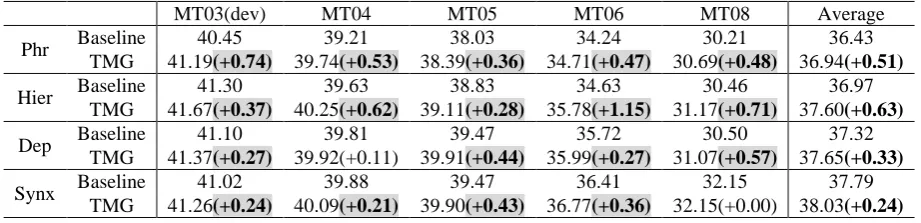
We develop TMG for each baseline system’s TM based on the other three TMs as auxiliary models. All prior probabilities of TMs are set equally to 0.25 heuristically as their similar per-formances. Evaluation results are shown in Ta-ble 2, where gains more than 0.2 BLEU points are highlighted as improved cases. Compared to baseline systems, systems based on generalized TMs improve in most cases (18 times out of 20). We also notice that the improvements achieved on tree-based systems (Dep and Synx) are rela-tively smaller than those on string-based systems (Phr and Hier). A potential explanation can be that with considering more syntactic restrictions, tree-based systems suffer less than string-based systems on the over-estimation problem. We do not present further results with variance features added because of their consistent un-promising numbers. We think this may be due to the consi-derable portion of non-overlapping translation pairs between main model and auxiliary models, which cause the variances not so accurate.
MT03(dev) MT04 MT05 MT06 MT08 Average
Phr Baseline 40.45 39.21 38.03 34.24 30.21 36.43 TMG 41.19(+0.74) 39.74(+0.53) 38.39(+0.36) 34.71(+0.47) 30.69(+0.48) 36.94(+0.51)
Hier Baseline 41.30 39.63 38.83 34.63 30.46 36.97 TMG 41.67(+0.37) 40.25(+0.62) 39.11(+0.28) 35.78(+1.15) 31.17(+0.71) 37.60(+0.63)
Dep Baseline 41.10 39.81 39.47 35.72 30.50 37.32 TMG 41.37(+0.27) 39.92(+0.11) 39.91(+0.44) 35.99(+0.27) 31.07(+0.57) 37.65(+0.33)
Synx Baseline 41.02 39.88 39.47 36.41 32.15 37.79 TMG 41.26(+0.24) 40.09(+0.21) 39.90(+0.43) 36.77(+0.36) 32.15(+0.00) 38.03(+0.24)
4.4 TMG based on Single Paradigm
We then evaluate TMG based on auxiliary mod-els generated by the random sampling method.
We first decide the percentage of training data to be sampled. We empirically vary this number by 20%, 40%, 60%, 80% and 90% and use each sampled data to train an auxiliary model. We then run TMG on the baseline TM with different auxiliary model used each time. For time saving, we only evaluate on MT03 for Phr in Figure 2.
Figure 2. Affects of different percentages of data
The optimal result is achieved when the per-centage is 80%, and we fix it as the default value in following experiments.
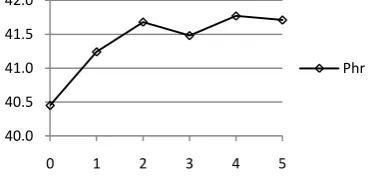
We then decide the number of auxiliary mod-els used for TMG by varying it from 1 to 5. We list different results on MT03 for Phr in Figure 3.
Figure 3. Affects of different numbers of auxi-liary models
The optimal result is achieved when the num-ber of auxiliary models is 4, and we fix it as the default value in following experiments.
We now develop TMG for each baseline sys-tem’s TM based on auxiliary models constructed under default settings determined above. Evalua-tion results are shown in Table 3. We also inves-tigate the affect of variance features for perfor-mance, whose results are denoted as TMG+Var. From Table 3 we can see that, compared to the results on baseline systems, systems using generalized TMs obtain improvements on almost all evaluation sets (19 times out of 20). With probability variance features added further, the improvements become even more stable than the ones using TMG only (20 times out of 20). Simi-lar to the trend in Table 2, we also notice that TMG method is more preferred by string-based systems (Phr and Hier) rather than tree-based systems (Dep and Synx). This makes our con-clusion more solidly that syntactic restrictions can help to alleviate the over-estimation problem.
4.5 Analysis on Phrase Coverage
We next empirically investigate on the transla-tion pair coverage between TM ensembles built by different ways, and use them to analyze re-sults got from previous experiments. Here, we only focus on full lexicalized translation entries between models. Those entries with variables are out of consideration in comparisons because of their model dependent properties.
Phrase pairs in the first three TMs have a length limitation in source side up to 3 words, and each source phrase can be translated to at most 20 target phrases.
40.0 40.5 41.0 41.5
0% 20% 40% 60% 80% 90%
Phr
40.0 40.5 41.0 41.5 42.0
0 1 2 3 4 5
Phr
MT03(dev) MT04 MT05 MT06 MT08 Average
Phr
Baseline 40.45 39.21 38.03 34.24 30.21 36.43
TMG 41.77(+1.32) 40.28(+1.07) 39.13(+1.10) 35.38(+1.14) 31.12(+0.91) 37.54(+1.11) TMG+Var 41.77(+1.32) 40.31(+1.10) 39.43(+1.30) 35.61(+1.37) 31.62(+1.41) 37.74(+1.31)
Hier
Baseline 41.30 39.63 38.83 34.63 30.46 36.97
TMG 42.28(+0.98) 40.45(+0.82) 39.61(+0.78) 35.67(+1.04) 31.54(+1.08) 37.91(+0.94) TMG+Var 42.42(+1.12) 40.55(+0.92) 39.69(+0.86) 35.55(+0.92) 31.41(+0.95) 37.92(+0.95)
Dep
Baseline 41.10 39.81 39.47 35.72 30.50 37.32
TMG 41.49(+0.39) 40.20(+0.39) 40.00(+0.53) 36.13(+0.41) 31.24(+0.74) 37.81(+0.49) TMG+Var 41.72(+0.62) 40.57(+0.76) 40.44(+0.97) 36.15(+0.43) 31.31(+0.81) 38.04(+0.72)
Synx
Baseline 41.02 39.88 39.47 36.41 32.15 37.79
TMG 41.18(+0.16) 40.30(+0.42) 39.90(+0.43) 36.99(+0.58) 32.45(+0.30) 38.16(+0.37) TMG+Var 41.42(+0.40) 40.55(+0.67) 40.17(+0.70) 36.89(+0.48) 32.51(+0.36) 38.31(+0.52)
For the fourth TM, these two limitations are released to 4 words and 30 target phrases. We treat phrase pairs identical on both sides but with different syntactic labels in the fourth TM as a unique pair for conveniences in statistics.
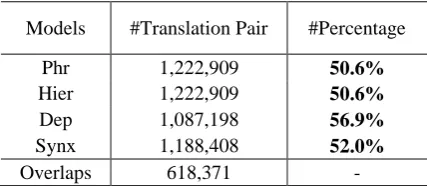
We first make statistics on TMs with different paradigms in Table 4. We can see from Table 4 that only slightly over half of the phrase pairs contained by the four involved TMs are common, which is also similar to the conclusion drawn in DeNeefe et al. (2006).
Models #Translation Pair #Percentage
Phr 1,222,909 50.6%
Hier 1,222,909 50.6%
Dep 1,087,198 56.9%
Synx 1,188,408 52.0%
Overlaps 618,371 -
Table 4. Rule statistics on TMs constructed by different paradigms
We then make statistics on TMs with identical paradigm in Table 5. For each baseline TM and its corresponding four auxiliary models con-structed by random data sampling, we count the number of phrase pairs that are common be-tween them and compute the percentage num-bers based on it for each TM individually.
Models TM0 TM1 TM2 TM3 TM4
Phr 61.8% 74.0% 74.1% 73.9% 74.1%
Hier 61.8% 74.0% 74.1% 73.9% 74.1%
Dep 60.8% 73.6% 73.6% 73.5% 73.7%
Synx 57.2% 68.4% 68.5% 68.5% 68.6%
Table 5. Rule statistics on TMs constructed by random sampling (TM0 is the main model)
Compared to the numbers in Table 4, we find that the coverage between baseline TM and sampled auxiliary models with identical para-digm is larger than that between baseline TM and auxiliary models with different paradigms (about 10 percents). It is a potential reason can explain why results of TMG based on sampled auxiliary models are more effective than those based on auxiliary models built with different paradigms, as we infer that they share more common phrase pairs each other and make the
computation of feature expectations and va-riances to be more reliable and accurate.
4.6 Improvements on System Combination
Besides working for single-system decoding, we also perform a system combination method on
N-best outputs from systems using generalized TMs. We re-implement a state-of-the-art word-level System Combination (SC) approach based on incremental HMM alignment proposed by Li
et al. (2009a). The default number of N-best candidates used is set to 20.
We evaluate SC on N-best outputs generated from 4 baseline decoders by using different TM settings and list results in Table 6, where Base stands for combination results on systems using default TMs; Paras stands for combination re-sults on systems using TMs generalized based on auxiliary models with different paradigms; and Samp stands for combination results on sys-tems using TMs generalized based on auxiliary models constructed by the random data sampling method. For the Samp setting, we also include probability variance features computed based on Equation 3 in the log-linear model.
SC MT03 MT04 MT05 MT06 MT08 Base 44.20 42.30 41.22 37.77 33.07 Paras 44.40 42.69 41.53 38.05 33.31 Samp 44.80 42.95 42.10 38.39 33.67
Table 6. Results on system combination
From Table 6 we can see that system combi-nation can benefit from TMG method.
4.7 Improvements on Model Combination
As an alternative, model combination is another effective way to improve translation perfor-mance by utilizing multiple systems. We re-implement the Model Combination (MC) ap-proach (DeNero et al., 2010) using N-best lists as its inputs and develop it on N-best outputs used in Table 6. Evaluation results are presented in Table 7.
MC MT03 MT04 MT05 MT06 MT08 Base 42.31 40.57 40.31 38.65 33.88 Paras 42.87 40.96 40.77 38.81 34.47 Samp 43.29 41.29 41.11 39.28 34.77
From Table 7 we can see that model combina-tion can also benefit from TMG method.
5
Related Work
Foster and Kuhn (2007) presented an approach that resembles more to our work, in which they divided the training corpus into different com-ponents and integrated models trained on each component using the mixture modeling. Howev-er, their motivation was to address the domain adaption problem, and additional genre informa-tion should be provided for the corpus partiinforma-tion to create multiple models for mixture. We in-stead present two ways for the model ensemble construction without extra information needed: building models by different paradigms or by a random data sampling technique inspired by a machine learning technique. Compared to the prior work, our approach is more general, which can also be used for model adaptation. We can also treat TMG as a smoothing way to address the over-estimation problem existing in almost all TMs. Some literatures have paid attention to this issue as well, such as Foster et al. (2006) and Mylonakis and Sima ’an (2008). However, they did not leverage information between mul-tiple models as we did, and developed on single models only. Furthermore, we also make current translation probability features to contain more statistical meanings by introducing the probabili-ty variance features into the log-linear model, which are completely novel to prior work and provide further improvements.
6
Conclusion and Future Work
In this paper, we have investigated a simple but effective translation model generalization me-thod that benefits by integrating values of prob-ability features between multiple TMs and using them in decoding phase directly. We also intro-duce novel probability variance features into the current feature sets of translation models and make the SMT models to be more flexible. We evaluate our method on four state-of-the-art SMT systems, and get promising results not only on single-system decodings, but also on a system combination approach and a model combination approach.
Making use of different distributions of trans-lation probability features is the essential of this
work. In the future, we will extend TMG method to other statistical models in SMT framework, (e.g. LM), which could be also suffered from the over-estimation problem. And we will make fur-ther research on how to tune prior probabilities of models automatically as well, in order to make our method to be more robust and tunable.
References
Auli Michael, Adam Lopez, Hieu Hoang, and Philipp Koehn. 2009. A Systematic Analysis of Translation Model Search Spaces. In 4th Workshop on Statis-tical Machine Translation, pages 224-232.
Breiman Leo. 1996. Bagging Predictors. Machine Learning.
Chiang David. 2007. Hierarchical Phrase Based Translation. Computational Linguistics, 33(2): 201-228.
DeNero John, Shankar Kumar, Ciprian Chelba, and Franz Och. 2010. Model Combination for Machine Translation. To appear in Proc. of the North Amer-ican Chapter of the Association for Computational Linguistic.
DeNeefe Steve, Kevin Knight, Wei Wang, and Da-niel Marcu. 2007. What Can Syntax-based MT Learn from Phrase-based MT? In Proc. of Empiri-cal Methods on Natural Language Processing, pages 755-763.
Foster George, Roland Kuhn, and Howard Johnson. 2006. Phrasetable Smoothing for Statistical Ma-chine Translation. In Proc. of Empirical Methods on Natural Language Processing, pages 53-61.
Foster George and Roland Kuhn. 2007. Mixture-Model Adaptation for SMT. In 2th Workshop on Statistical Machine Translation, pages 128-135.
Galley Michel, Jonathan Graehl, Kevin Knight, Da-niel Marcu, Steve DeNeefe, Wei Wang, and Igna-cio Thayer. 2006. Scalable Inference and Training of Context-Rich Syntactic Translation Models. In
Proc. of 44th Meeting of the Association for Com-putational Linguistics, pages: 961-968.
Huang Liang. 2008. Forest Reranking: Discrimina-tive Parsing with Non-Local Features. In Proc. of 46th Meeting of the Association for Computational Linguistics, pages 586-594.
He Xiaodong, Mei Yang, Jianfeng Gao, Patrick Nguyen, and Robert Moore. 2008. Indirect-HMM-based Hypothesis Alignment for Combining Out-puts from Machine Translation Systems. In Proc. of Empirical Methods on Natural Language Processing, pages 98-107.
Koehn Philipp. 2004. Phrase-based Model for SMT. Computational Linguistics, 28(1): 114-133.
Li Chi-Ho, Xiaodong He, Yupeng Liu, and Ning Xi. 2009a. Incremental HMM Alignment for MT sys-tem Combination. In Proc. of 47th Meeting of the Association for Computational Linguistics, pages 949-957.
Li Mu, Nan Duan, Dongdong Zhang, Chi-Ho Li, and Ming Zhou. 2009b. Collaborative Decoding: Par-tial Hypothesis Re-Ranking Using Translation Consensus between Decoders. In Proc. of 47th Meeting of the Association for Computational Lin-guistics, pages 585-592.
Liu Yang, Haitao Mi, Yang Feng, and Qun Liu. 2009.
Joint Decoding with Multiple Translation Models. In Proc. of 47th Meeting of the Association for Computational Linguistics, pages 576-584.
Mylonakis Markos and Khalil Sima ’an. 2008.
Phrase Translation Probabilities with ITG Priors and Smoothing as Learning Objective. In Proc. of Empirical Methods on Natural Language Processing, pages 630-639.
Matusov Evgeny, Nicola Ueffi ng, and Hermann Ney. 2006. Computing consensus translation from multiple machine translation systems using en-hanced hypotheses alignment. In Proc. of Euro-pean Charter of the Association for Computational Linguistics, pages 33-40.
Och Franz and Hermann Ney. 2000. Improved Statis-tical Alignment Models. In Proc. of 38th Meeting of the Association for Computational Linguistics, pages 440-447.
Och Franz. 2003. Minimum Error Rate Training in Statistical Machine Translation. In Proc. of 41th Meeting of the Association for Computational Lin-guistics, pages 160-167.
Och Franz and Hermann Ney. 2004. The Alignment template approach to Statistical Machine Transla-tion. Computational Linguistics, 30(4): 417-449.
Shen Libin, Jinxi Xu, and Ralph Weischedel. 2008. A new string-to-dependency machine translation al-gorithm with a target dependency language model. In Proc. of 46th Meeting of the Association for Computational Linguistics, pages 577-585.
Wu Dekai. 1997. Stochastic Inversion Transduction Grammars and Bilingual Parsing of Parallel Cor-pora. Computational Linguistics, 23(3): 377-404.
Xiong Deyi, Qun Liu, and Shouxun Lin. 2006. Max-imum Entropy based Phrase Reordering Model for Statistical Machine Translation. In Proc. of 44th Meeting of the Association for Computational Lin-guistics, pages 521-528.