An Empirical Study on Web Mining of Parallel Data
Gumwon Hong
1, Chi-Ho Li
2, Ming Zhou
2and Hae-Chang Rim
11
Department of Computer Science &
En-gineering, Korea University
{gwhong,rim}@nlp.korea.ac.kr
2Natural Language Computing Group,
Microsoft Research Asia
{chl,mingzhou}@microsoft.com
Abstract
This paper1 presents an empirical ap-proach to mining parallel corpora. Con-ventional approaches use a readily available collection of comparable, non-parallel corpora to extract non-parallel sen-tences. This paper attempts the much more challenging task of directly search-ing for high-quality sentence pairs from the Web. We tackle the problem by formulating good search query using „Learning to Rank‟ and by filtering noisy document pairs using IBM Model 1 alignment. End-to-end evaluation shows that the proposed approach sig-nificantly improves the performance of statistical machine translation.
1
Introduction
Bilingual corpora are very valuable resources in NLP. They can be used in statistical machine translation (SMT), cross language information retrieval, and paraphrasing. Thus the acquisition of bilingual corpora has received much attention.
Hansards, or parliamentary proceedings in more than one language, are obvious source of bilingual corpora, yet they are about a particular domain and therefore of limited use. Many re-searchers then explore the Web. Some approach attempts to locate bilingual text within a web page (Jiang et al., 2009); some others attempt to collect web pages in different languages and decide the parallel relationship between the web pages by means of structural cues, like exist-ence of a common ancestor web page, similarity between URLs, and similarity between the HTML structures (Chen and Nie, 2000; Resnik
1
This work has been done while the first author was visit-ing Microsoft Research Asia.
and Smith, 2003; Yang and Li, 2003; Shi et al., 2006). The corpora thus obtained are generally of high quality and wide variety in domain, but the amount is still limited, as web pages that exhibit those structural cues are not abundant.
Some other effort is to mine bilingual corpora by textual means only. That is, two pieces of text are decided to be parallel merely from the linguistic perspective, without considering any hint from HTML markup or website structure. These approaches (Zhao and Vogel, 2002; Utiyama and Isahara 2003; Fung and Cheung, 2004; Munteanu and Marcu, 2005; Abdul-Rauf and Schwenk, 2009) share roughly the same framework:
Phase 1: Document Pair Retrieval
1) documents in some target language (TL) are stored in some database;
2) each document in some source language (SL) is represented by some TL keywords;
3) the TL keywords in (2) are used to assign some TL documents to a particular SL doc-ument, using some information retrieval (IR) technique. For example, Munteanu and Mar-cu (2005) apply the Lemur IR toolkit, Utiyama and Isahara (2003) use the BM25 similarity measure, and Fung and Cheung (2004) use cosine similarity. Each TL docu-ment pairs up with the SL docudocu-ment to form a candidate parallel document pair.
Phase 2: Sentence Pair Extraction
1) sentence pairs can be obtained by running sentence alignment over all candidate docu-ment pairs (or a selection of them) (Zhao and Vogel, 2002; Utiyama and Isahara, 2003); 2) sentence pairs can also be selected, by some
classifier or reliability measure, from the candidate sentence pairs enumerated from the candidate document pairs (Munteanu and Marcu, 2005).
pairs, partially because document pair retrieval is not accurate, and partially because the ulti-mate purpose of these corpora is SMT training, which is based on sentence pairs. It is found that most of the sentence pairs thus obtained are not truly parallel; rather they are loose translations of each other or they carry partially similar mes-sages. Such bilingual corpora are thus known as
comparable corpora, while genuinely mutual translations constitute parallel corpora.
Note also that all these comparable corpus mining approaches are tested on closed docu-ment collections only. For example, Zhao and Vogel (2002), Utiyama and Isahara (2003), and Munteanu and Marcu (2005) all acquire their comparable corpora from a collection of news articles which are either downloaded from the Web or archived by LDC. The search of candi-date document pairs in such a closed collection is easy in three ways:
1) all the TL documents come from the same news agency and they are not mixed up with similar documents from other news agencies; 2) all the TL documents are news text and they
are not mixed up with text of other domains; 3) in fact, the search in these approaches is made easier by applying tricks like date win-dow.
There is no evidence that these methods apply to corpus mining from an open document col-lection (e.g. the entire Web) without search con-straint. The possibility of open-ended text min-ing is a crucial problem.
This paper focuses on bilingual corpus min-ing usmin-ing only textual means. It attempts to an-swer two questions:
1) Can comparable corpus mining be applied to an open document collection, i.e., the Web? 2) Can comparable corpus mining be adapted to
parallel corpus mining?
We give affirmation to both questions. For the first problem, we modify document pair retrieval so that there is no longer a closed set of TL documents. Instead we search for candidate TL documents for a particular SL document from the Web by means of some Web search engine. For the second problem, in Phase 2 we replace the sentence pair classifier by a document pair filter and a sentence alignment module. Based on end-to-end SMT experiments, we will show that 1) high quality bilingual corpora can be mined from the Web; 2) the very
first key to Web-mining of bilingual corpus is the formulation of good TL keywords to represent a SL document; 3) a simple document pair filter using IBM Model 1 probabilities is able to identify parallel corpus out of noisy comparable text; and 4) Web-mined parallel corpus, despite its smaller size, improves SMT much more than Web-mined comparable corpus.
2
Problem Setting
Our ultimate goal is to mine from the Web training data for translation from Chinese (SL) to English (TL). As the first step, about 11,000 Chinese web pages of news articles are crawled from some Chinese News sites. Then the task is to search for the English sentences correspond-ing to those in the selected SL articles. These selected SL news articles all contain cue phrases like “根据外电报道” (according to foreign me-dia), as these cue phrases suggest that the Chi-nese articles are likely to have English counter-parts. Moreover, each selected SL article has at least 500 words (empirically determined) since we assume that it is much easier to formulate reliable keywords from a long document than a short one.
3
Document Pair Retrieval
Conventional approaches to comparable corpus mining usually start with document pair retriev-al, which assigns to each SL document a set of candidate TL documents. This step is essentially a preliminary search for candidate sentence pairs for further scrutiny in Phase 2. The target is to find document pairs which may contain many good sentence pairs, rather than to discard document pairs which may not contain good sentence pairs. Therefore, recall is much more emphasized than precision.
re-quires a more sophisticated formulation of que-ries to retrieve them.
In response to these challenges, we propose various kinds of queries (elaborated in the fol-lowing subsections). Moreover, we merge the TL documents found by each query into a big collection, so as to boost up the recall. In case a query fails to retrieve any document, we itera-tively drop a keyword in the query until some documents are found. On the other hand, alt-hough the document pairs in question are of news domain, we use the general Google/Yahoo web search engines instead of the specific news search engines, because 1) the news search en-gines keep only a few web pages for all pages about the same news event, and 2) we leave open possibility for correct TL documents to be found in non-news web pages.
3.1 Simple Queries
There are three baseline formulations of queries: 1) Query of translations of SL TF-IDF-ranked keywords (QSL-TFIDF). This is the method proposed by Munteanu and Marcu (2005). All the words in a SL document are ranked by TF-IDF and the top-N words are selected. Each keyword is then translated into a few TL words by a statistically learned diction-ary. In our experiments the dictionary is learned from NIST SMT training data. 2) Query of TF-IDF-ranked machine translated
keywords (QTL-TFIDF). It is assumed that a machine translation (MT) system is better at handling lexical ambiguity than simple dic-tionary translation. Thus we propose to first translate the SL document into TL and ex-tract the top-N TF-IDF-ranked words as query. In our experiments the MT system used is hierarchical phrase-based system (Chiang, 2007).2
3) Query of named entities (QNE). Another way to tackle the drawback of QSL-TFIDF is to focus on named entities (NEs) only, since NEs often provide strong clue for identify-ing correspondence between two languages. All NEs in a SL document are ranked by TF-IDF, and the top-N NEs are then trans-lated (word by word) by dictionary. In our experiments we identify SL (Chinese) NEs
2
We also try online Google translation service, and the performance was roughly the same.
implicitly found by the word segmentation algorithm stated in Gao et al. (2003), and the dictionaries for translating NEs include the same one used for QSL-TFIDF, and the LDC Chinese/English NE dictionary. For the NEs not covered by our dictionary, we use Google translation service as a back-up. A small-scale experiment is run to evaluate the merits of these queries. 300 Chinese news web pages in three different periods (each 100) are collected. For each Chinese text, each query (containing 10 keywords) is constructed and submitted to both Google and Yahoo Search, and top-40 returned English web pages for each search are kept. Note that the Chinese news ar-ticles are not part of 11,000 pages in section 2. In fact, they do not only satisfy the requirement of length and cue phrases (described in section 2), but they also have another property that they are translated from some English news articles (henceforth target pages) on the Web. Thus they are ideal data for studying the performance of document pair retrieval.
To test the influence of translation quality in document pair retrieval, we also try „oracle que-ries‟, i.e. queries formulated directly from the target pages:
1) OQTFIDF. This is the query of the top-N TF-IDF-ranked words from the target page. 2) OQNE. This is the query of the top-N
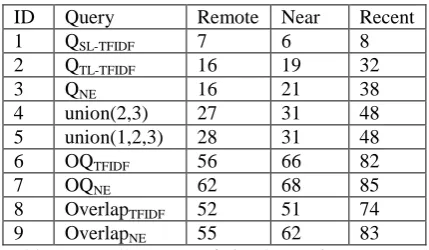
TF-IDF-ranked NEs from the target web page. We define recall as the proportion of SL docu-ments whose true target pages are found. The comparison between a retrieved page and the target page is done by Longest Common Subse-quence (LCS) ratio, defined as the length of the longest common word sequence of two docu-ments divided by the length of the longer of two documents. The threshold 0.7 is adopted as it is strict enough to distinguish parallel document pairs from non-parallel ones.
columns, viz. it is much more difficult to re-trieve outdated news document pairs. This im-plies that bilingual news mining must be incre-mentally carried out.
Comparing Test 1 to Tests 2 and 3, it is obvi-ous that QSL-TFIDF is not very useful in document pair retrieval. This confirms our hypothesis that suitable TL keywords are not likely to be ob-tained by simple dictionary lookup. While the recalls by QTL-TFIDF are similar to those by QNE, the two queries contribute in different ways. Test 4 simply merges the Web search results in Tests 2 and 3. The significantly higher recalls in Test 4 imply that each of the two queries finds substantially different targets than each other. The comparison of Test 5 to Test 4 further con-firms the weakness of QSL-TFIDF.
The huge gap between the three simple que-ries and the oracle queque-ries shows that the quality of translation of keywords from SL to TL is a major obstacle. There are two problems in trans-lation quality: 1) the MT system or dictionary
cannot produce any translation for a SL word (let us refer to such TL keywords as „Utopian translations‟); 2) the MT system or dictionary
produces an incorrect translation for a SL word. We can do very little for the Utopian transla-tions, as the only solution is simply to use a bet-ter MT system or a larger dictionary. On the contrary, it seems that the second problem can somewhat be alleviated, if we have a way to distinguish those terms that are likely to be cor-rect translations from those terms that are not. In other words, it may be worthwhile to reorder candidate TL keywords by our confidence in its translation quality.
Tests 8 and 9 in Table 1 show that this hy-pothesis is promising. In both tests the TF-IDF-based (Test 8) or the NE-TF-IDF-based (Test 9) key-words are selected from only those TL key-words that appear both in the target page and the ma-chine translated text of the source page. In other words, we ensure that the keywords in the query must be correct translations. The recalls (espe-cially the recalls by NE-based query in Test 9) are very close to the recalls by oracle queries. The conclusion is, even though we cannot pro-duce the Utopian translations, document pair retrieval can be improved to a large extent by removing incorrect translations. Even an imper-fect MT system or NE dictionary can help us achieve as good document pair retrieval recall as oracle queries.
In the next subsection we will take this in-sight into our bilingual data mining system, by selecting keywords which are likely to be cor-rect translation.
3.2 Re-ranked Queries
Machine learning is applied to re-rank key-words for a particular document. The re-ranking of keywords is based on two principles. The first one is, of course, the confidence on the translation quality. The more likely a keyword is a correct translation, the higher this keyword should be ranked. The second principle is the representativeness of document. The more rep-resentative of the topic of the document where a keyword comes from, the higher this keyword should be ranked. The design of features should incorporate both principles.
The representativeness of document is mani-fested in the following features for each key-word per each document:
TF: the term frequency.
IDF: the inverted document frequency.
TF-IDF: the product of TF and IDF.
Title word: it indicates whether a key-word appears in the title of the document.
Bracketed word: it indicates whether a word is enclosed in a bracket in the source document.
Position of first appearance: the position where a keyword first appears in a doc-ument, normalized by number of words in the document.
ID Query Remote Near Recent
1 QSL-TFIDF 7 6 8
2 QTL-TFIDF 16 19 32
3 QNE 16 21 38
4 union(2,3) 27 31 48 5 union(1,2,3) 28 31 48
6 OQTFIDF 56 66 82
7 OQNE 62 68 85
8 OverlapTFIDF 52 51 74
9 OverlapNE 55 62 83
NE types: it indicates whether a keyword is a person, organization, location, nu-merical expression, or non NE.
The confidence on translation quality is man-ifested in the following features:
Translation source: it indicates whether the keyword (in TL) is produced by MT system, dictionary, or by both.
Original word: it indicates whether the keyword is originally written in English
in the source document. Note that this feature also manifests the representative-ness of a document.
Dictionary rank: if the keyword is a NE produced by dictionary, this feature indi-cates the rank of the NE keyword among all translation options registered in the dictionary.
It is difficult to definitely classify a TL key-word into good or bad translation in absolute sense, and therefore we take the alternative of ranking TL keywords with respect to the two principles. The learning algorithm used is Rank-ing SVM (Herbrich et al., 2000; Joachims, 2006), which is a state-of-the-art method of the “Learning to rank” framework.
The training dataset of the keyword re-ranker comprises 1,900 Chinese/English news docu-ment pairs crawled from the Web3. This set is not part of 11,000 pages in section 2. These document pairs share the same properties as those 300 pairs used in Section 3.1. For each English/target document, we build a set TALL, which contains all words in the English docu-ment, and also a set TNE, which is a subset of TALL such that all words in TNE are NEs in TALL. The words in both sets are ranked by TFIDF. On the other hand, for each Chinese/source document, we machine-translate it and then store the translated words into a set S, and we also add the dictionary translations of the source NEs into S. Note that S is composed of both good translations (appearing in the target docu-ment) and bad translations (not appearing in the target document).
Then there are two ways to assign labels to the words in S. In the first way of labeling (LALL), the label 3 is assigned to those words in S which are ranked among top 5 in TALL, label 2
3
We also attempt to add more training data for re-ranking but the performance remain the same.
to those ranked among top 10 but not top 5 in TALL, 1 to those beyond top 10 but still in TALL, and 0 to those words which do not appear in TALL at all. The second way of labeling, LNE, is done in similar way with respect to TNE. Col-lecting all training samples over all document pairs, we can train a model, MALL, based on la-beling LALL, and another model MNE, based on labeling LNE.
The trained models can then be applied to re-rank the keywords of simple queries. In this case, a set STEST is constructed from the 300 Chinese documents in similar way of construct-ing S. We repeat the experiment in Section 3.1 with two new queries:
1) QRANK-TFIDF: the top N keywords from re-ranking STEST by MALL;
2) QRANK-NE: the top N keywords from rerank-ing STEST by MNE.
Again N is chosen as 10.
The results shown in Table 2 indicate that, while the re-ranked queries still perform much poorer than oracle queries (Tests 6 and 7 in Ta-ble 1), they show great improvement over the simple queries (Tests 1 to 5 in Table 1). The results also show that re-ranked queries based on NEs are more reliable than those based on common words.
4
Sentence pair Extraction
The document pairs obtained by the various queries described in Section 3 are used to pro-duce sentence pairs as SMT training data. There are two different methods of extraction for cor-pora of different nature.
4.1 For Comparable Corpora
Sentence pair extraction for comparable corpus is the same as that elaborated in Munteanu and Marcu (2005). All possible sentence pairs are enumerated from all candidate document pairs produced in Phase 1. These huge number of candidate sentence pairs are first passed to a coarse sentence pair filter, which discards very unlikely candidates by heuristics like sentence
ID Query Remote Near Recent
10 QRANK-TFIDF 18 20 29
11 QRANK-NE 35 43 54
length ratio and percentage of word pairs regis-tered in some dictionary.
The remaining candidates are then given to a Maximum Entropy based classifier (Zhang, 2004), which uses features based on alignment patterns produced by some word alignment model. In our experiment we use the HMM alignment model with the NIST SMT training dataset. The sentence pairs which are assigned as positive by the classifier are collected as the mined comparable corpus.
4.2 For Parallel Corpora
The sentence pairs obtained in Section 4.1 are found to be mostly not genuine mutual transla-tions. Often one of the sentences contains some extra phrase or clause, or even conveys different meaning than the other. It is doubtful if the doc-ument pairs from Phase 1 are too noisy to be processed by the sentence pair classifier. An alternative way for sentence pair extraction is to further filter the document pairs and discard any pairs that do not look like parallel.
It is hypothesized that the parallel relation-ship between two documents can be assimilated by the word alignment between them. The doc-ument pair filter produces the Viterbi alignment, with the associated probability, of each docu-ment pair based on IBM Model 1 (Brown et al., 1993). The word alignment model (i.e. the sta-tistical dictionary used by IBM Model 1) is trained on the NIST SMT training dataset. The probability of the Viterbi alignment of a docu-ment pair is the sole basis on which we decide whether the pair is genuinely parallel. That is, an empirically determined threshold is used to distinguish parallel pairs from non-parallel ones. In our experiment, a very strict threshold is se-lected so as to boost up the precision at the ex-pense of recall.
There are a few important details that enable the document pair filter succeed in identifying parallel text:
1) Function words and other common words occur frequently and so any pair of common word occupies certain probability mass in an alignment model. These common words enable even non-parallel documents achieve high alignment probability. In fact, it is well known that the correct alignment of com-mon words must take into account position-al and/or structurposition-al factors, and it is
benefi-cial to a simple alignment model like IBM Model 1 to work on data without common words. Therefore, all words on a compre-hensive stopword list must be removed from a document pair before word align-ment.
2) The alignment probability must be normal-ized with respect to sentence length, so that the threshold applies to all documents re-gardless of document length.
Subjective evaluation on selected samples shows that most of the document pairs kept by the filter are genuinely parallel. Thus the docu-ment pairs can be broken down into sentence pairs simply by a sentence alignment method. For the sentence alignment, our experiments use the algorithm in Moore (2002).
5
Experiments
It is a difficult task to evaluate the quality of automatically acquired bilingual corpora. As our ultimate purpose of mining bilingual corpora is to provide more and better training data for SMT, we evaluate the parallel and comparable corpora with respect to improvement in Bleu score (Papineni et al., 2002).
5.1 Experiment Setup
Our experiment starts with the 11,000 Chinese documents as described in Section 2. We use various combinations of queries in document pair retrieval (Section 3). Based on the candi-date document pairs, we produce both compara-ble corpora and parallel corpora using sentence pair extraction (Section 4). The corpora are then given to our SMT systems as training data.
The SMT systems learn translation knowledge (phrase table and rule table) in standard way. The parameters in the underlying log-linear model are trained by Minimum Error Rate Training (Och, 2003) on the development set of NIST 2003 test set. The quality of translation output is evaluated by case-insensitive BLEU4 on NIST 2005 and NIST 2008 test sets4.
5.2 Experimental result
Table 3 lists the size of various mined parallel and comparable corpora against the baseline B1 bilingual dataset. It is obvious that for a specific type of query in document pair retrieval, the parallel corpus is significantly smaller than the corresponding comparable corpus.
The apparent explanation is that a lot of doc-ument pairs are discarded due to the docdoc-ument
4
It is checked that there is no sentence in the test sets overlapping with any sentences in the mined corpus.
pair filter. Note that the big difference in size of the two comparable corpora by single queries, i.e., QRANK-NE and M&M, verifies again that re-ranked queries based on NEs are more reliable in sentence pair extraction.
Table 4 lists the Bleu scores obtained by
augmenting the baseline bilingual training set
with the mined corpora. The most important observation is that, despite their smaller size, parallel corpora lead to no less, and often better, improvement in translation quality than compa-rable corpora. That is especially true for the case where document pair retrieval is based on all five types of query5. The superiority of paral-lel corpora confirms that, in Phase 2 (sentence pair extraction), quality is more important than quantity and thus the filtering of document pair/sentence pair must not be generous.
On the other hand, sentence pair extraction for parallel corpora generally achieves the best result when all queries are applied in document pair retrieval. It is not sufficient to use the more sophisticated re-ranked queries. That means in Phase 1 quantity is more important and we must seek more ways to retrieve as many document pairs as possible. That also confirms the empha-sis on recall in document pair retrieval.
Looking into the performance of comparable corpora, it is observed that the M&M query does not effectively apply to Web mining of comparable corpora but the proposed queries do. Any of the proposed query leads to better result than the conventional method, i.e. M&M. Moreover, it can be seen that all four combina-tions of proposed queries achieve similar
5
QSL-TFIDF, QTL-TFIDF, QNE, QRANK-TFIDF, and QRANK-NE
Queries SP extraction
#SP #SL words
#TL words Baseline: B1 in NIST 68K 1.7M 1.9M M&M comparable 43K 1.1M 1.2M QRANK-NE comparable 98K 2.7M 2.8M
all simple comparable 98K 2.6M 2.9M all ranked comparable 115K 3.1M 3.3M all query comparable 135K 3.6M 4.0M QRANK-NE
all simple
parallel parallel
66K 52K
1.9M 1.5M
1.8M 1.4M all ranked parallel 73K 2.1M 2.0M all query parallel 90K 2.5M 2.4M Table 3: Statistics on corpus size. SP means sentence pair. „all simple‟, „all ranked‟, and „all query‟ refer to the merge of the retrieval results of all simple queries, all re-ranked queries, and all simple and re-ranked que-ries, respectively; M&M (after Munteanu and Marcu (2005)) refers to QSL-TFIDF.
Bilingual Training Corpus Phrase-based SMT (PSMT) Hierarchical PSMT NIST 2005 NIST 2008 NIST 2005 NIST 2008 B1 (baseline) 33.08 21.66 32.85 21.18 B1+comparable(M&M) 33.51(+0.43) 22.71(+1.05) 32.99(+0.14) 22.11(+0.93) B1+comparable(QRANK-NE) 34.81(+1.73) 23.30(+1.64) 34.43(+1.58) 22.85(+1.67)
B1+comparable(all simple) 34.74(+1.66) 23.48(+1.82) 34.28(+1.43) 23.18(+2.00) B1+comparable(all ranked) 34.79(+1.71) 23.48(+1.82) 34.37(+1.52) 23.06(+1.88) B1+comparable(all query) 34.74(+1.66) 23.19(+1.53) 34.46(+1.61) 23.12(+1.94) B1+parallel(QRANK-NE) 34.75(+1.67) 23.37(+1.71) 34.24(+1.39) 23.45(+2.27)
formance. This illustrates a particular advantage of using a single re-ranked query, viz. QRANK-NE, because it significantly reduces the retrieval time and downloading space required for docu-ment pair retrieval as it is the main bottleneck of whole process.
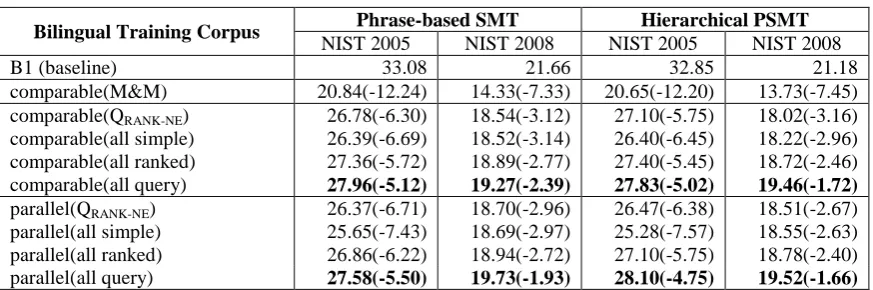
Table 5 lists the Bleu scores obtained by re-placing the baseline bilingual training set with
the mined corpora. It is easy to note that transla-tion quality drops radically by using mined bi-lingual corpus alone. That is a natural conse-quence of the noisy nature of Web mined data. We should not be too pessimistic about Web mined data, however. Comparing the Bleu scores for NIST 2005 test set to those for NIST 2008 test set, it can be seen that the reduction of translation quality for the NIST 2008 set is much smaller than that for the NIST 2005 set. It is not difficult to explain the difference. Both the baseline B1 training set and the NIST 2005 comprise news wire (in-domain) text only. Alt-hough the acquisition of bilingual data also tar-gets news text, the noisy mined corpus can nev-er compete with the well prepared B1 dataset. On the contrary, the NIST 2008 test set contains a large portion of out-of-domain text, and so the B1 set does not gain any advantage over Web mined corpora. It might be that better and/or larger Web mined corpus achieves the same performance as manually prepared corpus.
Note also that the reduction in Bleu score by each mined corpus is roughly the same as that by each other, while in general parallel corpora are slightly better than comparable corpora.
6
Conclusion and Future Work
In this paper, we tackle the problem of mining parallel sentences directly from the Web as
training data for SMT. The proposed method essentially follows the corpus mining frame-work by pioneer frame-work like Munteanu and Mar-cu (2005). However, unlike those conventional approaches, which work on closed document collection only, we propose different ways of formulating queries for discovering parallel documents over Web search engines. Using learning to rank algorithm, we re-rank keywords based on representativeness and translation quality. This new type of query significantly outperforms existing query formulation in re-trieving document pairs. We also devise a doc-ument pair filter based on IBM model 1 for handling the noisy result from document pair retrieval. Experimental results show that the proposed approach achieves substantial im-provement in SMT performance.
For mining news text, in future we plan to apply the proposed approach to other language pairs. Also, we will attempt to use meta-information implied in SL document, such as “publishing date” or “news agency name”, as further clue to the document pair retrieval. Such meta-information may likely to increase the precision of retrieval, which is important to the efficiency of the retrieval process.
An important contribution of this work is to show the possibility of mining text other than news domain from the Web, which is another piece of future work. The difficulty of this task should not be undermined, however. Our suc-cess in mining news text from the Web depends on the cue phrases available in news articles. These cue phrases more or less indicate the ex-istence of corresponding articles in another lan-guage. Therefore, to mine non-news corpus, we should carefully identify and select cue phrases.
Bilingual Training Corpus Phrase-based SMT Hierarchical PSMT NIST 2005 NIST 2008 NIST 2005 NIST 2008 B1 (baseline) 33.08 21.66 32.85 21.18 comparable(M&M) 20.84(-12.24) 14.33(-7.33) 20.65(-12.20) 13.73(-7.45) comparable(QRANK-NE) 26.78(-6.30) 18.54(-3.12) 27.10(-5.75) 18.02(-3.16)
comparable(all simple) 26.39(-6.69) 18.52(-3.14) 26.40(-6.45) 18.22(-2.96) comparable(all ranked) 27.36(-5.72) 18.89(-2.77) 27.40(-5.45) 18.72(-2.46) comparable(all query) 27.96(-5.12) 19.27(-2.39) 27.83(-5.02) 19.46(-1.72) parallel(QRANK-NE) 26.37(-6.71) 18.70(-2.96) 26.47(-6.38) 18.51(-2.67)
parallel(all simple) 25.65(-7.43) 18.69(-2.97) 25.28(-7.57) 18.55(-2.63) parallel(all ranked) 26.86(-6.22) 18.94(-2.72) 27.10(-5.75) 18.78(-2.40) parallel(all query) 27.58(-5.50) 19.73(-1.93) 28.10(-4.75) 19.52(-1.66)
References
Abdul-Rauf, Sadaf and Holger Schwenk. 2009. Ex-ploiting Comparable Corpora with TER and TERp. In Proceedings of ACL-IJCNLP 2009 workshop on Building and Using Comparable Corpora, pages 46–54.
Brown, Peter F., Vincent J. Della Pietra, Stephen A. Della Pietra, and Robert L. Mercer. 1993. The Mathematics of Statistical Machine Translation: Parameter Estimation. Computational Linguistics,
19(2): 263-311.
Chen, Jiang and Jian-Yun Nie. 2000. Automatic Construction of Parallel Chinese-English Corpus for Cross-Language Information Retrieval. In
Proceedings of NAACL-ANLP, pages 21-28.
Chiang, David. 2007. Hierarchical Phrase-based Translation. Computational Linguistics, 33(2): 202-228.
Fung, Pascale, and Percy Cheung. 2004. Mining very non-parallel corpora: Parallel sentence and lexi-con extraction via bootstrapping and EM. In Pro-ceedings of 2004 Conference on Empirical
Meth-ods in Natural Language Processing, pages 57-63.
Gao, Jianfeng, Mu Li, and Changning Huang. 2003. Improved Source-Channel Models for Chinese Word Segmentation. In Proceedings of the 41st Annual Meeting of the Association for Computa-tional Linguistics, pages 272-279.
Herbrich, Ralf, Thore Graepel, and Klaus Obermayer. 2000. Large margin rank boundaries for ordinal regression. In Advances in Large Margin Classifi-ers, pages 115–132. MIT Press, Cambridge, MA.
Jiang, Long, Shiquan Yang, Ming Zhou, Xiaohua Liu, and Qingsheng Zhu. 2009. Mining Bilingual Data from the Web with Adaptively Learnt Pat-terns. In Proceedings of the 47th Annual Meeting of the Association for Computational Linguistics and 4th International Joint Conference on Natural
Language Processing, pages 870-878.
Joachims, Thorsten. 2006. Training Linear SVMs in Linear Time. In Proceedings of the 12th ACM SIGKDD International Conference on Knowledge
Discovery and Data Mining, pages 217-226.
Koehn, Philipp, Franz Och, and Daniel Marcu. 2003. Statistical Phrase-based Translation. In Proceed-ings of conference combining Human Language Technology conference series and the North American Chapter of the Association for Compu-tational Linguistics conference series, pages 48-54.
Moore, Robert. 2002. Fast and Accurate Sentence Alignment of Bilingual Corpora. In Proceedings of the 5th conference of the Association for Ma-chine Translation in the Americas, pages 135–144.
Munteanu, Dragos, and Daniel Marcu. 2005. Im-proving Machine Translation Performance by Ex-ploiting Non-Parallel Corpora. Computational Linguistics, 31(4): 477-504.
Och, Franz J. 2003. Minimum Error Rate Training in Statistical Machine Translation. In Proceedings of the 41st Annual Meeting of the Association for Computational Linguistics, pages 160-167.
Papineni, Kishore, Salim Roukos, Todd Ward, and Wei-Jing Zhu. 2002. BLEU: a Method for Auto-matic Evaluation of Machine Translation. In Pro-ceedings of the 40th Annual Meeting of the Asso-ciation for Computational Linguistics, pages 311-318.
Resnik, Philip, and Noah Smith. 2003. The Web as a Parallel Corpus. Computational Linguistics, 29(3): 349-380.
Shi, Lei, Cheng Niu, Ming Zhou, and Jianfeng Gao. 2006. A DOM Tree Alignment Model for Mining Parallel Data from the Web. In Proceedings of the 21st International Conference on Computational Linguistics and the 44th Annual Meeting of the As-sociation for Computational Linguistics, pages 489-496.
Utiyama, Masao, and Hitoshi Isahara. 2003. Reliable Measures for Aligning Japanese-English News Articles and Sentences. In Proceedings ofthe 41st Annual Meeting of the Association for Computa-tional Linguistics, pages 72-79.
Vogel, Stephan. 2003. Using noisy bilingual data for statistical machine translation. In Proceedings of the 10th Conference of the European Chapter of the Association for Computational Linguistics,
pages 175-178.
Yang, Christopher C., and Kar Wing Li. 2003. Au-tomatic construction of English/Chinese parallel corpora. Journal of the American Society for
In-formation Science and Technology, 54(8):730–
742.
Zhang, Le. 2004. Maximum Entropy Modeling Toolkit for Python and C++. http://homepages.inf.ed.ac.uk/s0450736/maxent_t oolkit.html