C, TM: An Exmnt)le-Based Translation Aid System
Satoshi SATO *
School of Information Science
Japan Institute of Science and Technology, lqokuriku
Tat, stmokuehi, Ishikawa, 923 12,
Japan
sato~jaist-east.ac.j p
A b s t r a c t
T h i s p a p e r describes a Japanese-English translation aid system, C'I'M, which has a usefid capability for flexible retrieval of texts f r o m hilingaal corpora or translation databases. T r a n s l a t i o n examples (pairs of a text and its translation equivalent) are v e r y helpful for us to t r a n s l a t e the similar text. Our character-based best m a t c h retrieval m e t h o d can re: trieve translation examples similar to the given input. T h i s m e t h o d has the following a d v a n t a g e s : (1) this m e t h o d accepts free-style translation examples, i.e., pairs of any text string and its translation equiva- lent, (2) morphological analysis is unnecessary, (3) this m e t h o d accepts fl'ce-Myle inlmts (i.e., any text strings) for retrieval. We show the retrieval e x a m p l e s with the following characteristic features: phrasal ex- pression, long-distance dependency, idiom, s y n o n y m , mad s e m a n t i c ambiguity.
1
I n t r o d u c t i o n
In the late 1980's, several c o m m e r c i a l J a p a n e s e - English m a c h i n e translation s y s t e m s had heen devel- oped in J a p a n , In these systems, the c o m p u t e r is the agent of translation, while the user assists in editing the translation inputs and revising the results. Al- though t h e y are usefal to t r a n s l a t e large a m o u n t s of texts roughly and rapidly, high quality translation is impossible.
T r a n s l a t i o n a M is a n o t h e r kind of m a c h i n e trans- lation: the user is the a g e n t of translation, while the c o m p u t e r provides him or her with the helpfifl tools, e.g., quick-retrieval electronic dictionaries. A quick- retrieval bilingual corpus is also usefifl, specifically when it h,'~s the flexihle (best m a t c h ) retrieval mech- anism. Because translatiml e x a m p l e s (pairs of source text, and its translation equivalent) are very helpful for us to t r a n s l a t e the similar text. T h i s t y p e of sys- t e m is called a~ example-based translalion aid [6], and there are two p r o t o t y p e systems in Japanese-English translation: E T O C [8] and N a k a n m r a ' s s y s t e m [5].
*The author had been I, rallsfetTeiI from Kyot(~ I.Jllivenlity ()n
[image:1.432.240.372.124.212.2]April I, 1992. This work w~.~ done al Kyolo University.
[Intmt Text]
(He is a great swimmer.)
t
Best Match ~ Retrieval
J
[Retrieved EXaml)h, ] YOll~re ~z great actor.
Figure h B ~ i c Configuration of Example-B,'Lsed Translation Aid
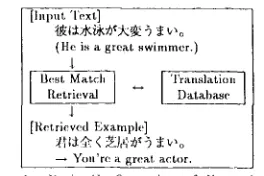
Figure I shows the basic configuration of example- ha~ed translation aid (EI~TA). It consists of two com- ponents: the t r a n s l a t i o n d a t a b a s e is t h e collection of translation examples, and the b e s t m a t c h r e - t r i e v a l engine is to retrieve the e x a m p l e t h a t is the most similar to the given input text. T h e character- istic of the E B T A s y s t e m is t h a t it accepts free-style texl inputs for the retrieval: it frees the user f r o m learning the t b r m a l language for datah,~se query.
'l'he central p r o b l e m in E B T A is the i m p l e m e n t a - tion of the hest m a t c h retrieval. T w o m e t h o d s were proposed: one is the s y n t a x - m a t c h i n g driven by gen- eralization rules in E T O C [8], and the o t h e r is Naka- n m r a ' s m e t h o d using content words [5]. T h e y are the w o r d - b a s e d b e s t m a t c h r e t r i e v a l m e t h o d s 1, which need morphological analysis.
T h i s p a p e r proposes the c h a r a c t e r - b a s e d b e s t m a t c h r e t r i e v a l m e t h o d , specifically for J a p a n e s e t e x t s C o m p a r e d with the word-hased m e t h o d s , the charaeter-h~sed m e t h o d has the following a d v a n t a g e s :
• Morphological analysis is unnecessary.
• Some kind of s y n o n y m s can he retrieved w i t h o u t a thesallrlls.
T h i s m e t h o d has been i m p l e m e n t e d in C T M ~, a Japanese-English translation aid s y s t e m for writ- i n g / t r a n s l a t i n g technical papers.
1 ]n w.rd bm~ed (reap. char~'ter b&sed) hem lll/~tc|t retrieval method, a word (Ires n. chara~'ter) is a primitive.
2C'I'M is named frc~m th~ .lalmnese p h r ~ , "Chotto 'Isukatte Mitene", which means "nNe it naly time you want".
2
T h e
C h a r a c t e r - B a s e d
B e s t
M a t c h
R e t r i e v a l
M e t h o d
2.1
C h a r a c t e r i s t i c s o f J a p a n e s e W r i t -t e n T e x t s
J a p a n e s e written texts h a v e r e m a r k a b l e characteris- tics as follows. 'riley cannot he found in E u r o p e a n languages, i.e., English, French, and G e r m a n .
1. T h e n u m b e r of characters is very large.
T h e n u m h e r of characters t h a t are used ill text is more t h a n 7,000 in J a p a n e s e . while it is less than a hundred in a E u r o p e a n language.
2. S y n o u y m s often have the s a m e Kanji character.
J a p a n e s e characters are divided into t h r e e types'. Hi- r a g a n a (83 characters), K a t a k a n a (86 characters), and Kanji. A l t i r a g a n a or K a t a k a n a c h a r a c t e r ex- presses a s o u n d , and a Kanji c h a r a c t e r represents a s e m a n t i c primitive. For example, tile Kanji c h a r a c t e r " ~ " m e a n s "thinking", and it is used for construct- lug several words concerned with thinking: e.g., ,~( ~ ( t h i n k i n g ) ~ ~",~, (consideration), ~ , ~ ' ( d e e p think- ing), ~ ~ T a (think), ~ [ ~ T T a (devise).
3. T h e r e is no delimiter between words.
In l"uropean languages, the white space is the delim- iter for word separation. In contrast, J a p a n e s e has no explicit delimiter. Therefore, the main p a r t of J a p a n e s e morphological analysis is to divide a text string into words: it is not easy task a.
These characteristics of J a p a n e s e suggest the c h a r a c t e r - b a s e d b e s t l l l a t e | l , becanse
I While the word-based m e t h o d needs morphologi- cal analysis, the character-bmsed m e t h o d does not need it.
2. In o r d e r to retrieve s y n o n y m s the word-based m e t h o d needs a t h e s a u r u s . In coutra.st, the c h a r a c t e r - b a s e d m e t h o d call retrieve s o m e kind of s y n o n y m s withont a thesallrus, because synonynls often have tile same Kanji c h a r a c t e r in J a p a n e s e .
2.2
T h e C h a r a c t e r - B a s e d B e s t M a t c h
T h e c h a r a c t e r - b a s e d best m a t c h can be d e t e r m i n e d by defining the distance or similarity m e a s u r e be- tween two strings.T h e simple m e a s u r e of similarity hetween two strings, A = alau...a~., H = b t b 2 . . . b y , is t h e n u m - ber of the m a t c h i n g characters considering the char- acter order constraint. It is not particularly good
a F o r e x a m p l e , a Jap&llese m o r p h o h ~ g i c a l a n M y M s pFOgl'&lll developed by Nyolt~ University fails to anMyze 3 ~ ,5 % of Selll ellCeS.
memsure, b a t m a k e s a convenient s t a r t i n g point. We define it as follows:
s ( i , j ) =
0 i f i = o v j = o
s ( i - l,j
l ) + m ( i , j ) , )
m a x s(i l , j ) ,s ( i , j 1) i f ( l _< i < x) A ( 1 < _ j < y )
1 if a~ = b 3
m { i , j ) = 0 i f a , ~ b j
This m e a s u r e often produces the undesirable re- suits, because we ignore continuation of m a t c h i n g characters. For example, consider the following strings:
A = I " I ~ R 4 ~ ' ¢ 7 0 (solve the problem)
f~ = t ~ a ~ m 5 , ~ j ~ 1 c e ~ Ltco
(He solved the problem yesterday.)
( d e t e r m i n e tile m e t h o d for solving the p r o b l e m )
We w a n t to be S ( A , 1 3 ) > ,9(A, F¢'), but the above m e a s u r e produces ,5'(A, B) < ,S'(A, B~). To solve the problem, we consider tile bonus for c o n t i m m n s m a t c h - ing characters. It can be done by modifying m ( i , j ) m the the above definition:
,5'(A,,~) = s(x,:j)
s ( i , j ) =
.s(i -- 1 , j 1) + m i n ( c m ( i , j ) , W ) m a x s ( i - l , j ) ,
s ( i , j - 1)
if(l
< i < ~)A(1 _<j _< y)
~,,~(/, j) =
0 i f i = O V j = O
e m ( i l , j - 1) + m ( i , j )
if(1
_< i _< x)^(~ _<j
<:/)1
if ai = bjm ( i , j ) = 0 i f a i ~ b j
T h i s is the similarity score t h a t we use, where W is a p a r a m e t e r t h a t d e t e r m i n e s the m a x i m u m value of the bonus for tile continuons m a t c h i n g characters. When 14" = 1, this definition is the s a m e with tile previous definition. Table l shows ,5'(A, B) and S ( A , B ' ) with v a r y i n g v a h w s of W. l_lsually we use W = 4. 4
4 ' l ' h i s v a l u e w a s d e t e m n i , t e d e m p i r i c a l l y . II m a y b e e x plained ~-s follows, '['he average character length of a Japanese word is abottt two, and we frel that the COlllillll(lllS lll~.tChillg of two w~)rds is Ihe Mrollg match.
Table h Scores vs. W
W [ 'l '2 3 4 5
S ( A , I ] ) [ 5: 9 : 12 14 15
5'(A,B') 7 9 9 9 9
Table 2: T r a n s l a t i o n I)atah,'~se
l
ID l .lnp~umse ~ <'95"69 English several 2 ~"3"C ~ every tlmc 3 ~ a O ~ some (lity 4 ~ O') } yeuterd~tyTahle 3: C h a r a c t e r Index Ch. lI)'s Ch. II)'s
~ 1, 2, 3 O 1, 2, 3
fl
4
-¢
2
7~ ~ 1, 3 a) 1, 4
4 ~ 2
<
1
2 . 3
A c c e l e r a t i o n by C h a r a c t e r I n d e x
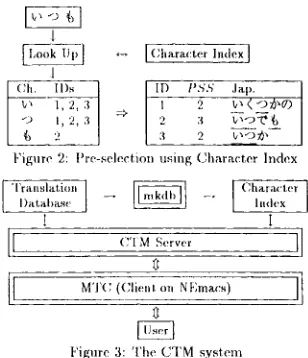
At the be'st n/arch retrieval, we use the acceleration m e t h o d using t h e c h a r a c t e r index. '~ T h e c h a r a c t e r index is tile tahle of every c h a r a c t e r with ll)'s of ex- amples in which the c h a r a c t e r is a p p e a r e d . T a b l e 2 shows all exatnple of translation d a t a b a s e and T a b l e 3 shows the c h a r a c t e r index of it.In the first stage of the retrieval, the c h a r a c t e r in- dex is used for the pre-seleetion of tile examples. Fig- ore 2 illustrates the pre-selection process: it is
1. Look up the records for the c h a r a c t e r s t h a t are a p p e a r e d in the input string.
2. For e'very examph,, c o m p u t e the pre-selection score, I ' S S , wtfich can he o h t a i n e d by counting tile nurnher of the e x a m p l e l l ) ' s in the records. It is the n u m b e r of m a t c h i n g c h a r a c t e r s between the input string and tilt! e x a m p l e ignoring the charac- ter order constraint.
3. Select tile top N e x a m p l e s t h a t have tile largest pre-selection score, where N is the p a r a m e t e r and we usually use N = 200. s
In the second stage of the retrieval, the similarity scores of life-selected e x a m p l e s arc eomptlte(I, and the e x a m p l e s are ordered by the score.
3
T h e C T M
S y s t e m
Above m e n t i o n e d retrieval m e c h a n i s m hP-~ been im- p l e m e n t e d in C T M , a J a p a n e s e - E n g l i s h translation 5 W e C&llllOt COllll)llte tile similarity re:ore of every exltnlt)le ill tile tlatabm~e, because the C()llll)lll~iltioll Ileeds almut 5 lllil- tisecond b e t w e e n the' ItVel'age illl}ll( s i r i n g (lO <'ll&racter~) &lid t h e average extmtDle (5(] cha~'actet~) (m S p a r c S l a l i o n 2,
eThis value wa.~ determined empirically.
,[
L ~ k ~ l ~ 4~ [CI . . . ter Index]
1
I
Ch. II)s I, 2, 3 "& ID '2 P S S " 3 Jap. ~ ~ : 9 "72 ~o Figure 2: Prc-seleetiml using C h a r a c t e r Index'l'ranslati .... _ ~ _, ~
I )it t al)i~.~e
I I
I] M'I'C (Clienl ... NE . . . ) ~ ]
l"igure 3: T h e C T M s y s t e m
aid s y s t e m C T M is written by C and runs on Sun Workstations. Pigure 3 shows tile contlguration of C T M : it consists of three p r o g r a m s .
m k d b T h e p r o g r a m to create the c h a r a c t e r index t¥om tile translation d a t a b a s e .
C T M s e r v e r T h e main p r o g r a m , which retrieves t h e hest m a t c h e d e x a m p l e s with the given input. 7
M T C ~ T h e client p r o g r a m on NF.macs (Nihongo ( J a p a n e s e ) G N U Emacs), which interacts the
C ' I ' M server via Ethernet.
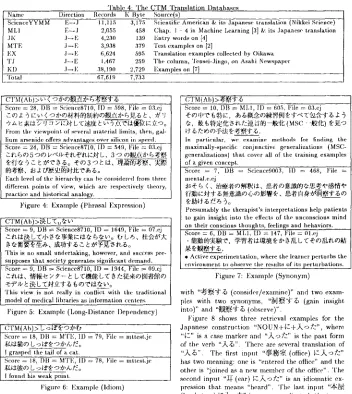
T h e translation datah,-Lse of (YI'M is text tiles, in which a J a p a n e s e text string and an English text string a p p e a r one .after the other. T h e s e files call be m a d e from J al)anese text files and the c o r r e s p o n d e n t English text tiles hy nsing the alignment p r o g r a t n [1] semi-automatically. We h a v e m a d e the translation d a t a h a s e from several sources: Tahle 4 shows ollr translation databases.
4
R e t r i e v a l
E x a m p l e s
We show here C, T M retrieval cxaml)les with the fol- lowing features: phra.qal expression, long-distance (le- pendency, idiom, synonynl, and semantic ambiguity.
Figure 4 shows a retriewd exanlple of phrasal ex- pression " ~ < " D h ~ C ) ~ J ~ : ) : : ~ ¢ , ~ ' ~ . ~ J ' Y o (consider f r o m several points of view)". Although there is no ex- act m a t c h e d expression in the d a t a h a s e , C T M can retrieve helpful e x a m p l e s for us to t r a n s l a t e it.
rThe CTM ~erver ha~ ~tller facilities: tile charactelq)aaed exact lllatdl retrieval fiw Jap~tllese texts, and tire word-bmsed hem or e x e r t nl&tch retrieval f~n' English texts.
s M'I'(Y is named t'r~]n tile lanal~pne phra-~', "Molt. "1 ~ukatte C, hondai', whi,'h III~RII~ "11~ il lllOr~ a n d Hlore".
[image:3.432.227.381.27.206.2]T a b l e 4: T h e ~ T M T r a n s l a t i o n D a t a b a s e s
Name Direction ll.eco rds K Byte Sonrce(s)
ScienceYYMM 1';~J 11,115 3,175 Scientilic American & its Japanese translation (Nikkei Science) MLI E ~ , I 2,655 458 Chap. I 4 in Machine Learning [3] ,tz its Japanese translation
.11,~ . I ~ E 4,230 139 ~;ntry words on [4]
M T E J ~ E 3,938 379 Test examph!s on [2]
EX J ~ E 6,624 595 Translation examples co]leered by Oikawa
T J , I ~ E 1,d67 259 The column, Tensei-Jingn, on Asahi Newspaper
K]) .]~l", 38,190 2,729 F, xamples on [7]
Total 67,619 7,733
C'/'M(AI,)> ~' { -9 h'o)~,t.~(7,~' ¢9 ~-~g,-J- 7a
Score = 28, 1311 = Science8710, lI) = 598, I"ile = 03.ej ~ o ) , t 5 l : ~ , < -gz>o),~,f*~f~$1/61o)t¢,lt;t.~,h~gSL~ &, ~',)
l"rmn the viewpoint of several material limits, then, gaJ- fium arsenlde offers advantages ow'r silicon in speed. Score = 24, 1)It = Science8710, II) = 549, File = fla.ej ~ - ~ o) 5 -9o) t ~ < ) ~ f t ~ : ~ , ~ b . 3 -9 e~.,~,~, r~ ~-.g!.
Each lewd of thr hierarchy can be considered from three different points (ff view, which are respectively theory, practice and historical analogy.
F i g u r e 4: E x a m p l e ( P h r a s a l Expression)
C T M ( A b ) > ~ b'CJz ~,
Score = 9, DB = Science8710, ID = 1649, File = 07.ej
This is no small undertaking, however, and snccess pre- snpposes that society generates significant demand. Score - 9, DB = Science8710, 11) = 1944, File : 09.ej
This view is not reMly in conflict witt, the traditional model of medical libraries as informati<m centers.
F i g u r e 5: E x a m p l e ( L o n g - D i s t a n c e l ) e p e n d e n c y )
- C T M ( A b ) > [. -~/,~'~"9 ~ . b
Score = 18, DB = M'FE, II) = 79, File = mttest.je ,~Xlat ~ O) b o l~'¢g -9 zbt~ t~o
I gra-~l>~t I.he tail of a <:at,.
Score = 18, DB = MTE, 1I) = 78, File = rnttest.je
I fonnd his weak tmint.
F i g u r e 6: E x a m p l e ( I d i o m )
C'I'M s u p p o r t s the retrieval of long=distance depen- dency: F i g u r e 5 shows a retrieval e x a m p l e , where " ~ L"C" is an a d v e r b , and ,,¢'¢~+v, is an auxiliary adjec= tive for negation, and they are often used t o g e t h e r with the general m e a n i n g " n e v e r " .
C T M also s u p p o r t s t h e r e t r i e v a l of i d i o m a t i c ex- pression: F i g u r e 6 shows an e x a m p l e . In this figure, the first retrieval e x a m p l e is t h e literal m e a n i n g , and the second is t h e i d i o m a t i c m e a n i n g .
T h e c h a r a c t e r - b a s e d best m a t c h m e t h o d can re- trieve s y n o n y m s . Figure 7 s h o w s an e x a m p l e : in this case. C T M retrieved an exact m a t c h e x a m p l e
C T M ( A b ) > - ~ f ~ . T 7~
Scare = 10, DB = M]A, ID = 605, File = 03.ej
~, ~ g ' ~ t U 5 t ~ ' : ~ f ~ - ~ (MSC "~4~) '~.g-9
In particular, we examine method~ for finding the maximally-specific conjunctiw~ generalizations (MSC- generalizations) that cover all of the training examples of a Riven concept.
Score = 7, DB = Science9003, ID = 468, File = nl~,[i t&l.e.ej
Presumably the therapist's interpretations help patients to gain insight into the effects of the unconscious mind on their conscions thoughts, feelings and behaviors. Score = 6, DB = MI,1, ID = 147, File = 01.ej
: ~ ¢ ~ ' ~ .
• Active experimentation, where the le&rner perturbs the ellvlrollment re) observe the resnlts of its perturbations.
F i g u r e 7: E x a m p l e ( S y n o n y m )
w i t h "~',~,-~j-To ( c o n s i d e r / e x a m i n e ) " a n d two e x a m - pies with two s y n o n y m s , "~l,iJg'?}~ "¢ To (gain i n s i g h t into)" and " ~ J J ~ J - - 5 ( o b s e r v e ) " .
F i g u r e 8 shows three retrieval e x a m p l e s for the J a p a n e s e c o n s t r u c t i o n " N O U N + / + ~ - + ~ o ; ~ z '', where "IS." is a case m a r k e r a n d " ~ 9 ) ~ " is t h e past. f o r m of t h e verb ".),,To". T h e r e are several t r a n s l a t i o n of " / k . T a " T h e f r s t input " ~ L I ' ~ (office) ~ : - J v o / ' z " ha.s two m e a n i n g : one is "entered the office" and t h e other is "joined as a new m e m b e r of t h e office". T h e second i n p u t "J~ (ear) ~S-/vo/'#." is an i d i o m a t i c ex- pression t h a t m e a n s " b e a r d " . 'Fhe l,'ust i n p u t ":eg~-t~: ( b o o k s t o r e ) {,2/k.-'9 ? ~:'' is more c o m p l i c a t e d : t h e trans- lation d e p e n d s on not only "~E ( n i ) " - c a s e hut also " ~ (ga)"-ca.se. T h e retrieval e x a m p l e s show the following three cases:
1. " ] k ( hu m a n ) ÷ 7~'~+ ~ . ' _ " ( r o o m ) + ~Z q- 2k. 7o" ( h u m a n e n t e r s t h e r o o m )
2. "$il, (wind)+i/+g[l[+._" (room)+~Z-+.A.7o" (the wind b l o w s i n t o t h e r o o m )
3. " ~ (book) + 7~'+-~l'.'.: (hooks tore) + ~5 + & 7o" (the book a r r i v e s a t t h e bookstore)
[image:4.432.47.399.30.424.2]Score - 14, I)B ~ MTE, 111 = 290, l,'ilc = inttest.je
lie entered the (:la~sroom hom the hack entrance. Score = 14, I)P. = Scien<:e9003, II) = 404, I"ile = inter.e.ej
llucy-Mei WiLllg, a recellt graduate student in my hal)o: ratory, extended these lindings by showing that the 11, 2 receptor fnnctions a~u an "on-off ~ switch.
C'['M (M,) >'II~5 L o-Z75:
Score = 14, I)B = MTE, II) - 279, Fib. = mttest.je
RUliiors reached her ears. (:'1' M ( A |,) > ~1":-)~:~ ft. o ?,"
Score = 14, I)B = EX, ID = 5947, File : yourci.jc
It appears that the thief entered the room by tile window. Score ~ 14, DB = MTI';, II) -- 283, l"ih. -- mttest.je
:~-
5 ~/~L;O ~ ~ v- A ~, t: oDraft blew into the room.
Score = 12, l)ll : MTI';, 11) -- 278, l"ile ~ mttest.je
Newly pul)lished /)oinks arrived a t the tmoksttm~. F i g u r e 8: E x a m p l e ( A m h i g l f i t y )
5
E v a l u a t i o n
It is v e r y difficult to e v a l u a t e a t r a n s l a t i o n aid sys- tem, because its effectiveness essentially d e p e n d s on the u s e r ' s satisfaction: when the user feels t h a t the s y s t e m is helpfld, it is effective. T h e e v a l u a t i o n of C T M is now in progress, an<l we s h o w s o m e results of e x p e r i m e n t s here.
T h e R e t r i e v a l T i m e
F, mpirieally, we o h t a i m ' d the following equation, which e s t i m a t e s the retriewd t i m e (millisecond).
t i m e ( I , k , N ) = I x (D0 x k + 2 / 3 x N ) where I is tile length of tile i n p u t s t r i n g , k ( m e g a byte) is t h e d a t a b a s e size, and N is tile w e - s e l e c t i o n p a r a m e t e r . For e×ample, i f / = D0 ( c h a r a c t e r s ) , k = 8 ( m e g a byte), N = 200, then t i m e = 2,133 (millisec- ond). It s h o w s t h a t tile c u r r e n t systeln responses ill a few seconds a n d it is not so fi~st. T h e m o r e accel- eration is need for t h e larger d a t a h , ~ e .
E v a l u a t i o n o f 1 0 0 r e t r i e v a l s
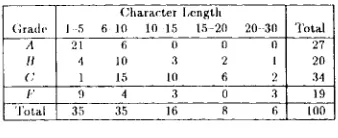
Wc h a v e e v a h m t e d 100 retrieval results I~y h a n d We have given one of ttle following g r a d e s to each r e t r i e v e d e x a m p l e .
A T h e e x a m p l e e x a c t l y m a t c h e s t h e input.
B T h e e x a m p l e provides e n o u g h infornmtion a b o u t tile t r a n s l a t i o n of t h e whole input.
C T h e examl)le provides i n f o r m a t i o n a h o u t the t r a n s l a t i o n of s o m e p a r t of t h e i n p u t .
A II (; I" Total
T a b l e 5: E v a l u a t i o n of 100 retrievals
Character l,ength 1 5 6 10 10 15 15 20 20 311
21 6 o D D 27
4 10 3 2 1 20
1 15 10 6 2 34
9 4 3 0 3 19
35 35 16 8 6 10O
F T h e e x a m p l e provides a l m o s t no i n f o r m a t i o n a b o u t t h e t r a n s l a t i o n of the input.
We e v a l a a t o d top five e x a m p l e s for each retrieval, a n d tile hest grade of t h e m is used for the e v a l n a t i o n of a r e t r i e v a l J ~ T a b l e 5 shows the result of t h e evalu- ation. T h e table s h o w s t h a t ( I ) we can o b t a i n very usefill i n f o r m a t i o n f r o m 47% of t h e retrievals, (2) we can o b t a i n at least s o m e i n f o r m a t i o n fi'om 81% of the retrievals.
A c k n o w l e d g m e n t s
T h e a u t h o r would like to t h a n k Ms. Yuko T o m i t a , who im[ped m e to m a k e t h e t r a n s l a t i o n datal~,'~es.
R e f e r e n c e s
[l] Gah~, W. and (lhur(:h, K.: A Program fi)r Aligning Sentences ill BilingnM Corl)ora , l'roc, of ACL-91, pp177 184, 199l.
[2] Ikeltara, S. : Teal ,'ientencea /or ]'huduat-
in 9 Japanese-English Machim 'FranMation, (in
Japanese), NTT, 1991.
[3] Michalski, R., Carlmnell, J. and Mit<hell, T. (Eds.):
Machiu~ Learning, Tioga Puhlishing Company,
1983.
[4] Nagao, M. et ;d (I'Ms): Iwanami Encyclopedic
lhctionory of Computer Science, (in Japanese),
Iwanami Shoten, 1990.
[5] Nakamura, N.: Translation Support by ltetrieving Bilingual Texts, (in Japanese), I¥oc. of 38lh Con- vention of IPSJ, pp357 358, 198!).
[6] Solo, S.: l';xamph~-Itased Translation Approltch,
Pro~. c,] International WorkM.~p on t'itndamentol
lteseareh for flu: l'iaure (hner.tion of Natural Lan- guage Processing, A'I'R Interpreting "lclephony ILe- search l,aborataries, ppl 16, 1991.
[7] Shhnizu and Narita (Eds.): The Kodunsha Japanese- English Dictionary, } ' : o u d a n s h a , 1976.
[8] S u m i t a , E, ~tnd Tsutsumi, Y.: A Translation Aid S w t e m Using l"lexibh: 71:zt Retrieval Ba.qed on
Synt~:-Matching, TILl, Research ]teport, TR-87-
1019, Tokyo Research Lalmratory, IBM, 1988.
9[t is eltough for the u~er to tlnd a useful example in the top five eXalllpJes.
[image:5.432.40.214.27.261.2] [image:5.432.219.388.45.114.2]