KIND TYPES IN KNOWLEDGE REPRESENTATION K. D a h l g r e n
IBH Los A n g e l e s S c i e n t i f i c C e n t e r 1 1 6 0 1 W i l s h i r o B1. Los A n g e l e s , C a l i f o r n i a 9 0 0 2 5
J. McDowell Department of Linguistics University of Southern California
Los Angeles, California 90089
Abstract Tiffs paper describes Kind Types (KT), a system which uses commonsense knowledge to reason about natural language text. KT en- codes some of the knowledge underlying natural language understanding, including category distinctions and descriptions dlffercntiating real-world objects, states and events. It embeds an ontology reflecting the ordinary person's top-level cognitive model of real-world distinctions and a data- base of prototype descriptions of real-world entities. KT is transportable, empirlcally-based and constrained for efficient reasoning in ways similar to h u m a n reasoning processes.
I. The problem A model of the semantic knowledge of concepts underlying natural language is definitional rather than assertlonal in that it contains general descriptions of objects and their relations, as opposed to facts about specific objects (Levesque 84)i Part of competence in English is the knowledge that an elephant is an animal, and therefore it moves on its own. Competence also involves knowing particular things about elephants, such as that they have trunks. This general description of the elej~hant concept is part of commonsense knowledge and belief. We will call this the cognitive model. In order to implement it, a com- puter system must represent w h a t speakers of a language believe about the world and their named concepts, rather t h a n represent the actual world. A complete computer model of the cognitive model would repre- sent the commonsense conceptual scheme presupposed by a particular culture and language, in tbis case, urban American English,
Knowledge of a natural language implies knowledge of a kind of theory of the environment used by a culture. In learning a language a child learns the category cuts recognized in that theory fBerlin 72l IDou£herty 7g). Assuming that knowledge of word meaning is not differently re- presented than other kinds of knowledge ( T a r n a w s k y 82), KT is designed to encode the world view embodied in natural language as ordinary knowledge, while retaining the autonomy of combinatorial semantics and of syntax. KT does not provide all the meaning, but it yields an interest~ ing and transportable portion of it.
The work reported here addresses two major problems. First, the knowledge associated with a concept does not a l w a y s give necessary and sufficient conditions for deciding whether an object falls under the con- cept name. The problem is to find a systematic w a y of predicting which concepts can be reasoned about using first order logic directly and simply (as a conjunction of predicates) and which ones require default logic. Second, the cognitive model models the actual world, which is open and continuous (Hayes 85). The potential concepts and relations between them are infinite. Nevertheless, humans manage to reason without cog- nitive overload. Can the computer model be systematically constrained using predictions paralleling those employed by humans in reasoning about the actual world7
Consider the following database of facts (assertions) and axioms (defi- nitions). The language used is irrelevant; any system isomorphic to first order logic will have the same deficiency.
l) FACTS H u m a n ( m a r y ) . Teacher(mary). Student of (mary,john). Teacherof(john, mary). AXIOMS
V x Teacher(x) ~ H u m a n ( x ) . V x ~t y Teacher(x) ~ Teacherof(y,x).
A question-answering system with the above database of facts and
216
axioms can respond easily to questions such as (2) but would be unable to answer (3).
2) Does M a r y have a student? Who is M a r y ' s student7 Is M a r y h u m a n ? 3) Is M a r y touchable?
Can M a r y move himseIf about7 What does M a r y do?
Are John and M a r y part of an institution?
The questions in (3) can be answered by a system which has a t a x o n o m i c hierarchy with features at the nodes, such as K L - O N E (Brachman and Schmolze 1985). If M a r y is human, M a r y is physical object, which has the feature "touchable". Similarly, since M a r y is an animal, she can move herself about. KT employs such a t a x o n o m y , and it is called an ontology to reflect the fact that KT reasons with such information as though it were true and complete, in contrast to generic information whicl{ is probabilistle. The ontology is is unique to KT and is based upon results in cognitive psychology, linguistics and philosophy.
Another deficiency of tile database in ( l ) is that it knows nothing about John, M a r y and their relationship, even though English speakers share descriptions of the typical objects in the sets defined by the predicates Human, Teacher and Student. For example, it would be desireablo if the system could respond as follows:
4) Is M a r y intelligent? --Probably so. Is M a r y articulate7 --Probably so. Does John listen to Mary7 --Probably so. ls M a r y educated? --Inherently so. What does Mary do? --Inherently, teaches.
The questions in (4) reflect the kind of things that average people think of when confronted with the predicates (1) (Dah gren 85). Why not have the AI system infer similarly? In order for such information to be useful, the system needs to know that "intelligent" is a probabilistic feature as- sociated with the predicate Teacher. Therefore, if told ~ l n t e l l i g e n t ( m a r y ) it should be able to reason that (5) while reasoning that (6) is definitely inconsistent.
5) ~ lntelllgent(mary) A T e a c h e r ( m a r y ) 6) (Remainder ( X / 2 ) = 0) A O d d n u m b e r ( X )
A system needs the capacity to reason with prototype information assn- elated with concepts. But the vastness of such information is an obstacle to its use in commonsense reasoning systems. The strategy employed in the KT system is to take advantage of the high degree of structure in prototype information in order to constrain it. Different types of kinds, such as artifacts, natural kinds and persons, are associated with predict- ably different types of information, and KT exploits these constraints.
II. Diversity in the L e z i c p t / T h e task of representing meaning for sorts ( c o m m o n nouns) attd predicates (verbs and adjectives) themselves, has been impeded by several philosophical problems which are yet to be re- solved. The traditional approach, decomposition into conjunctions of other predicates, is notoriously defective. There is no principled w a y to select or limit the number of other predicates. Suppose the meaning of a~n~N_le is represented as (7).
7) Apple -~. Fruit (P, ed V Green) A l',otmd A Sizel0
P r e d i c a t e m e a n i n g r e p r e s e n t a t i o n is difficult b e c a u s e the d o m a i n of the cognitive model is the a c t u a l World, w h i c h is b o t h open a n d u n k n o w n to a large extent. I-h,mans c a n n e v e r be totally e x p e r t a b o u t the a c t u a l w o r l d . A n d , the k n o w l e d g e o1 p r e d i c a t e s used b y speakers of a n a t u r a l language varies with expertise, h o w precise the p r e d i c a t e itself is, a n d c o n t e x t . Some psychologists m a i n t a i n t h a t the the i n h e r e n t openness of the actual w o r l d is dealt with cognitively b y m a k i n g clear ( t h o u g h possi- bly i n a c c u r a t e ) c a t e g o r y cuts, a n d then r e a s o n i n g a b o u t categories of ob- jects, including the u n c l e a r cases, using p r o t o t y p e s . (P, osch, el al 76) (Smith and Medin 80). This view implies diversity of representations of p r e d i c a t e meanings across the lexicon. Some types of predicates will have criterial features, O D D NUMBEI'~, others, s u c h as n a m e s a n d n a t u r a l kinds, L E M O N , will not.
Because it represents sort a n d p r e d i c a t e m e a n i n g with prototypes, and b e c a u s e it uses first o r d e r logic, K T differs in t h e o r y a n d results from s y s t e m s such as K L - O N E . In K L - O N E , c o n c e p t s a r e defined b y thelr roles (descriptive elements) a n d their s u b s u m i n g concepts (those con- cepts s u p e r o r d i n a t e to t h e m in the t a x o n o m y ) . The c o n c e p t E L E P H A N T is defined b y rolesets describing facts such as " h a s 4 legs", a n d by its at- t a c h m e n t to M A M M A L . The claim is t h a t all a n d a n y instantiation of the E L E P H A N T c o n c e p t has 4 legs. In c o n t r a s t , descriptions in K T are probabilistic. The s y s t e m accepts elephants with 3 legs, t h o u g h it k n o w s t h a t elephants inherentfy have 4 legs. It accepts eggs w h i c h a r e b r o w n , even t h o u g h it k n o w s t h a t eggs are p r o t o t y p i c a l l y white. F u r t h e r , in K L - O N E , since the descriptions a r c m e a n t to be defining, non-defining associated i n f o r m a t i o n is not e n c o d e d . By c o n t r a s t , K T encodes a great deal of i n f o r m a t i o n usually associated with a concept, w i t h o u t the hn- plicit claim t h a t it applies to all instantiations of the c o n c e p t . ELE- P H A N T c a n h a v e features " f o r g e t f u l " , " l m n b e r i n g " a n d so forth, w i t h o u t claiming t h a t all elephants h a v e those features.
A n o t h e r implication of the p r o t o t y p e model is t h a t the c o n t e n t of fea- tures is seen as essentially limitless. In c o n t r a s t , the s e m a n t i c net model assumes that there is a m a n a g e a b l e set of primitive c o n c e p t s w h o s e size is m u c h smallcr t h a t t h a t of the English lexicon, t h a t these a r e explicitly c o n n e c t e d . In KT, only ontological relationships are s t a t e d as rulcs. The relationships b e t w e e n specific descriptions c a n bc derived t h r o u g h problem-solving, but is not e n c o d e d . F o r example, in K L - O N E , the fact t h a t both clouds a n d eggs are w h i t e is directly stated b y a link f r o m both C L O U D a n d E G G to WHITE. In KT, t h a t both have a color is s t a t e d in the kind type P H Y S I C A L O B J E C T , but t h a t they both h a v e the s a m e color is reasoned at r u n time.
The diversity of i n f o r m a t i o n K T accepts is c o n s t r a i n e d b y kind types, w h i c h predict t h a t associated with E L E P H A N T are l e a t u r e s describing parts, because E L E P H A N T is in the kind type P H Y S I C A L O B J E C T . On the o t h e r b a n d , E L E P H A N T does not h a v e features describing its m o d e of c o n s t r u c t i o n because it is not in tile kind type AI~.'I'IFAC'F. Thus, the K T s y s t e m predicts limitless n u m b e r s of possible descriptions w h i c h are c o n s t r a i n e d b y types deriving f r o m c o r r e l a t i o n a l c o n s t r a i n t s of the a c t u a l w o r l d .
The K T s y s t e m differs f r o m most o t h e r r e p r e s e n t a t i o n s of the c o m m o n s e n s e k n o w l e d g e u n d e r l y i n g n a t u r a l langtmge in t a k i n g the con- t e n t of descriptions f r o m psycholinguistic studies. Because of its empir- ical basis, K T responds to queries in a n a t u r a l a n d h u m a n - l i k e w a y . T h o u g h other formalisms could be used to represent empirically-derived models of h u m a n c o m m o n s e n s e knowledge, K T lends itself to represent- ins the diversity of i n f o r m a t i o n f o u n d in the d a t a b e c a u s e it allows a vlr- tually unlimited n u m b e r of features, while organizing t h e m with the kind types.
III. The K i n d ~ ~ K T reads g e o g r a p h y text, a n d shows its u n d e r s t a n d i n g of the t e x t b y a n s w e r i n g questions. T e x t u n d e r s t a n d i n g d e m o n s t r a t e s the usefulness of the system, but m a n y interesting problems in t h a t area of r e s e m c h a r e not addressed by this w o r k . K T is w r i t t e n in V M / P R O L O G . It uses a parser, a f i r s t - o r d e r logic t r a n s l a t o r a n d a m e t a i n t e r p r e t e r dew:loped b y Stabler a n d T a r n a w s k y (19851. It employs a set of d a t a b a s e s w h i c h r e p r e s e n t the c o m m o n s e n s e ontology, tim ge- neric features for sorts, t y p e i n f o r m a t i o n for the generic features, a n d kind types for the ontology. Below is a sample text r e p r e s e n t a t i v e of the English K T u n d e r s t a n d s .
S a m ling_ Text J o h n is a m i n e r w h o lives in a m o u n t a i n t o w n . His wife raises a c h i c k e n w h o lays b r o w n eggs. The c o m p a n y - o w n e d clinic is near t h e mine. T h e nurse m o n i t o r s the health of the miners. She a p p r o v e s of J o h n ' s diet.
111.1 Tim Ontological S c h e m a To c a p t u r e ontological c o n s t r a i n t s , K T e m p l o y s a top-level c o n c e p t u a l s c h e m a , some of which a p p e a r s in Figure 1. It is intended to m i r r o r tile a v e r a g e English-speaker's beliefs a b o u t w h a t tile m a j o r c a t e g o r y cuts of the e n v i r o n m e n t arc, that is, a e o m l n o o s c n g e o n t o l o g y .
F i g u r e 1 The O n t o l o g i c a l Schema
ENTITY ~ (ABSTRACT v ILEAL) & (INDIVIDUAL v COLLECTIVE) ABSTRACT ~ IDEAL V PROPOSITIONAL v qUANTITY v ]RREAL REAL ~ (PHYSICAL v TEMPORAL v SENTIENT)
& (NATURAL v SOCIAL) PHYSICAL ~ (STATIONARY v NONSTATIONARY)
& (ANIMATE v INANIMATE) NONSTATIONARY -- SELFMOVING V NONSELFMOVING
COLLECT]VE ~ MASS v SET v STRUCTURE STATIONARY ~ ~ MOVEABLE
TEMPORAL ~ STATIVE v NONSTATiVE NONSTATIVE ~ (GOAL v NONGOAL)
& (PROCESS v ACTIVITY v MOTION) PROCESS ~ POSITIVE v NEGATIVE
ACTIVITY ~ OCCUPATIONAL v INTERACTIONAL OCCUPATIONAL ~ AGRICULTURAL v MININGMANU
v IRADE v SERVICE v EDUCATION INTERACTIONAL ~ POSSESSIVE v ASSISTIVE v CONIACTt}A4.
V CONFRONTATIONAL MOTION ~ (FAST v SLOW) & (TOWARD v AWAY)
Tim goal is to e n c o d e all ontology w h i c h is consistent with a n ernpirically verifiable cognitive model. As m u c h evklence as possible was derived f r o m p s y c h o l o g i c a l r c s c a r c h . The s c h e m a was developed to h a n d l e the p r e d i c a t e s found in 4100 w o l d s o[ g e o g r a p h y text d r a w n f r o m t e x t b o o k s .
Despite the c o m p l e x i t y of c o n s t r u c t i n g a c o m p u t e r model of the
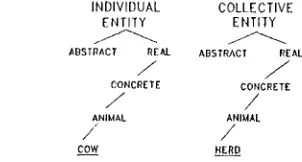
ontology, t w o c o m m o n l y - u s e d sinrplifieations, b i n a r y trees a n d p l a n a r b r a n c h i n g in trees, w c r e rejected. First, t h o u g h b i n a r y trees have simpIi- l y i n g m a t h e m a t i c a l properties, they a r c not likely to be psychologically real. People easily think in t e r m s of m o r e than t w o b r a n c h e s , such as FISH vs BIRD vs M A M M A L , and so on, off of the VEWI'EBI~.A'I'E node. Secondly, most representations a s s u m e t h a t each node has a unique p a r e n t . But cross-classification is n e c d c d shlce c o l n n ] o o s e n s c rt2}lso?ling USeS it. People u n d e r s t a n d , for e x a m p l e , t h a t entities cress-classify as in- dividuals or sets a n d real or a b s t r a c t . Tiffs m e a n s t h a t at e a c h node, m o r e t h a n one plane might be needed for b r a n c h i n g . Cross-classiflcation is h a n d l e d as in ( M c C o r d 85). A type h i e r a r c h y is g e n e r a t e d which pernfits e a c h node to be cross-classified in !! ways. In the top level rule of Figure 1 e a c h e n t i t y must be classified both w a y s , as either A B S ' I ' R A C T or ILEAL, and as either I N D I V I D U A L or C O L L E C T I V E . 'lhis c o r r e s p o n d s to the claim that cngnilively there is essentially a palallel ontological s c h e m a for collectives. For e x a m p l e , people k n o w t h a t herds consist of animals, so t h a t herds a r e real a n d c o n c r e t e . Thus we h a v e the parallel o n t o l o g y Iragments in (8).
(8)
INDIVIDUAL COLLECTIVE
ENTITY ENTIIY
ABSTRACT REAl_ ABSTRACT REAL
/
J
CONCRETE CONCRETE
/
/
ANIMAL ANIMAL
/
/
CO,_~W HERD
I n h e r i t a n c e of properties w o r k s differently for tile collectivcs t h a n it does for individuals. Because c o w is u n d e r A N I M A L , " c o w is a kind of a n i m a l " is true. In c o n t r a s t , !toLd a t t a c h e s to A N I M A L , but " a h e r d is a kind of a n i m a l " is not true. A herd consists of animals. We h a v e f o u n d t h a t t h o u g h there arc gaps a m o n g the collectives, a surprising m n n b e r of types of entities lmve collective n a m e s in English. F o r e x a m p l e , plop-
[image:2.612.318.469.591.672.2]ositions c o m e in collectives ( d i s c o u r s e ~ t h ~ . A n o t h e r i m p o r t a n t cross-classification involves S O C I A L vs N A T U R A L . Entities (or events) w h i c h c o m e into being (or t a k e place) n a t u r a l l y m u s t be distinguished f r o m those w h i c h arise t h r o u g h some sort of social i n t e r v e n t i o n . A R T I F A C T is one of the S O C I A L nodes. The distinction needs to be m a d e high up in the ontology because it affects most kind types. F o r e x - ample, events m a y either be S O C I A L (p_arty_) or N A T U R A L _(earth- guake). (Section IV e x p a n d s u p o n the justifications for the ontology).
The ontology also assumes the possibility of multiple a t t a c h m e n t s of instantiations to nodes. Thus the representation is a c t u a l l y a lattice r a t h e r t h a n a tree. F o r e x a m p l e , an entity, John, is both a H U M A N w i t h the physical properties of a m a m m a l , and is also a P E R S O N w h o thinks. The latter makes J o h n very similar to other sentients s u c h at institutions a n d social roles. Instead of loading all of t h a t c o m p l e x i t y into a single H U M A N node, we m a k e the SENTIENT~NON-SENTIENT distinction high tip in the h i e r a r c h y . There is ample philosophical ( S t r a w s o n 53) a n d psychological ( G e h n a n a n d Spelke 81) s u p p o r t Ior this decision. A n y a c - tual person is a t t a c h e d to both the H U M A N a n d P E R S O N nodes in the ontology.
1II.2 G e n e r i c I n f o r m a t i o n In the generic features d a t a b a s e , each s o r t is r e p r e s e n t e d as a predicate with t w o a r g u m e n t s . The first is a list of p r o t o t y p e features a n d tile second is a list of inherent features. A p r o t e - type f e a t u r e it typically associated with a sort or tuedicate. Most entities' h a v e m o r e p r o t o t y p i c a l features t h a n inherent features. F r o m our s a m - ple, a miner is typically " m a l e " ; a norse is typically " f e m a l e " ; a t o w n typically has " h o u s e s " , Ua s q u a r e II, Ila f o u n t a i n " , a n d so on, h l h e r e n t features are are rationally unrevisable properties of a sort or predicate. Thus, a m a n is inherently " m a l e " , a wife is inherently " m a r r i e d " , a house is i n h e r e n t l y " h o u s e - s l z e d " . F r o m our sample, a miner i n h e r e n t l y " w o r k s in a m i n e " , a nurse inherently is " e d u c a t e d " , a t o w n i n h e r e n t l y c o n t a i n s "buildings", a n d so on.
IlI.3 F e a t u r e ~I~y~ The lu'ototype features a r e represented b y the s a m e set of predicates osed to r e p r e s e n t the inherent 1eatures, thus achieving SOOle econollly bl the rules. Nevertheless, the n m n b e r of predicates needed to e n c o d e the i n h e r e n t a n d p r o t o t y p e features is theoretically limitless. F o r t u n a t e l y , a small a n d m a n a g e a b l e set of 33 f e a t u r e types encodes a great deal of inforlnation, a l t h o u g h not exhaustively. The fea- tures themselves w e r e c h o s e n empirically to c o r r e s p o n d with psycholingulstic d a t a g a t h e r e d b y l;'.esch et al (1976), A s h e r a f t (1976) and D a h i g r e n (1985a) W h e n a s k e d to list prototypieal Ieatures of various c o n c r e t e objects, subjects tend to n a m e features w h i c h fall into a small n u n r b e r of types s u c h as SIZE, C O L O R , S H A P E , a n d F U N C T I O N . Similarly, a few types of f e a t u r e s such as STATUS, SEX, I N T E R N A L TI~.AIT A N D I~.ELAT1ON a r e n a m e d for social roles.
Notice t h a t a f e a t u r e type such as SIZE or C O L O R m a y be i n h e r e n t for one sort but only p r o t o t y p l e a l for a n o t h e r . F o r instance, while blood inherently has C O L O P , " r e d " , a brick is only p r o t o t y p i c a l l y " r e d " . While a brick inherently has S H A P E " r e c t a n g u l a r parallehJpitmd" , bread is only prototypically " l o a f - s h a p e d " . In some cases, a sort has a f e a t u r e t y p e both inherently a n d p r o t o t y p i c a l l y . For e x a m p l e , a d o c t o r has the inher- ent FUNCTION " t r e a t s sick peot~le" a n d the p r o t o t y p i c a l F U N C T I O N "consoles sick people".
I11.4 Kind q'ypcs as M e t a s o r t s Most k n o w l e d g e r e p r e s e n t a t i o n systems permit a n y c o m b i n a t i o n of the features in descriptions. K T limits these c o m b i n a t i o n s by taking a d v a n t a g e of several i m p o r t a n t ontological con- straints affecting the possible r e a l - w o r l d objects a n d t h e r e f o r e possible c o m b i n a t i o n s of features in c o m m o n s e n s e knowledge. Objects 1all into kinds. In particular, n a t u r a l kinds exist b e c a u s e their m e m b e r s s h a r e some u n d e r l y i n g trait, while artifacts a n d social kinds exist b e c a u s e el social convention S c h w a r t z ( 1 9 7 9 ) D a h l g r e n (1985b). We call classifica- tions of kinds K I N D TYPES, so t h a t N A T U P , A L KIND constitutes one kiud type, A R T I F A C T a n o t h e r , a n d so on. Kind types c o n s t r a i n the eomnlonsense k n o w l e d g e base in several ways• First, e a c h kind type is u n d e r s t o o d in terms of c e r t a i n predictable f e a t u r e types. N A T U R A L K I N D is conceived p r i m a r i l y in t e r m s of perceptual features, while A R T I F A C T a d d s f u n c t i o n a l features. Second, there is a c o r r e l a t i o n a l s t r u c t u r e to the f e a t u r e s of r e a i - w o r l d objects. Given t h a t a n object is a
m a m m a l , c e r t a i n f e a t u r e s will be f o u n d (eg. " f u r " ) a n d others will be absent (eg. " f e a t h e r s " ) .
Associated w i t h e a c h n o d e in the ontology is kind type i n f o r m a t i o n e n c o d i n g f e a t u r e types entities a t t a c h e d at t h a t node m a y have. Entities m a y be described b y f e a t u r e s falling into a some or all of these f e a t u r e types, a n d n o others. I n h e r i t a n c e up the tree ensures t h a t a n y l o w e r n o d e has all the f e a t u r e types of higher nodes on a n y path to E N T I T Y . F o r instance, a n y n o d e u n d e r P I t Y S I C A L m a y have certain f e a t u r e types, a n d a n y n o d e u n d e r AP, T I F A C T m a y have those inherited I t e m P l I Y S - 1CAL, as well as fu,'ther f e a t u r e types, as below:
P I I Y S I C A L - Shape. Size, Color, Material rl'exture, O d o r , l t a s p a r t s , P a r t o f A F . T I F A C T - { P H Y S I C A L ] , F u n c t i o n , O p e r a t i o n ,
C o n s t r u c t i o n , O w n e r
A t each node, only c e r t a i n f e a t u r e types are applicable. Conversely, e a c h f e a t u r e k n o w n to K T is classified by t y p e as a C O L O R , SIZE, F U N C - T I O N , I N T E R N A L T R A I T or o t h e r . C o h n (19851 describes the econ- onry of the use of sorts in logic p r o g r a m m i n g . In the K T system, sorts a n d predicates a p p e a r at the t e r m i n a l nodes of the ontology. In addition, the kind types e m p l o y e d b y the s y s t e m represent m e t a s o r t s , in t h a t they c o n s t r a i n the possible ty_~es of sorts recognized b y the system.
I11.5 E n c o d i n g the C o m m o n Sense Knowlcdgt~ The r e p r e s e n t a t i o n s described a b o v e will be illustrated w i t h the sort nurse. N u r s e is a t t a c h e d to the o h t o l o g y in a x i o m
9) n u r s e ( X ) -+ role(X).
F r o m this a x i o m nurse inherits S E N T I E N T , S O C I A L , P H Y S I C A L , R E A L , I N D I V I D U A L a n d E N T I T Y tronl the ontology, In the generic • d a t a b a s e , the a x i o m (101 lists the p r o t o t y p e a n d i n h e r e n t Ieatures of
n u r s e .
10) marse ({caring,female}, {educated,asslstant, h e l p ( X , Y ) & p e r s o n ( Y ) & sick(Y)}).
N o t i c e t h a t the last inherent f e a t u r e is in the f o r m of a P P . O L O G clause. This m a k e s it possible to use the whole c o m p l e x f e a t u r e as input to the English g r a m m a r in o r d e r to [ o r m n l a t e a n English response to a question s u c h as " W h a t does the nurse d o ? " , or "Does the u u r s c help peopleT". T h e f e a t u r e typing d a t a b a s e classifies the f e a t u r e s as follows:
relalion(assistant). interonltrait (caring). i n t e r n z l t r a i t ( e d u c a t e d ) . sex(female).
function(help(*,*)).
The kind types predict t h a t as a I~.OLE, n m s e will h a v e c e r t a i n types of features. Inherited f r o m the S E N T I E N T kind t y p e are f e a t u r e types I N T E R N A L TP, AIT ( " c a r i n g " ) a n d G O A L ( " t r i e s to h e l p " ) . Inherited f r o m the S O C I A L kind type are f e a t u r e types F U N C T I O N ( " t a k e s c a r e of p a t i e n t s " ) a n d R E Q U I R E M E N T ("license"). In addition, RE- L A T I O N type f e a t u r e s ( " a s s i s t a n t " ) a r e predicted with a R O L E ,
IV. The I n f e r e n c e Mecharfism Built into the n a t u r a l language c o m p o - nent b y Stabler a n d T a r n a w s k y is a m c t a i n t e r p r e t e r w h i c h solves queries of all a x i o m s active in the system. This permits us to q u e r y ontological a n d generic i n f o r m a t i o n as welt as t e x t u a l i n f o r m a t i o n . T h e t r a n s l a t i o n of tile first sentence of Sample T e x t is as in (11).
11) miner(john} & t o w n ( t o w n 2 2 0 )
T h e p r o b l e m solver derives t11o a n s w e r s to qneries as in (12}. m a t c h i n g logic translations of tile queries, w h i c h a r e in ttm f o r m of Prelog goals, to the d a t a b a s e .
12) Is J o h n a miner7 -- Yes
In addition, K T is able to nlake a n u m b e r of inferences f r o m the t e x t w h i c h are not d i r e c t l y stated there. The inferences are d r a w n f r o m vari- ous aspects of the c o m m o n - s e n s e k n o w l e d g e built into KT.
IV.I I n h e r i t a n c e Using the ontological d a t a b a s e anti tile s a m e p r o b l e m solver, the K T s y s t e m d e d u c e s t a x o n o m i c a l l y inherited i n f o r m a t i o n a b o u t the entities m e n t i o n e d in tile text, as in (13]-(14).
13) W h a t is a miner7
- - A miner is a role, sentient, concrete, social, individual a n d a n entity. 14) W h a t does a m i n e r do?
- - A miner digs for minerals. What is digging7
--a goal-oriented, n a t u r a l , n o n m c u t a l , real, tem.tmt'al activity
If a n entity has dual a t t a c h m e n t , for e x a m p l e as a h u m a n a n d as a role, or as a place anti as a n institution, then K T explains inheritance relations along both paths of the ontology. A clinic is both a social place a n d a n institution, a n d so w h e n asked (15),
15) W h a t is the clinic?
K T replies both t h a t " A clinic is a n institution, sentient, physical, real, collective, s t r u c t u r e . " a n d t h a t " A clinic is a social place, place, inani- nmte, physical, s t a t i o n a r y , social, real, individual." Direct ontological questions such as (16) are also a n s w e r e d :
16) ls tile clinic a social place? --Yes Is the clinic collective? --Yes
The inheritance p a t h is followed in a n s w e r i n g such questions, so t h a t the s y s t e m call a n s w e r not only queries of node a t t a c h m e n t s at to the termi- nal nodes of the ontology, b u t at all higher levels.
IV.2 Coln1~letq. a.D~l - hmon)plc_'tc.l(nowlcd~gc_" In reasoning with this s c h e m a , the s y s t e m k n o w s w h i c h valid inferences it c a n derive ontologically, a n d t h c r e f c r e definitively, a n d w h i c h k n o w l e d g e is i n c o m - plete. For e x a m p l e , K T k n o w s t h a t it k n o w s the following for certain:
V x H u m a n ( x ) ~ Thinks(x) V x T e a c h e r ( x ) - - l l u m a n ( x )
It also k n o w s t h a t if s o m e t h i n g is H U M A N , it is not A I I S T R A C T . W h e n asked "Is the teai:her a b s t r a c t ? " it a n s w e r s " N o " . Thus it handles the exclusivity of sets called for b y H c n d r i x (1979) a n d T e o e n b a u m ( 1 9 8 5 ) . O n the other h a n d , it knows w h i c h i n f o r m a t i o n is incomplete. With ge- neric descriptions, K T k n o w s t h a t it only k n o w s at the la'obabilistie level. It asked, "Is M a r y intelligent?" it rcspouds " P r o b a b l y so." 'lhis reflects the fact t h a t most English speakers share a p r o t o t y p e of teachers as intel- ligent. The logic w o r k s this w a y . If a question is ontological, K T gives dclinitive ( y e s / n o ) a n s w e r s . If the question is generic, the a n s w e r is qualified as either p r o t o t y p e or inherent. If no attswcr c a n be derived to a non-ontological question; K T responds "1 d o n ' t kttow." Thus K T m a k e s the open w o r l d a s s u m p t i o n e x c e p t with r e g a r d to ontological classifica. tions. Tills ability to reason a b o u t incomplete definitions is s h n i l a r to Levesque's proposal for incomplete d a t a b a s e s (Levesque 84).
IV.3 Prototy_p_c_'_ag~tlnhgj2Efit Fea!31res K T a n s w e r s queries c o n c e r n i n g features of the entities in the text, both directly a n d b y types of features. Direct f e a t u r e queries a r e of the f o r m (17). T h e f o r m of the a n s w e r de- pends upon w h e t h e r the f e a t u r e is prototypical or inherent.
17) Is the m i n e r r u g g e d ? - - P r o b a b l y so. Is the clinic a place? --Inherently so. Does the chicken lay eggs7 - - I n h e r e n t l y so. A r e tile eggs white7 - - P r o b a b l y so.
t I o w is digging done7 - - P r o b a b l y with a shovel. W h e r e is digging done7 - - P r o b a b l y in the e a r t h .
IV.4 O v e r r i d i n g F e a t u r e s Genmqe i n f o r m a t i o n is h a n d l e d d i f f e r e n t l y f r o m ontological i n f o r m a t i o n . First, it is tentatively inferred, a n d c h e c k e d against tile c u r r e n t k n o w l e d g e base of i n f o r m a t i o n built u p f r o m the r e a d i n g tile text. If a n y t h i n g ill the t c x t n a l d a t a b a s e conflicts with a generic inference, the latter is o v e r r i d d e n . K'F takes the text as the a u - t h o r i t y , a n d if the text says t h a t a n e n t i t y has a f e a t u r e c o n t r a d i c t i n g those in its o o m m o n s e n s e k n o w l e d g e of the entity, the t e x t ' s claim c o m e s first. F o r e x a m p l e , Salnplc T e x t says t h a t the eggs are " b r o w n " , w h i c h overrides the p r o t o t y p i c a l generic l c a t u r o " w h i t e " w h i c h is listed for c~g, as in (18).
18) A r e the eggs b r o w n ? --The text says so.
The cancellation takes place simply by m a t c h i n g to the t e x t u a l d a l a b a s e first. Sbnilarly, if a text said t h a t an elephant had three legs. the K T sys- t e m w o u l d r e a s o n that it h a d three legs, a n d not the i n h e r e n t f o u r that elephants have. By overriding inherent features, K T gets a r o n n l l the cancellation p r o b l e m w h i c h arises w h e n features a r e viewed as logically n e c e s s a r y . If " h a s four legs" is t a k e n to be a logically n e c e s s a r y f e a t u r e , a u g three-legged elephant forces a c o n t r a d i c t i o n , or special processing for e x c e p t i o n s ( B r a c h m a n a n d Schmolze 1985). T h e K T s y s t e m a c c e p t s both facts as true, with no c o n t r a d i c t i o n . This p a r t i c u l a r e l e p h a n t has three legs, a n d elephants inherently h a v e f o u r legs.
In a t t e m p t i n g to m a t c h to both the t e x t u a l and generic d a t a b a s e s , tile possibility of infinite r e c u r s i o n arises. This is t r u e in principle for the hu- m a n reasoner, as well. K T p r e v e n t s infinite recursion b y limiting infer- enccs to a d e p t h of 5.
Because of the f e a t u r e typing, K T c a n a n s w e r queries as in (19).
19) W h a t color a r e tile eggs?
W h a t f u n c t i o n does tile clinic have?
F e a t u r e t y p i n g classifies " b r o w n " as of type C O L O R . W h e n K T looks first at the t r a n s l a t i o n of the t e x t to see w h e t h e r it c o n t a i n s an assertion w h i c h states a color for tile eggs, it must distinguish tile facts in the text w h i c h a r c r e l e v a n t to the f e a t u r e type queried. With respect to Sample Text, in o r d e r for K T to a n s w e r " W h a t color are tile e g g s ? " , K T must k n o w t h a t " b r o w n " is a C O l . O R . W i t h o u t f e a t u r e types, K T would not c o n t r a s t " w h i t e " with " b r o w n " .
KrI ' d e d u c e s sets of lacts, as well as individual facts. W h e n q n m i e d for a t y p e of feature, sucll as F U N C T I O N , K T responds with all functions listed for a sort. F o r e x a m p l e , clinics p r o t o l y p i c a l l y h a v e b o t h o u t p a t i e n t a n d emergency' functions, a n d Krl ' lists both w h e n queried for funclion. F o r sorts which a r e s t r u c t u r a l , that is, c o n c r e t e objects a n d institutions, K T is able to describe tile s t r u c t u r e . If asked " W h a t s t r u c t u r e does the clinic h a v e ? " , K T a n s w e l s that typically it has a h i e r a r c h y of head- asslstant-clientele a n d has roles of d o c t o r for head, nurse for assislant nnd patient for clientele. Similarly, if asked " W h a t s t r u c t u r e does the lish h a v e ? " , K T a n s w e r s , inherently it has these parts: fins, 1 tail, 1 head, 2 eyes, scales. When KT lists parts, b a r e plurals m e a n a n unspecified numo ber g r e a t e r than one.
IV.5 Kind "l~'t~es The kind types are useful in b o t h parsing a n d infercnc- lug for t e x t u n d e r s t a n d i n g . In the parsing phase, kind types c a n be used f o u r w a y s . First, verb sense a m b i g u i t y c a n be resolve d by' the kind types of s u b j e c t a n d object h e a d nouns. In a sentence with the verb take, k n o w i n g t h a t the subject is a vehicle forces the choice of the one sense of the verb, a n d k n o w i n g t h a t it is a h u m a n forces a n o t h e r . Secoudly, KT c a n reason the other w a y a r o u n d , a n d use selection restrictions on verbs to infer the kind types entities r e f e r r e d to in the sentence. C o n s i d e r sen- tence (20).
20) A B C sued tile m a n .
Using kind types for selection restrictions, K T infers t h a t the e n t i t y n a m e d A B C is a S E N T I E N T . Given the f u r t h e r i n f o r m a t i o n in (21), KT infers t h a t A B C is an I N S T r I ' U T I O N a n d not a PEP, S O N , b e c a u s e the v e r b ~ requires an INSTITUTION as object.
21) T h e m a n h a d joined A B C illegally.
Thirdly, c e r t a i n a n a p h o r i c references c a n be resolved using kind types. W h e n v e r b selection restrictions classify the e n t i t y r e f e r r e d to b y a p r o - n o u n as in a c e r t a i n kind type, then possible a n t e c e d e n t s are c o r r e s p o n d - ingly constrained. C o n s i d e r the relationships in (22). ~ corefers with milk because, w h e n intransitive, s ~ requires a L I Q U I D as subject.
22) The c a t d r a n k the milk. It spilled.
F o u r t h l y , a t t a c h m e n t ambiguities for prepositional phrases c a n be re- solved using kind types. C o n s i d e r sentence (23).
23) J o h n b o u g h t the lock in the a f t e r n o o n .
It is s y n t a c t i c a l l y possible for the prepositional p h r a s e in the a I t e r n o o n to m o d i f y the lock, the v e r b p h r a s e or the whole sentence. Since a f t e r n o o n is in the kind type T E M P O R A L , K T c a n resolve this s y n t a c t i c a m b i g u i t y , a n d a t t a c h the prepositional p h r a s e so t h a t it modifies t h e whole s e n t e n c e ( D a h l g r e n a n d McDowell, 1986).
IV.6 S u m m a r y of I n f e r e n c e M e c h a n i s m In s u m m a r y , predications used to derive inferences in the text a r e f o u n d in five aspects of c o m m o n - s e n s e knowledge:
a) Ontological S c h e m a
b) V e r b a n d adjective selection restrictions c) G e n e r i c I n f o r m a t i o n
d) T y p i n g I n f o r m a t i o n e) Kind types
In using KT, queries drive these inferences. A f t e r a text s u c h as the Sample T e x t has been read, K T c a n r e s p o n d to queries a n d seem to u n - d e r s t a n d the text in a m o r e h u m a n - l i k e w a y using the various aspects of k n o w l e d g e indicated above. Below are listed some queries a n d responses.
Q: W h o is J o h n ?
A: The m a n w h o lives in the t o w n . - - - P r o t o t y p i c a l t o w n has people living in it. - - - P r o t o t y p i e a l male person is a m a n (not a boy). Q: Was the t o w n built?
A: Yes.
---By ontology of a r t i f a c t s Q: W h o built the t o w n . A: People.
---By o n t o l o g y of artifacts Q: Does J o h n w e a r pants7 A: P r o b a b l y so.
---By p r o t o t y p e d a t a b a s e . Q: Does J o h n eat eggs. A: Yes.
- - - B e c a u s e eggs a r e food. Q: W h a t does health think7 A: H e a l t h d o e s n ' t think.
---By kind types.
Q: Does J o h n look like a clinic7 A: No.
---By ontology d a t a b a s e . Q: Does J o h n live in a ' t e n t 7 A: P r o b a b l y not.
---By p r o t o t y p e of t o w n Q: Does J o h n h a v e a function2 A: Yes,
- - - B y kind types
IV. Basis for the C o m m o n s e n s e Knowledge_ Results in linguistlc re- s e a r c h underline the i m p o r t a n c e of c a t e g o r y distinctions, s u c h as those b e t w e e n a b s t r a c t a n d c o n c r e t e objects, a n d persons as opposed to o t h e r objects. These actively a f f e c t sentence i n t e r p r e t a t i o n a n d generation. T h e sentence " T h e r o c k read the b o o k " m u s t either be i n t e r p r e t e d as a n o m a l o u s or m e t a p h o r i c a l b c e a u s e only persons read. These c o n s t r a i n t s p r o v i d e a n empirical basis f o r the ontology. Cognitive psychological re-
s e a r c h provides a f u r t h e r basis for the ontology. Keil's w o r k cn ontological c a t e g o r i z a t i o n in cognitive d e v e l o p m e n t w a s c o n s u l t e d in c o n s t r u c t i n g the s c h e m a (Kei179). G e h n a n a n d Spelke's results suggested placing S E N T I E N T h i g h e r in the s c h e m a ( G e h n a n a n d Spelke 81). G r a e s s e r a n d C l a r k ' s studies w e r e the basis of the v e r b ontology ( G r a e s s e r & Clark, 1985). Psycholingulstie r e s e a r c h in the p r o t o t y p e t h e o r y provided descriptions of the a c t u a l p r o t o t y p e s s h a r e d b y English- speakers for a n u m b e r of these categories (Rosch, ct a 1 7 6 ) ( D a h l g r e n 85).
The ontological s c h e m a w a s developed in t w o steps. First, the verbs f r o m the c o r p u s o[ g e o g r a p h y texts w e r e classified a c c o t d l n g to selectional restrictions (SRs) oo subjects a n d objects. Second, the mini- real categories n e e d e d to a c e o m o d a t e these Sl~.s w e r e a r r a n g e d in a hi- e r a r c h i c a l s c h e m a . C e r t a i n SRs, such as H U M A N , A N I M A ' I f f , C O N C R E T E , w e r e expected. O t h e r s w e r e surprises. Some verbs re- q u i r e d c o m p l e m e n t s t h a t w e r e m a r k e d for P L A C E , a n d others required e i t h e r subjects or objects to h a v e c e r t a i n mnveability Ieatures. q'hese are s u m m a r i z e d below.
S T A T I O N A R Y : n o r m a l l y immobile, a t t a c h e d to the e a r t h , m o v e d only at g r e a t effort.
S E L F M O V I N G : n o r m a l l y in m o t i o n or designed for motion, in some eases with no a p p a r e n t initial source.
N O N S E L F M O V I N G : n o r m a l l y immobile but c a n be m o v e d with slight effort. A s o u r c e for the m o t i o n is e x p e c t e d , usually s o m e t h i n g S E L F M O V 1 N G .
O n e other interesting result from this stage of tire project is t h a t a n m n b e r of v c r b s t a k e e l t h e r a P R O P O S I T I O N A L or a S E N T I E N T subject. Both a book a n d a person c a n say something.
O n c e the set of categories h a d been established, the next stage w a s [it- ting tllem into a h i e r a r c h y f r o m w h i c h inheritance of f e a t u r e s c(mM be
c o m p u t e d b y KT. There w e r e several c o n s t r a i n t s guiding this process. First, we w a n t e d the ontology to be as c o m p a c t as possible. Second, we w i s h e d to minimize n o n e x i s t e n t leaf nodes. Third, we p r e f e r r e d ttmt the s y s t e m infer too little t h a n too m u c h . D a r i n g this process it was also n e c e s s a r y to decide w h i c h of the Sl~.s represented t r u e c a t e g o r y cuts in an ontological s c h e m a a n d w h i c h w e r e m e r e l y features on individual lexieal items. The guiding principle here w a s that if the distinction u n d e r e x a m - i n a t i o n (i.e. A N I M A T E / I N A N I M A T E ) p e r v a d e d some subtrce, then it w a s assigned to a b r a n c h i n g point. But if some distinction w a s n e e d e d in isolated parts of the tree, then it was represented as a feature. F o r in- s t a n c e , w e f o u n d t h a t the INDIVIDUAL~COLLECTIVE distinction p e r v a d e s the lexicon a n d m u s t be a p r i m a r y cut in the ontology. M a n y verbs select only I N D I V I D U A L (rnin21~clc) or only C O L L E C ' I I V t ~ (stamj~ede) subjects or" objects. Properties w h i c h w e r e assigned 1eature s t a t u s w e r e items like E D I B L E a n d SIZE.
T h e N A T U R A L / S O C I A L distinction was placed high on tile tree be- c a u s e h u m a n intervention pervades the world. All a b s t r a c t entities a t e p r o d u c t s oI tile h u m a n mind, but every c a t e g o r y of real entities, including e v e n t s a n d states, contains d o z e n s of e x a m p l e s of the p r o d u c t s of society. W e t h e r e f o r e reserved the t e r m A R T I F A C T for irranimatc m a n - m a d e objects to distinguish t h e m f r o m n a t u r a l i n a n i m a t e objccts. 'Ihe SENTIENT~PHYSICAL distinction is also fairly high. S E N T I E N F is often placed as a s u b o r d i n a t e nf A N I M A T E , but in c o m m o n s e n s e rea- soning, the properties of people a n d things are very difIerent. The N A T U R A L / S O C I A L distinction applies to S E N T I E N T just as it does to P H Y S I C A L . A N A T U R A L , SENTIENT entity is a P E R S O N , t h a t is a m a n , w o m a ~ w h e r e a s a S O C I A L , SI~NTI]JNT e n t i t y is a R O L E , seoretary~ miner, president. A collection of P E R S O N is a BODY, c r o w d I , Agsnob _. A collection of R O L E is a n I N S T I T U T I O N , hos imp~l~ school. The I N D I V I D U A L / C O L L E C T I V E cut h a d to be m a d e at the level of E N T I T Y (the highest level) at the s a m e place as the A I J S T R A C T / R E A L cut. This was not the only place w h e r e multiple distinctions applied (see Figure I).
units (saskd~__water), Finally, there a r e s t r u c t u r e s w h e r e the m e m b e r s h a v e specified relations, such as in institutions (school, cotnpanz~
It was c o n s i d e r a t i o n of b o t h the c o n s t r a i n t s listed above, a n d the as- slgnments of SRs to f e a t u r e or node status t h a t led us to a b a n d o n b o t h b i n a r y b r a n c h i n g a n d p l a n a r trees as useful r e p r e s e n t a t i o n a l devices. While it was possible to model some distinctions as b i n a r y , others re- q u i r e d m o r e t h a n t w o b r a n c h e s . F o r e x a m p l e , A B S T R A C T entities w h i c h divided into I D E A L , PP, O P O S H ' I O N A L , Q U A N T H ' Y , and I R R E A L , all of w h i c h have equivalent s t a t u s as SRs.
Figure ill Terminal Nodes in the ~c]lenla
Example Rule
bush PLANT ~ REAL & INI)IVIDUAL & I'IIYSICAL & NATURAl.. & ANIMATE & STATIONARY bear ANIMAL * REAL & INDIVIDUAL & PtlYSICAL
& NATURAL & ANIMAqE & NONSTATIONAR% & SELFMOVING mountain PLACE ~- REAL & INDIVIDUAL & PIIYSICAL
& STATIONARY & INANIMATE mountain NATURAL PLACE ~ NATURAL & PLACE
village SOCIAL PI~[ACE ~- PLACE & SOCIAL stone MINERA~ ,- REAL & INDIVIDtJAt & PIIYSICAL
& NA'IUI~AI. & INANIMATE & NONSTATIONARY & N{}NSEI.FMOVING Santos PERSON ,- REAL & INDIVIDUAL & NAqURAL
& SENTII'N 1' car VEIIICLI:. -- AIVHFACT & SEI.FMOVING
& PIIYSICAL & SEt.FMOVING radio AICIIFACT -~ ARTIFACT & NONSELFMOVING secretary ROLE * REAl., & INDIVIDUAL & SENTIENT
& SOCIAL book DISCOURSE * ABSH~.ACT & COLLECTIVE
& PILOPOSITIONAL
We w e r e still faced with the fact t h a t m a n y entities still seemed to s t r a d d l e the h i e r a r c h y . Is an individual h u m a n a P R I M A T E or a P E R - SON, or both7 Is a hospital a n I N S T I T U T I O N or a P L A C E , or both? If we w e r e to establish a h i e r a r c h y w h i c h w o u l d reflect these differences, w e w o u l d end u p with a very large a n d u n w i e l d y s c h e m a with huge gaps. Therefore, we deekted on multiple a t t a c h m e n t for those entities w h i c h re(mlred it. This decision was justified as well b y e x a m i o a t i o n of the texts w h i c h revealed t h a t a h u m a n teeing was generally dealt w i t h i n a c o n t e x t as either a person or a physiological being, but r a r e l y as both at tim s a m e time. Figure IIl giw:s e x a m p l e s of some nouns, their a s s i g n m e n t to cate- gories a n d rules b y w h i c h t e r m i n a l nodes in the s c h e m a are g e n e r a t e d f r o m higher..level nodes. Figure lII shows only a few e x a m p l e s of termi- nal nodes irt the s c h e m a , H o w e v e r , e v e r y path t h r o u g h the ontology re- suits in a terminal node which is n a m e d a n d w h i c h represents a unique class defined b y inheritance of features up the tree. T e t m i n a [ n o d e names distinguish the individuals f r o m the collectives, F o r instance, the collec- tive n o d e c o r r e s p o n d i n g to I ' L A N I ' is FLOP, A. The individual node cor- responding to D I S C O U R S E is P R O P O S H ' I O N . Similarly, STUFF is the collective nf MINERAl_, I N S T H ' U T I O N is the collective of ROLl?, a n d B O D Y is the collective of P E R S O N , etc.
The types of features w h i c h o c c u r r e d in the d a t a at e a c h node in the ontology w e r e the basis of the kind types. It is a n e m p M e a l fact t h a t fea- t u r e types are correlated in relation to ontological classifications. A t e a c h n o d e in the ontology is a kind t y p e encoding c e r t a i n sets of properties t h a t a n y entity classified at t h a t node m a y have. I n h e r i t a n c e up the tree en- sures t h a t a n y l o w e r n o d e has all the properties of higher nodes on a sin- gle path to E N T I T Y . F o r e a c h p r o p e r t y at a node, a set of values applies. While the values for items s u c h as C O L O R are fairly obvious, we have h a d to c o n s t r u c t value ranges elsewhere. F o r SIZE, we ltave s t a r t e d with the set {microscopic, l~iny, small, handleable, m e d i u m , large, huge, building-sized, s k y s c r a p e r - sized, m o u n t a i n o u s , region-sized!, w h i c h is a reality-oriented scale to be applied loosely. The kind types w e r e ex- t r a c t e d empirically f r o m the generic d a t a a f t e r all the f e a t u r e s w e r e t y p e d , b y inspection of types of f e a t u r e s associa[ed with sorts a n d predi- cates at e a c h n o d e of the ontology.
The texts in the corpus describe lifestyle and industry in wlrious coun- tries. Generic descriptions of the nouns in the text were drawn frotn the psycholinguistic literature, to the extent possible. ((Rosch 76); (Ashcraft 76); (Dahlgren 85)). F o r P, O L E , we used generic descriptions of social roles collected b y D a h l g r e n a n d partially published in ( D a h l g r e n 85). For P H Y S I C A L we used generic descriptions f r o m ( A s h c r a f t 76). F o r those
n o u n s w h e r e n o d a t a existed, g e n e r i c descriptions w e r e c r e a t e d c e n - f o r m i n g to the types of i n f o r m a t i o n g e n e r a t e d b y subjects for similar nouns. We d o not consider this a d e f e c t of our system, since w e are not t r y i n g to a r g u e for the psychological reality of a n y p a r t i c u l a r generic de- scription, but m e r e l y for the efficacy of a r e a s o n i n g s y s t e m which uses t h e m . The decision to place features in the p r o t o t y p e list or the inherent list for a sort or p r e d i c a t e w a s d e c i d e d b y t w o judges. It is a research goal to verify j u d g m e n t s e x p e r i m e n t a l l y .
Co eclusjot~ hi conclusion, KT encodes an ontology which omdels the top level of typical t~'nglish s p e a k e r ' s cognitive model ef the actual wolld. It employs several different types of i n f o r m a t i o n to r e a s o n in h u m a n - l i k e w a y s about t e x t t h a t it reads. In addition to the onlolngy, iI uses velb selection restrictions a n d generic i n [ o r m a t l o n associated with COIleel)ls. By enlploying s y s t e m a t i c c o n s t r a i n t s in the form of kind types assoeialed with nodes in the ontology, KT reasons efficiently. All of lhe i n f o r m a t i o n K T uses is d r a w n f r o m empirical studies of h u m a n cognitive psychology, linguistics or the c o r p u s of text w h i c h K T reads. Because of this empirical basis, a n d the b r e a d t h of the ontology, K T is a t r a n s p o r t a b l e s y s l c m w h i c h is potentially useful for u n d e r s t a n d i n g a n y text of a general, literal nat'tn'e,
REF]7 R E N C E S
A s h c r a l t , M.II. P r o p e r t y n o r m s for typical a n d atypical items l r o m 17 categories. Mere9% Z 9qd Cogttition, 6: 227-32, 19"18.
B r a c h m a n , P-_l. a n d J.G. Schmolze. 1985. A n overview of the K L - O N E k n o w l e d g e r e p r e s e n t a t i o n system. C ogt]iLive Science 9 : 171-210. Berlin, B. 1972, Speculations on the g r o w t h of e t h n o b o t a n i c a l
n o m e n c l a t u r e . [.5938uagc:3nd So£i~t Z 1:41-86. Dahlgren, K. 1985a, The Structnl e of Social Categories,
C ogniLivq_Science 9:379-398.
Dahlgren, K. 1985b. Kind types in lexieal r e p r e s e n t a t i o n . To appear. Dahlgren, K. a n d J, McDowell. 1986. Using e o t n m o n s e n s e k n o w l c d g e
to disatnbiguale, To a p p e a r .
D o u g h e r t y , J.W.D. 1978. Salience a n d relativity in classification Axeer icaR E t[)~mlo~is b 5:66~80.
D o w t y , David R. 1979. W tA£1 M~!an!#g ~!B! M o n t a ugpe G [ a ! n A w i.
D u r d r e c h t , llolland: D. Reidel Publishing C o m p a n y G e h n a n , R. a n d E , Spelke. 1981, T h o u g h t s A b o u t A n i m a t e a n d
I n a n i m a t e Objects, in S'ecia) CDg!!i).i'ce D ~ w e l ~ a c j ~, cds. J.II. Flavell a n d L. P, oss, p. 43-81.
Graesser, A. a n d L. C l a r k . 1985. Strtt£1urps anc t I'recettures i~[ _In3plieit fZnowle_d~g £. . N o r w o o d , N e w Jersey: Ablex. H a y e s , P.J. 1985. The s e c o n d naive physics manifesto.
In For_u)al[l'heur_i£s o/tlaq.Co3nmonsetlye World, eds. J,P,. H o b b s a n d R . C . M o o r e . N o r w o o d , N.J.; Ablex. H e n d r i x , G . G . 1979, E n c o d i n g K n o w l e d g e in Partitioned N e t w o r k s ,
in Asspciative Net~'ork_s, ed. N.J. Findler, p.51-92. Keil, F. C. 1979. Se!!mjltic and (.~onceptual Develo3Eneot.
t l a r w u ' d U Press.
Levesque, 11. 1984, The logic of imcotnplete k n o w l e d g e bases, in _QvLCot~cEph,al M£~!eling. eels. M. L. Broclie,
J. Mylopeulos a n d J,W. Sehmidt. N e w York: Sptiogcr-Verlag. M c C o r d , M. 1985. The Icxical base for setnantic intcrpretatital in a
prolog parser. Wet kshop on the Lexicon, Parsing a n d Seuaantie Interpretation. C I J N Y G r a d u a t e Center.
R o s c h , I3., Mervis, C.B., G r a y . W.D., J o h n s o n . D.M. & Boyes-Braem, I', 19/6. Basic objects in n a t u r a l categories. _C__ogeilivc_l[sychqlqgy 8:382-439. Smith, E d w a r d E. a n d Medin, Douglas L. 1985. Catcgories
and Concepts. t l a r v a r d U.
Stabler, E.P,, Jr., a n d G.O. T a r n a w s k y . 1985, N L P r o l c g - - - A prolog-based n a t u r a l l a n g u a g e facility, T o a p p e a r . S t r a w s o n , P.C, 1953. Indivkluals. L o n d o n : Methuen.
t
T a r n a w s k y , G.O. 1)82. Knowled&e Semantics. Unpublished N Y U Dissertation.
T e n e n b a u t n , J.D. 1985. T a x o n o m i c reasoning. Prec, IJCAI.