Comparing source and target texts in a translation corpus
Magnus MerkelDepartment of Computer and Information Science Linköping University
1 Introduction
In this paper the Linköping Translation Corpus (LTC) is used as an example on how simple methods and tools can be applied to investigate the relationships between source and target texts in a translation corpus.
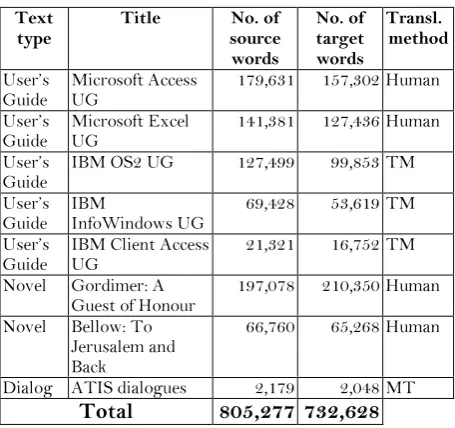
[image:1.595.64.292.367.581.2]The Linköping Translation Corpus consists of English source texts linked to Swedish target texts. The text material comes from two major text types: user’s guides to computer programs and fiction. There is also a shorter machine-translated text consisting of dialogue included in the corpus. LTC consists of 805,277 words in the source text and 732,628 words in the target texts, making the total word size of just over 1,500,000 words.
Table 1 below shows an overview of the translation corpus:
Table 1. The Linköping Translation Corpus - an overview
Text
type Title sourceNo. of words
No. of target words
Transl. method
User’s
Guide Microsoft AccessUG 179,631 157,302 Human User’s
Guide Microsoft ExcelUG 141,381 127,436 Human User’s
Guide IBM OS2 UG 127,499 99,853 TM
User’s
Guide IBMInfoWindows UG 69,428 53,619 TM User’s
Guide IBM Client AccessUG 21,321 16,752 TM NovelGordimer: A
Guest of Honour 197,078 210,350 Human Novel Bellow: To
Jerusalem and Back
66,760 65,268 Human
Dialog ATIS dialogues 2,179 2,048 MT
Total 805,277 732,628
Three of the translations were translated with the aid of IBM’s translation memory tool (TM), which gave an extra dimension to the corpus.
Given a translation corpus such as LTC, one task is to uncover the characteristics of the translation as a whole, or to see whether the translations could be characterised as source-oriented or target-oriented translations (Newmark 1988). The analysis of
translation corpus can be made in several steps, going from the simplest case, namely just to compare surface data from the source and target texts independently to a full-blown analysis of how the translator(s) have chosen to render the target text given lexical, syntactic and semantic constraints. In this paper, the first steps of such an analysis and later are shown as well as a sketch on how these analyses correspond with a thorough linguistic analysis of the relationships between the source and target texts.
2 Step 1: Source and target texts independently
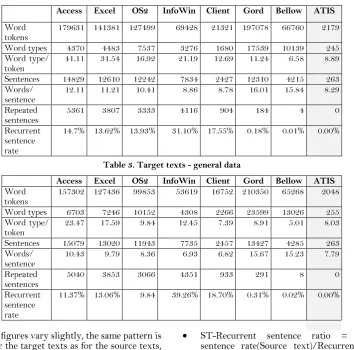
The majority of the translation analyses comes from using the DAVE toolbox, developed at Linköping University. With the DAVE tools we extracted data on the Linköping Translation Corpus first as separate texts, i.e. the source texts and target texts independently, including data for
· Word type/token ratio · Sentence type/token ratio
· Average number of words per sentence · Number of repeated sentences
· Recurrent sentence rate
[image:1.595.64.292.368.582.2]Table 2. Source texts - general data
Access Excel OS2 InfoWin Client Gord Bellow ATIS
Word
tokens 179631 141381 127499 69428 21321 197078 66760 2179 Word types 4370 4483 7537 3276 1680 17539 10139 245 Word type/
token 41.11 31.54 16.92 21.19 12.69 11.24 6.58 8.89 Sentences 14829 12610 12242 7834 2427 12310 4215 263 Words/
sentence 12.11 11.21 10.41 8.86 8.78 16.01 15.84 8.29 Repeated
sentences 5361 3807 3333 4116 904 184 4 0
Recurrent sentence rate
14.7% 13.62% 13.93% 31.10% 17.55% 0.18% 0.01% 0.00%
Table 3. Target texts - general data
Access Excel OS2 InfoWin Client Gord Bellow ATIS
Word
tokens 157302 127436 99853 53619 16752 210350 65268 2048 Word types 6703 7246 10152 4308 2266 23599 13026 255 Word type/
token 23.47 17.59 9.84 12.45 7.39 8.91 5.01 8.03 Sentences 15079 13020 11943 7735 2457 13427 4285 263 Words/
sentence 10.43 9.79 8.36 6.93 6.82 15.67 15.23 7.79 Repeated
sentences 5040 3853 3066 4351 933 291 8 0
Recurrent sentence rate
11.37% 13.06% 9.84 39.26% 18.70% 0.31% 0.02% 0.00%
Although the figures vary slightly, the same pattern is discernible for the target texts as for the source texts, namely that the novels contain the highest numbers of word types, longest sentences and lowest recurrent sentence rates. The Microsoft texts and IBM texts also seem to be relatively similar.
The next step is then to compare the general data from the source and target texts and see if we can conclude something about the translations. We do this by comparing the relative proportions of number of sentences, number of word tokens and recurrent sentence rates, by using the following simple measures (the figures summarized in Table 4 below): · ST-Sentence = the number of source
sentences/number of target sentences
· ST-Word ratio = number of source words/number of target words,
· ST-Recurrent sentence ratio = Recurrent sentence rate(Source text)/Recurrent sentence rate(Target text).
[image:2.595.117.479.641.746.2]The figures tells us that only two of the texts have more source sentences than target sentences (namely OS2 and InfoWin). This could indicate that most of the texts contain more deletions or that the sentence pairs have a high degree of n-1 sentence correspondences, but at this point this is mere speculation. Only one text, the Gordimer novel, contain more running words in the translation than in the original text. Due to fact that Swedish contain more compounds (written as single words) than English, and that at a large proportion of the definite article “the” and the verb “do” do not have Swedish counterparts, it would be reasonable to expect that the number of words be smaller in the Swedish text. But, again we can only speculate that the text type, in this case fiction, seems to give rise to a relatively higher number of target words.
Table 4. Relative comparisons between source texts and target texts
Acc. Excel OS2 Info Client Gord Bellow ATIS
ST-Sentence
ratio 0.98 0.97 1.02 1.01 0.99. 0.92 0.98 1.00 ST-Word
ratio 1.14 1.11 1,28 1.29 1,27 0.94 1.02 1,06 ST-Recurrent
This is apparent if we also look at the word ratio for the other novel by Bellow which contain fewer words in the translation compared to the original, but the figure (1.02) is still considerably lower than for the translations of the computer manuals.
The English-Swedish Parallel Corpus (ESPC) from Lund contain comparable ST-word ratios for the translations of fiction from English to Swedish (0.98). Looking at the total material (English to Swedish) including non-fiction, gives a ST-word ratio of 1.003 in ESPC.1 This means that the non-fiction part of the ESPC corpus contain more source words than target words (ST-word ratio 1.028). The computer manuals in the Linköping Translation Corpus do seem to be different in this respect as the ST-word ratios range from 1.11 to 1.29. In relative terms it is reasonable to expect that more information is preserved or added in the fiction translations compared to the translations of manuals.
When we compare the values for sentence recurrence in the texts, we can see that two of the IBM texts (InfoWin and Client) actually have higher sentence recurrence rates in the target than in the source, which is in line with the first hypothesis as these texts were translated with the aid of translation memories. The two Microsoft texts have higher recurrence rates for the source text than the target text which is in accordance with the second hypothesis, namely that consistency on the sentence level would be more difficult in traditional translation.
The text that does not fit the pattern then is the OS2 text, which has a higher recurrence rate in the source text than in the target text even though the translation was produced with translation memory.
3 Step 2: Source and target texts jointly (as an aligned corpus)
To be able to make more detailed observations on the relationships between the source and the arget text, it is necessary to investigate the source text and target text as a whole, that is, as parallel texts and this is done by using the DAVE tool box (see Merkel 1999).The DAVE toolbox contains some bitext-tailored tools, for example, a module for analysing discrepancies (or inconsistencies) in the translation as well as a module for bilingual concordancing.
1Data from ESPC was kindly provided to me by Bengt Altenberg
(personal communication October, 7 1999). The fiction ST-word ratio is based on 276,591 source words/281,127 target words and the total ST-word-ratio on 494,374 source words/492,885 target
The Discrepancy analysis provides information on how consistent or inconsistent the translations of the recurrent sentences are. The Bilingual concordance module lets the user browse and search the parallel text for any combination of source and target words and multi-word units and collect data for the co-occurrence of certain items.
In particular, the focus is on whether there are any observable differences in the translations as far as text type and method of translation are concerned, especially for the distinctions of source- vs. target-orientation, consistency and correspondence. The following types of extracted data from the Linköping Translation Corpus (LTC) are in focus: (i) sentence mappings, (ii) consistency and variation and (iii) co-occurrence data for a sample of lexical items.
2.1 Sentence mapping
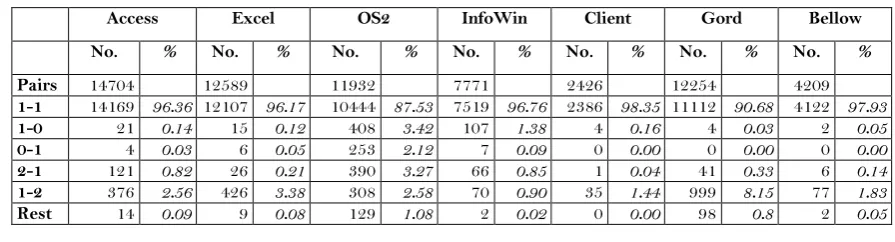
The majority of the translations in the Linköping translation corpus contain 1-1 sentence mappings to the degree of a 96-98.35 per cent interval, as can be seen in Table 5. The OS2 text has a strikingly high proportion of deletions (1-0) and insertions (0-1) which indicate that the translation is not particularly close to the original, but is rather a kind of communicative, more target-oriented translation, cf. Newmark (1988). However, the translation of this text has been made with the aid of a translation memory tool, which contradicts a target-oriented translation as translation memories should actually steer translators towards source-oriented translation. For the time being we can only note that there seems to be something strange about the OS2 translation, given the use of translation tools and the fact that data from the sentence mappings give us another message.
[image:3.595.95.543.586.707.2]The second translation that sticks out is the Gordimer text. Here there is only one aspect that seems peculiar, and that is the relatively high proportion of 1-2 mappings. Over 8 per cent of the pairs are instances of when one English sentence has been translated with two Swedish sentences.
Table 5. Sentence mappings from the parallel texts (excluding ATIS)
Access Excel OS2 InfoWin Client Gord Bellow
No. % No. % No. % No. % No. % No. % No. %
Pairs 14704 12589 11932 7771 2426 12254 4209
1-1 14169 96.36 12107 96.17 10444 87.53 7519 96.76 2386 98.35 11112 90.68 4122 97.93
1-0 21 0.14 15 0.12 408 3.42 107 1.38 4 0.16 4 0.03 2 0.05
0-1 4 0.03 6 0.05 253 2.12 7 0.09 0 0.00 0 0.00 0 0.00
2-1 121 0.82 26 0.21 390 3.27 66 0.85 1 0.04 41 0.33 6 0.14
1-2 376 2.56 426 3.38 308 2.58 70 0.90 35 1.44 999 8.15 77 1.83
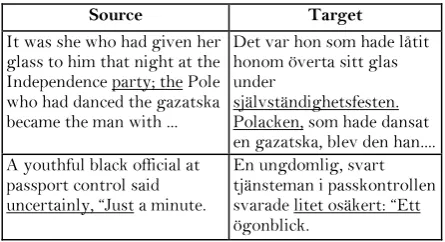
The explanation for this has to do with at least two different uses of punctuation characters in English and Swedish. First, in English the semicolon is used more often than in Swedish as a delimiter between main clauses, which means that perhaps we should have classified the semicolon as a possible sentence delimiter during the alignment process. Secondly, in English a comma may precede an utterance (within quotation characters) whereas in Swedish the line will commonly be indicated with a colon. The two different uses of semicolons and commas are shown in the two examples from the Gordimer novel in Table 6. The actual positions that were discussed above are underlined in the source and target texts.
Table 6. Different uses of the semicolon and the comma in English and Swedish
Source Target
It was she who had given her glass to him that night at the Independence party; the Pole who had danced the gazatska became the man with ...
Det var hon som hade låtit honom överta sitt glas under
självständighetsfesten. Polacken, som hade dansat en gazatska, blev den han.... A youthful black official at
passport control said uncertainly, “Just a minute.
En ungdomlig, svart tjänsteman i passkontrollen svarade litet osäkert: “Ett ögonblick.
If we regard semicolons as sentence delimiters as well as commas in sequences of <comma-space-quotation mark-uppercase letter>, and then recalculate the proportions, it turns out that the proportion of 1-1 mappings increases to 95.94 per cent, which takes the Gordimer text up to roughly the same relative proportions as the other texts (except the OS2 text). A flexible method to handle “unusual” sentence boundaries has been suggested by Palmer and Hearst (1994) which may help to improve sentence alignment.
2.2 Discrepancy Analysis
By using discrepancy analysis it can be shown that all translated texts are more or less inconsistent. For manually translated texts the variations are what can be expected, but we discovered an unexpected high degree of inconsistency in the translation memory translated manuals and found that this was due to a clash between an established translation culture and new technology (see Merkel 1996). The discrepancy analysis also revealed relative differences between the manuals which showed how the Client translation actually was a more consistent translation and therefore probably more source-oriented translations than the other user’s guides.
2.3 Bilingual concordancing
Co-occurrence data could be useful in several applications. In contrastive linguistics, it could form the basis for extracting exactly those sentence pairs that contain the word(s) that are of interest to the scholar. Altenberg (1998) has developed a measure, mutual correspondence, that aims to capture the degree of correspondence in parallel corpora between pairs of words in English-to-Swedish translations and Swedish–to-English translations
jointly. For example, if the English word “however” is always translated into the Swedish “emellertid” and “emellertid” is always translated by “however” in English translations then the Mutual Correspondence (MC) between “however” and “emellertid” is 100 per cent.
As the Linköping translation corpus only contains translations in one direction, namely into Swedish, mutual correspondence cannot be calculated, but it is possible to investigate the relative word co-occurrence rate (WCR) for a source and a target word, as follows:
) ( ) (
) 100 ) , ( ( 2
B freq A freq
B A cooccur WCR
+ ´ ´
=
If a word A occurs 10 times in the source text, a target word B occurs 15 times in the target text and A and B co-occur 8 times, the WCR for A and B is 64 per cent (16/25). The measure actually takes into account the number of times a token of one of the words occurs in a co-occurrence relation in the corpus.
The MC measure will capture the extent to which two words are mutual translations of each other, while the WCR measure will measure the proportion of co-occurrence between one source and one target word given a corpus containing only one translation direction.
Altenberg measures the translation bias as the ratio of how many target tokens that are realised from the source word. The formula for translation bias (TB) can be expressed as follows:
) (
) , ( )
, (
A freq
A B cooccur B
A
TB =
which means a simple ratio between the number of times a target item, B, co-occurs with the source item, A, in relation to the total number of source items A.
Different hypotheses could be tested by investigating co-occurrence data and translation bias; for example, is it possible to conclude how source-oriented a target text is given only co-occurrence data of word pairs from different translations? Text-type specific translation corpora could provide information about what the standard co-occurrence rates would be for a core of word pairs. These pairs and their co-occurrence rates could then be tested on translations from the same text type and perhaps give an indication of how source-oriented the translations are.
[image:4.595.70.293.263.384.2]conjunctions, subjunctions, numerals and proper names/technical terms.
The brief analysis on word correspondences confirms the view that the best candidates for anchoring words can be found among cognates (numbers and proper names) an, to a certain extent, technical terms. Conjunctions and subjunctions can also function as potentially good candidates for most texts. It also shows that the texts that were considered to be more source-oriented in their translation style also exhibit more consistent translations on the word level.
The Bilingual concordance component is a useful tool for the contrastive linguist, the translation scholar and the language engineer. The contrastive linguist can compile statistical data on co-occurrence and extract sentence pairs from parallel corpora that are specifically interesting for a certain contrastive study. The translation scholar may be more inclined to study translation bias; that is, given a certain source object, what are the preferred choices of the translators as they appear in the text. The translation scholar will focus on the translation direction of the text, whereas the contrastive linguist will be more interested in the relationship between two language systems.
3
Step 3: Structural and Semantic
Correspondence
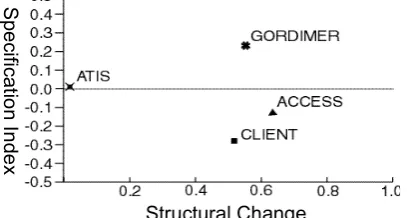
In Ahrenberg & Merkel (2000), a descriptive model for measuring the salient traits and tendencies of a translation as compared with the source text were applied to the LTC. Here samples from each translation from the corpus were analyzed in detail to uncover structural and semantic changes in the translation. Many of the traits that we have seen in steps 1 and 2 were verified in this study. In Figure 1, below it is shown graphically how four of the translations are located as regards structural and semantic changes. The Gordimer translation contains more information than its orignal, but exhibits structural changes on the same level as the Access and Client translations. The MT-produced ATIS translation is, not surprisingly, shown to be equal in both structure and specification degree compared to its original. These data correlate with ST-Word ratio presented for these texts in step 2 earlier.
4
Current work: Step 4 - TransMap
At present, the project TransMap, conducted at Linköping University, is developing the analysis methods further by extracting and specifying correspondence data in translation corpora where word and phrase linking is done in combination with a word aligner and a user. The idea is to classify as correspondences on several levels including correspondences of base forms parts-of-speech, syntactic function, and type (such as pronominalization, deletion, addition, convergence and divergence). A shift in direction has here been made compared to the group’s earlier work in that the present approach includes using available linguistic resources in the word alignment and phrase extraction tools, such as POS taggers and lemmatizers, and not just string data.5
Conclusion
By comparing string level data in translation corpora, a great deal of information can be extracted, as have been shown in steps 1 and 2. Many characteristics that were uncovered with these simple methods were actually confirmed when a more thorough linguistic investigation was made on samples from each translation. It remains to be seen if these also holds when the more elaborate techniques of interactive linking and classification of translation units have been finished.
6
References
L. Ahrenberg & M. Merkel. Correspondence measures for MT evaluation. Proceedings of the LREC 2000 Workshop on Evaluation of Machine Translation, Athens, Greece 29th May, 2000, pp. 41-46, 2000.
B. Altenberg. Adverbial connectors in English and Swedish. Out of corpora. Studies in honour of Stig Johansson. H. Hasselgård & S. Oksefjell (eds.), Rodopi, Amsterdam: 249-268, 1998.
S. Johansson & K. Hofland. Towards an English Norwegian Parallel Corpus. Creating and Using English Language Corpora. U Fries, G. Tottie and P. Scheider. Zürich. Rodopi:25:37, 1994.
M. Merkel. Checking Translations for Inconsistency - a Tool for the Editor. In Proceedings from AMTA-96, Montreal:157-167, 1996.
M. Merkel. Understanding and Enhancing Translation by Parallel Text Processing. Ph.D. Thesis No. 607. Department of Computer and Information Science, Linköping University, 1999. P. Newmark, A Textbook of Translation, Prentice Hall, London, 1988.
D.D. Palmer & M.A.Hearst. Adaptive Senence Boundary Disambiguation. Proceedings of the Fourth Conference on Applied Natural Language Processing (ANLP-94), Stuttgart:78-83, 1994.
M. Simard, G.F. Foster, & P. Isabelle. Using Cognates to Align Sentences in Bilingual Corpora. Proceedings of the Fourth International Conference on Theoretical and Methodological Issues in Machine Translation, Montreal,1992.
D. Wu. Aligning a Parallell English-Chinese Corpus Statistically with Lexical Criteria. Proceedings of the 32nd Annual Meeting of the ACL: 80-87, 1994.
Structural Change
S
p
ec
if
ic
a
tio
n
Ind
ex
[image:5.595.59.263.585.694.2]