Using Knowledge and Constraints To Find the Best Antecedent
P rateek J indal
Dan Roth
Dept. of Computer Science, UIUC 201 N. Goodwin Ave., Urbana, IL - 61801
{jindal2, danr}@illinois.edu
Abstract
Coreference resolution is the problem of clustering mentions into entities and is very critical for natural language understanding.This paper studies the problem of coreference resolution in the context of the newly emerging domain of Electronic Health Records (EHRs). The commonly used “best-link” model for coreference resolution considers only the scores from a pairwise classifier in selecting the best antecedent. In this paper, we extend this model to include several constraints derived from surface-form of the mentions and the context in which they appear. Another major contribution of this paper is to show the use of domain-specific knowledge sources, mention parsing and clinical descriptors in deriving features which contribute to improved coreference resolution performance. We present experiments on4different clinical datasets illustrating that our approach outperforms a strong baseline and a state-of-the-art system by a wide margin.
1 Introduction
The HITECH (Health Information Technology for Economic and Clinical Health) Act, part of the 2009 economic stimulus package (American Recovery and Reinvestment Act) passed by the US Congress, aims at inducing more physicians to adoptElectronic Health Records (EHRs). An EHR is an evolving concept defined as a systematic collection of electronic health information about individual patient. Ability to automatically extract information from EHRs lies at the heart of several applications.
This paper addresses the task of coreference resolution for EHRs.Coreference resolution is the task of finding referring expressions in a text that refer to the same entity, i.e., finding expressions that corefer. The set of coreferring expressions is called as a coreference chain. Consider the following text sampled from one of the EHRs in the corpus used by us:
This 63-year-old man had[malignant fibrous histiocytoma of duodenum], discovered in 02/95. Other than [a mass in the duodenum], the patient was also diagnosed with anemia. A
[leiomyosarcoma]was resected after embolization of the splenic artery. However,[it]could not be completely excised; moreover[the tumor]metastasized to the liver as was discovered on follow up scan in 06/95.
In the above text, all the phrases which are shown in brackets refer to the same entity and hence form a coreference chain. It is clear that identifying such coreference chains requires a lot of medical knowledge. For example, we need to know that “mass” can refer to a “malignant histiocytoma”. Most of the work on coreference resolution has focussed on the news text. Several different architectures have been proposed for coreference resolution. Recently, entity-based models for coreference resolution have been proposed. Such approaches try to directly model the entities in the text and usually involve some kind of global inference and tend to be quite complex. However, most of the best results on coreference resolution were achieved with simpler architectures which use a pairwise classifier between mentions and a decoding strategy like “closest-first” or “best-link” to first find the best antecedent for every mention. This step is then followed up by an inference procedure in which coreference chains are formed (Chang et al., 2011; Pradhan et al., 2011). In this paper, we extend the “best-link” model to include several constraints derived from surface-form of the mentions and the context in which they appear. Another contribution of this paper is to show the use of domain-specific knowledge sources (like UMLS1, MetaMap), mention parsing and
clinical descriptors (obtained from medical ontologies) in deriving the features which are helpful for coreference resolution. In clinical Information Extraction (IE), researchers often map clinical text to UMLS concepts (Zheng et al., 2012; Rink et al., 2012). But such mapping alone doesn’t allow an IE system to exploit the useful information contained in the parent trees of the concepts. Clinical descriptors designed by us overcome this limitation. We use two medical ontologies, MeSH2and
SNOMED CT3to design our descriptors.
We conducted experiments on four different clinical datasets. Our results show that knowledge sources help in improving the recall and constraints help to increase the precision of the system. Knowledge and constraints used by us helped us to achieve significant performance improvements over a strong baseline derived from existing state-of-the-art approaches.
To summarize, the key contributions of our paper are as follows:
• This paper studies coreference resolution on the new and important domain of EHRs.
• This paper presents different knowledge sources which would be useful for Information Extraction in medical and clinical domains. We use medical ontologies (MeSH, SNOMED CT) to get clinical descriptors which encode useful information contained in the parent trees of the concepts.
• We propose a rich local model to find the best antecedent.
• We usemention parsingto obtain a semantic representation of the mentions. Similar technique can also be used for other domains.
• Our system outperforms a strong baseline on four different clinical datasets.
2 Task Description
Coreference resolution aims at clustering together textual mentions within a single document based on underlying referent entities. For our experiments, we used the datasets provided by i2b2 team as part of coreference challenge.We use the same problem definition as was specified in the i2b2 coreference challenge. Mentions have already been identified and classified into 4 types : test (TEST), treatment (TRE), problem (PROB) and pronoun (PRON). Coreference relation can exist only within the mentions of same type. However, PRON mentions can corefer with any other mention. Given the entity mentions along with the types, the aim is to build coreference chains for the first 3 types: TEST, TRE and PROB. Since PRON mentions can corefer with the mentions of other types, there are no separate pronoun (PRON) chains.
3 Coreference Model
In this paper, we view coreference resolution as a graph problem: Given a set of mentions and their context as nodes, generate a set of edges such that any two mentions that belong in the same equivalence class are connected by some path in the graph. We construct this entity-mention graph by finding out the best antecedent of each given mention (anaphor) such that the antecedent belongs to the same equivalence class as the anaphor. The “Best-Link” strategy (Ng and Cardie, 2002; Bengtson and Roth, 2008; Chang et al., 2011) for selecting the antecedent of a mention chooses as the antecedent that candidate which gets the maximum score according to a pairwise coreference functionpc. We extend the “Best-Link” strategy by including several constraints in its objective function as shown below.
3.1 Decision Model: Constrained Best-Link
Given a documentdand a pairwise coreference scoring functionpcthat maps an ordered pair of mentions to a value indicating the probability that they are coreferential, we generate a coreference graphGdaccording to the following decision model:
For each mentionmiin documentd, letBmibe the set of mentions appearing beforemiind. Thus, Bmi={m1,m2, ...,mi−1}. Letabe the highest scoring antecedent. Then, we have:
a=arg max
mj∈Bmi scorei(mj)
=arg max
mj∈Bmi k1·pc(mj,mi)−d(mj,mi) + L X
l=1
In the above equation,d(mj,mi)refers to the normalized distance betweenmjandmiwhich takes values between0and1. In equation (1),Clrefers tolthconstraint and is defined as follows (for all values ofl):
Cl(mj,mi) =
0 iflthconstraint is satisfied
−pl otherwise (2)
Ifscorei(a)is greater than a thresholdδ, then we add the edge(a,mi)to the coreference graphGd. Threshold parameterδis chosen to bek1
2. Value ofpc(mj,mi)lies between0and1. The value ofk1is chosen to be sufficiently greater than1so that the pairwise classifier is given preference over the distance term in choosing the best antecedent. But if thepcvalues of any two candidates are almost similar, then the antecedent which is closer to the anaphor gets the higher score because of the distance term in Equation (1). Thus, our decision model combines the advantages of both “best-link” and “closest-first” models which are generally used for coreference resolution. Setting
k1=∞andL=0reduces our model to the standard “best-link” decision model.
plis the penalty associated with thelthconstraint. Thus, different constraints can have different penalties. Higher the penalty associated with the constraint, the stronger it is enforced. If0<pl<k1
2, then the constraint is soft because violation of such constraint by a mention pair doesn’t necessarily rule it out. But ifpl>k21, then the constraint becomes hard.
The resulting graph produced by the decoding technique mentioned above contains connected components, each representing one equivalence class, with all the mentions in the component referring to the same entity. Equivalence classes are determined by taking the transitive closure of all the links.
3.2 Pairwise Coreference Function
We train 4 classifiers, one each for TEST, TRE, PROB and PRON classes. Each of these classifiers takes as input an ordered pair of mentions(a,m)such thataprecedesmin the document, and produces as output a value that is interpreted as the conditional probability thataandmbelong in the same equivalence class. For any mention-pair(a,m), the classifier is chosen based on the type of mentionm.
For each mentionmwe select fromm’s equivalence class the closest preceding mentionaand present the pair(a,m)as a positive training example to the classifier which corresponds to the type of mentionm. For eachm, we generate negative examples(a,m)for all mentionsathat precedem and are not in the same equivalence class.
We learn the pairwise classifiers using LIBSVM package (Chang and Lin, 2011).
4 Baseline
In this section, we describe the baseline system used by us. We designed the baseline system based on the existing state-of-the-art coreference systems which use pairwise models (Bengtson and Roth 2008; Haghighi and Klein 2009). Baseline system uses the coreference model as described in the previous section. However, there are no constraints in the baseline system. The features used for training the pairwise classifier have been described below. All the features used by us take only two values: 1 (if the feature is active) or 0 (if the feature is not active).
4.1 Lexical Features
• Both the mentions have identical surface forms (i.e.ex tentmi==ex tentmj).
• Surface form of one of the mentions is a proper substring of that of another.
• Both the mentions share the same head word.
4.2 Syntactic Features
We check for the presence of several syntactic constructs among the mentions and generate the following features which tell whether or not the given mention pair satisfies the constructs:
• Apposition: Two noun phrases (NPs) are appositive when they are placed side-by-side with one element serving to define or modify the other e.g.In a recent examination, the patient was diagnosed with [medulloblastoma],[a malignant brain tumor].
• Predicate Nominative: The predicate nominative is the noun following a linking verb that restates or stands for the subject e.g.[Coronary Arteriosclerosis]is a[heart disease]which happens when the coronary arteries become narrowed.
• Relative Pronoun: It is a pronoun that modifies the head of the antecedent NP e.g. After discussion , an[abdominal CT scan]was obtained[which]revealed diffuse metastatic lesions of the ribs .
4.3 Semantic Features
Some of the coreferential mention pairs have similar but not identical heads. To find out whether any two words are similar or not requires semantic knowledge. Wordnet has been extensively used as a source of semantic knowledge for general English text. We generate the following two features from Wordnet:
• Wordnet-head-match: We get the synsets of heads of both the mentions and see whether the heads share any common synset. For example, the wordshemorrhageandbleedingshare the same synset which refers to theflow of blood from a ruptured blood vessel.
• Wordnet-head-hypernyms-match: Some closely related words (likeepistaxisandhemorrhage) do not share any common synset. However, if we consider the parents (or hypernyms) of the synsets of such words in the Wordnet hierarchy, we can see that the two words are similar. We take only the immediate hypernyms of the synsets. Inclusion of hypernyms which are more than 1 level above the synsets of the words leads to over-generalization. For example, we may get thatnauseaandanemiaare coreferent which is actually not true.
4.4 Distance-Based Features
We used the following distance-based features:• Adjacent-Mentions: This feature is active if there is no intervening mention between the given mentions which has the same type as the mentions under consideration.
• Distant-Mentions: This feature is active if the two mentions are separated by more than 2 sentences.
5 Using Domain-Specific Knowledge
her [cancer]
her [malignancy]
list concept: Primary Malignant Neoplasm (C1306459)
parents: Tumor Morphology (C0474796)
Figure 1: This figure shows the UMLS mappings for two mentions “her cancer” and “her malig-nancy”. The terms “cancer” and “malignancy” have at least one common concept. Our matching procedure based on UMLS correctly predicts the given mentions to be coreferent.
address the ambiguity and variability that exists in medical terminology. To improve the perfor-mance of coreference resolution, we extended the baseline system by incorporating domain-specific knowledge into it.
5.1 UMLS and MetaMap
The UMLS (UMLS, 2012), or Unified Medical Language System, is a set of files and software that brings together many health and biomedical vocabularies. MetaMap (Aronson and Lang, 2010) is a configurable program which maps biomedical text to the UMLS Metathesaurus. We use the mapping provided by MetaMap to represent the mentions in a standard way which allows for effective matching of the mentions. We find the parents of concepts using the Web Service provided by UTS (UTS, 2012) (UMLS Technology Services).
Matching Mentions Using UMLS: We would refer to the surface forms of the two mentions bys1 ands2. First, we remove the stopwords from the given strings and then process the resulting strings using MetaMap and thus, get the mappings of the mentions to UMLS concepts. Next, we check whether any two spans (given by MetaMap) ofs1ands2are equivalent. Two spans are considered equivalent if they share the same UMLS concepts (or parents of UMLS concepts). Whenever we find two equivalent spans, we remove them froms1ands2. Finally, we check whether the resulting stringss1ands2match trivially. Two strings match trivially if they are identical or one of them is a substring of the other.
Consider Figure 1 for an example. This figure shows the UMLS mappings for two mentions “her cancer” and “her malignancy”. “her” is considered as a stopword and is first removed from both the strings. Since the two spans “cancer” and “malignancy” share same UMLS concepts, they are equivalent. So, we remove “cancer” and “malignancy” from the two strings. The resulting strings are both empty and are considered to be matching.
Features Derived: Based on the matching procedure described above, we derive the following two features:
• UMLS-Match: In this feature, we do not consider the parents of the concepts during the matching
5.2 Mention Parsing
We parsed the mentions to extract the components like Modifiers, Body Parts and Anatomical Terms of location (ATs). We did not require exact match for these extracted components. We just specified that these components should not be incompatible with each other. The remaining portions of the surface forms of mentions were canonicalized and matching procedure described in Section 5.1 was used to determine whether they matched. Figure 2 shows an example where the structures obtained by parsing the two mentions are matching to one another.
Canonicalization referred to above involves the following two steps:
• Expanding the abbreviations: Clinical narratives use a lot of abbreviations. A few examples are: mri (magnetic resonance imaging), copd (chronic obstructive pulmonary disease) etc. Abbreviations were expanded to their full forms as a normalization step. We collected abbreviations from several sources like training data, Wikipedia4, Medilexicon5etc. For
ambiguous abbreviations, we considered all possible expansions. If a match was found using any of the expansions, then coreference pair was considered valid.
• Converting Hyponyms to Hypernyms: During preprocessing, we converted some of the common hyponyms to the corresponding hypernyms. Examples of such conversions are: chemotherapy→therapy, hemicolectomy→colectomy. Such conversions were found to be very helpful because it is a common practice in clinical documents to refer to some of the problems and treatments introduced earlier in the document with their more general names later on. These hyponym-hypernym pairs were collected from the unannotated training data in an unsupervised setting.
Features Derived: Following feature was derived from mention parsing:
• Mention-Parsing: This feature is true for the mention pairs which match according to the mention parsing procedure described above.
5.3 Clinical Descriptors
MeSH6(Medical Subject Headings) is the National Library of Medicine’s controlled vocabulary
thesaurus. It consists of sets of terms in a hierarchical structure that permits searching at various levels of specificity. We obtain MeSH descriptor for a concept in the following way:
1. First of all, we get all the paths from the concept to the root of MeSH hierarchy. In general, there can be more than 1 paths.
2. Then we construct one list which consists of the top 4 parents of all the paths obtained in Step 1.
3. The list obtained in step 2 is pruned where more preference is given to those parents which appear more frequently.
4. The final list obtained in step 3 is the MeSH descriptor of the concept.
Similar procedure is used to obtain the SNOMED CT7descriptor of a concept. SNOMED CT
(SNOMED Clinical Terms) is yet another medical ontology which consists of the most com-prehensive, multilingual clinical healthcare terminology in the world. SNOMED CT is owned,
poorly differentiated
Figure 2: This figure shows the structures obtained by the mention parsing of two mentions shown on the top of the figure. Since the two structures match one another, we predict the two mentions to be coreferent.
maintained and distributed by the International Health Terminology Standard Development Organ-isation (IHTSDO). Figure 3 and Figure 4 show two different paths in MeSH and SNOMED CT parent trees for the same concept “Myocardial Infarction”. We found that, in general, SNOMED CT gives much more paths (from concept to root of hierarchy) than MeSH. Some concepts in SNOMED CT have more than300possible paths to the root of hierarchy.
Features Derived: Based on the clinical descriptors described above, we derive the following two features:
• MeSH-Match: This feature is active if the Mesh descriptors of two concepts are the same
• SNOMEDCT-Match: This feature is active if the SNOMED CT descriptors of two concepts are the same
6 Description of Constraints
Myocardial Infarction
Myocardial Infarction
Figure 3: Figure showing two different paths in MeSH parent tree for the concept “Myocardial Infarction”
Myocardial Infarction
Myocardial Infarction
Myocardial Infarction
Figure 4: Figure showing two different paths in SNOMED CT parent tree for the concept “Myocar-dial Infarction”
6.1 Surface Form Constraints
Following surface form constraints were used by us:
• Length Constraint: Surface form of both the mentions must be at least2characters long.
• Modifier Constraint: Mentions should not have incompatible modifiers e.g. “small/large”
• Body Parts Constraint: If body parts (like chest, arm, head) are specified, they should not be incompatible.
• Anatomical Terms Constraint: If anatomical terms8(like proximal, anterior, dorsal) are
specified, they should not be incompatible.
• Popular Head Constraint: Certain head words like “disease” occur very commonly in the dataset. Mentions which have same popular head are considered coreferential only if the classifier predicts the mentions to be coreferential even after removing the heads from the mentions.
• Number Constraint: Two mentions must agree in number.
• Temporal Constraint: If only one of the mentions contains the word “follow-up” or “repeat”, then the mention pair is not considered coreferential because the two mentions refer to tests or treatments which have been done at different times.
6.2 Contextual Constraints
Following contextual constraints were used by us:
• Family History: If the left context of any mention (in a window of size4) contains the phrase “family history”, then the mention pair is not considered coreferential because one of the mentions refers to some family member of the patient and not the patient himself. Window size was determined using cross-validation on the training set.
• Negation Constraint: None of the mentions should be present in a negated form.
• PRN Constraint: Problem mentions which have “p.r.n.” as the prefix can’t participate in coreference relation because such mentions refer to hypothetical problems and not the real problems. For example, “p.r.n. headache” means “if the headache arises ...”.
• TEST Constraint: We observed from the documents in the training data that the TEST mentions which appear under the heading “LABORATORY DATA” generally don’t participate in coreference.
Other than the above mentioned constraints, following additional constraint was used to disallow coreference chains beginning with pronouns.
• In Equation (1), ifmjis a pronoun, then there must exist some mentionmkwithk<jsuch thatmkis a valid antecedent ofmj.
7 Experimental Setup
Datasets:For our experiments, we used the coreference datasets made available by i2b2 team as part of 2011 i2b2 challenge. The datasets consist of EHRs from three different organizations: Partners HealthCare (Part), Beth Israel Deaconess Medical Center (Beth) and University of Pittsburgh (Pit). The data from University of Pittsburgh is divided into 2 parts, namely Discharge and Progress records. All records have been fully de-identified and manually annotated for coreference. This gave us a total of 4 datasets. We would refer to these datasets asPart,Beth,PitDandPitPin the following discussion.
The total number of documents in the training set ofPart,Beth,PitDandPitPare 136, 115, 119 and 122 respectively. Test set ofPart,Beth,PitDandPitPcontains 94, 79, 77 and 72 documents respectively. For more information about the datasets, please refer to Uzuner et al. (Uzuner et al., 2012). We used B-cubed (Bagga and Baldwin, 1998), MUC (Vilain et al., 1995) and CEAF (Luo, 2005) as the evaluation metrics in our experiments.
Choice of Parameters: We use cross-validation on the training data to determine the system parameters. In Equation (1), we setk1=100. With this choice ofk1, distance term becomes significant only if the scores given by pairwise classifier for different mention pairs differ by less than0.01. Since all our constraints are important to be enforced, we chosepl=100in Equation (2) for all values ofl. This choice of penalty parameters makes all the constraints hard.
8 Results
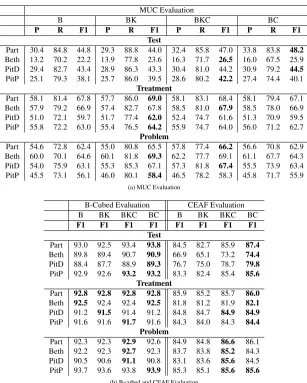
are no separate PRON chains. PRON mentions are included within the TEST, TRE and PROB chains. Results shown in Table 1 are quite interesting and are explained below.
It is interesting to note that adding knowledge to the system always leads to higher recall values. On the other hand, addition of constraints always leads to higher precision values. Next, we note that different metrics behave differently in evaluating the performance of the systems. B-cubed metric gives higher F1 scores that CEAF metric which in turn gives higher F1 scores than MUC metric. This is because of the presence of large number of singletons in the corpora. B-cubed metric highly awards the correct prediction of singletons. MUC, on the other hand, is totally insensitive to singletons. CEAF is intermediate between B-cubed and MUC as far as singletons are concerned. Next, we note the following major points about each category of mentions. For statistical significance tests, Bootstrap Resampling Test (Koehn, 2004) was used atp=0.05.
1.Test: ForTestmentions, the best configuration is Baseline+Constraints (BC). For MUC metric, both BKC and BC performed the best for 2 corpora each. However, for B-cubed and CEAF evaluation metrics, BC performed the best for all the corpora. Hence, overall, we can say that BC is the best configuration forTestmentions. This is because of the fact that coreference forTestmentions (like “his ct scan”, “a mammogram” etc.) can generally be easily predicted simply by looking at the surface forms. Also, many of theTestcoreference chains are quite short with only 2-3 mentions which occur close to one another. So, knowledge is not so helpful forTestmentions.
2.Treatment: ForTreatmentmentions, the best configuration is Baseline+Knowledge (BK). This is clearly evident from MUC metric. Only forBethcorpus, BKC performed better than BK but the difference is not statistically significant (67.8 vs 67.9). For B-cubed and CEAF evaluation metrics, the maximum F1 scores forTreatmentcategory are quite close to Baseline scores and hence, the results are not statistically significant. Thus, B-cubed and CEAF metrics do not help much in predicting which system is better forTreatmentmentions.
3.Problem: ForProblemmentions, the best system is Baseline+Knowledge+Constraints (BKC). This is clearly evident from B-cubed and CEAF Evaluation metrics. For MUC evaluation metric, BK performed better than BKC for 2 corpora. However, the difference in such cases is not statistically significant (69.1 vs 69.3 and 58.3 vs 58.4). Thus, we see that both, knowledge and constraints, benefitProblemmentions. This is due to the fact thatProblemmentions, in general are quite long and complicated.Problemmentions generally occur with modifiers and have variegated surface forms. For example, “the patient’s low potassium level” is coreferrent with “postoperatively hypokalemia”.
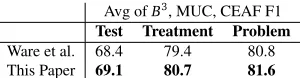
Finally, in Table 2, we show the comparison of our system with a state-of-the-art system, Ware et al. (Ware et al., 2012), which used same test settings as ours. The numbers reported in Table 2 refer to the unweighted average of Bcubed, MUC and CEAF F1 scores computed across all the 4 corpora. We chose unweighted average for comparison because it was the official metric of i2b2 2011 shared task on coreference. We see from this table that our system consistently outperformed Ware et al.’s system for all categories of mentions.
9 Error Analysis
MUC Evaluation
B BK BKC BC
P R F1 P R F1 P R F1 P R F1 Test
Part 30.4 84.8 44.8 29.3 88.8 44.0 32.4 85.8 47.0 33.8 83.8 48.2 Beth 13.2 70.2 22.2 13.9 77.8 23.6 16.3 71.7 26.5 16.0 67.5 25.9 PitD 29.4 82.7 43.4 28.9 86.3 43.3 30.4 81.0 44.2 30.9 79.2 44.5 PitP 25.1 79.3 38.1 25.7 86.0 39.5 28.6 80.2 42.2 27.4 74.4 40.1
Treatment
Part 58.1 81.4 67.8 57.7 86.0 69.0 58.1 83.1 68.4 58.1 79.4 67.1 Beth 57.9 79.2 66.9 57.4 82.7 67.8 58.5 81.0 67.9 58.5 78.0 66.9 PitD 51.0 72.1 59.7 51.7 77.4 62.0 52.4 74.7 61.6 51.3 70.9 59.5 PitP 55.8 72.2 63.0 55.4 76.5 64.2 55.9 74.7 64.0 56.0 71.2 62.7
Problem
Part 54.6 72.8 62.4 55.0 80.8 65.5 57.8 77.4 66.2 56.6 70.8 62.9 Beth 60.0 70.1 64.6 60.1 81.8 69.3 62.2 77.7 69.1 61.1 67.7 64.3 PitD 54.0 75.9 63.1 55.3 85.3 67.1 57.3 81.8 67.4 55.5 73.9 63.4 PitP 45.5 73.1 56.1 46.0 80.1 58.4 46.5 78.2 58.3 45.8 71.7 55.9
(a) MUC Evaluation
B-Cubed Evaluation CEAF Evaluation
B BK BKC BC B BK BKC BC
F1 F1 F1 F1 F1 F1 F1 F1 Test
Part 93.0 92.5 93.4 93.8 84.5 82.7 85.9 87.4 Beth 89.8 89.4 90.7 90.9 66.9 65.1 73.2 74.4 PitD 88.4 87.7 88.9 89.3 76.7 75.0 78.7 79.8 PitP 92.9 92.6 93.2 93.2 83.3 82.4 85.4 85.6
Treatment
Part 92.8 92.8 92.8 92.8 85.9 85.2 85.7 86.0 Beth 92.5 92.4 92.4 92.5 81.8 81.2 81.9 82.1 PitD 91.2 91.5 91.4 91.2 84.8 84.7 84.9 84.9 PitP 91.6 91.6 91.7 91.6 84.3 84.0 84.3 84.4
Problem
Part 92.3 92.3 92.9 92.6 84.9 84.8 86.6 86.1 Beth 92.2 92.3 92.7 92.3 83.7 83.8 85.2 84.3 PitD 90.5 90.6 91.1 90.8 83.1 83.6 85.6 84.5 PitP 93.7 93.6 93.8 93.9 85.3 85.1 85.6 85.6
(b) B-cubed and CEAF Evaluation
Avg ofB3, MUC, CEAF F1 Test Treatment Problem Ware et al. 68.4 79.4 80.8 This Paper 69.1 80.7 81.6
Table 2: This table shows the comparison of system presented in this paper with a state-of-the-art system, Ware et al. The numbers refer to the unweighted average of Bcubed, MUC and CEAF F1 scores computed across all the4corpora.
TEST TRE PROB PRON
TEST 92/60 - - 22/12
TRE - 187/186 - 57/14
PROB - - 320/293 70/21
PRON 32/10 47/13 97/37 20/7 Total 124/70 234/199 417/330 169/54
Table 3: This table shows the number of pairwise errors produced by our system on a portion of the test dataset. Rows indicate types of antecedent; columns are mention types. Each cell shows the number of precision/recall errors for that configuration. The total number of gold links is 2,252.
in Table 1. Error analysis of our system reveals that its precision can be improved by analyzing the context of the mentions more deeply. For example, it would be helpful to know the time (if mentioned) at which a particular test was conducted. It would be also beneficial to know whether a particular problem is mentioned in relation to the patient or one of his/her family members. On inspection, we found that our system made recall errors only on very difficult mention pairs. Predicting coreference relation among such mention pairs requires a lot of reasoning.
10 Related Work
For news text, several different architectures have been proposed for coreference resolution. Systems have been developed which allow for entity-level features or features over sets of noun phrases (Cu-lotta et al., 2007). Such methods generally involve some kind of global inference which is difficult to implement and may also be intractable. Research (Finkel and Manning, 2008; Haghighi and Klein, 2007; Poon and Domingos, 2008) has also been carried out to explore how to reconcile pairwise decisions to form coherent clusters.
However, pairwise models with rich knowledge base have been shown to be very successful in both supervised and unsupervised setups (Bengtson and Roth, 2008; Haghighi and Klein, 2009). An important step in such models is to find the antecedent for each mention. For selecting the antecedent, “best-link” decoding strategy has been shown to give better results than “closest-first”. In this paper, we extended the “best-link” strategy used by researchers by incorporating other factors like distance between mentions, several constraints etc. during the inference step.
domain.
One of the earliest works in coreference resolution in clinical domain is that of Zheng et al. (Zheng et al., 2011). In this work, authors review recent advances in general purpose coreference resolution to lay the foundation for methodologies in the clinical domain. Later, Zheng et al. (Zheng et al., 2012) describe a simple pairwise classification technique for coreference resolution in clinical domain and got an overall B-cubed score of0.69and MUC score of0.35. Bodnari et al. (Bodnari et al., 2012) and Jindal et al. (Jindal and Roth, 2012) also use a pairwise classification technique for clinical coreference resolution and use UMLS to get some of their semantic features. However, they don’t use the concepts’ parents information available in UMLS. Uzuner et al. (Uzuner et al., 2012) give a brief overview of several systems which participated in 2012 i2b2 coreference challenge. Most of the systems submitted in the challenge were rule-based. Rink et al. (Rink et al., 2012) used a multi-pass sieve architecture which is similar to the one developed by Raghunathan et al. (Raghunathan et al., 2010). Xu et al. (Xu et al., 2012) developed an effective strategy for pronoun resolution where they first determined the type of the pronoun and then chose the closest preceding concept of the same type as the antecedent. All these works assumed mentions’ boundaries (along with their types) to be given just like ours.
Conclusion
Electronic Health Records are becoming increasingly important and their automatic analysis lies at the heart of several applications. This paper presented a system for coreference resolution for EHRs. In this paper, we proposed a rich model for selecting the best antecedent which involves inference using pairwise classifier scores and several constraints derived from surface-form of the mentions and the context in which they appear. We also showed the importance of domain-specific knowledge sources and clinical descriptors for achieving good performance in coreference resolution. While the knowledge sources used by us helped to improve the recall, constraints were helpful to increase the precision of system. Our experimental results show that different mention types benefit to different extent from knowledge and constraints. Our system consistently outperformed a strong baseline and a state-of-the-art system on four different datasets.
Acknowledgments
References
Aronson, A. and Lang, F. (2010). An overview of metamap: historical perspective and recent advances.Journal of the American Medical Informatics Association, 17(3):229.
Bagga, A. and Baldwin, B. (1998). Algorithms for scoring coreference chains. InIn LREC Workshop on Linguistics Coreference, pages 563–566. Citeseer.
Bean, D. and Riloff, E. (2004). Unsupervised learning of contextual role knowledge for coreference resolution. InProc. of HLT/NAACL, pages 297–304.
Bengtson, E. and Roth, D. (2008). Understanding the value of features for coreference resolution. InProceedings of EMNLP, pages 294–303. ACL.
Bodnari, A., Szolovits, P., and Uzuner, Ö. (2012). Mcores: a system for noun phrase coreference resolution for clinical records.J Am Med Info Assoc, 19(5):906–912.
Bryl, V., Giuliano, C., Serafini, L., and Tymoshenko, K. (2010). Using background knowledge to support coreference resolution. InProceedings of ECAI 2010, August.
Chang, C.-C. and Lin, C.-J. (2011). LIBSVM: A library for support vector machines. ACM Transactions on Intelligent Systems and Technology, 2:27:1–27:27.
Chang, K., Samdani, R., Rozovskaya, A., Rizzolo, N., Sammons, M., and Roth, D. (2011). Inference protocols for coreference resolution. InCoNLL Shared Task, pages 40–44. ACL.
Culotta, A., Wick, M., Hall, R., and McCallum, A. (2007). First-order probabilistic models for coreference resolution. InProceedings of NAACL HLT, pages 81–88.
Finkel, J. and Manning, C. (2008). Enforcing transitivity in coreference resolution. InProceedings of 46th ACL-HLT Short Papers, pages 45–48. ACL.
Haghighi, A. and Klein, D. (2007). Unsupervised coreference resolution in a nonparametric bayesian model. InAnnual meeting-Association for Computational Linguistics, page 848.
Haghighi, A. and Klein, D. (2009). Simple coreference resolution with rich syntactic and semantic features. InProceedings of EMNLP Volume 3, pages 1152–1161. ACL.
Jindal, P. and Roth, D. (2012). Using domain knowledge and domain-inspired discourse model for coreference resolution for clinical narratives.Journal of the American Medical Informatics Association.
Koehn, P. (2004). Statistical significance tests for machine translation evaluation. InProceedings of EMNLP, volume 4, pages 388–395.
Luo, X. (2005). On coreference resolution performance metrics. InProceedings of HLT and EMNLP, pages 25–32. ACL.
Ng, V. (2010). Supervised noun phrase coreference research: The first fifteen years. InProceedings of 48th ACL, pages 1396–1411. ACL.
Ponzetto, S. and Strube, M. (2006). Exploiting semantic role labeling, wordnet and wikipedia for coreference resolution. InProceedings of the NAACL, pages 192–199. ACL.
Poon, H. and Domingos, P. (2008). Joint unsupervised coreference resolution with markov logic. InProceedings of EMNLP, pages 650–659. ACL.
Pradhan, S., Ramshaw, L., Marcus, M., Palmer, M., Weischedel, R., and Xue, N. (2011). Conll-2011 shared task: Modeling unrestricted coreference in ontonotes.CoNLL 2011, page 1.
Raghunathan, K., Lee, H., Rangarajan, S., Chambers, N., Surdeanu, M., Jurafsky, D., and Manning, C. (2010). A multi-pass sieve for coreference resolution. InProceedings of EMNLP, pages 492–501. ACL.
Rahman, A. and Ng, V. (2011). Coreference resolution with world knowledge. InProceedings of the 49th ACL-HLT Volume 1, pages 814–824. ACL.
Rink, B., Roberts, K., and Harabagiu, S. (2012). A supervised framework for resolving coreference in clinical records.Journal of the American Medical Informatics Association, 19(5):875–882.
UMLS (2012). http://www.nlm.nih.gov/research/umls/ (accessed aug 25, 2012).
Uryupina, O., Poesio, M., Giuliano, C., and Tymoshenko, K. (2011). Disambiguation and filtering methods in using web knowledge for coreference resolution. InProceedings of the 24th International Florida Artificial Intelligence Research Society Conference.
UTS (2012). Umls technology services. https://uts.nlm.nih.gov/home.html (accessed aug 25, 2012).
Uzuner, O., Bodnari, A., Shen, S., Forbush, T., Pestian, J., and South, B. (2012). Evaluating the state of the art in coreference resolution for electronic medical records.Journal of the American Medical Informatics Association.
Vilain, M., Burger, J., Aberdeen, J., Connolly, D., and Hirschman, L. (1995). A model-theoretic coreference scoring scheme. InProceedings of the 6th MUC, pages 45–52. ACL.
Ware, H., Mullett, C., Jagannathan, V., and El-Rawas, O. (2012). Machine learning-based coreference resolution of concepts in clinical documents.J Am Med Info Assoc, 19(5):883–887.
Xu, Y., Liu, J., Wu, J., Wang, Y., Tu, Z., Sun, J., Tsujii, J., Eric, I., and Chang, C. (2012). A classification approach to coreference in discharge summaries: 2011 i2b2 challenge.Journal of the American Medical Informatics Association, 19(5):897–905.
Zheng, J., Chapman, W., Crowley, R., and Savova, G. (2011). Coreference resolution: A review of general methodologies and applications in the clinical domain.JBI.