Annotation Tools and Knowledge Representation for a
Text-To-Scene System
Bob Co yne
1Alex Klapheke
1M asoud Rouhizadeh
2Richard Sproat
3Daniel Bauer
1 (1) Columbia University(2) Oregon Health Sciences University (3) Google
[email protected], [email protected], [email protected], [email protected], [email protected]
A
BSTRACTText-to-scene conversion requires knowledge about how actions and locations are expressed in language and realized in the world. To provide this knowlege, we are creating a lexical resource (VigNet) that extends FrameNet by creating a set of intermediate frames (vignettes) that bridge between thehigh-levelsemantics of FrameNet frames and a new set oflow-level
primitive graphical frames. Vignettes can be thought of as a link betweenfunctionandform
– between what a scene means and what it looks like. In this paper, we describe the set of primitive graphical frames and the functional properties of 3D objects (affordances) we use in this decomposition. We examine the methods and tools we have developed to populate VigNet with a large number of action and location vignettes.
Figure 1: Mocked-up scenes using theWASH-FRUIT-IN-SINKvignette (“John washes the apple”) andWASH-FLOOR-W-SPONGEvignette (“John washes the floor”).
1 Introduction
3D graphics authoring is a difficult process, requiring users to master a series of complex menus, dialog boxes, and often tedious direct manipulation techniques. Natural language offers an interface that is intuitive and immediately accessible to anyone, without requiring any special skill or training. The WordsEye system (Coyne and Sproat, 2001) lets users create 3D scenes by describing them in language. It has been used by several thousand users to create over 10,000 scenes by merely describing them. We have tested WordsEye as an educational tool with rising 5th grade children in a summer enrichment program where it was found to significantly improve literacy skills over the students who had taken the more traditional version of the course (Coyne et al., 2011b). As one of the students said “When you read a book, you don’t get any pictures. WordsEye helps you create your own pictures, so you can picture in your mind what happens in the story.” The students were also introduced to WordsEye’s face and emotion manipulation capabilities – the children loved including themselves and other people in scenes and modifying the facial expressions. We are currently experimenting with automatically depicting Twitter tweets as a way to bring text-to-scene visualization to a wider audience and to test the limits of the system in an open domain with ill-formed text. In this paper we describe a new set annotation tools and the graphical primitives we have developed in order to build a knowledge base that maps linguistic constructs into semantic frames representing spatial relations and other graphical relations.
WordsEye currently focuses on directly expressed spatial relations and other graphically real-izable properties. As a result, users must describe scenes in somewhat stilted language. Our goal is to build a comprehensive text-to-scene system that can handle a wide range of input text. When considering sentences such asJohn is washing an appleandJohn is washing the floor, it becomes apparent that different graphical knowledge is needed to generate scenes representing the meaning of these two sentences (see Figure 1): the human actor is assuming different poses, he is interacting differently with the thing being washed, and the water, present in both scenes, is supplied differently. If we consider the types of knowledge needed for scene generation, we find that we cannot simply associate a single set of knowledge with the English verbwash. Instead we need to take into account the arguments of the verb as well.
Knowledge about verbs and their arguments is encoded in FrameNet (Ruppenhofer et al., 2010). FrameNet is a lexical resource focused on representing semantic relations and their possible instantiations in lexical items. In FrameNet, lexical items are grouped into frames that represent their shared semantic structure. A FrameNet frame consists of a set of frame-based roles, called
meaning of the lexical units in that frame. Frames can contain any number of individual lexical units. The COMMERCE_SELLframe, for example, has lexical units for words likeretail,sell, and
vend. The exact expression of FEs for a given sentence constitutes what FrameNet refers to as avalence pattern. Valence patterns map grammatical roles to frame element for a given verb. Every verb typically has many valence patterns, representing the various ways that verb can be used in sentences. So, for the verbgive, the sentenceJohn gave the book to Maryhas the valence pattern of: ((Donor Subject) (Theme Object) (Recipient Dep/to)). AndJohn gave Mary the book has the valence pattern of ((Donor Subject) (Recipient Object) (Theme Dep/NP)). FrameNet also supportsframe-to-frame relations– these allow frames to be inherited, to perspectivize each other, or to map to a sequence of temporally ordered subframes.
(Coyne et al., 2011a) describes an extension to FrameNet calledvignettes. Vignettes are frames that represent the graphical realization of actions and compound objects such as locations. Vignettes can be thought of a bridge between thehigh-levelsemantics encoded by FrameNet and thelow-levelsemantics (spatial relations and other graphical properties of objects) required to construct a 3D scene. Vignettes inherit high-level semantics from FrameNet via normal frame-to-frame inheritance and decompose into low-level graphical frames using a newSUBFRAME -PARALLELframe-to-frame relation. Vignettes can be defined not only for actions but also for locations or any other compound objects. For example, a living room might contain a sofa, coffee table, and fireplace in a particular arrangement
There is a long history in artificial intelligence and cognitive linguistics of decomposing meaning into semantic primitives. These efforts fall into two broad classes – those focusing on primitive features of objects used to distinguish one object from another (for example in prototype theory (Rosch, 1973)) and those focused on state changes, temporal relations, and causality (Miller and Johnson-Laird, 1976). Conceptual Dependency (Schank and Abelson, 1977) is an early representational system that specifies a small number of state-change primitives into which all meaning is reduced. In lexical conceptual structure (Jackendoff, 1985), lexical relations are decomposed into a similar set of primitives. VerbNet (Kipper et al., 2000) grounds verb semantics into a small number of causal primitives representing temporal constraints tied to causality and state changes. In contrast to these causally and temporally oriented approaches, vignettes map semantics into sets of graphical constraints active at a single moment in time. This allows for and emphasizescontextual entailmentrather than causal and temporal reasoning.
In order to apply graphical primitives to objects, it is necessary to know how objects are used and can be manipulated. The concept ofaffordances(Gibson, 1977; Norman, 1988) was introduced in the study of ergonomics and the psychological interpretation of the environment and has been examined as well from a philosophical perspective (Haugeland, 1995). Affordances are traditionally considered to be the qualities of objects in the environment that allow people or animals to interact with them. For example, the door of a refrigerator provides an affordance that allows access to the interior of the refrigerator, and the handle on a door provides an affordance that allows the door to be grasped in order to open and close it. We take a slightly broader view and include as affordances any functional or physical property of an object that allows it to participate not only in actions with people but also in relations with other objects.
editing. Furthermore, much of the information that we are looking for is common-sense knowledge that is taken for granted by human beings and is not explicitly stated in corpora. In other work Rouhizadeh et al. (2010) and Rouhizadeh et al. (2011b), Amazon Mechanical Turk (AMT) was used to collect information about locations of different objects, their parts, and surrounding objects. Various corpus association and WordNet similarity measures were applied to filter the undesirable AMT inputs.Reasonably clean data was achieved by this approach. In Rouhizadeh et al. (2011c) AMT was used for building a low-level description corpus for locations by collecting free-form text descriptions of room locations based on their pictures. The WordsEye NLP module was used to extract location elements from processed descriptions. Objects and other elements of locations were extracted in the form ofRELATION–GROUND–FIGURE. Directly collecting objects of locations with AMT was investigated in Rouhizadeh et al. (2011a). AMT was then used for annotating the orientation of those objects (for more details see subsection 4.1).
This paper is structured as follows. In Section 2, we describe the graphical primitives used in vignettes as well as the set of affordances on 3D objects that enable vignettes to specify their arguments in a generic way. In Section 3, we describe how we choose and process lexical patterns to serve as input valence patterns to be used in defining action vignettes. In Section 4, we describe the annotation tools and graphical user interfaces we have developed to define location vignettes and action vignettes (with their associated valence patterns). We also describe the user interface we developed for assigning affordances and normalized part names to 3D objects. We conclude and describe future work in Section 5.
2 Vignettes and Affordances
In this section we examine, in more detail, the set of primitive graphical frames used by vignettes and the 3D object affordances used in applying those graphical primitives.
2.1 Primitive Graphical Frames
We observe that visual scenes can be decomposed into a relatively small and recurring set of primitive graphical relations. These relations represent different spatial and graphical properties such as positions, orientations, sizes, surface properties, character poses, and facial expressions. So, for example,the man washing the floorcan be decomposed into a set of relations consisting of the man in a kneeling pose on the floor, with a bucket to his side, and holding a sponge that he applies to the floor. To capture the different manners of performing actions within the same high-level semantic frame, we define a specialized type of sub-frame called avignette(Coyne et al., 2011a). Vignettes can be thought of as a bridge betweenform(the way scenes look) and
function(what is happening or conveyed in a scene). They encode and map low-level graphical relations to the high-level semantics encoded by FrameNet. To make this decomposition, the following sets of primitive graphical frames (grouped by type) are used:
Holding/Touching target or patient:These specify that an agent is holding or touching an object. They vary in how the target object is situated. Arguments are provided to specify the particular body part and pose involved in holding or touching the object.
GRASP/TOUCH-ON-SELF:button one’s shirt GRASP/TOUCH FIXTURE:hold a doorknob
GRASP/TOUCH NON-FIXTURE:hold a coffee mug POSITION-THEME-MANUALLY:put a picture on a wall
Apply Handheld Instruments:These specify a handheld instrument being applied to an object. Handheld instruments typically have affordances (see section 2.2), such as a HANDLEthat allow them to be held and aINSTRUMENT-HOTSPOT, such as the blade of a knife or tip of a pencil, that is applied to a target. Undirected instruments (playing a violin) often involve specialized poses that are associated with the use of those instruments.
APPLY-INSTRUMENT-TO-HELD-PATIENT:write on a handheld notepad APPLY-INSTRUMENT-USING-WORKSURFACE:cut carrots on a table APPLY-INSTRUMENT-TO-TARGET:paint the wall
POSITION-THEME-WITH-INSTRUMENT:roast the marshmallow USE-UNDIRECTED-INSTRUMENT:play the violin. talk on the phone
Using stationary machines/fixtures: Fixturesare large stationary objects. Machinesare fixtures that can be operated to achieve some effect. Machines, such as ovens, can affect aPATIENT. The patient can rest on the machine’sPATIENT-AREAaffordance. Other machines, such as vending machines, can haveINPUT/OUTPUT-AREAaffordances. They differ from instruments in that they are not held or otherwise supported by the user. See Section 2.2 for a listing of affordances.
APPLY-MACHINE-TO-PATIENT:boil the potatoes on the stove USE-FIXTURE/MACHINE:open the door
Looking/gesturing at target:In these frames, the agent is looking or gesturing at an object or in some direction. The particular pose or manner of gesturing can be specified.
LOOK-AT-TARGET:glance across the room
GESTURE-AT-TARGET:wave at the stranger
LOOK-AT-WITH-INSTRUMENT:take a picture of friends
Aiming and projectiles:In these frames, the agent is aiming or hurling an object at a remote target. A projectile can be either included or not.
HURL-PROJECTILE-AT-TARGET:throw the stone, kick the ball AIM-INSTRUMENT-AT-TARGET:shoot the rifle
AIM-FIXTURE/MACHINE-AT-TARGET:shoot the cannon
Agent-in-Motion:In these frames, the agent is moving, possibly in or with a vehicle. This frame includes a source or goal location and an area or path for the motion.
SELF-MOTION:swim across the lake USE-VEHICLE:ride the horse
PUSH-OR-PULL-FIXTURE/VEHICLE:push the wheelbarrow
Humans and Poses:These include facial expressions, body poses, and other body states. In the two-person interaction case, a set of specialized two-person poses can be specified.
STANCE:stand. jump, sit, ... FACIAL-EXPRESSION:happy, excited, ... THOUGHT-SPEECH-BUBBLE:think about home WEAR:dressed in old pair of jeans
Low-Level Spatial and Graphical Primitives: This is a grab-bag of lower level primitives such spatial relations and surface properties (colors, textures, reflectivity). These are often used to specify relations and properties on objects in the vignette (often to represent the resulting state of an object from an action) rather than to directly encode the main action of the input text.
PART-OF: one entity is part of another
POSITION:A flower in a vase.Note that spatial relations rely on the spatial regions and affordances on the objects. (Coyne et al., 2010) Therefore the exact realization of spatial relations, like other graphical primitives, will depend on the exact set of arguments and the affordances they provide.
POSITION-BETWEEN: a figure is between a ground1 and a ground2 ORIENTATION: an entity is facing a target object or direction
SURFACE-ATTRIBUTE: the shininess, color, texture, or transparency of an entity LIGHT-PROPERTIES: a light source color or brightness
ENTITY-SIZE-SHAPE: the size or shape of an entity
ENTITY-STATE: an entity is folded, crumpled, shattered, etc.
We note the following: 1) These graphically primitive frames themselves can sometimes be conceptually decomposed into even finer-grained graphical operations. For example, to put a character in a given pose, it is necessary to individually orient the limbs in a certain way. So it could be argued that the set of graphical relations described above are not truly primitive. Our focus, however, is to capture the cognitively salient graphical features of a scene. We therefore handle these very low-level details in our 3D graphics subsystem rather than attempting to represent them directly with vignettes. 2) If needed, a graphical frame can specify not just an entity as an argument, but also what affordance on that entity is used. For example inUSE -FIXTURE/MACHINE, theTOUCH-CONTROLaffordance (such as a button or switch to turn on a piece of electronics) would typically be used. If a non-default value is needed, or there is no default, it can be specified as an argument to the graphical primitive itself. 3) The graphical primitives can also include arguments for necessary supports or containers. For example, the various GRASP primitives specify not only aGRASPED-THEMEargument, but also allow aCONTAINER-FOR-THEME. This allows a single primitive to handle actions likeJohn held the coffeewhich actually involves holding a coffee mug rather than the coffee itself. We do this for convenience. In all cases, the relations between containers and supports could be specified with separate graphical primitives.
2.2 Affordances and Spatial Tags
In order to apply graphical relations to actual 3D objects we need knowledge of the structure of those objects. For example, opening a door involves grasping the doorknob, and putting a flower in a vase involves putting the stem of the flower into the container area of the vase. This knowledge of objects is captured by the notion ofaffordances. These affordances constrain how objects and human characters interact with one another in the world. Note that fairly complex poses like riding a bicycle can be accomplished by using theFOOTHOLD(pedal),GRIP -CONTROL(handlebars), andSEAT-STRADDLING(seat) affordances. We identified the following set of affordances by examining over 2000 3D objects in our library and identifying what parts of those objects would function as affordances. The interface we used for assigning these affordances to the 3D objects is described in Section 4.3.
Hotspot:INSTRUMENT-HOTSPOT,MACHINE-PATIENT-AREA,SOUND-SOURCE,LIGHT-SOURCE Container and Surface: WORK-SURFACE, MACHINE-PATIENT-AREA,STORAGE-AREA, CONTAINER
-BASIN,CAP-COVER,RECEPTICLE
Self-Support: SEAT-WITH-BACK, SEAT, SEAT-STRADDLING, HANDHOLD, FOOTHOLD, HANDHOLD -FOOTHOLD,LYING-SUPPORT,ARM-REST,LEG-REST,HEAD-REST
Touch-Grip:INSTRUMENT-GRIP,CARRYING-GRIP,OPEN-CLOSE-GRIP,PUSH-PULL-GRIP,TOUCH-CONTROL, GRIP-CONTROL,PEDAL,EYEPIECE,EARPIECE,NOSEPIECE,MOUTHPIECE,INSERTION-PIECE Functional area:OUTPUT-AREA,INPUT-AREA,DISPLAY,WRITING-AREA
Spatial regions:BASE,STEM,CANOPY,TOP-SURFACE,BOTTOM-SURFACE,WALL
3 Preparation for Action Vignette Annotation
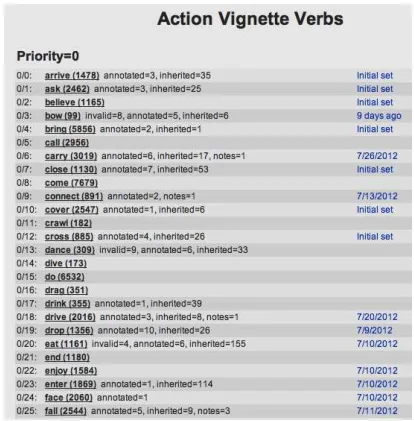
In this section we discuss how we prepared a set of approximately 1000 core verbs and their arguments to serve as input for the action vignette annotation process. These verbs were manually chosen, using subjective judgements, to include verbs that are commonly used as well as those that are concrete in nature and hence could be readily depicted. We also specified relative priorities to further guide our annotation efforts. Some of these verbs are shown in Figure 6. The list of actual verb phrases to annotate was obtained from the British National Corpus (BNC), which we parsed with the MICA parser (Bangalore et al., 2009). An AWK script was written to extract verbs from the output along with particles, direct and indirect objects, and prepositional phrases which convey salient information about the action. These verb-argument tuples provided the skeletal sentences and valence patterns representing the typical ways these verbs would be used. It is these verb-argument tuples that would then be annotated.
3.1 Parsing
MICA (Bangalore et al., 2009) is a dependency parser that uses tree insertion grammars and supertagging. A supertag is an elementary tree of a tree grammar, associated with a lexical item. The tree insertion grammar MICA is trained on was automatically extracted from a TIG-converted version of the Penn Treebank. The parser first assigns n-best supertags to an input token sequence, and then extracts from the lattice of super-tags the most likely complete tree insertion grammar derivation. Each supertag carries information about the syntactic context the lexical item may occur in and other lexical information. The Mica post-processor can use this information to augmented the resulting dependency parse with deep linguistic features, such as ubcategorization information and voice. Verbal arguments associated with each supertag can be identified asdeep syntacticroles (subject, object, indirect object in normalized active-voice word order). The referents of empty arguments in control and raising constructions can be identified and re-attached to their verbs. This makes extraction of verb/core-argument seeds much easier and more reliable.
3.2 Extraction and Sorting
oneself. Articles are normalized toaoran, and possessive adjectives toone’s. No other noun modifiers are preserved. The script then looks for prepositions which are children of the verb, and finds their objects, making the same modifications to these objects as to direct and indirect objects. The preposition and its objects are returned as a singleprepositional phraseunit. The direct object, indirect object, and prepositional phrase are returned after the verb in the order in which they appear in the sentence. Finally, if the script detects an infinitive verb which is subject-controlled by the verb being processed, the phraseto do somethingis added to the very end of the phrase.
There were, at times, problems with the parse which impeded the function of the extractor, prompting the addition of code in the extractor work around these errors. For example, the contractionI’mwas parsed as two lexical items by MICA:Iand’m. However,’mwas not recognized as a form of the wordam—itself a form of the verbto be—but rather was analyzed as a distinct verb. Thus, the extractor was modified to detect and fix this particular case. After a list of verb phrases was produced from the BNC, it was pared down to a more manageable size. First, the verb phrases were sorted by frequency, so that the most common phrases appeared at the top of the list. From this, we filtered out verb phrases based on whether they were part of our list of core verbs. Some examples of final extracted verb-argument tuples:
(131 (:VERB "eat") (:DIRECT-OBJECT "something")) – 131 verb phrases witheatand a pronoun. (24 (:VERB "eat") (:DIRECT-OBJECT "a meal")) – 24 verb phrases witheatandmeal.
4 Annotation Methods and Tools
In this section we describe some of the different methodologies and user interfaces we have developed for defining vignettes and assigning affordances and normalized part-names to 3D objects.
4.1 Using AMT to build location vignettes
We have been investigating the use of Amazon Mechanical Turk (AMT) for building locations vignettes. The inputs to our AMT tasks are ’typical’ photos of different rooms, that show large objects typical of that particular room. We carefully selected the picture from the results of image searches using Google and Bing. Turkers of each task had to be in the US and had previous approval rating of at least 99%. Restricting the location of the Turkers increases the chance that they are native speakers of English, or at least have good command of the language.
Phase 1: Collecting the functionally and visually important objects of rooms
The functionally important objects for a room are those that are required in order for the room to be recognized or to function properly. The visually important objects are those that help define the basic structural makeup of that particular room instance, such as large objects and those that are fixed in location. Examples of those objects in a kitchen can be “stove", “oven", “sink", “cabinets", and so on. After collecting the objects from several AMT tasks, we post-process them with the following steps (Rouhizadeh et al., 2011a):
1. Manual checking of spelling and converting plural nouns to singular. 2. Removing conjunctions such as “and",“or", and “/".
4. Substituting words with major substrings in common (“night stand", “night-stand"⇒ “nightstand").
5. Selecting the head nouns of compounds (“computer monitor"⇒“monitor").
Phase 2: Collecting the visual properties of the rooms
Turkers should determine the room layout (diagonal or horizontal), room size (small, medium, or large), ceiling height, wall texture (painted color, wallpaper pattern, fabric, wood paneling, tile, concrete, or stone), and floor texture (tile, wood, carpeted, stone, or concrete).
Phase 3: Collecting the spatial relations between the objects
For each objectOthat is collected in phase 1 Turkers should answer the following questions: (see Figure 2)
1. IsOlocated against a wall? If so, determine the wall.
2. IsOnear another object? If so, determine the object, determine the direction (front, back, or side), and the distance (1 ft, 2 ft, 3 ft, or 4 ft or more).
3. IsOsupported by (i.e. on, part of, or attached-to) another object? If so, determine the object.
4. IsOfacing another object? (e.g. chair facing a table) If so, determine the object.
We have completed phases 1 and 2 for 85 rooms and are now performing phase 3 for those rooms. To evaluate the results of phase 1, we compare the objects we collect to a gold-standard set of objects that are found in five rooms compiled by an expert. 91% of our collected objects were correct (precision) and we could gather 88% of the objects that we expected (recall).
4.2 Defining Location Vignettes using a Text-to-Scene System
Figure 2: Collecting spatial relations between objects in Phase 3 of the AMT task
Figure 3: Kitchen location vignette defined with WordsEye
[image:10.420.101.306.469.506.2]4.3 Assigning Part Names and Affordances
WordsEye utilizes a library of 2200 common 3D objects. The parts of these objects are often named (by the 3D artist who created them) with some abbreviated form of a normal English word. For example, the left and right tusks on one of the 3D models for an elephant are named
ltuskandrtusk. In addition to normalizing part names, we need to specify which parts function as affordances. We developed a web-based user interface to assign both a normalized part name and any corresponding affordances for every part (see Figure 5).
It is important to note that we are defining parts and affordances on actual 3D objects rather than on conceptual types in the ontology. This eliminates a typical problem in ontologies where higher-level concepts define properties that may not apply to all lower level concepts. For example, in WordNet (Fellbaum, 1998), the synsetshoehas a meronym (part designation) of
shoelace. Not all types of shoes, however, have shoelaces. In particular, the synsetloaferis a hyponym ofshoe, but loafers don’t have shoelaces. Since our taxonomy contains actual 3D objects, we can instead assign the exact set of parts, affordances, and other properties that apply to those specific objects. We can then infer by induction that most shoes have laces, but not all.
[image:11.420.114.320.301.422.2]We have successfully annotated our entire 3D library in this manner, in the process renaming about 18,000 parts and assigning 2,400 affordances. Since our interface lets the annotator assign part names by typing in a word, there were cases of unknown or misspelled words. There were also cases of ambiguity, with multiple word senses for the same input part name. These were fixed in a post-process by automatically finding all problematic cases (those with either no known word sense or more than one) and manually assigning the correct sense.
Figure 5: Parts and affordances for a door 3D object
4.4 Defining Action Vignettes
17% of our core verbs have no FrameNet equivalent. Secondly, the mapping from frames to vignettes would complicate and slow down the annotation process, forcing the annotator to understand much of FrameNet in addition to our graphical primitives. These problems will be addressed in future work (see Section 5).
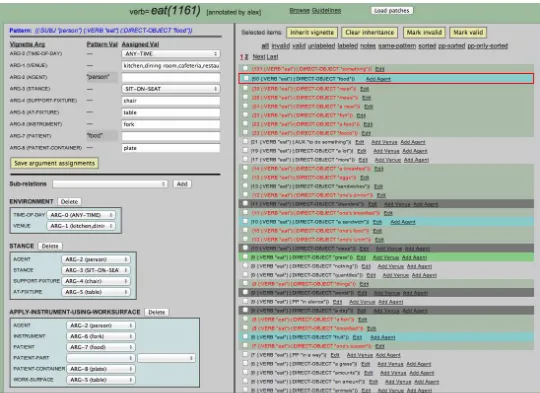
Annotating action vignettes involves mapping each verb-argument tuple to sets of primitive graphical frames representing how that verb (with arguments) would be depicted. See Figure 7. These decomposed tuples implicitly define new vignettes, where the tuples correspond to valence patterns that specify when that vignette is invoked. Since many tuples can be depicted in the same basic manner (albeit with different input arguments), we allow inheritance between vignettes. Inherited vignettes decompose to the same set of graphical primitives as their parent, but can override the values of the arguments. For example,wash an appleandwash a pear
would invoke the same vignette, which we can think of asWASH-FRUIT-IN-SINK. The user interface supports this functionality by allowing the annotator to select and assign multiple input tuples to the same vignette.
[image:12.420.99.306.290.501.2]We have so far annotated about 90 core verbs using this interface. In the process, we have specified 450 top-level vignettes and 2500 inherited vignettes (some of which override the inherited values). We have found that the original set of graphical primitives (Section 2.1) has remained fairly stable during this process, with an occasional new parameter or value type being added as new cases were encountered. We have made changes to the user interface (for example, adding different sorting keys and viewing options) based on experience using it. See Figure 8.
Figure 7: Action Vignette Editor forwash fruitandchop carrot
[image:13.420.82.352.262.459.2]5 Conclusion and Future Work
In this paper we have presented approaches to acquiring real-world knowledge to be used in a text-to-scene system. The core of our approach is embodied in the notion of vignettes. Vignettes are frames that are decomposable into grounded graphical relations. To implement vignettes we haved defined a specific set of graphical primitives that allow us to map between high-level to low-level semantics. These graphical primitives enable a wide variety of scenes to specified with a sufficient level of detail. In order to apply these graphical primitives to 3D objects we have defined a set of affordances representing the structure of those objects and how they are used and manipulated. Finally, building on this framework of vignettes, graphical primitives, and affordances, we have developed several methods for populating our resource with both locations and action vignettes. For action vignettes, this involved preparing a corpus of verb-argument tuples to be used as input data and developing tools to annotate that data with vignettes. To define location vignettes we used both AMT crowdsourcing methods and WordsEye, our text-to-scene system, as an annotation tool itself. Our resulting resource (called VigNet) is a lexically-oriented knowledge-base with lexical inputs mapping to vignettes, which in turn map to graphical primitives and actual 3D objects. VigNet will be made publicly available athttp://www.cs.columbia.edu/speech/text2scene.
Future work includes finishing the vignette annotation process. In addition, action vignettes, as defined in the user interface, will require some amount of post-processing in order to be used. In particular, we need to handle unknown words and word sense ambiguity issues for those words that were typed in by the annotator. Those will be normalized and disambiguated in a separate semi-automatic pass as we did for part names (Section 4.3). We will also perform a separate post-processing task to link vignettes to their corresponding FrameNet frames. One main challenge in using vignettes is that there won’t be a vignette to match every possible input. Instead, it will be necessary to generalize the input arguments to find the closest vignette. For example, a vignette defined forwash an apple(using a sink) can be applied to washing any small round fruit. This is partially addressed by annotators listing multiple possible values to fill arguments when defining the vignette. In general, however, finding the closest vignette will involve estimating the semantic distance between the arguments of the candidate vignettes and those of the input sentence. To do this, we will leverage information in our ontology that specifies the sizes, shapes, substances, and other semantic properties of all 3D objects and their parents. We also note that vignettes, themselves, can explicitly specify arbitrarily complex sets of constraints and restrictions on their arguments to help make these matches.
A second major challege in using vignettes is to compose actions vignettes with location vignettes in the course of text-to-scene generation. We intend to accomplish this as follows. If an action is mentioned, then the default venue for that action will evoke a set of possible location vignettes. Any affordances required by the action will be unified with those provided by the location. For example, the vignette forchop carrots, might supply a defaultVENUEof a kitchen and APPLY-INSTRUMENT-USING-WORKSURFACE. The kitchen vignette includes a counter and kitchen table, both of which provide aWORK-SURFACEaffordance.
Acknowledgments
References
Bangalore, S., Boullier, P., Nasr, A., Rambow, O., and Sagot, B. (2009). Mica: a probabilistic dependency parser based on tree insertion grammars application note. InProceedings of Human Language Technologies: The 2009 Annual Conference of the North American Chapter of the Association for Computational Linguistics, Companion Volume: Short Papers, pages 185–188. Association for Computational Linguistics.
Coyne, B., Bauer, D., and Rambow, O. (2011a). VigNet: Grounding Language in Graphics using Frame Semantics. InWorkshop on Relational Models of Semantics (RELMS) at ACL.
Coyne, B., Schudel, C., Bitz, M., and Hirschberg, J. (2011b). Evaluating a Text-to-Scene Generation System as an Aid to Literacy. InWorkshop on Speech and Language Technology in Education (SlaTE) at Interspeech 2011.
Coyne, B. and Sproat, R. (2001). Wordseye: An automatic text-to-scene conversion system. InProceedings of the 28th annual conference on Computer graphics and interactive techniques, pages 487– 496, Los Angeles, CA, USA.
Coyne, B., Sproat, R., and Hirschberg, J. (2010). Spatial relations in text-to-scene conversion. InComputational Models of Spatial Language Interpretation, Workshop at Spatial Cognition 2010, pages 9–16, Mt. Hood, OR, USA.
Fellbaum, C. (1998).WordNet: an electronic lexical database. MIT Press.
Gibson, J. (1977). The Theory of Affordances. In Shaw, R. and Bransford, J., editor,Perceiving, acting, and knowing: Toward an ecological psychology, pages 67–82. Erlbaum, Hillsdale, NJ.
Haugeland, J. (1995). Mind embodied and embedded. In Houng, Y. and Ho, J., editors,Mind and Cognition. Academia Sinica, Taipei.
Jackendoff, R. (1985).Semantics and cognition, volume 8. The MIT Press.
Kipper, K., Dang, H. T., and Palmer, M. (2000). Class-Based Construction of a Verb Lexicon. In
Proceedings of AAAI 2000, Austin, TX.
Miller, G. and Johnson-Laird, P. (1976).Language and perception.Belknap Press.
Norman, D. A. (1988).The Psychology of Everyday Things. Basic Books.
Rosch, E. (1973). Natural categories.Cognitive psychology, 4(3):328–350.
Rouhizadeh, M., Bauer, D., Coyne, B., Rambow, O., and Sproat, R. (2011a). Collecting spatial information for locations in a text-to-scene conversion system. InProceedings of the Workshop on Computational Models of Spatial Language Interpretation and Generation (CoSLI 2011), Boston, MA.
Rouhizadeh, M., Bowler, M., Sproat, R., and Coyne, B. (2011b). Collecting semantic data by Mechanical Turk for the lexical knowledge resource of a text-to-picture generating sys-tem. In Bos, J. and Pulman, S., editors,Proceedings of the Ninth International Conference on Computational Semantics (IWCS 2011), The University of Oxford.
Rouhizadeh, M., Coyne, B., and Sproat, R. (2011c). Collecting semantic information for locations in the scenario-based lexical knowledge resource of a text-to-scene conversion system. In König, A., Dengel, A., Hinkelmann, K., Kise, K., Howlett, R., and Jain, L., editors,
Knowledge-Based and Intelligent Information and Engineering Systems, volume 6884 ofLecture Notes in Computer Science, pages 378–387. Springer Berlin/Heidelberg.
Ruppenhofer, J., Ellsworth, M., Petruck, M., Johnson, C. R., and Scheffczyk, J. (2010).Framenet II: Extended Theory and Practice. ICSI Berkeley.
Schank, R. C. and Abelson, R. (1977). Scripts, Plans, Goals, and Understanding. Earlbaum, Hillsdale, NJ.
Sproat, R. (2001). Inferring the environment in a text-to-scene conversion system. In