Data-Oriented Translation
Arjen Poutsma
Department of Computational Linguistics University of Amsterdam
the Netherlands
Abstract
In this article, we present a statistical approach to machine translation that is based on Data-Oriented Parsing: Data-Oriented Translation (DOT). In DOT, we use linked subtree pairs for creating a derivation of a source sentence. Each linked subtree pair has a certain probability, and consists of two trees: one in the source language and one in the target lan-guage. When a derivation has been formed with these subtree pairs, we can create a translation from this derivation. Since there are typically many dif-ferent derivations of the same sentence in the source language, there can be as many different translations for it. The probability of a translation can be calcu-lated as the total probability of all the derivations that form this translation. We give the computa-tional aspects for this model, show that we can con-vert each subtree pair into a productive rewrite rule, and that the most probable translation can be com-puted by means of Monte Carlo disambiguation. Fi-nally, we discuss some pilot experiments with the Verbmobil corpus.
1 Introduction
The Data-Oriented Parsing model has been pre-sented as a promising paradigm for natural language processing (Scha, 1990; Bod, 1995; Bod, 1998). It has been shown that DOP has the ability to lo-cate syntactic and semantic dependencies, both of which are quite important for machine translation. We hope that, by basing our model on DOP, we can inherit these advantages, thus obtaining a new and interesting way to perform machine translation.
In section 2, we describe this novel model by identifying its parameters. In section 3, we describe its computational aspects; in section 4, we discuss some pilot experiments with this model; and finally, in section 5, we give some issues open for future research.
2 The Data-Oriented Translation Model
In this section, we will give the instantiation of a model that uses DOP for MT purposes, which we will call Data-Oriented Translation (DOT).1 This model is largely based on DOP1 (Bod, 1998, chapt. 2).
In DOT, we use linked subtree pairs as combi-national fragments.2 Each linked subtree pair has a certain probability, and consists of a tree in the source language and a tree in the target language. By combining these fragments to form an an analy-sis of the source sentence, we automatically gener-ate a translation, i.e. we form a derivation of both source sentence and target sentence. Since there are typically many different derivations which con-tain the same source sentence, there can be equally many different translations for it. The probability of a translation can be calculated as the total probabil-ity of all the derivations that form this translation.
The model presented here is capable of translat-ing between two languages only. This limitation is by no means a property of the model itself, but is chosen for simplicity and readability reasons only.
The following parameters should be specified for a DOP-like approach to MT:
1. the representations of sentences that are as-sumed,
2. the fragments of these representations that can be used for generating new representations,
3. the operator that is used to combine the frag-ments to form a translation, and
1This is actually the second instantiation of such a
frame-work. The original model (Poutsma, 1998; Poutsma, 2000) had a major flaw, which resulted in translations that were simply in-correct, as pointed out by Way (1999).
2Links between tree nodes were introduced for TAG trees,
S
a a
a ! ! !
NP
Charles
VP
Q Q
V
likes
NP
Anne
S
a a
a ! ! !
NP
Anne
VP
H H
V
plaˆıt
PP
Q Q
P
`a
NP
Charles
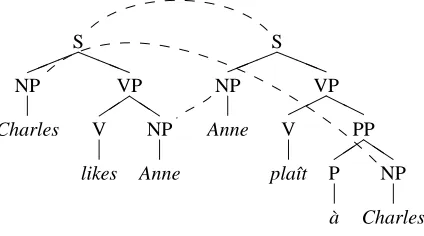
Figure 1: A linked tree pairhTs;Tti.
4. the model that is used for determining the probability of a target sentence given a source sentence.
In the explanation that follows, we will use a sub-script s to denote an element of the source language, and a subscript t to denote one of the target lan-guage.
2.1 Representations
In DOT, we basically use the same utterance-analysis as in DOP1 (i.e. syntactically labeled phrase structure trees). To allow for translation ca-pabilities in this model, we will use pairs of trees that incorporate semantic information. The amount of semantic information need not be very detailed, since all we are interested in is semantic equiva-lence. Two trees T1 and T2 are said to be semantic equivalents (denoted as T1'T2) iff T1 can be re-placed with T2without loss of meaning.
We can now introduce the notion of links: a link symbolizes a semantic equivalence between two trees, or part of trees. It can occur at any level in the tree structure, except for the terminal level.3
The representation used in DOT is a 3-tuple
hTs;Tt;φi, where Tsis a tree in the source language,
Ttis a tree in the target language, andφis a function that maps between semantic equivalent parts in both trees. In the rest of this article, we will refer to this 3-tuple as the pairhTs;Tti.
Because of the semantic equivalence, a link must exist at the top level of the tree pairhTs;Tti. Figure 1 shows an example of two linked trees, the links are depicted graphically as dashed lines.
3Links cannot occur at the terminal level, since we map
between semantic equivalent parts on the level of syntactic categories.
2.2 Fragments
Likewise, we will use linked subtrees as our frag-ments. Given a pair of linked treeshTs;Tti, a linked
subtree pair of hTs;Tti consists of two connected and linked subgraphshts;ttiofhTs;Ttisuch that:
1. for every pair of linked nodes inhts;tti, it holds that:
(a) both nodes in hts;tti have either zero daughter nodes,
or
(b) both nodes have all the daughter nodes of the corresponding nodes inhTs;Tti
and
2. every non-linked node in either ts(or tt) has all the daughter nodes of the corresponding node in Ts(Tt),
and
3. both tsand tt consist of more than one node.
This definition has a number of consequences. First of all, it is more restrictive than the DOP1 def-inition for subtrees, thus resulting in a smaller or equal amount of subtrees per tree. Secondly, it de-fines a possible pair of linked subtrees. Typically, there are many pairs of linked subtrees for each set of linked trees. Thirdly, the linked tree pair itself is also a valid linked subtree pair. Finally, accord-ing to this definition, all the linked subtree pairs are semantic equivalents, since the semantic daughter nodes of the original tree are removed or retained si-multaneously (clause 1). The nodes for which a se-mantic equivalent does not exist are always retained (clause 2).
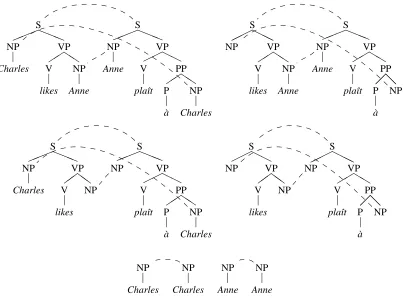
We can now define the bag of linked subtree pairs, which we will use as a grammar. Given a corpus of linked trees C, the bag of linked subtree pairs of C is the bag in which linked subtree pairs occur exactly as often as they can be identified in C.4 Figure 2 show the bag of linked subtree pairs for the linked tree pairhTs;Tti.
2.3 Composition operator
In DOT, we use the leftmost substitution opera-tor for forming combinations of grammar rules. The composition of the linked tree pairhts;tti and
4The similarity between Example-based MT (Nagao, 1984)
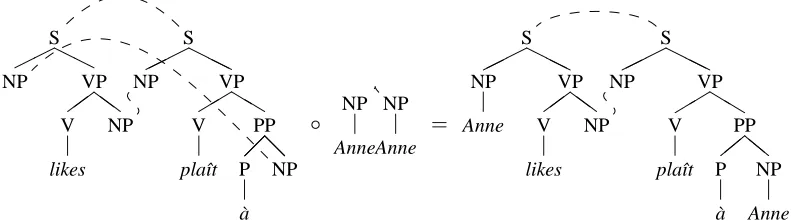
S the label of the leftmost nonterminal linked frontier node and the label of its linked counterpart are iden-tical to the labels of the root nodes ofhus;uti. If this composition is defined, it yields a copy ofhts;tti, in which a copy of ushas been substituted on ts’s left-most nonterminal linked frontier node, and a copy of uthas been substituted on the node’s linked coun-terpart. The composition operation is illustrated in figure 3.
Given a bag of linked subtree pairs B, a se-quence of compositionshts
1;tt
2.4 Probability calculation
To compute the probability of the target composi-tion, we make the same statistical assumptions as in DOP1 with regard to independence and representa-tion of the subtrees (Bod, 1998, p. 16).
The probability of selecting a subtree pairhts;tti is calculated by dividing the frequency of the sub-tree pair in the bag by the number of subsub-trees that have the same root node labels in this bag. In other words, letjhts;ttijbe the number of times the sub-Given the assumptions that all subtree pairs are independent, the probability of a derivation
hts 1;tt
1iÆÆhts
N;tt
Niis equal to the product of the probabilities of the used subtree pairs.
P(hts
The translation generated by a derivation is equal to the sentence yielded by the target trees of the derivation. Typically, a translation can be generated by a large number of different derivations, each of which has its own probability. Therefore, the prob-ability of a translation ws) wt is the sum of the probabilities of its derivations:
P(ws;wt)=
∑
P(D hws;wtiS
Figure 3: The composition operation
The justification of this last equation is quite triv-ial. As in any statistical MT system, we wish to choose the target sentence wt so as to maximize
P(wtjws)(Brown et al., 1990, p. 79). If we take the sum over all possible derivations that were formed from wsand derive wt, we can rewrite this as equa-tion 4, as seen below. Since both ws and wt are contained in Dhws;wti, we can remove them both and arrive at equation 5, which—as we maximize over wt—is equivalent to equation 3 above.
max
3 Computational Aspects
When translating using the DOT model, we can dis-tinguish between three computational stages:
1. parsing: the formation of a derivation forest,
2. translation: the transfer of the derivation for-est from the source language to the target lan-guage,
3. disambiguation: the selection of the most probable translation from the derivation forest.
3.1 Parsing
In DOT, every subtree pair hts;tti can be seen as a productive rewrite rule: hroot(ts);root(tt)i!
hfrontier(ts);frontier(tt)i, where all linkage in the frontier nodes is retained. The linked non-terminals in the yield constitute the symbol pairs to which new rules (subtree pairs) are applied. For instance, the rightmost subtree pair in figure 3 can be rewritten as
hS;Si!h(Anne;likes;NP);(NP;plaˆıt;`a;Anne)i
This rule can then be combined with rules that have the root pairhNP;NPi, and so on.
If we only consider the left-side part of this rule, we can use algorithms that exist for context-free grammars, so that we can parse a sentence of n words with a time complexity which is polynomial in n. These algorithms give as output a chart-like derivation forest (Sima’an et al., 1994), which con-tains the tree pairs of all the derivations that can be formed.
3.2 Translation
Since every tree pair in the derivation forest contains a tree for the target language, the translation of this forest is trivial.
3.3 Disambiguation
In order to select the most probable translation, it is not efficient to compare all translations, since there can be exponentially many of them. Furthermore, it has been shown that the Viterbi algorithm cannot be used to make the most probable selection from a DOP-like derivation forest (Sima’an, 1996).
Instead, we use a random selection method to generate derivations from the target derivation forest, otherwise known as Monte Carlo sam-pling (Bod, 1998, p. 46–49). In this method, the random choices of derivations are based on the probabilities of the underlying subderivations. If we generate a large number of samples, we can esti-mate the most probable translation as the translation which results most often. The most probable trans-lation can be estimated as accurately as desired by making the number of random samples sufficiently large.
4 Pilot Experiments
and Japanese. We only used the German and En-glish datasets, which were aligned at sentence level, and syntactically annotated using different annota-tion schemes.5
Naturally, the tree pairs in the corpus did not con-tain any links, so—in order to make it useful for DOT—we had to analyze each tree pair, and place links where necessary. We also corrected tree pairs that were not aligned correctly. Figure 4 shows an example of a corrected and linked tree from our cor-rection of the Verbmobil corpus.
We used a blind testing method, dividing the 266 trees of our corpus into an 85% training set of 226 tree pairs, and a 15% test set of 40 tree pairs. We carried out three experiments, in both directions, each using a different split of training and test set. The 226 training set tree pairs were converted into fragments (i.e. subtree pairs), and were enriched with their corpus probabilities. The 40 sentences from the test set served as input sentences: they were translated with the fragments from the train-ing set ustrain-ing a bottom-up chart parser, and disam-biguated by the Monte Carlo algorithm. The most probable translations were estimated from probabil-ity distributions of 1500 sampled derivations, which accounts for a standard deviation σ0:013. Fi-nally, we compared the resulting translations with the original translation as given in the test set. We also fed the test sentences into another MT-system: AltaVista’s Babelfish, which is based on Systran.6
4.1 Evaluation
In a manner similar to (Brown et al., 1990, p. 83), we assigned each of the resulting sentences a cate-gory according to the following criteria. If the pro-duced sentence was exactly the same as the actual Verbmobil translation, we assigned it the exact cat-egory. If it was a legitimate translation of the source sentence but in different words, we assigned it the alternate category. If it made sense as a sentence, but could not be interpreted as a valid translation of the source sentence, we assigned it the wrong cat-egory. If the translation only yielded a part of the source sentence, we assigned it the partial category: either partial exact if it was a part of the actual Verb-mobil translation, or partial alternate if it was part of an alternate translation. Finally, if no translation
5The Penn Treebank scheme for English; the T¨ubingen
scheme for German.
6This service is available on the Internet via http:// babelfish.altavista.com.
Exact
That would be very interesting. Verbmobil: Das w¨are sehr interessant. Translated as: Das w¨are sehr interessant.
Alternate
I will book the trains. Verbmobil: Ich buche die Z¨uge.
Translated as: Ich werde die Z¨uge reservieren.
Wrong
Es ist ja keine Beh¨orde. Verbmobil: It is not an administrative office
you know.
Translated as: There is not an administrative office you know.
Partial Exact
And as said I think the location of the branch office is posh.
Verbmobil: Und wie gesagt ich denke die Lage zur Filiale spricht B¨ande ist.
Translated as: ich denke die Lage
Partial Alternate
Ich habe Preise vom Parkhotel Hannover da.
Verbmobil: I have got prices for Hannover Parkhotel here.
Translated as: for Parkhotel Hannover
Figure 5: Translation and classification examples.
was given, we assigned it the none category. The re-sults we obtained from Systran were also evaluated using this procedure. Figure 5 gives some classifi-cation examples.
The method of evaluation is very strict: even if our model generated a translation that had a better quality than the given Verbmobil translation, we still assigned it the (partial) alternate category. This can be seen in the second example in figure 5.
4.2 Results
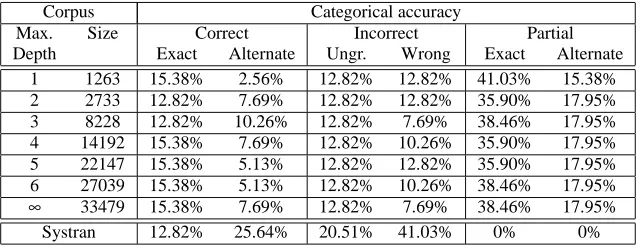
The results that we obtained can be seen in table 1 and 2. In both our experiments, the number of exact translations was somewhat higher than Sys-tran’s, but Systran excelled at the number of al-ternate translations. This can be explained by the fact that Systran has a much larger lexicon, thus al-lowing it to form much more alternate translations. While it is meaningless to compare results obtained from different corpora, it may be interesting to note that Brown et al. (1990) report a 5% exact match in experiments with the Hansard corpus, indicating that an exact match is very hard to achieve.
S
P P
P P
LK
machen
MF
P P
P
NX
wir
NX
es
ADVX
dann
S
X X
X X #
#
MD
shall
NP
we
VP
P P
P
VB
do
NP
it
ADVP
then
Figure 4: Example of a linked tree pair in Verbmobil
Corpus Categorical accuracy
Max. Size Correct Incorrect Partial
Depth Exact Alternate Ungr. Wrong Exact Alternate
1 1263 16.22% 2.70% 18.92% 18.92% 18.92% 24.32%
2 2733 16.22% 2.70% 32.43% 5.41% 27.03% 16.22%
3 8228 18.92% 5.41% 32.43% 5.41% 24.32% 13.51%
4 14192 18.92% 5.41% 32.43% 5.41% 24.32% 13.51%
5 22147 18.92% 5.41% 32.43% 5.41% 24.32% 13.51%
6 27039 18.92% 5.41% 32.43% 5.41% 27.03% 10.81%
∞ 33479 18.92% 5.41% 32.43% 5.41% 24.32% 13.51%
Systran 8.11% 37.84% 18.92% 35.14% 0% 0%
Table 1: Results of English to German translation experiments
English to German experiment were much higher than Systran’s (32% versus Systran’s 19%); vice-versa it was much lower (13% versus Systran’s 21%). Since the German grammar is more complex than the English grammar, this result could be ex-pected. It is simpler to map a complex grammar to a simpler than vice-versa.
The partial translations, which are quite useful for forming the basis of a post-edited, manual trans-lation, varied around 38% in our English to Ger-man experiments, and around 55% when translating from German to English. Systran is incapable of forming partial translations.
As can be seen from the tables, we experimented with the maximum depth of the tree pairs used. We expected that the performance of the model would increase when we used deeper subtree pairs, since deeper structures allow for more complex struc-tures, and therefore better translations. Our exper-iments showed, however, that there was very little increase of performance as we increased the maxi-mum tree depth. A possible explanation is that the trees in our corpus contained a lot of lexical context (i.e. terminals) at very small tree depths. Instead of varying the maximum tree depth, we should ex-periment with varying the maximum tree width. We plan to perform such experiments in the future.
5 Future work
Though the findings presented in this article cover the most important issues regarding DOT, there are still some topics open for future research.
As we stated in the previous section, we wish to see whether DOT’s performance increases as we vary the maximum width of a tree.
In the experiments it became clear that DOT lacks a large lexicon, thus resulting in less alternate trans-lations than Systran. By using an external lexicon, we can form a part-of-speech sequences from the source sentence, and use this sequence as input for DOT. The resulting target part-of-speech sequence can then be reformed into a target sentence.
The experiments discussed in this article are pilot experiments, and do not account for much. In order to find more about DOT and its (dis)abilities, more experiments on larger corpora are required.
6 Conclusion
Corpus Categorical accuracy
Max. Size Correct Incorrect Partial
Depth Exact Alternate Ungr. Wrong Exact Alternate
1 1263 15.38% 2.56% 12.82% 12.82% 41.03% 15.38%
2 2733 12.82% 7.69% 12.82% 12.82% 35.90% 17.95%
3 8228 12.82% 10.26% 12.82% 7.69% 38.46% 17.95%
4 14192 15.38% 7.69% 12.82% 10.26% 35.90% 17.95%
5 22147 15.38% 5.13% 12.82% 12.82% 35.90% 17.95%
6 27039 15.38% 5.13% 12.82% 10.26% 38.46% 17.95%
∞ 33479 15.38% 7.69% 12.82% 7.69% 38.46% 17.95%
Systran 12.82% 25.64% 20.51% 41.03% 0% 0%
Table 2: Results of German to English translation experiments
then be calculated as the total probability of all the derivations that form this translation.
The computational aspects of DOT have been dis-cussed, where we introduced a way to reform each subtree pair into a productive rewrite rule so that well-known parsing algorithms can be used. We de-termine the best translation by Monte Carlo sam-pling.
We have discussed the results of some pilot ex-periments with a part of the Verbmobil corpus, and showed a method of evaluating them. The evalua-tion showed that DOT produces less correct trans-lation than Systran, but also less incorrect transla-tions. We expected to see an increase in perfor-mance as we increased the depth of subtree pairs used, but this was not the case.
Finally, we supplied some topics which are open for future research.
References
A. Abeill´e, Y. Schabes, and A.K. Joshi. 1990. Us-ing lexicalized tags for machine translation. In Proceedings of the 13th international conference on computational linguistics, volume 3, pages 1– 6, Helsinki.
R. Bod. 1995. Enriching linguistics with statistics: Performance models of natural language. Num-ber 1995-14 in ILLC Dissertation Series. Institute for Logic, Language and Computation, Amster-dam.
R. Bod. 1998. Beyond grammar: an experience-based theory of language. Number 88 in CSLI lecture notes. CSLI Publications, Stanford, Cali-fornia.
J. Brown, J. Cocke, S. Della Pietra, V. Della Pietra, F. Jelinek, J. Lafferty, R. Mercer, and P. Roossin. 1990. A statistical approach to machine transla-tion. Computational Linguistics, 16(2):79–86.
M. Nagao. 1984. A framework of a mechani-cal translation between Japanese and English by analogy principle. In A. Elithorn and R. Banerji, editors, Artificial and Human Intelligence, chap-ter 11, pages 173–180. North-Holland, Amschap-ter- Amster-dam.
A. Poutsma. 1998. Data-Oriented Translation. In Ninth Conference of Computational Linguistics in the Netherlands, Leuven, Belgium. Confer-ence presentation.
A. Poutsma. 2000. Data-Oriented Translation: Us-ing the DOP framework for MT. Master’s the-sis, Faculty of Mathematics, Computer Science, Physics and Astronomy, University of Amster-dam, the Netherlands.
R. Scha. 1990. Taaltheorie en taaltechnologie; competence en performance. In Q.A.M. de Kort and G.L.J. Leerdam, editors, Computertoepassin-gen in de Neerlandistiek. Landelijke Vereniging van Neerlandici, Almere, the Netherlands. S.M. Schieber and Y. Schabes. 1990. Synchronous
tree-adjoining grammars. In Proceedings of the 13th international conference on computational linguistics, volume 3, pages 253–258, Helsinki. K. Sima’an, R. Bod, S. Krauwer, and R. Scha.
1994. Efficient disambiguation by means of stochastic tree substitution grammars. In Pro-ceedings International Conference on New Meth-ods in Language Processing, Manchester, UK. UMIST.
K. Sima’an. 1996. Computational Complexity of Probabilistic Disambiguation by means of Tree Grammars. In Proceedings COLING-96, Copen-hagen, Denmark.