Input-to-Output Gate to Improve RNN Language Models
Sho Takase Jun Suzuki Masaaki Nagata
NTT Communication Science Laboratories
{takase.sho, suzuki.jun, nagata.masaaki}@lab.ntt.co.jp
Abstract
This paper proposes a reinforcing method that refines the output layers of existing Re-current Neural Network (RNN) language models. We refer to our proposed method as Input-to-Output Gate (IOG)1. IOG has an extremely simple structure, and thus, can be easily combined with any RNN lan-guage models. Our experiments on the Penn Treebank and WikiText-2 datasets demonstrate that IOG consistently boosts the performance of several different types of current topline RNN language models. 1 Introduction
A neural language model is a central technol-ogy of recently developed neural architectures in the natural language processing (NLP) field. For example, neural encoder-decoder models, which were successfully applied to various natural lan-guage generation tasks including machine transla-tion (Sutskever et al., 2014), summarizatransla-tion (Rush et al., 2015), and dialogue (Wen et al., 2015), can be interpreted as conditional neural language mod-els. Moreover, word embedding methods, such as Skip-gram (Mikolov et al., 2013) and vLBL (Mnih and Kavukcuoglu, 2013), are also originated from neural language models that aim to handle much larger vocabulary and data sizes. Thus, language modeling is a good benchmark task for investigat-ing the general frameworks of neural methods in the NLP field.
In this paper, we address improving the perfor-mance on the language modeling task. In particular, we focus on boosting the quality of existing Recur-rent Neural Network (RNN) language models. We propose the Input-to-Output Gate (IOG) method,
1Our implementation is publicly available at https://github.com/nttcslab-nlp/iog.
which incorporates an additional gate function in the output layer of the selected RNN language model to refine the output. One notable charac-teristic of IOG is that it can be easily incorporated in any RNN language models since it is designed to be a simple structure. Our experiments on the Penn Treebank and WikiText-2 datasets demonstrate that IOG consistently boosts the performance of several different types of current topline RNN language models. In addition, IOG achieves comparable scores to the state-of-the-art on the Penn Treebank dataset and outperforms the WikiText-2 dataset.
2 RNN Language Model
This section briefly overviews the RNN language models. Hereafter, we denote a word sequence with lengthT, namely,w1, ..., wT asw1:T for short. Formally, a typical RNN language model computes the joint probability of word sequencew1:T by the product of the conditional probabilities of each timestept:
p(w1:T) =p(w1)
TY−1
t=1
p(wt+1|w1:t). (1)
p(w1) is generally assumed to be1in this
litera-ture, that is, p(w1) = 1, and thus, we can ignore
the calculation of this term (See the implementa-tion of Zaremba et al. (2014)2, for example). To estimate the conditional probabilityp(wt+1|w1:t), we apply RNNs. LetV be the vocabulary size, and letPt ∈RV be the probability distribution of the vocabulary at timestept. Moreover, letDhandDe respectively be the dimensions of the hidden state and embedding vectors. Then, the RNN language
2https://github.com/wojzaremba/lstm
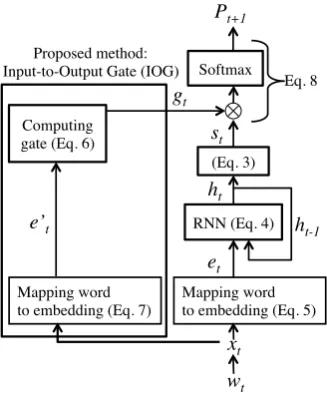
xt
Mapping word to embedding (Eq. 5) Computing
gate (Eq. 6)
Pt+1
wt
Mapping word to embedding (Eq. 7)
e’t
et
RNN (Eq. 4)
ht
ht-1
Softmax
(Eq. 3) Eq. 8
gt
st
Proposed method: Input-to-Output Gate (IOG)
Figure 1: Overview of computing probability dis-tribution.
models predictPt+1by the following equation:
Pt+1 = softmax(st), (2)
st=W ht+b, (3)
ht=f(et, ht−1), (4)
et=Ext, (5)
whereW ∈RV×Dhis a matrix,b∈RV is a bias
term, E ∈ RDe×V is a word embedding matrix, xt ∈ {0,1}V is a one-hot vector representing the word at timestept, andht−1 is the hidden state at
previous timestept−1. htat timestept = 0is defined as a zero vector, that is,h0 =0. Letf(·)
represent an abstract function of an RNN, which might be the Elman network (Elman, 1990), the Long Short-Term Memory (LSTM) (Hochreiter and Schmidhuber, 1997), the Recurrent Highway Network (RHN) (Zilly et al., 2017), or any other RNN variants.
3 Input-to-Output Gate
In this section, we describe our proposed method: Input-to-Output Gate (IOG). As illustrated in Fig-ure 1, IOG adjusts the output of an RNN language model by the gate mechanism before computing the probability of the next word. We expect that IOG will boost the probability of the word that may occur. For example, a word followed by a prepo-sition such as ‘of’ is probably a noun. Therefore, if the word at timesteptis a preposition, IOG re-fines the output of a language model to raise the probabilities of nouns.
Hyper-parameter Selected value Embedding dimensionDg 300
Dropout rate 50%
Optimization method Adam Initial learning rate 0.001 Learning rate decay 1/√Epoch
Max epoch 5
Table 1: Hyper-parameters in training IOG.
Formally, letxtbe a one-hot vector representing
wt, IOG calculates the gate gt by the following equations:
gt=σ(Wge0t+bg), (6)
e0t=Egxt. (7)
Here, Wg ∈ RV×Dg is a matrix, bg ∈ RV is a bias term, andEg ∈RDg×V is a word embedding matrix3. Then, we compute the probability distri-bution of the RNN language model by applying the above gate to the Equation (2) as follows:
Pt+1= softmax(gtst), (8)
whererepresents the element-wise multiplication of two vectors.
4 Experiments
4.1 Dataset
We conducted word-level prediction experiments on the Penn Treebank (PTB) (Marcus et al., 1993) and WikiText-2 (Merity et al., 2017b) datasets. The PTB dataset consists of 929k training words, 73k validation words, and 82k test words. The WikiText-2 dataset consists of 2,088k training words, 217k validation words, and 245k test words. Mikolov et al. (2010) and Merity et al. (2017b) respectively published pre-processed PTB4 and WikiText-25datasets. We used these pre-processed datasets for fair comparisons with previous studies.
4.2 Training Procedure
For the PTB dataset, we prepared a total of 5 RNN language models as our baseline models. First, we replicated LSTM with dropout and LSTM with variational inference based dropout, which we re-fer to as “LSTM” and “Variational LSTM”, respec-tively. Following Zaremba et al. (2014) and Gal
3We prepared different embeddings from those used in an
RNN language model.
4http://www.fit.vutbr.cz/ imikolov/rnnlm/
Model Parameters Validation Test
LSTM (medium) (Zaremba et al., 2014)† 20M 86.2 82.7
LSTM (medium, replication of Zaremba et al. (2014)) 20M 87.1 84.0
+ IOG (proposed) 26M 84.1 81.1
LSTM (large) (Zaremba et al., 2014)† 66M 82.2 78.4
LSTM (large, replication of Zaremba et al. (2014)) 66M 82.7 78.6
+ IOG (proposed) 72M 78.5 75.5
Variational LSTM (medium) (Gal and Ghahramani, 2016)† 20M 81.9±0.2 79.7±0.1 Variational LSTM (medium, replication of Gal and Ghahramani (2016)) 20M 82.8 79.1
+ IOG (proposed) 26M 81.2 78.1
Variational LSTM (large) (Gal and Ghahramani, 2016)† 66M 77.9±0.3 75.2±0.2 Variational LSTM (large, replication of Gal and Ghahramani (2016)) 66M 78.1 74.6
+ IOG (proposed) 72M 76.9 74.1
Variational RHN (depth 8) (Zilly et al., 2017)† 32M 71.2 68.5
Variational RHN (depth 8, replication of Zilly et al. (2017)) 32M 72.1 68.9
+ IOG (proposed) 38M 69.2 66.5
Variational RHN (depth 8, replication of Zilly et al. (2017)) + WT 23M 69.2 66.3
+ IOG (proposed) 29M 67.0 64.4
Ensemble of 5 Variational RHNs 160M 66.1 63.1
+ IOG (proposed) 166M 64.7 62.0
Ensemble of 10 Variational RHNs 320M 65.2 62.3
+ IOG (proposed) 326M 64.1 61.4
Neural cache model (Grave et al., 2017)† 21M - 72.1
Pointer Sentinel LSTM (medium) (Merity et al., 2017b)† 21M 72.4 70.9 Variational LSTM (large) + WT + AL (Inan et al., 2016)† 51M 71.1 68.5 Variational RHN (depth 10) + WT (Press and Wolf, 2017)† 24M 68.1 66.0 Neural Architecture Search with base 8 (Zoph and Le, 2017)† 32M - 67.9 Neural Architecture Search with base 8 + WT(Zoph and Le, 2017)† 25M - 64.0 Neural Architecture Search with base 8 + WT (Zoph and Le, 2017)† 54M - 62.4
AWD LSTM + WT (Merity et al., 2017a)† 24M 60.0 57.3
AWD LSTM + WT (result by code of Merity et al. (2017a)6) 24M 58.6 56.7
+ IOG (proposed) 30M 58.5 56.7
AWD LSTM + WT + cache (size = 2000) (Merity et al., 2017a)† 24M 53.9 52.8
AWD LSTM + WT + cache (size = 500) 24M 53.4 53.0
+ IOG (proposed) 30M 53.3 53.0
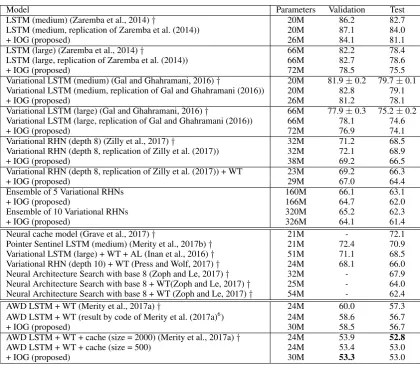
Table 2: Comparison between baseline models and the proposed method (represented as “+ IOG”) on the Penn Treebank (PTB) dataset. †denotes results published in previous studies. The method with WT shared word embeddings (E in the Equation (5)) with the weight matrix of the final layer (W in the Equation (3)). AL denotes that the method used a previously proposed augmented loss function (Inan et al., 2016).
Model Parameters Validation Test
LSTM (medium, replication of Zaremba et al. (2014)) 50M 102.2 96.2
+ IOG (proposed) 70M 99.2 93.8
Variational LSTM (medium, replication of Gal and Ghahramani (2016)) 50M 97.2 91.8
+ IOG (proposed) 70M 95.9 91.0
Variational LSTM (medium) + cache (size = 2000) 50M 69.6 66.1
+ IOG (proposed) 70M 69.3 65.9
Pointer Sentinel LSTM (Merity et al., 2017b)† 51M7 84.8 80.8
Neural cache model (size = 100) (Grave et al., 2017)† 42M - 81.6 Neural cache model (size = 2000) (Grave et al., 2017)† 42M - 68.9
AWD LSTM + WT (Merity et al., 2017a)† 33M 68.6 65.8
AWD LSTM + WT (result by code of Merity et al. (2017a)) 33M 68.6 65.8
+ IOG (proposed) 53M 68.6 65.9
AWD LSTM + WT + cache (size = 3785) (Merity et al., 2017a)† 33M 53.8 52.0
AWD LSTM + WT + cache (size = 3785) 33M 53.5 51.7
+ IOG (proposed) 53M 53.6 51.7
and Ghahramani (2016), we prepared the medium setting (2-layer LSTM with 650 dimensions for each layer), and the large setting (2-layer LSTM with 1500 dimensions for each layer) for each LSTM. We also replicated “Variational RHN” with a depth of 8 described in Zilly et al. (2017). For the WikiText-2 dataset, we prepared the medium setting standard and variational LSTMs as our base-lines, which are identical as those used in Merity et al. (2017b).
After reproducing the baselines, we incorporated IOG with those models. Table 1 summarizes the hyper-parameters used for training the IOG. During training IOG, we fixed the parameters of the RNN language models to avoid over-fitting.
4.3 Results
We show the perplexities of the baselines and those combined with IOG for the PTB in Table 2, and for the WikiText-2 in Table 3. These tables, which contain both the scores reported in the previous studies and those obtained by our reproduced mod-els, indicate that IOG reduced the perplexity. In other words, IOG boosted the performance of the baseline models. We emphasize that IOG is not restricted to a neural architecture of a language model because it improved the RHN and LSTM performances.
In addition to the comparison with the base-lines, Table 2 and Table 3 contain the scores pub-lished in previous studies. Merity et al. (2017b) and Grave et al. (2017) proposed similar methods. Their methods, which are called “cache mecha-nism” (or ‘pointer’), keep multiple hidden states at past timesteps to select words from previous se-quences. Inan et al. (2016) and Press and Wolf (2017) introduced a technique that shares word em-beddings with the weight matrix of the final layer (represented as ‘WT’ in Table 2). Inan et al. (2016) also proposed using word embeddings to augment loss function (represented as ‘AL’ in Table 2). Zoph and Le (2017) adopted RNNs and reinforcement learning to automatically construct a novel RNN architecture. We expect that IOG will improve these models since it can be combined with any RNN language models. In fact, Table 2 and Table 3
6In contrast to other comparisons, we used
the following implementation by the authors:
https://github.com/salesforce/awd-lstm-lm
7The number of parameters is different from the one
de-scribed in Merity et al. (2017b). We guess that they do not consider the increase of the vocabulary size.
demonstrate that IOG enhanced the performance even when the RNN language model was combined with ‘WT’ or the cache mechanism.
Table 2 also shows the scores in the ensemble set-tings. Model ensemble techniques are widely used for further improving the performance of neural networks. In this experiment, we employed a sim-ple ensemble technique: using the average of the output probability distributions from each model as output. We computed the probability distribution
Pt+1on the ensemble of theM models as follows:
Pt+1 = M1
M X
m=1
mPt+1, (9)
where mPt+1 represents the probability
distribu-tion predicted by them-th model. In the ensemble setting, we applied only one IOG to the multiple models. In other words, we used the same IOG for computing the probability distributions of each language model, namely, computing the Equation (8). Table 2 describes that 5 and 10 model ensem-ble of Variational RHNs outperformed the single model by more than 5 in perplexity. Table 2 shows that IOG reduced the perplexity of the ensemble models. Remarkably, even though the 10 Varia-tional RHN ensemble achieved the state-of-the-art performance on the PTB dataset, IOG improved the performance by about 1 in perplexity8.
In addition, as additional experiments, we incor-porated IOG with the latest method, which was proposed after the submission deadline of IJCNLP 2017. Merity et al. (2017a) introduced various regularization and optimization techniques such as DropConnect (Wan et al., 2013) and averaged stochastic gradient descent (Polyak and Juditsky, 1992) to the LSTM language model. They called their approach AWD LSTM, which is an abbrevia-tion of averaged stochastic gradient descent weight-dropped LSTM. Table 2 and Table 3 indicate the results on the PTB and the WikiText-2 respectively. These tables show that IOG was not effective to AWD LSTM. Perhaps, the reason is that the plexity of AWD LSTM is close to the best per-formance of the simple LSTM architecture. We also note that IOG did not have any harmful effect on the language models because it maintained the performances of AWD LSTM with ‘WT’ and the
8This result was the state-of-the-art score at the submission
Model Diff Test Variational RHN (replicate) - 68.9 Variational RHN + IOG (proposed) - 66.5 Variational RHN + IOG with hidden +0.8M 75.6 Variational RHN + LSTM gate +0.7M 68.1
Table 4: Comparison among architectures for com-puting the output gate on the PTB dataset. The column ‘Diff’ shows increase of parameters from IOG (proposed).
cache mechanism. Moreover, incorporating IOG is much easier than exploring the best regularization and optimization methods for each RNN language model. Therefore, to improve the performance, we recommend combining IOG before searching for the best practice.
4.4 Discussion
Although IOG consists only of word embeddings and one weight matrix, the experimental results were surprisingly good. One might think that more sophisticated architectures can provide further im-provements. To investigate this question, we exam-ined two additional architectures to compute the output gategtin the Equation (6).
The first one substituted the calculation of the gate functiongtby the followingg0t:
g0
t=σ(Wg0[ht, e0t] +bg), (10)
whereW0
g ∈RV×(Dh+Dg), and[ht, e0t]represents the concatenation of the hidden statehtof RHN and embeddingse0
tused in IOG. We refer to this architecture as “+ IOG with hidden”.
The second one similarly substitutedgtby the followingg00
t:
gt00=σ(Wgh0t+bg), (11)
h0
t=f0(e0t, h0t−1), (12)
wheref0(·)is the 1-layer LSTM in our experiments. We set the dimension of the LSTM hidden state to 300, that is, Dg = 300, and the other hyper-parameters remained as described in Section 4.2. We refer to the second one as “+ LSTM gate”.
Table 4 shows the results of the above two archi-tectures on the PTB dataset. IOG clearly outper-formed the other more sophisticated architectures. This fact suggests that (1) incorporating additional architectures does not always improve the perfor-mance, and (2) not always become better even if it is a sophisticated architecture. We need to carefully
Input word Top 5 weighted words
of security, columbia, steel, irs, thrift in columbia, ford, order, labor, east go after, through, back, on, ahead attention was, than,heosi, from, to whether to, she, estimates, i, ual
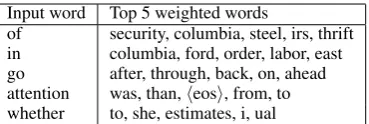
Table 5: Top 5 weighted words for each input word on the PTB experiment.
design an architecture that can provide complemen-tary (or orthogonal) information to the baseline RNNs.
In addition, to investigate the mechanism of IOG, we selected particular words, and listed the top 5 weighted words given each selected word as in-put in Table 59. IOG gave high weights to nouns when the input word was a preposition: ‘of’ and ‘in’. Moreover, IOG encouraged outputting phrasal verbs such as “go after”. These observations gener-ally match human intuition.
5 Conclusion
We proposed Input-to-Output Gate (IOG), which refines the output of an RNN language model by the gate mechanism. IOG can be incorporated in any RNN language models due to its simple structure. In fact, our experimental results demonstrated that IOG improved the performance of several different settings of RNN language models. Furthermore, the experimental results indicate that IOG can be used with other techniques such as ensemble.
Acknowledgments
We thank the anonymous reviewers for their helpful comments.
References
Jeffrey L Elman. 1990. Finding Structure in Time.
Cognitive science14(2):179–211.
Yarin Gal and Zoubin Ghahramani. 2016. A Theoreti-cally Grounded Application of Dropout in Recurrent Neural Networks. InAdvances in Neural Informa-tion Processing Systems 29 (NIPS 2016).
Edouard Grave, Armand Joulin, and Nicolas Usunier. 2017. Improving Neural Language Models with a Continuous Cache. In5th International Conference on Learning Representations (ICLR 2017).
9In this exploration, we excluded words occurring fewer
Sepp Hochreiter and J¨urgen Schmidhuber. 1997. Long Short-Term Memory. Neural Computation
9(8):1735–1780.
Hakan Inan, Khashayar Khosravi, and Richard Socher. 2016. Tying Word Vectors and Word Classifiers: A Loss Framework for Language Modeling. In
Proceedings of the 5th International Conference on Learning Representations (ICLR 2017).
Mitchell P. Marcus, Mary Ann Marcinkiewicz, and Beatrice Santorini. 1993. Building a Large Anno-tated Corpus of English: The Penn Treebank. Com-putational Linguistics19(2):313–330.
Stephen Merity, Nitish Shirish Keskar, and Richard
Socher. 2017a. Regularizing and
Optimiz-ing LSTM Language Models. arXiv preprint
arXiv:1708.02182.
Stephen Merity, Caiming Xiong, James Bradbury, and Richard Socher. 2017b. Pointer Sentinel Mix-ture Models. In Proceedings of the 5th Inter-national Conference on Learning Representations (ICLR 2017).
Tomas Mikolov, Martin Karafi´at, Luk´as Burget, Jan Cernock´y, and Sanjeev Khudanpur. 2010. Recurrent Neural Network based Language Model. In Pro-ceedings of the 11th Annual Conference of the In-ternational Speech Communication Association (IN-TERSPEECH 2010). pages 1045–1048.
Tomas Mikolov, Ilya Sutskever, Kai Chen, Greg S Cor-rado, and Jeff Dean. 2013. Distributed Representa-tions of Words and Phrases and their Compositional-ity. InAdvances in Neural Information Processing Systems 26 (NIPS 2013), pages 3111–3119.
Andriy Mnih and Koray Kavukcuoglu. 2013. Learn-ing Word EmbeddLearn-ings Efficiently with Noise-Contrastive Estimation. In Advances in Neural Information Processing Systems 26 (NIPS 2013), pages 2265–2273.
Boris T Polyak and Anatoli B Juditsky. 1992. Ac-celeration of Stochastic Approximation by Averag-ing. SIAM Journal on Control and Optimization
30(4):838–855.
Ofir Press and Lior Wolf. 2017. Using the Output Em-bedding to Improve Language Models. In Proceed-ings of the 15th Conference of the European Chap-ter of the Association for Computational Linguistics (EACL 2017). pages 157–163.
Alexander M. Rush, Sumit Chopra, and Jason Weston. 2015. A Neural Attention Model for Abstractive Sentence Summarization. In Proceedings of the 2015 Conference on Empirical Methods in Natural Language Processing (EMNLP 2015). pages 379– 389.
Ilya Sutskever, Oriol Vinyals, and Quoc V. Le. 2014. Sequence to Sequence Learning with Neural Net-works. InAdvances in Neural Information Process-ing Systems 27 (NIPS 2014). pages 3104–3112.
Li Wan, Matthew Zeiler, Sixin Zhang, Yann L Cun, and Rob Fergus. 2013. Regularization of Neural Net-works using DropConnect. In Proceedings of the 30th International Conference on Machine Learning (ICML 2013). pages 1058–1066.
Tsung-Hsien Wen, Milica Gasic, Nikola Mrkˇsi´c, Pei-Hao Su, David Vandyke, and Steve Young. 2015. Se-mantically Conditioned LSTM-based Natural Lan-guage Generation for Spoken Dialogue Systems. In
Proceedings of the 2015 Conference on Empirical Methods in Natural Language Processing (EMNLP 2015). pages 1711–1721.
Wojciech Zaremba, Ilya Sutskever, and Oriol Vinyals. 2014. Recurrent Neural Network Regularization. In
Proceedings of the 2nd International Conference on Learning Representations (ICLR 2014).
Julian Georg Zilly, Rupesh Kumar Srivastava, Jan Koutn´ık, and J¨urgen Schmidhuber. 2017. Recurrent Highway Networks. Proceedings of the 34th Inter-national Conference on Machine Learning (ICML 2017)pages 4189–4198.
Barret Zoph and Quoc V. Le. 2017. Neural Archi-tecture Search with Reinforcement Learning. In