
A Statistical Framework for Product Description Generation
Jinpeng Wang1, Yutai Hou2∗, Jing Liu1, Yunbo Cao3 and Chin-Yew Lin1 1Microsoft Research Asia,{jinpwa,liudani,cyl}@microsoft.com
2Harbin University of Technology,[email protected] 3Tencent Corporation, Beijing,[email protected]
Abstract
We present in this paper a statistical framework that generates accurate and fluent product description from product attributes. Specifically, after extracting templates and learning writing knowledge from attribute-description parallel data, we use the learned knowledge to decidewhat to sayandhow to sayfor product descrip-tion generadescrip-tion. To evaluate accuracy and fluency for the generated descriptions, in addition to BLEU and Recall, we propose to measure what to say (in terms of at-tribute coverage) and to measure how to say (by attribute-specified generation) sep-arately. Experimental results show that our framework is effective.
1 Introduction
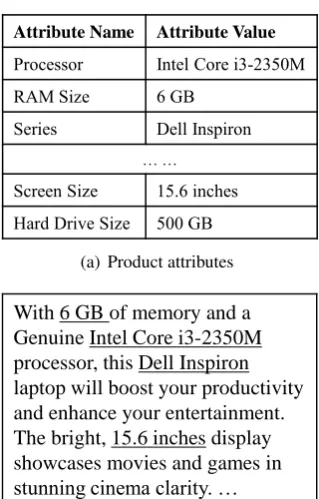
In this paper, we study the problem of product description generation, i.e., given attributes of a product, a system automatically generates corre-sponding description for this product (see Fig.1). One application for this task is in (voice) QA sys-tems like Amazon Echo, where reading out the attributes of a product is not desirable. We also found that only 45% of descriptions contain more than 50 words after analyzing 40 million prod-ucts from Amazon. Generating descriptions for the products which do not have descriptions, and explaining complex attributes of the product for better understanding are also valuable.
Data-to-text generation renders structured records into natural language (Reiter and Dale,
2000), which is similar to this problem. Statistical approaches were employed to reduce extensive
∗This work was done when the second author was an
in-tern at Microsoft Research Asia.
Attribute Name Attribute Value
Processor Intel Core i3-2350M RAM Size 6 GB
Series Dell Inspiron … …
Screen Size 15.6 inches Hard Drive Size 500 GB
(a) Product attributes
With 6 GB of memory and a Genuine Intel Core i3-2350M processor, this Dell Inspiron laptop will boost your productivity and enhance your entertainment. The bright, 15.6 inches display showcases movies and games in stunning cinema clarity. …
(b) Generated description
Figure 1: Example of generating product descrip-tion from product attributes.
development time by learning rules from histori-cal data (Langkilde and Knight,1998;Liang et al.,
2009). Duboue and McKeown (2003) proposed a statistical approach to mine content selection rules for biography descriptions; Kondadadi et al.(2013) andHowald et al.(2013) proposed a statistical approach to select appropriate templates for weather report generation.
However, product description generation is dif-ferent from above work. To generating a useful product description, a system needs to be aware of the relative importance among the attributes of a product and to maintain accuracy at the same time. Successful product description generation needs to address two major challenges: (1)What to say: decide which attributes should be included
in the description; (2)How to say: decide how to order selected attributes in the description.
To tackle these problems, we introduce a sta-tistical framework. Our approach has three sig-nificant merits. (1) Coherent with fact: we pro-posed to learn structured knowledge from train-ing dataset, and use it to choose important at-tributes and determine the structure of description; (2) Fluent: the proposed approach is template-based which guarantees grammaticality of gen-erated descriptions, and the proposed templated knowledge help to choose semantically correct template; (3)Highly automated: the proposed ap-proach required only weak human intervention.
Moreover, in addition to the standard metrics for data-to-text generation, e.g, BLEU (Konstas and Lapata, 2013; Lebret et al., 2016; Kiddon et al., 2016); to evaluate accuracy and fluency of generated descriptions, we propose to measure what to say and how to say separately.
2 Problem Definition
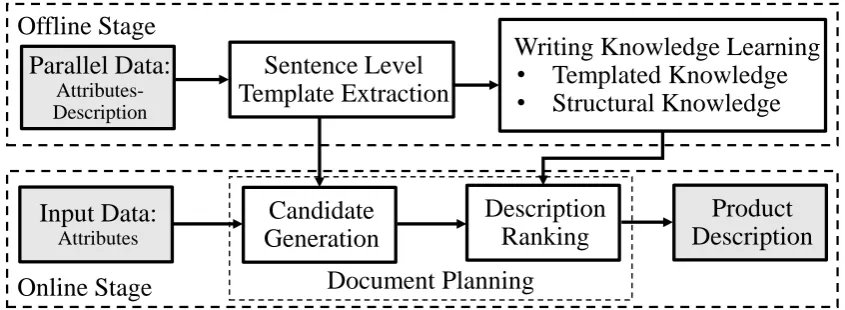
Fig.2shows the system framework of product de-scription generation. Our system first extracts sen-tence level templates and learns writing knowl-edge from a given parallel dataset, then generates a new description for an input data at the online stage by combining sentence level templates us-ing the learned writus-ing knowledge. The latter step which generates document from sentences is the core component of the product description gen-erate framework. It is calledDocument Planning and is our focus in this paper.
Document Planning as a Ranking Problem In the online stage, given the attributes of a prod-uct and the extracted templates, we first generate candidate descriptions by combining all valid tem-plates which fit the given attributes, and then rank the candidate descriptions with the learned writing knowledge. After formulating it as a ranking prob-lem, it is flexible to integrate all kinds of features to estimate the quality of the generated descrip-tions.
Sentence Level Template Extraction Given a parallel dataset, we first align descriptions and theirs corresponding attributes to extract tem-plates. Several studies (Liang et al., 2009; Kon-dadadi et al.,2013;Lebret et al.,2016) can be ap-plied to solve this problem. In this paper, we fol-low the approach which is proposed byKondadadi et al.(2013). Table1shows some sample extracted
Original Text:
•The massive 8 GB of memory will allow you to have lots of files open at the same time.
•The D520 laptop installed with Windows 7.
Extracted Sentence Level Templates:
•The massive[RAM Size]of memory will allow you to have lots of files open at the same time.
•TheD520laptop installed with [Operating Sys-tem].
Table 1: Extracted template examples. Words in bracket are aligned attributes; words with under-line are attributes missing in template extraction.
templates.
3 Document Planning with Writing Knowledge
Product description generation is far more than simply combining sentences level templates. As we have discussed in the introduction, there are two main challenges for this problem:what to say andhow to say. To solve these problems, we pro-pose to learn templated knowledge and structured knowledge, and use them for ranking generated candidate descriptions.
3.1 Templated Knowledge
At the first step of generating description in the on-line stage, we fill the extracted templates with the attributes of the input data. However, the extracted templates are with different quality or might have semantic gap with the filled values.
Value PreferenceFor the first extracted template shown in Table1, the context words in this tem-plate depend on value of “RAM Size” strongly. This template is more coherent with products whose “RAM Size” is “8 GB” or “16 GB” rather than that is “1 GB”. To calculate the relatedness between attribute valuevaand templatet, we
de-fine value preference as:
ValPref(va, t) = X
vi∈V(t)
1−Dist(va, vi)
P(vi),
Input Data:
Attributes
Offline Stage
Online Stage
Candidate
Generation
Description
Ranking
Product
Description
Parallel Data:
Attributes-Description
Sentence Level
Template Extraction
Writing Knowledge Learning
•
Templated Knowledge
•
Structural Knowledge
Document Planning
Figure 2: The system framework.
P(vi) is the probability of value vi in V(t), and
Dist(va, vi) is defined as distance between two
values. We can treat all values of attribute as string type, and use normalized editing distance to measure Dist(va, vi)2. To improve accuracy for
specific domain, for attributes with numerical val-ues3, Dist(v
a, vi) = v(max)|va−vi|
a −va(min), wherev (max)
a ,
va(min)are the upper and lower bound of attribute ain training data.
Missing AttributeFor the second extracted tem-plate shown in Table 1, “D520” is an attribute value which is missing in template extraction, and such low-quality template with unaligned attribute may hurt the performance of generated descrip-tion. We defineMissing Attribute as a word that contains capital letters or numbers, and use this metric as a metric to penalize templates with po-tential missing attributes during template selec-tion.
3.2 Structured Knowledge
We would also like the generated description con-tains the important attributes of a product and co-herent in semantic. This writing knowledge can be learned from training data.
Attribute PriorNot all attributes of a product are equally important and not all of them are men-tioned in a description with the same probability. To capture this information, we define the prior of an attributeai asP(ai) = Mention(ai)
P
jMention(aj), where Mention(ai)is the number of mention of attribute
aiin the extracted templates. 2Normalized by the longer length ofv
aandvi.
3Improvement will be made even if just creating Dist(., .) for the common attributes. In our case, only “RAM Size” and “Hard Disk Size” are treated as with numerical values.
Attribute Dependency It is worth noting that attributes which are mentioned in a description are interrelated. For example, in descriptions of computers, “CPU” usually mentioned in the first sentence and “RAM Speed” usually fol-lows “RAM Size”. To capture such information, the dependency between attribute ai and aj can be defined as P(ai|aj) = Co-occurrence(ai,aj)
P
kCo-occurrence(ak,aj), where Co-occurrence(ai, aj) is the count of ai
andaj mentioned in consecutive sentences4. For
a document dwhich is constructed by sentences (s1, ..., sn), where each sentencesi contains a set
of attributes(ai,1, ...ai,|si|). We assume that cur-rent sentencesi depend only on its previous sen-tencesi−1, and the structured score for document
dcan be defined as
Struct(d) =
n X
i=2
P(si|si−1) =
n X
i=2
P(si, si−1) P
lP(s(l), si−1),
(2) where P(si, si−1) has multiple choices, e.g., P
j,k{P(ai,j|ai−1,k)},maxj,k{P(ai,j|ai−1,k)}or
minj,k{P(ai,j|ai−1,k)}.
3.3 Ranking the Generated Descriptions
We first generate candidate descriptions for rank-ing. Given the attributes of a product, we fill the attribute values into templates which have corre-sponding slots, and treat all the combinations of filled templates as generated candidate descrip-tions. We then adopt SVM-rank (Joachims,2002) with linear kernel to rank the candidate descrip-tions, and treat the top candidate as the answer. Specifically, we use BLEU score between
ence description and generated description as label score and use the features shown in Table2.
Basic knowledge:
• # words;
• # sentences;
• # mentioned attributes.
Templated knowledge:
• Value preference: is described by Eq. 1. We calculate the sum, max and min of value pref-erences for all attributes in candidate document, and treat them as separated features;
• # missing attribute: is described in Section2.
Structured knowledge:
• Attribute prior: is the sum of attribute priors for attributes mentioned in candidate description.
• Attribute dependency: is described by Eq. 2. The structured scores which based on different version ofP(si, si−1) are treated as separated
features;
Table 2: Features of ranking model.
4 Experiments
4.1 Dataset
We collect the dataset, i.e., (description, attributes) pairs, from category “Computers & Tablets” from Amazon.com, and discard products whose de-scription contains less than 100 words or whose attribute list contains less than five attributes. Ta-ble3shows the statistics5. This dataset has been
divided into three parts to provide training (70%), validation (10%) and test sets (20%).
Parameter Value
# (description, attribute table) pairs 25,375 Avg. # of words in description 117.4 Avg. # of sentences in description 4.7 Avg. # of attributes in attribute list 21.2
Table 3: Dataset statistics.
4.2 Compared Methods
We compare these methods in experiments: Basic, +Templated, +Structured and Full are
5The dataset will be available at http://joopoo. github.io
ranked based on basic features, basic+templated features, basic+structured features and ba-sic+templated+structured features respectively; WordCountandAttriCountare rankers which sort candidates in the descending order of word count and attribute count respectively; OracleBLEU is an oracle ranker which always chooses the top candidate in term of BLEU as the answer (can be seen as the upper bound of ranking).
4.3 Overall Performance
First of all, we show an example of generated de-scription in Table5. We adopt language similarity BLEU (Papineni et al.,2002) and retrieval accura-cies top-K recall6as our evaluation metrics, which
are widely used in related work. Table 4 shows that both of structured information and template information help improve the overall performance, and the full model achieves the best performance. Notice that the upper bound in term of BLEU is only 31.5, so the above performance is acceptable. For Recall, both Value Preference and Attribute Prior are the most useful features for retrieving the groundtruth.
Method BLEU Recall@3
Basic 13.2 (↑0%) 0.409 (↑0%) +Structured 14.0 (↑6.1%) 0.795 (↑94.2%) +Templated 15.3 (↑15.9%) 0.717 (↑75.2%) Full 15.4(↑16.7%) 0.803(↑96.1%)
WordCount 13.1 0.255
AttriCount 11.3 0.155 OracleBLEU 31.5 1.000
Table 4: Overall performance.
4.4 Attribute Coverage
We propose to evaluate attribute coverage which is important for product description generation. For example, a product in our dataset has 21.2 attributes on average, while only 7.6 attributes are mentioned in a reference description on av-erage. Specifically, we extract attributes which mentioned in a reference description, and compare them with those in its corresponding generated de-scriptions. From Table6, we can see that by con-sidering structured information+Structuredis bet-ter than+Templatedin term of attribute coverage while that is on the contrary in term of BLEU.
Original Description Generated Description
Dell Inspiron 15 5000 15-5547 15.6” Touchscreen LED (In-plane Switching (IPS) Technol-ogy) Notebook - Intel Core i7 i7-4510U 2 GHz - Silver - 16 GB RAM - 1 TB HDD - Intel HD Graphics 4400 - Windows 8.1 64-bit (English) - 1920 x 1080 Display - Bluetooth - E i5547-12500sLV
(Product Link: www.amazon. com/dp/B00LGNL5S6)
This Dell Inspiron 15-5558 laptop gives you the everyday features you need, at a great value! It runs many ser-vices simultaneously and the dynamic combination of the 2 GHz Intel Core i7 processor and 16 GB RAM enables the acute ability to focus on concurrent tasks with minimal per-formance degradation. It features an elegant design, includes enhancements to the apps you use most, and enables your PC and Windows 8 devices to work together in amazing ways. With flexible technology and service options, wireless connec-tivity, and Intel processors packed into a compact system, the Dell Inspiron 15-5558 gives you the essential mobility that will get your business going places.
Table 5: An example of generated description.
It is worth noting thatOracleBLEUwhich ranks generated descriptions in term of BLEU performs fair. This is because BLEU only takes word over-lap into consideration but not attributes. In other words, descriptions that share same words ob-tain high BLUE scores, although they are talk-ing about different attributes. For example, de-scriptions about “RAM” and “Hard Disk” may share same words as “massive” or “GB”. From this point, attribute coverage can be seen as comple-mentary to BLEU.
Method Precision Recall F1
Basic 0.610 0.573 0.573 +Structured 0.615 0.590 0.584 +Templated 0.612 0.580 0.577 Full 0.623 0.611 0.597
WordCount 0.623 0.543 0.557 AttriCount 0.596 0.621 0.589 OracleBLEU 0.605 0.592 0.577
Table 6: Performance on attribute coverage.
4.5 Attribute-Specified Generation
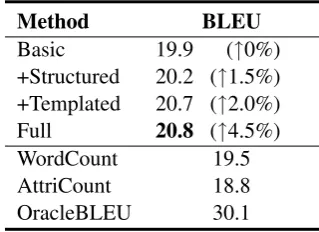
After evaluating attribute coverage, we move to evaluate descriptions which are generated with specific attributes. This task can help us to eval-uate quality of generating description by avoid-ing effect due to attribute selection. In another word, we generate a product description with a given subset of attributes which have been men-tioned in the reference description instead of given the whole attributes. From Table7we can see bet-ter performance for all methods as attributes are
specified. Our methods still outperform baselines even when part of features are weakened in this setting, e.g., the prior scores in structured feature. This means that the basic and templated features are also helpful for description generation.
Method BLEU
Basic 19.9 (↑0%) +Structured 20.2 (↑1.5%) +Templated 20.7 (↑2.0%) Full 20.8 (↑4.5%) WordCount 19.5 AttriCount 18.8 OracleBLEU 30.1
Table 7: Performance on attribute-specified de-scription generation.
4.6 Human Evaluation
In this evaluation, the following factors are evalu-ated: (1) Fluency; (2) Correctness: how well the generated description fits corresponding attribute values; (3) Completeness: how well the generated description mentions most of main attributes; and 4) Salient Attribute Mention: how well the gen-erated description highlights its salient attributes. We selected 50 random test products, and for each product we used a Likert scale (∈[1,5]) and report averaged ratings among two annotators.
latter tends to mention fewer attributes in descrip-tions.
Method Full WordCount Reference
Fluency 4.07 3.67 4.62
Correctness 4.03 3.74 4.87
Completeness 4.32 4.13 4.04 Salient Attr. 4.01 3.76 4.33
Table 8: Human evaluation results on the gener-ated and reference descriptions. Score∈[1,5].
5 Conclusions
In this paper, we proposed a statistical framework for product description generation. The proposed structured information and templated information are helpful for deciding what to say and how to say for description generation. In addition, a new eval-uation process is proposed to measure the gener-ated descriptions. The experimental results show that our framework is effective in generating accu-rate and fluent product description.
References
Pablo A. Duboue and Kathleen R. McKeown. 2003. Statistical acquisition of content selection rules for natural language generation. InProceedings of the 2003 Conference on Empirical Methods in Natural Language Processing, EMNLP ’03, pages 121–128, Stroudsburg, PA, USA. Association for Computa-tional Linguistics.
Blake Howald, Ravikumar Kondadadi, and Frank Schilder. 2013. Domain adaptable semantic cluster-ing in statistical NLG. InProceedings of the 10th International Conference on Computational Seman-tics (IWCS 2013) – Long Papers, pages 143–154, Potsdam, Germany. Association for Computational Linguistics.
Thorsten Joachims. 2002. Optimizing search engines using clickthrough data. In Proceedings of the Eighth ACM SIGKDD International Conference on Knowledge Discovery and Data Mining, KDD ’02, pages 133–142, New York, NY, USA. ACM. Chlo´e Kiddon, Luke Zettlemoyer, and Yejin Choi.
2016. Globally coherent text generation with neu-ral checklist models. InProceedings of the 2016 Conference on Empirical Methods in Natural Lan-guage Processing, EMNLP 2016, Austin, Texas, USA, November 1-4, 2016, pages 329–339.
Ravi Kondadadi, Blake Howald, and Frank Schilder. 2013. A statistical NLG framework for aggregated planning and realization. InProceedings of the 51st
Annual Meeting of the Association for Computa-tional Linguistics (Volume 1: Long Papers), pages 1406–1415, Sofia, Bulgaria. Association for Com-putational Linguistics.
Ioannis Konstas and Mirella Lapata. 2013. Inducing document plans for concept-to-text generation. In
Proceedings of the 2013 Conference on Empirical Methods in Natural Language Processing, EMNLP 2013, 18-21 October 2013, Grand Hyatt Seattle, Seattle, Washington, USA, A meeting of SIGDAT, a Special Interest Group of the ACL, pages 1503– 1514.
Irene Langkilde and Kevin Knight. 1998. Generation that exploits corpus-based statistical knowledge. In
Proceedings of the 36th Annual Meeting of the Asso-ciation for Computational Linguistics and 17th In-ternational Conference on Computational Linguis-tics - Volume 1, ACL ’98, pages 704–710, Strouds-burg, PA, USA. Association for Computational Lin-guistics.
R´emi Lebret, David Grangier, and Michael Auli. 2016. Neural text generation from structured data with ap-plication to the biography domain. In Proceed-ings of the 2016 Conference on Empirical Meth-ods in Natural Language Processing, EMNLP 2016, Austin, Texas, USA, November 1-4, 2016, pages 1203–1213.
Percy Liang, Michael I. Jordan, and Dan Klein. 2009. Learning semantic correspondences with less super-vision. InProceedings of the Joint Conference of the 47th Annual Meeting of the ACL and the 4th Interna-tional Joint Conference on Natural Language Pro-cessing of the AFNLP: Volume 1 - Volume 1, ACL ’09, pages 91–99, Stroudsburg, PA, USA. Associa-tion for ComputaAssocia-tional Linguistics.
Kishore Papineni, Salim Roukos, Todd Ward, and Wei-Jing Zhu. 2002. Bleu: A method for automatic eval-uation of machine translation. In Proceedings of the 40th Annual Meeting on Association for Com-putational Linguistics, ACL ’02, pages 311–318, Stroudsburg, PA, USA. Association for Computa-tional Linguistics.
![Table 8: Human evaluation results on the gener-ated and reference descriptions. Score ∈[ 1, 5] .](https://thumb-us.123doks.com/thumbv2/123dok_us/800110.1094146/6.595.73.298.101.173/table-human-evaluation-results-gener-reference-descriptions-score.webp)