A Topic-Triggered Language Model for Statistical Machine Translation
Heng Yu†, Jinsong Su∗, Yajuan l ¨u†, Qun Liu‡ †
†Institute of Computing Technology, Chinese Academy of Sciences ∗Software School of Xiamen University
‡Centre for Next Generation Localisation
Faculty of Engineering and Computing, Dublin City University {yuheng,lvyajuan,liuqun}@ict.ac.cn
[email protected] [email protected]
Abstract
Language model is an essential part in sta-tistical machine translation, but traditional
n-gram language models can only capture
a limited local context in the translated sentence, thus lacking the global informa-tion for predicinforma-tion. This paper describes a novel topic-triggered language model, which takes into account the topical
con-text by estimating the n-gram
probabil-ity under the given topics and online ad-justs language model score according to different topic distributions. Experimental results show that our method provides a
average improvement of +0.76 Bleu on
NIST Chinese-to-English translation task and a reduction in word perplexity of the test-document.
1 Introduction
Language model (LM) measures the fluency of translation outputs (Brown et al., 1993), and plays an important role in statistical machine translation (SMT). Traditional language model predicts the next word conditioning only on the precedingn−1 words, thus ignores syntactic structures in the sen-tence and global information over the document.
One direct approach to handle this problem is to explore sentence-level context, such as syntax-based language model for reranking (Charniak et al., 2003), and dependency language model for String-to-Dependency model (Shen et al., 2008). But these methods are still not robust enough to handle the polysemy and domain changes, as they lack the global-context information.
Another interesting line is to utilize informa-tion at document-level. Intuitively, different do-mains or topics have differentn-gram probability distributions. Thus, we should take into account the topic information when we translate a doc-ument. Topic model has been learned in several
parts of SMT, such as word-alignment (Zhao and Xing, 2006; Zhao and Xing, 2007; Gong et al., 2011), translation model (Xiao et al., 2012). All these works show that a particular translation of-ten appears in some specific topical context, so it is reasonable to enhance the prediction ability of language model by incorporating topical informa-tion. Tan et al. (2011) introduces a large scale dis-tributed composite language model incorporating document-level information. But they only focus on the target side and explore in n-best rerank-ing task which has a limited search space, while another promising application is taking account of topical information on both sides and integrate the LM into decoding to online select transla-tion hypotheses. However, the integratransla-tion is not easy. Since the test-document can be from any topic, it is hard to dynamically estimate language model probability according to various topic dis-tributions.
In this paper, we follow this line and introduce a novel topic-triggered language model. We first es-timate the topic distribution for each document in training data, and assign those topic probabilities to each sentence. With target-side topic probabil-ities, we train a topic-specific language model for each topic. Then, rather than limiting topical con-text to target side, we utilize the source-side topi-cal information at decoding time and online adjust language model score according to the topic dis-tribution of the translated-document. As there is no explicit correspondence between topics on both sides, we project the source-side topic distribution to the target side as a trigger to our topic spe-cific language models. As compared with previous works, our model takes advantage of the topical information on both sides, thus breaking down the context barrier for language model. Experimental results on various Chinese-English test sets show that our method gains an average improvement of
+0.76 Bleupoints and a perplexity reduction over
the baseline model.
2 Related Work
Previous works devoted to improving language models in SMT mostly focus on utilizing more contextual information, such as syntax-based LMs (Charniak et al., 2003; Schwartz et al., 2011; Shen et al., 2008; Hassan et al., 2009), Forward & MI trigger LM (Xiong et al., 2011), and large-scale language models (Zhang et al., 2006; Brants et al., 2007; Emami et al., 2007; Talbot and Osborne, 2007). Since our philosophy is fundamentally dif-ferent from them in that we incorporate informa-tion at document level to build language models. So we discuss previous works that explore topic information for SMT in this section.
Researchers have been trying to incorporate topic information into language models in several ways. Gildea and Hofmann (1999) use EM al-gorithm to perform a topic factor decomposition based on a segmented training corpus. They es-timate unigram topic-based probability and
com-bine it with standard n-gram model. Tam et al.
(2007) and Ruiz and Federico (2011) introduce topic model for cross-lingual language model adaptation task. They use bilingual topic model to project latent topic distribution across languages. Based on the BLSA, they are able to transfer source-side topic weights into target-side and use them to generate topic-based marginals to adaptn -gram language model. Our model is different from theirs in that rather than using topic-based proba-bilities to adaptn-gram model, we directly calcu-late LM probability conditioned on topic distribu-tions.
There are also some valuable applications of topic model for machine translation. Zhao and Xing (2006) propose the Bilingual Topic Admix-ture Model (BiTAM) for word alignment and ex-tract topic-dependent translation model accord-ingly. Gong et al. (2011) introduce topic model for filtering topic-mismatched phrase pairs. Su et al. (2012) use the topic distribution of in-domain monolingual corpus to adapt the translation model. Xiao et al. (2012) introduce a topic similarity model to select the synchronous rules for hierar-chical phrase-based translation. Our work is in the same spirit with those works, but we are interested in LM problem rather than other parts in SMT.
Our work models topic probabilities into train-ing corpus and trains several topic-specific LMs,
so it is in the same spirit of mixture modeling. Hei-del et al. (2007) use topic distribution to cluster the training corpora and train LMs accordingly. Our method is different from theirs in that we assign topic probabilities to training sentences rather than segment them into different topics, so our model is more robust to data sparse problem. Besides, Fos-ter and Kuhn (2007), Civera and Juan (2007), L¨u et al. (2007) also adapt mixture modeling frame-work to exploit the full potential of existing cor-pus. Adopting this framework, the training corpus is first divided into different parts, each of which is used to train a sub model, then these sub mod-els are used together with different weights during decoding. Those works typically use word simi-larities and sentence level information, while our work extents the context into the document level.
3 Topic triggered Language Model
Polysemy is a difficult problem for statistical ma-chine translation. As shown in Figure 1, English sentence ”give me a shot” has different meanings in different domains. Using traditional LM, which only considers the local context information in the translated sentence, this ambiguous translation is hard to handle, since these translations are all com-mon in the corpus with different domains. But with the help of topical context information, the diff er-ence can be told. For example, the word ’shot’ is often translated into ”(photo)” in the sentences re-lated to the film topic, and to ”(chance)” in sports topic. So as the topic information is concerned, LM allows for more fine-grained distinction of dif-ferent translations and enjoys stronger prediction power.
In our method, we introduce the topic of current
documenttas a hidden variable, and decompose
the language model probability as follows:
P(e)=X
t
P(e,t)=X
t
P(e|t)·P(t) (1)
P(e|t) indicates the probability of the sequence e
given the topict, and P(t) is the topic distribution of the test-document which is calculated during decoding. In general, our framework to build the topic-trigger language model can be specified into two steps:
• Build topic-specific LMs conditioned on the
Give me a shot
Film topic
➗(photo)
Oral topic
ᵪՊ(chance)
Military topic
ሴࠫ (gun shoot)
Sports topic
[image:3.595.137.461.62.159.2]䘋⨳ (goal)
Figure 1: Example of different translations of word ”shot” in different topics
• Capture source-side topic information during
decoding and online adjust LM score
We will give detailed description of the two parts in the following section.
3.1 Topic-specific language model
In this section, we first briefly review the principle of Hidden Topic Markov Model (HTMM) which is the basis of our method, then describe our ap-proach to build topic-specific LMs in detail.
3.1.1 Hidden Topic Markov Model
Topic model is a suite of algorithms aiming to discover the hidden thematic structure in large archives of documents. Recently both Latent Dirichlet Allocation (LDA) (Blei et al., 2003) and Probabilistic Latent Semantic Analysis (PLSA) (Hofmann, 1999) have been successfully applied in various NLP tasks. Based on the ”bag-of-words” assumption that the order of words can be ignored, these methods model the corpus as a co-occurrence matrix of words and documents, and build generative models to infer the latent aspect of topics. Using these models, words can be clus-tered into the derived topics with a probability dis-tribution. and the correlation between words can be automatically captured via topics.
However, the ”bag-of-words” assumption is an unrealistic oversimplification in language model case because it ignores the order of words which is critical in estimatingn-gram probabilities. To rem-edy this problem, we use Hidden Topic Markov Models (HTMM), proposed by (Gruber et al., 2007) , which models the topics of words in the document as a Markov chain. The model is based on the assumption that all words in the same sentence share the same topic and the succes-sive sentences are more likely to have the same topic. HTMM incorporates the local dependency between words by Hidden Markov Model for bet-ter topic estimation.
3.1.2 Topic Probability Assignment
We use HTMM (Gruber et al., 2007) to train topic model on our training set and obtain sentence-level topic probabilities. To avoid data sparse problems, we use the topic probability of each sen-tence as a soft clustering for each topic rather than force hard decisions on topic assignment. In this way, we are able to get n-gram distributions for different topics. So the topic-sensitive words will have a higher occurrence in specific topics while common words will distribute uniformly in every topic.
3.1.3 Estimation
We follow the common practise inn-gram model
(Goodman, 2001) and simplify P(e|t) into a se-rial of n-gram probabilities P(wi|wii−n+1,t) based
on Markov Assumption. Formally, we decompose the probability as follows:
P(e|t)=P(w1|t)·P(w2|w1,t)· · ·P(wi|wii−n+1,t) (2)
Noted that, based on HTMM, we assume that all words in one sentence share the same topic, so
topict in Equation 2 can be shared. To compute
P(wi|wii−n+1,t), We use Maximum-Likelihood
Es-timation (MLE) with then-gram fractional count
for each topic. And since some topic-based n
-grams probabilities are sharply distributed, we use Witten-Bell(WB) method (Witten and Bell, 1991) for smoothing.
PMLE(wi|wii−−1n+1,te)=
Count(wii−n+1,te)
Count(wii−−1n+1,te)
(3)
P(wi|wiw−i−n1+1,te)=λwi−i−n1+1PMLE(wi|w
i−1
wi−n+1,te)
+(1−λwi−1
i−n+1)P(wi
|wiw−i−n1+2,te)
(4)
In Equation 4, λ is a normalization
which can be calculated using the following equa-tion:
λwi−1
i−n+1 =
N1+(wii−−1n−1,te)
N1+(wii−−1n−1,te)+Pwic(w
i
i−n+1,te) (5)
where N1+(wii−−1n−1,te) denotes for the number
of words w following wii−−1n−1 in topic te, and
c(wii−n+1,te) is the count ofn-gramwii−n+1inte.
3.2 Integration with SMT
We integrate our LM into SMT system to utilize topic distribution of the test-document as a trig-ger to each topic-specific language model. But as we know, only source side is available before de-coding in SMT. So in order to get target-side topic distributionP(te), we need to estimate the
source-side topic distribution P(tf) and then project it to
the target side. So Equation 1 can be further re-fined as the following Equation:
P(e)=X
te
P(e|te)· X
tf
P(te|tf)·P(tf) (6)
where P(te|tf) is the topic projection probability.
3.2.1 Topic Projection
Since topic distributions of bilingual sentences of-ten share the same pattern (Gao et al., 2011), we follow the work of Xiao et al. (2012) and introduce the topic projection probability P(te|tf) to project
the source-side topic distribution into the target-side topic space. We train topic models on both sides of the training data, then with the help of the word alignment we estimate the projection proba-bility by the co-occurrence of the source-side and the target-side topic assignment.
Formally, we denote each parallel sentence pair by (tf,te,a), where tf and te are the topic
as-signments of source-side and target-side sentences
respectively, and a is a set of word alignments
{(fi,ej)}. An alignment (i,j) denotes source-side
word fi aligns to target-side wordej, so the
top-ics of both words are also aligned. Thus, the
co-occurrence of a source-side topic with index df
and a target-side topicde,Cnt(tf,te) is calculated
by:
Cnt(tf,te)= X
(tf,te,a)
X
(i,j)∈a
δ(tfi,df)∗δ(tej,de) (7)
whereδ(x;y) is the Kronecker function, which is
1 if x=y and 0 otherwise. We then compute the
probability of P(t=df,t=de) by normalizing the
co-occurrence count. Overall, we obtain a corre-spondence matrixMde×df from target-side topic to
source-side topic, where the item Mi;j represents
the probability P(tf =i,te = j). Then with the
cor-respondence matrixMde×df, we are able to project
the source-side topicP(tf) to the target-side topic
space, which we called projected target-side topic distributionT(P(tf)).
3.2.2 Topic-triggered Estimation
During decoding, we first estimate the source-side topic distribution of the test-set P(tf), then using
the topic projection matrix, we map P(tf) to the
target side, and generate each topicte with
prob-ability P(te|tf). Then topic te triggers its
topic-specific LMP(e|te). We use the weighted sum of
each model as the final LM score.
4 Experiments and Results
We try to answer the following questions by ex-periments:
• Can our topic-triggered language model help
improve translation quality in terms of both Bleuand perplexity.
• How is the topic number affect the language model performance.
• Can our model make better use of training
corpus than N-gram model.
4.1 Experiment setup
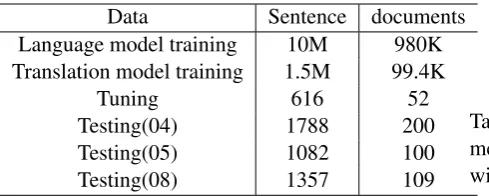
We present our experiments on the NIST Chinese-English translation tasks. The bilingual training data for translation model contain 1.5M sentence pair with 38M Chinese words and 32M English words. The monolingual data for training En-glish language model includes the Xinhua por-tion of the GIGAWORD corpus, which contains 10M sentences. We used the NIST evaluation set of 2006(MT06) as our development set, and sets of MT04/05/08 as test sets. Corpus statistics are shown in Table 1.
We obtain symmetric word alignments of
train-ing data by first runntrain-ing GIZA++(Och and Ney,
Data Sentence documents
Language model training 10M 980K
Translation model training 1.5M 99.4K
Tuning 616 52
Testing(04) 1788 200
Testing(05) 1082 100
Testing(08) 1357 109
Table 1: Training, tuning and test data used for evaluating Bleuscore.
rules from this word-aligned training data. A 4-gram language model is trained on the monolin-gual data by SRILM toolkit (Stolcke, 2002). Case-insensitive NIST BLEU (Papineni et al., 2002) is used to measure translation performance. We use minimum error rate training (Och, 2003) for opti-mizing the feature weights.
To obtain topic distribution, We use the open source LDA tool Open HTMM developed by Gru-ber et al. (2007) for estimation and inference. Dur-ing this process, we empirically set the
parame-ter values for HTMM training as: α = 1.5, β =
1.01,iters= 100. See Gruber et al. (2007) for the meanings of these parameters. and set the topic number to 301for both source and target side. The source-side topic model is estimated from the Chi-nese part of training corpus, while the target side is estimated from both Xinhua and the English side of training corpus.
4.2 Effect of topic-trigger language model
For machine translation task, our baseline is the traditional hiero system with standard features (Chiang, 2007). The baseline language model is a 4-gram model trained on Xinhua corpus. Noted that we use Keneser-Ney smoothing (Kneser and Ney, 1995) for baseline LM since it’s universally acknowledged to achieve better performance. And our topic-triggered language model is trained on the same corpus with topic distribution estimated from topic model. We add our model as an new feature into the system, denote as STLM. To prove the soundness of our approach, we re-implement two comparative experiments: HTLM makes hard-decision on topic selection in both training and de-coding, assigning the topic with the highest prob-ability to the sentence, which is in the same spirit with the Heidel et al. (2007) method. Second, we
1We determine the topic number by testing 5, 10, 15, 30,
50 in our preliminary experiments. We find that 30 topics pro-duces a slightly better performance than other values.
ppl 04 05 08
Base LM 158.42 134.59 208.11
[image:5.595.72.317.61.159.2]Topic LM 148.11 119.17 200.41
Table 3: 4-gram word perplexity results of our
method in terms of ppl, We compare our model
with baselinen-gram model (”Base LM”) on three
test-sets.
follow the method by Tam et al. (2007), denote as ”Tam”, and generate topic-based marginals to
adaptn-gram language model.
Table 2 reports the Bleu and TER scores on
all test-sets. The baseline system achieves Bleu
score of 37.43 on NIST04, 33.67 on NIST05 and 28.54 on NIST08 set. Our method(STLM) gains an average improvement of+0.76 Bleuand an
av-erage reduction of −0.88 TER over the baseline. Results on NIST MT 04, 05, 08 are statistically significant with p<0.05 (Koehn, 2004). This ver-ifies that our topic-triggered language model is a
good complement forn-gram model to further
im-prove translation quality. We can also see that our method generally out-performs the Tam’s method, because our model can capture n-gram level topic information, rather than only focus on estimating 1-gram topic-based probability. Another interest-ing result is forcinterest-ing hard-decision on topic selec-tion (HTLM) only achieves a little improvement over the baseline. The reason is two folded: First, in LM training process, the hard-decision on topic will serve as a corpus split strategy and cause data sparse problems. Second in decoding, one sen-tence may not solely belong to one topic, so the hard decision will cause inaccurateness in LM pre-diction.
We then evaluate our method in terms of per-plexity. As an initial measure to compare language models, average per-word perplexity(ppl) , reports how surprised a model is by test data. Equation 8 calculatespplusing log baseb for a test set ofT tokens.
ppl=b
−logbP(e1...eT)
T (8)
we evaluate 4-gram perplexity of the translation hypotheses using baseline language model and our topic-triggered model.
Model 04 05 08 AVG
Bleu TER Bleu TER Bleu TER Bleu TER
Baseline 37.43 39.88 33.67 42.45 28.54 47.32 33.21 43.22
Tam 37.86 39.12 34.28 41.93 29.02 46.92 33.72 42.66
HTLM 37.46 39.86 33.74 42.41 28.67 47.23 33.29 43.17
[image:6.595.129.472.62.146.2]STLM 38.28 38.95 34.30 41.93 29.32 46.14 33.97 42.34
Table 2: Results of our method in terms of Bleu/TER, ”Tam” dentes using topic adaptation method from
Tam et al. (2007). ”HTLM” denotes using topic-triggered LM with hard decision of topic assignment, and ”STLM” means topic assignment by probabilities. Scores marked in bold are statistically significantly with p<0.05 (Koehn, 2004).
Test-set 04 05 08
baseline 31.31 28.43 23.67
5 topics 30.81 27.96 23.26
10 topics 30.98 28.12 23.42
15 topics 31.32 28.40 23.64
20 topics 31.39 28.40 23.82
30 topics 31.75 28.51 24.05
[image:6.595.101.265.227.338.2]50 topics 31.70 28.48 24.01
Table 4: Results on all test sets with different topic number.
4.3 Effect of topic number
In topic model training, topic number is a man-ually set parameter. However, as an empirical fac-tor, the topic number diverse a lot in different train-ing corpus. so it’s worthy to explore the effect of topic number on the performance of our topic-trigger language model. We set topic number to 5, 10, 15, 20, 30, 50 respectively to train topic mod-els on both sides.
Table 4 shows the Bleuscores using 5, 10, 15,
20 ,30, 50 topics. We can see that with only 5 top-ics, the model performance is a little worse than the baseline model. This is reasonable because the corpus has not been fully clustered into diff er-ent topics, so the topic information has not been fully utilized. But we can see ,as the topic num-ber grows larger, the performance gets better with a peak at 30 topics, resulting a 0.34 improvement average over the baseline.
But there is a little slump when it comes to 50, we think the reason is as we models topic distri-bution into the LM training corpus, the distribu-tion gets too scattered as topic number grows caus-ing data-sparse problem in topic-specific language model training, thus affecting the overall probabil-ity of the language model.
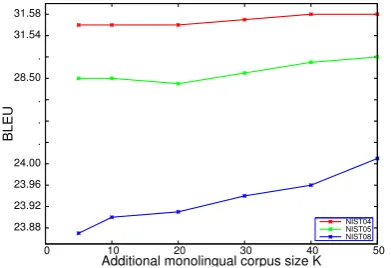
23.88 23.92 23.96 24.00 . . . 28.50 . 31.54 31.58
0 10 20 30 40 50
BLEU
Additional monolingual corpus size K
NIST04 NIST05 NIST08
Figure 2: BLEU improvement with additional topic-modeling training corpus
4.4 Effect of better topic model estimation
Finally, we investigate the effect of larger topic-training corpus. One important feature of topic model is the larger the training corpus is , the bet-ter model we will get. In our experiment, we use the source of fbis which only have 10,947 docu-ments to train source-side topic model. This may not be good enough to correctly estimate the topic distribution of the test set, since we know that NIST08 contains a large portion of web corpus. So we add different size of source-side monolin-gual corpus: 5K, 10K, 20K, 30K, 40K, 50K from Chinese Sohu weblog corpus2only to train diff er-ent source-side topic models with 30 topics.
Figure 4 shows the Bleu scores of the
transla-tion system on NIST04,05,08. It can be seen that additional corpus improves translations quality on NIST08. This is because the additional corpus ex-pand the diversity of the topic model, especially for NIST08 which contains a large part of web data, generating more accurate topic distribution. The best Bleucomes to 24.12 when the additional
corpus size is 50K, achieving 0.42 gains on the
[image:6.595.318.514.231.365.2]baseline system. But on 04 and 05 test-sets, the improvement is not that significant. This may be-cause the 04, 05 set are not similar with the addi-tional corpus, so they are not effected by the im-provement of topic model. The results indicates that the performance of our topic-triggered lan-guage model is directly associated with the topic model, which can be improved by training with larger and more relative corpus.
5 Conclusion
In this paper. we follow this line and introduce a novel topic-triggered LM. We first estimate the topic distribution for each document in training data, and assign those topic probabilities to each sentence, then, we train a topic-specific n-gram LM for each topic based on those topic proba-bilities. At decoding time, as target translations are not available before translation, we simply project the topic distribution from source to tar-get side. Then we compute the topic-triggered LM score according to the topic distribution of the translated-document. Experimental results show that our model achieves better performance than
traditional n-gram model on both perplexity and
Bleuscore.
In the future, we will verify our method in other domain and language pairs. Further more, we want to combine our work with other related works to see if it can further improve the translation quality. Finally, we will explore more robust framework to incorporate syntax and semantic information to make our language model more powerful.
6 Acknowledgments
The authors were supported by 863 State Key Project (No. 2011AA01A207), and Na-tional Key Technology R&D Program (No. 2012BAH39B03). Jinsong Su’s work is sup-ported by Reseach Fund for the Doctoral Pro-gram of Higher Education of China (Grant NO. 20120121120046). Qun Liu’s work is partially supported by Science Foundation Ireland (Grant No.07/CE/I1142) as part of the CNGL at Dublin City University. We would like to thank the anony-mous reviewers for their insightful comments and those who helped to modify the paper.
References
David M. Blei, Andrew Y. Ng, Michael I. Jordan, and
John Lafferty. 2003. Latent dirichlet allocation. In
Journal of Machine Learning Research, volume 3,
page 2003.
Thorsten Brants, Ashok C. Popat, Peng Xu, Franz J.
Och, Jeffrey Dean, and Google Inc. 2007. Large
language models in machine translation. In In
EMNLP, pages 858–867.
Peter F. Brown, Vincent J. Della Pietra, Stephen A. Della Pietra, and Robert L. Mercer. 1993. The mathematics of statistical machine translation:
pa-rameter estimation. Comput. Linguist., 19(2):263–
311, June.
Eugene Charniak, Kevin Knight, and Kenji Yamada. 2003. Syntax-based language models for statistical
machine translation. InIn MT Summit IX. Intl.
As-soc. for Machine Translation.
David Chiang. 2007. Hierarchical phrase-based
trans-lation.Computational Linguistics, 33.
Jorge Civera and Alfons Juan. 2007. Domain adap-tation in statistical machine translation with
mix-ture modelling. InProceedings of the Second
Work-shop on Statistical Machine Translation, StatMT
’07, pages 177–180, Stroudsburg, PA, USA. Asso-ciation for Computational Linguistics.
A. Emami, K. Papineni, and J. Sorensen. 2007.
Large-scale distributed language modeling. InAcoustics,
Speech and Signal Processing, 2007. ICASSP 2007.
IEEE International Conference on, volume 4, pages
IV–37 –IV–40, april.
George Foster and Roland Kuhn. 2007.
Mixture-model adaptation for smt. InProceedings of the
Sec-ond Workshop on Statistical Machine Translation,
StatMT ’07, pages 128–135, Stroudsburg, PA, USA. Association for Computational Linguistics.
Jianfeng Gao, Kristina Toutanova, and Wen-tau Yih. 2011. Clickthrough-based latent semantic models
for web search. In Proceedings of the 34th
inter-national ACM SIGIR conference on Research and
development in Information Retrieval, SIGIR ’11,
pages 675–684, New York, NY, USA. ACM.
Daniel Gildea and Thomas Hofmann. 1999.
Topic-based language models using em. InIn Proceedings
of EUROSPEECH, pages 2167–2170.
Z. Gong, G. Zhou, and L. Li. 2011. Improve smt with
source-side ”topic-document” distributions. In
Ma-chine Translation Summit XIII, page 496.
Joshua T. Goodman. 2001. A bit of progress in
language modeling. In Technical Report
MSR-TR-2001-72.
Amit Gruber, Yair Weiss, and Michal Rosen-Zvi. 2007.
Hidden topic markov models. In International
Conference on Artificial Intelligence and Statistics,
Hany Hassan, Khalil Sima’an, and Andy Way. 2009. A syntactified direct translation model with
linear-time decoding. In Proceedings of EMNLP 2009,
pages 1182–1191, Singapore, August. Association for Computational Linguistics.
Aaron Heidel, Hung an Chang, and Lin-Shan Lee.
2007. Language model adaptation using latent
dirichlet allocation and an efficient topic inference
algorithm. pages 2361–2364.
T. Hofmann. 1999. Probabilistic latent semantic
in-dexing. In Proceedings of the 22nd annual
inter-national ACM SIGIR conference on Research and
development in information retrieval, pages 50–57.
ACM.
R. Kneser and H. Ney. 1995. Improved backing-offfor
m-gram language modeling. InAcoustics, Speech,
and Signal Processing, 1995. ICASSP-95., 1995
In-ternational Conference on, volume 1, pages 181 –
184 vol.1, may.
Philipp Koehn, Franz Josef Och, and Daniel Marcu.
2003. Statistical phrase-based translation. InProc.
of HLT-NAACL 2003, pages 127–133.
Philipp Koehn. 2004. Statistical significance tests for
machine translation evaluation. InProc. of EMNLP
2004, pages 388–395.
Yajuan L¨u, Jin Huang, and Qun Liu. 2007. Improving statistical machine translation performance by
train-ing data selection and optimization. In
EMNLP-CoNLL, pages 343–350.
Franz Joseph Och and Hermann Ney. 2004. The align-ment template approach to statistical machine
trans-lation. Computational Linguistics, pages 417–449.
Franz Josef Och. 2003. Minimum error rate training
in statistical machine translation. In Proc. of ACL
2003, pages 160–167.
Kishore Papineni, Salim Roukos, Todd Ward, and Wei-Jing Zhu. 2002. Bleu: a method for automatic
eval-uation of machine translation. InProc. of ACL 2002,
pages 311–318.
Nick Ruiz and Marcello Federico. 2011. Topic adap-tation for lecture translation through bilingual latent
semantic models. InProceedings of the Sixth
Work-shop on Statistical Machine Translation, WMT ’11,
pages 294–302, Stroudsburg, PA, USA. Association for Computational Linguistics.
Lane Schwartz, Chris Callison-Burch, William
Schuler, and Stephen Wu. 2011. Incremental syn-tactic language models for phrase-based translation.
InProceedings of ACL 2011, pages 620–631, June.
Libin Shen, Jinxi Xu, and Ralph M Weischedel. 2008. A new string-to-dependency machine translation al-gorithm with a target dependency language model.
InACL, pages 577–585.
Andreas Stolcke. 2002. Srilm - an extensible language
modeling toolkit. In Proc. of ICSLP 2002, pages
901–904.
Jinsong Su, Hua Wu, Haifeng Wang, Yidong Chen, Xiaodong Shi, Huailin Dong, and Qun Liu. 2012. Translation model adaptation for statistical machine translation with monolingual topic information. In
Proceedings of ACL 2012, pages 459–468, Jeju
Is-land, Korea, July. Association for Computational Linguistics.
David Talbot and Miles Osborne. 2007. Randomised language modelling for statistical machine
transla-tion. In Prague, Czech Republic. Association for
Computational Linguistics, pages 512–519.
Yik-Cheung Tam, Ian Lane, and Tanja Schultz. 2007. Bilingual-lsa based lm adaptation for spoken
lan-guage translation. In Proceedings of ACL 2007,
pages 520–527, Prague, Czech Republic, June. As-sociation for Computational Linguistics.
Ming Tan, Wenli Zhou, Lei Zheng, and Shaojun Wang. 2011. A large scale distributed syntactic, semantic and lexical language model for machine translation.
In Proceedings of the 49th Annual Meeting of the
Association for Computational Linguistics: Human
Language Technologies, pages 201–210, Portland,
Oregon, USA, June. Association for Computational Linguistics.
Ian H Witten and Timothy C Bell. 1991. The zero-frequency problem: Estimating the probabilities of
novel events in adaptive text compression.
Infor-mation Theory, IEEE Transactions on, 37(4):1085–
1094.
Xinyan Xiao, Deyi Xiong, Min Zhang, Qun Liu, and Shouxun Lin. 2012. A topic similarity model for
hierarchical phrase-based translation. In
Proceed-ings of the 50th Annual Meeting of the Association for Computational Linguistics (Volume 1: Long
Pa-pers), pages 750–758, Jeju Island, Korea, July.
As-sociation for Computational Linguistics.
Deyi Xiong, Min Zhang, and Haizhou Li. 2011.
Enhancing language models in statistical machine translation with backward n-grams and mutual
in-formation triggers. InACL, pages 1288–1297.
Ying Zhang, Almut Silja, and Hildebrand Stephan Vo-gel. 2006. Distributed language modeling for n-best
list re-ranking. Inin Proceedings of the 2006
Con-ference on Empirical Methods in Natural Language
Processing, pages 216–223.
B. Zhao and E.P. Xing. 2006. Bitam: Bilingual topic
admixture models for word alignment. In
Proceed-ings of the COLING/ACL on Main conference poster
sessions, pages 969–976. Association for
Computa-tional Linguistics.
Bing Zhao and Eric P Xing. 2007. Hm-bitam: Bilin-gual topic exploration, word alignment, and
transla-tion. InAdvances in Neural Information Processing