Identification of Personal Information Shared in Chat-Oriented Dialogue
Sarah Fillwock
∗, David Traum
† ∗Michigan State University428 S. Shaw Lane, East Lansing, MI 48824 [email protected]
†Institute for Creative Technologies, University of Southern California
12015 Waterfront Dr, Playa Vista, CA 90094 [email protected]
Abstract
We present an analysis of how personal information is shared in chat-oriented dialogue. We develop an annotation scheme, including entity-types, attributes, and values, that can be used to annotate the presence and type of personal information in these dialogues. A collection of attribute types is identified from the annotation of three chat-oriented dialogue corpora and a taxonomy of personal information pertinent to chat-oriented dialogue is presented. We examine similarities and differences in the frequency of specific attributes in the three corpora and observe that there is much overlap between the attribute types which are shared between dialogue participants in these different settings. The work presented here suggests that there is a common set of attribute types that frequently occur within chat-oriented dialogue in general. This resource can be used in the development of chat-oriented dialogue systems by providing common topics that a dialogue system should be able to talk about.
Keywords:dialogue, personal information, attributes, knowledge base, chat-oriented, user model
1.
Introduction
Spoken dialogue has been studied from the perspectives of many different disciplines, with a primary focus on ana-lyzing the turn-taking procedure of dialogue, the effects of social context, and the underlying structure of sequences of dialogue (Eggins and Slade, 1997). Within this body of work, spoken dialogue is often divided into two major categories: task-oriented dialogues and chat-oriented di-alogues. Although task-oriented dialogues have received the most attention historically, interest in chat-oriented di-alogue has been on the rise in recent decades. One major factor in this increase of interest has been the popularity of artificial conversational dialogue agents.
As defined by Eggins and Slade (1997), chat-oriented di-alogue - or casual conversation as they name it - is char-acterized by its topic flexibility, the informal nature of the exchange, and the fact that the participants are not trying to accomplish any particular functional task through their dia-logue. Aiming to overcome the seeming open-domain gen-erality of chat-oriented dialogues, much of the effort has been placed into identifying the sub-types of chat-oriented dialogue and characterizing the general structure of these sub-types (Eggins and Slade, 1997; Slade and Gardner, 1993; de Silva Joyce and Slade, 2000).
Although there has been much work on defining and an-alyzing the characteristic structure of chat-oriented dia-logues, there has been less work on exploring the content of these dialogues in terms of their characteristic topics. An understanding of the topics that are commonly focused on during chat-oriented dialogues would provide both greater insight into the function of chat-oriented dialogues on an inter-personal level and also allow for interesting analyses based on the popular topics of conversation. One promising area of inquiry is the sharing of personal information be-tween the conversational participants.It has been observed
that people frequently focus on sharing personal informa-tion about themselves in chat-oriented dialogues (Mitsuda et al., 2017). Consequently, this provides evidence that fo-cusing on topics related to personal information will cover a significant portion of topics relevant to chat-oriented dia-logue.
Our goal in this work was to identify the different types of personal information that people share in chat-oriented di-alogue, and to investigate how communication of personal information occurs in different dialogue activities. In order to do this, we annotated the utterances in human dialogues with the information that the speaker was sharing about themselves or about entities close to them, such as family members, friends, and organizations. We did this for three different dialogue datasets. These annotations were used to determine categories of information that a person can share, and our annotation results were compared across the three different dialogue datasets to find general patterns for all chat-oriented dialogues, as well as information-sharing variations that occurred in the different corpora.
2.
Related Work
have developed an emotional attachment.
Within casual conversations, Eggins and Slade (1997) have argued that the interaction takes the form of sequences of chunks and chats. They define chunks as the more struc-tured, monologue-like interactions in conversations where one party tends to dominate, and chats as the highly interac-tive segments of conversation where multiple speakers tend to be involved in the conversation and compete for turns. They further conceptualize the idea of ‘chunks’ by defin-ing different categories of interaction that occur in these segments - such as gossip, anecdote, and joke-telling - and breaking down each category into a structured sequence of conversational stages.
Although these previous works examine the content of the chat-oriented dialogues in their work on understanding the dialogue structure, the focus is not on identifying and un-derstanding what people tend to talk about in their casual conversations. Other work has taken a different approach to studying chat-oriented dialogue by focusing on the pro-gression of topics and its effect on the conversational par-ticipants’ experience in the interaction.
Previous work from Hirano et al. (2016) has investi-gated different personalization strategies in chat-oriented dialogue and found that the strategies related to topic elab-oration and topic changing significantly increased the satis-faction of the conversational participants. A major com-ponent of these strategies is the ability to use the infor-mation known about one dialogue participant to guide the other dialogue participant in selecting an appropriate new topic. However, this work did not cover what types of part-ner information are used in these personalization strategies to drive the decisions made by a dialogue participant. Mitsuda et al. (2017) studied a similar phenomenon when they developed a taxonomy of categories for the types of perceived information that a human can glean from an utter-ance. Their work provides evidence that chat-oriented dia-logues are dominated by personal information, since 78.5% of the categories of perceived information are directly re-lated to personal information about the speaker or about people, events, and organizations that the speaker has a re-lationship with. However, this work did not focus on per-sonal information about the speaker, since it also included categories for general world knowledge and did not suffi-ciently discriminate types of personal information. Work by Allwood et al. (2011) that studied the differences in topics that are discussed in monocultural and intercul-tural first-time encounters also uncovered common topics that are directly related to the sharing of personal informa-tion, such as age, family, and religion. It is notable that Allwood et al. (2011) observed that there was significant overlap in the topics that were discussed between all three dialogue situations that they studied: dialogues between two Chinese participants, two Swedish participants, and one Chinese and one Swedish participant. This provides strong support that personal information is a vital compo-nent of all chat-oriented dialogue, regardless of culture and participant similarity. However, similar to the work by Mit-suda et al. (2017), the topics that were identified in this work are also too broad to be useful for gaining an under-standing of personal information shared in dialogue.
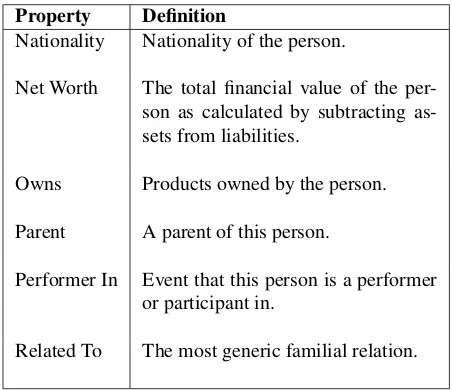
One source of detailed types of personal information is Schema.org, an open source resource that contains schemas for structured data, primarily for use by web developers in order to create web pages that are easily indexable by search engines. The schemas on Schema.org are collec-tions of properties that can be used to described specific concepts. For our work, we were particularly interested in the schema definition of the concept ‘Person’, part of which can be found in Table 1. We used the properties of a Person as defined by Schema.org as the starting point for defining the personal attribute types that are shared in chat-oriented dialogues.
Property Definition
Nationality Nationality of the person.
Net Worth The total financial value of the per-son as calculated by subtracting as-sets from liabilities.
Owns Products owned by the person.
Parent A parent of this person.
Performer In Event that this person is a performer or participant in.
Related To The most generic familial relation.
Table 1: Examples of the properties of a ‘Person’ along with their definitions, as defined by Schema.org
3.
Attributes and Entities
For this work, we were interested in identifying the types of personal information that are shared by a speaker in chat-oriented dialogue. Within this context, the termattribute instanceis used to refer to a single piece of personal infor-mation shared by a speaker, such as that they were born in Phoenix or that they are 45 years old. Anattribute instance
can be completely described in terms of itsattribute type
and itsattribute value, such as (birthplace Phoenix) or (age 45).
In this work, anattribute instanceis applied to a particular individual of anentity type(not necessarily a person). For example, it is possible to say that Phoenix is a large city, where thisattribute instancewould have anattribute type
of ‘size’ and anattribute valueof ‘large’. In this case, the
entity typeof theattribute instanceis ‘Place’, because the individual being described - Phoenix - is a city.
4.
Corpora
4.1.
Story-swapping Corpus
In 2015, Gilani et al. (2016) conducted a study on story-swapping that investigated the impact that different virtual storytellers had on a human participant who engaged in a story-swapping dialogue with the virtual storyteller. Par-ticipants interacted with different versions of a virtual sto-ryteller in a “get to know you” scenario where they an-swered predetermined ice-breaker questions. The partici-pants were given the ice-breaker questions beforehand and initiated each exchange with the virtual storyteller by ask-ing one of the questions. In response, the virtual storyteller produced a relevant story that answered the question, and asked the same question back to the participant, who then gave an answer in response.
Because our work aimed to identify attributes shared in nat-ural human dialogues, only the utterances given by the hu-man participant were included from this dataset and the utterances produced from the virtual storytellers were ig-nored. Although this dataset could be viewed as an inor-ganic source of human conversation due to the scripted na-ture of the topics and the artificial storyteller participant, the ice-breaker questions function as guiding topics to the conversation and the information that a human participant chose to share in response to the topics was produced natu-rally from the human.
4.2.
Switchboard Corpus
The Switchboard: Telephone Speech Corpus for Research and Development was collected between 1990 and 1991 by Texas Instruments, with sponsorship from DARPA. It con-sists of two-sided telephone conversations between human participants, where the participants were connected via a robotic switchboard operator and were unfamiliar with the other person they were speaking to. Upon initiation of a telephone conversation, the operator gave the participants a specific topic to discuss with each other based on their previously indicated topics of interest. Some example top-ics are capital punishment, pets, cars, and recycling. In general, the course of the ensuing conversation focused on the assigned topic as speakers exchanged their opinions and relevant experiences to the topic at hand.
The Switchboard Corpus was originally released by the Linguistics Data Consortium in 1992-1993, but was re-leased again in 1997 with some errors fixed. In total, it contains 2400 conversations between 543 speakers (God-frey et al., 1992). Transcripts of the recorded telephone conversations were also produced, which has resulted in much work on annotating the dialogues with different lin-guistics features, from phonetics to syntax (Calhoun et al., 2010). Of particular importance to this work are the word-level, turn, and utterance boundary transcriptions, where the speakers were labeled as ‘A’ and ‘B’. An extension of the 1997 “Switchboard 1 Release 2” Corpus - called the “Switchboard Dialog Act Corpus” - was used in this work. It contains word-level transcriptions of the dialogues seg-mented into turn-taking utterances, where each utterance is tagged with a dialog act but the dialog act was stripped from the utterance for our purposes (Stolcke et al., 2000).
4.3.
SpeedDate Corpus
In 2005, Jurafsky et al. (2009) used three speed-dating ses-sions run at an elite private American university to collect casual dialogues. These speed-dating sessions were com-posed of graduate students from the university who partic-ipated in 4-minute “get to know you” sessions with each other on a one-to-one basis. Each session occurred in an open setting, and each participant wore an audio recorder during the session so that the audio could be captured. Transcribers at a professional transcription service used the recordings to create a transcript for each date between two graduate students. In total, there were 991 dates that had usable transcript data.
Although the majority of each dialogue followed the typi-cal open-ended structure of sharing personal information in a get-to-know-you setting - as expected of a first date - the content of many of the dialogues was also directly affected by the speed-dating environment, since participants typi-cally began their conversations with a discussion of the na-ture of the speed-dating activity. One common occurrence was that participants would often comment on the tasks that were required of them - such as their difficulty in filling out the surveys about each person with whom they have a date. In addition, participants would often bring up noteworthy elements of the speed-dating environment - for example, that there is a large proportion of law students taking part in the speed-dating activity.
5.
Procedure for the Identification of
Attribute Instances
75 dialogues from each corpus were randomly selected for annotation. Each utterance was appraised for whether there was a derivable attribute instance. If there was an attribute instance, then Schema.org was investigated to find an tribute type that would capture the information in the at-tribute instance. In the case that no corresponding atat-tribute type could be found, a new type was created. This new type was then considered in each subsequent utterance as a possible attribute type - along with the properties from Schema.org - if an attribute instance was found. Once the attribute type of an utterance was identified, then the value of the attribute instance was selected as a substring from the utterance and the entity type was identified by classifying what the attribute was being assigned to. If there was no attribute instance derivable from the utterance, then it was not annotated.
Frequently, there were multiple attribute instances within a single utterance. All possible attribute instances that could be derived from a single utterance were identified and an-notated for that utterance.
Table 2 shows an example of the annotations for a dialogue from the Switchboard Corpus.
6.
Attributes in Chat-Oriented Dialogues
6.1.
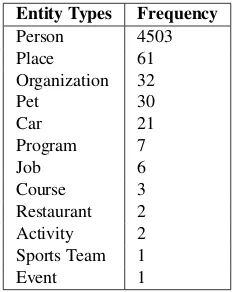
Entity Types
DIALOGUE ATTRIBUTE nally got rid of it cause I never used it.
Table 2: Example of attribute annotations for a portion of a dialogue from the Switchboard Corpus
identified as well as their respective distributions in the di-alogues.
Table 3: Entity types found in dialogue
6.2.
Attribute Types
We found a total of 166 types of attributes that people share in these chat-oriented dialogues. Most attribute types were slot-based, where a specific filler could be found for the attribute based on the information shared in the utterance - such as a person’s name or the university they are cur-rently studying at. However, there were many instances of a binary-valued attribute type, where an utterance would indicate that a particular property was true or false for the given entity under discussion. An example of this occurs in the sentence ‘My daughter agrees with me’ since this utter-ance clearly depicts that the speaker has a daughter. This can be captured through a binary attribute type, which was called ‘children.daughter.t’. All attribute types that end in .t indicate a binary attribute with the value of true, whereas attribute types that end in .f indicate a binary attribute with
the value of false. Both slot-based and binary attribute types were mapped to a single word in the utterance as the at-tribute value.
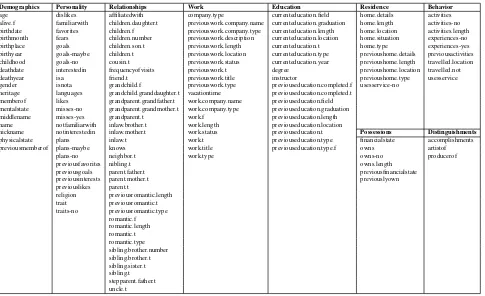
These 166 attribute types are grouped into 12 broad cate-gories. The first 9 categories pertain to the attribute types that were used most frequently in relation to the entity type of ‘Person’ and can be seen in Table 4. The remaining 3 categories include attribute types that were never used in relation to the entity type of ‘Person’ and can be seen in Ta-ble 5. The 12 categories are described in more detail below.
6.2.1. Demographics
The category Demographics includes attributes for basic identifying information - such as age and name - as well as traits that distinguish different populations from one an-other - such as heritage and membership in different organi-zations. This category also contains attributes that indicate well-being.
6.2.2. Personality
Personalityattributes capture the distinctive elements of a person that grant them individuality. It includes a person’s likes, dislikes, fears, goals, plans, and physical traits.
6.2.3. Relationships
Relationships contains attributes that provide information about the different relationships a person has with other people - mother, father, children, neighbor, sibling, and so on. It includes whether the person has these relationships and how long they have known each other. A person’s his-tory of romantic relationships is also captured by the at-tributes in this category.
6.2.4. Work
The attributes in the categoryWorkfocus on the details of a person’s current - and past - employment. It includes char-acteristics like job title, length of employment, location of work, and company.
6.2.5. Education
Similar toWork,Educationencapsulates attributes that fine a person’s educational history. It captures relevant de-tails such as where a person has attended school, what field they have studied, and the degree they pursued there.
6.2.6. Residence
Residencecontains attributes for current and past living ar-rangements, such as the type of dwelling, the location of residency, and the length of a time a person lived there. It also includes attributes for more detailed aspects of the liv-ing arrangements, such as specific qualities of the home.
6.2.7. Possessions
Attributes in thePossessionscategory indicate the material wealth of a person. These attributes capture what objects a person owns and doesn’t own, as well as any information on their financial state.
6.2.8. Behavior
at-Demographics Personality Relationships Work Education Residence Behavior age dislikes affiliatedwith company.type currenteducation.field home.details activities alive.f familiarwith children.daughter.t previouswork.company.name currenteducation.graduation home.length activities-no birthdate favorites children.f previouswork.company.type currenteducation.length home.location activities.length birthmonth fears children.number previouswork.description currenteducation.location home.situation experiences-no birthplace goals children.son.t previouswork.length currenteducation.t home.type experiences-yes birthyear goals-maybe children.t previouswork.location currenteducation.type previoushome.details previousactivities childhood goals-no cousin.t previouswork.status currenteducation.year previoushome.length travelled.location deathdate interestedin frequencyofvisits previouswork.t degree previoushome.location travelled.not deathyear isa friend.t previouswork.title instructor previoushome.type usesservice gender isnota grandchild.f previouswork.type previouseducation.completed.f usesservice-no
heritage languages grandchild.granddaughter.t vacationtime previouseducation.completed.t memberof likes grandparent.grandfather.t work.company.name previouseducation.field mentalstate misses-no grandparent.grandmother.t work.company.type previouseducation.graduation middlename misses-yes grandparent.t work.f previouseducation.length name notfamiliarwith inlaw.brother.t work.length previouseducation.location
nickname notinterestedin inlaw.mother.t work.status previouseducation.t Possessions Distinguishments physicalstate plans inlaw.t work.t previouseducation.type financialstate accomplishments previousmemberof plans-maybe knows work.title previouseducation.type.f owns artistof
plans-no neighbor.t work.type owns-no producerof
previousfavorites nibling.t owns.length
previousgoals parent.father.t previousfinancialstate
previousinterests parent.mother.t previouslyown
previouslikes parent.t
religion previousromantic.length trait previousromantic.t traits-no previousromantic.type
romantic.f romantic.length romantic.t romantic.type sibling.brother.number sibling.brother.t sibling.sister.t sibling.t stepparent.father.t uncle.t
Table 4: Attribute types found in dialogue, attributable to a Person
Pet Vehicle Location
breed model commonactivity numberofdoors containedinplace vehicleengine crime
vehiclemodeldate demographics price largerthan
proximity previousnames servescuisine similarto size type rules clients.type
Table 5: Attribute types found in dialogue, not attributable to a Person
tributes that indicate certain activities or experiences a son does not participate in, or specific locations that a per-son has never travelled to.
6.2.9. Distinguishments
The attributes in the Distinguishmentscategory list a per-son’s accomplishments.
6.2.10. Pet
Petattributes include only those attributes which were used to describe pets (namely, their breed). Other attributes from thePersonalitycategory were also associated with pets in the dialogues.
6.2.11. Vehicle
Vehicleattributes focus on the model and price of a Vehicle entity, as well as other features like the number of doors.
6.2.12. Location
Location attributes are used in the descriptions of places, such as cities and businesses. These cover a variety of char-acteristics, including demographic distributions, proximity to other places, and size.
7.
Attribute and Entity Type Evaluation
We performed a small inter-annotator agreement study on 15 dialogues, which was composed of 5 randomly selected dialogues from each corpus. We calculated inter-annotator agreement on both attribute type and entity type, but not for attribute values. Because the possible attribute values for any attribute type are open-ended paraphrases of a part of the utterance, it is impossible to give annotators a finite list of possible attribute values. For this reason, it is difficult to operationalize the similarity between the attribute values chosen by different annotators. In addition, we believe that the inter-annotator agreement on the attribute types pro-vides a good approximation for the agreement that would be found on the attribute values, since these two concepts are directly related.
is an accurate description of our data. It accomplishes this through a revised chance-agreement measure, which is ex-plained in detail in Gwet (2002). We calculated AC1 for each attribute type by treating them as a binary labels for each utterance, such that an annotator either indicated the particular attribute type was ‘present’ or ‘not present’ in a particular utterance. AC1 is calculated as:
AC1 = p−e(γ)
1−e(γ) (1)
wherepis the base agreement measure between the anno-tators ande(γ)is the revised chance-agreement probability. We only calculated AC1 for those attribute and entity types that were annotated by at least one annotator, which was 94 attribute types (out of 166 total) and 2 entity types (out of 12 total). The final AC1 value is calculated as the aver-age of the AC1 values calculated for each attribute type and entity type and is shown in Table 6.
Annotators were a mix of experts and non-experts. Half of the annotation material came from the authors’ work on identifying the attribute and entity types. The other half came from novice annotations, since they were conducted by an outsider to the work who was given an annotation manual written by the authors. Each annotator was given a finite list of possible attribute types and entity types that an utterance could be classified with.
Annotation Element AC1
Attribute Type 99.76% Entity Type 96.28%
Table 6: Inter-Annotator Agreement Statistics
The inter-annotator agreement is so high because each ut-terance contains at most a few attributes or entities, and an-notators agree on the many attribute and entity types that are not present in each utterance.
Since we are mainly interested in annotator agreement on the presence of the different labels, we corrected for this artifact of the inter-annotator agreement measure by also calculating precision, recall, and F1-score for the attribute and entity type annotations. We calculated these measures for each individual attribute type and entity type. The fi-nal measures shown in Table 7 reflect the average of these individual measures.
Annotation Element Precision Recall F1-Score
Attribute Type 36.4% 34.6% 35.5% Entity Type 59.4% 60.7% 60.0%
Table 7: Precision, Recall, and F1-Score for Annotations
The resulting precision, recall, and F1-score presents a more pessimistic perspective on the inter-annotator agree-ment for attribute and entity types in dialogue utterances, especially for the attribute types. The fine-grained distinc-tion between the different attribute types seems to be a lim-iting factor in the reliability of the attribute type labels. Fre-quently, the annotators agreed that an utterance should be
labeled with a specific type category (such as ‘currented-ucation’ or ‘previouswork’), but they then chose different sub-categories (such as ‘previouswork.type’ versus ‘previ-ouswork.description’). In addition, it can be argued that there is a degree of semantic overlap between many of the attribute types, such as ‘goals’ and ‘interests’, which is also evidenced through the annotations made by each of the an-notators. As such, these attribute types would be better cap-tured through a higher-order type that encapsulates both. With the limitations of the current annotation scheme iden-tified, it is important to note that this work does not purport to have identified the single true taxonomy of personal in-formation present in chat-oriented dialogues. Instead, we aimed to get a sense of the types of information that tend to occur in chat-oriented dialogues and offer reasonably plau-sible categories of topics that can be found.
Attribute Instances Utterances
Corpora Total Range Average Total Range Average Story-swapping 1921 6-61 25.6 4509 21-173 60.1 Switchboard 1495 2-70 19.9 13982 64-444 186.4 SpeedDate 1251 2-46 16.7 8673 66-189 115.6
Table 8: Distribution of the number of attribute instances and utterances between the three corpora
8.
Observations and Analysis of the
Attribute Distributions
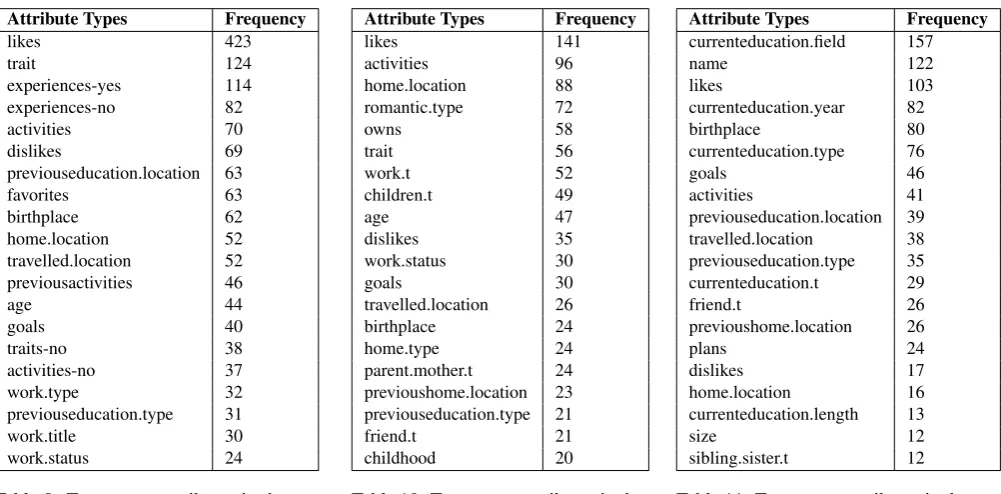
The total number of utterances and attribute instances that occurred over the 75 dialogues of each corpus - as well as their ranges and averages within a single dialogue in each corpus - can be found in Table 8. Although the total number of utterances is much lower in the Story-swapping Corpus than the other two, this can be attributed to the fact that only the half of each dialogue that was spoken by the human par-ticipant was considered. In total - when taking into account the other half of the dialogues - the total number of utter-ances over the 75 dialogues for the Story-swapping Corpus is approximately 9000, which is similar to the total number of utterances of the other two corpora.
Attribute Types Frequency
Table 9: Top twenty attributes in the Story-swapping Corpus
Table 10: Top twenty attributes in the Switchboard Corpus
Table 11: Top twenty attributes in the SpeedDate Corpus
Attribute Types Frequency Top-Twenty
Appearances
Table 12: Twenty most frequent attribute types found over-all in the three corpora, and the number of corpora in which each appeared in the individual top-twenty lists
types, which can most clearly be seen when comparing their respective most-frequent attribute types, although the specific attribute types in these categories varied between the corpora.
Upon closer examination of the distributions for each pus, there were telling differences between the three cor-pora that relate to their variation in domain and dialogue participants. The most apparent discrepancy occurs in the distribution of work-related and education-related attribute
types. It is seen in the Story-swapping Corpus and Switch-board Corpus that both had more frequent work-related at-tribute types than the SpeedDate Corpus, which had more frequent education-related attributes. This makes sense in light of the fact that all of the conversation participants in the SpeedDate Corpus were graduate students, and thus their education - and not their employment - was most salient.
Although the three corpora used in this work differed in the paradigms by which they were collected, it could be argued that all three belong to the same overarching cate-gory of polite casual conversation as defined by Eggins (de Silva Joyce and Slade, 2000). It may be the case that the common attribute types observed in this work would not ex-tend to the confirming subcategory of casual conversation, where the participants are well-acquainted and in frequent contact with one another, or to other types of casual con-versation. Further exploration of the similarities and dif-ferences between the common attribute types of different categories of chat-oriented dialogue remains as an area of future work.
9.
Conclusions and Future Work
We have created two useful resources for chat-oriented di-alogue - first, an enhanced collection of personal attributes that can be used as topics for dialogue interaction and, sec-ond, a corpus of dialogues annotated for attribute types, at-tribute values, and entity types. These resources were cre-ated through examination of three different kinds of chat dialogue corpora. Comparative analysis shows that while there are significant differences in the types and frequen-cies of attributes in the different corpora (which could be used to distinguish different genres of chat), there are also significant similarities that occur in two or all three. We plan to use these resources for several purposes in our future work. First, these annotations can be used as training and testing data for classifiers that recognize when people mention these attributes in their utterances. This capabil-ity will enable dialogue agents to develop a user model of the other conversational participants and to personalize the dialogues to the topics most interesting to them. In addi-tion, the commonly discussed personal attributes indicated by this work can be incorporated into the backstory devel-opment of dialogue agents so that they can engage in more human-like chat.
10.
Acknowledgements
The first author was supported by the National Science Foundation under grant CNS-1560426, “REU Site: Re-search in Interactive Virtual Experiences” (PI: Evan Suma). The effort described here has been partly supported by the U.S. Army. Any opinions, content or information presented does not necessarily reflect the position or the policy of the United States Government, and no official endorsement should be inferred.
11.
Bibliographical References
Allwood, J., Lindstr¨om, N. B., and Lu, J. (2011). Intercul-tural dynamics of fist acquaintance: comparative study of swedish, chinese and swedish-chinese first time encoun-ters. InInternational Conference on Universal Access in Human-Computer Interaction, pages 12–21. Springer. Calhoun, S., Carletta, J., Brenier, J. M., Mayo, N.,
Juraf-sky, D., Steedman, M., and Beaver, D. (2010). The nxt-format switchboard corpus: a rich resource for investi-gating the syntax, semantics, pragmatics and prosody of dialogue. Language Resources and Evaluation, 44:387– 419.
de Silva Joyce, H. and Slade, D. (2000). The nature of ca-sual conversation: Implications for teaching. Teachers’ Voices, 6:viii–xv.
Eggins, S. and Slade, D. (1997). Analysing Casual Con-versation. Continuum.
Gilani, S. N., Sheetz, K., Lucas, G., and Traum, D. (2016). What kind of stories should a virtual human swap? In
The Sixteenth International Conference on Intelligent Virtual Agents, pages 128–140, Los Angeles, CA, USA, September. Springer.
Godfrey, J., Holliman, E., and McDaniel, J. (1992). Switchboard: telephone speech corpus for research and development. In[Proceedings] ICASSP-92: 1992 IEEE International Conference on Acoustics, Speech, and Sig-nal Processing, volume 1, pages 517–520. IEEE. Gwet, K. (2002). Kappa statistic is not satisfactory for
assessing the extent of agreement between raters. Sta-tistical methods for inter-rater reliability assessment, 1(6):1–6.
Hirano, T., Higashinaka, R., and Matsuo, Y. (2016). An-alyzing post-dialogue comments by speakers – how do humans personalize their utterances in dialogue? –. In
Proceedings of the 17th Annual Meeting of the Special Interest Group on Discourse and Dialogue, pages 157– 165, Los Angeles, September. Association for Computa-tional Linguistics.
Jurafsky, D., Ranganath, R., and McFarland, D. (2009). Extracting social meaning: Identifying interactional style in spoken conversation. Proceedings of Human Language Technologies: The 2009 Annual Conference of the North American Chapter of the Association for Com-putational Linguistics, pages 638–646.
Mitsuda, K., Higashinaka, R., and Matsuo, Y. (2017). What information should a dialogue system understand?: Collection and analysis of perceived information in chat-oriented dialogue. InInternational Workshop on Spoken Dialogue Systems Technology (IWSDS).
Slade, D. and Gardner, R., (1993). Teaching Casual Con-versation: The Issue of Simplification. ERIC.
Stolcke, A., Ries, K., Coccaro, N., Shriberg, E., Bates, R., Jurafsky, D., Taylor, P., Martin, R., Ess-Dykema, C. V., and Meteer, M. (2000). Dialogue act modeling for auto-matic tagging and recognition of conversational speech.
Computational Linguistics, 26(3).
12.
Language Resource References
John J. Godfrey and Edward Holliman. (1993).