Deep JSLC: A Multimodal Corpus Collection for Data-driven Generation of
Japanese Sign Language Expressions
Heike Brock, Kazuhiro Nakadai
Honda Research Institute Japan Ltd. Honcho 8-1, Wako-shi, Saitama, Japan [email protected], [email protected]Abstract
The three-dimensional visualization of spoken or written information in Sign Language (SL) is considered a potential tool for better inclusion of deaf or hard of hearing individuals with low literacy skills. However, conventional technologies for such CG-supported data display are not able to depict all relevant features of a natural signing sequence such as facial expression, spatial references or inter-sign movement, leading to poor acceptance amongst speakers of sign language. The deployment of fully data-driven, deep sequence generation models that proved themselves powerful in speech and text applications might overcome this lack of naturalness. Therefore, we collected a corpus of continuous sentence utterances in Japanese Sign Language (JSL) applicable to the learning of deep neural network models. The presented corpus contains multimodal content information of high resolution motion capture data, video data and both visual and gloss-like mark up annotations obtained with the support of fluent JSL signers. Furthermore, all annotations were encoded under three different encoding schemes with respect to directions, intonation and non-manual information. Currently, the corpus is employed to learn first sequence-to-sequence networks where it shows the ability to train relevant language features.
Keywords:sign language, deep learning corpus, assistive language technologies
1.
Introduction
Research has shown that information conveyed using Sign Language (SL) is much more comprehensible and acces-sible than written information display for the majority of native SL speakers (Traxler, 2000). However, human trans-lation services are neither always available on demand, nor applicable in certain settings such as internal company meetings. The automatic display of spoken or written con-tent by signing CG avatars or robot agents could there-fore offer a cheap possibility to make information more accessible to Deaf or Hard of Hearing (DHH) individuals with lower written language literacy (Huenerfauth, 2008). Unfortunately, automated SL generation technologies have not yet reached a level of quality that would foster their full acceptance by DHH users (Kipp et al., 2011b). This is mainly due to the language’s multi-dimensional char-acter: information is not only conveyed using single ges-tures and finger movements, but also Non-Manual Signs (NMSs) such as body language and facial expressions. Fur-thermore, lexical items within a signed conversation can be dynamically changed to express spatial and temporal infor-mation (Huenerfauth and Hanson, 2009). This creates non-linear, multichannel dependencies that (a) complicate the translation of SL as compared to spoken languages and (b) require specific descriptions for motion synthesis. As a re-sult, temporal and spatial relations of generated signing mo-tion sequences might easily appear artificial and unnatural when applied to three-dimensional avatar animations (Ka-corri et al., 2015).
To increase the acceptance of three-dimensional sign an-imations within affected users, effort is made to develop new methodologies that can better represent the temporal, spatial and multimodal aspects of signed content informa-tion (Ebling and Huenerfauth, 2015; Kacorri and Huen-erfauth, 2016). To date, all of these methods rely on the concatenation and interpolation of pre-recorded sample
se-quences and separate lexical items. Systems that can re-produce natural signed utterances by intrinsic learning of their specific lingustic features are not known to be re-ported yet, commonly restricting existing data sources to non-repetitive corpus collections of signs and short phrases of specific content domains. Considering the recent success of deep neural networks in sequence generation tasks such as text-to-speech translations (Oord et al., 2016), one can expect similar architectures to also be meaningful for the synthesis of SL. To learn and evaluate respective network models, it is essential to have access to a suitable training corpus. In this work, we therefore present a fully annotated Japanese Sign Language (JSL) corpus that was specifically designed for the learning of deep sequence generation mod-els for sign animation synthesis. Here, it is particularly im-portant to ensure the accuracy, density and completeness of the recorded signing data up to subtle finger and facial movements and the repetitive occurrence of NMSs with wide intra-feature variability. Therefore, the presented deep JSL Corpus (JSLC) constitutes a collection of natural JSL sentences recorded with a multi camera optical motion cap-ture system and includes various types of NMSs as well as variations in sentence intonations and signing speed. The corpus is designed to offer possibilities for easy data aug-mentation and ready to be applied under various deep net-work models. To bring the quality of automatically gener-ated sign animation display to a next level of realism within the next years, it shall now be used for the development of an appropriate network model.
translation software (Sun et al., 2013), dictionaries (Pro Deaf, 2017) or even commercial devices like the Motion-Savvy tablet app (Motion Motion-Savvy, 2017). However, most of these technologies are not capable of processing con-tinuous and natural sentence utterances, and even less are concerned with the synthesis of signed expressions from a given set of text or speech data. Current SL generation methods are either fully synthesized from form notation such as VRML (Kipp et al., 2011a) or semi-automatically synthesized using a corpus of pre-captured gestures (Gibet et al., 2016; Ebling and Huenerfauth, 2015). Most re-cent neural network models that achieved superior results in speech generation are not known to be reported for applica-tions with SL. One of the main reasons for this leeway is the multi-dimensional character of continuous signing with its inherent use of NMSs and spatial and temporal references that impede the use of machine translation algorithms. An-other reason is the necessity of an extensive, highly detailed and accurate motion data set that is very costly to obtain: respective data is best obtained by using a multi-camera optical motion capture system for body, finger and facial capturing, and requires specialized post-processing proce-dures to exclude marker occlusions and mislabeling. Be-sides, existing SL motion capture data sets are commonly not publicly available. This imposes the need to acquire new data for system development.
Most current sign animation technologies were developed for the processing of comparatively well-researched SLs such as American Sign Language (ASL) (Lu and Huener-fauth, 2011), German Sign Language (DGS) (Ebling and Huenerfauth, 2015) or French Sign Language (LSF) (Gibet et al., 2016). JSL in contrast remains a relatively unex-plored language under both syntactic and semantic aspects. Grammatical structures and lexical items can be undefined or subject to regional and demographic variations. For this reason, the generation of JSL sequences also constitutes a rare research domain. To date, sign animations were cre-ated for the following two fields of application: medical content translation for enhanced doctor-patient communi-cation (Nagashima et al., 2016) and the broadcasting of weather forecasts in the national TV program (Umeda et al., 2016). Both animations are based on semi-automatized synthesis methods that utilize data from a problem-specific corpus of optical motion capture data. These corpora con-tain a variant number of single lexical items and few short complete sentences that were each signed once by one sin-gle speaker. Such sparsity in the vocabulary domain and the absence of NMSs is likely unsuitable for the deep learning of signed sequence connections. Therefore, we built the present deep JSLC in a different way that is not known to be reported similarly by any other research yet.
3.
Corpus Definition
A large amount of data is necessary to train deep sequence generation networks that could cover the full vocabulary spectrum of JSL. However as compared to speech or text data, the acquisition of detailed, accurate and complete SL expressions is a very expensive and time-consuming task. To evaluate the potential benefit of deep sequence gener-ation techniques for natural sign display, it was
consid-ered sufficient to first train networks on a smaller subset of JSL vocabulary that could be extended for better gener-alization later. Therefore, we defined the proposed deep JSLC as a collection of sentence expressions and multi-word phrases within a dense vocabulary domain. Apart from the choice of repetitive vocabulary and content, this was achieved by the utilization of compound words built from lexical items and space and size classifiers (e.g. hos-pital signed as MEDICAL/ BUILDING and doctor signed as MEDICAL/ MAN, or to swim signed as SWIM and pool signed as SWIM/ PLACE).
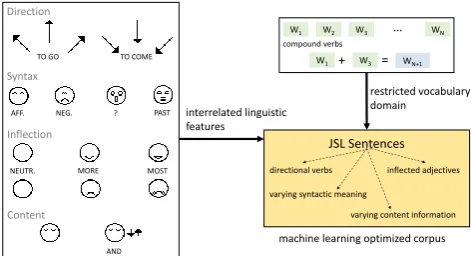
Furthermore, the corpus should incorporate a combination of the most important and variant linguistic features of JSL that can hardly be reproduced by conventional generation methods in a satisfying way (Figure 1):
• Direction: Directional modification of lexical items conveys spatial and grammatical content information, such as the passive voice of words (e.g. BEING SPO-KEN AT versus TO SPEAK) or the center of actions (e.g. TO GO and TO COME, TO SEE, TO BEG)
• Syntax:Intonation conveyed by syntactic NMSs (e.g. a raised eyebrow or head shaking) provides informa-tion on the sentence structure such as negainforma-tion, past tense or question
• Adjective inflection: Positive, comparative and su-perlative forms of adjectives are expressed using a varying amount of facial NMSs (e.g. pressing eyes together, open mouth)
• Content separation: Lexical items are separated by a subtle nod of the head (e.g. my mother signed as ME/ MOTHER versus me and my mother signed as ME (+NOD)/ MOTHER)
Figure 1: Signed expressions are difficult to convey in a nat-ural way using virtual avatars. The fundamental structure of the corpus was designed specifically to enable a more reliable and accurate machine learning of contextual inter-relation within JSL sentence expressions.
conversation samples of5-10lexical items each were cho-sen as fundamental corpus cho-sentence patterns from a set of intermediate-level SL practice sentences. These 69 sen-tence patterns were then modified to define 4to6pattern variations by a random combination of dense-domain com-pound verbs and the previous linguistic features. The fol-lowing sentences A, B, C and D for example constitute vari-ations of one sentence pattern, whereas PT1 denotes a ref-erence to oneself, PT2 denotes a pointing to the opponent person (respectively conversation partner) and PT3 denotes a pointing to a third person, object or place:
A PT3/ MOVIE/ BUILDING/ PT3/ INTERESTING/ MOVIE/ WATCH/ PAST (translating as ’I watched an interesting movie in this cinema.’)
B MOVIE/ BUILDING/ PT3/ VERY INTERESTING/ MOVIE/ WATCH/ PAST/ PT2? (translating as ’You watched a very interesting movie in the cinema?’)
C PT3/ MOVIE/ BUILDING/ PT3/ PT1/ SATO/ MAN/ MOVIE/ WATCH/ NO (translating as ’I did not watch an interesting movie in this cinema with Mr. Sato.’)
D MOVIE/ BUILDING/ PT3/ PT1/ SATO/ WOMAN/ PRETTY INTERESTING/ MOVIE/ WATCH/ PAST (translating as ’I watched a pretty interesting movie in the cinema with Ms. Sato.’)
Utilizing this sentence pattern variation strategy, a collec-tion of430JSL sentences were defined to build the basic framework for corpus collection. These sentences consti-tute natural JSL expressions as expressed by native sign-ers and therefore contain a very unbalanced word distri-bution: especially lexical items that support the semantic understanding within a signed sentence such as PT3 (pro-viding contextual references to objects and persons) occur frequently within a JSL sentence. To reduce their impact on the network learning, we defined an additional set of260 short training phrases. These phrases were built from the basic sentences and constituted a semantically meaningful succession of3to6less frequent words. Phrase variations taken from the sample sentences A, B, C and D were for ex-ample INTERESTING/ MOVIE/ WATCH/ PAST, MOVIE/ WATCH/ NO and SATO/ WOMAN/ PRETTY INTEREST-ING/ MOVIE/ WATCH.
4.
Corpus Acquisition
All basic sentences and phrases were signed between one to three times in varying speed and sentence intonation by one Child Of Deaf Adults (CODA), leading to931corpus sentences and502corpus phrases with varying spatial and semantic content information. The data acquisition was fur-thermore assisted by a deaf native JSL speaker who super-vised the grammatical correctness and naturalness of the signed corpus content.
During signing, the displacement of123markers attached to the signer’s body was captured using an optical Vi-con camera system of48cameras with a sampling rate of 120Hz. Additional data for extensive corpus annotation or the learning of sentence recognition networks was ac-quired using a Microsoft Kinect (sampling rate30Hz) and
a consumer video camera (sampling rate60Hz). All cap-ture modalities were synchronized via an external trigger and recorded a total of 10.384 signed utterances within a vocabulary of197lexical items.
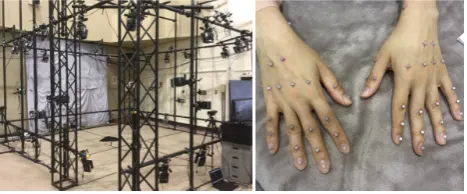
To ensure sufficiently dense data for subsequent natural signing avatar generation,92out of the123optical motion capture markers were utilized for the acquisition of detailed finger and facial movements such as the blinking of eyes or the raise of eyebrows (Figure 2). These markers were of 3mm size, with24markers placed on each hand up to the wrist and44makers attached to the face of the signer. All Vicon recordings were post-processed to ensure correct marker labeling and to eliminate missing frames caused by marker occlusions during data recording.
Figure 2: A set of48optical cameras was used to record the signed motion sentences. Marker were densely placed on body, finger and face of the sign speaker to obtain a highly-dimensional collection of sign motion data.
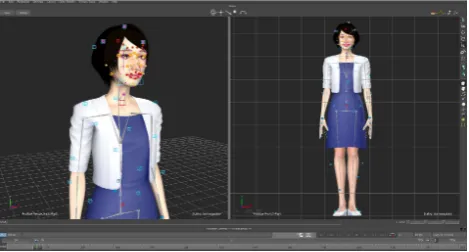
The cleaned data was made available in C3D and BVH for-mat, which are two common data formats for the storage and processing of optical motion capture data. Whereas C3D contains the raw three-dimensional point clouds of all marker positions as obtained during the motion capture process, BVH contains kinematic information of a virtual character’s body joints. To obtain such higher-level data, the raw C3D data was rigged onto the skeleton of a virtual avatar (Figure 3) and the three-dimensional joint position and rotation of107relevant skeleton joints (including fin-ger joints and controllers for facial expression) saved as the file’s main motion data streams. For the given problem, the BVH format should be considered particularly useful since newly generated motion streams can be directly transferred onto the corresponding virtual avatar for visual display and evaluation.
5.
Corpus Annotation
Figure 3: 3D model used to rig the raw motion capture data onto an avatar skeleton to provide joint position and rota-tion data in BVH format.
A major advantage of deep sequence generation models such as Recurrent Neural Networks (RNNs) is that they do not require the training data to be pre-segmented (Graves, 2013). However for eventual use in baseline networks or automatic sentence segmentation models, additional time annotations for separation of all lexical items in the corpus were determined. These were based on changes in hand and finger shapes as well as motion directions using the synchronized video data.
5.1.
Encoding
Three different types of encoding were chosen for subse-quent corpus deployment in potential neural network mod-els. Here, the idea was to provide different types of en-coding to evaluate whether the presence of specific linguis-tic feature information could reproduce non-manual sign-ing aspects in a better way.
The first encoding constitutes a simple one-hot encoded representation of all occurring lexical items and does not contain any additional information on the linguistic fea-tures incorporated within the deep JSLC. The second en-coding constitutes the simple one-hot encoded representa-tion plus addirepresenta-tional informarepresenta-tion on all linguistic features as additional elements of the one-hot encoded vectors for each respective sign. In concrete, these additional vector elements represent information on:
1. Use of left or right hand to convey primary sentence meaning
2. Start location of the primary hand within a position segment defined in relation to the upper body
3. End location of the primary hand within a position segment defined in relation to the upper body
4. Signing in active or passive form (if applicable, else none)
5. Stage of adjective inflection (if applicable, else non)
6. Inclusion of interrogation (if applicable, else non)
7. Inclusion of negation (if applicable, else non)
The third encoding was based on the visual markup annota-tion, following the representation of Sign Writing Markup Language (SWML) (Costa et al., 2001). Here, every lexi-cal item was encoded as the combination of its Sign Writ-ing components in SWML. For example the lexical item MOVIE is built by one head icon with the SWML index 04-01-001-01-01-01, two handshape icons (left and right hand) with the SWML indices 001-01-01-03 and 01-05-001-01-01-11 and two directional icons (for left and right hand) with the SWML indices 03-006-01-01-13 and 02-03-006-01-02-01.
6.
Corpus Deployment
We evaluated the corpus usability for the learning of JSL sentence structure with a straightforward modification of the sequence to sequence model (Seq2Seq) for English-French translation (Sutskever et al., 2014). However, the determination of generated sequence quality is a difficult task that is commonly performed by rigging the generated sequences on a virtual character, and by subsequently as-sessing their naturalness and understandability in user stud-ies. For this reason, we used the corpus in a reversed recog-nition scenario here: the acquired motion data streams were first encoded by a RNN cell and then passed to a decoder RNN cell providing an output expectation of the expressed sentence. Since the Seq2Seq model is bidirectional, evalu-ation of corpus efficiency can be expected to also hold valid for generation scenarios.
PT3/
MOVIE/
BUILDING/
PT3/ INTERESTING/ MOVIE/
WATCH/ PAST
Figure 4: Visualization of previously introduced sentence variation A in Japanese Sign Writing and its corresponding gloss annotation.
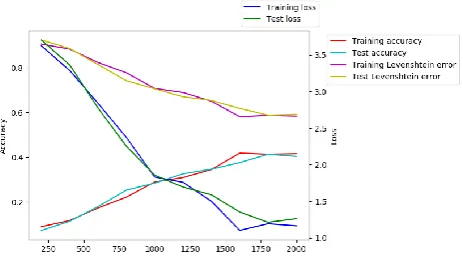
Figure 5: Evolution of training and testing accuracy and loss for sentence recognition as obtained with a standard se-quence to sese-quence model and1hidden layer of256LSTM cells for a smaller subset of the full corpus sentences only. Over2000 epochs, a recognition network of≈ 20% test accuracy was learned. The network is strongly overfitting.
the main training data should therefore be considered as an useful extension of the full sentence collection.
7.
Discussion
Previous results suggests that the presented corpus is gen-erally capable to train a Seq2Seq network that understands common multi-modal interrelation within JSL utterances. Test accuracies of≈40%do not appear sufficient for ap-plication in real-life scenarios yet, but reach the best ob-tained accuracies of similarly continuous and weakly super-vised sentence recognition scenarios (Koller et al., 2016). To date, no specific modifications of the model parameters were performed, and we expect to achieve better results of improved accuracy and smaller loss by adding a suitable data embedding and an attention model. Moreover, it was shown that a higher number of training data is beneficial for network learning. Better recognition and generation net-works should therefore be achieved by further augmenting the corpus size and balancing out the general word distri-bution. Thanks to the corpus design with its repetitive oc-currence of identical sentences and phrases, respective data can be synthesized relatively easily from the existing data in the following, using sequence alignment methods such as squeezing, stretching or undersampling.
All in all, we believe that the specific characteristics of its corpus design and content make the present deep JSLC a very valuable collection of JSL motion data. It shall now
Figure 6: Evolution of training and testing accuracy and loss for sentence recognition as obtained with a standard sequence to sequence model and 1 hidden layer of 256 LSTM cells using a larger number of corpus data for net-work training. Over2000epochs, a recognition network of ≈40%test accuracy was learned that generalizes better to unknown data.
be used to define suitable network parameters and varia-tions such as attention models, and to subsequently learn a wide variety of sequence generation networks. In a last step, the usability and eventual benefit of the trained gen-eration networks shall be evaluated with respect to realism and naturalism of the resulting animations.
8.
Conclusion
shall be enhanced and modified to provide intelligent net-works that can help to generate naturally signing avatars in the future.
9.
References
Costa, A. R., Dimuro, G. P., et al. (2001). Supporting deaf sign languages in written form on the web. In10th World Wide Web Conference, Hong Kong. Home Page of Web and Society Track, http://www10.org/ cdrom/posters/frame.html.
Ebling, S. and Huenerfauth, M. (2015). Bridging the gap between sign language machine translation and sign lan-guage animation using sequence classification. In Pro-ceedings of the 6th Workshop on Speech and Language Processing for Assistive Technologies (SLPAT).
Gibet, S., Lefebvre-Albaret, F., Hamon, L., Brun, R., and Turki, A. (2016). Interactive editing in french sign lan-guage dedicated to virtual signers: requirements and challenges.Universal Access in the Information Society, 15(4):525–539.
Graves, A. (2013). Generating sequences with recurrent neural networks. arXiv preprint arXiv:1308.0850. Huenerfauth, M. and Hanson, V. (2009). Sign language in
the interface: access for deaf signers. Universal Access Handbook. NJ: Erlbaum, 38.
Huenerfauth, M. (2008). Generating american sign lan-guage animation: overcoming misconceptions and tech-nical challenges. Universal Access in the Information Society, 6(4):419–434.
Kacorri, H. and Huenerfauth, M. (2016). Selecting exem-plar recordings of american sign language non-manual expressions for animation synthesis based on manual sign timing. InProc. SLPAT 2016 Workshop on Speech and Language Processing for Assistive Technologies, pages 14–19.
Kacorri, H., Huenerfauth, M., Ebling, S., Patel, K., and Willard, M. (2015). Demographic and experiential fac-tors influencing acceptance of sign language animation by deaf users. InProceedings of the 17th International ACM SIGACCESS Conference on Computers and Acces-sibility, ASSETS ’15, pages 147–154, New York, NY, USA. ACM.
Kipp, M., Heloir, A., and Nguyen, Q. (2011a). Sign lan-guage avatars: Animation and comprehensibility. In In-telligent Virtual Agents, pages 113–126. Springer. Kipp, M., Nguyen, Q., Heloir, A., and Matthes, S. (2011b).
Assessing the deaf user perspective on sign language avatars. In The Proceedings of the 13th International ACM SIGACCESS Conference on Computers and Acces-sibility, ASSETS ’11, pages 107–114, New York, NY, USA. ACM.
Koller, O., Ney, H., and Bowden, R. (2016). Deep hand: How to train a cnn on 1 million hand images when your data is continuous and weakly labelled. InProceedings of the IEEE Conference on Computer Vision and Pattern Recognition, pages 3793–3802.
Lu, P. and Huenerfauth, M. (2011). Data-driven synthesis of spatially inflected verbs for american sign language animation.ACM Transactions on Accessible Computing (TACCESS), 4(1):4.
Matsumoto, T., Kato, M., and Ikeda, T. (2009). Jspad: A sign language writing tool using signwriting. In Pro-ceedings of the 3rd International Universal Communica-tion Symposium, IUCS ’09, pages 363–367, New York, NY, USA. ACM.
Motion Savvy. (2017). UNI sign language trans-lation tablet. http://www.motionsavvy.com/ index.html. Accessed: 2017-09-21.
Nagashima, Y., Watanabe, K., Terauchi, M., Kato, N., Uchida, T., Umeda, S., Miyazaki, T., Azuma, M., and Hiruma, N. (2016). A support tool for analyzing the 3d motions of sign language and the construction of a morpheme dictionary. In International Conference on Human-Computer Interaction, pages 124–129. Springer. Oord, A. v. d., Dieleman, S., Zen, H., Simonyan, K., Vinyals, O., Graves, A., Kalchbrenner, N., Senior, A., and Kavukcuoglu, K. (2016). Wavenet: A generative model for raw audio. arXiv preprint arXiv:1609.03499. Pro Deaf. (2017). Libras sign language translator. http:
//prodeaf.net/en-us. Accessed: 2017-09-21. Sun, C., Zhang, T., Bao, B.-K., Xu, C., and Mei, T. (2013).
Discriminative exemplar coding for sign language recog-nition with kinect. IEEE Transactions on Cybernetics, 43(5):1418–1428.
Sutskever, I., Vinyals, O., and Le, Q. V. (2014). Sequence to sequence learning with neural networks. InAdvances in neural information processing systems, pages 3104– 3112.
Traxler, C. B. (2000). The stanford achievement test: Na-tional norming and performance standards for deaf and hard-of-hearing students. Journal of deaf studies and deaf education, 5(4):337–348.
Umeda, S., Uchida, T., Azuma, M., Miyazaki, T., Kato, N., and Hiruma, N. (2016). Automatic production system of sign language cg animation for meteorological informa-tion.