A constraint driven metagrammar
Joseph Le Roux LORIA Institut National Polytechnique de Lorraine 615, Rue du Jardin Botanique
54 600 Villers-L`es-Nancy France
Benoˆıt Crabb´e HCRC / ICCS University of Edinburgh
2 Buccleuch Place EH8 9LW, Edinburgh, Scotland
Yannick Parmentier INRIA / LORIA Universit´e Henri Poincar´e 615, Rue du Jardin Botanique
54 600 Villers-L`es-Nancy France
Abstract
We present an operational framework al-lowing to express a large scale Tree Ad-joining Grammar (TAG) by using higher
level operational constraints on tree de-scriptions. These constraints first meant to guarantee the well formedness of the grammatical units may also be viewed as a way to put model theoretic syntax at work through an efficient offline grammat-ical compilation process. Our strategy pre-serves TAG formal properties, hence en-sures a reasonable processing efficiency.
1 Introduction
This paper is concerned with the semi-automatic grammar development of real-scale grammars. For natural language syntax, lexicalised TAGs are made of thousands of trees, carrying an extreme structural redundancy. Their development and their maintenance is known to be cumbersome as the size of the grammar raises significantly.
To counter the lack of generalisations inher-ent to strong lexicalisation, various proposals for semi-automatic grammar development have been carried out: lexical rules or meta-rules (Becker, 2000) and metagrammars: (Candito, 1999; Gaiffe et al., 2002; Xia, 2001). The aim of these frame-works is twofold: expressing general facts about the grammar of a language and factorising the in-formation to avoid redundancy.
The metagrammar path adopts a different per-spective from the lexical rule based grammar de-velopment: instead of describing how a derived tree is different from a canonical one, grammati-cal description mainly consists of combining frag-mentary tree descriptions or building blocks.
The paper is structured as follows. We start in section 2 by providing motivations and back-ground information on the framework we are us-ing. Section 3 shows that the metagrammar frame-work may be viewed as an offline system allowing to express high level well-formedness constraints on elementary grammatical structures while pre-serving TAG computational and formal
proper-ties. Section 4 shows how to implement effi-ciently this constraint-based approach with logic programming techniques and finally section 5 pro-vides an idea of the performance of the imple-mented system.
2 eXtensible MetaGrammar (XMG)
By opposition to other metagrammatical frame-works,XMG(Duchier et al., 2004) uses an expres-sive though simple language, enabling a mono-tonic description of a real scale grammar. Mono-tonicity is important because it means that the or-der of application of the different operations does not matter. This is the major drawback of lexical-rule systems. Moreover, (Crabb´e, 2005b) shows that it is sufficiently expressive to implement con-veniently a coreTAGfor French.
XMGallows the grammar writer to manipulate tree descriptions through a control language. The intuition behind is that a metagrammatical lan-guage needs to provide means to describe syn-tactic information along two methodological axis (Crabb´e, 2005b): structure sharing and
alterna-tives. Structure sharing is the axis dedicated to
express factorisation in the grammar, whereas al-ternatives allow to express regular alternation re-lationships such as alternatives between the rep-resentation of a canonical nominal subject and its interrogative representation, or between an active
and a passive verb form .
Building on this intuition theXMGlanguage al-lows the user to name partial tree descriptions within classes. The name of the class can be ma-nipulated afterwards. For instance the following tree descriptions on the right of the arrow are as-sociated with the names stated on the left of the arrow2:
(1) a. CanonicalSubject →
S
N↓ V
b. RelativisedSubject→
N
N* S
N↓ V
c. VerbalForm→
S
V
Naming is the main device that allows the gram-mar writer to express and to take advantage of the structure sharing axis mentioned above. Indeed class names can be reused in other descriptions. Thus names can also be used to describe alterna-tives. To express, in our simplified example, that a
Subject is an abstract way to name a Relativised-Subject or a CanonicalRelativised-Subject, we use a choice
op-erator (∨) as illustrated below:
(2) Subject→CanonicalSubject
∨RelativisedSubject
Disjunction (non-deterministic choice) is the de-vice provided by the language to express the methodological axis of alternatives.
Finally, names can be given to class combina-tions. To express the composition of two tree de-scriptions in the language, we use the∧operator.
1
The passive is a semi-regular alternation, many transi-tive verbs do not passivise. Our system presupposes a classi-cal architecture for the computational representation of Tree Adjoining Grammars such as XTAG, where means to ex-press such exceptions during the anchoring process are well-known. In what follows, we therefore consider only tree tem-plates (or tree schematas) as our working units. Finally the trees depicted in this paper take their inspiration from the grammar described by (Abeill´e, 2002).
2
To represent the tree descriptions mentioned in this pa-per, we use a graphical notation. Immediate dominance is de-picted with a straight line and precedence follows the graphi-cal order. Note that nodes are decorated with their labels only, ignoring the names of the variables denoting them. Note also that we use only the reflexive transitive closure of precedence between sibling nodes and it is explicitly stated with the sym-bol≺∗.
Thus we can say that an IntransitiveVerb is made by the composition of a Subject and a VerbalForm as follows:
(3) IntransitiveVerb→Subject∧VerbalForm
Given these 3 primitives, the control language is naturally interpreted as a context free grammar whose terminals are tree descriptions and where our composition plays the role of concatenation. This abstract grammar or metagrammar is further restricted to be non recursive in order to ensure that the generated TAGis finite.
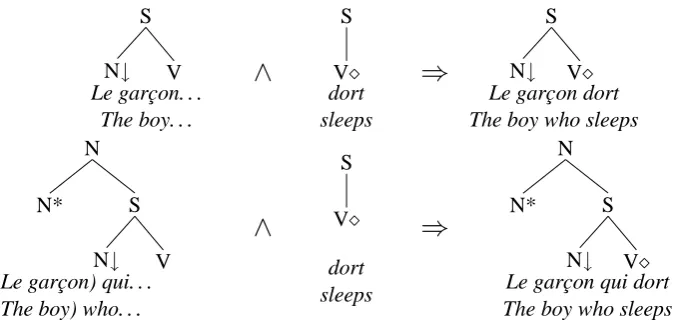
Provided the axiom IntransitiveVerb, an inter-preter for this language generates non determinis-tically all the sentences of the grammar3 underly-ing a grammatical description. Thus in our current example the two sentences generated are those de-picted on the left hand side of the arrows in Figure 1. On the right hand side of the arrow is depicted the result of the composition of the tree descrip-tions.
It remains to make clear what is actually this composition. The grammatical classes may con-tain information on tree descriptions and/or ex-press composition of descriptions stated in other classes. Tree descriptions take their inspiration from the logic described in (Rogers and Vijay-Shanker, 1994). Its syntax is the following:
Description ::= x→y|x→∗y |
x≺y |x≺∗ y|
x[f:E]
where x, yare node variables, → the dominance relation,≺the precedence relation,∗denoting the reflexive transitive closure of a relation. The last line associates x with a featuref whose value is the result of evaluating expressionE.
Tree descriptions are interpreted as finite linear ordered trees being the minimal models of the de-scription.
Using tree descriptions, the above mentioned operation of tree “composition” breaks down to a conjunction of formulas where variables of each conjunct are in first approximation renamed to avoid name collisions. Renaming is a crucial dif-ference with previous approaches to metagrammar (Candito, 1999; Xia, 2001) where the user had to manage explicitly a “global namespace”. Here a specific attention is given to namespace manage-ment, because this was a bottleneck for real scale
S
N↓ V
Le garc¸on. . . The boy. . .
∧
S
V dort sleeps
⇒
S
N↓ V Le garc¸on dort The boy who sleeps
N
N* S
N↓ V
(Le garc¸on) qui. . . (The boy) who. . .
∧
S
V
dort sleeps
⇒
N
N* S
N↓ V Le garc¸on qui dort The boy who sleeps
Figure 1: Interpretation of a grammatical description
grammar design. More precisely each class has its own namespace of identifiers and namespace merging can be triggered when a class combina-tion occurs. This merging relies on a fine-grained import/export mechanism.
In addition to conjunction and disjunction,XMG is augmented with syntactic sugar to offer some of the features other metagrammatical formalisms propose. For instance, inheritance of classes is not built-in in the core language but is realised through conjunction and namespace import. Of course, this restricts users to monotonic inheritance (spe-cialisation) but it seems to be sufficient for most linguists.
3 Constraining admissible structures
XMGhas been tested against the development of a large scale French Grammar (Crabb´e, 2005a). To ease practical grammatical development we have added several augmentations to the common tree description language presented so far in order to further restrict the class of admissible structures generated by the metagrammar.
Further constraining the structures generated by a grammar is a common practice in computational linguistics. For instance a Lexical Functional Grammar (Bresnan and Kaplan, 1982) further re-stricts the structures generated by the grammar by means of a functional uniqueness and a functional completeness principles. These constraints further restricts the class of admissible structures gener-ated by an LFG grammar to verify valency condi-tions.
For TAG and in a theoretical context, (Frank,
2002) states a set of such well formedness prin-ciples that contribute to formulate a TAG theory within a minimalist framework. In what remains
we describe operational constraints of this kind that further restrict the admissibility of the struc-ture generated by the metagrammar. By contrast with the principles stated by (Frank, 2002), we do not make any theoretical claim, instead we are stating operational constraints that have been found useful in practical grammar development.
However as already noted by (Frank, 2002) and by opposition to an LFG framework where con-straints apply to the syntactic structure of a sen-tence as a whole, we formulate here constraints on the well-formedness of TAG elementary trees. In other words these constraints apply to units that define themselves their own global domain of lo-cality. In this case, it means that we can safely ignore locality issues while formulating our con-straints. This is theoretically weaker than formu-lating constraints on the whole sentential structure but this framework allows us to generate common
TAG units, preserving the formal and computa-tional properties ofTAG.
We formulate this constraint driven framework by specifying conditions on model admissibility. Methodologically the constraints used in the de-velopment of the French TAG can be classified in four categories: formal constraints, operational constraints, language dependent constraints and theoretical principles.
First the formal constraints are those constrain-ing the trees generated by the model builder to be regular TAG trees. These constraints require
of formal constraints may change the target for-malism. Indeed XMG provides a different set of formal constraints (not detailed here) that allow to generate elementary units for another formalism, namely Interaction Grammars.
The second kind of constraint is a single
op-erational constraint dubbed the colouration
con-straint. We found it convenient in the course of grammar development. It consists of associ-ating colour-based polarities to the nodes to en-sure a proper combination of the fragmentary tree descriptions stated within classes. Since in our framework descriptions stated in two different classes are renamed before being conjoined, given a formula being the conjunction of the two follow-ing tree descriptions :
(4)
X
W Z
X
Z Y
both the following trees are valid models of that formula:
(5) (a)
X
W Z Y (b)
X
W Z Z Y
In the context of grammar development, however, only (a) is regarded as a desired model. To rule out (b) (Candito, 1999; Xia, 2001) use a naming con-vention that can be viewed as follows4: they assign a name to every node of the tree description. Both further constrain model admissibility by enforcing the identity of the interpretation of two variables associated to the same name. Thus the description stated in their systems can be exemplified as fol-lows:
(6)
Xa
Wb Zc
Xa
Zc Yd
Though solving the initial formal problem, this de-sign choice creates two additional complications: (1) it constrains the grammar writer to manually manage a global naming, entailing obvious prob-lems as the size of the grammatical description grows and (2) it prevents the user to reuse sev-eral times the same class in a composition. This case is a real issue in the context of grammati-cal development since a grammar writer willing to describe a ditransitive context with two prepo-sitional phrases cannot reuse two times a fragment
4They actually use a different formal representation that does not affect the present discussion.
will identify them.
To solve these problems we use a colouration constraint. This constraint associates unary prop-erties, colours, to every node of the descriptions. A colour is taken among the set red(•R), black(•B),
white (◦W). A valid model is a model in which
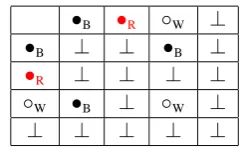
ev-ery node is coloured either in red or black. Two variables in the description interpreted by the same node have their colours merged following the table given in Figure 2.
•B •R ◦W ⊥
•B ⊥ ⊥ •B ⊥
•R ⊥ ⊥ ⊥ ⊥
◦W •B ⊥ ◦W ⊥
⊥ ⊥ ⊥ ⊥ ⊥
Figure 2: Colour identification rules.
The table indicates the resulting colour after a merge. The ⊥ symbol indicates that this two colours cannot be merged and hence two nodes la-belled with these colours cannot be merged. Note that the table is designed to ensure that merging is not a procedural operation.
The idea behind colouration is that of saturat-ing the tree description. The colour white repre-sents the non saturation or the need of a node to be combined with a resource, represented by the colour black. Black nodes need not necessarily be combined with other nodes. Red is the colour used to label nodes that cannot be merged with any other node. A sample tree description with coloured node is as follows:
(7)
X•B
W•R Z•B
X◦W
Z◦W Y•R
Colours contribute to rule out the (b) case and re-move the grammar writer the burden of managing manually a “global namespace”.
The third category of constraints are language
dependent constraints. In the case of French, such
constraints are clitic ordering, islands constraints, etc. We illustrate these constraints with clitic or-dering in French. In French clitics are non tonic particles with two specific properties already iden-tified by (Perlmutter, 1970): first they appear in front of the verb in a fixed order according to their rank (8a-8b) and second two different clitics in front of the verb cannot have the same rank (8c). For instance the clitics le, la have the rank 3 and
S
N↓ ≺+ V’ ∧
V’
Cl↓3
V
≺+ ∧
V’
Cl↓4
V
≺+ ∧ S
V’
V ⇒
S
N↓ V’
Cl↓3 Cl↓4 V
S
N↓ V’
Cl↓4 Cl↓3 V
Figure 3: Clitic ordering
(8) a. Jean le3lui4donne
John gives it to him
b. *Jean lui4le3donne
*John gives to him it
c. *Jean le3 la3 donne
*John gives it it
In the French grammar of (Crabb´e, 2005a) trees with clitics are generated with the fragments illus-trated on the left of the arrow in Figure 35. As illustrated on the right of the arrow, the composi-tion may generate ill-formed trees. To rule them out we formulate a clitic ordering constraint. Each variable labelled with a clitic category is also la-belled with a property, an integer representing its rank. The constraint stipulates that sibling nodes labelled with a rank have to be linearly ordered ac-cording to the order defined over integers.
Overall language dependent constraints handle cases where the information independently spec-ified in different fragments may interact. These interactions are a counterpart in a metagrammar to the interactions between independently described lexical rules in a lexical rule based system. As-suming independent lexical rules moving canoni-cal arguments (NP or PP) to their clitic position, lexical rules fall short for capturing the relative or-dering among clitics6.
A fourth category of constraints, not imple-mented in our system so far are obviously the
lan-guage independent principles defining the theory
underlying the grammar. Such constraints could involve for instance a Principle of Predicate Argu-ment Coocurrency (PPAC) or even the set of min-imalist principles described by (Frank, 2002).
4 Efficient implementation
We describe now the implementation of our meta-grammatical framework. In particular, we will
fo-5Colours are omitted.
6This observation was already made by (Perlmutter, 1970) in a generative grammar framework where clitics where as-sumed to be moved by transformations.
cus on the implementation of the constraints dis-cussed above withinXMG.
As mentioned above, a metagrammar corre-sponds to a reduced description of the grammar. In our case, this description consists of tree frag-ments combined either conjunctively or disjunc-tively. These combinations are expressed using a language close to the Definite Clause Grammar formalism (Pereira and Warren, 1980), except that partial tree descriptions are used as terminal sym-bols. In this context, a metagrammar can be re-duced to a logic program whose execution will lead to the computation of the trees of the gram-mar.
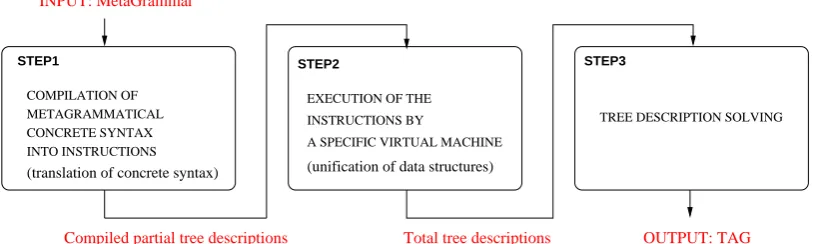
To perform this execution, a compiler for our metagrammatical language has been implemented. This compilation is a 3-step process as shown in Figure 4.
First, the metagrammar is compiled into in-structions for a specific virtual machine inspired by the Warren’s Abstract Machine (Ait-Kaci, 1991). These instructions correspond to the un-folding of the relations7 contained in the tree de-scriptions of the metagrammar.
Then, the virtual machine performs unifications of structures meant to refer to corresponding in-formation within fragments (e.g. two nodes, two feature structures ...). Note that theXMG’s virtual machine uses the structure sharing technique for memory management, i.e. data are represented by a pair pattern – environment in which to interpret it. The consequences are that (a) we save mem-ory when compiling the metagrammar, and (b) we have to perform pointer dereferencing during uni-fication. Even if the latter is time-consuming, it remains more efficient than structure copying as we have to possibly deal with a certain amount of tree descriptions.
Eventually, as a result of this instruction pro-cessing by the virtual machine, we obtain
STEP1
(translation of concrete syntax)
INTO INSTRUCTIONS CONCRETE SYNTAX METAGRAMMATICAL COMPILATION OF
TREE DESCRIPTION SOLVING
STEP3
(unification of data structures) STEP2
A SPECIFIC VIRTUAL MACHINE INSTRUCTIONS BY
EXECUTION OF THE
Total tree descriptions OUTPUT: TAG Compiled partial tree descriptions
Figure 4: Metagrammar compilation.
tially total tree descriptions, that have to be solved in order to produce the expectedTAG.
Now, we will introduce XMG’s tree description solver and show that it is naturally designed to pro-cess efficiently the higher level constraints men-tioned above. In particular, we will see that the description solver has been designed to be easily extended with additional parametric admissibility constraints.
4.1 Tree descriptions solving
To find the minimal models corresponding to the total tree descriptions obtained by accumulating fragmentary tree descriptions, we use a tree de-scription solver. This solver has been developed in the Constraint Programming paradigm using the constraint satisfaction approach of (Duchier and Niehren, 2000). The idea is to translate relations between node variables into constraints over sets of integers.
Basically, we refer to a node of the input de-scription in terms of the nodes being equals, above, below, or on its side (see Figure 5). More precisely, we associate each node of the descrip-tion with an integer, then our reference to a node corresponds to a tuple containing sets of nodes (i.e. sets of integers).
As a first approximation, let us imagine that we refer to a nodexin a model by means of a 5-tuple
Nxi =(Eq,Up,Down,Left,Right)whereiis an in-teger associated with x and Eq (respectively Up,
Down, Left, Right) denotes the set of nodes8in the description which are equal, (respectively above, below, left, and right) ofx.
Then we can convert the relations between nodes of our description language into constraints on sets of integer.
8I.e. integers.
Eq
Up
Down Left
Right
Figure 5: Node representation.
For instance, if we consider 2 nodesxandyof the description. Assuming we associatexwith the integeriand ywithj, we can translate the domi-nance relationx→ ythe following way9:
Nxi→N j y≡
[Ni
x.EqU p ⊆N j
y.U p∧Nx.Downi ⊇N j
y.EqDown
∧Nx.Lef ti ⊆N j
y.Lef t∧N i
x.Right ⊆N j y.Right]
This means that if the node10xstrictly dominates
yin the input description, then (i) the set of nodes that are above or equal x in a valid model is in-cluded in the set of those that are strictly abovey
and (ii) the dual holds for the nodes that are above and (iii) the set of nodes that are on the left ofyis included in the set of those that are on the left ofx
and (iv) similarly for the right part.
Once the constraints framework is settled, we can search for the solutions to our problem, i.e. the variable assignments for each of the sets of in-tegers used to refer to the nodes of the input de-scription. This search is performed by associating with each pair of nodes(x, y)of the input descrip-tion a choice variable denoting the mutually ex-clusive relations11 between these two nodes. Then
9
Nx.EqU pi corresponds to the disjoint union ofNx.Eqi and Nx.U p, similarly fori Nx.EqDownj withNx.Eqi andNx.Down.i
10
we use a search strategy to explore the consistent assignments to these choices variables (and the as-sociated assignments for sets of integers referring to nodes)12. Note that the strategy used in XMG is a first-fail strategy which leads to very good re-sults (see section 5 below). The implementation of this solver has been done using the constraint programming support of the Mozart Programming System (The Oz-Mozart Board, 2005).
4.2 Extension to higher-level constraints solving
An important feature of our approach is that this system of constraints over integer sets can be extended so that we not only ensure tree well-formedness of the outputted trees, but also the re-spect of linguistic properties such as the unique-ness of clitics in French, etc.
The idea is that if we extend adequately our node representation, we can find additional con-straints that reflects the syntactic concon-straints we want to express.
Clitic uniqueness For instance, let us consider the clitic uniqueness constraint introduced above. We want to express the fact that in a valid model
φ, there is only one node having a given property
p(i.e. a parameter of the constraint, here the cat-egory clitic13). This can be done by introducing, for each nodexof the description, a boolean
vari-ablepxindicating whether the node denotingxin the model has this property or not. Then, if we call Vpφthe set of integers referring to nodes having the
propertypin a model, we have:
px≡(Nx.iEq∩ Vpφ)6=∅
Finally, if we represent the true value with the in-teger 1 and false with 0, we can sum the px for
eachx in the model. When this sum gets greater
than 1, we can consider that we are not building a valid model.
Colouration constraint Another example of the constraints introduced in section 3 is coloura-tion. Colouration represents operational con-straints whose effect is to control tree fragment combination. The idea is to label nodes with a colour between red, black and white. Then, during
12More information about the use of such choice variables is given in (Duchier, 1999)
13In fact, the uniqueness concerns the rank of the clitics, see (Crabb´e, 2005b),§9.6.3.
description solving, nodes are identified according to the rules given previously (see Figure 2).
That is, red nodes are not identified with any other node, white nodes can be identified with a black one. Black nodes are not identified with each other. A valid model in this context is a satu-rated tree, i.e. where nodes are either black (possi-bly resulting from identifications) or red. In other words, for every node in the model, there is at most one red or black node with which it has been iden-tified. The implementation of such a constraint is done the following way. First, the tuples rep-resenting nodes are extended by adding a integer field RB referring to the red or black node with which the node has been identified. Then, con-sidering the following sets of integers: VR, VB,
VW respectively containing the integers referring to red, black and white nodes in the input descrip-tion, the following constraints hold:
x∈ VR ⇒ Nx.iRB=i∧ Nx.iEq={i} (a)
x∈ VB ⇒ Nx.iRB=i (b)
x∈ VW ⇒ Nx.iRB∈ V
φ
B (c)
whereVBφrepresents the black nodes in a model,
i.e. VBφ =Vφ∩ VB. (a) expresses the fact that for
red nodes, Ni
x.RB is the integer iassociated with
x itself, andNx.iEq is a set only containing i. (b) means that for black nodes, we have thatNx.iRBis also the integeridenotingxitself, but we cannot say anything about Nx.iEq. Eventually (c) means that whites nodes have to be identified with a black one.
Thus, we have seen that Constraint
Program-ming offers an efficient and relatively natural way
of representing syntactic constraints, as ”all” that has to be done is to find an adequate node repre-sentation in terms of sets of nodes, then declare the constraints associated with these sets, and finally use a search strategy to compute the solutions.
5 Some features
There are two points worth considering here: (i) the usability of the formalism to describe a real scale grammar with a high factorisation, and (ii) the efficiency of the implementation in terms of time and memory use.
classes . Moreover, this description has been de-signed relatively quickly as the description lan-guage is intuitive as advocated in (Crabb´e, 2005a).
Concerning the efficiency of the system, the compilation of thisTAGwith more than 6,000 trees
takes about 15 min with a P4 processor 2.6 GHz and 1 GB RAM. Note that compared with the compilation time of previous approaches (Candito, 1999; Gaiffe et al., 2002) (with the latter, aTAGof
3,000 trees was compiled in about an hour), these results are quite encouraging.
Eventually,XMGis released under the terms of the GPL-like CeCILL license15 and can be freely downloaded athttp://sourcesup.cru.fr/xmg.
6 Conclusion
Unlike previous approaches, the description lan-guage implemented by XMG is fully declara-tive, hence allowing to reuse efficient techniques borrowed to Logic Programming. The system has been used successfully to produce core TAG
(Crabb´e, 2005b) and Interaction Grammar (Per-rier, 2003) for French along with a core French
TAGaugmented with semantics (Gardent, 2006).
This paper shows that the metagrammar can be used to put model theoretic syntax at work while preserving reasonably efficient processing proper-ties. The strategy used here builds on constraining offline aTAGwhose units are elementary trees The
other option is to formulate constraints applied on-line, in the course of parsing, applying on the whole syntactic structure. In a dependency frame-work, XDGfollowed this path (Debusmann et al., 2004), however it remains unknown to us whether this approach remains computationally tractable for parsing with real scale grammars.
References
A. Abeill´e. 2002. Une grammaire ´electronique du franais. CNRS Editions, Paris.
H. Ait-Kaci. 1991. Warren’s abstract machine: A tuto-rial reconstruction. In K. Furukawa, editor, Proc. of the
Eighth International Conference of Logic Programming.
MIT Press, Cambridge, MA.
T. Becker. 2000. Patterns in metarules. In A. Abeille and O. Rambow, editors, Tree Adjoining Grammars: formal,
computational and linguistic aspects. CSLI publications,
Stanford.
14I.e. tree fragments or conjunction / disjunction of frag-ments
15More information about this license athttp://www.
cecill.info/index.en.html.
Joan Bresnan and Ronal M. Kaplan. 1982. The Mental
Rep-resentation of Grammatical Relations. The MIT Press,
Cambridge MA.
M.H. Candito. 1999. Repr´esentation modulaire et param´etrable de grammaires ´electroniques lexicalis´ees : application au franc¸ais et `a l’italien. Ph.D. thesis,
Uni-versit´e Paris 7.
B. Crabb´e. 2005a. Grammatical development with XMG. Proceedings of the Fifth International Conference on Log-ical Aspects of Computational Linguistics (LACL05). B. Crabb´e. 2005b. Repr´esentation informatique de
maires fortement lexicalis´ees : Application `a la gram-maire d’arbres adjoints. Ph.D. thesis, Universit´e Nancy
2.
R. Debusmann, D. Duchier, and G.-J. M. Kruijff. 2004. Ex-tensible dependency grammar: A new methodology. In
Proceedings of the COLING 2004 Workshop on Recent Advances in Dependency Grammar, Geneva/SUI.
D. Duchier and J. Niehren. 2000. Dominance constraints with set operators. In Proceedings of CL2000, volume 1861 of Lecture Notes in Computer Science, pages 326– 341. Springer.
D. Duchier, J. Le Roux, and Y. Parmentier. 2004. The Meta-grammar Compiler: An NLP Application with a Multi-paradigm Architecture. In 2nd International Mozart/Oz
Conference (MOZ’2004), Charleroi.
D. Duchier. 1999. Set constraints in computational linguis-tics - solving tree descriptions. In Workshop on
Declara-tive Programming with Sets (DPS’99), Paris, pp. 91 - 98.
Robert Frank. 2002. Phrase Structure Composition and
Syn-tactic Dependencies. MIT Press, Boston.
B. Gaiffe, B. Crabb´e, and A. Roussanaly. 2002. A new meta-grammar compiler. In Proceedings of TAG+6, Venice. C. Gardent. 2006. Int´egration d’une dimension s´emantique
dans les grammaires d’arbres adjoints. In Actes de La
13`eme ´edition de la conf´erence sur le TALN (TALN 2006).
F. Pereira and D. Warren. 1980. Definite clause grammars for language analysis —a survey of the formalism and a comparison to augmented transition networks. Artificial
Intelligence, 13:231–278.
David Perlmutter. 1970. Surface structure constraints in syn-tax. Linguistic Inquiry, 1:187–255.
Guy Perrier. 2003. Les grammaires d’interaction. HDR en informatique, Universit´e Nancy 2.
J. Rogers and K. Vijay-Shanker. 1994. Obtaining trees from their descriptions: An application to tree-adjoining gram-mars. Computational Intelligence, 10:401–421.
The Oz-Mozart Board. 2005. The Oz-Mozart Programming System. http://www.mozart-oz.org.
Fei Xia. 2001. Automatic Grammar Generation from two
Different Perspectives. Ph.D. thesis, University of