International Journal of Research in Advent Technology, Vol.4, No.11, November 2016
E-ISSN: 2321-9637
Available online at www.ijrat.org
24
Modification by vacuum metallization of composite
PAN membranes - conditions, mechanism and structure
Violeta Slavova
1, Milena Miteva
2, StoikoPetrov
3Technical University of Sofia -Faculty and College of Sliven, Sliven, Bulgaria1,Chief AssistantProfesor1 University “Prof. AsenZlatarov”, Burgas, Bulgaria 2, 3,Chief AssistantProfesor2, Profesor3
Email:[email protected]1 , [email protected]2
Abstract - Polyacrylonitrile ultrafiltration membranes obtained by phase inversion from 16 mass% solution of polyacrylonitrile (PAN) and dimethylsulfoxide(DMSO) were vacuum metalized for different exposition periods. It was found from the studies carried out on their selectivity (φ,%) and permeability(J,l/m2.h)towards water and calibrant, scanning electron microscopy (SEM) and atomic-force microscopy (AFM) that the metallization can successfully replace the thermal treatment used to stabilize the membrane structure during operation. Depending on the metallization duration, metal layers of different densities and thicknesses were deposited which can be further used for modification of the selective and transport characteristics of the membrane. The optimal metallization time was determined to be 15 sec.with effective values of permeability – 33 l/m2.h and selectivity towards albumin – 80%.
Index Terms- PAN membrane, membrane modification,vacuummetallization
1. INTRODUCTION
Polyacrylonitrile and its copolymers are quite suitable for synthesis of semi-permeable polymer membranes of certain structure and porosity, as well as composite structures for asymmetric ultrafiltration (UF) membranes [1].
Taking into account the high requirements to membrane properties, it is very hard to combine mechanical stability, functionality, high selectivity with high permeability, low surface polarization. Methods of their improvement are incessantly looked for using various modification techniques [2].
The asymmetric membranes are characterized by their varying bulk structure which consists of dense surface layer and highly porous sub-layer. The porosity gradually increases from the surface to the inner parts of the membrane. The upper layer provides mainly the selective characteristics of the membrane, the sub-layer gives the permeability and the two as a whole ensure the stability of the structure under operation. For membranes prepared by phase inversion, small changes in solution composition or preparation conditions might result in considerably different structure. These dependencies determine the specific operation characteristics and provide various opportunities for further modification[3]. The thermal treatment of asymmetric PAN membranes guarantees the mechanical rigidity under operation. Studies have shown that the thermal fixation plays an important role in the formation of the final structure and properties of the membrane and, furthermore, it can be used as a method of modification [4].
The vacuum metallization is a new method in the field of membrane modification which combines the
good operation properties of metals and polymers. A number of technological factors are important for the process of formation of the metal coating and its expected properties; the most significant ones are the physicochemical state of polymer surface and the parameters of the regime of layer deposition [5]. The vacuum methods of deposition of layers are based on evaporation (or cathode sputtering by ion bombardment) of metals and condensation of the vapors of these metals onto membrane surface[6].
As a result of the different regimes of vacuum metallization (exposition time), a metal layer is formed on the polymeric surface of the membrane which turns out to be a second selective layer determining the characteristics of the already formed membrane. Anyway, the physical processes taking place at the boundary metal-polymer would depend much stronger on the shape and structure of the surface than on the properties and functionality of the polymer material.
In the present work, the aim of the metallization is to fix the selective layer after the stage of phase inversion while keeping the porous structure effective for the membrane process.
Thus, the stage of thermal treatment will be avoided and a modification will be made which will change the transport and selectivecharacteristics of the membranes to make them suitable for use in particular cases.
2. EXPERIMENTAL
The membranes were obtained by the dry-wet phase inversion method from 16 mass% polymer solution of
PAN and DMSO. PAN is the
25 produced byLUKOIL Neftochim Bourgas Co.,Bulgaria
with average molecular weight58000 g/mol.Dimethylsulfoxide (product of Fluka, Germany) hadmolecular weight 78,13g/mol, temperature of freezing– 17,5 ÷ 20,4°С, density at 20°C –1,1 g/сm3.
The membranes were formed from polymer solution deposited on a substrate of double calendered polyester matt fixed on glass. The polyester matt was FO-2403, product of ,,Velidon Filter”, Germany. The phase inversion was carried out in deionized water followed by washing the membranes with distilled water.
For successful vacuum metallization of the membranes, their surface was preliminarily activatedwith alkali solutions of SnCl2.2H2O .
The metal coatings were prepared on an vacuum apparatus BUP-5 /Russia/ by sputtering flat target of iron-chromium-nickel alloy sized ø 100 x 10mm at distance between the target and the substrate L M-N= 180mm and specific sputtering power Np=5,4W/см2. Magnetron deposition of iron-chromium-nickel alloy was performed in a vacuum chamber with initial pressure P = 1.10-3 Pa, working gaseous medium Ar with purity 99,99% and working pressure in the chamber – P = 4.10-2 Pa. Three periods of coating deposition (exposition times) were employed: 5, 15, 25 sec. After the accomplishment of the deposition process, the membranes were cooled to normal temperature.The selectivities(φ,%) and permeabilities (J,l/m2.h) of the non-metallized and metallizedmembranes was determined for water and albumin as calibrant on a laboratory module “Sartorius” model SM-165, England. The selectivity was tested with calibrant albumin fraction V (from bovine serum) for biochemistry,
concentration in the permeate and retentate was determined on the basis of absorption measured by spectrometer UV/VIS ‘’UNICAM” 8625 at wavelength for albuminλ=280 nm.
The morphology of the membranes was studied by scanning electron microscopy on an apparatus JSM-5510 of “JEOL”, Japan with cathode sputtering. The surface characteristics were studied by AFM analysis on a system NanoScopeV(Bruker, Germany) under regime in air and room temperature. The silicon probes used (Tap300Al-G, BudgetSensors, Innovative solutions Co., Bulgaria) with 30 nm thick aluminum reflex coating.
3. RESULTSANDDISCUSSION
[image:2.595.106.485.498.685.2]The results obtained from the studies on the water permeability were carried out with non-metallized membrane and membranes metallized at different exposition times. The water permeability at maximal applied pressure of 0.5 Pa decreased from 1000 l/m2h for the non-metallized membrane to: 200 l/m2h, 140 l/m2h and 80 l/m2h at exposition time of 5s, 15s and 25s, respectively. Simultaneously, it can be seen from the hysteresis dependence presented in figure1 that thehysteresis area substantially decreased for the three metallized membranes. These results are similar to the ones obtained from the studies on the effect of thermal treatment on the same membrane [7]. The effect of metallization (fig. 1) coincides with the effect of the thermal treatment which confirms the possibility to use vacuum metallization as a method for fixing the selective layer of the membranes.
Fig. 1.Hysteresis of membranes obtained from 16 mass% solutions of PAN/DMSO and metallized for periods from 0 to 25 sec.
This process proceeds depending on the mechanism of deposition of the metallizing layer (fig.2).The
metal nuclei are concentrated mainly in the macropo-reregi - 0 250 500 750 1000
0 0.1 0.2 0.3 0.4 0.5
J , l/ m 2 h
International Journal of Research in Advent Technology, Vol.4, No.11, November
2016
E-ISSN: 2321-9637
Available online at www.ijrat.org
26 on. This is a natural process of aggregation which is
stipulated by the activity of the polymer edges of the
[image:3.595.73.291.124.243.2]pores.
Fig. 2. Surfacemetallization
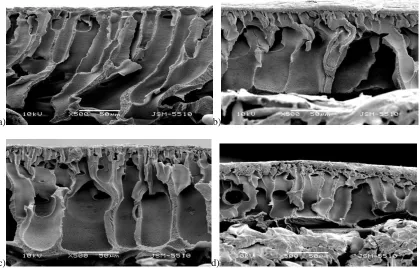
Further, the process of deposition continues across the rest of the surface where the accumulation isuniform and depends on the period of membrane treatment. The thickness of the metal coating formedon the membrane surface at different metallizationtimes can be clearly seen in the SEM images of vacuum metallized membranes (fig.3). the thicknessof the metal coating increased with the exposition time but the process did not proceed within the porous structure of the membrane.
а) b)
[image:3.595.74.494.278.546.2]c) d)
Fig. 3.SEM images of a cross-section of PAN membranes vacuum metallized for: а) 0 sec., b) – 5 sec., c) – 15 sec., d) – 25 sec.
The effect of the layer with respect to the exposition time can be confirmed als by the values of the permeability and selectivity determined with the calibrant.
Depending on the metallization time, a metal structure with varying density and thickness is formed. In any case, it is on the membrane surface and is built up as a second basic layer which affects its selectivity (table 1).Comparing the characteristics of the non-metallized and metallized membranes, it was foundthat the permeability for albumin graduallydecreased
Table 1.Permeability and selectivity of membranes for Albumin at 0.3 MPa.
metallization, sec. Jalb, l/m2h φalb, %
0 45 60
5 36 74
15 33 80
25 25 85
from 45 to 25 l/m2h and the selectivity increased from 60% to 85% with the increase of the exposition time to 25s.
These changes were due to the accumulation and growth of the metallizing nuclei, mainly on membrane surface. The variation of the layer thickness improved the selective ability of the metallized object.
[image:3.595.300.526.627.688.2]27 The coating was analyzed by AFM with respect to
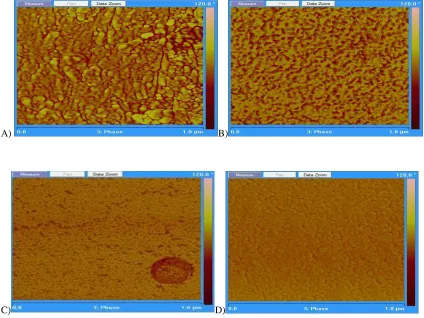
the exposition time. The changes observed inmem-brane surface are shown in figure 4. Considering the phase contrast of all the four images, the degree ofde-position of the metallizing layer can be clearly seen. The brighter zones correspond to higher projected-partswhilethedarkerzones – tolower (deeper) parts.
Figure 4Ashowsaphaseimageofthesurfaceofpurenon-metallizedPAN membrane. After 5 sec. metallization, the deposited metal layer has smaller area and smaller thickness (fig. 4B) compared to the image taken after metallization for 15 sec. (the brighter zones in fig.4C).The pores and deposition
[image:4.595.71.495.258.576.2]sites can be clearly distinguishedand the layer formed is more uniform in figure 4C than that observed in figure 4D.The highest contrast was observed after 25 sec. metallization which indicates for the increased variance in height.The bright coloring corresponds
tothe largest andmost densely covered surface area with hardly distinguishable pores.Therefore, thelow- permeabilityobservedwasduetothepartialblockingof-theporesasaresultoftheexcess deposition of metallizing layer.
А) B)
C) D)
Fig.4Images 2D of PAN membranes taken by AFM: non-metallized - A), metallized – B) -5sec., C) -15sec., D) - 25sec.
The studies carried out prove the possibilities to use vacuum metallization aiming to modify the composite asymmetric PAN membrane structure.
4. CONCLUSIONS
The results presented show the possibility to use vacuum metallization as a method for fixation of the selective layer of asymmetric PAN membranes. Depending on metallization duration, metal structure with varying density and thickness is formed which
may be used to correct the selective and transport characteristics of the membranes. The optimal duration of membranes metallization was determined to be 15s to obtain effective values of permeability 33 l/m2h and selectivity80% towards albumin.
REFERENCES
[1] Baker, R.W. (2004): Membrane technology and applications.Second Edition,Wiley & SonsLtd,
International Journal of Research in Advent Technology, Vol.4, No.11, November
2016
E-ISSN: 2321-9637
Available online at www.ijrat.org
28 [2] Ulbricht, М.(2006): Advanced functional polymer
membranes. Polymer, 47(7), pp.2217–2262. [3] Mulder, M.(1996): Basic Principles of Membrane
Technology. Kluwer Academic Publishers, Dor-drecht, pp. 564.
[4] Дубяга, В.П.; Перепечкин, Л.П.; Каталевский
Е.E. (1981): Полимерныемембраны.
Москва,Изд. ”Химия”, с.231.
[5]Zhang, G.; Gao, X.; Ji, S.; Liu, Z.(2008): Electric field-enhanced assembly of polyelectrolyte com-posite membranes.Journal of Membrane Science, 307 (2), pp.151-155.
[6]Кънев, М.;Узунов,Ц.;Ховсепян,П. (1986):
Технология за нанасяне на покрития.ВТУ “
Ангел Кънчев “, Русe.