449
Implementation Of Efficient Approximate Multiplier
Using Partial Product Multiplier Generator
1
N Gopi Chand,
2Dr. P Sudheer Raghavan
1Research scholar, Dept of ECE, Sathyabama University, Chennai, Tamil Nadu 600119
2Professor, Dept of ECE, Sathyabama University, Chennai, Tamil Nadu 600119
Abstract:Multipliers are most important parts in signal processing applications or other computationally drastic applications. Therefore, multiplier designs are mainly focused on high-speed & low area. These parameters are achieved by approximate multipliers. Generally, approximate computing has a significant attention as a rising strategy to decrease power consumption of error tolerant applications like image processing. In this paper we proposed the design of approximate multipliers using partial product generation. In this new design approach for approximation of multiplier, partial products of the multiplier are altered to introduce varying probability terms. Logic complexity of approximation is varied for the accumulation of altered partial products based on their probability. Synthesis results reveal that proposed multiplier achieves better performance, compared to an exact multiplier.
Key Words: Approximate multipliers, partial product generation, error analysis, area, delay.
1. INTRODUCTION
The digital circuits that are designed in such a way that the condition is not met in terms of functionality and some savings are required in terms of energy, delay or area are called approximate circuits. They are perfectly suitable for some applications, where errors are not decipherable as human perception capabilities are limited (e.g. in multimedia applications), no golden solution is offered for confirmation of circuit behavior (e.g. in data mining applications), or users are basically willing to acknowledge some inaccuracies (e.g. when battery of a mobile phone is almost depleted). Approximate computing is a computation that provides a possible inexact result rather than an accurate result, for a situation where an approximate result is sufficient for a purpose. One example for that situation is a search engine where no accurate answer may exist for a particular search query and hence, lot of answers may be suitable. In the same way, occasional dipping of some frames in a video application can go unobserved due to perceptual limitations of humans. Approximate computing is depends on the observation that in many scenarios, although performing accurate computation requires large amount of resources, allowing bounded approximation can provide inconsistent gains in performance and energy, while still achieving adequate result accuracy.
Many of the DSP cores implement image and video processing algorithms where final outputs are either images or videos prepared for human consumptions.
This fact enables us to use approximations for improving the speed/energy efficiency. This originates from the limited perceptual abilities of human beings in observing an image or a video. In addition to the image and video processing applications, there are other areas where the exactness of the arithmetic operations is not critical to the functionality of the system. Being able to use the approximate computing provides the designer with the ability of making tradeoffs between the accuracy and the speed as well as power/energy consumption. Applying the approximation to the arithmetic units can be performed at different design abstraction levels including circuit, logic, and architecture levels, as well as algorithm and software layers. The approximation may be performed using different techniques such as allowing some timing violations (e.g., voltage over scaling or over clocking) and function approximation methods (e.g., modifying the Boolean function of a circuit) or a combination of them.
450 midway things, which is critical in regards to control
usage. Softened show multiplier is executed up, where the base basic bits of data sources are truncated, while confining midway things to diminish gear multifaceted nature.
In most multimedia applications, human beings can gather useful information from slightly erroneous outputs. Therefore, we do not need to produce exactly correct numerical outputs. Previous research in this context exploits error resiliency primarily through voltage over scaling, utilizing algorithmic and architectural techniques to mitigate the resulting errors. In this paper, we propose logic complexity reduction at the transistor level as an alternative approach to take advantage of the relaxation of numerical accuracy. We demonstrate this concept by proposing various imprecise or approximate full adder cells with reduced complexity at the transistor level, and utilize them to design approximate multi-bit adders. In addition to the inherent reduction in switched capacitance, our techniques result in significantly shorter critical paths, enabling voltage scaling. We design architectures for video and image compression algorithms using the proposed approximate arithmetic units and evaluate them to demonstrate the efficacy of our approach.
In the category of function approximation methods, a number of approximating arithmetic building blocks, such as adders and multipliers, at different design levels have been suggested. To reduce hardware complexity of multipliers, truncation is widely employed in fixed-width multiplier designs. Then a constant or variable correction term is added to compensate for the quantization error introduced by the truncated part. Approximation techniques in multipliers focus on accumulation of partial products, which is crucial in terms of power consumption. Broken array multiplier is implemented, where the least significant bits of inputs are truncated, while forming partial products to reduce hardware complexity. The proposed multiplier in saves few adder circuits in partial product accumulation. Many increasingly popular applications, such as image processing and recognition, are inherently tolerant of small
Inaccuracies. These applications are computationally demanding and multiplication is their fundamental arithmetic
Function, which creates an opportunity to trade off computational accuracy for reduced power consumption. Approximate computing is an efficient approach for error- tolerant applications because it can trade off accuracy for Power, and it currently plays an important role in such application domains. Different error-tolerant applications have different accuracy requirements, as do different program
phases in an application. If multiplication accuracy is fixed, power will be wasted when high accuracy is not required. This means that approximate multipliers should be dynamically reconfigurable to match the different accuracy requirements of different program phases and applications. An approximate tree compressor is utilized to reduce the accumulation layer depth of the partial product tree. Our approach introduces a term representing the power and accuracy requirements which simplifies the partial product reduction (PPR) component as needed. An approximate multiplier is designed using the proposed adder and compressor. Compared with the conventional Wallace tree multiplier, the proposed approximate multiplier, this reduces the area and delay of the circuit in effective way. All the multiplier designs are then evaluated in a real image processing application.
2. LITERATURE SURVEY
Approximate computing is an attractive paradigm for digital processing at nano metric scales. Inexact computing is particularly interesting for computer arithmetic designs. The analysis and design of two new approximate compressors for utilization in a multiplier. These designs rely on different features of compression, such that imprecision in computation (as measured by the error rate and the so-called normalized error distance) can meet with respect to circuit-based figures of merit of a design. The partial products of the multiplier are altered to introduce varying probability terms. Logic complexity of approximation is varied for the accumulation of altered partial products based on their probability. The proposed approximation is utilized in two variants of multiplier. The need to support various digital signal processing (DSP) and classification applications on energy-constrained devices has steadily grown. Such applications often extensively perform matrix multiplications using fixed-point arithmetic while exhibiting tolerance for some computational errors. Hence, improving the energy efficiency of multiplications is critical. Finally, the demonstrated computational error does not create any notable impact on the quality of DSP and the accuracy of classification applications
451 execution time and power consumptions of different
applications. Similarly, for some applications, the usage of DSP blocks might result in exhaustion of the DSP blocks in concurrently running applications. Utilizing an FPGA-based accurate n×n multiplier design, optimized for area and energy efficiency, the novel contributions of this paper include a design space exploration methodology for generating approximate multipliers of arbitrary data sizes. For each n×n accurate multiplier, we provide three approximate n×n multiplier designs by efficient utilization of LUTs and carry chains. In order to reduce the execution time of an n×n multiplier, our methodology recommends implementing it using four instances of n 2 multipliers. Each individual instance of n 2 multiplier can be generated either directly or recursively from four instances of n 4 multipliers. Besides supporting accurate summation of partial products, we also provide a novel n-bit approximate adder to reduce the overall execution time of the multiplier. All implementations have been characterized by their area and latency requirements and average relative errors.
The gap between capabilities of CMOS technology scaling and requirements of future application workloads is increasing rapidly. There are several promising design approaches that jointly can reduce this gap significantly. Approximate computing is one of them and in recent years, has attracted the strongest attention of the scientific community. Approximate computing exploits inherent error resilience of applications and features high-performance energy-efficient software and hardware implementations by trading-off computational quality (e.g., accuracy) for computational efforts (e.g., performance and energy). Over the decade, several research efforts have explored approximate computing throughout all the layers of computing stack, however, most of the work at hardware level of abstraction has been proposed on adders. In, a comparative survey of state- of-the-art approximate adders is provided. And it also provides comparison based on both conventional design metrics as well as approximate computing design metrics.
Liu et al. utilized an approximate adder to reduce carry propagation delay in partial product accumulation. They also proposed a recovery vector to improve accuracy. The bit width of the error recovery vector can be selected by the designer to satisfy accuracy requirements. Hashemi et al. proposed atechnique that reduces the size of the
multiplier by detecting the leading one bit of the input operands and selecting the following bits as abridged operands for both inputs, where is a designer-defined value that specifies the bandwidth used in the core accurate multiplier. Both authors allow a static trade- off between power consumption and accuracy. The bit lengths of the recovery vector and the input operands are determined during the design process and the accuracy is not dynamically controllable, unlike with our proposed multiplier. Moons et al. proposed a system-level technique that disables part of the combinational logic and reconfigures the pipelined registers and combinational logic. It can trade off accuracy for power dynamically by changing the numbers of pipeline stages and voltage-accuracy scaling modes. Our proposed multiplier also disables part of the combinational logic in the to achieve low delay ad area, but ours does not require a pipeline system or control circuits for voltage scaling..
452
3. PROPOSED SYSTEM
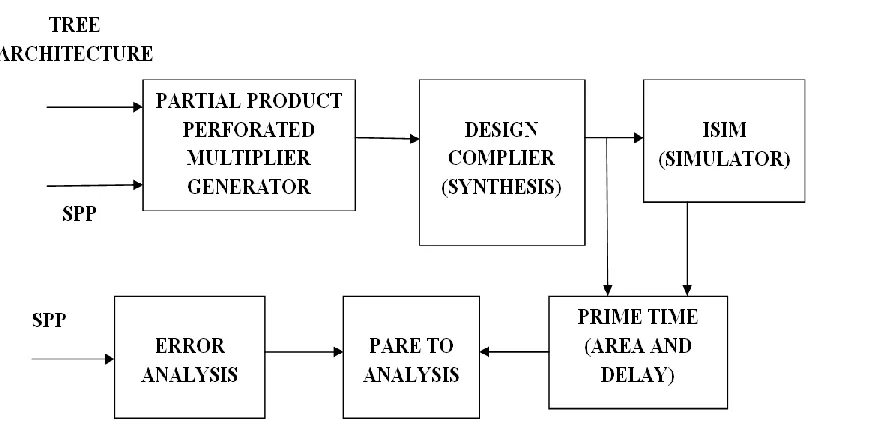
Fig. 1: PROPOSED SYSTEM
The above figure (1) shows the block diagram of proposed system. In this system we use partial product multiplier generator, design compiler, ISIM simulator, and error analysis blocks. Implementation of multiplier comprises three steps: generation of partial products, partial products reduction tree, and finally, a vector merge addition to produce final product from the sum and carry rows generated from the tree architecture. Approximation is handled in such a way that the absolute difference between actual output and approximate output is always maintained as one. Hence Carry outputs are approximated only for the cases, where Sum is approximated. Here first inputs are taken from the tree architecture and simulating planning panel and given to partial product multiplier generator. This multiplier generator will multiply the values and generate particular signal. Now this propagate and generate signals are compiled and simulated by ISIM simulator. If any error occurred in the system then the signal is given to the error analysis block. This will modify and produce results in effective way. The accumulation of generate signals is done column wise. After this we will calculate delay and area, compared to other approximate multipliers this produces effective results. Now let us discuss about each device in detail manner.
A. Partial Product Perforated Multiplier
Generator
Digital multipliers are extensively used in arithmetic units of microprocessors, multimedia and digital signal processors. Basically, binary representation is used while designing high performance multipliers. Many algorithms and architectures have been nominated to design high-speed and low power multipliers. A simple binary (NB) multiplication by digital circuits comprises three steps. In the first step, partial products are produced; in the second step, all partial products are added by a partial product reduction tree still two partial product rows be left over. In the third step, the two partial product rows are summed up by a fast carry propagation adder. Two methods have been used to carry out the second step for the partial product reduction. A product formed by multiplying the multiplicand by one digit of the multiplier when the multiplier has more than one digit. Partial products are used as intermediate steps in calculating larger products.
B. Design Compiler
A compiler is a computer program that transforms computer code written in one programming language (the source language) into another programming language (the target language). Compilers are a type of translator that support digital devices, primarily computers. A compiler is likely to perform many or all of the following operations: preprocessing, lexical
453 translation), conversion of input programs to
an intermediate representation, code optimization and code generation. Compilers implement these operations in phases that promote efficient design and correct transformations of source input to target output. Program faults caused by incorrect compiler behavior can be very difficult to track down and work around; therefore, compiler
implementers invest significant effort to ensure compiler correctness.
C. ISIM Simulator
ISim provides a complete, full-featured HDL simulator integrated within ISE. HDL simulation now can be an even more fundamental step within your design flow with the tight integration of the ISim within your design environment.
4. RESULTS
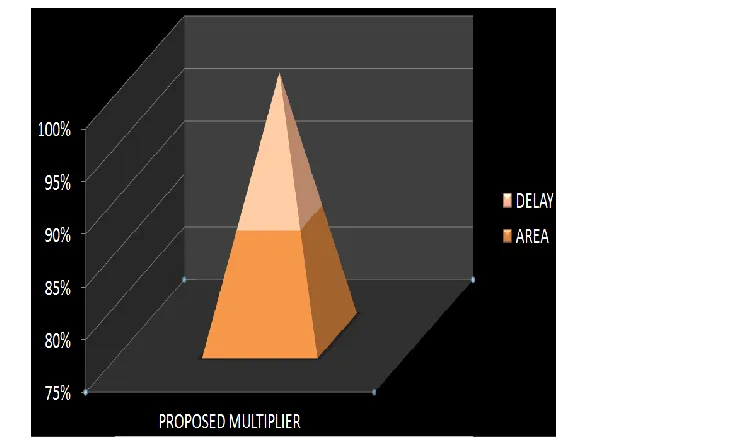
Fig. 2: Area and delay in proposed system
5. CONCLUSION
In this paper, we discussed about the implementation of approximate multipliers using partial product generate technique. This approximation technique enables the parameters like high area and delay savings while retaining high accuracy. We explored product perforation on multiplier architecture, evaluating its impact on different architectures and error bounds. Finally, these techniques are scalable, offering better results as the multiplier’s bit width increases. The proposed multiplier designs can be used in applications with minimal loss in output quality while saving significant delay and area
.
REFERENCES
[1] S. M. Sunil Dutt, Sukumar Nandi and Gaurav Trivedi ―A Comparative Survey of Approximate Adders‖ 26th International Conference Radioelektronika (RADIOELEKTRONIKA), pp. 61 - 65, Apr 2016.
[2] [2] Amir Momeni; Jie Han; Paolo Montuschi; Fabrizio Lombardi, ―Design and Analysis of Approximate Compressors
for Multiplication‖, IEEE Transactions on Computers Year, Vol. 64, no.4, pp. 984 - 994, Feb. 2015.
[3] Liangyu Qian; Chenghua Wang; Weiqiang Liu; Fabrizio Lombardi; Jie Han, ―Design and Evaluation of An Approximate Wallace-Booth Multiplier‖ , IEEE International Symposium on Circuits and Systems (ISCAS), pp. 1974 – 1977, Aug 2016 [4] [4] Suganthi Venkatachalam; Seok-Bum Ko,
― Design of Power and Area Efficient Approximate Multipliers‖ IEEE Transactions on Very Large Scale Integration (VLSI) Systems, Volume: 25, No. 5 pp. 1782 - 1786, Jan 2017.
[5] Srinivasan Narayanamoorthy; Hadi Asghari Moghaddam; Zhenhong Liu; Taejoon Park; Nam Sung Kim, ―Energy-Efficient Approximate Multiplication for Digital Signal Processing and Classification Applications‖, IEEE Transactions on Very Large Scale Integration (VLSI) Systems, Vol. 23, No. 6, pp. 1180 – 1184, June 2015. [6] Georgios Zervakis; Kostas Tsoumanis;
454 Pekmestzi, ―Design-Efficient Approximate
Multiplication Circuits Through Partial Product Perforation‖ IEEE Transactions on Very Large Scale Integration (VLSI) Systems, Vol. 24, No.10 pp. 3105 – 3117, Oct 2016.
[7] [7] Y.RamaLakshmanna, G.V.S.Padma Rao, N. Udaya Kumar, K. Bala Sindhuri, ―A Survey on Different Multiplier Techniques‖, SSRG International Journal of Electronics and Communication Engineering (SSRG-IJECE) – Vol.3 no.3, pp.8-11, March 2016 [8] Qi Wang and Y. R. Shayan, "A versatile
signed array multiplier suitable for VLSI implementation," Electrical and Computer Engineering, IEEE CCECE 2003. Canadian Conference on, vol.1, pp. 199-202, 2003. [9] Laxman S, Darshan Prabhu R, Mahesh S
Shetty , Mrs. Manjula BM, Dr. Chirag Sharma ―FPGA Implementation of Different Multiplier Architectures‖ International Journal of Emerging Technology and Advanced Engineering Vol 2, no. 6, June 2012 ISSN: 2250- 2459. [10]C. Liu, J. Han, and F. Lombardi, “A