SiSSA - An Infrastructure for NLP Application Development
A. Lavelli and F. Pianesi
ITC-irst
via Sommarive 18
38050 Povo (TN) ITALY
[email protected]
[email protected]
E. Maci and I. Prodanof
Ist. di Ling. Comput.
Area di Ricerca CNR
via Alfieri 1, San Cataldo
56010 Pisa ITALY
[email protected]
[email protected]
L. Dini and G. Mazzini
CELI
corso Moncalieri 21
10131 Torino ITALY
[email protected]
[email protected]
Abstract
Recently there has been a growing in-terest in infrastructures for sharing NLP tools and resources. This paper presents SiSSA, a project that aims at devel-oping an infrastructure for prototyping, editing and validation of NLP applica-tion architectures. The system will pro-vide the user with a graphical environ-ment for (1) selecting the NLP activities relevant for the particular NLP task and the associated linguistic processors that execute them; (2) connecting new lin-guistic processors to SiSSA; (3) check-ing that the chosen architectural hy-pothesis corresponds to the functional specifications of the given application.
1
Introduction
In recent years there has been a growing inter-est in the commercial deployment of NLP tech-nologies and in infrastructures for sharing NLP tools and resources. Such interest makes more and more urgent the availability of toolsets that allow an easy and quick integration of linguistic resources and modules and the rapid prototyping of NLP applications. An example of the efforts in such a direction is GATE (a General Architecture for Text Engineering, (Cunningham et al., 1997)), which provides a software infrastructure on top of which heterogeneous NLP processing modules may be evaluated and refined individually, or may be combined into larger application systems.
This paper presents SiSSA (Sistema integrato di Supporto allo Sviluppo di Applicazioni - Inte-grated System of Support to Application Devel-opment), a project with a twofold aim:
the definition of a common metaformalism (called FIST) for the unification of different formalisms for grammar description, and the implementation of a Grammar Repository for storing grammars written using FIST;
the implementation of an infrastructure for the rapid prototyping and testing of architec-tures for NLP systems, starting from linguis-tic processors made available by SiSSA it-self.
In this paper we concentrate on the latter as-pect, i.e. the infrastructure for designing NLP ar-chitectures. To this end, SiSSA provides the user with a graphical environment for (1) selecting the linguistic activities which are relevant to the par-ticular application at hand, along with the linguis-tic processors that execute them; (2) checking that the chosen architectural hypothesis corresponds to the functional specifications of the application; (3) connecting to SiSSA new linguistic proces-sors, this way making them available for the pro-totyping/design activities.
product of the user’s activity, namely, the archi-tecture of the NLP application the user is building. A project encodes processing flows among basic units, each consisting of a linguistic task that is executed by a linguistic processor.
Projects have two uses. First, they store the sta-tus of a user session. Second, they are the main units of runtime modules: the SiSSA Manager (see below) interprets projects by executing the procedures chosen by the user and applying them to the document selected for execution.
SiSSA makes crucial use of state-of-the-art software technologies (CORBA, XML) in order to integrate the various modules in an effective way. The core of SiSSA has been developed in Java; hence it can run both on Windows and on Unix platforms.
SiSSA consists of two parts: an autonomous application (called SiSSA Manager) and a set of executable modules, henceforth called proces-sors. The SiSSA Manager provides an infrastruc-ture for architecinfrastruc-ture composition and processor integration. That is, it provides all the necessary support to allow the user to select linguistic activ-ities, connect them in an overall processing chain, and associate each activity to a linguistic proces-sor. Moreover, it takes care of executing the pro-cessing flow encoded in the project, reporting re-sults to the user, etc.
A major goal while designing SiSSA was to allow the system to reuse existing processors as much as possible. This was meant to extend to processors located in other sites than the user’s. Already existing processors are written in differ-ent programming languages and run on differdiffer-ent hardware and software platforms; so this objec-tive required the adoption of a distributed archi-tecture, providing:
flexibility (processors can be developed and updated independently);
expandibility (new processors can be added);
independence from the programming lan-guages employed to implement the proces-sors;
distribution of execution on different hard-ware platforms.
As a result, the user can exploit for his/her needs processors that are located anywhere, pro-vided that they have been notified to SiSSA, and enclosed in a wrapper so as to comply with the SiSSA interface (see Section 2.2 and 2.3).
In the following sections, we first present a de-tailed description of SiSSA. Then some consider-ations on the pratical use of the system are intro-duced. Finally some details about the current sta-tus of the SiSSA implementation and the future work follow.
2
SiSSA
The SiSSA system consists of:
the SiSSA Manager;
the processors;
the grammars contained in the Grammar Repository;1
formal specifications of the interfaces each processor has to provide in order to be “in-tegrable” in SiSSA (this part uses CORBA, Common Object Request Broker Architec-ture -http://www.corba.org,);
protocols for communication and formats for representation and exchange of information (achieved using XML (Bray et al., 2000)).
The difference between the third and the fourth element above is that the CORBA part specifies the details of the communication process with-out any reference to the linguistic characteris-tics of the integrable processors (this part could be largely reused in other non linguistic projects involving a distributed architecture); the specifi-cally linguistic details are embedded in the XML documents passed between the processors.
2.1 SiSSA Architecture
The central element in the SiSSA architecture is an autonomous application, called SiSSA Man-ager. It is autonomous since it takes the initiative in the management of the processing flow of the SiSSA system, where it mainly plays the role of client. Its main tasks are the following:
to interact with the Processor Repository (the place where information about proces-sors known to SiSSA is stored) to take a cen-sus, activate and connect the processors no-tified to the system;
to present the system functionalities to the user by means of a web-based graphical in-terface. To this end, the SiSSA Manager acts as a server with respect to the processors towards which it mediates the “centralized” GUI. Through the latter, the SiSSA Manager not only interprets the user’s actions but also gives her/him a report on the ongoing pro-cessing, storing and presenting logs and sta-tus messages coming from the active proces-sors;
to manage and interpret the projects built by the user.
The Processor Repository classifies the proces-sors, by associating each of them to the appro-priate class of linguistic processors (e.g., mor-phological analyzers, PoS taggers, etc.).2 The Processor Repository also provides functionali-ties for permanently storing the properfunctionali-ties asso-ciated with the processors registered in the repos-itory. Among them, the properties that specify the methods for activating a processor are crucial. As a matter of fact, the single processors must be ac-tive in order to be available for use by SiSSA. The activation of a processor takes place by means of an Activation Server3 reachable via CORBA at the URL stored in the Processor Repository and specifying the corresponding activation string. The information is stored in the repository us-ing RDF4 and RDFS5 (Resource Description
2
Currently the following classes of processors are de-fined in SiSSA: documentProc, preprocessorProc, textZon-erProc, nERecogniztextZon-erProc, morphologyProc, poSTagger-Proc, syntaxpoSTagger-Proc, semanticspoSTagger-Proc, DiscoursepoSTagger-Proc, XSLProc.
3In case the processor resides on a computer directly
ac-cessible to the SiSSA Manager, it can be activated by means of a shell command. In the following we always consider the case in which the activation server is needed.
4
RDF is a W3C Recommendation of 22 February 1999 (Lassila and Swick, 1999) that specifies a declarative lan-guage (based on XML) formally equivalent to propositional logics. RDF is usually employed to describe resources on the web.
5
RDF Schema Specification 1.0, published as a W3C Candidate Recommendation in March 2000 (Brickley and Guha, 2000).
Framework and RDF Schema). RDF Schema makes available tools to check that the descrip-tions of the processors’ characteristics comply with SiSSA Manager’s constraints. The RDF specification of the processors made available in SiSSA is usually built using a graphical inter-face. The adoption of RDF and RDF Schema en-hances the generality of SiSSA, by avoiding ad hoc languages for resource description, and ad hoc schemas for the validation of documents de-scribing the processors.
Turning to the processors stored in the repos-itory, they mainly play the role of servers which are activated upon request by the SiSSA Manager. The goal of making available distributed ar-chitectures for projects is pursued through the adoption of CORBA (Common Object Request Broker Architecture - http://www.corba. org, developed by the OMG industry consor-tium), which acts as the glue keeping together the executable parts of SiSSA.6 To be available to SiSSA, processors must be registered in the Processor Repository. To this end, they must ex-hibit interfaces that comply with a set of specifi-cations defined using the CORBA Interface Defi-nition Language (IDL). Thus, providing the com-pliant interfaces is a necessary step towards inte-grating new processors within SiSSA.
As to communication formats, the overall goals of SiSSA made the adoption of XML (Bray et al., 2000) a natural choice. Thus messages are ex-changed in the form of XML documents of type process-data (see Section 2.3). These doc-uments incorporate in a single structure: the ob-ject to be processed, and information relevant for the processing itself (metadata). The generality of such a format permits its use both for the commu-nication between the SiSSA Manager and the pro-cessors, and for those directly taking place among the processors.
2.2 Communication Protocols
As said, SiSSA provides a set of formal IDL spec-ifications which the interfaces of processors aim-ing at beaim-ing integrated in the environment must adhere to. Such specifications model the interac-tion between the SiSSA Manager and the
proces-6
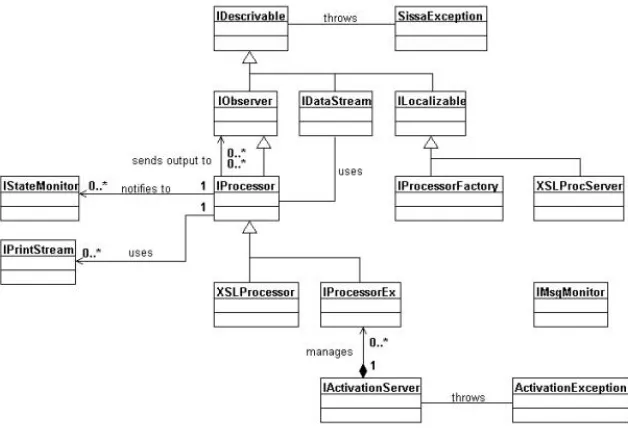
Figure 1: The UML diagram of the SiSSA IDLs.
sors, as mediated by CORBA. They can be seen as a contract that the SiSSA Manager and the proces-sors have to comply for their mutual integration to be successful. A UML diagram of the SiSSA IDL specifications is shown in Figure 1.
The scenario of the cooperation between the SiSSA Manager and a generic processor can be described as follows:
the processor’s activation server starts and connects on the CORBA bus as a named server at a specified URL (i.e, the corbaloc: URL stored in the Processor Repository);
the SiSSA Manager, in its turn connected to the CORBA bus, can contact the activation server using the corbaloc: URL speci-fied in the Processor Repository; using the processor’s activation string it can ask the server to activate the corresponding proces-sor;
from now on, the interaction takes place di-rectly between the SiSSA Manager and the processors whose interface it obtained;
the SiSSA Manager can in this way act as a true manager, establishing and removing the connections between the processors accord-ing to the design of the processaccord-ing flow de-cided by the user.
In SiSSA, the communication is asynchronous, and is implemented by means of a flow of XML documents. The processors and the SiSSA Man-ager can be both the source and the target of com-munication. Moreover, each communication can have more than one target.
Being a possible target of communications, each registrable processor provides the function-alities of the interfaceIObserver. The SiSSA Manager’s way to establish/remove the relation-ships between processors according to the user requirements amounts to inserting/deleting ob-servers into a processor’s list of obob-servers.
IStateMonitor(provided by the SiSSA Man-ager) allows each processor to signal its callers the status of its own processing (an example of its use is shown in the bottom bar of the window shown in Figure 3).
An important service provided by the SiSSA Manager is the XSL7 processing of XML docu-ments. To this end, the SiSSA Manager provides the interface XSLProcServer, through which XSLProcessor (a processor specialized in XSL transformations) is made available.8 This feature allows the insertion of XSL transformations be-tween any pair of processors, this way providing the possibility of adapting one processor’s output to the requirement of the following one(s). This feature is of the utmost importance for augment-ing SiSSA’s capabilities of integrataugment-ing and suc-cessfully making available a wide range of pro-cessors.
2.3 Communication and Representation Formats
Communications take place using a “data contain-er” modeled by the interfaceIDataStream. An object that implements such interface is sent by a processor to each of its observers on completion of its processing.
IDataStream is designed as a container rather than as a structured model of the data exchanged. The definition of structured mod-els for data is completely independent from IDataStream, and is obtained through differ-ent means. Indeed, given that the contdiffer-ents of data streams are XML documents, their structure is made explicit by means of Document Type Defi-nitions (DTDs).
SiSSA is a development environment, meant to be open to the integration of new components, whereby the latter can differ among them along a number of dimension, including the input/output formats. At the same time, SiSSA should allow the user an adequate level of control over the in-termediate results produced during the computa-tion (i.e., the output of each processor). XML al-lows a representation of data which is transparent
7The Extensible Style Language (XSL (Adler et al.,
2000)) is a language that allows to transform data from one XML representation to another.
8
The SiSSA Manager uses the Xalan XSLT processor,
http://xml.apache.org.
and accessible to the developer, without the need for her/him to know the details of the implementa-tion of the single components. At the same time, it does not increase the complexity of the CORBA interfaces that encapsulate such data.
The data defined in XML are associated to a document of type process-data. Each doc-ument of type process-data necessarily in-cludes two parts:
linguistic data, usually corresponding to the result of the computation done by the source processor;
metadata. Their role is to specify: the level of analysis accomplished by the source pro-cessor (e.g., tokenisation, parsing, etc.); the unique identifier of the processor originat-ing the data; further useful information about processing (time of execution, rules applied, etc.). Moreover, metadata make available a unique identifier for theprocess-data document. This is useful so to associate the input with the different output structures pro-duced by the different processing steps.
The linguistic data have to comply with the definitions specified for the different classes of processors. Such classes are identified by the attributelevel-of-analysis present in the metadata (e.g., morphological analyzer, PoS tag-ger, chunk parser, etc.) and should take into ac-count (at least to a certain extent) idiosyncrasies of specific processors. For instance, a morpho-logical analyzer can adopt a set of category labels not entirely coincident with that of another mor-phological analyzer.
single DTD, defined as part of the resources inter-nal to SiSSA, while the latter can be conveyed by various DTDs, possibly made available in SiSSA along with each processor.
As said, each processor at the end of its processing makes available a document of type process-data, which contains exclusively the output data of the specific processor – and obvi-ously the corresponding metadata. Such a doc-ument is a representation of the output of the processor that generated it, and does not contain any representation relative to previous levels of analysis, the input text or the history of the pro-cessing done so far. Thus, for efficiency reasons process-data are not incremental collection of all the data produced by the various processors. At the same time, the need to keep a link be-tween the input test and the output produced by the system cannot be ignored. It is also reason-able that in certain situations (e.g., during testing and debugging) the structures produced by the in-termediate processors, as well as the metadata of the various processors, are needed to show or save tracing information. In the proposed architecture, this task is accomplished by the SiSSA Manager, that can register itself as an observer of any pro-cessor; in this way it can access the processor out-put and show it to the user or build a tracing struc-ture.9
3
SiSSA at Work
There are two main activities regarding the char-acteristics of SiSSA described in this paper: the development of projects and the integration of processors.
3.1 Projects
The creation and editing of projects takes place exclusively via the SiSSA graphical interface. First the user decides which linguistic activities are relevant to her/his project. Then s/he can browse the Processor Repository, searching for those which are suitable to realize each linguis-tic activity.10 Finally, s/he composes them into a project.
9The SiSSA Manager uses the Xerces XML parser, http://xml.apache.org.
10
The processors currently available within SiSSA are some processors developed by the partners of the project: the morphological analyzer and the parser of NLGRADE (ILC,
When it is necessary to test a given project on a text the SiSSA Manager prepares a suitable stream (IDataStream) and sends it to the pro-cessor selected as the first in the analysis chain. The processor interprets the metadata, executes the specified operation on the linguistic data and finally sends its output to all its observers; some of them can be required to perform further cessing on the linguistic data. The output pro-duced by a processor is sent to the SiSSA Man-ager as well, so that it can be shown to the user in a suitable form.
In Figure 2 the starting page of the SiSSA sys-tem is shown. In the upper part of the window there are a few buttons that are present in all the pages of SiSSA. From left to right:
Home: a link to the starting page of SiSSA;
SiSSA Manager: a link to the page of the SiSSA Manager;
Progetti(projects): a link to the page that allows to create, edit, and activate the user’s projects;
Repository: a link to the page for inter-acting with the Processor Repository;
Help: an online help.
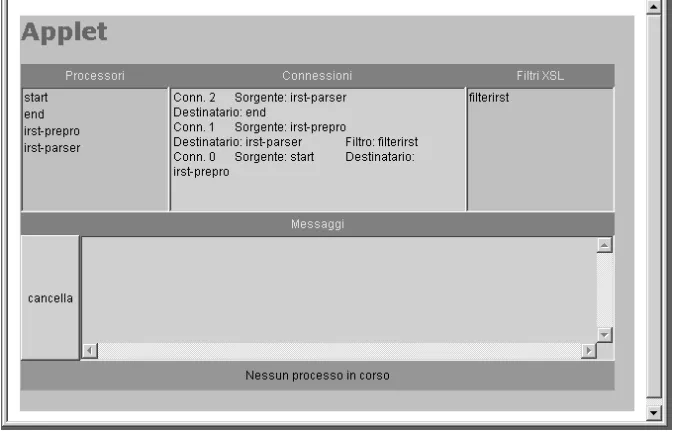
Figure 3 shows the applet that interactively monitors the status of the project currently active and displays it to the user. In the upper part of the window the details of the active project are shown: the processors (left), the connections be-tween processors (middle), and the XSL filters (right). In the lower part of the window the mes-sages coming from the processors are shown. The bottom bar shows which of the processors/filters is currently active (using the IStateMonitor interface described in Section 2.2).
3.2 Integration of processors
Differently from the activity of creation and edit-ing of projects, only the final part of the work in-volved in the integration of processors is accom-plished via the SISSA graphical interface (more
Figure 2: The starting page of SiSSA.
precisely, the registration in the Processor Repos-itory of the availability of the processors).
In order to make a processor SiSSA-compliant, the following steps are necessary:
to provide it with a wrapper so that it com-municates via the CORBA IDLs of SISSA;
to make a translation between the proces-sor’s native input/output and the correspond-ing lcorrespond-inguistic representation specified by process-data;
to register the processor in the Processor Repository using the SiSSA graphical inter-face; during this step the class of the pro-cessor, itscorbaloc:URL and activation string have to be specified.
4
Conclusions
The release 1.2 of the SiSSA Manager has been completed and is currently under use at the sites involved in the SiSSA project.
Given the emphasis on rapid prototyping, SiSSA has been developed with flexibility during the development phase as a primary goal. Obvi-ously this flexibility is no longer needed when an application is delivered (on the contrary flexibility
can considerably reduce the performances of the system). We are currently studying approaches to allow the delivery of efficient runtime processors. Currently the SiSSA Manager is a single-user application. An extension is the possibility of having more than one user that uses it at the same time.
The SiSSA system has been developed as part of the TAL project. TAL is a project partially funded by the Italian Ministry for University and Scientific Research.
References
Sharon Adler, Anders Berglund, Jeff Caruso, Stephen Deach, Paul Grosso, Eduardo Gutentag, Alex Milowski, Scott Parnell, Jeremy Richman, and Steve Zilles. 2000. Extensible Stylesheet Lan-guage (XSL) Version 1.0. W3C Candidate
Recom-mendation 21 November 2000. http://www.
w3.org/TR/xsl/.
Tim Bray, Jean Paoli, C. M. Sperberg-McQueen, and Eve Maler. 2000. Extensible Markup Language (XML) 1.0 (Second Edition). W3C
Recommenda-tion 6 October 2000. http://www.w3.org/
TR/REC-xml/.
Dan Brickley and R.V. Guha. 2000. Resource
Figure 3: The applet that shows the connections between processors.
27 March 2000. http://www.w3.org/TR/
2000/CR-rdf-schema-20000327/.
Fabio Ciravegna, Alberto Lavelli, Daniela Petrelli, and Fabio Pianesi. 1997. Participatory Design for Lin-guistic Engineering: the case of the GEPPETTO
Development Environment. In Proceedings of the
ACL/EACL’97 Workshop on Computational Envi-ronments for Grammar Development and Linguistic Engineering, Madrid, Spain, July.
Fabio Ciravegna, Alberto Lavelli, Daniela Petrelli, and Fabio Pianesi. 1998. Developing language resources and applications with GEPPETTO. In
Proceedings of the First International Conference on Language Resources & Evaluation, Granada,
Spain.
Hamish Cunningham, K. Humphreys, Robert
Gaizauskas, and Yorick Wilks. 1997. Software infrastructure for natural language processing. In
Proceedings of the Fifth Conference on Applied Natural Language Processing (ANLP-97).
Ora Lassila and Ralph R. Swick. 1999.
Re-source Description Framework (RDF) Model and Syntax Specification. W3C Recommendation 22
February 1999. http://www.w3.org/TR/
REC-rdf-syntax/.
I. Prodanof, A. Cappelli, L. Moretti, M. Carenini, P. Moreschini, and M. Vanocchi. 1998. A gram-mar development environment for reusable and eas-ily customizable NL applications. In Proceedings
of the First International Conference on Language Resources & Evaluation, Granada, Spain.
I. Prodanof, A. Cappelli, and L. Moretti. 2000. Reusability as easy adaptability: A substantial ad-vance in NL technology. In Proceedings of the