
An Evaluation Framework for Multimodal Interaction
Nikhil Krishnaswamy and James Pustejovsky
Brandeis UniversityWaltham, MA, USA {nkrishna, jamesp}@brandeis.edu
Abstract
In this paper we present a framework for evaluating interactions between a human user and an embodied virtual agent that communicates using natural language, gesture, and by executing actions in a shared context created through a visual simulation interface. These inter-actions take place in real time and demonstrate collaboration between a human and a computer on object interaction and manipulation. Our framework leverages the semantics of language and gesture to assess the level of mutual understanding during the interaction and the ease with which the two agents communicate. We present initial results from trials involving construction tasks in a blocks world scenario and discuss extensions of the evaluation framework to more naturalistic and robust interactions.
Keywords:multimodal, evaluation, semantics, objects, events, language, gesture, simulation, action, vision
1.
Introduction
As the field of computational linguistics evolves and more sophisticated natural language systems become integrated with everyday use, naive users will come to expect their in-teractions to approximate what they are familiar with when communicating with another human, multimodally. With increased interest in multimodal interaction comes a need to evaluate the performance of a multimodal system on all lev-els with which it engages the user. Such evaluation should be modality-agnostic and assess the success of communica-tion between human and computer, based on the semantics of objects, events, and actions situated within the shared context created by the human-computer interaction. We use the modeling language VoxML (Pustejovsky and Krishnaswamy, 2016) as the platform for modeling the aforementioned objects, events, and actions, and use the VoxML-based simulation implementation VoxSim to create the environment in which a multimodal interaction involv-ing natural language and gesture takes place. This allows us to exercise VoxML object and event semantics to assess conditions on the success or failure of the interaction.
2.
Multimodal Interaction
A wealth of prior work exists on the role of gestural in-formation in human-computer interaction. “Put-that-there” (Bolt, 1980) included deixis for disambiguation, and in-spired a community surrounding multimodal integration (Dumas et al., 2009; Kennington et al., 2013; Turk, 2014). As speech and gesture are processed partially indepen-dently (Quek et al., 2002), using both modalities comple-mentarily increases human working memory and decreases cognitive load (Dumas et al., 2009). Visual information has been shown to be particularly useful in establishing mutual understanding that enables further communication (Clark and Wilkes-Gibbs, 1986; Clark and Brennan, 1991; Dil-lenbourg and Traum, 2006; Eisenstein et al., 2008a; Eisen-stein et al., 2008b). We will hereafter refer to this type of shared understanding as “common ground,” which can be expressed in multiple modalities.
Coordination between humans using non-verbal communi-cation (cf. Cassell (2000), Cassell et al. (2000)) can be adapted to the HCI domain, particularly in the context of
shared visual workspaces (Fussell et al., 2000; Kraut et al., 2003; Fussell et al., 2004; Gergle et al., 2004). Allowing for shared gaze has been shown to increase performance in spatial tasks in shared collaborations (Brennan et al., 2008), and the co-involvement of gaze and speech have also been studied in interaction with robots and avatars (Mehlmann et al., 2014; Skantze et al., 2014; Andrist et al., 2017). In the context of shared physical tasks in a common workspace, shared perception creates the context for the conversation between interlocutors (Lascarides and Stone, 2006; Lascarides and Stone, 2009b; Clair et al., 2010; Matuszek et al., 2014), and it is this shared space that gives many gestures, such as pointing, their meaning (Kr-ishnaswamy and Pustejovsky, 2016a). Dynamic computa-tion of discourse (Asher and Lascarides, 2003) becomes more complex with multiple modalities but embodied ac-tions (such as coverbal gestures) fortunately do not seem to violate coherence relations (Lascarides and Stone, 2009a). Prior work on multimodal evaluation also includes evalu-ation of gestural usage, although in this case gesture of-ten refers to interfaces with multimodal displays, such as those on mobile devices (Oviatt, 2003; Lemmel¨a et al., 2008; Johnston, 2009). Evaluation of embodied virtual agents is often focused on the agent’s “personality” or non-verbal actions, to help overcome the “uncanny valley” ef-fect (Kr¨amer et al., 2007). However, recent developments in multimodal technology and robotics provide resources on formally evaluating the success of multimodal ground-ing operations (e.g., Declerck et al. (2010), Hough and Schlangen (2016), Zarrieß and Schlangen (2017)), or of in-teractive systems (e.g., Fotinea et al. (2016)).
a single depth camera, a tablet computer and any machine capable of running the Unity-based VoxSim virtual world. With access to the GPUs over the internet, all required com-ponents can be minimally carried in a backpack and de-ployed anywhere with a fast internet connection. Coupled with a streamlined evaluation scheme, this allows data to be collected in a variety of different situations and conditions. We are concerned with evaluating a system for its effective-ness in creating mutual understanding between the human and virtual agents. An effective multimodal system should therefore support multimodal commands and shared per-ception, and approximate peer-to-peer conversations. We propose a semantically-informed evaluation scheme and a sample scenario for evaluation, with the expectation that a lightweight scheme for evaluating lightweight systems should scale to domain-agnostic interactions.
2.1.
Gestures
Visual gesture recognition has long been a challenge for real-time systems (Jaimes and Sebe, 2007; Rieser and Poe-sio, 2009; Gebre et al., 2012; Madeo et al., 2016). In our demonstration system, we use Microsoft Kinect depth sensing (Zhang, 2012) and ResNet-style deep convolutional neural networks (DCNNs) (He et al., 2016) implemented in TensorFlow (Abadi et al., 2016). The system is capable of recognizing 35 independent gestures, chosen for their fre-quent occurrence in a prior elicitation study on human sub-jects (Wang et al., 2017a; Wang et al., 2017b). Seven of these are currently used in the sample blocks world task:
1. Engage. Begins the task when the human approaches the avatar, and ends it when they step back.
2. Positive acknowledge. A head nod or a “thumbs up.” Used to signal agreement with avatar’s choice or an-swer a question affirmatively.
3. Negative acknowledge. A head shake, “thumbs down,” or palm-forward “stop” sign. Signals disagree-ment with a choice or negative response to a question.
4. Point. Deixis includes the direction of the hand and/or arm motion: one or two of front, back, left, right, up, or down. Indicates a region or object(s) in that region.
5. Grab. A “claw,” mimicking grabbing an object. Tells the avatar to grasp an indicated object.
6. Carry. Moving the arm in a direction while the hand is in the grab position. “Carry up” can be thought of as pick up, while “carry down” is equivalent to put down.
7. Push. A flat hand moving in the direction of the open palm. Like “carry,” but without the up and down direc-tions. A beckoning motion signals the avatar to push an object toward the human.
Each gesture is assigned a compositional, underspecified semantics. We treat gestures as a special case of the VoxML entity typePROGRAM. Figure 1 shows an example. Each gesture is linked to a VoxML verbal PROGRAM
(e.g., the gesture in Figure 1 would also link to the verb [[PUSH]]). Each gesture and associated programs are distinguishable based on minimal pairs of features (e.g., [[PUSH]] in this vocabulary requires that fingers be pointed forward whereas [[CARRY]] keeps the fingers curved). This allows an evaluation scheme to correlate specific successes
Figure 1: Sample gesture voxeme: [[PUSH]]
or failures within an interaction with the features surround-ing a gesture that occurred at the same time. An example enabled by evaluation might be discovering that straight-fingered gestures are more easily interpretable than curved-fingered gestures, or that gestures without direction are less ambiguous than gestures with it.
2.2.
VoxSim
The virtual avatar and blocks world are implemented with VoxSim, a semantically-informed reasoning system (Krish-naswamy and Pustejovsky, 2016b) that allows the avatar to react to gestural events with both actions and words. VoxSim is built on the platform created by VoxML “vox-emes,” or semantic visual objects, and therefore allows the direct interpretation of gestures mapped through dynamic semantics. A sample voxeme for a gesture is given above in Section 2.1. The system also accepts speech input for simple directions, answers to yes/no questions, and object disambiguation by attributive adjective. Further informa-tion about voxeme properties is laid out in Pustejovsky and Krishnaswamy (2016).
2.3.
Scenario
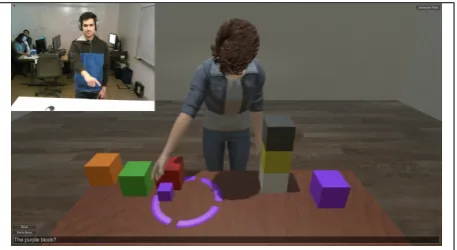
The sample interaction is adopted from functionality pre-sented in Krishnaswamy et al. (2017). In this scenario, a human and an avatar in the VoxSim environment must col-laborate to complete a simple construction task using vir-tual blocks that are manipulated by the avatar. The human has a plan or goal configuration that they must instruct the avatar to reach using a combination of gestures and nat-ural language instructions. The avatar in turn communi-cates through gestures and natural language output to re-quest clarification of ambiguous instructions or present its interpretation of the human’s commands. The human may indicate (point to) blocks and instruct the avatar to slide and move them relative to other blocks or relative to regions of the virtual table. The human must also respond to the avatar’s questions, when the avatar perceives an ambiguity in the human’s instructions.
3.
Hallmarks of Communication
As our goal in developing multimodal interactions is to achieve naturalistic communication, we must first examine what we mean by and desire out of an interaction such as that illustrated in Section 2.3.
Figure 2: Example interaction setup, showing human su-perimposed in upper left on avatar and VoxSim
goals and build off each other’s contributions, thereby con-veying the impression to the user that the computer system is experiencing the same events. We therefore build the evaluation scheme off of the following qualitative metrics:
1. Interaction has mechanisms to move the conversation forward (Asher and Gillies, 2003; Johnston, 2009) 2. System makes appropriate use of multiple modalities
(Arbib and Rizzolatti, 1996; Arbib, 2008)
3. Each interlocutor can steer the course of the interac-tion (Hobbs and Evans, 1980)
4. Both parties can clearly reference items in the in-teraction based on their respective frames of refer-ence (Ligozat, 1993; Zimmermann and Freksa, 1996; Wooldridge and Lomuscio, 1999)
5. Both parties can demonstrate knowledge of the chang-ing situation (Ziemke and Sharkey, 2001)
Many of these metrics are subjective, so we approach eval-uation from a semantics-centered perspective, and use dis-tinct semantic properties of specific elements in the inter-action to determine what about the interinter-action enabled or hindered “shared understanding.”
4.
Evaluation
A robust multimodal evaluation scheme should be able to be applied to a human-computer interaction on a novel sys-tem and return a result representative of the syssys-tem’s cov-erageof the total possible interactions within the system’s domain (e.g., construction tasks in a blocks world). To this end, a user must be truly naive, having very little to no knowledge of exactly what the system understands. This way, during evaluation, the user has their own definition of objects, actions, and events, and the system has its own. By interacting with the system, the human should be able to learn its ways of acting within the task domain, what it knows, and what it does not.
4.1.
Logging
The interaction consists of “moves” taken by each partici-pant, which are logged live during the interaction. For in-stance, in our sample scenario, we log:
• Gesture received by computer (i.e., made by human) • Word received by computer (i.e., spoken by human) • Gesture made by computer
• Action taken by computer
• Utterance made by computer
Each of these have VoxML semantics assigned to their con-tent.
An interlocutor’s understanding throughout the task can be inferred from the logged data by the time and number of moves taken to successfully communicate an instruction (e.g., successfully indicating a distinct object, successfully indicating an action to be taken, or any combination of the previous) or understanding of an instruction (e.g, acknowl-edging receipt of an instruction, asking a clarifying ques-tion, or executing an interpreted action). Longer time be-tween steps indicates more time needed for the human to think (either for interpretation or planning), or for the avatar to generate an interpretation of the human’s input, and more moves in the course of completing a single instruction indi-cates difficulty in communicating intended meaning. Having identified some proxy measures for the respective understanding of the human and the computer in the inter-action, the task then becomes quantifying how much the two accord.
4.2.
Data collection
We ran preliminary trials on the gesture interaction system heretofore described, with 20 individual human subjects, all computer science graduate students without prior knowl-edge of the avatar’s conceptual vocabulary. All subjects were presented with a scene with six uniquely-colored, identically-sized blocks and told to collaborate with the avatar to build a six-block, three-stepped staircase. They were told the computer was capable of understanding tures and speech but were not given specific words or ges-tures to use. We then logged each interaction from start to finish, defined as the point at which the human and com-puter had created a three-stepped staircase to the satisfac-tion of the human user.
4.3.
Post-processing
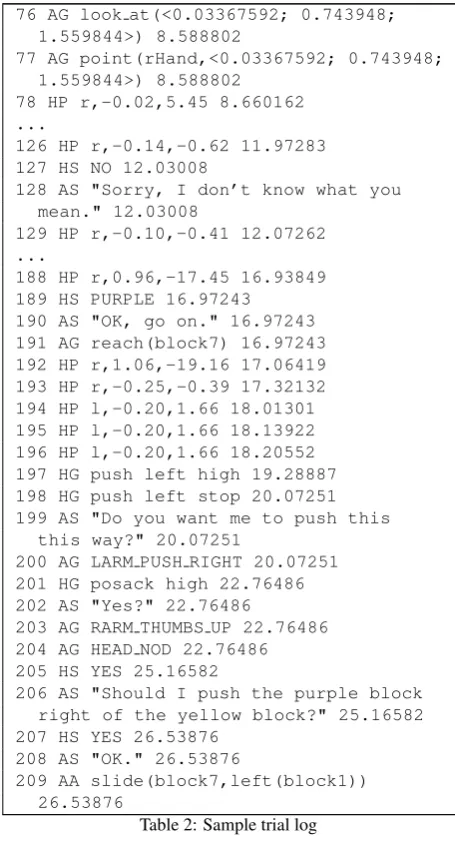
Consider the following output snippet from a sample trial. Beginning with the block setup in Figure 2, the human at-tempts to instruct the computer to select the purple block and slide it next to the yellow block. Moves are numbered, Gindicates gestures,Sindicates spoken words,Aindicates actions taken, andPindicates a continuously-updated mov-ing coordinate interpreted from the human user’s pointmov-ing and situated in the virtual world, as indicated by the purple circle in Figure 2. Each update in continuous pointing is in-terpreted as a separate move and multiple updates are elided in the example below for space reasons. PrefixedH indi-cates a human move while prefixedA indicates an avatar move. The description and interpretation of each gesture is laid out in Krishnaswamy et al. (2017) and above in Section 2.1. Time format is given as seconds after trial start.
1 HG engage start 1.145281
2 AS "Hello." 1.145281 3 HP r,-0.25,-0.87 4.889832 ...
73 HP r,-0.08,11.69 8.552608 74 HG right point high,-0.02,5.45
8.588802
76 AG look at(<0.03367592; 0.743948; 1.559844>) 8.588802
77 AG point(rHand,<0.03367592; 0.743948; 1.559844>) 8.588802
78 HP r,-0.02,5.45 8.660162 ...
126 HP r,-0.14,-0.62 11.97283
127 HS NO 12.03008
128 AS "Sorry, I don’t know what you
mean." 12.03008
129 HP r,-0.10,-0.41 12.07262
...
188 HP r,0.96,-17.45 16.93849 189 HS PURPLE 16.97243
190 AS "OK, go on." 16.97243 191 AG reach(block7) 16.97243
192 HP r,1.06,-19.16 17.06419 193 HP r,-0.25,-0.39 17.32132
194 HP l,-0.20,1.66 18.01301 195 HP l,-0.20,1.66 18.13922
196 HP l,-0.20,1.66 18.20552 197 HG push left high 19.28887 198 HG push left stop 20.07251
199 AS "Do you want me to push this this way?" 20.07251
200 AG LARM PUSH RIGHT 20.07251 201 HG posack high 22.76486
202 AS "Yes?" 22.76486
203 AG RARM THUMBS UP 22.76486
204 AG HEAD NOD 22.76486 205 HS YES 25.16582
206 AS "Should I push the purple block
right of the yellow block?" 25.16582 207 HS YES 26.53876
208 AS "OK." 26.53876
209 AA slide(block7,left(block1))
26.53876
Table 2: Sample trial log
As a proxy for the human’s understanding of an avatar move, we simply take the time elapsed between thefirstin a block of avatar moves uninterrupted by a human move, and the human response that follows. The avatar’s move can be gesture, action, utterance, or ensemble of multiple types, and multiple moves in a block often happen simultaneously (e.g., moves 199 and 200 here). Here, we can see that be-tween moves 190 and 192,0.092seconds elapsed, whereas between 202 and 205, 2.401seconds elapsed. These dif-ferences should reflect the clarity or expressiveness of the avatar’s move. We call this the human’s time tobegin re-sponse. The avatar’s utterance at 190 simply prompts the human to move to their next planned step, so the human can proceed without having to spend time interpreting it. The utterance at 202 is a question asking the human to confirm a move, which requires the human to process the preceding discourse and infer some of the computer’s intent in order to respond properly, possibly accounting for the longer re-sponse time.
Often, the human may make (or the gesture recognition may see) gestures that, in the current context, the avatar has no interpretation for, and thus the human makes multi-ple moves before the avatar responds. These circumstances are also captured by measuring the time between the first in
an uninterrupted block of moves by the human, and the first response by the avatar thereafter. Between steps 3 and 75, the human points around for3.699seconds before landing on a particular spot that the avatar asks to confirm. Later, 3.008seconds pass between the human’s moves beginning at 192 (responding to the avatar’s utterance at 190) and the avatar’s response to the subsequent content at 199, a length which may indicate difficulty moving the conversation for-ward. The system may be misinterpreting the gestures re-ceived or the human may be making gestures the system does not recognize. By contrast, when the human succeeds in producing contentful gestures or speech interpretable in context, the avatar is able to respond immediately as the input is processed (cf., moves 1-2, 201-202, 205-206) and move the conversation forward. We call this the avatar’s time to recognize content. The human may have trouble communicating something contentful at the beginning, but by the time context is established through deixis and object disambiguation, the avatar is able to advance the interaction by providing a possible interpretation of the human’spush instruction. These distinctions, if consistent across multi-ple trials, show areas where the communication between the interlocutors flows quickly or more slowly.
Response times may be charted against the semantic fea-tures of the moves that prompted the relevant response. As VoxML structures are componential, the distribution of response times can be plotted as a probability den-sity over the magnitude function of preceding moves that contain a given semantic feature. For instance, the re-sponse time to apush instruction, where the fingers must be pointed forward (as in Figure 1), can be compared to re-sponse times to acarryinstruction where the fingers must be curved. Response times can be divided with quantiles with a qselected for the desired granularity, and compa-rable moves should be those that occur in similar seman-tic contexts, that is,[mj−n..mj+n]wheremj is the move in question, examined in a window of size2n+ 1. Thus
P(ti|mj−n..mj..mj+n)represents the probability that a re-sponse time tfalls in an intervali given a move and sur-rounding context. Individual moves can be replaced by a VoxML semantic feature of the move. HigherPfor loweri
indicates a higher likelihood of understanding being shared through the move or semantic feature atmj.
5.
Preliminary Results
Here we present a selection of the some of the most interest-ing and illustrative results drawn from the pilot user studies. In each chart, the X-axis shows the quantile in which reac-tion times fall relative to all reacreac-tion times per agent for any move, and the Y-axis shows the probability that the reaction time to the move in question falls within that quantile (on a 0%-100% scale).q= 5 in these plots.
Figure 3: P(ti|M), for avatar time to recognize posi-tive/negative acknowledgment gesture (left top/bottom) vs. word “yes”/“no” (right top/bottom)
avatar appears to have a slightly quicker reaction time, in most cases, to positive acknowledgment through gesture than negative acknowledgment.
Figure 4: P(ti|M) for human time to begin response to [[PUSH]] gesture (left) vs. [[CARRY]] gesture (right)
Figure 5: Abbreviated gesture voxeme type structures: [[PUSH]] vs. [[CARRY]]
Figure 4 shows the distribution of times taken for the human to respond to the avatar making a [[PUSH]] or [[CARRY]] gesture. The distributions are roughly equivalent, favor-ing the mid-range, but [[PUSH]] is almost twice as likely as [[CARRY]] to have a “very quick” (first interval) re-sponse time and middle-quintile rere-sponse times are accord-ingly lower. The minimal distinction between [[PUSH]] and [[CARRY]] is the orientation and curvature of the hand and fingers, as shown in Figure 5, and so we can surmise that gestures with curved fingers might be harder for the human to interpret when compared to gestures with straight fingers (this evidences a conjecture made in Section 2.1.).
Figure 6: P(ti|M)for avatar time to recognize [[POINT]] gesture with the left hand (left) vs. right hand (right)
Figure 6 shows the distribution of times taken for the avatar to recognize a pointing gesture with the left and right hand, respectively. The distributions roughly track each other, but the avatar is notably quicker to recognize right-hand point-ing than left-hand pointpoint-ing. Semantically, these gestures are the same, with only the orientation of the extended finger relative to the hand flipped. A possible explana-tion is that the gesture recogniexplana-tion displays greater variance in detecting the coordinates denoted by left-hand pointing, which should be accounted for in the recognition model.
Figure 7: P(ti|M) for human time to begin response to avatar asking a question
Figure 7 shows the distribution of times taken for the human to respond to the avatar’s question. In most cases, the hu-man answers quickly, or takes a long time to answer. This may be caused by the human not hearing or realizing that a question has been asked, and since the system does not repeat itself, some time can pass before the human realizes the move to make to move the conversation forward. As developers, inferences like the above provide useful in-formation for improving our example system.
6.
Evaluation Variants
than any loss of understanding. Therefore we would like to present a set of variant and optional metrics to account for some of these potential omissions and test different aspects of the system under evaluation.
6.1.
Additional and Optional Metrics
One simple additional parameter to log is flagging those utterances that clearly indicate confusion, such as the avatar saying “I don’t understand,” or the human saying ”never mind,” or abruptly disengaging mid-interaction. This can easily be evaluated to determine the probability of obvious confusion given a semantic context.
Similarly, affirmative and negative responses can be incor-porated as a heuristic in determining when a block of moves should be initiated and terminated in evaluation. In Table 2, for instance, at move 75 the avatar asks the user if they are pointing at a particular location, and that question is an-swered with “No.” That entire span in the interaction indi-cates communication of the pointing concept from the hu-man to the avatar, but misinterpretation of the intent. If we were to treat that entire span as a block when calculating reaction time, rather than the raw human vs. avatar moves, we could glean additional information about the accuracy of pointing in the scenario.
6.2.
Variant Conditions
In the outline above, we begin trials having given the user little to no information about the computer’s vocabulary or capability. This allows evaluation to test the coverage of the system, but not necessarily how well the human adapts their behavior to the system. Therefore trials might also be conducted after the user has been presented with written de-scriptions of possible gestures (as in Section 2.1.), or after watching a video recorded from a successfully completed interaction, which would allow them to see gestures and known vocabulary in use. Both these conditions could al-low evaluation of how well the interaction functions within the known constraints on the vocabulary, and can test if training the user reduces error.
6.3.
User Feedback and “Ground Truth”
User reaction to the trial may be assessed by surveying them immediately following the interaction. For instance, they might rate certain moves by the avatar from clear to confusing, giving a qualitative rating of specific circum-stances. Additionally, users might provide live feedback during the trial by a “talkback mode,” wherein they could provide inputs such as the following:
• What user expects avatar to do following their move • Whether an avatar question is reasonable or not • Whether an avatar response is situationally
inappro-priate, incomplete, redundant, etc.
How can the overall success or failure of an interaction be assessed from the perspective of the computer system? At the beginning of the interaction, the target pattern might be fed into a planner that determines an optimal solution of moves to make on the part of both parties in order to build the target pattern (i.e., a ground truth solution), and at the completion of the interaction, the actually executed
interaction is compared to the optimal solution. This can be assessed using simple metrics, like edit distance.
6.4.
Scenario Variants and User Modeling
Blocks world tasks can serve as a proxy for situations re-quiring a collaborative interaction in a controlled environ-ment, but do risk missing information about what a user knows about other types of complex objects versus what a computer knows. Introducing non-block objects adds other parameters that can be conditioned against, such as how the interlocutors interpret each others’ behavior with con-vex objects vs. non-concon-vex objects, or round objects vs. flat ones. Would a human, for example, more readily ask an agent to roll a ball than roll a block, due to knowledge that ballsaffordbeing rolled (Gibson, 1977; Gibson, 1979)? This information can then be incorporated into the agent’s model of what its interlocutor knows about the vocabulary of available concepts. As the virtual agent becomes more and more certain that the human knows certain concepts or prefers certain moves, it may more readily execute them, or could even plan for expected user behavior.7.
Conclusion
We have proposed an evaluation scheme to assess the cov-erage of multimodal interaction systems and provided an outline of its use evaluating a sample interaction in a system that uses linguistic, gestural, and visual modalities. The ex-ample system exploits many advantages of virtual embod-iment (Kiela et al., 2016), but consistent evaluation is re-quired to test areas where the system needs improvement, and the framework outlined above can provide this infor-mation without very complicated algorithms to process the logged data. It uses simple metrics and processing based on object and event semantics. These properties are agnostic to the precise modalities used in a given interaction, and so the evaluation scheme accommodates measurement of various phenomena through the course of a human-computer inter-action in a multimodal system. We have presented prelim-inary results from naive users run through the sample sys-tem, which show how we can use simple metrics to assess the ease or difficulty with which specific features communi-cate information. We believe this type of evaluation will be useful for developing user models and helping researchers assess the gaps in novel computational interaction systems in a variety of modalities, scenarios, and interaction types.
8.
Acknowledgements
Research Projects Agency (DARPA), Contract W911NF-15-C-0238. Approved for Public Release, Distribution Un-limited. The views expressed are those of the authors and do not reflect the official policy or position of the Depart-ment of Defense or the U.S. GovernDepart-ment.
9.
Bibliographical References
Abadi, M., Barham, P., Chen, J., Chen, Z., Davis, A., Dean, J., Devin, M., Ghemawat, S., Irving, G., Isard, M., et al. (2016). TensorFlow: A system for large-scale machine learning. In Proceedings of the 12th USENIX Sympo-sium on Operating Systems Design and Implementation (OSDI). Savannah, Georgia, USA.
Andrist, S., Gleicher, M., and Mutlu, B. (2017). Looking Coordinated: Bidirectional Gaze Mechanisms for Col-laborative Interaction with Virtual Characters. In Pro-ceedings of the 2017 CHI Conference on Human Factors in Computing Systems, CHI ’17, pages 2571–2582, New York, NY, USA. ACM.
Arbib, M. and Rizzolatti, G. (1996). Neural expectations: A possible evolutionary path from manual skills to lan-guage. Communication and Cognition, 29:393–424. Arbib, M. A. (2008). From grasp to language:
embod-ied concepts and the challenge of abstraction. Journal of Physiology-Paris, 102(1):4–20.
Asher, N. and Gillies, A. (2003). Common ground, correc-tions, and coordination. Argumentation, 17(4):481–512. Asher, N. and Lascarides, A. (2003). Logics of
conversa-tion. Cambridge University Press.
Bolt, R. A. (1980). “Put-that-there”: Voice and gesture at the graphics interface, volume 14. ACM.
Brennan, S. E., Chen, X., Dickinson, C. A., Neider, M. B., and Zelinsky, G. J. (2008). Coordinating cognition: The costs and benefits of shared gaze during collaborative search.Cognition, 106(3):1465–1477, March.
Cassell, J., Stone, M., and Yan, H. (2000). Coordination and context-dependence in the generation of embodied conversation. In Proceedings of the first international conference on Natural language generation-Volume 14, pages 171–178. Association for Computational Linguis-tics.
Cassell, J. (2000). Embodied conversational agents. MIT press.
Clair, A. S., Mead, R., Matari´c, M. J., et al. (2010). Moni-toring and guiding user attention and intention in human-robot interaction. InICRA-ICAIR Workshop, Anchorage, AK, USA, volume 1025.
Clark, H. H. and Brennan, S. E. (1991). Grounding in communication. In Lauren Resnick, et al., editors, Per-spectives on Socially Shared Cognition, pages 13–1991. American Psychological Association.
Clark, H. H. and Wilkes-Gibbs, D. (1986). Referring as a collaborative process.Cognition, 22(1):1–39, February. Thierry Declerck, et al., editors. (2010). Semantic
Multi-media: 5th International Conference on Semantic and Digital Media Technologies, SAMT 2010. Saarbr¨ucken, Germany, December 1-3, 2010. Revised Selected Papers. Dillenbourg, P. and Traum, D. (2006). Sharing solutions: Persistence and grounding in multimodal collaborative
problem solving. The Journal of the Learning Sciences, 15(1):121–151.
Dumas, B., Lalanne, D., and Oviatt, S. (2009). Multimodal interfaces: A survey of principles, models and frame-works. Human machine interaction, pages 3–26. Eisenstein, J., Barzilay, R., and Davis, R. (2008a).
Dis-course topic and gestural form. InAAAI, pages 836–841. Eisenstein, J., Barzilay, R., and Davis, R. (2008b). Ges-ture salience as a hidden variable for coreference resolu-tion and keyframe extracresolu-tion. Journal of Artificial Intel-ligence Research, 31:353–398.
Fotinea, S.-E., Efthimiou, E., Koutsombogera, M., Dimou, A.-L., Goulas, T., and Vasilaki, K. (2016). Multimodal resources for human-robot communication modelling. In Nicoletta Calzolari (Conference Chair), et al., edi-tors,Proceedings of the Tenth International Conference on Language Resources and Evaluation (LREC 2016), Paris, France, May. European Language Resources As-sociation (ELRA).
Fussell, S. R., Kraut, R. E., and Siegel, J. (2000). Coordi-nation of Communication: Effects of Shared Visual Con-text on Collaborative Work. InProceedings of the 2000 ACM Conference on Computer Supported Cooperative Work, CSCW ’00, pages 21–30, New York, NY, USA. ACM.
Fussell, S. R., Setlock, L. D., Yang, J., Ou, J., Mauer, E., and Kramer, A. D. I. (2004). Gestures over Video Streams to Support Remote Collaboration on Phys-ical Tasks. Hum.-Comput. Interact., 19(3):273–309, September.
Gebre, B. G., Wittenburg, P., and Lenkiewicz, P. (2012). Towards automatic gesture stroke detection. In Proceed-ings of the Eighth International Conference on Language Resources and Evaluation (LREC-2012). European Lan-guage Resources Association (ELRA).
Gergle, D., Kraut, R. E., and Fussell, S. R. (2004). Ac-tion As Language in a Shared Visual Space. In Proceed-ings of the 2004 ACM Conference on Computer Sup-ported Cooperative Work, CSCW ’04, pages 487–496, New York, NY, USA. ACM.
Gibson, J. J. (1977). The theory of affordances. Perceiv-ing, ActPerceiv-ing, and Knowing: Toward an ecological psy-chology, pages 67–82.
Gibson, J. J. (1979). The Ecology Approach to Visual Per-ception: Classic Edition. Psychology Press.
He, K., Zhang, X., Ren, S., and Sun, J. (2016). Deep resid-ual learning for image recognition. In Proceedings of the IEEE Conference on Computer Vision and Pattern Recognition, pages 770–778.
Hobbs, J. R. and Evans, D. A. (1980). Conversation as planned behavior. Cognitive Science, 4(4):349–377. Hough, J. and Schlangen, D. (2016). Investigating fluidity
for human-robot interaction with real-time, real-world grounding strategies.
Jaimes, A. and Sebe, N. (2007). Multimodal human– computer interaction: A survey. Computer vision and image understanding, 108(1):116–134.
interna-tional conference on Multimodal interfaces, pages 47– 54. ACM.
Kennington, C., Kousidis, S., and Schlangen, D. (2013). Interpreting situated dialogue utterances: an update model that uses speech, gaze, and gesture information. Proceedings of SIGdial 2013.
Kiela, D., Bulat, L., Vero, A. L., and Clark, S. (2016). Virtual embodiment: A scalable long-term strat-egy for artificial intelligence research. arXiv preprint arXiv:1610.07432.
Kr¨amer, N. C., Simons, N., and Kopp, S. (2007). The ef-fects of an embodied conversational agent’s nonverbal behavior on user’s evaluation and behavioral mimicry. InInternational Workshop on Intelligent Virtual Agents, pages 238–251. Springer.
Kraut, R. E., Fussell, S. R., and Siegel, J. (2003). Visual Information As a Conversational Resource in Collabora-tive Physical Tasks. Hum.-Comput. Interact., 18(1):13– 49, June.
Krishnaswamy, N. and Pustejovsky, J. (2016a). Multi-modal semantic simulations of linguistically underspeci-fied motion events. InSpatial Cognition X: International Conference on Spatial Cognition. Springer.
Krishnaswamy, N. and Pustejovsky, J. (2016b). VoxSim: A visual platform for modeling motion language. In Pro-ceedings of COLING 2016, the 26th International Con-ference on Computational Linguistics: Technical Papers. ACL.
Krishnaswamy, N., Narayana, P., Wang, I., Rim, K., Ban-gar, R., Patil, D., Mulay, G., Ruiz, J., Beveridge, R., Draper, B., and Pustejovsky, J. (2017). Communicating and acting: Understanding gesture in simulation seman-tics. In12th International Workshop on Computational Semantics.
Lascarides, A. and Stone, M. (2006). Formal semantics for iconic gesture. InProceedings of the 10th Workshop on the Semantics and Pragmatics of Dialogue (BRAN-DIAL), pages 64–71.
Lascarides, A. and Stone, M. (2009a). Discourse coher-ence and gesture interpretation.Gesture, 9(2):147–180. Lascarides, A. and Stone, M. (2009b). A formal semantic
analysis of gesture.Journal of Semantics, page ffp004. Lemmel¨a, S., Vetek, A., M¨akel¨a, K., and Trendafilov, D.
(2008). Designing and evaluating multimodal interac-tion for mobile contexts. InProceedings of the 10th in-ternational conference on Multimodal interfaces, pages 265–272. ACM.
Ligozat, G. F. (1993). Qualitative triangulation for spatial reasoning. InEuropean Conference on Spatial Informa-tion Theory, pages 54–68. Springer.
Madeo, R. C. B., Peres, S. M., and de Moraes Lima, C. A. (2016). Gesture phase segmentation using sup-port vector machines.Expert Systems with Applications, 56:100–115.
Matuszek, C., Bo, L., Zettlemoyer, L., and Fox, D. (2014). Learning from unscripted deictic gesture and language for human-robot interactions. In AAAI, pages 2556– 2563.
Mehlmann, G., H¨aring, M., Janowski, K., Baur, T.,
Geb-hard, P., and Andr´e, E. (2014). Exploring a Model of Gaze for Grounding in Multimodal HRI. In Proceed-ings of the 16th International Conference on Multimodal Interaction, ICMI ’14, pages 247–254, New York, NY, USA. ACM.
Oviatt, S. (2003). User-centered modeling and evalua-tion of multimodal interfaces. Proceedings of the IEEE, 91(9):1457–1468.
Pustejovsky, J. and Krishnaswamy, N. (2016). VoxML: A visualization modeling language. In Nicoletta Calzo-lari (Conference Chair), et al., editors,Proceedings of the Tenth International Conference on Language Resources and Evaluation (LREC 2016), Paris, France, May. Euro-pean Language Resources Association (ELRA). Quek, F., McNeill, D., Bryll, R., Duncan, S., Ma, X.-F.,
Kirbas, C., McCullough, K. E., and Ansari, R. (2002). Multimodal human discourse: gesture and speech.ACM Transactions on Computer-Human Interaction (TOCHI), 9(3):171–193.
Rieser, H. and Poesio, M. (2009). Interactive gesture in dialogue: a PTT Model.
Skantze, G., Hjalmarsson, A., and Oertel, C. (2014). Turn-taking, feedback and joint attention in situated human-robot interaction. Speech Communication, 65:50–66, November.
Turk, M. (2014). Multimodal interaction: A review. Pat-tern Recognition Letters, 36:189–195.
Wang, I., Narayana, P., Patil, D., Mulay, G., Bangar, R., Draper, B., Beveridge, R., and Ruiz, J. (2017a). EGGNOG: A continuous, multi-modal data set of nat-urally occurring gestures with ground truth labels. InTo appear in the Proceedings of the 12th IEEE International Conference on Automatic Face & Gesture Recognition. Wang, I., Narayana, P., Patil, D., Mulay, G., Bangar, R.,
Draper, B., Beveridge, R., and Ruiz, J. (2017b). Explor-ing the use of gesture in collaborative tasks. In Proceed-ings of the 2017 CHI Conference Extended Abstracts on Human Factors in Computing Systems, CHI EA ’17, pages 2990–2997, New York, NY, USA. ACM.
Wooldridge, M. and Lomuscio, A. (1999). Reasoning about visibility, perception, and knowledge. In Interna-tional Workshop on Agent Theories, Architectures, and Languages, pages 1–12. Springer.
Zarrieß, S. and Schlangen, D. (2017). Deriving conti-nous grounded meaning representations from referen-tially structured multimodal contexts. InProceedings of the 2017 Conference on Empirical Methods in Natural Language Processing, pages 970–976.
Zhang, Z. (2012). Microsoft kinect sensor and its effect. IEEE MulitMedia, 19:4–10.
Ziemke, T. and Sharkey, N. E. (2001). A stroll through the worlds of robots and animals: Applying jakob von uexkull’s theory of meaning to adaptive robots and ar-tificial life. SEMIOTICA-LA HAYE THEN BERLIN-, 134(1/4):701–746.
![Figure 1: Sample gesture voxeme: [[PUSH]]](https://thumb-us.123doks.com/thumbv2/123dok_us/814101.1096415/2.595.306.534.70.174/figure-sample-gesture-voxeme-push.webp)
![Figure 4: P(ti|M) for human time to begin response to[[PUSH]] gesture (left) vs. [[CARRY]] gesture (right)](https://thumb-us.123doks.com/thumbv2/123dok_us/814101.1096415/5.595.322.514.341.483/figure-human-begin-response-push-gesture-carry-gesture.webp)