Young-Sook Hwang
, Sang-Bum Kim
, Hae-Chang Rim
1Dept. of Computer and Radio Communications Engineering, Korea University
2Institute of Future Technology, SK Telecom
1
{jlee,swlee,gwhong,rim}@nlp.korea.ac.kr,
2{yshwang,sangbum.kim}@sktelecom.com
Abstract
Statistical word alignment often suffers from data sparseness. Part-of-speeches are often incorporated in NLP tasks to reduce data sparseness. In this paper, we attempt to mitigate such problem by reflecting alignment tendency between part-of-speeches to statistical word alignment. Because our approach does not rely on any language-dependent knowledge, it is very simple and purely statistic to be applied to any language pairs. End-to-end evaluation shows that the proposed method can improve not only the quality of statistical word alignment but the performance of sta-tistical machine translation.
1
Introduction
Word alignment is defined as mapping corre-sponding words in parallel text. A word aligned parallel corpora are very valuable re-sources in NLP. They can be used in various applications such as word sense disambigua-tion, automatic construction of bilingual lexi-con, and statistical machine translation (SMT). In particular, the initial quality of statistical word alignment dominates the quality of SMT (Och and Ney 2000; Ganchev et al., 2008); almost all current SMT systems basically refer to the information inferred from word align-ment result.
One of the widely used approaches to statis-tical word alignment is based on the IBM models (Brown et al., 1993). IBM models are constructed based on words’ co-occurrence and positional information. If sufficient
train-ing data are given, IBM models can be suc-cessfully applied to any language pairs. How-ever, for minority language pairs such as Eng-lish-Korean and Swedish-Japanese, it is very difficult to obtain large amounts of parallel corpora. Without sufficient amount of parallel corpus, it is very difficult to learn the correct correspondences between words that infre-quently occur in the training data.
Part-of-speeches (POS), which represent morphological classes of words, can give valu-able information about individual words and their neighbors. Identifying whether a word is a noun or a verb can let us predict which words are likely to be mapped in word alignment and which words are likely to occur in its vicinity in target sentence generation.
Many studies incorporate POS information in SMT. Some researchers perform POS tag-ging on their bilingual training data (Lee et al., 2006; Sanchis and Sánchez, 2008). Some of them replace individual words as new words, such as in “word/POS” form, producing new, extended vocabulary. The advantage of this approach is that POS information can help to resolve lexical ambiguity and thus improve translation quality.
On the other hand, Koehn et al. (2007) pro-pose a factored translation model that can in-corporate any linguistic factors including POS information in phrase-based SMT. The model provides a generalized representation of a translation model, because it can map multiple source and target factors.
1) The POS information tagged to each word may help to disambiguate in selecting word correspondences, but the increased vocabulary can also make the training data more sparse.
2) The factored translation model may help to effectively handle out-of-vocabulary (OOV) by incorporating many linguistic factors, but it still crucially relies on the in-itial quality of word alignment that will dominate the translation probabilities. This paper focuses on devising a better method for incorporating POS information in word alignment. It attempts to answer the fol-lowing questions:
1) Can the information regarding POS align-ment tendency affect the post-processing of word alignment?
2) Can the result of word alignment affected by such information help improving the quality of SMT?
2
POS Alignment Tendency
Despite the language pairs, words with similar POSs often correspond to each other in statisti-cal word alignment. Similarly, words with dif-ferent POSs are seldom aligned. For example, Korean proper nouns very often align with English proper nouns very often but seldom align with English adverbs. We believe that this phenomenon occurs not only on English-Korean pairs but also on most of other lan-guage pairs.
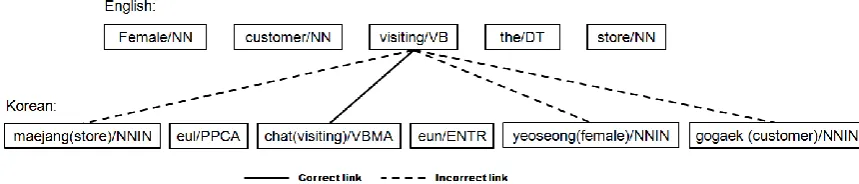
Thus, in this study we hypothesize that all source language (SL) POSs have some rela-tionship with target language (TL) POSs. Fig-ure 1 exemplifies some results of using the IBM Models in English-Korean word align-ment. As can be seen in the figure, the English word “visiting” is incorrectly and excessively aligned to four Korean morphemes “maejang”,
“chat”, “yeoseong”, and “gogaek”. One reason for this is the sparseness of the training data; the only correct Korean morpheme “chat” does not sufficiently co-occur with “visiting” in the training data. However, it is generally believed that an English verb is more likely aligned to a Korean verb rather than a Korean noun. Like-wise, we suppose that among many POSs, there are strong relationships between similar POSs and relatively weak relationships be-tween different POSs. We hypothesize that the discovery of such relationships in advance can lead to better word alignment results.
In this paper, we propose a new method to obtain the relationship from word alignment results. The relationships among POSs, hence-forth the POS alignment tendency, can be identified by the probability of the given POS pairs’ alignment result where the source lan-guage POS and the target lanlan-guage POS co-occur in bilingual sentences. We formulate this idea using the maximum likelihood estimation as follows:
( | ( ) ( ))
( ( ) ( )) ∑ * + ( ( ) ( ))
where f and e denote source word and target word respectively. count() is a function that returns the number of co-occurrence of f and e when they are aligned (or not aligned). Then, we adjust the formula with the existing align-ment score between f and e.
( ) ( )
( ) ( | ( ) ( ))
where PIBM(f |e) indicates the alignment prob-ability estimated by the IBM models. is a weighting parameter to interpolate the reliabili-ties of both alignment factors. In the
[image:2.595.80.510.81.173.2]riment, is empirically set to improve the word alignment performance ( =0.5).
3
Modifying Alignment
Based on the new scoring scheme as intro-duced in the previous section, we modify the result of the initial word alignment. The modi-fication is performed in the following proce-dure:
1. For each source word f that has out-bound alignment link other than null,
2. Find the target word e that has the maxi-mum alignment score according to the proposed alignment adjustment measure, and change the alignment result by map-ping f to e.
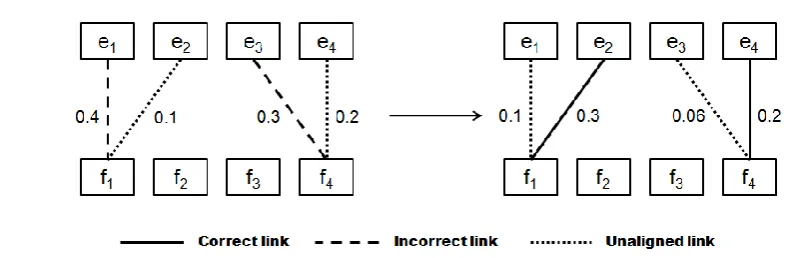
This modification guarantees that the number of alignment does not change; the algorithm is designed to minimize the risk by maintaining the fertility of a word estimated by the IBM Model. Figure 2 illustrates the result before and after the alignment modification. Incor-rectly links from e1 and e3 are deleted and
missing links from e2 and e4 are generated
dur-ing this alignment modification.
The alignment modification through the re-flection of POS alignment tendency is per-formed on both e-to-f and f-to-e bidirectional word alignments. The bidirectional word alignment results are then symmetrized.
4
Experiments
In this paper, we attempt to reflect the POS alignment tendency in improving the word alignment performance. This section provides the experimental setup and the results that demonstrate whether the proposed approach can improve the statistical word alignment
per-formance.
We collected bilingual texts from major bi-lingual news broadcasting sites. 500K sentence pairs are collected and refined manually to construct correct parallel sentences pairs. The same number of monolingual sentences is also used from the same sites to train Korean lan-guage. We also prepared a subset of the bilin-gual text with the size of 50K to show that the proposed model is very effective when the training set is small.
In order to evaluate the performance of word alignment, we additionally constructed a reference set with 400 sentence pairs. The evaluation is performed using precision, recall, and F-score. We use the GIZA++ toolkit for word alignment as well as four heuristic sym-metrizations: intersection, union, grow-diag-final, and grow-diag (Och, 2000).
4.1 Word Alignment
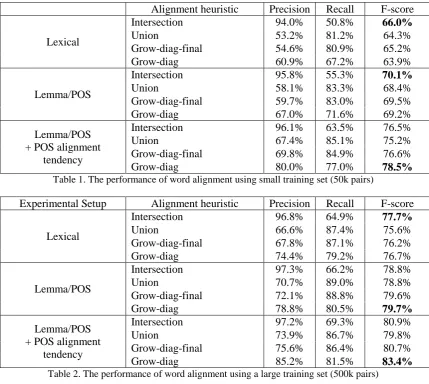
[image:3.595.83.481.73.202.2]We now evaluate the effectiveness of the pro-posed word alignment method. Table 1 and 2 report the experimental results by adding POS information to the parallel corpus. “Lexical” denotes the result of conventional word align-ment produced by GIZA++. No pre-processing or post-processing is applied in this result. “Lemma/POS” is the result of word alignment with the pre-processing introduced Lee et al. (2006). Compared to the result, lemmatized lexical and POS tags are proven to be useful information for word alignment. “Lemma/POS” consistently outperforms “Lexical” despite the symmetrization heuristics in terms of precision, recall and F-score. We expect this improve-ment is benefited from the alleviated data sparseness by using lemmatized lexical and POS tags rather than using the lexical itself.
Alignment heuristic Precision Recall F-score
Lexical
Intersection 94.0% 50.8% 66.0%
Union 53.2% 81.2% 64.3% Grow-diag-final 54.6% 80.9% 65.2% Grow-diag 60.9% 67.2% 63.9%
Lemma/POS
Intersection 95.8% 55.3% 70.1%
Union 58.1% 83.3% 68.4% Grow-diag-final 59.7% 83.0% 69.5% Grow-diag 67.0% 71.6% 69.2%
Lemma/POS + POS alignment
tendency
Intersection 96.1% 63.5% 76.5% Union 67.4% 85.1% 75.2% Grow-diag-final 69.8% 84.9% 76.6% Grow-diag 80.0% 77.0% 78.5% Table 1. The performance of word alignment using small training set (50k pairs)
Experimental Setup Alignment heuristic Precision Recall F-score
Lexical
Intersection 96.8% 64.9% 77.7%
Union 66.6% 87.4% 75.6% Grow-diag-final 67.8% 87.1% 76.2% Grow-diag 74.4% 79.2% 76.7%
Lemma/POS
Intersection 97.3% 66.2% 78.8% Union 70.7% 89.0% 78.8% Grow-diag-final 72.1% 88.8% 79.6% Grow-diag 78.8% 80.5% 79.7%
Lemma/POS + POS alignment
tendency
[image:4.595.82.512.77.461.2]Intersection 97.2% 69.3% 80.9% Union 73.9% 86.7% 79.8% Grow-diag-final 75.6% 86.4% 80.7% Grow-diag 85.2% 81.5% 83.4% Table 2. The performance of word alignment using a large training set (500k pairs)
Experimental Setup Symmetrization Heuristic BLEU(50k) BLEU (500k)
Lexical
Intersection 20.1% 29.2%
Union 18.6% 27.2%
Grow-diag-final 19.9% 27.7%
Grow-diag 20.2% 29.4%
Lemma/POS
Intersection 20.3% 26.4%
Union 18.5% 27.8%
Grow-diag-final 20.1% 29.2%
Grow-diag 20.4% 30.8%
Factored Model (Lemma, POS)
Intersection 20.5% 30.0%
Union 18.1% 27.5%
Grow-diag-final 20.3% 28.2%
Grow-diag 20.9% 31.1%
Lemma/POS + POS alignment
tendency
Intersection 21.8% 29.3%
Union 19.5% 27.2%
Grow-diag-final 21.3% 28.4%
Grow-diag 20.8% 29.1%
[image:4.595.85.512.468.696.2]Since lemmatized lexical and POS tags are shown to be useful, our post-processing meth-od is applied to “Lemma/POS”.
The experimental results show that the pro-posed method consistently improves word alignment in terms of F-score. It is interesting that the proposed method improves the recall of the intersection result and the precision of the union result. Thus, the proposed method achieves the best alignment performance.
As can be seen in Table 1 and 2, our method consistently improves the performance of word alignment despite the size of training data. In a small data set, the improvement of our method is much higher than that in a large set. This implies that our method is more helpful when the training data set is insufficient.
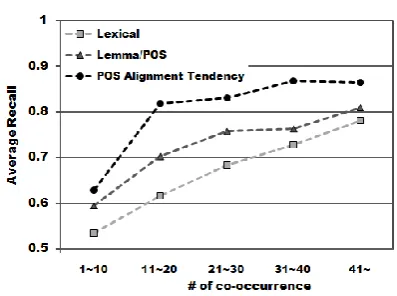
We investigate whether the proposed meth-od actually alleviates the data sparseness prob-lem by analyzing the aligned word pairs of low co-occurrence frequency. There are multiple word pairs that share the same number of co-occurrence in the corpus. For example, let us assume that “report-bogoha”, “newspaper-sinmun” and “China-jungguk” pairs are co-occurred 1,000 times. We can calculate the mean of their individual recalls. We refer to this new measurement as average recall. The average recalls of these pairs are relatively higher than those of pairs with low co-occurrence frequency such as “food-jinji” and “center-chojeom” pairs. These pairs are diffi-cult to be linked, because the word alignment model suffers from data sparseness when esti-mating their translation probability.
Figure 3 shows the average recall according to the number of co-occurrence. We can
ob-serve that the word alignment model tends to link word pairs more correctly if they are more frequently co-occurred. Both “Lemma/POS” and our method consistently show higher aver-age recall throughout all frequencies, and the proposed method shows the best performance. It is also notable that the both “Lemma/POS” and our method achieve much more improve-ment for low co-occurrence frequencies (e.g., 11~40). This implies that the proposed method incorporates POS information more effectively than the previous method, since the proposed method achieves much higher average recall.
4.2 Statistical Machine Translation
Next, we examine the effect of the improve-ment of the word alignimprove-ment on the translation quality. For this, we built some SMT systems with the word alignment results. We use the Moses toolkit for translation (Koehn et al., 2007). Moses is an implementation of phrase-based statistical machine translation model that has shown a state-of-the-art performance in various evaluation sets. We also perform the evaluation of the Factored model (Koehn et al., 2007) using Moses.
To investigate how the improved word alignment affect the quality of machine lation, we calculate the BLEU score for trans-lation results with different word alignment settings as shown in Table 3. First of all, we can easily conclude that the quality of the translation is strongly dominated by the size of the training data. We can also find that the quality of the translation is correlated to the performance of the word alignment.
[image:5.595.94.293.72.220.2]For a small test set, the proposed method achieved the best performance in terms of BLEU (21.8%). For a larger test set, however, the proposed method could not improve the performance of the translation with better word alignment. It is not feasible to investigate the factors that affect this deterioration, since Mo-ses is a black box module to our system. The training of the phrase-based SMT model in-volves the extraction of phrases, and the result of word alignment is reflected within this pro-cess. When the training data is small, the num-ber of extracted phrases is also apparently small. However, abundant phrases are extract-ed from a large amount of training data. In this case, we hypothesize that the most plausible
phrases are already obtained, and the effect of more accurate word alignment seems insignifi-cant. More thorough analysis of this is re-mained as future work.
4.3 Acquisition of Bilingual Dictionary
One of the most applications of word align-ment is the construction of bilingual dictionar-ies. By using word alignment, we can collect a (ranked) list of bilingual word pairs. Table 4 reports the top 10 translations (the most ac-ceptable target words to align) for Korean word “bap” (food). The table contains the probabilities estimated by the IBM Models, the adjusted scores, and the number of co-occurrence, respectively. Italicized translations are in fact incorrect translations. Highlighted ones are new translation candidates that are correct. As can be seen in the table, the pro-posed approach shows a positive effect of rais-ing new and better candidates for translation. For example, “bread” and “breakfast” have come up to the top 10 translations. This demonstrates that the low co-occurrences of “bap” with “bread” and “breakfast” are not suitably handled by alignments solely based on lexicals. However, the proposed approach ranks them at higher positions by reflecting the alignment tendency of POSs.
5
Conclusion
In this paper, we propose a new method for incorporating the POS alignment tendency to improve traditional word alignment model in post processing step. Experimental results show that the proposed method helps to allevi-ate the data sparseness problem especially
when the training data is insufficient.
It is still difficult to conclude that better word alignment always leads to better transla-tion. We plan on investigating the effective-ness of the proposed method using other trans-lation system, such as Hiero (Chiang et al., 2005). We also plan to incorporate our method into other effective models, such as Factored translation model.
References
David Chiang et al., 2005. The Hiero machine translation system: Extensions, evaluation, and analysis. In Proc. of HLT-EMLP:779–786, Oct.
Franz Josef Och. 2000. Giza++: Training of statis-tical translation models. Available at
http://www-i6.informatik.rwthaachen.de/∼och/software/GIZA+ +.html.
Franz Josef Och & Hermann Ney. 2003. A System-atic Comparison of Various Statistical Alignment Models. Computational Linguistics 29 (1):19-51.
G. Sanchis and J.A. Sánchez. Vocabulary exten- sion via POS information for SMT. In Mixing Approaches to Machine Translation, 2008.
Jonghoon Lee, Donghyeon Lee and Gary Geunbae Lee. Improving Phrase-based Korean-English Sta-tistical Machine Translation. INTERSPEECH 2006.
Kuzman Ganchev, Joao V. Graca and Ben Taskar. 2008. Better Alignments = Better Translations? Proceedings of ACL-08: HLT: 986–993.
Peter F. Brown et al.,1993. The Mathematics of Statistical Machine Translation: Parameter Esti-mation. Computational Linguistics 9(2): 263-311
Rank IBM Model POS Alignment Tendency translation ( ) #co-occur translation ( ) #co-occur 1 2 3 4 5 6 7 8 9 10 bob/NNP rice/NN eat/VB meal/NN food/NN bob/NN feed/VB cook/VB living/NN dinner/NN 0.348 0.192 0.107 0.075 0.043 0.038 0.010 0.010 0.008 0.008 83 73 57 43 29 10 7 9 4 10 bob/NNP rice/NN meal/NN food/NN eat/VB bob/NN living/NN dinner/NN bread/NN breakfast/NN 0.214 0.136 0.078 0.062 0.061 0.059 0.045 0.044 0.044 0.043 83 73 43 29 57 10 4 10 9 6
Philipp Koehn and Hieu Hoang. Factored Transla-tion Models. EMNLP 2007.