Discriminant Ranking for Efficient Treebanking
Yi Zhang Valia Kordoni
LT-Lab, German Research Center for Artificial Intelligence (DFKI GmbH) Department of Computational Linguistics, Saarland University
{yzhang,kordoni}@coli.uni-sb.de
Abstract
Treebank annotation is a labor-intensive and time-consuming task. In this paper, we show that a simple statistical ranking model can significantly improve treebank-ing efficiency by prompttreebank-ing human an-notators, well-trained in disambiguation tasks for treebanking but not necessarily grammar experts, to the most relevant lin-guistic disambiguation decisions. Experi-ments were carried out to evaluate the im-pact of such techniques on annotation ef-ficiency and quality. The detailed analysis of outputs from the ranking model shows strong correlation to the human annotator behavior. When integrated into the tree-banking environment, the model brings a significant annotation speed-up with im-proved inter-annotator agreement.†
1 Introduction
The development of a large-scale treebank (Mar-cus et al., 1993; Hajiˇc et al., 2000; Brants et al., 2002) with rich syntactic annotations is a highly rewarding task. But the huge amount of man-ual labor required for the annotation task itself, as well as the difficulties in standardizing linguis-tic analyses, results in long development cycles of such valuable language resources, which typ-ically amounts to years or even decades. Despite the profound scientific and practical value of de-tailed syntactic treebanks, the requirement and ne-cessity for long-term commitment raises the risk †The first author thanks the German Excellence Cluster
of Multimodal Computing and Interaction for the support of the work.
cost of such projects, a fact which often makes them not feasible in many current economical en-vironments.
In recent years, computational grammars have been employed to assist the construction of such language resources. A typical development model involves a parser which generates candidate anal-yses, and human annotators who manually iden-tify the desired tree structure. This treebanking method dramatically reduces the cost of train-ing annotators, for they are not required to spon-taneously produce linguistic solutions to vari-ous phenomena. Instead, they are trained to associate their language intuition with specific linguistically-relevant decisions. How to select and carefully present such decisions to the notators is thus crucial for achieving high an-notation speed and quality. On the other hand, for large treebanking projects, parallel annota-tion with multiple annotators is usually neces-sary. Inter-annotator agreement is a crucial quality measure in such cases. But improvements on an-notation speed should not be achieved at expense of the quality of the treebank.
ones, which enables well-trained human annota-tors to speed-up treebanking without compromis-ing on the quality of the lcompromis-inguistic decisions guid-ing the annotation task.
The remaining of this paper is structured as fol-lows: Section 2 gives an overview of the diffi-culties in syntactic annotation, and the potential ways of improving the annotation efficiency with-out damaging the quality; Section 3 presents the new annotation method which is based on a statis-tical discriminant ranking model; Sections 4 and 5 describe the setup and results of a series of anno-tation experiments; Section 6 concludes the paper and proposes future research directions.
2 Background
Large-scale full syntactic annotation has for quite some time been approached with mixed feelings by researchers. On the one hand, detailed syn-tactic annotation serves as a basis for corpus-linguistic study and data-driven NLP methods. Especially, when combined with popular super-vised machine learning methods, richly annotated language resources, like, for instance, treebanks, play a key role in modern computational linguis-tics. The public availability of large-scale tree-banks in recent years has stimulated the blossom-ing of data-driven approaches to syntactic and se-mantic parsing.
On the other hand, though, the creation of de-tailed syntactic structures turns out to be an ex-tremely challenging task. From the choice of the appropriate linguistic framework and the de-sign of the annotation scheme to the choice of the text source and the working protocols on the syn-cronization of the parallel development, as well as the quality assurance, none of these steps in the entire annotation procedure is considered a solved issue. Given the vast design choices, very few of the treebanking projects have made it through all these difficult annotation stages. Even the most outstanding projects have not been com-pleted without receiving criticisms.
Our treebanking project is no exception. The aim of the project is to provide annotations of the Wall Street Journal (henceforward WSJ) sections of the Penn Treebank (henceforward PTB (Marcus et al., 1993)) with the help of
the English Resource Grammar (henceforward ERG; (Flickinger, 2002)), a hand-written large-scale and wide-coverage grammar of English in the framework of Head-Driven Phrase Structure Grammar (HPSG; (Pollard and Sag, 1994)). Such annotations are very rich linguistically, since apart from syntax they also incorporate semantic infor-mation. The annotation cycle is organized into iterations of parsing, treebanking in the sense of disambiguating syntactic and semantic analyses of the various linguistic phenomena contained in the corpus, error analysis and grammar/treebank update cycles. That is, sentences from theWSJ are first parsed with the PET parser (Callmeier, 2001), an efficient unification-based parser, using the ERG. The parsing results are then manually disambiguated by human annotators. However, instead of considering individual trees, the annota-tion process is mostly invested on binary decisions which are made on either accepting or rejecting constructions or lexical types. Each of such deci-sions, called discriminants, as we will also see in the following, reduces the number of the trees sat-isfying the constraints. The process is presented in the next section in more detail. What should, though, be clear is that the aforementioned multi-cycle annotation procedure is as time-consuming and human-error prone as any other, despite the fact that at the center of the entire annotation cy-cle lies a valuable linguistic resource, which has been developed with a lot of effort over many years, namely theERG. For the first period of this project, we have established an average speed of 40 sentences per annotator hour, meaning a total of∼1200 hours of annotation for the entireWSJ. Including the long training period at the beginning of the project, and periodical grammar and tree-bank updates, the project period is roughly two years with two part-time annotators employed.
3 Statistical Discriminant Ranking
3.1 Discriminants & Decisions
to extensively in the following, is that the can-didate trees are constructed automatically by the grammar, and then manually disambiguated by human annotators. In doing so, linguistically rich annotation is built efficiently with minimum man-ual labor. In order to further improve the manman-ual disambiguation efficiency, systems like [incr tsdb()](Oepen, 2001) compute the difference between candidate analyses. Instead of looking at the huge parse forest, the treebank annotators se-lect or reject the features that distinguish between different parses, until no ambiguity remains (ei-ther one analysis is accepted from the parse forest, or all of them are rejected). The number of deci-sions for each sentence is normally aroundlog2n
where n is the total number of candidate trees.
For a sentence with 5000 candidate readings, only about 12 treebanking decisions are required for a complete disambiguation. A similar method was also proposed in (Carter, 1997).
Formally, an attribute that distinguishes be-tween different parses is called a discriminant. For Redwoods-style treebanks, this is extracted ei-ther from the syntactic derivation trees or the se-mantic representations (in the form of Minimal Recursion Semantics (MRS; (Copestake et al., 2005))).
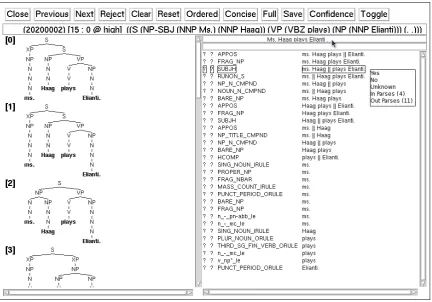
Figure 1 shows an example graphical annota-tion interface. At the top of the window, a list of action buttons shows the operations permitted on the sentence level. Then the sentence in its original PTB bracket format is shown. 15 : 0
indicates that at the current disambiguation state,
15 trees remain to be disambiguated while0 has
been eliminated. On the left large panel, the can-didate trees are shown in their simplified phrase-structure representation. Note that the actual HPSG analyses are not shown in the screenshot and can be displayed on request. On the right large panel, the list of effective discriminants (see Sec-tion 3.2) up to this disambiguaSec-tion state is shown. The highlighted discriminant in Figure 1 suggests a possibility of constructing the entire sentence by choosing a subject-head rule (SUBJH), taking“ms.
Haag” as the subject and“plays Elianti.” as the head daughter. When the discriminant is clicked, the annotator can sayyes or no to it, hence nar-rowing the remaining trees to theIn ParsesorOut
Parses. Theunknownbutton is used to mark the uncertainties and is rarely used.
Note that in this interface, the discriminants are sorted in descending order according to their length, meaning that the discriminants related to higher level constructions are shown before the lexical type choices. When up to 500 parses are stored in the forest, the average number of discriminants per forest is about 100. Scan-ning through the long list manually can be time-consuming and distracting.
Kordoni and Zhang (2009) show that annota-tors tend to start with the decisions with the most certainty, and delay the “hard” decisions as much as possible. As the decision progresses, many of the “hard” discriminants will receive an inferred value from the certain decisions. Our annotation guideline only describes specific decisions. The order in which discriminants are chosen is left un-derspecified and very much depends on personal styles. In practice, we see that our annotators gradually developed complex strategies which in-volve both top-down and bottom-up pruning.
One potential drawback of such a discriminant-based treebanking method is that the process is very sensitive to decision errors. One wrong judg-ment can rule out the correct tree and ruin the analysis of the sentence. In such a case, the an-notators usually resort to backtracking to previous decisions they had made. To compensate for this, we ask our annotators to double-check the tree-banked analysis before saving the disambiguation result. And in case of doubt, they are instructed to avoid ambivalent decisions as much as possible.
3.2 Maximum-Entropy-Based Discriminant Ranking Model
Suppose for a sentence ω, a parse forestY was
generated by the grammar. Note that for effi-ciency reasons, the parse forest might have been trimmed to only contain up to n top readings
ranked by the parse disambiguation model. For convenience, we note the parse forestY as a set
of parses {y1, y2, . . . , yn}. Each discriminantd
defines a binary valued function δ on the parse forest (δ : Y 7→ {0,1}) , which can be inter-preted as whether a parseyihas attributedor not.
Figure 1: Screenshot of the discriminant-based treebanking graphical annotator interface
function defines a bi-partition of the parse forest. When both subsets of the partition are non-empty, i.e., there exists at least one yp and yq such that
δ(yp) = 0andδ(yq) = 1, the discriminant is
con-sideredeffectiveon the forestY. In the following discussion, we are only considering the set of ef-fective discriminantsDfor parse forestY.
Instead of directly predicting the outcome of disambiguation decision on each discriminant (i.e., whether the GOLD tree has discriminant
function value 0 or 1), our model tries to measure the probability of a discriminant being chosen by human annotators, regardless of the yes/no deci-sion. For each discriminantd, and the parse forest Y, a set of feature functionsf1, f2, . . . , fkreceive
real values, and contribute to the following log-linear model:
P(d|Y, D) = exp(
Pk
i=1λifi(d, Y))
P
d0∈Dexp(Pki=1λifi(d0, Y))
(1) where λ1, λ2, . . . , λk are the parameters of the
model.
To estimate these model parameters, we gather the annotation logs from our treebank annotators on the completed datasets with detailed informa-tion about each discriminant. Apart from the necessary information to reconstruct the discrim-inants from the forest, the log also contains the status information of i) whether the discriminant takes value 0 or 1 on the gold tree; ii) whether the human annotator has saidyesornoto the dis-criminant. Note that the human annotator does not need to manually decide on the value of each dis-criminant. Whenever a new decision is made, the forest will be pruned to the subset of trees compat-ible with the decision. And all remaining discrim-inants are checked for effectiveness on the pruned forest. Discriminants which become ineffective from previous decisions are said to have received inferredvalues.
es-timation toolkit TADM1. For training, we use
all the manually disambiguated discriminants as positive instances, and automatically inferred dis-criminants as negative instances.
The discriminant ranking model is applied dur-ing the manual annotation sessions. When a parse forest is loaded and the discriminants are con-structed, each discriminant is assigned an (un-normalized) score Pk
i=1λifi(d, Y), and the list
of discriminants is sorted by descending order of the score accordingly. The scoring and sort-ing adds negligible additional computation on the treebanking software, and is not noticeable to the human annotators. By putting those discriminants that are potentially to be manually judged near the top of the list, the model saves manual labor on scanning through the lengthy list by filtering out ambivalent discriminants.
Note that this discriminant ranking model pre-dicts the possibility of a discriminant being man-ually disambiguated. It is not modeling the spe-cific decision that the human annotator makes on the discriminant. Including the decision outcome in the model can potentially damage the annota-tion quality if annotators develop a habit of over-trusting the model prediction, making the whole manual annotation pointless. A discriminant rank-ing model, however, only suggestively re-orders the discriminants on the presentation level, which are much safer when the annotation quality is con-cerned.
3.3 Feature Model for Syntactic Discriminants
In practice, there are different ways of finding dis-criminants from the parse forest. For instance, the [incr tsdb()]system supports both syntax-based and semantics-syntax-based discriminants. The syntax-based discriminants are extracted from the derivation trees of theHPSG analyses. AllHPSG rule applications (unary or binary) and choices of lexical entries are picked as candidate dis-criminants and checked for effectiveness. The semantics-based discriminants, on the other hand, represent the differences on the semantic struc-tures (MRS in the cases of DELPH-IN2
gram-1http://tadm.sourceforge.net/ 2http://www.delph-in.net/
mars). With a few exceptions, manyDELPH-IN HPSG treebanks choose to use the syntactic dis-criminants which allow human annotators to pick the low-level constructions. The above proposed ranking model works for different types of dis-criminants (and potentially a mixture of different discriminant types). But for the evaluation of this paper, we show the feature model designed for the syntactic discriminants only.
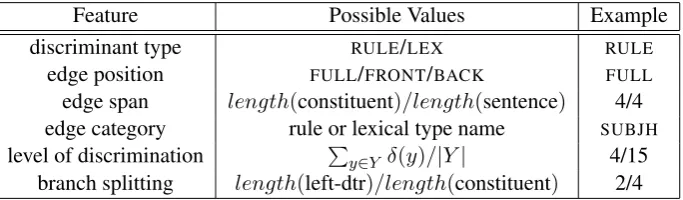
The syntactic discriminants record the differ-ences between derivation trees by memorizing di-rect rule applications and lexical choices. Beside the rule or lexical entry name, the discriminant also records the information concerning the corre-sponding constituent, e.g., the category and span-ning of the constituent, the parent and daughters of the constituent, etc. Furthermore, given the dis-criminantdand the parse forestY, we can calcu-late the distribution of parses over the value of the discriminant functionδ, which can be
character-ized byPy∈Y δ(y)/|Y|. This numeric feature
in-dicates how many parses can be ruled out with the given discriminant.
As example, for the highlighted discriminant in Figure 1, the extracted features are listed in Ta-ble 1.
4 Experiment Setup
To test the effectiveness of the discriminant rank-ing models, we carried out a series of experi-ments, investigating their effects on both annota-tion speed and quality. The experiment was done in the context of our ongoing annotation project of theWSJsections of thePTBdescribed in Sec-tion 2. Despite sharing the source of texts, the new project aims to create an independently an-notated corpus. Therefore, the trees from thePTB were not used to guide the disambiguation pro-cess. In this annotation project, two annotators (both graduate students, referred to as A and B below) are employed to manually disambiguate the parsing outputs of the ERG. For quality con-trol and adjudication in case of disagreement, a third linguist/grammarian annotates parts of the treebank in parallel.
mod-Feature Possible Values Example
discriminant type RULE/LEX RULE
edge position FULL/FRONT/BACK FULL
edge span length(constituent)/length(sentence) 4/4
edge category rule or lexical type name SUBJH
level of discrimination Py∈Y δ(y)/|Y| 4/15
branch splitting length(left-dtr)/length(constituent) 2/4
Table 1: Features for syntactic discriminant ranking model and example values for the highlighted discriminant in Figure 1
els with the datasets completed so far: MODEL -A and MODEL-B trained with annotation logs
from two annotators separately, and MODEL -BOTHtrained jointly with data from both
annota-tors. For each annotator’s model (MODEL-A and MODEL-B), we used about 6,000 disambiguated
parse forests for training. For each of these 6,000 forests, the log file contains about 600,000 effec-tive discriminants, among which only ∼6% re-ceived a manual decision.
To evaluate the treebanking speed, we have the annotators work under a distraction-free en-vironment and record their annotation speed. The speed is averaged over several 1-hour annotation sessions. Different discriminant ranking models were used without the annotators being informed of the details of the setting.
As testing dataset, we use the texts from the PARC 700 Dependency Bank (King et al., 2003), which include 700 carefully selected sentences from the WSJ sections of the PTB. These sen-tences were originally chosen for the purpose of parser evaluation. Many linguistically challeng-ing phenomena are included in these sentences, although the sentence length is shorter in average than the sentence length in the entire WSJ. The language is also less related to the financial do-main specific language observed in theWSJ. We parsed the dataset with the Feb. 2009 version of the ERG, and recorded up to 500 trees per sen-tence (ranked by a MaxEnt parse selection model trained on previously treebankedWSJsections).
5 Results
Although we employed a typical statistical rank-ing model in our system, it is difficult to directly
evaluate the absolute performance of the predicted ranking. Annotators only annotate a very small subset of the discriminants, and their order is not fully specified. To compare the behavior of mod-els trained with data annotated by different anno-tators, we plot the relative ranking (normalized to
[0,1]for each sentence, with0 being the highest
rank and1the lowest) of discriminants for 50
sen-tences in Figure 2.
The plot shows a strong positive linear correla-tion between the two ranking models. The partic-ularly strong correlation at the low and high ends of the ranking shows that the two annotators share a similar behavior pattern concerning the most and least preferred discriminants. The correlation is slightly weaker in the middle ranking zone, where different preferences or annotation styles can be observed.
To further visualize the effect of the ranking model, we highlighted with color the discrimi-nants which are manually annotated by annotator B under a basic setting without using the ranking models. 75% of these “prominent” discriminants are grouped within the top-25% region of the plot. Without surprise, the model B gives an average relative ranking of 0.18 as oppose to 0.21 with model A. The overall distribution of rankings for manually disambiguated discriminants are shown in Figure 3.
0 0.2 0.4 0.6 0.8 1
0 0.2 0.4 0.6 0.8 1
Model B Ranking
Model A Ranking
Figure 2: Correlation of discriminant ranks with different models and manual annotation
0 10 20 30 40 50 60
0 0.05 0.1 0.15 0.2 0.25 0.3 0.35 0.4 0.45 0.5 0.55 0.6 0.65 0.7 0.75 0.8 0.85 0.9 0.95 1
Number of Discriminants
Relative Ranking
Model A Model B
Figure 3: Histogram of rankings given by two models on discriminants manually picked by an-notator B
ing their own ranking model. The peer-model refers to the annotation sessions where the annota-tors use their peer colleague’s model. And finally, the joint-model refers to the annotations done by the jointly trained model.
The annotation efficiency was boosted by over 50% with all the discriminant ranking models. The own-model setting achieved best speed. This is probably due to the fact that the model most closely reflects the annotation habit of the annota-tor. But the advantage over other models is very small.
To measure the inter-annotator agreement, we calculate the Cohen’s KAPPA (Carletta, 1996) on
the constituents of the derivation trees:
κ= P r(a)−P r(e)
1−P r(e) (2)
Ranking Model Speed (s/h) Speed-up (%)
Baseline 61.9 –
Own-model 96.1 55%
Peer-model 94.6 53%
Joint-model 95.0 53%
Table 2: Average annotation speed with different discriminant ranking models
where P r(a) is the relative observed agreement
between annotators, andP r(e) is the probability
of two annotators agreeing by chance. The calcu-lation ofP r(a) can be done in a similar way to
the calculation of PARSEVAL labeled bracketing
accuracy, whileP r(e) is estimated by averaging
the agreement over a large set of tree pairs ran-domly sampled from the parse forest. Since the calculation ofκtakes into account the agreement
occurring by chance, it is a safer (though has the tendency of being overly conservative) measure of agreement.
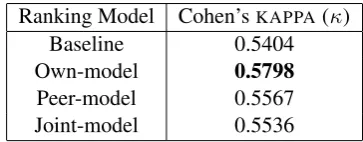
Ranking Model Cohen’sKAPPA(κ) Baseline 0.5404 Own-model 0.5798
Peer-model 0.5567 Joint-model 0.5536
Table 3: Inter-annotator agreement measured by constituent-level Cohen’sKAPPA
The numbers in Table 3 show that the use of discriminant ranking models results in a small im-provement to the inter-annotator agreement, with the best agreement achieved by each annotator us-ing the model trained with their own annotation records. These numbers are comforting in that the annotation quality is not damaged by our new way to present the linguistic decisions.
agreement level atκ = 0.6. Given the highly
de-tailed linguistic annotations specified by the gram-mar (over 260 rules and 800 lexical types), this figure indicates a very substantial agreement be-tween our annotators. Our further investigation has shown that the agreement figure hits the ceil-ing at aroundκ = 0.65. Further training and
dis-cussion is not rewarded with sustainable improve-ment of annotation quality.
Apart from the numerical evaluation, we also interview our annotators for subjective feelings about the various ranking models. There is gen-erally a very positive attitude towards all the rank-ing models over the baseline. An easily decid-able discriminant is usually found within the top-3 with very few exceptions, which leads to a self-noticeable speed-up that confirms our numeric findings. It is also interesting to note that, de-spite the substantial difference between the statis-tical models, the difference is hardly noticed by the annotators. And the results only show small variations in both the annotation speed, as well as the inter-annotator agreement.
The annotators also claim that the speed-up is somewhat diminished over the “rejected” sen-tences, for which none of the candidate trees are acceptable. In such cases, the annotators still have to go through a long sequence of discriminants, and sometimes have to redo the previous steps in fear of the chain-effect of wrong decisions. How to compensate for the psychological insatisfaction of rejecting all analyses while maintaining good annotation speed and quality is a new topic for our future research.
6 Conclusion & Future Work
We propose to use a statistical ranking model to assist the discriminant-based treebank annotation. Our experiment shows that such a model, trained on annotation history, brings a huge efficiency im-provement together with slightly improved inter-annotator agreement.
Although the reported experiments were car-ried out on the specific HPSG treebank, we be-lieve that the proposed ranked discriminant-based annotation method can be applied in annotation tasks concerning different linguistic frameworks, or even different layers of linguistic
representa-tion. Apart from the specific features presented in Section 3.3, the model itself does not assume a phrase-structure tree annotation, and the discrimi-nants can take various forms. Assuming a “gram-mar” produces a number of candidate analyses, the annotators can rely on the ranking model to ef-ficiently pick relevant discriminants, and focus on making linguistically relevant decisions. This is especially suitable for large annotation tasks aim-ing for parallel rich annotation by multiple anno-tators, where fully manual annotation is not fea-sible and high inter-annotator agreement hard to achieve.
The ranking model is based on annotation his-tory and influences the future progress of tree-banking. It can be dynamically integrated into the treebank development cycles in which the anno-tation habit evolves over time. Such a model can also shorten the training period for new annota-tors, which is an interesting aspect for our future investigation.
From a different point of view, the rankings of the discriminants show annotators’ confidence on various ambiguities. The clearly uneven distri-bution over discriminants can also provide gram-mar writers with interesting feedback, helping with the improvement of the linguistic analysis. We would also like to integrate confidence mea-sures into the computer-assisted treebank tion process, which could potentially help annota-tors make difficult decisions, such as whether to reject all trees for a sentence.
References
[Brants et al.2002] Brants, Sabine, Stefanie Dipper, Silvia Hansen, Wolfgang Lezius, and George Smith.
2002. The tiger treebank. In Proceedings of
the workshop on treebanks and linguistic theories, pages 24–41.
[Callmeier2001] Callmeier, Ulrich. 2001.
Effi-cient parsing with large-scale unification gram-mars. Master’s thesis, Universit¨at des Saarlandes, Saarbr¨ucken, Germany.
[Carletta1996] Carletta, Jean. 1996. Assessing agree-ment on classification tasks: the kappa statistic. Computational Linguistics, 22(2):249–254. [Carter1997] Carter, David. 1997. The treebanker: a
Proceedings of the ACL Workshop on Computa-tional Environments for Grammar Development and Linguistic Engineering, pages 9–15, Madrid, Spain.
[Copestake et al.2005] Copestake, Ann, Dan
Flickinger, Carl J. Pollard, and Ivan A. Sag. 2005. Minimal recursion semantics: an
introduc-tion. Research on Language and Computation,
3(4):281–332.
[Flickinger2002] Flickinger, Dan. 2002. On build-ing a more efficient grammar by exploitbuild-ing types. In Oepen, Stephan, Dan Flickinger, Jun’ichi Tsu-jii, and Hans Uszkoreit, editors,Collaborative Lan-guage Engineering, pages 1–17. CSLI Publications. [Hajiˇc et al.2000] Hajiˇc, Jan, Alena B¨ohmov´a, Eva Hajiˇcov´a, and Barbora Vidov´a-Hladk´a. 2000. The Prague Dependency Treebank: A Three-Level An-notation Scenario. In Abeill´e, A., editor,Treebanks: Building and Using Parsed Corpora, pages 103– 127. Amsterdam:Kluwer.
[King et al.2003] King, Tracy H., Richard Crouch, Ste-fan Riezler, Mary Dalrymple, and Ronald M. Ka-plan. 2003. The PARC 700 Dependency Bank. In Proceedings of the 4th International Workshop on Linguistically Interpreted Corpora, held at the 10th Conference of the European Chapter of the Associa-tion for ComputaAssocia-tional Linguistics (EACL’03), Bu-dapest, Hungary.
[Kordoni and Zhang2009] Kordoni, Valia and
Yi Zhang. 2009. Annotating wall street jour-nal texts using a hand-crafted deep linguistic
grammar. In Proceedings of The Third Linguistic
Annotation Workshop (LAW III), Singapore. [Marcus et al.1993] Marcus, Mitchell P., Beatrice
San-torini, and Mary Ann Marcinkiewicz. 1993. Build-ing a large annotated corpus of english: The penn
treebank. Computational Linguistics, 19(2):313–
330.
[Oepen et al.2002] Oepen, Stephan, Kristina
Toutanova, Stuart Shieber, Christopher Man-ning, Dan Flickinger, and Thorsten Brants. 2002. The LinGO Redwoods treebank: motivation and
preliminary applications. InProceedings of
COL-ING 2002: The 17th International Conference on Computational Linguistics: Project Notes, Taipei, Taiwan.
[Oepen2001] Oepen, Stephan. 2001. [incr tsdb()] — competence and performance laboratory. User man-ual. Technical report, Computational Linguistics, Saarland University, Saarbr¨ucken, Germany. [Pollard and Sag1994] Pollard, Carl J. and Ivan A. Sag.
1994. Head-Driven Phrase Structure Grammar.