Regenerating Hypotheses for Statistical Machine Translation
Boxing Chen, Min Zhang, Aiti Aw
and
Haizhou Li
Department of Human Language Technology
Institute for Infocomm Research
21 Heng Mui Keng Terrace, 119613, Singapore
{bxchen, mzhang, aaiti, hli}@i2r.a-star.edu.sg
Abstract
This paper studies three techniques that improve the quality of N-best hypotheses through additional regeneration process. Unlike the multi-system consensus ap-proach where multiple translation sys-tems are used, our improvement is achieved through the expansion of the N-best hypotheses from a single system. We explore three different methods to im-plement the regeneration process: re-decoding, n-gram expansion, and confu-sion network-based regeneration. Ex-periments on Chinese-to-English NIST and IWSLT tasks show that all three methods obtain consistent improvements. Moreover, the combination of the three strategies achieves further improvements and outperforms the baseline by 0.81 BLEU-score on IWSLT’06, 0.57 on NIST’03, 0.61 on NIST’05 test set re-spectively.
1
Introduction
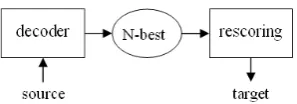
State-of-the-art Statistical Machine Translation (SMT) systems usually adopt a two-pass search strategy (Och, 2003; Koehn, et al., 2003) as shown in Figure 1. In the first pass, a decoding algorithm is applied to generate an N-best list of translation hypotheses, while in the second pass, the final translation is selected by rescoring and re-ranking the N-best translations through addi-tional feature functions. The fundamental as-sumption behind using a second pass is that the generated N-best list may contain better
© 2008. Licensed under the Creative Commons Attri-bution-Noncommercial-Share Alike 3.0 Unported
license ( http://creativecommons.org/licenses/by-nc-sa/3.0/). Some rights reserved.
tions than the best choice found by the decoder. Therefore, the performance of a two-pass SMT system can be improved from two aspects, i.e. scoring models and the quality of the N-best hy-potheses.
Rescoring pass improves the performance of machine translation by enhancing the scoring models with more global sophisticated and dis-criminative feature functions. The idea for apply-ing two passes instead of one is that some global feature functions cannot be easily decomposed into local scores and computed during decoding. Furthermore, rescoring allows some feature func-tions, such as word and n-gram posterior prob-abilities, to be estimated on the N-best list (Uef-fing, 2003; Chen et al., 2005; Zens and Ney, 2006).
In this two-pass method, translation perform-ance hinges on the N-best hypotheses that are generated in the first pass (since rescoring occurs on these), so adding the translation candidates generated by other MT systems to these hypothe-ses could potentially improve the performance. This technique is called system combination (Bangalore et al., 2001; Matusov et al., 2006; Sim et al., 2007; Rosti et al., 2007a; Rosti et al., 2007b).
We have instead chosen to regenerate new hy-potheses from the original N-best list, a tech-nique which we call regeneration. Regeneration is an intermediate pass between decoding and rescoring as depicted in Figure 2. Given the original N-best list (N-best1) generated by the decoder, this regeneration pass creates new trans-lation hypotheses from this list to form another N-best list (N-best2). These two N-best lists are then combined and given to the rescoring pass to derive the best translation.
We implement three methods to regenerate new hypotheses: re-decoding, n-gram expansion and confusion network. Re-decoding (Rosti et al., 2007a) based regeneration re-decodes the source sentence using original LM as well as new
lation and reordering models that are trained on the source-to-target N-best translations generated in the first pass. N-gram expansion (Chen et al., 2007) regenerates more hypotheses by continu-ously expanding the partial hypotheses through an n-gram language model trained on the original N-best translations. And confusion network gen-erates new hypotheses based on confusion net-work decoding (Matusov et al., 2006), where the confusion network is built on the original N-best translations.
Confusion network and re-decoding have been well studied in the combination of different MT systems (Bangalore et al., 2001; Matusov et al., 2006; Sim et al., 2007; Rosti et al., 2007a; Rosti et al., 2007b). Researchers have used confusion network to compute consensus translations from the outputs of different MT systems and improve the performance over each single systems. (Rosti et al., 2007a) also used re-decoding to do system combination by extracting sentence-specific phrase translation tables from the outputs of dif-ferent MT systems and running a phrase-based decoding with this new translation table. Finally, N-gram expansion method (Chen et al., 2007) collects sub-strings occurring in the N-best list to produce alternative translations.
This work demonstrates that a state-of-the-art MT system can be further improved by means of
regeneration which expands its own N-best
translations other than taking the translation can-didates from the other MT systems.
Figure 1: Structure of a typical two-pass ma-chine translation system. N-best translations are generated by the decoder and the 1-best transla-tion is returned after rescored with additransla-tional feature functions.
Figure 2: Structure of a three-pass machine translation system with the new regeneration pass. The original N-best translations list (N-best1) is expanded to generate a new N-best translations list (N-best2) before the rescoring pass.
2
SMT Process
Phrase-based statistical machine translation sys-tems are usually modeled through a log-linear framework (Och and Ney, 2002). By introducing the hidden word alignment variable
a
(Brown et al., 1993), the optimal translation can be searched for based on the following criterion:*
1 ,
arg max( Mm m m( , , ))
e a
e =
∑
= λ h e f a (1)where is a string of phrases in the target
lan-guage,
e f
f a
is the source language string of
phrases,
h e
are feature functions,weights
( , , )
mm
λ
are typically optimized to maximize the scoring function (Och, 2003).Our MT baseline system is based on Moses decoder (Koehn et al., 2007) with word align-ment obtained from GIZA++ (Och et al., 2003). The translation model (TM), lexicalized word reordering model (RM) are trained using the tools provided in the open source Moses package. Language model (LM) is trained with SRILM toolkit (Stolcke, 2002) with modified Kneser-Ney smoothing method (Chen and Goodman, 1998).
3
Regeneration Methods
Given the original N-best translations, regenera-tion pass is to generate M new target translaregenera-tions which are not seen in the original N-best choices.
3.1 Regeneration with Re-decoding
One way of regeneration is by running the de-coding again to obtain new hypotheses through a re-decoding process (Rosti et al., 2007a). In this work, the same decoder (Moses) is used to pro-duce the new M-best translations using a new translation model and reordering model trained over the word-aligned source input and original N-best target hypotheses. Although the target-to-source phrase alignments are available in the original N-best hypotheses, to enlarge the differ-ence between the new M-best translations and the original N-best translations, we re-align the words using GIZA++.
1. Run GIZA++ to align the words between the source input and target N-best translations; 2. Train translation and reordering model; 3. Optimize the weights of the decoder with
the new models;
4. Decode the source input by using new mod-els and new weights to generate N+M dis-tinct translations (“disdis-tinct” here refers to the target language string only, not consider-ing the phrase segmentation, etc.);
5. Output M-best translations which are not seen in the original N-best translations. Re-decoding on test set follows the same steps, but without the tuning step, step 3.
3.2 Regeneration with N-gram Expansion
N-gram expansion (Chen et al., 2007) combines the sub-strings occurred in the original N-best translations to generate new hypotheses. Firstly, all n-grams from the original N-best translations are collected. Then the partial hypotheses are continuously expanded by appending a word through the n-grams collected in the first step. We explain this method in more detail using the following example.
Suppose we have four original hypotheses shown in Figure 3. Firstly, we collect all the 3-grams from the original hypotheses. The first n-grams of all original entries in the N-best list are set as the initial partial hypotheses. They are: it's 5 minutes, it is 5, it’s about 5 and i walk 5. Then the expansion of a partial hypothesis starts by computing the set of grams matching its last n-1 words. As shown in Figure 4, the n-gram 5 minutes on matches the last two words of the partial hypothesis it’s about 5 minutes. So the hypothesis is expanded to it’s about 5 minutes on. The expansion continues until the partial hy-pothesis ends with a special end-of-sentence symbol that occurs at the end of all N-best strings.
Figure 5 shows some new hypotheses that are generated from the example in Figure 3. This is an example excerpted from our development data. One reference is also given in Figure 5; the first new generated hypothesis is equal to this refer-ence. But unfortunately, there is no such hy-pothesis in the original N-best translations.
During the new hypotheses generation, the translation outputs of a given source sentence are computed through a beam-search algorithm with a log-linear combination of the feature functions. In addition to n-gram frequency and n-gram pos-terior probability which have been used in (Chen et al., 2007), we also used language model, di-rect/inverse IBM model 1, and word penalty in
this work. The size of the beam is set to N+M, to ensure more than M new hypotheses are gener-ated.
Original hypotheses
1. it's 5 minutes on foot . 2. it is 5 minutes on foot . 3. it’s about 5 minutes’ to walk . 4. i walk 5 minutes .
n-grams
it's 5 minutes, 5 minutes on, …… on foot ., about 5 minutes …… 5 minutes .
Figure 3: Example of original hypotheses and 3-grams collected from them.
partial hyp. it’s about 5 minutes n-gram + 5 minutes on new partial hyp. it’s about 5 minutes on
Figure 4: Expanding a partial hypothesis via a matching n-gram.
New hypotheses
it’s about 5 minutes on foot . it's 5 minutes .
i walk 5 minutes on foot . ……
Reference it's about five minutes on foot .
Figure 5: New generated hypotheses through n-gram expansion and one reference.
3.3 Regeneration with Confusion Network
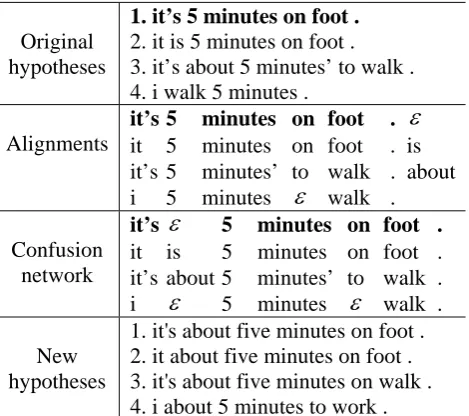
Confusion network based regeneration builds a confusion network over the original N-best hy-potheses, and then extracts M-best hypotheses from it. The word order in the N-best translations could be very different, so we need to choose a hypothesis with the “most correct” word order as the confusion network skeleton (alignment refer-ence), then align and reorder other hypotheses in this word order.
(TER) based alignment to build the confusion
Choosing alignment reference: Since the N-best translations are ranked, choosing the first best hypothesis as the skeleton is straightforward in our work.
Aligning words: As a confusion network can be easily built from a one-to-one alignment, we de-velop our algorithm based on the one-to-one as-sumption and use competitive linking algorithm (Melamed, 2000) for our word alignment. Firstly, an association score is computed for every possi-ble word pair from the skeleton and sentence to be aligned. Then a greedy algorithm is applied to select the best word-alignment. In this paper, we use a linear combination of multiple association scores, as suggested in (Kraif and Chen, 2004). As the two sentences to be aligned are in the same language, the association scores are com-puted on the following four clues. They are cog-nate (S
about it’s 5 minutes’ to walk .
1), word class (S2), synonyms (S3), and
position difference (S4). The four scores are
line-arly combined with empirically determined weights as shown is Equation 2.
4
Reordering words: After word alignment, the words in all other hypotheses are reordered to match the word order of the skeleton. The aligned words are reordered according to their alignment indices. The unaligned words are reor-dered in two strategies: moved with its previous word or next word. In this work, additional ex-periments suggested that moving the unaligned word with its previous word achieve better per-formance. In the case that the first word is un-aligned, it will be moved with its next word. Each word is assigned a score based on a simple voting scheme. Figure 6 shows an example of creating a confusion network.
Extracting M-best translations: New transla-tions are extracted from the confusion network. We again use beam-search algorithm to derive new hypotheses. The same feature functions proposed in Section 3.2 are used to score the par-tial hypotheses. Moreover, we also use position based word probability (i.e. in Figure 6, the words in position 5, “on” scored a probability of 0.5, and “
ε
” scored a probability of 0.25) as a feature function. Figure 6 shows some examples of new hypotheses generated through confusion network regeneration. hypotheses 3. it's about five minutes on walk .4. i about 5 minutes to work .
Figure 6: Example of creating a confusion net-work from the word alignments, and new hy-potheses generated through the confusion net-work. The sentence in bold is the alignment ref-erence.
4
Rescoring model
Since the final N+M-best hypotheses are pro-duced either from different methods or same de-coder with different models, local feature func-tions of each hypothesis are not directly compa-rable, and thus inadequate for rescoring. We hence exploit rich global feature functions in the rescoring models to compensate the loss of local feature functions. We apply the following 10 fea-ture functions and optimize the weight of each feature function using the tool in Moses package.
• direct and inverse IBM model 1 and 3
• association score, i.e. hyper-geometric distri-bution probabilities and mutual information
• lexicalized word/block reordering rules (Chen et al., 2006)
• 6-gram target LM
• 8-gram target class based LM, word-classes are clustered by GIZA++
• length ratio between source and target sen-tence
• question feature (Chen et al., 2005)
•linear sum of n-grams relative frequencies within N-best translations (Chen et al., 2005)
• n-gram posterior probabilities within the N-best translations (Zens and Ney, 2006)
5
Experiments
data Chinese English5.1 Tasks
We carried out two sets of experiments on two different datasets. One is in spoken language domain while the other is on newswire corpus. Both experiments are on Chinese-to-English translation.
Experiments on spoken language domain were carried out on the Basic Traveling Expression Corpus (BTEC) (Takezawa et al., 2002) Chi-nese- to-English data augmented with HIT-corpus1. BTEC is a multilingual speech corpus which contains sentences spoken by tourists. 40K sentence-pairs are used in our experiment. HIT-corpus is a balanced corpus and has 500K sen-tence-pairs in total. We selected 360K sentence-pairs that are more similar to BTEC data accord-ing to its sub-topic. Additionally, the English sentences of Tanaka corpus2 were also used to train our LM. We ran experiments on an IWSLT3 challenge track which uses IWSLT-20064 DEV clean text set as development set and IWSLT-2006 TEST clean text as test set. Table 1 summarizes the statistics of the training, dev and test data for IWSLT task.
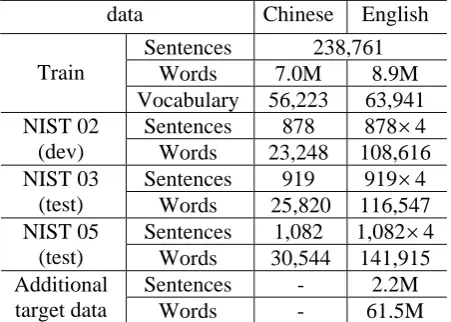
Experiments on newswire domain were car-ried out on the FBIS5 corpus. We used NIST6 2002 MT evaluation test set as our development set, and the NIST 2003, 2005 test sets as our test sets. Table 2 summarizes the statistics of the training, dev and test data for NIST task.
data Chinese English
Sentences 406,122
Words 4,443K 4,591K
Train
Vocabulary 69,989 61,087
Sentences 489 489×7
Dev.
Words 5,896 45,449
Sentences 500 500×7
Test
Words 6,296 51,227
Sentences - 155K Additional
target data Words - 1.7M
Table 1: Statistics of training, development and test data for IWSLT task.
International Workshop for Spoken Language Trans-lation
4
http:// www.slc.atr.jp/IWSLT2006/ 5
Vocabulary 56,223 63,941
Sentences 878 878×4
NIST 02
(dev) Words 23,248 108,616
Sentences 919 919×4
NIST 03
(test) Words 25,820 116,547
Sentences 1,082 1,082×4
NIST 05
(test) Words 30,544 141,915
Sentences - 2.2M Additional
target data Words - 61.5M
Table 2: Statistics of training, development and test data for NIST task.
Dev set Test set
System #hypo BLEU NIST BLEU NIST
1-best - 29.98 7.468 29.10 7.103
RESC1 1,200 31.60 7.657 30.42 7.165
RD 1,200 32.46 7.664 30.95 7.175
NE 1,200 32.58 7.660 31.02 7.178
CN 1,200 32.33 7.671 30.82 7.200
RESC2 2,000 31.72 7.659 30.55 7.166
32.98 7.673 31.36 7.202
COMB 2,000
Table 3: Translation performances (BLEU% and NIST scores) of IWSLT task: decoder (1-best), rescoring on original 1,200 N-best (RESC1) and 2,000 N-best hypotheses (RESC2), re-decoding (RD), n-gram expansion (NE), confusion net-work (CN) and combination of all hypotheses (COMB).
5.2 Results
1-NIST’02 (dev) NIST’03 (test) NIST’05 (test)
System #hypo BLEU NIST BLEU NIST BLEU NIST
1-best 1 27.67 8.498 26.68 8.271 24.82 7.856
RESC1 2,400 28.13 8.519 27.09 8.312 25.29 7.868
RD 2,400 28.46 8.518 27.34 8.320 25.54 7.897
NE 2,400 28.52 8.539 27.47 8.329 25.65 7.907
CN 2,400 28.40 8.545 27.30 8.332 25.54 7.913
RESC2 4,000 28.27 8.522 27.21 8.320 25.43 7.875
COMB 4,000 28.92 8.602 27.78 8.401 26.04 7.994
Table 4: Translation performances (BLEU% and NIST scores) of NIST task: decoder (1-best), rescoring on original 2,400 N-best (RESC1) and 4,000 N-best hypotheses (RESC2), re-decoding (RD), n-gram expansion (NE), confusion network (CN) and combination of all hypotheses (COMB).
Reference No tax is needed for this item . Thank you .
RESC2 you don't have to do not need to pay duty on this . thank you . 1
COMB (RD) not need to pay duty on this . thank you .
Reference Certainly . The fitting room is over there . Please come with me . RESC2 the fitting room is over there . can you come with me .
2
COMB (NE) yes , you can . the fitting room is over there . please come with me . Reference OK . I will bring it to you in five minutes .
RESC2 a good five minutes , we will give you . 3
COMB (CN) ok . after five minutes , i will give it to you .
Table 5: Translations output by system RESC2 and COMB on IWSLT task (case-insensitive).
best from 4,000 (1,600 + 3 800) distinct hy-potheses.
×
Our evaluation metrics are BLEU (Papineni et al., 2002) and NIST, which are to perform case-insensitive matching of n-grams up to n = 4. The translation performance of IWSLT task and NIST task is reported in Tables 3 and 4 respec-tively. The row “1-best” reports the scores of the translations produced by the decoder. The col-umn “#hypo” means the size of the N-best hy-potheses involved in rescoring. Note that on top of the same global feature functions as men-tioned in Section 4, the local feature functions used during decoding were also involved in res-coring RESC1 and RESC2.
First of all, we note that both BLEU and NIST scores of the first decoding step were improved through rescoring. If rescoring was applied after regeneration on the N+M best lists, additional improvements were gained for all the develop-ment and test sets on all three regeneration sys-tems. Absolute improvement on BLEU score of 0.4-0.6 on IWSLT’06 test set and 0.25-0.35 on NIST test sets were obtained when compared with system RESC1. Comparing the performance of three regeneration methods, we can see that re-decoding and confusion network based
method achieved very similar improvement; while n-gram expansion based regeneration ob-tained slightly better improvement than the other two methods. Combining all regenerated hy-potheses with the original hyhy-potheses further in-creased the scores on both tasks. Compared with RESC2, system COMB obtained absolute im-provement of 0.81 (31.36 – 30.55) BLEU score on IWSLT’06 test set, 0.57 (27.28 – 27.21) BLEU score on NIST’03 and 0.61 (26.04 – 25.43) BLEU score on NIST’05 respectively.
We further illustrate the effectiveness of the regeneration mechanism using some translation examples obtained from system RESC2 and COMB as shown in Table 5.
6
Discussion
all four lists, with differences found only in the remaining 400 hypotheses (M-best). The consis-tent improvement of oracle scores shows that the tra
theses contain better ones than the original ones.
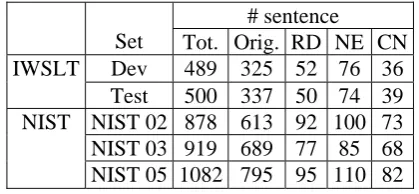
nslation candidates have been really improved. From another viewpoint, Table 7 shows the number of translations generated by each method in the final translation output (translations of COMB). After re-ranking N+3M entries, it is observed that more than 25% (e.g. for IWSLT’06 test set, (50+74+39)/500=32.6%; NIST’03 test set, (77+85+68)/919=25.1%; NIST’05 test set, (95+110+82)/1082=26.5%) of best scored out-puts were generated by the regeneration pass, showing that new generated translations are quite often the rescoring winner. This also proved that the new-generated hypo
List BLEU NIST WER PER
Moses 46.10 8.765 36.29 30.94
RD 46.91 8.764 35.29 30.62
NE 46.95 8.811 36.05 30.72
Dev.
CN 46.85 8.769 36.17 30.83
Moses 45.09 8.403 37.07 32.04
RD 45.67 8.418 36.50 31.82
NE 45.82 8.481 36.44 31.70
Test
CN 45.68 8.471 36.55 31.81
Table 6: Oracle scores (BLEU%, NIST, WER% and PER%) on IWSLT task 1,200-best lists of four systems: decoder (Moses), re-decoding (RD), n-gram expansion (NE) and confusion
etwork (CN).
Table 7: Number of translations generated by each method in the final translation output of system COMB: decoder (Orig.), re-decoding (RD), n-gram expansion (NE) and confusion network (CN). “Tot.” is the size of the dev/test set.
ities of words occur in the N-best translations.
n, and confusion ne
ree methods further im-pr
the N-best list through hypotheses regeneration.
S.
, pages 351–354. Madonna di
P.
ation.
Com-B.
Federico. 2005. The ITC-irst SMT System for Then, let us consider each single regeneration
method to understand why regeneration can pro-duce better hypotheses. Re-decoding may intro-duce new and better phrase-pairs which are ex-tracted from the N-best hypotheses to the
transla-tion model thus generate better hypotheses. N-gram expansion can (almost) fully exploit the search space of target strings, which can be gen-erated by an n-gram LM. As a result, it can pro-duce alternative translations which contain word re-orderings and phrase structures not considered by the search algorithm of the decoder (Chen, et al., 2007). Confusion network based regeneration reinforces the word choice by considering the posterior probabil
7
Conclusions
In this paper, we proposed a novel three-pass SMT framework against the typical two-pass system. This framework enhanced the quality of the translation candidates generated by our pro-posed regeneration pass and improved the final translation performance. Three regeneration methods were introduced, namely, re-decoding, word-based n-gram expansio
twork based regeneration.
Experiments were based on the state-of-the-art phrase-based decoder and carried out on the IWSLT and NIST Chinese-to-English task. We showed that all three methods improved the per-formance with the n-gram expansion method achieving the greatest improvement. Moreover, the combination of the th
oves the performance.
We conclude that translation performance can be improved by increasing the potential of trans-lation candidates to contain better transtrans-lations. We have presented an alternative solution to ameliorate the quality of translation candidates in a way that differs from system combination which takes translations from other MT systems. We demonstrated that the translation perform-ance could be self-boosted by expanding
References
Bangalore, G. Bordel, and G. Riccardi. 2001. Computing consensus translation from multiple machine translation systems. In Proceeding of IEEE workshop on Automatic Speech Recognition and Understanding
Campiglio, Italy.
F. Brown, V. J. Della Pietra, S. A. Della Pietra & R. L. Mercer. 1993. The Mathematics of Statistical Machine Translation: Parameter Estim
putational Linguistics, 19(2) 263-312.
IWSLT-2005. In Proceeding of IWSLT-2005, pp.98-104, Pittsburgh, USA, October.
B. Chen, M. Cettolo and M. Federico. 2006. Reorder-ing Rules for Phrase-based Statistical Machine Translation. In Proceeding ofIWSLT-2006, Kyoto, Japan.
B. Chen, M. Federico and M. Cettolo. 2007. Better N-best Translations through Generative n-gram Lan-guage Models. In Proceeding of MT Summit XI. Copenhagen, Denmark.
S. F. Chen and J. T. Goodman. 1998. An Empirical Study of Smoothing Techniques for Language Modeling. Technical Report TR-10-98, Computer Science Group, Harvard University.
P. Koehn, F. J. Och and D. Marcu. 2003. Statistical Phrase-based Translation. In Proceedings of HLT/NAACL, pp 127-133, Edmonton, Canada.
P. Koehn, H. Hoang, A. Birch, C. Callison-Burch, M. Federico, N. Bertoldi, B. Cowan, W. Shen, C. Moran, R. Zens, C. Dyer, O. Bojar, A. Constantin and E. Herbst. 2007. Moses: Open Source Toolkit for Statistical Machine Translation. In Proceeding ofACL-2007, pp. 177-180, Prague, Czech Republic.
O. Kraif, B. Chen. 2004. Combining clues for lexical level aligning using the Null hypothesis approach. In Proceeding of COLING-2004, Geneva, pp. 1261-1264.
E. Matusov, N. Ueffing, and H. Ney. 2006. Comput-ing consensus translation from multiple machine translation systems using enhanced hypotheses alignment. In Proceeding of EACL-2006, Trento, Italy.
I. D. Melamed. 2000. Models of translational equiva-lence among words. Computational Linguistics, 26(2), pp. 221-249.
F. J. Och. 2003. Minimum error rate training in statis-tical machine translation. In Proceedings of ACL-2003. Sapporo, Japan.
F. J. Och and H. Ney. 2003. A Systematic Compari-son of Various Statistical Alignment Models.
Computational Linguistics, 29(1), pp. 19-51.
K. Papineni, S. Roukos, T. Ward, and W.J. Zhu. 2002. BLEU: a method for automatic evaluation of ma-chine translation. In Proceeding ofACL-2002.
A. Rosti, N. F. Ayan, B. Xiang, S. Matsoukas, R. Schwartz and B. Dorr. 2007a. Combining Outputs from Multiple Machine Translation Systems. In
Proceeding of NAACL-HLT-2007, pp. 228-235. Rochester, NY.
A. Rosti, S. Matsoukas and R. Schwartz. 2007b. Im-proved Word-Level System Combination for Ma-chine Translation. In Proceeding of ACL-2007, Prague.
K. C. Sim, W. J. Byrne, M. J.F. Gales, H. Sahbi, and P. C. Woodland. 2007. Consensus network decod-ing for statistical machine translation system com-bination. In Proceeding of ICASSP-2007.
A. Stolcke. 2002. SRILM - an extensible language modelling toolkit. In Proceeding of ICSLP-2002. 901-904.
T. Takezawa, E. Sumita, F. Sugaya, H. Yamamoto, and S. Yamamoto. 2002. Toward a broad-coverage bilingual corpus for speech translation of travel conversations in the real world. In Proceeding of LREC-2002, Las Palmas de Gran Canaria, Spain.
R. Zens and H. Ney. 2006. N-gram Posterior Prob-abilities for Statistical Machine Translation. In