Active Learning with Sampling by Uncertainty and Density for Word
Sense Disambiguation and Text Classification
Jingbo Zhu Huizhen Wang Tianshun Yao
Natural Language Processing Laboratory
Northeastern University
Shenyang, Liaoning, P.R.China 110004
[email protected]
[email protected]
Benjamin K Tsou
Language Information Sciences
Research Centre
City University of Hong Kong
HK, P.R.China
[email protected]
Abstract
This paper addresses two issues of active learning. Firstly, to solve a problem of uncertainty sampling that it often fails by selecting outliers, this paper presents a new selective sampling technique, sam-pling by uncertainty and density (SUD), in which a k-Nearest-Neighbor-based density measure is adopted to determine whether an unlabeled example is an out-lier. Secondly, a technique of sampling by clustering (SBC) is applied to build a representative initial training data set for active learning. Finally, we implement a new algorithm of active learning with SUD and SBC techniques. The experi-mental results from three real-world data sets show that our method outperforms competing methods, particularly at the early stages of active learning.
1
Introduction
Creating a large labeled training corpus is expen-sive and time-consuming in some real-world ap-plications (e.g. word sense annotation), and is often a bottleneck to build a supervised classifier for a new application or domain. Our study aims to minimize the amount of human labeling ef-forts required for a supervised classifier (e.g. for automated word sense disambiguation) to
achieve a satisfactory performance by using
ac-tive learning.
Among the techniques to solve the knowledge bottleneck problem, active learning is a widely used framework in which the learner has the abil-ity to automatically select the most informative
© 2008. Licensed under the Creative Commons
Attri-bution-Noncommercial-Share Alike 3.0 Unported
license (http://creativecommons.org/licenses/by-nc-sa/3.0/). Some rights reserved.
unlabeled examples for human annotation. The ability of the active learner can be referred to as
selective sampling. Uncertainty sampling (Lewis and Gale, 1994) is a popular selective sampling technique, and has been widely studied in natural language processing (NLP) applications such as
word sense disambiguation (WSD) (Chen et al.,
2006; Chan and Ng, 2007), text classification
(TC) (Lewis and Gale, 1994; Zhu et al., 2008),
statistical syntactic parsing (Tang et al., 2002),
and named entity recognition (Shen et al., 2004).
Actually the motivation behind uncertainty sampling is to find some unlabeled examples near decision boundaries, and use them to clarify the position of decision boundaries. However, uncertainly sampling often fails by selecting
out-liers (Roy and McCallum, 2001; Tang et al.,
2002). These selected outliers (i.e. unlabeled ex-amples) have high uncertainty, but can not pro-vide much help to the learner. To solve the out-lier problem, we proposed in this paper a new
method, sampling by uncertainty and density
(SUD), in which a K-Nearest-Neighbor-based
density (KNN-density) measure is used to deter-mine whether an unlabeled example is an outlier, and a combination strategy based on KNN-density measure and uncertainty measure is de-signed to select the most informative unlabeled examples for human annotation at each learning iteration.
The second effort we made is to study how to build a representative initial training data set for active learning. We think building a more repre-sentative initial training data set is very helpful for active learning. In previous studies on active learning, the initial training data set is generally generated at random, based on an assumption that random sampling will be likely to build the initial training set with same prior data distribu-tion as that of whole corpus. However, this situa-tion seldom occurs in real-world applicasitua-tions due to the small size of initial training set used. In
this paper, we utilize an approach, sampling by clustering (SBC), to selecting the most represen-tative examples to form initial training data set for active learning. To do it, the whole unlabeled corpus should be first clustered into predefined number of clusters (i.e. the predefined size of the initial training data set). The example closest to the centroid of each cluster will be selected to augment initial training data set, which is consid-ered as the most representative case.
Finally, we describe an implementation of ac-tive learning with SUD and SBC techniques. Ex-perimental results of active learning for WSD and TC tasks show that our proposed method outperforms competing methods, particularly at the early stages of active learning process. It is noteworthy that these proposed techniques are easy to implement, and can be easily applied to several learners, such as Maximum Entropy (ME), naïve Bayes (NB) and Support Vector Machines (SVMs).
2
Active Learning Process
In this work, we are interested in uncertainty
sampling (Lewis and Gale, 1994) for pool-based
active learning, in which an unlabeled example x
with maximum uncertainty is selected for human annotation at each learning cycle. The maximum uncertainty implies that the current classifier (i.e. the learner) has the least confidence on its classi-fication of this unlabeled example.
Actually active learning is a two-stage process in which a small number of labeled samples and a large number of unlabeled examples are first collected in the initialization stage, and a closed-loop stage of query and retraining is adopted.
Procedure: Active Learning Process
Input: initial small training set L, and pool of unla-beled data set U
Use L to train the initial classifier C
Repeat
1. Use the current classifier C to label all
unla-beled examples in U
2. Use uncertainty sampling technique to select
m2 most informative unlabeled examples, and
ask oracle H for labeling
3. Augment L with these m new examples, and
remove them from U
4. Use L to retrain the current classifier C
Until the predefined stopping criterion SC is met. Figure 1. Active learning with uncertainty sam-pling technique
2
A batch-based sample selection labels the top-m most informative unlabeled examples at each learning cycle to decrease the number times the learner is retrained.
3
Uncertainty Measures
In real-world applications, only limited size of training sample set can be provided to train a supervised classifier. Due to manual efforts in-volved, such brings up a considerable issue: what is the best subset of examples to annotate. In the uncertainty sampling scheme, the unlabeled ex-ample with maximum uncertainty is viewed as the most informative case. The key point of un-certainty sampling is how to measure the
uncer-tainty of an unlabeled example x.
3.1 Entropy Measure
The well-known entropy is a popular uncertainty
measurement widely used in previous studies on
active learning (Tang et al., 2002; Chen et al.
2006; Zhu and Hovy, 2007):
∑
∈
− =
Y y
x y P x y P x
H( ) ( | )log ( | ) (1)
where P(y|x) is the a posteriori probability. We
denote the output class y∈Y={y1, y2, …, yk}. H is
the uncertainty measurement function based on the entropy estimation of the classifier’s posterior distribution.
In the following comparison experiments, the uncertainty sampling based on entropy criterion is considered as the baseline method, also called traditional uncertainty sampling.
3.2 Density*Entropy Measure
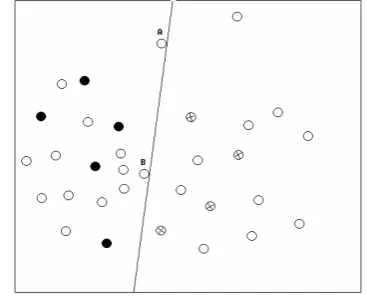
To analyze the outlier problem of traditional un-certainty sampling, we first give an example to explain our motivation.
Figure 2. An example of two points A and B with
maximum uncertainty at the ith learning iteration
As mentioned in Section 1,the motivation
be-hind uncertainty sampling is to find some unla-beled examples near decision boundaries, and assume that these examples have the maximum uncertainty. Fig. 2 shows two unlabeled
learning cycle. Roughly speaking, there are three
unlabeled examples near or similar to B, but,
none for A. We think example B has higher
rep-resentativeness than example A, and A is likely to be an outlier. We think adding B to the train-ing set will help the learner more than A.
The motivation of our study is that we prefer not only the most informative example in terms of uncertainty measure, but also the most repre-sentative example in terms of density measure. The density measure can be evaluated based on how many examples there are similar or near to it. An example with high density degree is less likely to be an outlier.
In most real-world applications, because the scale of unlabeled corpus would be very large,
Tang et al. (2002) and Shen et al. (2004)
evalu-ated the density of an example within a cluster.
Unlike their work3, we adopt a new approach,
called K-Nearest-Neighbor-based density
(KNN-density) measure, to evaluating the density of an
unlabeled example x. Given a set of K (i.e. =20
used in our experiments) most similar examples
S(x)={s1, s2, …, sK} of the example x, the
KNN-As discussed above, we prefer to select exam-ples with maximum uncertainty and highest den-sity for human annotation. We think getting their labels can help the learner greatly. To do it, we
proposed a new method, sampling by uncertainty
and density (SUD), in which entropy-based un-certainty measure and KNN-density measure are considered simultaneously.
In SUD scheme, a new uncertainty measure, called density*entropy measure4, is defined as:
)
4
Initial Training Set Generation
As shown in Fig. 1, only a small number of train-ing samples are provided at the beginntrain-ing of tive learning process. In previous studies on ac-tive learning, the initial training set is generally generated by random sampling from the whole unlabeled corpus. However, random sampling technique can not guarantee selecting a most
3
We also tried their cluster-based density measure, but per-formance was essentially degraded.
4
We also tried other ways like λ*DS(x)+(1-λ) H(x)
measure used in previous studies, but it seems to be random. Actually it is very difficult to determine an appropriateλ
value for a specific task.
resentative subset, because the size of initial training set is generally too small (e.g. 10). We think selecting some representative examples to form initial training set can help the active learner.
In this section we utilize an approach,
sam-pling by clustering (SBC), to selecting the most representative examples to form initial training data set. In the SBC scheme, the whole unlabeled corpus has been first clustered into a predefined number of clusters (i.e. the predefined size of the initial training set). The example closest to the centroid of each cluster will be selected to aug-ment initial training set, which is viewed as the most representative case.
We use the K-means clustering algorithm (Duda and Hart, 1973) to cluster examples in the whole unlabeled corpus. In the following K-means clustering algorithm, the traditional cosine measure is adopted to estimate the similarity be-tween two examples, that is
j
To summarize the SBC-based initial training set generation algorithm, let U={U1, U2, …, UN}
be the set of unlabeled examples to be clustered,
and k be the predefined size of initial training
data set. In other words, SBC technique selects k
most representative unlabeled examples from U
to generate the initial training data set. The SBC-based initial training set generation procedure is summarized as follows:
SBC-based Initial Training Set Generation Input: U, k
Phrase 1: Cluster the corpus U into k clusters
Ψ
j(j=1,…,k) by using K-means clusteringalgo-rithm as follows:
1. Initialization. Randomly choosing k
exam-ples as the centroid φj(j=1,…,k) for initial
4. Repeat Step 2 and Step 3 until the
Phrase 2: Select the example uj closest to the
The computation complexity of the K-means
clustering algorithm is O(NdkT), where d is the
number of features and T is the number of
itera-tions. In practice, we can define the stopping cri-terion (i.e. shown in Step 4) of K-means cluster-ing algorithm that relative change of the total distortion is smaller than a threshold.
5
Active Learning with SUD and SBC
Procedure: Active Learning with SUD and SBC
Input: Pool of unlabeled data set U; k is the prede-fined size of initial training data set
Initialization.
z Evaluate the density of each unlabeled example
in terms of KNN-density measure;
z Use SBC technique to generate the small initial
training data set of size k. Use L to train the initial classifier C
Repeat
1. Use the current classifier C to label all
unla-beled examples in U
2. Use uncertainty sampling technique in terms
of density*entropy measure to select m most informative unlabeled examples, and ask
ora-cle H for labeling, namely SUD scheme.
3. Augment L with these m new examples, and
remove them from U
4. Use L to retrain the current classifier C
Until the predefined stopping criterion SC is met. Figure 3. Active learning with SUD and SBC
Fig. 3 shows the algorithm of active learning with SUD and SBC techniques. Actually there are some variations. For example, if the initial training data set is generated by SBC, and en-tropy-based uncertainty measure is used, it is active learning with SBC. Similarly, if the initial training data set is generated at random, and the density*entropy uncertainty measure is used, it is active learning with SUD. If both SBC and SUD techniques are not used, we call it (traditional) uncertainty sampling as baseline method.
6
Evaluation
In the following comparison experiments, we evaluate the effectiveness of various active learn-ing methods for WSD and TC tasks on three pub-licly available real-world data sets.
6.1 Deficiency Measure
To compare various active learning methods,
deficiency is a statistic developed to compare performance of active learning methods globally across the learning curve, which has been used in previous studies (Schein and Unga, 2007). The deficiency measure can be defined as:
∑
∑
= iteration. REF is the baseline active learning method, and AL is the active learning variant of the learning algorithm of REF, e.g. activelearn-ing with SUD and SBC. n refers to the evaluation
stopping points (i.e. the number of learned ex-amples). Smaller deficiency value (i.e. <1.0) in-dicates AL method is better than REF method. Conversely, a larger value (i.e. >1.0) indicates a negative result.
In the following comparison experiments, we evaluate the effectiveness of six active learning
methods, including random sampling (random),
uncertainty sampling (uncertainty), SUD, ran-dom sampling with SBC (ranran-dom+SBC), uncer-tainty sampling with SBC (unceruncer-tainty+SBC),
and SUD with SBC (SUD+SBC). “+SBC” indi-cates initial training data set generated by SBC technique. Otherwise, initial training set is gen-erated at random. To evaluate deficiency of each method, the REF method (i.e. the baseline method) defined in Equation (5) refers to (tradi-tional) uncertainty sampling.
6.2 Experimental Settings
We utilize a maximum entropy (ME) model (Berger et al., 1996) to design the basic classifier for WSD and TC tasks. The advantage of the ME model is the ability to freely incorporate features from diverse sources into a single, well-grounded statistical model. A publicly available ME
tool-kit5 was used in our experiments. To build the
ME-based classifier for WSD, three knowledge sources are used to capture contextual
informa-tion: unordered single words in topical context,
POS of neighboring words with position infor-mation, and local collocations, which are the same as the knowledge sources used in (Lee and Ng, 2002). In the design of text classifier, the maximum entropy model is also utilized, and no feature selection technique is used.
5
In the following comparison experiments, the algorithm starts with a initial training set of 10 labeled examples, and make 10 queries after each learning iteration. A 10 by 10-fold cross-validation was performed. All results reported are the average of 10 trials in each active learning process.
6.3 Data Sets
Three publicly available natural data sets have been used in the following active learning
com-parison experiments. Interest data set is used for
WSD tasks. Comp2 and WebKB data sets are
used for TC tasks.
The Interest data set developed by Bruce and Wiebe (1994) has been previously used for WSD (Ng and Lee, 1996). This data set consists of
2369 sentences of the noun “interest” with its
correct sense manually labeled. The noun “interest” has six different senses in this data set.
The Comp2 data set consists of comp.graphics
and comp.windows.x categories from News-Groups, which has been previously used in ac-tive learning for TC (Roy and McCallum, 2001; Schein and Ungar, 2007).
The WebKB dataset was widely used in TC research. Following previous studies (McCallum and Nigam, 1998), we use the four most
popu-lous categories: student, faculty, course and
pro-ject, altogether containing 4199 web pages. In
the preprocessing step, we remove those words that occur merely once without using stemming. The resulting vocabulary has 23803 words.
Data sets Interest Comp2 WebKB
Accuracy 0.908 0.90 0.91
Table 1. Average accuracy of supervised learning on each data set when all examples have been learned.
6.4 Active Learning for WSD Task
0.55 0.6 0.65 0.7 0.75 0.8 0.85 0.9
0 50 100 150 200 250 300
A
ccu
ra
cy
Number of Learned Examples Active Learning for WSD on Interest
random random + SBC uncertainty uncertainty + SBC SUD SUD + SBC
Figure 4. Active learning curve for WSD on In-terest data set
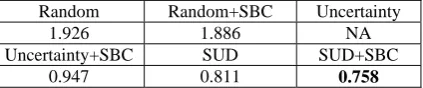
Random Random+SBC Uncertainty
1.926 1.886 NA
Uncertainty+SBC SUD SUD+SBC
0.947 0.811 0.758
Table 2. Average deficiency achieved by various
active learning methods on Interest data set. The stopping point is 300.
Fig. 4 depicts performance curves of various ac-tive learning methods for WSD task on Interest data set. Among these six methods, random sam-pling method shows the worst performance. SUD method constantly outperforms uncertainty sam-pling. As discussed above, SUD method prefers not only the most uncertainty examples, but also the most representative examples. In the SUD scheme, the factor of KNN-density can effec-tively avoid selecting the outliers that often cause uncertainty sampling to fail.
It is noteworthy that using SBC to generate initial training data set can improve random (-0.04 deficiency), uncertainty (-0.053 deficiency) and SUD (-0.053 deficiency) methods, respec-tively. If the initial training data set is generated at random, the initial accuracy is only 55.6%. Interestingly, SBC achieves 62.2% initial accu-racy, and makes 6.6% accuracy performance im-provement. However, SBC only makes perform-ance improvement for each method at the early
stages of active learning. After 50unlabeled
ex-amples have been learned, it seems that SBC has very little contribution to random, uncertainty and SUD methods. Table 2 shows that the best method is SUD with SBC (0.758 deficiency), followed by SUD method.
6.5 Active Learning for TC Tasks
0.55 0.6 0.65 0.7 0.75 0.8 0.85
0 50 100 150
Accu
ra
cy
Number of Learned Examples Active Learning for Text Classification on Comp2
uncertainty uncertainty + SBC SUD SUD + SBC
Figure 5. Active learning curve for text classifi-cation on Comp2 data set
Uncertainty Uncertainty+SBC SUD SUD+SBC
NA 0.409 0.588 0.257
Table 3. Average deficiency achieved by various
0.3 0.35 0.4 0.45 0.5 0.55 0.6 0.65 0.7 0.75 0.8
0 50 100 150
Ac
cu
ra
c
y
Number of Learned Examples Active Learning for Text Classification on WebKB
uncertainty uncertainty + SBC SUD SUD + SBC
Figure 6. Active learning curve for text classifi-cation on WebKB data set
Uncertainty Uncertainty+SBC SUD SUD+SBC
NA 0.669 0.748 0.595
Table 4. Average deficiency achieved by various
active learning methods on WebKB data set. The stopping point is 150.
Fig. 5 and 6 show the effectiveness of various active learning methods for text classification tasks. Since random sampling performs poorly as shown in Fig. 4, it is not further shown in Fig. 5 and 6. We only compare uncertainty sampling and our proposed methods for both text classifi-cation tasks.
Similarly, SUD method constantly outper-forms uncertainty sampling on two data sets. SBC greatly improves uncertainty sampling (i.e. 0.591 and 0.331 deficiencies degraded) and SUD method (i.e. 0.331 and 0.153 deficiencies de-graded), respectively. Interestingly, unlike WSD task shown in Fig. 4, Table 3 and 4 show that uncertainty sampling with SBC outperforms our SUD method for text classification on both data sets. The reason is that SBC makes about 15% initial accuracy improvement on Comp2 data set, and about 23% initial accuracy improvement on WebKB data set. Such improvements indicate that selecting high representative initial training set is very necessary and helpful for active learn-ing. Table 3 and 4 show that the best active learning method for TC task is SUD with SBC, following by uncertainty sampling with SBC method. It is noteworthy that on WebKB uncer-tainty sampling with SBC (0.669 deficiency) achieves only slight better performance than SUD method (0.748 deficiency) as shown in Ta-ble 4, simply because SBC only introduce good performance improvement at the early stages. Actually on WebKB SUD method achieves slight better performance than uncertainty sam-pling with SBC after about 50 unlabeled exam-ples have been learned.
7
Related Work
In recent years active learning has been widely studied in various natural language processing (NLP) tasks, such as word sense disambiguation
(Chen et al., 2006; Zhu and Hovy, 2007), text
classification (TC) (Lewis and Gale, 1994; McCallum and Nigam, 1998), named entity
recognition (NER) (Shen et al., 2004), chunking
(Ngai and Yarowsky, 2000), information
extraction (IE) (Thompson et al., 1999), and
statistical parsing (Tang et al., 2002).
In addition to uncertainty sampling, there is another popular selective sampling scheme,
Query-by-committee (Engelson and Dagan, 1999), which generates a committee of classifiers (always more than two classifiers) and selects the next unlabeled example by the principle of maximal disagreement among these classifiers. A method similar to committee-based sampling is
co-testing proposed by Muslea et al. (2000), which trains two learners individually on two compatible and uncorrelated views that should be able to reach the same classification accuracy. In practice, however, these conditions of view se-lection are difficult to meet in real-world
applica-tions. Cohn et al. (1996) and Roy and McCallum
(2001) proposed a method that directly optimizes expected future error on future test examples. However, the computational complexity of their methods is very high.
There are some similar previous studies (Tang
et al., 2002; Shen et al., 2004) in which the rep-resentativeness criterion in active learning is considered. Unlike our sampling by uncertainty
and density technique, Tang et al. (2002) adopted
a sampling scheme of most uncertain per cluster
for NLP parsing, in which the learner selects the sentence with the highest uncertain score from each cluster, and use the density to weight the selected examples while we use density informa-tion to select the most informative examples. Ac-tually the scheme of most uncertain per cluster still can not solve the outlier problem faced by
uncertainty sampling technique. Shen et al.
8
Discussion
For batch mode active learning, we found some-times there is a redundancy problem that some selected examples are identical or similar. Such situation would reduce the representativeness of selected examples. To solve this problem, we tried the sampling scheme of “most uncertain per
cluster” (Tang et al., 2002) to select the most
informative examples. We think selecting exam-ples from each cluster can alleviate the redun-dancy problem. However, this sampling scheme works poorly for WSD and TC on the three data sets, compared to traditional uncertainty sam-pling. From the clustering results, we found these resulting clusters are very imbalanced. It makes sense that more informative examples are con-tained in a bigger cluster. In this work, we only use SUD technique to select the most informative examples for active learning. We plan to study how combining SBC and SUD techniques can enhance the selection of the most informative examples in the future work.
Furthermore, we think that a misclassified unlabeled example may convey more information than a correctly classified unlabeled example which is closer to the decision boundary. But there is a difficulty that the true label of each unlabeled example is unknown. To use misclassi-fication information to select the most informa-tive examples, we should study how to automati-cally determine whether an unlabeled example has been misclassified. For example, we can make an assumption that an unlabeled example may be misclassified if this example was previ-ously “outside” and is now “inside”. We will study this issue in the future work.
Actually these proposed techniques can be easily applied for committee-based sampling for active learning. However, to do so, we should adopt a new uncertainty measurement such as
vote entropy to measure the uncertaity of each unlabled example in committee-based sampling scheme.
9
Conclusion and Future Work
In this paper, we have addressed two issues of active learning, involving the outlier problem of traditional uncertainty sampling, and initial train-ing data set generation. To solve the outlier prob-lem of traditional uncertainly sampling, we pro-posed a new method of sampling by uncertainty and density (SUD) in which KNN-density meas-ure and uncertainty measmeas-ure are combined
to-gether to select the most informative unlabeled example for human annotation at each learning cycle. We employ a method of sampling by clus-tering (SBC) to generate a representative initial training data set. Experimental results on three evaluation data sets show that our combined SUD with SBC method achieved the best per-formance compared to other competing methods, particularly at the early stages of active learning process. In future work, we will focus on the re-dundancy problem faced by batch mode active learning, and how to make use of misclassified information to select the most useful examples for human annotation.
Acknowledgments
This work was supported in part by the National 863 High-tech Project (2006AA01Z154) and the Program for New Century Excellent Talents in University (NCET-05-0287).
References
Berger Adam L., Vincent J. Della Pietra, Stephen A.
Della Pietra. 1996. A maximum entropy approach
to natural language processing. Computational Linguistics 22(1):39–71.
Bruce Rebecca and Janyce Wiebe. 1994. Word sense
disambiguation using decomposable models. Pro-ceedings of the 32nd annual meeting on Associa-tion for ComputaAssocia-tional Linguistics, pp. 139-146.
Chan Yee Seng and Hwee Tou Ng. 2007. Domain
adaptation with active learning for word sense dis-ambiguation. Proceedings of the 45th annual meet-ing on Association for Computational Lmeet-inguistics, pp. 49-56
Chen Jinying, Andrew Schein, Lyle Ungar and
Martha Palmer. 2006. An empirical study of the
behavior of active learning for word sense disam-biguation. Proceedings of the main conference on Human Language Technology Conference of the North American Chapter of the Association of Computational Linguistics, pp. 120-127
Cohn David A., Zoubin Ghahramani and Michael I. Jordan. 1996. Active learning with statistical mod-els. Journal of Artificial Intelligence Research, 4, 129–145.
Duda Richard O. and Peter E. Hart. 1973. Pattern
classification and scene analysis. New York: Wiley.
Engelson S. Argamon and I. Dagan. 1999.
Lee Yoong Keok and Hwee Tou Ng. 2002. An em-pirical evaluation of knowledge sources and learn-ing algorithm for word sense disambiguation. In Proceedings of the ACL-02 conference on Empiri-cal methods in natural language processing, pp. 41-48
Lewis David D. and William A. Gale. 1994. A
se-quential algorithm for training text classifiers. In Proceedings of the 17th annual international ACM SIGIR conference on Research and development in information retrieval, pp. 3-12
McCallum Andrew and Kamal Nigam. 1998. A
com-parison of event models for naïve bayes text classi-fication. In AAAI-98 workshop on learning for text categorization.
Muslea Ion, Steven Minton and Craig A. Knoblock.
2000. Selective sampling with redundant views. In
Proceedings of the Seventeenth National ence on Artificial Intelligence and Twelfth Confer-ence on Innovative Applications of Artificial Intel-ligence, pp. 621-626.
Ng Hwee Tou and Hian Beng Lee. 1996. Integrating
multiple knowledge sources to disambiguate word sense: an exemplar-based approach. In Proceed-ings of the Thirty-Fourth Annual Meeting of the Association for Computational Linguistics, pp. 40-47
Ngai Grace and David Yarowsky. 2000. Rule writing
or annotation: cost-efficient resource usage for based noun phrase chunking. In Proceedings of the
38th Annual Meeting of the Association for
Com-putational Linguistics, pp. 117-125
Roy Nicholas and Andrew McCallum. 2001. Toward
optimal active learning through sampling estima-tion of error reducestima-tion. In Proceedings of the Eighteenth International Conference on Machine Learning, pp. 441-448
Schein Andrew I. and Lyle H. Ungar. 2007. Active
learning for logistic regression: an evaluation. Machine Learning 68(3): 235-265
Schohn Greg and David Cohn. 2000. Less is more:
Active learning with support vector machines. In Proceedings of the Seventeenth International Con-ference on Machine Learning, pp. 839-846
Shen Dan, Jie Zhang, Jian Su, Guodong Zhou and
Chew-Lim Tan. 2004. Multi-criteria-based active
learning for named entity recognition. In Proceed-ings of the 42nd Annual Meeting on Association for Computational Linguistics.
Tang Min, Xiaoqiang Luo and Salim Roukos. 2002.
Active learning for statistical natural language parsing. In Proceedings of the 40th Annual
Meet-ing on Association for Computational LMeet-inguistics, pp. 120-127
Thompson Cynthia A., Mary Elaine Califf and
Ray-mond J. Mooney. 1999. Active learning for natural
language parsing and information extraction. In Proceedings of the Sixteenth International Confer-ence on Machine Learning, pp. 406-414
Zhu Jingbo and Eduard Hovy. 2007. Active learning
for word sense disambiguation with methods for addressing the class imbalance problem. In Pro-ceedings of the 2007 Joint Conference on Empiri-cal Methods in Natural Language Processing and Computational Natural Language Learning, pp. 783-790
Zhu Jingbo, Huizhen Wang and Eduard Hovy. 2008.