Word Co-occurrence Counts Prediction for Bilingual Terminology
Extraction from Comparable Corpora
Amir Hazem and Emmanuel Morin
Laboratoire d’Informatique de Nantes-Atlantique (LINA) Universit´e de Nantes, 44322 Nantes Cedex 3, France {Amir.Hazem, Emmanuel.Morin}@univ-nantes.fr
Abstract
Methods dealing with bilingual lexicon extraction from comparable corpora are often based on word co-occurrence ob-servation and are by essence more effec-tive when using large corpora. In most cases, specialized comparable corpora are of small size, and this particularity has a direct impact on bilingual terminology ex-traction results. In order to overcome in-sufficient data coverage and to make word co-occurrence statistics more reliable, we propose building a predictive model of word co-occurrence counts. We compare different predicting models with the tra-ditionalStandard Approach (Fung, 1998) and show that once we have identified the best procedures, our method increases sig-nificantly the performance of extracting word translations from comparable cor-pora.
1 Introduction
Using comparable corpora for bilingual lexicon extraction is becoming more and more a mat-ter of inmat-terest, especially because of the easier availability of this kind of corpora comparing to parallel ones. Many researchers proposed a va-riety of approaches (Fung, 1995; Rapp, 1999; Chiao and Zweigenbaum, 2002; D´ejean et al., 2002; Morin et al., 2007; Laroche and Langlais, 2010, among others). While different improve-ments were achieved, the starting point remains words’co-occurrences as they represent the ob-servable evidence that can be distilled from a cor-pus. Hence, frequency counts for word pairs often serve as a basis for distributional methods. The main assumption underlying bilingual lexicon ex-traction is: two words are more likely to be a trans-lation of each other if they share the same
lexi-cal contexts (Fung, 1998). The most popular ap-proach named, theStandard Approach(Fung and Mckeown, 1997; Rapp, 1999), makes use of this assumption to perform bilingual lexicon extrac-tion. While good results on single word terms (SWTs) can be obtained from large corpora of sev-eral million words (80% for the top 10-20 (Fung and Mckeown, 1997), 91% accuracy for the top 3 (Cao and Li, 2002)). Results drop significantly using specialized small corpora (60% for the top 20 (Chiao and Zweigenbaum, 2002; D´ejean et al., 2002; Morin et al., 2007).
The reliability of co-occurrence counts greatly relies on the amount of data. Clearly, the larger the training corpus, the more representative it is likely to be, and thus the more reliable the statis-tics of words. Therefore, the number and distri-bution of types in the available small sample are not reliable estimators (Evert and Baroni, 2007). This latter fact motivates the necessity of an alter-native to the unreliable counts especially when us-ing small specialized comparable corpora. Statis-tical NLP often deals in the prediction of variables ranging from text categories to linguistic struc-tures to novel utterances. If large specialized com-parable corpora are not available, one way to ap-proach this problem and to make co-occurrence counts more reliable, is to use prediction models of word co-occurrence counts based on large train-ing datasets. Corpus data from the general domain such as newspapers, for instance, is abundant and can be easily used for training.
The main contribution of this paper is to in-vestigate different word co-occurrence prediction models for the task of bilingual terminology ex-traction from comparable corpora. Our aim is to make the observed word co-occurrence counts in small specialized comparable corpora more reli-able by re-estimating their probabilities. For that purpose we explore different models such as the linear regression often used to model data using
linear predictor functions, the mean average word co-occurrence increase and the Good-Turing esti-mator. All of the predicting models rely on the observed counts of word co-occurrence in a train-ing dataset of small and large corpora from the general domain. While prediction is widely used in NLP, to our knowledge no investigation of co-occurrence prediction for the task of bilingual ter-minology extraction from comparable corpora has been addressed so far. We show that using our method as a pre-processing step of the Standard Approach, leads to significant improvements on the performance of bilingual terminology extrac-tion.
In the remainder of this paper, we present in section 2 the related work on bilingual lexicon ex-traction from comparable corpora. Then, we in-troduce in section 3 the Standard Approachused as baseline. Section 4 describes our method and the different predicting models of co-occurrence counts. Section 5 describes the different linguis-tic resources used in our experiments. Section 6 evaluates the contribution of the predicting mod-els on the quality of bilingual terminology extrac-tion through different experiments. We discuss our findings in section 7 and finally conclude in sec-tion 8.
2 Related Work
The distributional hypothesis which states that words with similar meaning tend to occur in sim-ilar contexts, has been extended to the bilingual scenario (Fung, 1998; Rapp, 1999). Hence, us-ing comparable corpora, a translation of a source word can be found by identifying a target word with the most similar context. A popular method often used as a baseline is theStandard Approach
(Fung, 1998). It consists of using the bag-of-words paradigm to represent bag-of-words of source and target language by their context vector. After word contexts have been weighted using an associa-tion measure (the point-wise mutual informaassocia-tion (Fano, 1961), the log-likelihood (Dunning, 1993), the discounted odds-ratio (Laroche and Langlais, 2010)), the similarity between a source word’s context vector and all the context vectors in the target language is computed using a similarity measure (cosine (Salton and Lesk, 1968), Jaccard (Grefenstette, 1994)...). Finally, the translation candidates are ranked according to their similarity score.
Many variants of the Standard Approach have been proposed. They can differ in context repre-sentation (window-based, syntactic-based) (Morin et al., 2007; Gamallo, 2008), corpus charac-teristics (small, large, general or domain spe-cific...)(Chiao and Zweigenbaum, 2002; D´ejean et al., 2002; Morin et al., 2007), type of words to translate (single word terms (SWTs) or multi-word terms (MWTs))(Rapp, 1999; Daille and Morin, 2005), words frequency (less frequent, rare...)(Pekar et al., 2006), etc.
There exist other approaches for bilingual lexi-con extraction. D´ejean et al. (2002) introduce the
Extended Approachto avoid the insufficient cov-erage of the bilingual dictionary required for the translation of source context vectors. A variation of the latter method based on centroid is proposed by Daille and Morin (2005). Haghighi et al. (2008) employ dimension reduction using canonical com-ponent analysis (CCA) and Rubino and Linares (2011) propose a multi-view approach based on linear discriminant analysis (LDA) among others.
3 Standard Approach
The Standard Approach is based on words co-occurrence vectors. The basic idea is to go through a corpus and to count the number of timesn(c, t)
each context wordcoccurs within a window of a certain sizewaround each target wordt. Accord-ing to (Fung and Mckeown, 1997; Fung, 1998; Rapp, 1999), the Standard Approachcan be car-ried out as follows:
For a source word to translatewis, we first build its context vector vws
i. The vector vwis contains
all the words that co-occur with wsi within win-dows ofnwords. Let’s denote bycoocc(wsi, wsj)
the co-occurrence value of wsi and a given word of its context wsj. The process of building con-text vectors is repeated for all the words of the tar-get language. An association measure such as the point-wise mutual information (Fano, 1961), the log-likelihood (Dunning, 1993) or the discounted odds-ratio (Laroche and Langlais, 2010) is used to score the strength of correlation between a word and all the words of its context vector. The con-text vectorvws
i is projected into the target language
vtws
i. Each wordw
s
j ofvwsi is translated with help
of a bilingual dictionaryD. Ifwsj is not present in D, ws
to their frequency in the target language (Morin et al., 2007). A similarity measure is used to score each target word wti, in the target language with respect to the translated context vector,vwts
i. Usual
measures of vector similarity include the cosine similarity (Salton and Lesk, 1968) or the weighted Jaccard index (Grefenstette, 1994) for instance. The candidate translations of the wordwsi are the target words ranked following the similarity score.
4 Method
4.1 Basic Idea
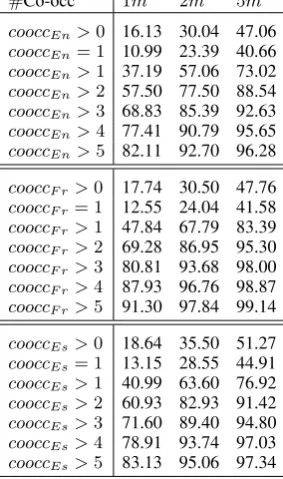
We start from the assumption that words that co-occur together more often than by chance in a small corpus, should have the same behaviour in a bigger corpus with higher co-occurrence ues. Our aim is to estimate the increasing val-ues. We choose to observe co-occurrence counts using a training dataset. Table 1 shows the in-crease of word co-occurrence counts in corpus of different sizes. Let’s denote by wi and wj two given words. We take as a starting point a corpus of 500,000 words in English, French and Spanish then, for each couple of words (wi, wj) that oc-cur together, we observe their co-ococ-currence count variation in corpus of 1, 2 and 5 million words per language. For instance, if coocc(wi, wj) = 5 in the English corpus of 500,000 words, we observe coocc(wi, wj)in the English corpus of 1, 2 and 5 million words and observe how much this value increases.
Table 1 can be read as follows: Let’s take cooccEn > 1, we can see in Table 1 that there is an increase of 37.19% of words that co-occur more than 1 time in the corpus of 1 million words, 57.06 % in the corpus of 2 million words and 73.02% in the corpus of 5 million words. The observations of Table 1 confirm that word co-occurrence counts increase in most cases (97.34% forcooccEs > 4, 98.87% forcooccF r>4...)
4.2 Co-occurrence Counts Estimation
Let’s denote by ES = {v1S, vS2, ..., vSn} the set of the observed co-occurrence counts in a small train-ing corpus. Our aim is to estimate the expected co-occurrence counts EL = {vL1, v2L, ..., vLn} in a large corpus. To do so, one intuitive way for estimation is the mean average increase (M AI) of each co-occurrence count. A more effective model that has proven its efficiency is linear re-gression. For that reason, we decided to use
lin-#Co-occ 1m 2m 5m cooccEn>0 16.13 30.04 47.06
cooccEn= 1 10.99 23.39 40.66
cooccEn>1 37.19 57.06 73.02
cooccEn>2 57.50 77.50 88.54
cooccEn>3 68.83 85.39 92.63
cooccEn>4 77.41 90.79 95.65
cooccEn>5 82.11 92.70 96.28
cooccF r>0 17.74 30.50 47.76
cooccF r= 1 12.55 24.04 41.58
cooccF r>1 47.84 67.79 83.39
cooccF r>2 69.28 86.95 95.30
cooccF r>3 80.81 93.68 98.00
cooccF r>4 87.93 96.76 98.87
cooccF r>5 91.30 97.84 99.14
cooccEs>0 18.64 35.50 51.27
cooccEs= 1 13.15 28.55 44.91
cooccEs>1 40.99 63.60 76.92
cooccEs>2 60.93 82.93 91.42
cooccEs>3 71.60 89.40 94.80
cooccEs>4 78.91 93.74 97.03
cooccEs>5 83.13 95.06 97.34
Table 1: Word co-occurrence counts increase (%) in corpus of different sizes on the English, French and Spanish Newspapers
ear regression (LReg) for prediction. In statisti-cal NLP, smoothing techniques for n-gram models have been addressed in a number of studies (Chen and Goodman, 1999). We chose to apply the sim-ple Good-Turing estimator (Good, 1953) as it is an appropriate way to estimate word co-occurrence counts. We finally present a naive model based on the maximum (M ax) and the mean average count (M ean) of observed word co-occurrence counts in a small and large training datasets.
4.2.1 Mean Average Increase
Results shown in Table 1 lead to an intuitive model which consists of the estimation of the mean average increase of each co-occurrence count. To estimate EL we use a training corpus divided in two sets of small (500,000 words) and large (10 million words) corpus. Hence, we esti-mate the increasing value for each co-occurrence pair count. Let’s denote by:
E1S={coocc1S(wi,wj) = 1,i∈[1,N],j∈[1,M]}
the set of co-occurrence pairs of count 1 observed in a small corpus and by:
EoL={coocc1L(wi,wj) = oij,i∈[1,N],j∈[1,M]}
the set of co-occurrence pairs of count oij ob-served in a large corpus. The mean average increase M AI1 for 1 count co-occurrence pairs
MAI1=
1
|E1 S|
N
X
i=1 M
X
j=1
(coocc1L(wi,wj)−coocc1S(wi,wj)) (1)
The generalized formula for a given pair co-occurrence countkis:
MAIk=
1
|Ek S|
N
X
i=1 M
X
j=1
(coocckL(wi,wj)−coocckS(wi,wj)) (2)
4.2.2 Good-Turing Estimator
Smoothing techniques (Good, 1953) are often used to better estimate probabilities when there is insufficient data to estimate probabilities accu-rately. They tend to make distributions more uni-form, by adjusting low probabilities such as zero probabilities upward, and high probabilities down-ward. The Good-Turing estimator (Good, 1953) states that for any n-gram that occursr times, we should pretend that it occursr∗times. The Good-Turing estimator uses the count of things you have seen once to help estimate the count of things you have never seen. In order to compute the fre-quency of words, we need to compute Nc, the number of events that occurctimes (assumes that all items are binomially distributed). Let Nr be the number of items that occur r times. Nr can be used to provide a better estimate ofr, given the binomial distribution. The adjusted frequencyr∗ is then:
r∗ = (r + 1)Nr+1
Nr (3)
The function r∗ is applied to all the observed co-occurrence counts of the test data.
4.2.3 Linear Regression
Starting from the observations in Table 1, thanks to linear regression we attempt to model the re-lationship between the first variable which corre-sponds to the co-occurrence distribution of words in the small corpus known as the explanatory vari-able, and the second variable which corresponds to the co-occurrence distribution of words in the large corpus known as the dependent variable. Be-fore applying the linear regression we want to en-sure that there is a correlation between the two variables; to do so, we apply the correlation co-efficient as presented in Table 2:
Cor 1m 2m 5m
corEn 0.933 0.894 0.788
corF r 0.924 0.899 0.872
corEs 0.904 0.854 0.801
Table 2: Word co-occurrence counts correlation between corpus of 500,000 words and corpus of different sizes (1 million, 2 million and 5 million words) on the English, French and Spanish News-paper
We can see according to Table 2 that there is a strong correlation of word co-occurrence counts across corpora of different sizes. Let’s denote byf the linear function of explanatory variables. We use in our case one explanatory variable X that corresponds to the set of word co-occurrence counts in a small corpus.
• Y =β1X+β0
• For eachxofX:f(x) =β1x+β0
By applying linear regression to our training dataset we obtain the following equations:
For the English corpus we obtain:
Y1m = 1.742X−0.686
Y2m = 3.184X−2.008
Y5m = 5.997X−3.967
For the French corpus we obtain:
Y1m = 1.802X−0.673
Y2m = 3.104X−1.773
Y5m = 7.167X−5.137
WhereY1mfor instance, corresponds to the lin-ear regression function llin-earned from the training corpus of 1 million words.
4.2.4 Mean and Max Models
values. Hence, using the mean process, each co-occurrence pair count can be estimated as follows:
Meank= 1 N
N
X
i=1
count(k,i) (4)
Where k is the observed count in the small cor-pus andiis the observed count in the large corpus of a given words pair. In the same way, using the max process, each co-occurrence pair count is es-timated as follows:
Maxk= 1
NMAX
N
i=1count(k,i) (5)
5 Linguistic Resources
In order to evaluate the prediction techniques, sev-eral linguistic resources are needed. We present hereafter the comparable corpora, the bilingual dictionary and the reference lists used in our ex-periments.
5.1 Corpus Data
Experiments have been carried out on two English-French comparable corpora. A special-ized corpus of 1 million words from the medical domain within the sub-domain of breast cancer and a specialized corpus from the domain of wind energy of 600,000 words.
Breast cancer Wind energy T okensS 500,000 300,000 T okensT 500,000 300,000
|S| 8,221 6,081
|T| 6,631 5,606
Table 3: Corpus size
For the breast cancer corpus, we have selected the documents from the Elsevier website1 in
or-der to obtain an English-French specialized com-parable corpora. We have automatically selected the documents published between 2001 and 2008 where the title or the keywords contain the term ’cancer du sein’ in French and ’breast cancer’ in English. For the wind energy corpus, we used theBabook crawler (Groc, 2011) to collect doc-uments in French and English from the web. As the documents were collected from different web-sites according to some keywords of the domain,
1www.elsevier.com
this corpus is more noisy and less well structured comparing to the breast cancer corpus. The two bilingual corpora have been normalized through the following linguistic pre-processing steps: to-kenization, part-of-speech tagging, and lemmati-zation. The function words have been removed and the words occurring once (i.e. hapax) in the French and the English parts have been discarded. As summarized in Table 3, The breast cancer cor-pus comprised about 8,221 distinct words in En-glish (|S|) and 6,631 distinct words in French (|T|). The wind energy corpus comprised about 6,081 distinct words in English (|S|) and 5,606 distinct words in French (|T|).
5.2 Dictionary
We used in our experiments the French-English bilingual dictionary ELRA-M0033 of about 200,000 entries2. It contains, after linguistic pre-processing steps and projection on both corpora less than 4000 distinct words. The details are given in Table 4.
Breast cancer Wind energy
|ELRAS| 3,573 3,459
|ELRAT| 3,670 3,326
Table 4: Dictionary coverage
5.3 Reference Lists
To build our reference lists, we selected only the English/French pair of single-word terms (SWTs) which occur more than five times in each part of the comparable corpus. As a result of filtering, 321 English/French SWTs were extracted (from the UMLS3meta-thesaurus) for the breast cancer cor-pus and 100 pairs for the wind energy corcor-pus. The small size of the reference lists can be explained by the fact that small specialized comparable cor-pora contain a limited set of specialized terms. We can also notice that in bilingual terminology ex-traction from specialized comparable corpora, the terminology reference list is often composed of 100 SWTs (180 SWTs in (D´ejean et al., 2002), 95 SWTs in (Chiao and Zweigenbaum, 2002), and 100 SWTs in (Daille and Morin, 2005)).
2
ELRA dictionary has been done by Sciper in the Tech-nolangue/Euradic project
5.4 Training Dataset
Predicting models such as linear regression or the Good-Turing estimator need a large training cor-pus to estimate the adjusted co-occurrences. For that purpose, we chose a training corpus composed of two sets. A small set of 500,000 words and a large set of 10 million words. We selected the doc-uments published in 1994 from newspapers Los Angeles Times/Le Monde.
6 Experiments and Results
The baseline in our experiments is the Standard Approach (Fung, 1998) which is often used for comparison (Pekar et al., 2006; Gamallo, 2008; Prochasson and Morin, 2009), etc. In this sec-tion, we first give the parameters of thestandard approach, than we present the results of the ex-periments conducted on the two corpora presented above: ’Breast cancer’ and ’Wind energy’.
6.1 Experimental Setup
Using theStandard Approach, three major param-eters need to be set:
1. The size of the window used to build the con-text vectors (Morin et al., 2007; Gamallo, 2008)
2. The association measure (the log-likelihood (Dunning, 1993), the point-wise mutual in-formation (Fano, 1961), the discounted odds-ratio (Laroche and Langlais, 2010)...)
3. The similarity measure (the weighted Jaccard index (Grefenstette, 1994), the cosine simi-larity (Salton and Lesk, 1968),...)
Laroche and Langlais (2010) carried out a com-plete study of the influence of these parameters on the quality of bilingual lexicon extraction from comparable corpora. To build the context vec-tors we chose a 7-window size. The entries of the context vectors were determined by the log-likelihood, the point-wise mutual information and the discounted odds-ratio. As similarity measure, we chose to use the weighted Jaccard index and the cosine similarity. Other combinations of pa-rameters were assessed but the previous parame-ters turned out to give the best performance.
We note thatTop kmeans that the correct trans-lation of a given word is present in the k first can-didates of the list returned by the Standard Ap-proach. We use also the mean average precision
MAP(Manning and Schutze, 2008) which repre-sents the quality of the system.
M AP(Q) = 1
|Q| |Q|
X
i=1 1
mi k
X
mi=1
P(Rik) (6)
where |Q|is the number of terms to be trans-lated, mi is the number of reference translations for theithterm (always 1 in our case), andP(Rik)
is 0 if the reference translation is not found for the ithterm or1/rif it is (ris the rank of the reference translation in the translation candidates).
6.2 Results
We conducted a set of two experiments on two specialized comparable corpora. We carried out a comparison between theStandard Approach(SA) and the different prediction models presented in section 4.2 namely: the maximum model (M ax), the mean model (M ean), the linear regression model (LReg), The Good-Turing estimator (GT) and the mean average increase model (M AI). Ex-periment 1 shows the results on the breast cancer corpus and experiment 2 those of the wind energy corpus.
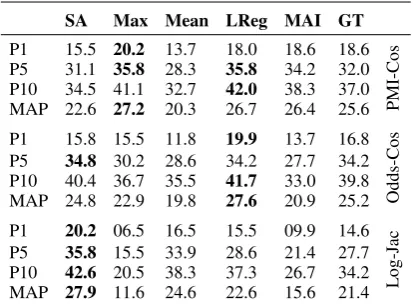
Table 5 shows the results of the experiments on the breast cancer corpus. The first observation concerns theStandard Approach (SA). The best results are obtained using the Log-Jac parameters with a MAP of 27.9%. We can also notice that for this configuration, none of the prediction mod-els improve the performance of theStandard Ap-proach. On the contrary, they even degrade the re-sults. The second observation concerns the Odds-Cos parameters where the naiveM ean,M axand M AI models are under the baseline. The best score is obtained by theLRegmodel with a MAP of 27.6%. The most notable result concerns the PMI-Cos parameters. We can notice that four of the five techniques improve the performance of the baseline. The best prediction model is the M ax technique which reaches a MAP of 27.2% and im-proves the Top1 precision of 4.8% and the Top10 precision of 6.6%.
Table 6 shows the results of the experiments on the wind energy corpus. Generally the results fol-low the same behaviour as the previous experi-ment. The best results of theStandard Approach
SA Max Mean LReg MAI GT
P1 15.5 20.2 13.7 18.0 18.6 18.6
PMI-Cos
P5 31.1 35.8 28.3 35.8 34.2 32.0 P10 34.5 41.1 32.7 42.0 38.3 37.0 MAP 22.6 27.2 20.3 26.7 26.4 25.6 P1 15.8 15.5 11.8 19.9 13.7 16.8
Odds-Cos
P5 34.8 30.2 28.6 34.2 27.7 34.2 P10 40.4 36.7 35.5 41.7 33.0 39.8 MAP 24.8 22.9 19.8 27.6 20.9 25.2 P1 20.2 06.5 16.5 15.5 09.9 14.6
Log-Jac
P5 35.8 15.5 33.9 28.6 21.4 27.7 P10 42.6 20.5 38.3 37.3 26.7 34.2 MAP 27.9 11.6 24.6 22.6 15.6 21.4 Table 5: Results of the experiments on the ’Breast cancer’ corpus (the improvements indicate a sig-nificance at the 0.05 level using Student’s t-test).
SA Max Mean LReg MAI GT
P1 07.0 13.0 10.0 18.0 15.3 14.0
PMI-Cos
P5 27.0 34.0 30.0 37.0 33.0 31.0 P10 37.0 46.0 36.0 46.0 43.0 43.0 MAP 17.8 23.1 19.2 28.0 25.0 22.9 P1 12.0 09.0 06.0 14.0 10.0 12.0
Odds-Cos
P5 31.0 20.0 27.0 32.0 25.0 31.0 P10 38.0 26.0 39.0 40.0 33.0 36.0 MAP 21.8 15.7 17.0 23.3 18.0 19.8 P1 17.0 09.0 18.0 15.0 18.0 13.0
Log-Jac
P5 36.0 16.0 30.0 31.0 29.0 27.0 P10 42.0 22.0 45.0 36.0 36.0 37.0 MAP 25.7 14.0 25.1 22.9 23.7 20.5 Table 6: Results of the experiments on the ’Wind energy’ corpus (the improvements indicate a sig-nificance at the 0.05 level using Student’s t-test).
here again the naiveM ean,M axandM AI mod-els are under the baseline. We can also notice thatGT is slightly under the standard approach. The best score is obtained by the LReg model with a MAP of 23.3%. Finally, the most remark-able result still concerns the PMI-Cos parameters where the same four of the five predicting tech-niques improve the performance of the baseline. The best prediction model is theLReg technique which reaches a MAP of 28.0% and improves the Top1 precision of 11.0% and the Top10 precision of 10.2%.
7 Discussion
The aim of this work was to propose and con-trast different word co-occurrence prediction ap-proaches: naive or intuitive (M ax, M ean and M AI) and more sophisticated (LReg and GT)
aiming to improve bilingual terminology extrac-tion. Our approach can be used as a pre-processing step of theStandard Approachby applying a pre-diction function to word co-occurrence counts.
According to the experimental results, the first observation is that the Standard Approach per-forms better when using the log-likelihood mea-sure comparatively to the discounted odds-ratio and the point-wise mutual information measures. This supposes that the log-likelihood provides a better estimation of word co-occurrence counts. The log-likelihood measures significance (i.e. the amount of evidence against the null hypothesis) and is known to be more robust against low ex-pected frequencies (Dunning, 1993). The lower performance of the Standard Approachwhen us-ing the point-wise mutual information is cer-tainly due to the over-estimation of low frequen-cies. In practical applications, PMI was found to have a tendency to assign inflated scores to low-frequency word pairs. Thus, even a single co-occurrence of two words might result in a fairly high association score. The discounted odds-ratio has shown lower results when compared to log-likelihood unlike its better performance as shown in Laroche and Langlais (2010). This is certainly due to the multiple parameters and resources of the
Standard Approachand also the cosine similarity measure which is sensitive to context vector size. In our experiments, we did not investigate this pa-rameter as it is not the matter of our study. We considered the whole context vector of each word.
According to the PMI-Cos configuration, the baseline is consistently outperformed by every prediction model (exceptM eanon the breast can-cer experiment). The good results of the proposed methods when associated to the PMI-Cos config-uration suggest that the over-estimation of infre-quent counts of PMI is skimmed by the predic-tion funcpredic-tion. This finding can be considered as a new way to counterbalance the low-frequency bias of PMI. The best prediction approach shown in the experiments isM axwith a MAP of 27.2%, followed byLReg with a MAP of 26.7% on the breast cancer corpus. Nevertheless, in the wind energy corpusLReg performed substantially bet-ter thanM axwith a MAP of 28.0% whileM ax reaches 23.1% only. Even the lower performance ofM AIandGT, they also provide significant im-provements.
algo-rithms reached good results while associated to the Log-Jac configuration. This is certainly re-lated to the properties of the log-likelihood associ-ation measure. While the prediction models tend to increase small co-occurrence counts, this can lead to the overrating of infrequent words renders the ranking of the log-likelihood measure useless. Concerning the Odds-Cos parameters, although there were slight improvements on theLReg algo-rithm, other methods have shown disappointing re-sults. Here again the Odds-ratio association mea-sure seems to be not compatible with re-estimating co-occurrence counts. More investigations are cer-tainly needed to highlight the reasons of this poor performance. It seems that prediction functions do not fit well with association measures based on contingency table.
The most noticeable improvement concerns the PMI-Cos configuration. Aside from the M ean method, all the other techniques have shown bet-ter performance than theStandard Approach. Ac-cording to the empirical results, point-wise mutual information performs better withM axandLReg techniques. Furthermore and as has been pointed out above, prediction models seem to be an al-ternative to the low-frequency bias of the point-wise mutual information. It is our hope that the present work may provide a starting point to co-occurrence prediction on comparable corpora as an alternative to unreliable counts. The next step is to explore more complex prediction models such as nonlinear regression that intuitively should fit better than a simple linear regression and to con-trast our prediction function with the various sug-gested heuristics for correcting PMI bias.
8 Conclusion
In this paper, we have described and compared different prediction models for the task of bilin-gual terminology extraction from comparable cor-pora. Our belief is that word co-occurrence counts prediction can be an alternative to the unreliable counts observed in small corpora. The results demonstrate the viability of the proposed approach using the PMI-Cos configuration. If more investi-gation is certainly needed for the Odds-Cos and Log-Jac configurations, the empirical results of our proposition suggest that predicting word co-occurrence counts is an appropriate way to im-prove the accuracy of the Standard Approach in small specialized comparable corpora.
Acknowledgments
The research leading to these results has re-ceived funding from the French National Research Agency under grant ANR-12-CORD-0020.
References
Y. Cao and H. Li. 2002. Base noun phrase
transla-tion using web data and the em algorithm.
Proceed-ings of the 19th International Conference on Com-putational Linguistics (COLING’02), Tapei, Taiwan, pages 127–133.
Stanley F. Chen and Joshua Goodman. 1999. An
empirical study of smoothing techniques for
lan-guage modeling. Computer Speech & Language,
13(4):359–393.
Yun-Chuang Chiao and Pierre Zweigenbaum. 2002. Looking for candidate translational equivalents in
specialized, comparable corpora. InProceedings of
the 19th International Conference on Computational Linguistics (COLING’02), pages 1208–1212, Tapei, Taiwan.
B´eatrice Daille and Emmanuel Morin. 2005. French-English Terminology Extraction from Comparable
Corpora. In Proceedings of the 2nd International
Joint Conference on Natural Language Processing (IJCLNP’05), pages 707–718, Jeju Island, Korea.
Herv´e D´ejean, Fatia Sadat, and ´Eric Gaussier. 2002. An approach based on multilingual thesauri and model combination for bilingual lexicon extraction. InProceedings of the 19th International Conference on Computational Linguistics (COLING’02), pages 218–224, Tapei, Taiwan.
Ted Dunning. 1993. Accurate Methods for the
Statis-tics of Surprise and Coincidence. Computational
Linguistics, 19(1):61–74.
Stefan Evert and Marco Baroni. 2007. zipfr: Word
fre-quency modeling in r. InProceedings of the 45th
Annual Meeting of the Association for Computa-tional Linguistics (ACL’07), Prague, Czech Repub-lic.
Robert M. Fano. 1961. Transmission of Information:
A Statistical Theory of Communications. MIT Press, Cambridge, MA, USA.
Pascale Fung and Kathleen Mckeown. 1997. Finding terminology translations from non-parallel corpora. InProceedings of the 5th Annual Workshop on Very Large Corpora (VLC97), page 192202, Hong Kong.
Pascale Fung. 1998. A Statistical View on Bilingual Lexicon Extraction: From ParallelCorpora to Non-parallel Corpora. InProceedings of the 3rd Confer-ence of the Association for Machine Translation in the Americas (AMTA’98), pages 1–16, Langhorne, PA, USA.
Otero Gamallo. 2008. Evaluating two different
methods for the task of extracting bilingual
lex-icons from comparable corpora. In Proceedings
of LREC 2008 Workshop on Comparable Corpora (LREC’08), pages 19–26, Marrakech, Marroco.
I. J. Good. 1953. The population frequencies of
species and the estimation of population parameters.
Biometrika, 40:16–264.
Gregory Grefenstette. 1994. Explorations in
Auto-matic Thesaurus Discovery. Kluwer Academic Pub-lisher, Boston, MA, USA.
Cl´ement De Groc. 2011. Babouk : Focused Web
Crawling for Corpus Compilation and Automatic
Terminology Extraction. In Proceedings of The
IEEE-WICACM International Conferences on Web Intelligence, pages 497–498, Lyon, France.
Aria Haghighi, Percy Liang, Taylor Berg-Kirkpatrick,
and Dan Klein. 2008. Learning bilingual
lexi-cons from monolingual corpora. In Proceedings
of the 46th Annual Meeting of the Association for Computational Linguistics (ACL’08), pages 771– 779, Columbus, Ohio, USA.
Audrey Laroche and Philippe Langlais. 2010. Revis-iting Context-based Projection Methods for
Term-Translation Spotting in Comparable Corpora. In
Proceedings of the 23rd International Conference on Computational Linguistics (COLING’10), pages 617–625, Beijing, China.
Raghavan; Manning, Christopher D.; Prabhakar and Hinrich Schutze. 2008. Introduction to information retrieval. Cambridge University Press.
Emmanuel Morin, B´eatrice Daille, Koichi Takeuchi, and Kyo Kageura. 2007. Bilingual Terminology Mining – Using Brain, not brawn comparable
cor-pora. In Proceedings of the 45th Annual
Meet-ing of the Association for Computational LMeet-inguistics (ACL’07), pages 664–671, Prague, Czech Republic.
Viktor Pekar, Ruslan Mitkov, Dimitar Blagoev, and An-drea Mulloni. 2006. Finding translations for
low-frequency words in comparable corpora. Machine
Translation, 20(4):247–266.
Emmanuel Prochasson and Emmanuel Morin. 2009. Anchor points for bilingual extraction from small
specialized comparable corpora. TAL, 50(1):283–
304.
Reinhard Rapp. 1999. Automatic Identification of
Word Translations from Unrelated English and
Ger-man Corpora. In Proceedings of the 37th Annual
Meeting of the Association for Computational Lin-guistics (ACL’99), pages 519–526, College Park, MD, USA.
Rapha¨el Rubino and Georges Linares. 2011. A multi-view approach for term translation spotting. In Pro-ceedings of the 12th International Conference on Computational Linguistics and Intelligent Text Pro-cessing (CICLing’11), pages 29–40, Tokyo, Japan.
Gerard Salton and Michael E. Lesk. 1968. Computer
evaluation of indexing and text processing.