Exploring self training for Hindi dependency parsing
Rahul Goutam Bharat Ram Ambati
Language Technologies Research Centre Language Technologies Research Centre
IIIT-Hyderabad, India IIIT-Hyderabad, India
[email protected] [email protected]
Abstract
In this paper we explore the effect of self-training on Hindi dependency parsing. We consider a state-of-the-art Hindi dependency parser and apply self-training by using a large raw corpus. We consider two types of raw corpus, one from same domain as of training and testing data and the other from different domain. We also do an experiment, where we add small gold-standard data to the training set. Comparing these experiments, we show the impact of adding small, but gold-standard data to training data versus large, but automat-ically parsed data on Hindi parser.
1
Introduction
Parsing morphologically rich free-word-order languages like Czech, Hindi, Turkish, etc., is a challenging task. Unlike English, most of the parsers for such languages have adopted the de-pendency grammatical framework. It is well known that for these languages, dependency framework is better suited (Shieber, 1985; Mel’čuk, 1988, Bharati et al., 1995). Due to the availability of annotated corpora in recent years, data driven dependency parsing has achieved considerable success. In spite of availability of annotated treebanks, state-of-the-art parsers for these languages have not reached the perfor-mance obtained for English (Nivre et al., 2007a). Frequently stated reasons for low performance are small treebank size, complex linguistic phe-nomenon, long distance dependencies, and non-projective structures (Nivre et al., 2007a; Nivre et al., 2007b; Bharati et al., 2008).
In this paper, we try to address the problem of small treebank size. We have lots of un-annotated data. One way to increase treebanks’ size is to manually annotate this data. But it is very time consuming task. Other way is to auto-matically parse this data and consider highly re-liable parses. But, what criteria should be used
for extracting reliable parses is a really challeng-ing task. In this paper, we explore a bootstrap-ping technique called self training and see its impact on dependency parsing accuracy. We consider a state-of-the-art Hindi dependency parser and analyze its performance using self-training. We consider two types of raw corpus, one from the same domain as of training and testing data and the other from a different do-main. We also show the impact of adding small, but gold-standard data to training data versus large, but automatically parsed data on Hindi dependency parsing.
The paper is arranged as follows. In section 2, we describe the related work in this field. In sec-tion 3, we present the current state-of-the-art of Hindi dependency parser. Section 3, talks about different experiments conducted and presents the results. We conclude with possible future work in section 4.
2
Related Work
In this section, we briefly describe major works on bootstrapping using statistical parsers.
Steedman et al. (2003) did experiments to show that raw data can be used to improve the performance of statistical parsers by bootstrap-ping. Although their main focus was on co-training between two statistical parsers, they have also performed self-training for each parser but the results are not that promising with self-training. They have also done cross-genre expe-riments to show that co-training is beneficial even when the seed set was from a different do-main compared to the raw data.
Reichart and Rappoport (2007) also perform similar cross-genre experiments to improve the quality of their parser and to adapt the parser to a different domain. They have also reported signif-icant reduction in annotation cost and amount of work because only small amount of manually annotated seed data was used.
McClosky et al. (2006) used a two phase pars-er-reranker system for self-training using readily available raw data. In their approach, instead of adding the raw data in steps, they have added the entire data in one go. They have reported signifi-cant improvement in accuracy over the previous state-of-the-art accuracy for Wall Street Journal parsing. They have also performed sentence length analysis to show that there is a general improvement in intermediate-length sentences, but no improvement at the extremes.
All the above mentioned works are on phrase structure parsing of English. There is an attempt at exploring usefulness of large raw corpus for dependency parsing by Chen et al. (2008). They could achieve considerable improvement over baseline for Chinese using only high confident edges instead of entire sentences. In our work the focus is dependency parsing of Hindi. We also explore how domain and quality of data affects the parser performance.
3
Hindi Dependency Parsing
In ICON 2009 and 2010, two tools contests were held that focused on Indian Language dependen-cy parsing (Husain, 2009; Husain et al., 2010). In these contests, rule-based, constraint based, sta-tistical and hybrid approaches were explored to-wards building dependency parsers for Hindi. In 2009 contest, given the gold standard chunk heads, the task was to find dependencies between them. But in 2010 contest, given words with gold features like part-of-speech (POS) and morph information, the task was to find word level de-pendency parse. Table 1, gives the basic statistics about the data.
Type Sentences Words Average Sen-tence Length
Training 2,972 64632 22.69
Development 543 12617 23.28
Testing 320 6589 20.59
Table 1: Hindi ICON 2010 data statistics
3.1 Baseline (State-of-the-art) System
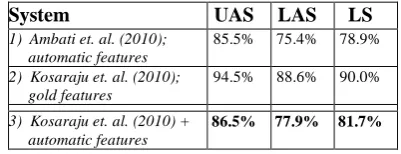
We consider the best system (Kosaraju et al., 2010) in ICON 2010 tools contest as the starting point. Kosaraju et al. (2010) used MaltParser (Nivre et al., 2007b) and achieved 94.5% Unla-beled Attachment Score (UAS) and 88.6% La-beled Attachment Score (LAS). They could achieve this using liblinear learner and nivres-tandard parsing algorithm. But, as mentioned
above, POS and other features used in this tem were gold standard. The only available sys-tem which uses automatically extracted features and does complete word level parsing for Hindi is Ambati et al. (2010). Though both Ambati et al. (2010) and Kosaraju et al. (2010) used Malt-Parser, the data used is the subset of the one used by the latter and the parser settings were slightly different.
Taking training data and parser settings of Ko-saraju et al. (2010) and automatic features similar to Ambati et al. (2010), we developed a parser and evaluated it on the ICON 2010 tools contest test data. We could achieve LAS of 77.9% and UAS of 86.5% on test set. This is the state-of-the-art system for Hindi dependency paring using automatic features. We consider this system as our baseline and try to explore self-training tech-nique.
System UAS LAS LS
1) Ambati et. al. (2010); automatic features
85.5% 75.4% 78.9%
2) Kosaraju et. al. (2010); gold features
94.5% 88.6% 90.0%
3) Kosaraju et. al. (2010) + automatic features
86.5% 77.9% 81.7%
Table 2: Comparison of different systems
4
Experiments and Analysis
We have modified the Malt parser used in base-line system so that it gives a confidence value for each arc-decision taken. We have taken the aver-age confidence value for all the arcs in the sen-tence to be the confidence value of a sensen-tence. This system was first trained on ICON 2010 tools contest training data for Hindi. The model generated was then used to parse the large raw corpus. The output sentences were then sorted in descending order based on their scores.
In the self-training experiments, in each itera-tion, we have added 1000 sentences from the sorted output generated above, to the training data and re-trained the parser. The resulting model was then used to parse the test data.
77.2 77.4 77.6 77.8 78 78.2 78.4 78.6 78.8
0 10 20 30 40 50
85.5 86 86.5 87 87.5 88
0 10 20 30 40 50
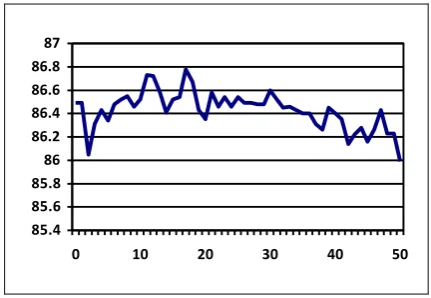
Figure 1a. Self training in-domain (LAS) Figure 1b. Self training in-domain (UAS)
76.6 76.8 77 77.2 77.4 77.6 77.8 78 78.2
0 10 20 30 40 50
85.4 85.6 85.8 86 86.2 86.4 86.6 86.8 87
0 10 20 30 40 50
Figure 2a. Self training out-of-domain (LAS) Figure 2b. Self training out-of-domain (UAS)
4.1 Self training: In-domain
We have taken raw news corpus of about 108,000 sentences. As a first step, we have cleaned the data. In this process, we removed the repeated sentences, and very large sentences (>100 words per sentence). Using the above mentioned approach of self-training, we added top 1000 sentences one by one to the training data. Performance of the resulting system on test data for the first 50 iterations is shown in Figures 1a and 1b. After 50 iterations, there was steady drop in the accuracy of the system. This could be because of less confidence values of the sen-tences after 50th iteration. As the confidence values are low, major arcs in these sentences might be wrong. As a result, these sentences were giving negative impact on the parser per-formance. There were slight fluctuations in the initial iteration and peeked at 23rd iteration. At this iteration, accuracy of 78.6% LAS and 86.9% UAS was achieved. With this data, we could achieve 0.7% and 0.4% improvement in LAS and UAS respectively over the baseline.
4.2 Self training: Out-of-domain
77.6 77.8 78 78.2 78.4 78.6 78.8 79 79.2 79.4
0 2 4 6 8 10
86.2 86.4 86.6 86.8 87 87.2 87.4
0 2 4 6 8 10
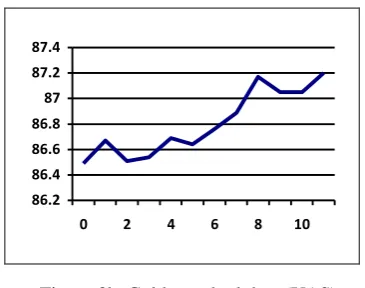
Figure 3a. Gold-standard data (LAS) Figure 3b. Gold-standard data (UAS)
4.3 Gold-Standard Data
In the previous two experiments (sections 4.1 and 4.2), we have taken large amount of raw data from same and different domains and applied self-training technique. In both these experi-ments, impact of large automatically annotated data was observed. In this experiment, we shall observe the impact of small but, gold-standard data. We have taken the development data of ICON 2010 tools contest. We have divided the data into sets of 50 sentences and added one by one similar to above experiments. We could achieve the accuracy of 79.2% LAS and 87.2% UAS at the final iteration. With this gold stan-dard data, we could achieve an improvement of 0.7% in UAS and 1.3% in LAS.
4.4 Analysis
Table 3, gives the summary comparing all the experiments performed. “*” mark in the table shows that, accuracy is statistically significant over the baseline. Significance is calculated us-ing McNemar’s test (p <= 0.05) made available with MaltEval (Nilsson and Nivre, 2008).
System UAS LAS LS
1) Baseline System 86.5% 77.9% 81.7% 2) In-domain self-training 87.0%* 78.6%* 82.3%*
3) Out-of-domain self-training 86.8% 77.8% 81.6% 4) Gold-Standard Data 87.2%* 79.2%* 82.9%*
Table 2. Summary of Experiments.
We could achieve significant improvement in the accuracy when the raw data is from the same domain. But, when the data is from different do-main, we haven’t seen any significant increase in the performance. This clearly shows the impor-tance of domain of the training data. One can get better accuracies when training data is similar to testing data. As expected, adding gold-standard data outperformed both the self-training experi-ments. Our experiments show that gold-standard
data is the best solution for improving the parser performance. When this is not possible, raw data from same domain seems to be a better option.
Interesting observation is that even when gold data is being added, there isn’t steady increase. Slight drop was observed when some sentences are added. This clearly shows that nature of the sentences being added to training data is very important. Currently, criterion being used to ex-tract reliable sentences from automatically parsed ones is average confidence score given by the parser. We are considering all the nodes in the sentences for calculating confidence score of sentence. It was shown by Ambati et al. (2010) that accuracy for intra-chunk dependencies is pretty high and that of inter-chunk dependencies is low. We can explore considering sentences with high confidence scores for inter-chunk nodes, rather than average score considering all the nodes. We can also explore considering only high confidence nodes rather than entire sen-tence, similar to works of Chen et al. (2008) and Mannem and Dara (2011).
5
Conclusions and Future Work
We explored the effect of self-training on Hindi dependency parsing. We showed the impact of adding small, but gold-standard data to training data versus large, but automatically parsed data on Hindi dependency parsing.
References
B. R. Ambati, M. Gupta, S. Husain and D. M. Shar-ma. 2010. A high recall error identification tool for Hindi treebank validation. In Proceedings of The 7th International Conference on Language Re-sources and Evaluation (LREC), Valleta, Malta.
A. Bharati, V. Chaitanya and R. Sangal. 1995. Natu-ral Language Processing: A Paninian Perspective, Prentice-Hall of India, New Delhi.
A. Bharati, S. Husain, B. Ambati, S. Jain, D. Sharma, and R. Sangal. 2008. Two semantic features make all the difference in parsing accuracy. In Proceed-ings of ICON-08.
R. Bhatt, B. Narasimhan, M. Palmer, O. Rambow, D. M.Sharma and F.Xia. 2009. Multi-Representational and Multi-Layered Treebank for Hindi/Urdu. In Proceedings of the Third Linguistic Annotation Workshop at 47th ACL and 4th IJCNLP.
W. Chen, Y. Wu, and H. Isahara. 2008. Learning reli-able information for dependency parsing adapta-tion. In Proceedings of the 22nd International Con-ference on Computational Linguistics (COLING).
S. Husain. 2009. Dependency Parsers for Indian Lan-guages. In Proceedings of ICON09 NLP Tools Contest: Indian Language Dependency Parsing. Hyderabad, India.
S. Husain, P. Mannem, B. Ambati and P. Gadde. 2010. The ICON-2010 Tools Contest on Indian Language Dependency Parsing. In Proceedings of ICON-2010 Tools Contest on Indian Language Dependency Parsing. Kharagpur, India.
P. Kosaraju, S. R. Kesidi, V. B. R. Ainavolu and P. Kukkadapu. 2010. Experiments on Indian Lan-guage Dependency Parsing. In Proceedings of the ICON10 NLP Tools Contest: Indian Language De-pendency Parsing.
P. Mannem and A. Dara. 2011. Partial Parsing from Bitext Projections. Accepted at the 49th Annual Meeting of the Association of Computational Lin-guistics.
D. McClosky, E. Charniak and M. Johnson. 2006. Effective Self-Training for Parsing. In Proceedings of the main conference on Human Language Tech-nology Conference of the North American Chapter of the Association of Computational Linguistics.
R. McDonald, K. Lerman, and F. Pereira. 2006. Mul-tilingual dependency analysis with a two-stage dis-criminative parser. In Proceedings of the Tenth Conference on Computational Natural Language Learning (CoNLL-X), pp. 216–220.
I. A. Mel’čuk. 1988. Dependency Syntax: Theory and Practice, State University Press of New York.
J. Nilsson and J. Nivre. 2008. Malteval:An evaluation and visualization tool for dependency parsing. In Proceedings of the Sixth LREC, Marrakech, Mo-rocco.
J. Nivre, J. Hall, S. Kubler, R. McDonald, J. Nilsson, S. Riedel and D. Yuret. 2007a. The CoNLL 2007 Shared Task on Dependency Parsing. In Proceed-ings of EMNLP/CoNLL-2007.
J. Nivre, J. Hall, J. Nilsson, A. Chanev, G. Eryigit, S. Kübler, S. Marinov and E Marsi. 2007b. MaltPars-er: A language-independent system for data-driven dependency parsing. Natural Language Engineer-ing, 13(2), 95-135.
R. Reichart, and A. Rappoport. 2007. Self-Training for Enhancement and Domain Adaptation of Statis-tical Parsers Trained on Small Datasets. In Pro-ceedings of the 45th Annual Meeting of the Associ-ation of ComputAssoci-ational Linguistics.
S. M. Shieber. 1985. Evidence against the context-freeness of natural language. In Linguistics and Philosophy, p. 8, 334–343.