
Human-Computer Interactive Chinese Word Segmentation:
An Adaptive Dirichlet Process Mixture Model Approach
Tongfei Chen
1, Xiaojun Zou
2, Weimeng Zhu
1, Junfeng Hu
2, * 1School of Electronics Engineering and Computer Science,
Peking University, Beijing, 100871, P. R. China
2Key Laboratory of Computational Linguistics (Peking University),
Ministry of Education, Beijing, 100871, P. R. China
{ctf,zouxj,zwm,hujf}@pku.edu.cn
Abstract
Previous research shows that Kalman fil-ter based human-compufil-ter infil-teractive Chinese word segmentation achieves an encouraging effect in reducing user inter-ventions, but suffers from the drawback of incompetence in distinguishing seg-mentation ambiguities. This paper pro-poses a novel approach to handle this problem by using an adaptive Dirichlet process mixture model. By adjusting the hyperparameters of the model, ideal clas-sifiers can be generated to conform to the interventions provided by the users. Ex-periments reveal that our approach achieves a notable improvement in han-dling segmentation ambiguities. With knowledge learnt from users, our model outperforms the baseline Kalman filter model by about 0.5% in segmenting ho-mogeneous texts.
1
Introduction
*As Chinese text is written without natural delim-iters such as whitespaces, word segmentation is often the essential first step in Chinese language processing (Liang, 1987). Over the past two dec-ades, various methods have been developed to address this issue (Nie et al., 1994; Sun et al., 1998; Luo et al., 2002; Zhang et al., 2003; Peng et al., 2004; Goldwater et al., 2006). Generally, supervised statistical learning methods are more adaptive and robust in processing unrestricted texts than the traditional dictionary-based meth-ods.
* To whom all correspondence should be addressed.
However, in some domain-specific applica-tions, for example ancient Chinese text pro-cessing, there is neither enough homogeneous corpora for training a reliable statistical model, nor a well-defined dictionary. In these tasks, un-supervised word segmentation is preferred to utilize the linguistic knowledge derived from the raw corpus itself. Many researches also enable users to take part in the segmentation process, adding expert knowledge to the system (Wang et al., 2002; Li and Chen, 2007). This is quite rea-sonable since the criteria of word segmentation are dependent on a user or the destination of use in many applications (Sproat et al., 1996).
Zhu et al. (2013) proposed a Kalman filter based human-computer interactive learning mod-el for segmenting Chinese texts depending upon neither lexicon nor any annotated corpus. This approach enables experts to observe and inter-vene with the segmentation results, while the segmenter learns and adapts to these knowledge iteratively. At the end of this procedure, a seg-mentation result that fully matches the demand of the user is returned. However, in some com-plicated cases where segmentation ambiguities exist, the Kalman filter will not converge and keep swapping in two or more states.
To overcome this drawback, we established an adaptive Dirichlet process mixture model (ADPMM) for human-computer interactive word segmentation. ADPMM gradually adapts itself to the knowledge supplied by users through the process of human-computer interaction, notably reducing human interventions by classifying each occurrence of a bigram into its correspond-ing class. Each generated class bears a tag sepa-rated or combined derived from user interven-tions; bigrams classified to a class later is judged as separated or combined according to the class tag. Knowledge learnt from the user can further
be used to aid the segmentation of homogeneous corpus.
The rest of this paper is organized as follows. The next section reviews related work. The de-tails of our model are elaborated in Section 3. In Section 4, experiments are presented to illustrate the performance of our model. The final section concludes the proposed model and discusses pos-sible future work.
2
Related Work
Unsupervised word segmentation is generally based on some predefined criteria, for example
mutual information (mi), to recognize a substring as a word. Sproat and Shih (1990) studied com-prehensively in this direction using mutual in-formation. Many successive researches applied different ensemble methods to mutual infor-mation (Chien, 1997; Yamamoto and Kenneth, 2001). Sun et al. (2004) designed an algorithm based on the linear combination of mi and differ-ence of t-score (dts). Other criteria like descrip-tion length gain (Kit and Wilks, 1999), assessor variety (Feng et al., 2004) and branch entropy
(Jin and Tanaka-Ishii, 2006) were also explored. Any automatic segmentation has limitations in some way and is far from fully matching the par-ticular need of users. Thus, human-computer in-teractive strategies are explored to allow users to pass their linguistic knowledge to the segmenter by directly intervening the segmentation process. Wang et al. (2002) developed a sentence-based human-computer interaction inductive learning method. Feng et al. (2006) proposed a certainty-based active learning segmentation algorithm to train an n-gram language model in an unsuper-vised learning framework. Li and Chen (2007) further explored a candidate word based human-computer interactive segmentation strategy.
Kalman filters (Kalman, 1960) are based on linear dynamic systems discretized in the time domain. Given parameters, Kalman filters esti-mates the unobserved state. Zhu et al. (2013) ap-plied Kalman filter model to learn and estimate user intentions in their human-computer interac-tive word segmentation framework.
A Dirichlet process is a stochastic process that is a distribution whose domain is itself a distribu-tion (Ferguson, 1973). It can also be viewed as an infinite-dimensional generalization of the Di-richlet distribution. It can be used to construct a mixture model with an unknown number of components (West et al., 1993). Dirichlet pro-cesses have been used to handle Chinese word
segmentation. Goldwater et al. (2006) explored a bigram model built upon a Dirichlet process to discover contextual dependencies.
3
Model
3.1 Baseline Model
Sun et al. (1998) proposed difference of t-score
(dts) as a useful complement to mutual infor-mation (mi). They further designed a compound statistical measurement based on the linear com-bination of mi and dts, named md (Sun et al., 2004). Given any bigram xy, in terms of md(x,y) and a threshold Θ, whether the bigram should be combined or separated can be determined—when
md(x,y) is greater than Θ, the bigram xy has more chance to be in a word. This model is a reference to our basic model before the human-computer interaction process. The formulae for calculating
md are as follows: ( , )
( , ) * (
* ( , ) ,
( , ) * ( , ) * ( , ,
) ,
,
) mi
mi
dts
dts
μ σ dts x y mi x y
mi x
μ dts x y
σ
md x y mi x
y
y λ dts x y
− =
=
+ × −
=
(1)
where μmi and μdts are means of mi and dts in the
corpus; σmi and σdts are standard deviations. mi*
and dts* are normalized versions of measure mi
and dts; λ is an empirical value.
Meanwhile, there is an optimization where lo-cal maxima and minima of md appear (Sun et al., 2004). Consider a character string abcd. If
md(b,c) > md(a,b) and md(b,c) > md(c,d), then
bc is considered a local maximum. Local mini-mum follows a similar definition. Obviously, local maxima are more likely to form words, while local minima are more likely to be separat-ed. To reflect this kind of tendency, we increase the md values at local maxima by a constant s, and decrease the md values at local minima by s.
Both baseline models above use a threshold value Θ to classify each bigram into two classes, namely combined and separated. Both approach-es are inherently binary classifiers which seek to classify occurrences of bigrams into classes.
3.2 Problem of Segmentation Ambiguity
In the scenario of human-computer interactive Chinese word segmentation, the Kalman filter approach proposed by Zhu et al. (2013) encoun-ters the problem of segmentation ambiguity, ren-dering it unsuccessful in converging in some special cases. If segmentation ambiguity exists, human interventions would be swapping, which in turn results in swapping states of the Kalman filter.
Take the bigram及其used in Zhu et al. (2013) as an example. It exhibits at least two types of segmentation in the corpus (e.g., separated in 以
及/其他 ‘and others’, and combined in 及其/浮
[image:3.595.306.524.362.678.2] [image:3.595.76.289.390.573.2]动 ‘and its fluctuations’). The Kalman filter ap-proach will not converge, and will keep swap-ping between two or more states as shown in Figure 1.
Figure 1. Problem encountered in Kalman Filter model on the bigram 及其. The vertical axis de-notes the md value, and the horizontal axis de-notes the occurrence of 及其 in the text. An in-crease in the value denotes that there exist inter-ventions tagged by the user as combined; where-as a decrewhere-ase in the value indicates the presence of interventions tagged as separated.
To address this problem, we adopt the md
measure described by Sun et al. (2004) to con-struct a Dirichlet process mixture model to clas-sify each occurrence of a bigram into its corre-sponding class. Each class bears a tag separated
or combined derived from user interventions. This model gradually adapts itself to the knowledge supplied by the user’s interventions through human-computer interaction, making it more robust in distinguishing segmentation am-biguities through the process of classifying them into different classes.
3.3 Adaptive Dirichlet Process Mixture Model
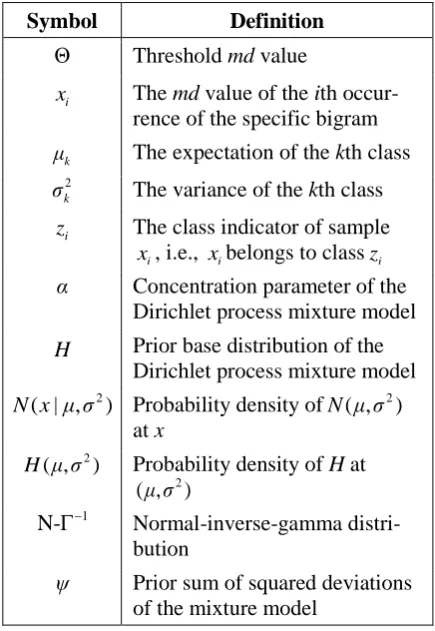
To address the problem mentioned above, classi-fication of each occurrence of a bigram into its corresponding class is required. Since we cannot predict the exact number of classes, a Dirichlet process mixture model (West et al., 1993) would suffice. Similar to the Kalman filter based ap-proach, we also assume that each bigram is inde-pendent, i.e., if the model for one bigram chang-es, other bigrams is not affected. To simplify our discussion, we focus on only one bigram in this section. Notations used in this paper are listed in Table 1.
Symbol Definition
Θ Threshold md value
i
x The md value of the ith occur-rence of the specific bigram
k
μ The expectation of the kth class
2
k
σ The variance of the kth class
i
z The class indicator of sample
i
x , i.e., xibelongs to classzi
α Concentration parameter of the Dirichlet process mixture model
H Prior base distribution of the
Dirichlet process mixture model
2
, ( |μ σ )
N x Probability density ofN( ,μ σ2) at x
2
) ( ,
H μ σ Probability density of H at
2
( ,μ σ )
1
N-Γ− Normal-inverse-gamma distri-bution
ψ Prior sum of squared deviations of the mixture model
Table 1. Notations used in this paper.
We consider the md value of each occurrence of a bigram as a sample of the bigram. Initially, samples are classified into class separated or
combined according to threshold value Θ. During
generated to handle complex situations when binary classifiers are unable to produce correct segmentation result. As the exact number of clas-ses cannot be predicted, the model used for the generation of multiple classes can be formulated as an infinite Gaussian mixture model, in which each sample belongs to a class that follows a Gaussian distribution, and each distribution is specified by a mean and a variance.
Infinite Gaussian mixture models can be for-mulated by a Dirichlet process with concentra-tion parameter α and base distribution H (West et al., 1993):
2
2 ,
,
, ) , (
~ DP( ) ~
~ ( ,
) , ,
.
k
N k k k
i
G
G α H μ σ
μ σ
x N
(2)
For simplicity, we choose the prior base dis-tribution H to be the conjugate prior of N( ,μ σ2).
The conjugate prior of a Gaussian distribution with unknown expectation and variance is the normal-inverse-gamma distribution:
2 1
0
Γ
( ,μ σ ) ~H=N- − (μ κ ν, , , )ψ , (3) where μ0 is the prior expectation of μ estimated from κ observations, and ψ is the prior sum of squared deviations estimated from ν observations (O’Hagan et al., 2004).
The prior parameter α and ψ are of special in-terest here. Parameter α is the concentration of the Dirichlet process. The greater α is, the proba-bility of producing more classes increases. Pa-rameter ψ represents the prior sum of squared deviations of each class. The lesser ψ is, the higher precision a class is, and the range the class covers becomes smaller.
To produce more classes that covers smaller ranges, we increase α and decrease ψ. We define this step as ADJUSTPARAMETER, which is im-plemented by multiplying a constant value to α and ψ respectively.
In the scenario of human-computer interactive word segmentation, humans can judge whether the segmentation result produced by the seg-menter is correct or not. These judgments act as constraints over samples. Classes produced shall conform to these judgments, i.e., samples within each class are uniformly judged as separated or uniformly judged as combined. If the initial re-sult does not conform to human judgments, more classes with smaller ranges should be generated. Thus ADJUSTPARAMETER should be performed.
Our adaptive Dirichlet process mixture model works as follows: In the initial state of a bigram, we construct a classifier such that all samples
below the threshold Θ are marked separated, while all samples above Θ are marked combined. Whenever a user intervention occurred, implying that the current classifier cannot distinguish cer-tain segmentation ambiguities, we increase the concentration parameter α, i.e. increase the prob-ability to generate more classes, and decrease the prior class sum of squared deviations ψ, i.e. in-crease the precision of a class. With these pa-rameters adjusted, re-cluster all the samples to date. Since the prior parameters α and ψ are ad-justed, the segmenter tends to produce more clas-ses. Iterate this process until all classes conform to human judgments, i.e., samples within each produced class share the same human judgment. Then tag each class with separated or combined
according to the human judgments of the sam-ples in that class. In this way, the Dirichlet pro-cess mixture model will adapt itself to conform to human judgments upon samples. This algo-rithm is illustrated in Algoalgo-rithm 1.
In Algorithm 1, Line 5 and 6 implements A D-JUSTPARAMETER. Empirical values 2.0 and 0.9 are assigned to coefficients pα and pψ. The
algo-rithm CLUSTERBYDPMM will be elaborated in Section 3.4.
Algorithm 1. ADAPTIVEDPMM
Input: Sample set X, human judgments J
Output: Clustering result C
1: begin
2: do
3: C ← CLUSTERBYDPMM(X, α, ψ)
4: if C conforms to human judgments J break
5: α ← α × pα 6: ψ← ψ × pψ
7: while maximum iteration count not reached 8: Tag each class in C according to judgments J
9: end
Whenever a user intervention occurred, the al-gorithm above is run once, and it returns the ex-pectation and variance of each class, along with the class tag. Use the expectation and variance to construct a naïve Bayes classifier from these data, namely
2
arg max ( ) ( | k, ) ,
k k
μ
P x σ
z= k N (4)
where x is a new sample, z is the class which x
belongs to, and , 2
k k
3.4 Inference of the Dirichlet Process Mixture Model
Each time a user intervenes in the segmentation process, implying that the samples should be re-clustered, we use a Gibbs sampler to perform the clustering task (MacEachern, 1994; Neal, 2000; Rasmussen, 2000). The algorithm below adopts Algorithm 3 described by Neal (2000).
Set up a Markov chain whose state consists of
1
( ,z ,zn),
=
z i.e., the class indicator of current samples. Repeatedly sample as follows:
For i = 1, …, n: Draw a new value for zi from:
,
,
( | , )
if for some
if
( | ) ( ) d 1
( |
for a ) ( 1
ll ) d
i z
i i z
i
j i i i
j
i
n
N x φ H φ φ
n α
i
P z z z x
z z j
z α
N x φ H φ
α
j φ n
z i
−
− −
− +
≠
∝ − +
≠ ≠
=
=
∫
∫
, (5)
where φ indicates the parameter pair ( ,μ σ2) ;
,
i z
n− is the number of samples in class z except
i
x ; andH−i z, is the posterior distribution of φ based on the prior H and all observations xj for which j≠iand zj=z.
Since H is chosen to be the conjugate prior of Gaussian distribution, i.e. the normal-inverse-gamma distribution mentioned in Section 3.3, the integral term in Equation (5) is analytically fea-sible, thus the sampling method presented here is feasible.
4
Experiments
In this section, we conducted several experi-ments to evaluate the performance of our seg-mentation model. Firstly, we analyzed the per-formance of segmentation ambiguity handling through a case study. Secondly, we verified the improvement in reducing human intervention after introducing our model. Thirdly, we tested the reusability of knowledge learnt from human interaction. The experiments are based on the
People’s Daily corpus from Jan. 1998 to Jun. 1998 provided by the Institute of Computational Linguistics, Peking University.
Several baseline models are used in this sec-tion. One is the approach proposed by Sun et al. (2004) (abbreviated as Sun’s Appr.) mentioned in Section 3.1, and the other is the Kalman Filter based approach proposed by Zhu et al. (2013) (abbreviated as Zhu’s Appr.). In addition, the memory approach (abbreviated as Memory Appr.), a bigram based human interactive model
whose initial segmentation is exactly the same as Sun’s Approach but its prediction of the bigram is taken from the latest human intervention (i.e., the latest correct segmentation result judged by human), is also compared in Sections 4.2 and 4.3. Our adaptive Dirichlet process mixture model is abbreviated as ADPMM.
4.1 Case Study
In this part, we took the aforementioned bigram
及 其 as an example, and examined the exact number of interventions by users during the hu-man-computer interaction process. Models used for comparison are Memory Appr., Zhu’s Appr. and ADPMM. The simulation of the segmenta-tion process was performed by using the correct segmentation text as input to the model. We de-fine an intervention rate (IR) of a specific bigram to measure the human effort in a corpus. The IR of bigram xy is defined as
# of interventions of IR[%]
# of occurrences of 100%.
xy xy ×
= (6)
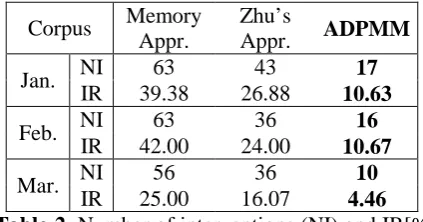
[image:5.595.309.521.552.663.2]Table 2 shows the number of interventions (denoted by NI) and the IR of bigram 及其under each model with People’s Daily Jan. 1998 to Mar. 1998 as test text. It can be seen from the table that ADPMM significantly reduced the number of interventions of bigram 及其 under all three corpora. In Feb. 1998, ADPMM reduced the NI from 36 in Zhu’s Appr. to 16 (about 55.56% reduction in percentage), while in Mar. 1998, from 36 to 10 (about 72.22% reduction in percentage). This experiment shows that our model greatly reduced the number of interven-tions in the case of the segmentation-ambiguous word 及其.
Corpus Memory Appr.
Zhu’s
Appr. ADPMM
Jan. NI 63 43 17 IR 39.38 26.88 10.63
Feb. NI 63 36 16 IR 42.00 24.00 10.67
Mar. NI 56 36 10 IR 25.00 16.07 4.46 Table 2. Number of interventions (NI) and IR[%]
of bigram 及其 under different corpora.
4.2 Simulating the Human-Computer Interactive Segmentation Process
prediction rate (BPR) described by Zhu et al. (2013) to quantify the conformity of the predic-tion of the model to user intenpredic-tion. BPR is de-fined as
# of correct predictions BPR[%]
# of all predictions ×100% .
= (7)
The result of the experiment is shown in Table 3. It can be seen that our model gained a slightly higher BPR than both Zhu’s Appr. and Memory Appr. (this is because segmentation ambiguities are relatively rare in corpora), which indicates that our model can reduce user interventions more effectively than Zhu’s Appr.
Corpus Sun’s Appr.
Memory Appr.
Zhu’s
Appr. ADPMM Jan. 84.22 94.55 94.66 94.95
Feb. 84.58 94.74 94.83 95.14
Mar. 84.59 95.04 95.17 95.46 Table 3. BPR[%] of different approaches under
different corpora.
4.3 Knowledge Reusability Test
After the experiment in Section 4.1, we obtained the classification information for each bigram, and we assumed that this information can be viewed as a kind of learnt knowledge that could be used to aid further word segmentation on ho-mogeneous corpus.
In this part, we performed an incremental test on knowledge reusability. This is done by apply-ing the model with knowledge learnt from text of previous months to segment the text of the cur-rent month, from Jan. to Jun., respectively. For example, we took the model with knowledge learnt from Jan. to segment the text of Feb.; the model with knowledge learnt from both Jan. and Feb. to segment text of Mar.; and so on. The BPRs of Memory Appr., Zhu’s Appr. and ADPMM are recorded using the testing scheme described above. As is shown in Figure 2, with the knowledge accumulating, the advantage of our model increases significantly: on Jan. (no previous knowledge exists), the advantage of our model is 0.29% and 0.40% over Zhu’s Appr. and Memory Appr. respectively; on Jun. this ad-vantage is enlarged to 0.47% and 0.68%; on May., this advantage reached 0.56% and 0.80%. This experiments shows that when a large train-ing corpus is present, knowledge of segmentation ambiguities will be stored in our model through the form of different classes of a bigram, making it more robust in handling future segmentation ambiguities.
Figure 2. BPR[%] of different word segmenta-tion approaches using an incremental testing scheme.
5
Conclusions and Future Work
Research shows that Kalman filter based human-computer interactive Chinese word segmentation framework suffers from the drawback of inepti-tude in handling segmentation ambiguities. This paper proposes an adaptive Dirichlet process mixture model (ADPMM). ADPMM adjusts the hyperparameters so that ideal classifiers can be generated to conform to the interventions provid-ed by the users. Experiments showprovid-ed that our approach achieves a notable improvement (more than 55.56% in a case study) in handling seg-mentation ambiguities, therefore effective in re-ducing human effort. In the knowledge reusabil-ity test, our model outperforms the baseline Kalman filter model by about 0.5% in segment-ing homogeneous texts with knowledge learnt from users.
Our future work will concentrate on improv-ing statistics criteria that would reflect contexts more precisely. As in the experiments, we found that the number of classes may grow rapidly. This is caused by the ineffectiveness of the md
measure to distinguish different contexts.
Acknowledgements
[image:6.595.305.524.81.258.2]References
Lee-Feng Chien. 1997. Pat-Tree-Based Keyword Ex-traction for Chinese Information Retrieval. In ACM SIGIR Forum, pages 50-58.
Michael D. Escobar. 1994. Estimating Normal Means with a Dirichlet Process Prior. Journal of the American Statistical Association, 89(425): 268-277.
Chong Feng, Zhaoxiong Chen, Heyan Huang, and Zhenzhen Guan. 2006. Active Learning in Chinese Word Segmentation Based on Multigram Language Model. Journal of Chinese Information Pro-cessing, 20(1): 50-58 (in Chinese)
Haodi Feng, Kang Chen, Xiaotie Deng, and Weimin Zheng. 2004. Accessor Variety Criteria for Chinese Word Extraction. Computational Linguistics, 30(1): 75-93.
Thomas S. Ferguson. 1973. A Bayesian Analysis of Some Nonparametric Problems. The Annals of Sta-tistics, pages 209-230.
Sharon Goldwater, Thomas L. Griffiths, and Mark Johnson. 2006. Contextual Dependencies in Unsu-pervised Word Segmentation. In COLING/ACL
2006, pages 673-680.
Zhihui Jin and Kumiko Tanaka-Ishii. 2006. Unsuper-vised Segmentation of Chinese Text by Use of Branching Entropy. In COLING/ACL 2006, pages 428-435.
Chunyu Kit and Yorick Wilks. 1999. Unsupervised Learning of Word Boundary with Description Length Gain. In Proceedings of the CoNLL99 ACL Workshop, pages 1-6.
Bin Li and Xiaohe Chen. 2007. A Human-Computer Interaction Word Segmentation Method Adapting to Chinese Unknown Texts. Journal of Chinese In-formation Processing, 21(3): 92-98. (in Chinese)
Rudolph E. Kalman. 1960. A New Approach to Line-ar Filtering and Prediction Problems. Journal of Basic Engineering, 82(1): 35-45.
Nanyuan Liang. 1987. CDWS: An Automatic Word Segmentation System for Written Chinese Texts.
Journal of Chinese Information Processing, 1(2): 44-52. (in Chinese)
Xiao Luo, Maosong Sun, and Benjamin K. Tsou. 2002. Covering Ambiguity Resolution in Chinese Word Segmentation Based on Contextual Infor-mation. In COLING 2002, pages 1-7.
Radford M. Neal. 2000. Markov Chain Sampling Methods for Dirichlet Process Mixture Models.
Journal of Computational and Graphical Statistics, 9(2): 249-265.
Jian-Yun Nie, Wanying Jin, and Marie-Louise Han-nan. 1994. A Hybrid Approach to Unknown Word
Detection and Segmentation of Chinese. In Pro-ceedings of International Conference on Chinese Computing, pages 326-335.
Anthony O’Hagan, Jonathan Forster, and Maurice G. Kendall. 2004. Bayesian Inference. London: Ar-nold.
Fuchun Peng, Fangfang Feng, and Andrew McCallum. 2004. Chinese Segmentation and New Word Detection Using Conditional Random Fields. In COLING 2004, pages 23-27.
Carl E. Rasmussen. 2000. The Infinite Gaussian Mix-ture Model. Advances in Neural Information Pro-cessing Systems, 12(5.2): 2.
Richard Sproat, William Gale, Chilin Shih, and Nan-cy Change. 1996. A Stochastic Finite-State Word Segmentation Algorithm for Chinese. Computa-tional Linguistics, 22(3): 377-404.
Richard Sproat and Chilin Shih. 1990. A Statistical Method for Finding Word Boundaries in Chinese Text. Computer Processing of Chinese and Orien-tal Languages, pages 336-351.
Maosong Sun, Dayang Shen, and Benjamin K. Tsou. 1998. Chinese Word Segmentation Without Using Lexicon and Hand-Crafted Training Data. In COL-ING/ACL 1998, (1998) 1265-1271.
Maosong Sun, Ming Xiao, and Benjamin K. Tsou. 2004. Chinese Word Segmentation without Using Dictionary Based on Unsupervised Learning Strat-egy. Chinese Journal of Computers, 27(6): 736-742 (in Chinese)
Zhongjian Wang, Kenji Araki, and Koji Tochinai. 2002. A Word Segmentation Method with Dynam-ic Adapting to Text Using Inductive Learning. In
Proceedings of the First SIGHAN Workshop on Chinese Language Processing, pages 1-5.
Mike West, Peter Müller, and Michael D. Escobar. 1993. Hierarchical Priors and Mixture Models, with Application in Regression and Density Esti-mation. Institute of Statistics and Decision Scienc-es, Duke University.
Mikio Yamamoto, and Church W. Kenneth. 2001. Using Suffix Arrays to Compute Term Frequency and Document Frequency for All Substrings in a Corpus. Computational Linguistics, 27(1): 1-30.
Hua-Ping Zhang, Qun Liu, Xue Q. Cheng, and Hong K Yu. 2003. Chinese Lexical Analysis Using Hier-archical Hidden Markov Model. In Proceedings of the Second SIGHAN Workshop on Chinese Lan-guage Processing, pages 63-70.
![Figure 2. BPR[%] of different word segmenta-tion approaches using an incremental testing scheme](https://thumb-us.123doks.com/thumbv2/123dok_us/801789.1094424/6.595.305.524.81.258/figure-different-segmenta-approaches-using-incremental-testing-scheme.webp)