3793
Incorporating Deep Visual Features into Multiobjective based Multi-view
Search Results Clustering
Sayantan Mitra
Department of CSE, IIT Patna, Bihta, India
Mohammed Hasanuzzaman
ADAPT Centre, School of Computing, Dublin City University,
Dublin, Ireland
Sriparna Saha
Department of CSE, IIT Patna, Bihta, India
Andy Way
ADAPT Centre, School of Computing, Dublin City University,
Dublin, Ireland
Abstract
Current paper explores the use of multi-view learning for search result clustering. A web-snippet can be represented using multiple views. Apart from textual view cued by both the semantic and syntactic information, a complementary view extracted from images contained in the web-snippets is also utilized in the current framework. A single consensus partitioning is finally ob-tained after consulting these two individual views by the deployment of a multi-objective based clustering technique. Several objective functions including the values of a cluster quality mea-sure evaluating the goodness of partitionings obtained using different views and an agreement-disagreement index, quantifying the amount of oneness among multiple views in generating par-titionings are optimized simultaneously using AMOSA. In order to detect the number of clusters automatically, concepts of variable length solutions and a vast range of permutation operators are introduced in the clustering process. Finally a set of alternative partitionings are obtained on the final Pareto front by the proposed multi-view based multi-objective technique. Experimental results by the proposed approach on several bench-mark test datasets with respect to different performance metrics evidently establish the power of visual and text based views in achieving better search result clustering.
1 Introduction
Web search results clustering (SRC), also known as ephemeral clustering or post-retrieval clustering has garnered much attention in the past few decades for making web browsing easier for users. The key objective of SRC systems is: for a given query it can return some meaningful labeled clusters from a set of web documents (or web snippets) retrieved from a search engine. Recent years have witnessed a large number of attempts in solving this SRC problem (Di Marco and Navigli, 2013; Scaiella et al., 2012). Most of them have developed some clustering algorithms optimizing a single objective criteria (Osinski and Weiss, 2005; Zamir and Etzioni, 1998; Moreno et al., 2013). But a complex data set like set of web-snippets can be clustered into several alternative partitionings. Therefore to detect all possible partitionings containing clusters of different shapes automatically, application of multiobjective optimization (MOO) for solving the problem of clustering becomes prevalent (Maulik et al., 2011). In this context, Acharya et al. (Acharya et al., 2014) have proposed a multi objective optimization based approach for solving SRC problem by extracting both semantic and syntactic information present in web-snippets. Results attained by this approach outperformed the other existing single objective based approaches. Moreover a web-snippet can be represented using different views, for example semantic view, syntactic view. Recently, Wahid et al. (Wahid et al., 2014) have developed a multi-view based MOO clustering technique for search result clustering where multiple views are consulted for developing a consensus partitioning of available web-snippets.
Multimodal approaches have gained increased attention over the past few years. These models have been used in various applications: image captioning (You et al., 2016); sentiment analysis (Poria et al.,
2016); multimodal machine translation (Specia et al., 2016); visual question answering (Antol et al., 2015); combating human trafficking (Tong et al., 2017); and detection of Cyber-bullying (Zhong et al., 2016). In today’s online environment, the strategic use of multimedia (image, video etc.) has become increasingly important part of creating a successful website. Visual information embedded in web doc-uments provides right-angled information that is free of ambiguities of natural language. It can also improve search ranking and Search engine optimization (SEO) scores on many levels that contribute to search visibility, find-ability, user satisfaction, experience and engagement. As a result, use of multi-media content in web documents has become more dominant than text in recent years. Rich content of multimedia data, constructed in alliance with the information contained in different modalities, calls for new and innovative methods for better management of web search results.
[image:2.595.133.451.297.442.2]In this paper, we hypothesize that high quality clustering can be obtained by representing different ob-jective functions over different views of web documents and simultaneously optimizing them. In contrast to prior works which solely depend on information extracted from text we present a multi objective based multiview clustering algorithm which integrates both visual (images) and text content of web-documents for solving SRC problem. Experimental results show that this new multi-view approach significantly outperforms state-of-the-art unimodal approaches. We motivate this paper with a real example which
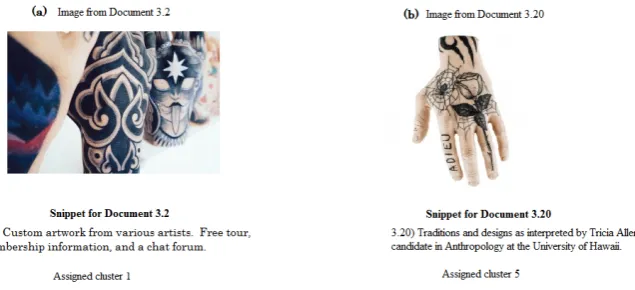
Figure 1: Example where text content differs but image information is same.
demonstrates the potential benefit of integrating visual information for better organization of web search results. Figure 1 shows results from state-of-the-art approach that depends only on text part of the web document for the web search query “3.1 Arts Bodyart Tattoo” in ODP-239 dataset. Even though it is clear from looking at the images that they should belong to same cluster, text snippets are not provid-ing enough clues, causprovid-ing it to appear in different clusters. It is evident from the example that there is complimentary information in the images that is either unavailable in the text or can be in contrast to the text. Our hypothesis is that we can improve SRC performance if we can capture this complimentary high-level visual information. We use pre-trained 19-layer VGG net (Simonyan and Zisserman, 2014) to extract high-level features directly from the image. After extracting the image features for all the images in our dataset,image viewof each document is generated (Section 3.1). To generate thetextual viewof each document, we combine the benefits of both Word2Vec (Mikolov et al., 2013) and TF-IDF. While Word2Vec vectors are better at capturing the generalized meaning of each word, combining them together by assigning equal weight to all words of a document to generate itstextual viewis not ideal for our task. For example, words that contribute to the syntax rather than the meaning of a sentence should have lower impact on clustering algorithm compared to more specific rare words. Therefore, we scale each word vector by the corresponding TF-IDF weight for that word and generate thetextual view fol-lowing the approach in Section 3.1. Finally, we combine both views of the dataset by our multi-objective based multi-view clustering framework.
and MMOEA (Wahid et al., 2014). Experiments are conducted on three different standard data sets (MORESQUE, ODP- 239 and AMBIENT) for two clustering evaluation metrics (Fb3 andF1). Results show that MOO-Multiview-PBM exceeds all text-based approaches and solutions. In this paper, our main contributions are as follows: a)As far the best of our knowledge, this is the first attempt to solve SRC by using both textual & visual information;b)A new multi objective based multi-view clustering algorithm for SRC, that determines the number of clusters automatically; andc)Novel text representation of document in the context of SRC by combining the benefits of both word2vec and TF-IDF.
2 Related Work
2.1 SRC Algorithms
Suffix Tree Clustering (STC) algorithm proposed by Zamir and Etzioni (1998), is a clustering technique, that combines base clusters having maximum string overlaps based on web snippets represented as com-pact tries. Results showed improvements over K-means, agglomerative hierarchical clustering, buckshot, single-pass and fractionation algorithms, and this approach is a tough baseline to beat Moreno and Dias (2014). Later, authors of Osinski and Weiss (2005) presented an approach named LINGO which utilizes similar representation of strings as done in Zamir and Etzioni (1998). Initially frequent phrases were ex-tracted based on suffix-arrays and later the group descriptions were matched with topics generated with latent semantic analysis. Documents were then assigned to their relevant groups. Carpineto et al. (2009) showed that the nature of the outputs obtained by SRC algorithms recommend the adoption of a meta clustering approach. The core idea is to combine the complementary results obtained from SOO (single objective) solutions. A novel approach that computes the agreement of two partitions of objects into var-ied clusters was proposed in this paper. This is done depending on the information content related to the series of decisions made by the partitions on single pairs of objects. OPTIMSRC results demonstrated that meta clustering is far better than individual clustering techniques. Moreno et al. (2013), adapted the K-means algorithm to a third-order similarity measure and proposed a stopping criterion that determines the optimal number of clusters automatically. Experiments were conducted on two standard data sets, MORESQUE (Navigli and Crisafulli, 2010) and ODP-239 (Carpineto and Romano, 2010), and showed significant improvement over all existing text-based SRC techniques developed by then.
Later, Acharya et al. (2014), first defined the SRC task as a multi-objective problem. They defined two objective functions ( separability & compactness), that are optimized parallely with the help of AMOSA (Bandyopadhyay et al., 2008). Their evaluations outperformed knowledge-driven exogenous strategies (Scaiella et al., 2012), text-based endogenous SRC approaches and algorithms.
In another work, the multi-view clustering approach proposed by Wahid et al. (2014) used the search capability of multi-objective optimization for SRC. It is basically a cluster ensemble approach where the outputs of multiple clustering techniques like hierarchical clustering approaches and K-means are combined efficiently using NSGA-II (Deb et al., 2002) (non-dominated sorting genetic algorithm-II).
A considerable amount of works have also been proposed that uses exogenous information to solve the SRC problem. One such work is proposed by Scaiella et al. (2012) which uses Wikipedia articles to develop a bipartite graph and employs spectral clustering over it to discover relevant clusters. Recently, authors of Di Marco and Navigli (2013) presented an approach to incorporate word sense induction on the Web1T corpus (Brants and Franz, 2006) that improves SRC.
2.2 Multi-view Clustering
clustering technique was proposed by (Tzortzis and Likas, 2009). The same authors later proposed a kernel-based weighted multi-view clustering technique (Tzortzis and Likas, 2012). A cluster ensemble based approach for multi-view clustering was proposed by (Xie and Sun, 2013). A new multi-view based K-means clustering technique was developed by (Cai et al., 2013) for large-scale data sets. (Wahid et al., 2014) have developed a cluster ensemble based technique to solve the multi-view clustering problem for web documents. Although it presented a multi-view based algorithm MMOEA for solving SRC problem but all the views (i.e., different representations of the data set) are related to semantic and syntactic contents of the web snippets.
3 Multiobjective Multi-view Approach for SRC
In this work we have proposed a multiobjective based multi-view approach, namely MOO-Multiview-PBMfor solving the problem of search result clustering.
3.1 Generation of Different Views
In the current study we have used some standard data sets of SRC problem for the purpose of evaluation: AMBIENT, MORESQUE (Navigli and Crisafulli, 2010) and ODP-239 (Carpineto and Romano, 2010). For each of web-snippets present in the data set, we have generated two views as follows:
1. The Textual view: This view represents both syntactic and semantic information of a document given a particular query. This is generated by combining the document similarity matrix obtained from both word embedding and TF-IDF. Using word embedding each word in the vocabulary is represented by a vector of dimension1×100. Document similarity matrix using word embedding is generated by Equation 1.
Semb(di, dj) =
1
kdikkdjk kdik X
r=1
kdjk X
b=1
CosSim(wri, wbj) (1)
Here,wri (resp. wjb) represents therth(resp. bth) word vector of documentdi (resp. dj).kdikand
kdjkdenote the total number of words in documents di anddj, respectively. CosSim(., .)is the
cosine similarity between two vectors. TF-IDF is generated using the following steps:
(a) The terms in the documents are first extracted,
(b) A document-term matrix is created. Here, a row, a column and a cell correspond to a document, a term, and the weighted value of a term for a document, respectively,
(c) TF-IDF (a common weighting scheme) values are used to fill this matrix. Each cell contains the TF-IDF score of a term given a document.
The cosine similarity is calculated between TF-IDF vectors of two documents to generate the
document×document similarity matrix Stf idf. Here Stf idf(di, dj) contains cosine similarity
between TF-IDF vectors of two documents,dianddj.
The Finaldocument×documentsimilarity matrix,Stext, is generated by the equation:
Stext(di, dj) =Semb(di, dj)×Stf idf(di, dj), i, j= 1, . . . , n (2)
Herenis the total number of documents.
2. The Image view: Images are extracted from each web document. We feed images to the pre-trained VGG19 network which computes a 4096 dimensional feature vector for every image that contains the activations of the hidden layer (‘fc7’) immediately before the VGG’s object classifier. Given two image vectorsimgi andimgj from two different web documentsdi anddj, respectively, the
similarity between the documents is calculated by Equation 3.
Simage(di, dj) =
1
kdikkdjk kdik X
r=1
kdjk X
b=1
CosSim(imgri, imgjb) (3)
Here,imgir(resp.imgbj) represents therth(resp.bth) image of thedi(resp.d) web document.kdik
3.2 String Representation and Archive Initialization
The first step of the proposed clustering approach is to initialize the Archive used in AMOSA (Bandy-opadhyay et al., 2008) with some alternative diverse set of solutions. The solutions are generated ran-domly. Here each solution contains a set of cluster centroids (representative web-snippets) in order to represent the partitioning of web-snippets.
The number of cluster centroids encoded in a particular solutioni, denoted byKi, is selected randomly
from the given range Kmin to Kmax as follows: Ki = (rand()mod(Kmax −1)) +Kmin. For the
purpose of initialization, Ki number of web-snippets are randomly selected from the data set and the
corresponding indices are used as the initial cluster centers.
3.3 Formation of Clusters and Objective Function Calculations
After initializing the archive members with some randomly selected cluster centroids, the following steps are executed to compute different objective functions. The search capability of AMOSA can be utilized to simultaneously optimize these objective functions.
1. First, the set of representative web-snippets present in the string are extracted. Let the entire set be {C1, C2, . . . , CK} here Ci is the ith cluster representative. K is the number of
clus-ters encoded in that particular string. K-medoids clustering is applied to the dataset using this set of cluster representatives for different views. In case of text-view, a particular document
di is assigned to cluster t whose centroid has the maximum similarity value to di given by t=argmaxk=1,...KStext(di, Ck).HereStext(di, Ck)is computed using Equation 2.
In case of visual view, a particular documentdiis assigned to clustertwhose centroid has the
max-imum similarity value todi. t=argmaxk=1,...KSimage(di, Ck).HereSimage(di, Ck)is computed
using Equation 3.
2. The PBM-index values are calculated for the final partitionings obtained using individual views. Let the values be denoted byP BMv,v= 1,2.
3. The adjoint matrix (Avof sizen×n, wherenis the number of documents) corresponding to view vis calculated as follows:
Avij = 1ifdianddj belong to the same cluster ori=j (4)
= 0 otherwise (5)
4. A new objective functionAgreement Indexis calculated as follows. This measures the agreement between the partitionings obtained using multiple views. The measure is calculated as follows:
At a time two views are considered: v1 and v2. Let the corresponding adjoint matrices be
Av1 and Av2, respectively. The number of agreement (na) is calculated as follows: na =
Pn
i=1 Pn
j=1IAv1
ij,Av2ij, here
IAv1 ij,A
v2
ij = 1 if A
v1
ij =Avij2 (6)
= 0 otherwise
The number of disagreements (nd) is calculated as follows:nd=n2−na.Agreement indexbetween
these two views (v1,v2) is calculated as follows:AIv1,v2= nna+1
d+1. The values of 1 in the numerator and denominator are used as a normalization factor to avoid the problem of division by zero. The totalAgreement indexfor the entire partitioning is calculated as follows:
AI =
m
X
j=1
m
X
i=1,j6=i
2×AIvj,vi
m×(m−1) , (7)
wheremis the available number of views.
5. The objective functions corresponding to a particular string are:
{P BMtext, P BMimage, AI}whereP BMtextandP BMimageare the values of PBM-indices
3.4 Update of String
After the objective functions are calculated, a consensus partitioning is obtained which satisfies all the available views. The cluster centroids corresponding to this consensus partitioning are used to update the string of AMOSA.
• Let the partitioning obtained using two views be represented byπ1, π2. Let us denote thejth cluster of viewvasπvj. First some reordering is done among all the obtained partitionings so that there is a one-to-one correspondence between the cluster numbers of different partitionings.
• New cluster centroidsC, are selected among those documents which are present in the same clus-ter corresponding to both the views. Let common documents of clusclus-ter i in both the views be {di1, . . . , dim}. Then the representative of this set, denoted byCi, isdtwhere
t=argmaxmk=1
Pm
j=1,j6=k Stext(d
i k,d
i
j)+Simage(d i k,d
i j) 2
m−1 . (8)
HereSf inalandSimageare calculated using Equation 2 and 3, respectively.
• Next, the newly generated cluster centroidsCj, j= 1, . . . , Kare used to obtain the final consensus
partitioning as follows: πj ={∀di∈S:Sim(di, Cj)> Sim(di, Cl) forl= 1, . . . , K, l6=j}.
Here,Kis the number of clusters encoded in that solution.
Sim(di, Cj) =
Stext(di, Cj) +Simage(di, Cj)
2 (9)
HereSf inalandSimageare calculated using Equation 2 and 3, respectively.Sdenotes the set of all
documents.
• Finally, the representatives of clustersπj, j = 1. . . , K are calculated using Equation 8. These
new cluster centroidsCj, j= 1, . . . , Kare used to replace the old centroids encoded in the string.
So, in order to obtain a consensus partitioning, initially the common points of different clusters present in different partitionings obtained using different views are identified. These points are further used to determine cluster centroids. The other points are assigned to the centroids having maximum similarity, calculated by Equation 9, to obtain a final consensus partitioning. These cluster centroids are used to update the given string.
3.5 Search Operators
In order to explore the search space efficiently using AMOSA, perturbation operations are introduced. These operators also help in generating some new solutions from the current solution which can further take part in the search process. For this purpose, three different perturbation operators are introduced. Below we describe three types of mutation operations in detail:
Mutation 1: In this operation each centroid is parsed individually and with some probability the exist-ing document id in the centroid is replaced by a new document id which is selected from the document collection randomly1.
Mutation 2: Here a cluster centroid is randomly selected and it is deleted from the string. Size of the string is reduced by 1.
Mutation 3: Here a web document is randomly chosen and the corresponding index is added to the string. Size of the string is increased by 1.
All the above mentioned three mutation operations are equi-probable. Any one of the above discussed mutation operators is applied on a particular solution to generate a new solution which can further par-ticipate in the process of AMOSA.
4 Results and Discussion
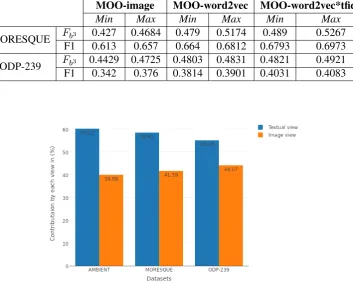
Results of different approaches are shown in Table 2 for all the data sets with respect to different per-formance metrics. From Table 2, it is evident that our proposed approachMOO-Multiview-PBM out-performs the results ofMOO-clus(Acharya et al., 2014) by a margin of around6.2%−6.5%in terms
ofFb3 −measureand7.0%−7.3%in terms ofF1−measurefor both MORESQUE and ODP-239 datasets. Box plots of results obtained from combinedF1−measureand combinedRandIndexover all three data sets (i.e., AMBIENT, MORESQUE and ODP-239) by our proposed method are reported in Figure 4. This is done to compare the performance ofMOO-Multiview-PBMwith MMOEA algorithm (Wahid et al., 2014). Although, AMBIENT has received less attention since the creation of ODP-239, we have included it to show a fair comparison of our results with the results from MMOEA (Wahid et al., 2014). In Figure 4, comparison with MMOEA (Wahid et al., 2014) is illustrated.MOO-Multiview-PBM (word2vec*tfidf)reports an average F1 measure and Rand Index values of0.74 and0.77, respectively, over all three datasets combined, which are similar to those obtained by MMOEA. Note that MMOEA is based on three views (Topics, terms and senses) and also utilized some external information like Wikipedia data during its processing. But our proposed method attains comparable results using infor-mation extracted only from the given datasets. No external inforinfor-mation was used during the computation of our approach.
Table 1: Evaluation results in terms ofF1andFb3 over MORESQUE and ODP239 data sets: Compari-son of the proposed approach with state-of-the-art approaches.†→Results are obtained by 10 consecutive runs of the algorithm and are statistically significant.
MOO-Multiview-PBM (word2vec*tf-idf)
MOO-Multiview-PBM
(word2vec) MOO-Clus SOO-SRC
Min Max Min Max Min Max GK-means STC LINGO BIK
MORESQUE Fb3 0.506 0.564† 0.510 0.557 0.477 0.502 0.482 0.460 0.399 0.315 F1 0.698 0.742† 0.682 0.728 0.658 0.675 0.655 0.455 0.326 0.317
ODP-239 Fb3 0.491 0.549† 0.482 0.531 0.478 0.484 0.452 0.403 0.346 0.307 F1 0.438 0.474† 0.431 0.462 0.379 0.384 0.366 0.324 0.273 0.2
Table 2: Evaluation results in terms ofF1andFb3 over MORESQUE and ODP239 data sets: Compari-son of the proposed approach over each single view.
MOO-image MOO-word2vec MOO-word2vec*tfidf
Min Max Min Max Min Max
MORESQUE Fb3 0.427 0.4684 0.479 0.5174 0.489 0.5267
F1 0.613 0.657 0.664 0.6812 0.6793 0.6973
ODP-239 Fb3 0.4429 0.4725 0.4803 0.4831 0.4821 0.4921
F1 0.342 0.376 0.3814 0.3901 0.4031 0.4083
[image:7.595.170.424.558.722.2]We have implemented our proposed algorithm using two different versions of textual views. Initially we have used word embeddings (Mikolov et al., 2013) for the textual view and combined it with image view in our algorithmMOO-Multiview-PBM(word2vec). Later we have used word embeddings and tf-idf vector together, described in Section 3.1, as textual view along with image view for our algorithm MOO-Multiview-PBM(word2vec*tf-idf). Results in Table 2 show thatMOO-Multiview-PBM(word2vec*tf-idf)
achieves an improvement of1.2%−1.8%overMOO-Multiview-PBM(word2vec). It substantiates our hypothesis that combining the benefits of both word2vec and TF-IDF can improve the search result clustering performance.
We have also quantified the influence of individual views in obtaining the final partitioning. The degree is expressed as follows:
Degreev =
kAv∩A∪vk kA∪vk
whereAvdenotes the adjoint matrix (expressed in Equation 4) corresponding to the partitioning obtained using view v and A∪v is the adjoint matrix corresponding to the consensus partitioning obtained by consulting all views. The contributions computed as above for different views are shown in Figure 2. It is observed that knowledge extracted from images has contributed on an average41.58%in the clustering process (refer to Figure 2) for all three datasets.
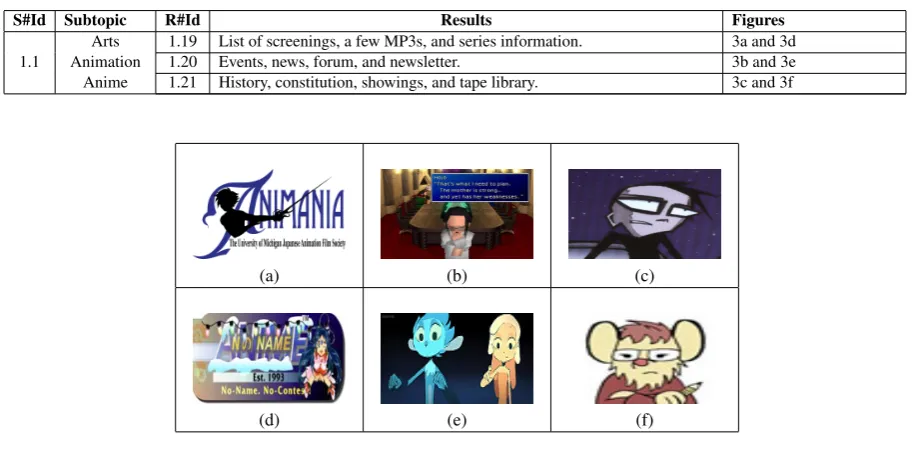
As mentioned in Section 1 that only textual information is not sufficient for SRC clustering, here we have presented some examples where although these web snippets belong to the same cluster, their textual information widely vary whereas their corresponding image information classify them into the same cluster. In Table 3, we have listed some sample queries from ODP-239 datasets whose textual contents vary widely related to query. In Figure 3, we have shown corresponding images extracted from websites of above mentioned queries. It is evident from these examples that image information is more relevant to the query compared to the textual information.
Table 3: List of query results whose textual contents differ.S#Id: Subtopic Id.R#Id: Result Id.
S#Id Subtopic R#Id Results Figures
1.1
Arts 1.19 List of screenings, a few MP3s, and series information. 3a and 3d Animation 1.20 Events, news, forum, and newsletter. 3b and 3e Anime 1.21 History, constitution, showings, and tape library. 3c and 3f
(a) (b) (c)
[image:8.595.70.527.423.648.2](d) (e) (f)
Figure 3: Sample figures extracted from each query given in Table 3.
5 Error Analysis
(a) (b) (c) (d)
Figure 4: Boxplots of the best (a) F1-measure (c) Rand index values obtained for different queries combining all the data sets together after application of the proposed MOO-Multiview-PBM technique. Boxplots of the best (b) F1-measure (d) Rand index values obtained for different queries combining all the data sets together after application of MMOEA (taken from the paper (Wahid et al., 2014)).
But in these web snippets text varies widely, viz.,“Meeting schedules, contact information, calendar of events, ftm, mtf, soffa, information, articles, book catalog, and guestbook.” in 2.65 and “Headline links from media sources worldwide.” in2.54, hence in predicted clustering solution both2.54and2.65
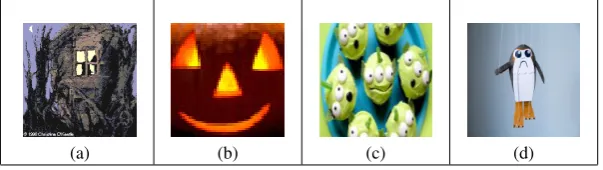
belong to different clusters. Secondly, there are few instances where textual view and image view differ widely, consensus between these two views is very less hence leads to misclassification. For example, in ODP-239 dataset query196.1and196.11originally belong to the same cluster. But the text contents, viz.,“Fairy and monster identification list, free e-cards, customs, recipes, games, history, and links to other holiday pages.” in196.1 and “Includes crafts, recipes, costumes, games and activities, and party ideas. Also features autumn harvest party ideas with pumpkin crafts.” in 196.11, and image contents of queries 196.1 (see Figures 5a and 5b) and 196.11 (see Figures 5c and 5d) differ widely hence no concrete consensus is drawn between the two views, therefore in predicted clustering solution they are misclassified.
(a) (b) (c) (d)
Figure 5: Sample figures extracted from queries in dataset ODP-239.
6 Conclusion
In the current study a multiobjective based multi-view clustering technique is developed for solving the problem of search result clustering (SRC). Views constructed over textual and visual information con-tained in web-snippets are considered. We have hypothesized that two web-snippets can be similar either with respect to content or with respect to images. These two views are exploited simultaneously in order to detect good-quality clustering of web-snippets. Three objective functions capturing the qualities of different partitions and a consensus function measuring the similarity between two partitions obtained using different views are simultaneously optimized using the search capability of a MOO process. Im-proved results on standard bench-mark data sets over state-of-the-art approaches support our hypothesis that use of multi-view information indeed helps in solving the SRC problem. In future we would like to exploit other views of web-snippets and incorporate it in our framework. Investigations of AMOSA as the underlying optimization strategy and PBM -index as the internal cluster validity index are also required to be carried out in future.
Acknowledgements
[image:9.595.149.451.424.509.2]co-funded under the European Regional Development Fund.
References
Sudipta Acharya, Sriparna Saha, Jose G Moreno, and Ga¨el Dias. 2014. Multi-objective search results clustering.
InProceedings of COLING 2014, the 25th International Conference on Computational Linguistics: Technical
Papers, pages 99–108.
Enrique Amig´o, Julio Gonzalo, Javier Artiles, and Felisa Verdejo. 2009. A comparison of extrinsic clustering evaluation metrics based on formal constraints. Information retrieval, 12(4):461–486.
Enrique Amig´o, Julio Gonzalo, and Felisa Verdejo. 2013. A general evaluation measure for document organiza-tion tasks. InProceedings of the 36th international ACM SIGIR conference on Research and development in information retrieval, pages 643–652. ACM.
Stanislaw Antol, Aishwarya Agrawal, Jiasen Lu, Margaret Mitchell, Dhruv Batra, C Lawrence Zitnick, and Devi Parikh. 2015. Vqa: Visual question answering. In Proceedings of the IEEE International Conference on
Computer Vision, pages 2425–2433.
Sanghamitra Bandyopadhyay, Sriparna Saha, Ujjwal Maulik, and Kalyanmoy Deb. 2008. A simulated annealing-based multiobjective optimization algorithm: Amosa. IEEE transactions on evolutionary computation, 12(3):269–283.
Steffen Bickel and Tobias Scheffer. 2004. Multi-view clustering. InICDM, volume 4, pages 19–26.
Thorsten Brants and Alex Franz. 2006. Web 1t 5-gram version 1.
Xiao Cai, Feiping Nie, and Heng Huang. 2013. Multi-view k-means clustering on big data. In IJCAI, pages 2598–2604.
Claudio Carpineto and Giovanni Romano. 2010. Optimal meta search results clustering. InProceedings of the
33rd international ACM SIGIR conference on Research and development in information retrieval, pages 170–
177. ACM.
Claudio Carpineto, Stanislaw Osi´nski, Giovanni Romano, and Dawid Weiss. 2009. A survey of web clustering engines. ACM Computing Surveys (CSUR), 41(3):17.
Daniel Crabtree, Xiaoying Gao, and Peter Andreae. 2005. Improving web clustering by cluster selection. In
Proceedings of the 2005 IEEE/WIC/ACM International Conference on Web Intelligence, pages 172–178. IEEE
Computer Society.
Virginia R De Sa. 2005. Spectral clustering with two views. InICML workshop on learning with multiple views, pages 20–27.
Kalyanmoy Deb, Amrit Pratap, Sameer Agarwal, and TAMT Meyarivan. 2002. A fast and elitist multiobjective genetic algorithm: Nsga-ii. IEEE transactions on evolutionary computation, 6(2):182–197.
Antonio Di Marco and Roberto Navigli. 2013. Clustering and diversifying web search results with graph-based word sense induction.Computational Linguistics, 39(3):709–754.
Lawrence Hubert and Phipps Arabie. 1985. Comparing partitions. Journal of classification, 2(1):193–218.
Abhishek Kumar and Hal Daum´e. 2011. A co-training approach for multi-view spectral clustering. InProceedings
of the 28th International Conference on Machine Learning (ICML-11), pages 393–400.
Ujjwal Maulik, Sanghamitra Bandyopadhyay, and Anirban Mukhopadhyay. 2011. Multiobjective Genetic Algo-rithms for Clustering: Applications in Data Mining and Bioinformatics. Springer Science & Business Media.
Tomas Mikolov, Kai Chen, Greg Corrado, and Jeffrey Dean. 2013. Efficient estimation of word representations in vector space. arXiv preprint arXiv:1301.3781.
Jose G Moreno and Ga¨el Dias. 2014. Easy web search results clustering: When baselines can reach state-of-the-art algorithms. In14th Conference of the European Chapter of the Association for Computational Linguistics.
Roberto Navigli and Giuseppe Crisafulli. 2010. Inducing word senses to improve web search result clustering.
InProceedings of the 2010 conference on empirical methods in natural language processing, pages 116–126.
Association for Computational Linguistics.
Stanislaw Osinski and Dawid Weiss. 2005. A concept-driven algorithm for clustering search results. IEEE Intelligent Systems, 20(3):48–54.
Malay K Pakhira, Sanghamitra Bandyopadhyay, and Ujjwal Maulik. 2004. Validity index for crisp and fuzzy clusters. Pattern recognition, 37(3):487–501.
Soujanya Poria, Iti Chaturvedi, Erik Cambria, and Amir Hussain. 2016. Convolutional mkl based multimodal emotion recognition and sentiment analysis. InData Mining (ICDM), 2016 IEEE 16th International Conference on, pages 439–448. IEEE.
Ugo Scaiella, Paolo Ferragina, Andrea Marino, and Massimiliano Ciaramita. 2012. Topical clustering of search results. InProceedings of the fifth ACM international conference on Web search and data mining, pages 223– 232. ACM.
Karen Simonyan and Andrew Zisserman. 2014. Very deep convolutional networks for large-scale image recogni-tion. arXiv preprint arXiv:1409.1556.
Lucia Specia, Stella Frank, Khalil Sima’an, and Desmond Elliott. 2016. A shared task on multimodal machine translation and crosslingual image description. InProceedings of the First Conference on Machine Translation:
Volume 2, Shared Task Papers, volume 2, pages 543–553.
Shiliang Sun. 2013. A survey of multi-view machine learning. Neural Computing and Applications, 23(7-8):2031–2038.
Edmund Tong, Amir Zadeh, Cara Jones, and Louis-Philippe Morency. 2017. Combating human trafficking with multimodal deep models. In Proceedings of the 55th Annual Meeting of the Association for Computational
Linguistics (Volume 1: Long Papers), volume 1, pages 1547–1556.
Grigorios Tzortzis and Aristidis Likas. 2009. Convex mixture models for multi-view clustering. InInternational Conference on Artificial Neural Networks, pages 205–214. Springer.
Grigorios Tzortzis and Aristidis Likas. 2012. Kernel-based weighted multi-view clustering. In Data Mining
(ICDM), 2012 IEEE 12th International Conference on, pages 675–684. IEEE.
Abdul Wahid, Xiaoying Gao, and Peter Andreae. 2014. Multi-view clustering of web documents using multi-objective genetic algorithm. InIEEE Congress on Evolutionary Computation, pages 2625–2632.
Xijiong Xie and Shiliang Sun. 2013. Multi-view clustering ensembles. InMachine Learning and Cybernetics
(ICMLC), 2013 International Conference on, volume 1, pages 51–56. IEEE.
Quanzeng You, Hailin Jin, Zhaowen Wang, Chen Fang, and Jiebo Luo. 2016. Image captioning with semantic attention. InProceedings of the IEEE Conference on Computer Vision and Pattern Recognition, pages 4651– 4659.
Oren Zamir and Oren Etzioni. 1998. Web document clustering: A feasibility demonstration. InProceedings of the
21st annual international ACM SIGIR conference on Research and development in information retrieval, pages
46–54. ACM.
Haoti Zhong, Hao Li, Anna Cinzia Squicciarini, Sarah Michele Rajtmajer, Christopher Griffin, David J Miller, and Cornelia Caragea. 2016. Content-driven detection of cyberbullying on the instagram social network. InIJCAI, pages 3952–3958.
Appendix A. Objective Functions
PBM index: This is a popular cluster validity index proposed by Pakhira, Bandyopadhyay and Maulik (Pakhira et al., 2004). It outperforms most of the cluster validity indices in the literature in properly detecting the optimal partitioning. This index is defined as follows:
P BM(K) = (1
K ×
E1 EK
Here, K denotes the number of clusters, EK = PKk=1Pnj=1k dist(Ck, d k
j) and DK =
maxKi,j=1dist(Ci, Cj), where Cj denotes the centroid of the jth cluster and d k
j denotes thejth
web-snippet of thekthcluster. nkis the total number of web-snippets of thekthcluster. The objective is to
maximize the PBM-index. In case of text-view,dist(Ck, d k
j) = 1−Stext(Ck, d k
j), whereStext is
cal-culated using Equation 2 and in case of image-viewdist(Ck, d k
j) = 1−Simage(Ck, d k
j), whereSimage
is calculated using Equation 3. SimilarlyDKvalue between two centroids is also calculated either using
text-based similarity or image based similarity measure.
Appendix B. Experimental Setup
We perform web snippet tokenization and word vector generation using gensim library.2 Word embed-dings are obtained from the pre-trained Google news word embedembed-dings.3 Image features are extracted from theFC7layer ofVGG19available in Keras library.4 We executed our algorithm over three gold standard datasets: AMBIENT5; MORESQUE (Navigli and Crisafulli, 2010); and ODP-239 (Carpineto and Romano, 2010). Description of the datasets, total number of relevant images extracted for each query and number of active query links present in each data set are summarized in Table 4.
The parameters of our proposed algorithms are: Tmin = 0.01, Tmax = 100, α = 0.85,HL = 20, SL= 30,itr= 20,Kmax=
√
#of samplesandKmin= 2. All these values have been determined after
conducting a thorough sensitivity study (and those are in line with the approach proposed by (Acharya et al., 2014)).
Table 4: First part represents SRC gold standard data sets. Second part represents total number of relevant images extracted for each query and number of active query links present in each data set.
Datasets # of
quaries
# of Subtopics
Avg/Min/Max # of Snippets # of web links
# of active web links
# of inactive web links
# of images in each quary Avg/Min/Max
AMBIENT 44 17.95/6/37 4400 4400 4137 263 6 / 4 / 20
MORESQUE 114 10 / 10 / 10 11400 11400 10834 566 8/ 4 / 18
ODP-239 239 6.7 / 2 / 38 25580 25580 19513 3067 6 / 3 / 25
Appendix C. Evaluation Metrics
An ideal SRC system should be represented by a unique cluster having all the relevant web pages in-side. However, determining a unique and complete metric to evaluate the performance of a clustering algorithm is still an open problem (Amig´o et al., 2013).
In order to measure the qualities of partitions obtained using different clustering techniques for these web search data sets, we have used three cluster quality measures,Fb3 measure (Amig´o et al., 2009),F1 measure (Crabtree et al., 2005) and Rand Index (Hubert and Arabie, 1985). In particular,Fb3 has been defined to evaluate completeness, cluster homogeneity, size-vs-quantity and rag-bag constraints.Fb3is a function ofP recisionb3(Pb3 ) andRecallb3 (Rb3 ). All metrics are defined as follows:.
Fb3 =
2×Pb3 ×Rb3
Pb3 +Rb3
, Pb3 =
1 N K X j=1 X
di∈πj
1
|πi |
X
dl∈πj
h∗(dj, dl),
Rb3 =
1 N K X j=1 X
di∈πj∗
1
|πi∗| X
dl∈πj∗
h∗(dj, dl)
here πj is thjth cluster and πj∗ is the gold standard ofjth cluster. h(., .) and h∗(., .) are defined in
h∗(dj, dl) =
n1
⇐⇒ ∃i :dj∈π∗i∧dl∈πi∗
0 :otherwise , h(dj, dl) =
n1
⇐⇒ ∃i :dj∈πi∧dl∈πi
0 :otherwise (11)
Appendix D. Model Comparisons
In order to comprehensively evaluate the performance of our proposed approach(MOO-Multiview-PBM), we listed some strong baseline approaches for comparison.
• MOO-clus(Acharya et al., 2014):This algorithm uses archived multi-objective simulated anneal-ing framework to simultaneously optimize two objectives, compactness and separation, for cluster-ing web snippets.
• GK-means(Moreno et al., 2013): This algorithm has adapted the K-means algorithm to a third-order similarity measure and proposed a stopping criterion to automatically determine the number of clusters.
• Suffix Tree Clustering(STC)(Zamir and Etzioni, 1998): It is an incremental, linear time algo-rithm which creates clusters based on phrases shared between documents.
• LINGO(Osinski and Weiss, 2005): In this method, initially the frequent phrases based on suffix-arrays are extracted and later matched the group description with topics obtained with latent seman-tic analysis.