Development of the Concept Dictionary
- Implementation
of Lexical Knowledge
Tomoymhi MA TSUKA WA, Eiji YOKOTA Japan Electronic Dictionary Research Institute, Ltd. (EDR) Mita-Kokusai-BIdg. 4-28, Mite I-chome,Minato-ku, Tokyo. 108. JAPAN
e-mail : matsu@edr5r,edt.co.jp [email protected] tel: 8 i-3-3798-5521,
fax: 81-3-3798-5335 S u m m a r y
The meth(xJology of development of the Concept Dictionary being compiled by EDR, which is to be a neutral dictionary for semantic processing of natural languages available for various application systems, is described. The Concept Dictionary is based on several linguistic semantic representation theories and consists of : a) concept descriptions, and b) the concept taxonomy.
Moreover, pnfference knowledge is being collected fi'om output data of various testing systems.
1. Introduction
A dictionary in which dependencies among 400,000 word senses of the English and Japanese languages are described in detail (Concept Dictionary) is being developed by EDR. The goal of the development is to build a neutral dictionary for natural language semantic processing that is available for various application systems. The implementation of the dictionary is based on several linguistic semantic representation theories.
For a long time, a series of trials for describing dependencies among words or word senses by bundling verbs, adjectives, etc., has been conducted. Establishing a deep case level and using a formalism independent of each language, Fillmore developed a theory of representation of dependency among words (Fillmore 1968).
On the other hand, Fodor and Katz explained a mechanism of selecting interpretations of constituents in a sentence by using a formalism composed of a semantic marker, distinguisher and selection restriction (Katz and Fodor 1963). In contrast to these theories, Wilks proposed a point of view to consider word dependency not as a constraint but as a preference (Wilks 1975). In addition, Schank proposed to abstract connotations not only from senses of nouns but also those of verbs, and he named them "primitive actions" (Schank 1975).
These semantic representation theories have been reviewed and used in developing practical natural language processing systems (Nagao 1985, etc.).
As such development of practical natural language processing systems progressed, the importance of accumulating lexJcal descriptions became recognized by developers of such systems. That is, a dictionary large enough in terms of both the granularity of semantic markers and the number of words or word senses became necessary to build. Against the background of the situation, the development of the Concept Dictionary began (Kakizaki 1987, Yokoi et. el. 1989, Uchida, 1990, Miik¢ et. el. 1990a). The methodology of development of
the Concept Dictionary, which consists of a) concept descriptions, which represent dependencies among concepts and categories, and b) the concept taxonomy, which represent super-sub relations among concepts, is described in sections 2 and 3. Preference knowledge, which represents preference order of concept descriptions, is explained in section 4. in section 5, spheres of applications and limitations of the dictionary arc discussed.
2. Development of Concept Descriptions
Concept relations are described at the following three levels:
a) concept-concept relation descriptions
b) concept-category relation descriptions c) category-category reladon descriptions
2.1
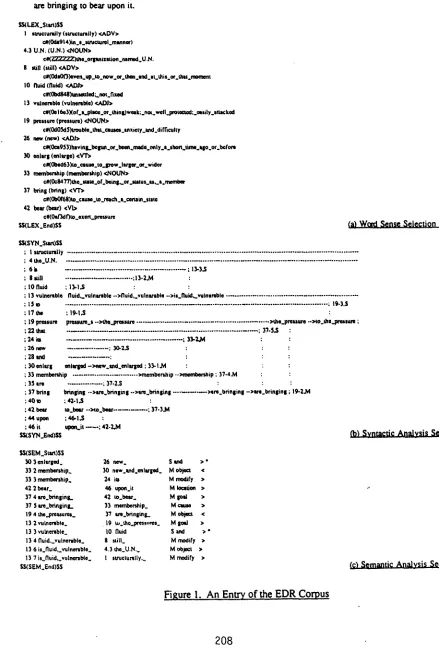
C o n c e p t - c o n c e p t R e l a t i o n D e s c r i p t i o n sWe are building an on-line corpus which includes 1,000,000 practical example sentences that are analyzed lexically, syntactically and semantically for the most pan manually (EDR corpus). Figure 1 is an example of
an entry of the corpus.
Firstly, (a) is the word sense selection (le×ical analysis) section, where a word sense (concept) has been selected for each word in the sentence. Secondly, (b) is the syntactic analysis section, where all binding relations among words has been analyzed. Finally, (c) is the semantic analysis section, where the semantic network representing the meaning of the sentence is decomposed into a set of triplets. These triplets correspond to the following concept-concept relation descriptions:
(I) c#enlarg¢--<and>-- c#new c#membership ---<object>~ ,#new c#bear --<location>'-" c#it
c#bdng ~<¢ause>--, cth'nembership ctWulnerable --<goal>--- c#pressure c#fluid--<modify>'-" c#sdll
c~11uid--<object>~ c~the_U,N c~fluid--<modify>'" c~so'ucturaHy
c#membership ---<object>~ c~tenlarge c#membcrship--<modify>---" c#its
c#bring--<goaJ>--'- c#bear
c#pressure *-<object>-- c#bring c#vulnerable--<and>'--" c#tluid c#vulnerable ~<modify>-, c#sdll c#vulnerable ~<object>'-- c#the_U.N c#vulnerabl¢ ~<modify>-* c#structurally
As shown above, concept-concept relation descriptions are extracted directly from the semantic analysis secdon (and word sense selection section) in the EDR Corpus. A method of collecting and selecting source
sentences for the EDR corpus is described in (Nakao 1990a) and a method of extracting concept descriptions from the FEDR corpus is explained in detail in (Nakao 1990b).
<<Text No : 00040000187d : 6/13/90 from ~J327#O3,y~l/4•>
=>> Structurally. the U,N. is still fluid and vulnerable ~o the pressures that its new and enlarged memberships are bringing to bear upon it.
$$(LEX_Stm)$S
I Stlmcturslly (su'~cmrmlly) <ADV> c#(0di914 )in _I _luurucu,im I .m lU, i net ) 4,3 U.N. (U.N,) ~NOUN>
¢lKZZZ2..;t,2,)the.orltniz mion _ n m d _ U ,N.
8 ~11 ( . i l l ) <ADV>
c#(OdaOl3)even_up_to_now.or_dm.*nd.*t_~is.~.lhtt.mm'twnL I0 fluid (RUM) <,ADdI>
c~01xl~48)un~lecl~not_fi xed 13 vulnerable (vulnerable) <AD.I~
¢#(0e 16~=3Xof.a..pl~.ot.thinl)we~k:.nm_well.,protec~ed:_mmily_uttack~ 19 I ~ s * u m (pressure) <NOUN>
c~0dO~S)troublo.tl~mt.c~use~_~iccy_and .dimculty 26 nmv (nmv) <ADJ>
clK0ca9$3)h|vinLbCltut .or.brat .made.only.t . $ h o n . l i m o . q o . o r . l x r f m 30 enltr8 (enlmle) <v'r>
c ~ Ol~ld63 )LO .¢su~_to.jFmw_lm'll~'_of .wider 33 mernl~,,rMtip (n'mml~rdtip) <NOUN>
c#(0c84 T ~ e _ m , e . o f _ t : ~ i n l ~ o r .slalus.u~a.member 37 brin s (brin 8) <VT>
c#(0b0(68)tO_ClUW .to.r~lch_l_CeruIm_$uKe 42 h e r (beAr) <VL~
c#(Olf3d f')LO exen_pn~uur=
$S(LEX_End)SS (a~ Won:l Sense Selection Section
$$(SYN_Sum)$S
; I Ilructumlly . . .
; 4~e_U.N, • . . . ; 6 b . . . ; 13-3~ ; 8 =.ill . . . ;13-2,M
; tO fluid : |3-I.S : :
; 13 vulnerable fluid~vulnurlble .->l'luid,.vulnm'lblo .->is.nuid~vulnurlble . . .
; 1 $ ~ . . . ; 19-3,S
: 17 the : 19-t~
; 19 pr=.,um pm,mu'e_$ -->~he.pressurcc . . . •~e_pmuure -~o.dlo.prmsum ; : 22 thai . . . : 37-5,S :
; 24 a . . . ; 33-2,,M : : : 26 new . . . ; 30-2~ : : : ; 28 mtd . . . : : : :
; 30 ~'ilUrll mtlmrpd -•new.~d.e~lm'lKed : 33- I,,M : : :
; 33 mcmnbership . . . >membership -.:mwmbership : 37-4.M : :
; 3S t m . . . ; 37-2,S : : :
; 37 brinl bhnlPnl . - > I t e . b n n l m l -->ire.brAn|ins . . . > , m . b n n l i n I ->mm_brinsins ; 19-2,M ; 40 to : 42-1~
: 42 l ~ r to_bear -->to.bur . . . ; 37-3,M
: 4,4 upon ; 46-1,S : : 46 it upon_it - - - - : 42.2,Jq
S$(SYN.End),t~ CoS Syntactic Analysis Section
~SEM.Suu'OSS
[image:3.596.85.524.87.739.2]30 3 e n l t r p d . 26 new. Sund > " 33 2 memb~ship. 30 new.tnd.cnlur|ed. M object < 33 3 m c m l ~ h i p . 24 its M rnodify • 42 2 herr_ 46 upc)n.it M location • 37 4 m'e_bfinSinL 42 to_bear. M ~ u l • 3'7 $ ure_bhniin L 33 membership_ M ~ • 19 4 ~'le,..pmtsum_ 3? u'e_bnrlSinlL. M obju:~ < 13 2 vulnerable_ |9 cu_~ho_press.ms_ M 8o*] • 13 '3 vuLn~'uble. |0 nuid Sand • * 13 4 fluid,_vulnenkble_ 8 still_ M modify • 13 6is.Muid, vulncrtble. 4 3 the.U,N.. M ob,~x:t • | 3 7 is_fluid._vulncrable. I structurally._ M m(xlify •
~ ( S E M .End)S$ (c~ Semantic Analvsis Secuon
Figure 1. A n Entry of the E D R Corpus
2.2 Concept-category Relation Descriptions
If some concept-concept relations share a concept, it is possible to bundle them into a representation. For example, concept.concept relation descriptions (2) can be bundled into a concept-category relation description (4), if a super-sub relation (3) is also described simultaneously within the concept taxonomy. 'This level of description corresponds to Fodor and Katz's representation using semantic markers and selection restrictions.
(2) cteoreak --<object>-- c#promise c#l~?,ak --<object>-'* c#1aw c#break --<object>~ c#mle c#break --<object>--- c~code
(to break a promise) (to beak a law)
(to break a rule) (to break a code)
(3) (rules)
c#promise c # 1 a w ~ c t i e ode
(4) c#break--<object>-- (rules)
2.3 Category-category Relation Descriptions
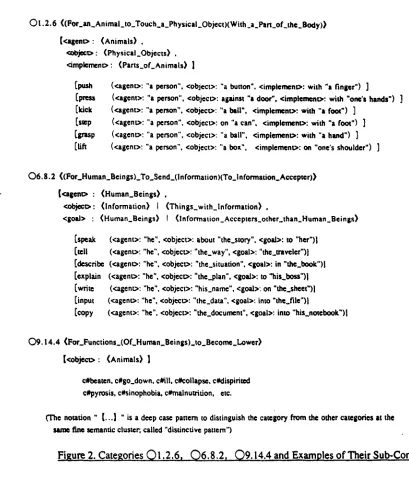
In the previous section, we discussed the cases in which filler concepts of deep case pattems can be bundled into categories, namely concept-category relations. Moreover, frame concepts in deep case patterns can also be bundled and represented by categories (frame categories) (Ogino et. al. 1989). For example, the three categories O1.2.6, 0 6 . 8 . 2 and C)9.14.4 defined in Figure 2 (Hereafter, the notation "C)" also means a category,) bundle concepts and are linked with other categories to describe category-category relations (5), (6) and ("7) :
(5) 01.2.6 --<agent>.>"-'," (Animals)
01.2.6 --<object.>-- (Physical_Objects) O t.2.6 --<implement>--* (Parts_of_Animals)
(6) 06.8.2 --<agent>-,' (Human_Beings)
06,8.2 ---<object>'-.,. (Information) : (Things_With_Information) 06.8.2 --<goal>'-" (Human_Beings} : (Information_Accepters)
(7) C)9.14.4--<object>-- (Animals)
::'"
O I , 2 . 6 ((For_an_Animal_to_Touch_a_Physical_Object)(With_a.Parz_of_the_Body)) [<aSont> : (Animals) ,
<object> : (Physical_Objects) , ~mpk:ment> : (Parts_of_Animals) ]
[push
[p,m
[kick [s=p [grasp Etm
(<agent>: "a person", <object>: "a button". <implement>: with "a linger") ]
(<agent>: "a person", <object>: against "a door", <implement>: with "one's hands") ] (<agent>: "a person". <object>: "a bali", <implement: with "a fooC) ]
(<agent>: "a person". <object>: on "a can", <implement>: with "a fooC) ] (<agent>: "a person", <object>: "a ball", <implement>: with "a hand") ] (<agent>: "a person", <object>: "a box". <implement>: on "one's shoulder") ]
06.8.2 ((For_Human_Beings)_To.Send_(In formation)(To_lnformation_Accepter))
[<agent> : (Human_Beings) ,
<object>: (Information) [ (Things_with_Information) ,
<goal> : (Human_Beings) [ (Information_Accepters_other_than_Human_Beings)
[speak (<agent>: "he", <object>: about "the_story", <goal>: to "her")l [tell (<agent>: "he", <object>: "the_way", <goal>: "the_lraveler")l [dc~riba (<agent>: "he". <object>: "the_situation". <goal>: in "the_book")l [explain (<agent>: "he", <object>: "the_plan", <goal>: to "his_boss")l [write (<agent>: "he", <object>: "his_name", <goal>: on "the_shcet')l [input (<agent>: "he", <object>: "the_data", <goal>: into "the_file")l
[copy (<agent>: "he", <object>: "the_document". <goal>: into "his.notebook')l
O9.14.4 (For_Functions_(Of_H uman_Beings)_to_Become_Lower) [<object> : (Animals) ]
c#baaten, c#go.down, c~il, c~ollapse, c~ispirited c#pyrosis, c~inophobia, c#malnutrition, etc.
[image:5.596.88.497.32.515.2](The notation " [...] " is a dccp case pattern to distinguish the category from the other categories at the same fate semantic cluster, called "distinctive pattern")
Figure 2. Categories Q1.2:6, ~6.8.2, O9.14.4 and
Exarnp!es of Their Sub.Concepts3 Development of the Concept Taxonomy
The two kinds of concept descriptions including categories, narncly concept-category relation descriptions
and category-category relation descriptions, mentioned in the previous sections, must have their descendant
concept-concept relations in order to become useful. That is, concepts must be able to be actually classified
into categories included in such descriptions.
A concept can generally be classified into more than one categories (multiple classification). However it
is difficult to make exhaustive multiple classification from the beginning, because in the case of multiple
classification, w e must compare concepts with categories m n times when there are m concepts and n categories. In the case of exclusive classification using a distinctive u'e¢ whose leaves mean categories, on the
other hand, w e must only compare concepts with nodes on the tree Ofrn(log n)) times. Additionally, the
number of categories which share same sub-concepts with a category (cross categories) is generally much less than the number of all categories. Moreover, it is not so difficult to make a list of cross categories for each category (cross category list) in advance.
Considering the points mentioned above, we use the following method for concept classification : 1) exclusive classification : selecting categories which hardly share same sub-concepts (exclusive categories), and making the first classification using a distinctive tree locating the exclusive categories at its leaf level. 2) cross classification : making the second classification into categories other than exclusive categories, based on cross category lists, and building a concept taxonomy from the results of the second classification. 3) improvement of the Concept Dictionary : modifying the Concept Dictionary based on the results from tests using various testing systems and automatic concept clustering from concept-concept relation descriptions. In the following sections 3.1 and 3.2, we explain the first exclusive classification and the second cross classification respectively. In section 3.3, we describe a method for modification of the Concept Dictionary.
3.1 E x c l u s i v e C l a s s i f i c a t i o n o f C o n c e p t s 3 . 1 . 1 C l a s s i f i c a t i o n i n t o M O N O - C a t e g o r i e s
The first classification into categories for nominal concepts (MONO-concepts) is made by using the MONO-concept taxonomy as shown in Figure 3 as a distinctive tree. That is, the classification starts from the top node, decends along branches of the tree, and when reaching a node, compares the node's children nodes with the input concept. This process is repeated, and if one of the leaves of the tree is reached, the MONO-category corresponding to the leave should ~ selected.
(MONO_Concepts)
(Physical
~ a c e s )
( A n i m a t e ~ / ¢ : : ~ d o n s )
A ~ (Parts_of
Animate_
uman_Attifacts)
/ /
~
~
(Natural-Obj
ects) "~N
( C h i i ~ . ~ _ B e i n g s _ w i t h _ O t h e r _ C h a r a c l e d s t i c s ) )
( R ~ o c i ~ _ P o s i I i o n s )
(Races • Ethnic_Groups)
[image:6.596.89.514.430.656.2](Abs~,bjects)
For example, in the case of the concept "c#police_man", when we start with the question, "Is that a physical object, a place or an abstract object?" (answer. a physical object), and pass through the questions, "Is that an animate object, a part of the body of an animate object, a natural object, a human artifact or an organization?" (answer: an animate object), "Is that a human being, an animal or a plant?" (answer: a human being), and "Is that a child, a relative, an occupation ...?" (answer: an occupation), then we can classify the concept into the category (Occupations) .
\
3.1,2
C l a s s i f i c a t i o n into K O T O - C a t e g o r i e sAs mentioned above, the first classification of the MONO-concepts is made by using the MONO-concept taxonomy's hierarchy as a distinctive tree. On the other hand, the method for the first classification of verbal concepts (KOTO-concepts) is not made by using the hierarchy as a distinctive tree but by semantic association from the meanings of the concepts and examples of deap case patterns of the concepts.
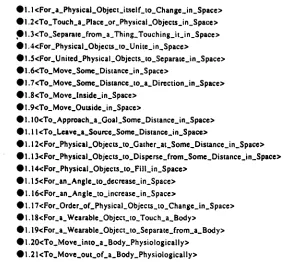
The hierarchy has three levels. The highest level has been divided coarsely based on semantic association (coarse semantic clusters; all can be seen in Figure 4). The second level has been also divided based on semantic association (fine semantic clusters; all below coarse semantic cluster ~ I can be seen in Figure 5). On the contrar'y, the third level has been divided based on the deep case pattern shared by concepts (KOTO-categories; all below fine semantic cluster • 1.2 can be seen in Figure 6), where one category has only one deep case pattern which is specified with its distinctive pattern (expressed with the notation" [... ] " as in Figure 2). We have now 14 coarse semantic clusters, 253 fine semantic clusters and 984 KOTO-categories in the hierarchy.
. o
(KOTO-Concepts)
'~'I<SPATIAL_RELATIONS> : relations among physical objects meaning states and changes in space '~'2<SPATIAL_ATTRIBUTES> : attributes of physical objects meaning spatial measures in space ' ~ ' 3 < S O C I A L _ R E L A T I O N S > : social relations among persons
'lff4<CLASS_RELATIONS> : inclusive relations and comparative relations among objects
lffS<POSSESSION> : relations among possessors and possessions
'~'6<INFORMAT1ON> : relations among information and information processers
'~'7<ESTIMATION> : relations and attributes of objects meaning states and changes of their estimations • ~'8<POSSIBILITY> : relations and attributes of events meaning states and changes of possibilities Iff9<FUNCTION> : relations and attributes of objects meaning states and changes of their functions
lff 10<PROGRESS> : relations and attributes of events meaning degrees of actualization l 1 <TIME> : relations and attributes of events meaning temporal order or distance '~' ! 2<QUANTITY> : relations and attributes of objects meaning quantity or deip'ee lff 13<OTHER_ATTRIBUTES> : attributes other than those above
14<EXISTENCE> : relations meaning appearance, continuance and disappearance of existences
Figure 4. Coarse Semantic Clusters and Their Definitions
I <SPATIAL_RELATIONS>
• 1. I <For.a_Physieal_Object_iL~¢lf_to_Chang¢_in_Spa¢¢>
• 1.2<To_Touch_a.Place_or_Physical_Objects in_Space > OI, 3<To_Separale_from a.Thing_Touch ing_it_in_Space> • 1.4<For_Physieal_Objects_to_U nit¢_i n Space>
• ! .5<For_United_Physical_Objects_to_Separatein_Spac¢>
• 1.6<To_Move.Some_Distance in S pace>
• 1.7<To_Movc_Som¢_Distance_to_a_Direetion_in_Space>
• ! .8<To_Move_Inside_in_Space>
• 1,9<To_Move_Outside in_Space>
• 1.10<To_Approach_a_Goal_Some_Distance_in_Space> • I, 11 <To_Leave_a_Soume_Some_Distanee_in_S pace>
• 1.12<For_Physical_Objects_to_G ather_at_Some_Distance_in_Spae¢>
• 1.13<For_Physical_Obj¢cts_to_Dispe rse_from_Some_Distanee_in_Space>
• I. ! 4<For_Physical_Objeets_to_Fill_in_Spac¢> • 1.15<For_an_Angle_to_d¢crease_in_Spac¢>
• 1. i 6<For_an_Angle_to_increase_in_S pace>
• 1.17<For_Order_of_Physical_Objects_to_Change_inSpa¢¢> • I. 18<For_a_Wearable_Obj¢ct_to_Touc h_a_Body>
• I. 19<For_a_Wearable_Object_to_Separate_from_a_Body> • 1.20<To_Move_into_a_Body_Ph ysiologieally>
• 1.21 <To_Move_out_of_a_Body_Physiologically>
Figure 5. Fine Semantic Clusters Below '~"
l<SpatialRelations>
• 1.2<To_Touch_a_Plac©_or_Physical_Obj©ct_in_S pace>
OI.2.1 ((For_a_Ph ysical_Object)_To_Touch_(A nothcr_Physicai_Objec0) Oi .2,2 ((For_a_Physical_ObjecO_To_Touch another_Physical_Object) O1.2.3 ((For_an Animal)_To_Touch.(A Physical_ObjecO_lntentionally) OI .2.4 ((For.an Animld)_To_Touch_a_Physical_Object_Intentionally)
OI.2.5 ((For_an_imentional_Object)_To_Touch_a_Physical_Object_lntentionally) OI.2.6 ((For_an.Animal)_to_Touch_(A_Physica LObj¢ct)(With_a_Part_of_the_Body)) OI.2,7 ((For_an Animal)_to_Touch_a_Ph ysical_Object_(With_a_Part_of_the_Body)) OI.2.8 ((For_an_A nimal)_to_Touch (A_Physical_Objeet)_with_a_Part_of_th¢_Body) OI.2.9 ((For an_Animal)_to_Touch_(A_Physical_Object)(With_an_lmplement)) OI.2.10 ((For_an Animal)_to_Touch.(A_Physical_Object) whh_an_lmplemcnt)
OI.2.11
©1.2.12
O1.2.13
OI.2.14 OI.2.15 01.2.16 01.2.t7 01.2.18 01.2.19 O1.2.20
((For_an_lntentional_Object)_to_S©nd_(A Physieal_Object)(To_Som¢_Plac¢)) ((For_an_Animal)_to_Go_(to_Some_Plac¢)_lntentionally)
((For_a Person)_to_Meet_ wit h_(anoth© r_Person)_Intentionally)
((For_an_Animal)_to_Grasp_(A_Physical_Object)(With_a_Part_of_th¢_Body)) ((For_an_Animal)_to_Grasp_(A.Physieal Obj¢cO(With an_Implement)) ((For_an_Person)_to_Put_(A_Ph ysical_Object)(On_Some_Pla¢¢))
((For an_Person)_to_Caus¢_(An_Animal_and_another_Animal)_to_Tou¢h_Each_Olher} ((For_an_Animal_and_anoth¢r_Animal)_to_Touch_Each_Other)
((For_an_Animal)_to_Touch_(An_Physical_Object))
( ( F•r- an- •m•nti•na•- •bj¢ct)- t•- Caus•- a- Physi•a•- •bject- t•-T•uch-(a- Physi•a•- •bj¢•t)
[image:8.596.170.453.91.353.2]The first classification of a concept into the KOTO-categories is made based on semantic association with the concept and deap case patterns created with the concept. The procedures are as follows: I) ~signing basic concepts into KOTO-categories: classifying about 4,000 basic concepts into fine semantic clusters, describing deep case patterns underlying example sentences created with the concepts and dividing the clusters into KOTO-categories to make each of them have only one deap case pattern. 2) Establishing two indexes : making a) a word index for retrieving categories by a word, and b) a case frame index for retrieving categories by a deep case set. 3) Searching category candidates: a) searching category candidates by associating basic concepts which seem to share a deap case pattern with the concept and retrieving the word index by words meaning the basic concepts, b) In a case in that it is impossible to associate any basic concepts with the concept, finding category candidates by creating example sentences, making deap case frames from the sentences, and retrieving the case frame index by the frames to find category candidates. 4) Selecting a category from the category candidates: classifying concepts into the most appropriate category by considering from the following three points of view: a) the names of the categories and their upper clusters, b) the distinctive patterns of the categories, and c) the basic concepts assigned to the categories.
3.2 Cross Classification of Concepts
Cross classification of concepts is made in the following way:
l) Making cross category lists for each exclusive categories. Types of cross relations are assorted into the following three types: a) a cross category which implies an exclusive category, b) a cross category which intersects an exclusive category, and c) a cross category which includes an exclusive
category.
2) Contrasting each concept classified into an exclusive categoriy and each cross category listed in the cross category list of the exclusive category and judging whether or not the concept can be classified into the cross category. Here in the above case c), all concepts in the exclusive category can be automatically classified into the cross category.
3.3 Improvement of the Concept Dictionary
Through the following procedures, categories which should be modified ate found and improvement of the Concept Dictionary is made:
1) Collecting negative examples:
When an answer other than correct answers is output from a testing system, an inappropriate concept-concept relation must be found deduced from the Concept Dictionary by viewing a debugging ~ace of the process of/he system. Such concept-concept relations are collected as
negative examples.
2) Collecting positive examples:When a correct answer is not output from a testing system, a concept-concept relation must be found to be added to the Concept Dictionary. Moreover, all correct answers output from all testing systems
must have their corresponding concept-concept relations deduced from the Concept Dictionary. These concept-concept relations are collected as
positive examples.
3) Estimation:
At a slage when negative and positive examples have been collected to some extent, the
divisibility
of each concept-category relation description and category-category relation description is estimated by using the following formula:(8) D (I, m , n) = "~>~ qt/
P(i)
,lwO
[ i V"
- iI/~m-sJ
where P(a3 =
.
0 .< k ~ 1.0 (a parameter),
n : the number of concepts under the category,
i : the number of incorrect classifications into the category, m : the number of examples,
I : the number of negative examples.
The formula (8) is derived as follows:
We suppose that the concept-category (or category,.cazegory) relation description (9) is an object of our estimation:
(9) a - tel " " B
that the number of the concepts classified under the camgory B is n:
( I 0 ) B
bt b2 ... b,
and that the number of (both negauve and positive) examples is m and the number of negative examples in the examples is h
( i l ) m examples
a - - r:l -- bt
a - - m l ~ b3
a m tel --" b4
a m tel ~ b.
* a - - tel - - bz
* a ~ t e l ---. b5
((re.l) positive examples) (I negative examples)
the probability that 1 negative examples are found out of m examples is given by the formula (12)".'
\
! ) ~ m - / /(12) P(i) =
Therefore, the probability that the ratio of the concepts not appropriate for the description (9) to the concepts located under the category B is more than k is given by the formula (8). Here we use Bayse's Theorem because
sellections of the number i are events independent from each other.
4) Deletion of the concept descriptions:
In cases in that the value of the formula (8) is more than 0.9 when k = 0.9, the concept description (9) is deleted from the Concept Dictionary and remaining positive examples are asserted as concept- concept relation descriptions into the Concept Dictionary because most of the examples for the description are negative.
5) Division of categories
In cases in that the value of the formula (8) is more than 0.9 when k = O. I, the category B is divided in two in order to represent both a category satisfying the relation (9) and a category not satisfying the relation (9) and all concepts under the category B is reclassified into the two categories because w e recognize that a) the number of examples are large enough for the estimation, and that b) the number of negative examples is too large to neglect. Here if the divided two categories exist as sub-categories of the category B in the concept taxonomy, the classification is not necessary.
6) Accumulation of preference knowledge
In cases in that the value of the formula (8) is not more than 0.9 when k = O. I, the collected negative examples are translated to preference knowledge (for data structures and usages of preference
knowledge, see Section 4). From a debugging trace of a testing system, together with a negative example, a concept, a word or a pronumciation corresponding to the negative example and a concept description more appropriate than the negative example must be also gained. This information is represented by preterence knowdedge with the following format 03) and accumulated:
(13) on <concept> I <word> I <pronunciation> give preference to
<a-more-appropriate-concept-description>
o v e r
<a-negative-example-of-.concept-description>
. . . ... . ... o o . . ... . ... ( ~., 'r)
~. We ~ a y use Poisson distribution asan approximation to (12) if n is large. However. since n ~ 3,000, it is realistic to calculate the formula (12).
7) Clustering of concept-concept relation descriptions
Concept-concept relation descriptions remaining after all the above procedures are clustered by using an optimal scaling or using DM-decomposition and a probability-based estimation and the gained clusters are asserted as concept-category relation descriptions into the Concept Dictionary. The
clustering algorithms are explained in detail in (Nakao 1988, Matsukawa 1989).
8) Reconstruction of the concept taxonomy
Category-category relation descriptions are clustered and hierachized by using DM-decomposition and set-relation calculations in order to bundle the descriptions into higher level categories. The hierachization algorithm is explained in detail in (Matsukawa 1990a, 1990b, Yokola 1990).
4
Preference Knowledge
All concepts, categories and concept descriptions have an ID number called concept ID. Knowledge for ordering input ,sentence interpretations given by using the Concept Dictionary are represented by data individually expressing the order of the concept [Ds that co-occur with each word pronunciation, word and concept, respectively (preference knowledge). We use the following three methods for ordering concept IDs:
a) Linear lists of concept IDs
b) Association lists of concept IDs and the concept IDs' preference value
c) Dbected graphs including arcs meaning preference relations between concept [Ds
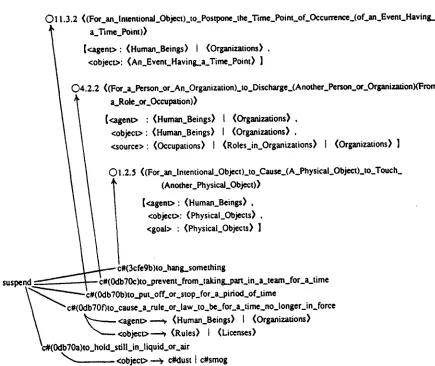
As mentioned in section 3.3, modification of the Concept Dictionary is made based on feedback information from tests performed by various kinds of processes in application systems (testing systems). Word sense selection and translation word candidates selection are ones of these processes. 'When an output answer given by such a testing system is different from correct answers, the reason for the difference is analyzod by viewing u'aces of processes of the system, and the Concept Dictionary and/or the preference knowledge ate/is modified. After such modifications, the correct answers become able to be selected by using the Concept Dictionary and the preference knowledge. For example, the word "suspend" has five senses, as shown in Figure 7. If the concept-concept relation shown in (14) is input, only two out of the five senses match the relation. The two senses are shown in (15):
(14) c#suspend --<object>'-" c#police_man
(to
suspend the policeman)
(15)
04.2.2 --<object>~ c#police_man
~ (~ .2.5 --<object>-" c~police_man
suspend ~
/
c#(3cfe9b)_to_hang_something011.3.2 ((For_an_lntentional_Object)_to_Postpone_the Time_Point_of_Occurrence_(of_an_Event_Having_
l
a_Time_Point))
[<agent>: (Human_Beings) I (Organizations),
<object>: (An_Event_Having a_Time_Point) ]
04.2.2 ((For a-P•rs•n-or-An-•rganiza•i•n)-••-Discharge-(An•ther-Person-or-organizati•n)(From-
a_Role~¢_Occupation) )
[<agent> :(Human_Beings)
[(Organizations),
<object>: (Human_Beings) I (Organizations),
<source>: (Occupations) I (Roles in_Organizations) I (Organizations)]
O1.2.5 ( (For_an_In tentional_Object )_to_Cause_(A_Physical_Object)_to_Touch_
l
(Another_Physical_Object))
[<agent> : (Human_Beings) ,
<object>: (Physical_Objects) ,
<goal> : (Physical_Objects) ]
•...•¢....t---•c#C3c
fe9b)to_hang_something
suspend ~
c#(0db70c)to_prevent_from_taking_pan_in_a_team_for_a_time
•
-'---, c#(0dbT0b)to_put_o ff_or_stop_ for_a_piriod_of_time
\
~ c#(0dbT0 f3to_cause_a_rule_or_law_to_be_ for_a_time_no_longer_in_force
\
~----.- <agent>
-. (Human_Beings) I (Organizations)
" ~ < o b j e c t >
~ (Rules) I (Licenses)
'c#(0dbT0a)to_hoid_still_in_liquid_or_air
[image:13.596.106.541.107.473.2]-- <object> ~ c#dust I c#smog
Figure 7. The Five Senses of Word "suspend" and Their Concept Descriptions
If we have preference knowledge on "c#police_man" as shown in (I 6), we can select only one sense out of
the two senses, namely "c#(0dbT0c)to_prevent_from_taking_part_in_a_team_for_a-time."
(16) on c#1x)lice_man
give preference to
04..2.2 --<object>~ (Human_Beings) ;
over
O1.2.5 --<object>--" (Physical Objects) ;
Moreover, such preference knowledge is given to each concept, word or pronunciation. For example,
"c#bird" and "c#rabbit" have different preference knowledge as follows:
(17) on
give preference to
cMly --<agmat>-" (intentional-Objects) ;
over
c~hop --<agent>-" (Animals) :
o n c#rabbit
give preference t o
c~hop - - < a g e n t > " " ( A n i m a l s ) ;
over
c~tly --<agent>'-,' (IntcndonaJ-Objects) :
By using this knowledge with the concept descriptions shown in Figure 8, Japanese sentences can be properly translated, for example as shown in (18) (for a method for unification of concepts expressed by different words or in different languages, see (Miike 1990b, Tominaga 1991)):
(18) a) T O R t - G A
( a b e )
TOBU. ~ . A bird flies.
b) U S A O I - O A T O B U . • A rabbit hops.
(a rabbit)
Preference knowledge is collected not only through processings of word sense selection and translation word candidate selection, but also throiagh those of structual disambiguation, paraphrasing and the like. Therefore, the knowledge includes descriptions corresponding to
lexical preference
proposed by Ford, Bresnan and Kaplan for structual disambiguation (Ford Bresnan and Kaplan 1982). Although such knowledge provides just a bias of interpretations of ambiguous structures, the knowledge is indispensable for deterministic sentence analysis without any knowledge about the discourse to be refered in order to use theprinciple of parsimony, the principle of a priori plausibility,
etc. (Crain and Steedman 1984, Hirst 1984).5 Discussion
0 11.6.4 ((For_An_Event_Having A_Period_Or_A _Time_Point) To_Get_Out_Of_Time_Order_(At_Sorne_Time)) [<object>: (Events_HavinLA_Penod) ', (Events_Having.A_Time_Point) . <source>: (Time_Point) ] OI.6.5 ((For_An lntentionai_Object)_To_Move_(From_Some_Place)(To_Some_Place)_lnmntionallY) ' \ ~ [,<agent>: (Intentional_Objects), <source>: (Places>, <goal>: (Places) I
(For_A_Physical_Object_With_Color_Or_A_Color_ltsel0_To_Change_lnto_A nother_Color) [<object>: (Physical_Objects_Wilh_Color) : (VaJues_Of..Atmbute_Color) :c#color]
O1.3.6 ( (For_A n_Animal)_To_Separate_(From_A_Ph ysical_Object_Or_A_Place)) ~ [<agent>: (Animals) , <source>: (Physical_Objects) : (Races) ]
•
. l 1.3 ((For_An_Animal)_To_Lcave_Some_Distance_(From_An_Physical_Object_Or_A_Place)) [<agent>: (Animals) , <source>: (Physical_Objects) : (Places) ].17.1 (F:or_Order_Of (A_Physical Object)(Against_A_Physical_Object)STo_Change_ln_Space) \ [<object>: (Physical_Objects) : <goal>: (Physical_Objects) ]
k TC
'c#(lO093d)jump_over
I O0947)run_away
~,,,,~,~,, -'~"~ c#(3cf4f6)discolor \ ~'c#(100942)husten ,I Wc#(3cefl l)fly ~' c#(0¢4bed)omit
t(100946)slap_on_the_cheek <object> > c#BINTA
<goal> ~ c#cheek 948)spread_b 'bes , ,
<object> ~ c#bribe
jump (over) run (away) jump: hop: leap fade: discolor - rush; husten; hurry fly
omit; skip slap (on the cheek)
spread
c#(10094 l)blow_a_fuse
~ < o b j e c t > ~ c#fus¢
blow
[image:15.596.84.536.78.558.2]("TOBU" and "BINTA" are Japanese words.)
Figure 8. TheTranslation Word Candidates of Pronunciation "TOBU" and Their Concept Descriptions
We are compiling and improving the Concept Dictionary based on the results of many practical tests performed by various application systems. Actually, however, the number of the application systems we arc using for testing dictionary data is only some dozen, and the functions we require the dictionary to fulfill are just at the level of practical necessity for the systems. In other words, compared with "the whole knowledge",
the Concept Dictionary actually lacks various parts. For example:
1) Coverage of Concept
Relations and Categories:a) Coverage of concept relations:
The number of sentences in the EDR corpus is 1,000,000. As mentioned above, we also create example sentences for some concepts and we use categories to describe concept relations. However, the coverage of concept relations is incomplete. The situation is similar to that of ordinary lexicography in that even if we had a very large corpus and aboundant lexicographers, they could never completely assign example sentences covering all kinds of word co-
occurrences in all types of contexts
b) Coverage of categories:
Some categories are useful to describe concept relations, while other categories are not. Since the Cost/performance of the implementation of useless categories is low, we do not implement such categories in the concept taxonomy.
2) Granularity of Concepts
Since concepts, our representation primitives, are almost as fine as translation words' senses in bilingual dictionaries, it is impossible to implement knowledge including finer instances.
a) Real world instances :
From concept-concept relations, we can extract slots of a class in the real world. For example, from the concept-concept relation shown in (19), we can extract slot "haveALid?" of class "C#vessel" as shown in (20):
(19) c#vessel --,cpart_of> u c#lid
(20) C#vessel
canHaveSI0ts: (haveALid?)
film we use the notation Cyc uses (Lenat and Ouha 1989))
However, we cannot extract some attributes of real world instances from concept relation descriptions. For example the value "yes" of the slot "have ALid?" shown at (21) can never be decided with the Concept Dictionary:
(21) TheVesselOnTheDesklnFronlOfMeAtl :OOamOnMarch3rdln 199 IJST instanceOf: C#vessel
b) Distinction of pragmatic referents:
Finer referents are used for describing pragmatic ambiguities of a sentence. For example, in order to express pragmatically different interpretations, different referents ate described into each mental space, according to Fauconnier's theory (Fauconnier 1984). For example, different interpretations of the sentence (22) require at least three different mental spaces and
six different referents of the word "president".
(22) John believes that the president was a baby in 1929.
The Concept Dictionary can not give distinction of such referents although it can give predicate concepts used in annotations for mental spaces.
• ~. . . .
References
Craln, S. and Steedman, M. (1984) "On not Being Led Up the Garden Path: The Use of Context by the Psychological
Parser", in: Dowty, D, R. ; Karttunen. L. J. and Zwicky, A. M. (editors). Syntactic Theory and How
People Parse Sentences, Camgridge University Press, 1984.
Fauconnier, G. (1984) Espaces Mentaux. Editions de Minuit.
Fillmore, C. J. (1968) "The Case for Case" in Bach E. and Harms R.T. (eds.), Universals in Linguistic Theory.
Holt, Rinehart and Winston, Chicago.
Ford, M., Bresnan, J.W. and Kaplan, R.M. (1982) "A Competence-based theory of syntactic closure", in: Bresnan, J.W.
(editor) The Mental Representatin of Grammatical Relations. Cambridge, Massashusetts: The MIT
Press, 1982.
Hirst, G.J. (1984) Semantic Interpretation against Ambiguity, University Microfilms International, pp. 196-200.
Kakizaki, N. (1987) "Research and Development of an Electronic Dictionary", Machine Translation Summit
pp.61-64.
Katz, J.J. and Fodor, J.A. (1963) "The Structure of a Semantic Theory", Language 39, pp. 170-210.
Lakoff~iG. (1966)"Stative Adjectives and Verbs in English", Mathematical Linguistics and Automatic Translation
17, pp.l-16, Report to the National Science Foundation.
Lenat, D.B. and Guha, R.V. (1989) Building Large Knowledge.Based Systems, Addison-Wesley Publishing
Company. Inc., pp. 160-162.
Matsukawa., T., Nakarnura, J. and Nagao, M. (1989) "An Algorithm of Word Clustering from Co-occurrence Data Using D M
Decomposition and Statistical Estimation". Information Processing Society o/Japan, NL-72-9.
Matsukawa, T., Kishimoto, Y., Miike, S., Yokota, E., Takai, S. and Amano, S. (1990a) "Construction of a Hierarchical
Concept Classification Based On Compaction of Concept Descriptions", Information Processing Society of Japan, NL-78-6.
MaLsukawL T., Nakazawa, M., Adachi. H. and Amano. S. (1990b) "Basic Functions of the Environment for Binary Reladon Categorization", Proceedings of 41th Conference of Information Processing Society of Japan,
75-7.
Miike, S.. Amano, S., Uchida, H. and Yokoi, T. (1990a) "The Struclure and Function of the EDR Concept Dictionary". TKE
'90: Terminology and Knowledge Engineering, Frankfurt, INDEKS VERLAG.
Miike, S. (1990b) "How to Define Concepts for Electronic Dictionaries", Proceedings of International Workshop
on Electronic Dictionaries, pp. 43..49. TR-031, Japan Elecu'onic Dictionary Research Institute, Ltd. Tokyo, Japan.
Nagao, M., Tsujii, J, and Nakamura. J. (1985) "The Japanese Government Project for Machine Translation", Computational
Linguistics, Vol 1 !, Numbers 2-3. April-September.
Nakao, Y. and Momiyama, Y. (1988) "Word Clustering by Word Bindings," Information Processing Society of
Japan, NL-65- I.
Nakao, Y. and Uchida, H. (1990a) "Corpus for Developing Dictionary," Euralex 4th International Congress.
Nakao, Y. (1990b) "How to Extract Dictionary Data from the EDR Copus". Proceedings of International
Workshop on Electronic Dictionaries, pp. 58-62. TR-031, Japan Electronic Dictionary Research Institute,
Ltd. Tokyo, Japan.
Ogino, T., Yamamoto, Y. Kiyono, M, Nawata, M. and Uchida. H. (1989) "Verb Classification Based On the Semantic
Reladon of Co-occurring Elements", Information Processing Society o f Japan, NL.71-2.
Schank, R. C. (1975). Conceptual Information Processing, North-Holland.
Tominaga, M., Miike, S., Uchida. H. and Yokoi. T. (1991) "Development of the EDR Concept Dictionary", Second
Workshop of Japan.United Kingdom Bilateral Cooperative Research Programme o n Computational Linguistics, UMIST.
Uchida, H. ( 1 9 9 0 ) "Electronic Dictionary", Proceedings of International Workshop on Electronic
Dictionaries, pp. 23-42. TR-03 I, Japan Electronic Dictionary Research Institute, Ltd. Tokyo, Japan.
Wilks, Y. (1975). "Preference Semantics", in Kecnan, Edward L. ted.), Formal Semantics of Natural Language,
Cambridge University Press, pp.329-348.
Yokoi, T., Uchida. H., Amano. S. and Kiyono, M. (1989) "Research and Development of Large-Scale Electronic Dictionaries -
Current Status of the EDR Project", Australian,Japanese Joint Symposium on Natural Language
Processing.