Named Entity Recognition for Indian Languages
Animesh Nayan, B. Ravi Kiran Rao, Pawandeep Singh,
Sudip Sanyal and Ratna Sanyal
Indian Institute of Information Technology
Allahabad, India
e-mail@domain
Abstract
Abstract Stub This paper talks about a new approach to recognize named entities for Indian languages. Phonetic matching tech-nique is used to match the strings of differ-ent languages on the basis of their similar sounding property. We have tested our sys-tem with a comparable corpus of English and Hindi language data. This approach is language independent and requires only a set of rules appropriate for a language.
1
Introduction
Named Entity Recognition (NER) is a subtask of machine translation and information retrieval. Named entities are words which belong to certain categories like persons, places, organizations, nu-merical quantities, expressions of times etc. A large number of techniques have been developed to recognize named entities for different languages. Some of them are Rule based and others are Statis-tical techniques. The rule based approach uses the morphological and contextual evidence (Kim and Woodland, 2000) of a natural language and conse-quently determines the named entities. This even-tually leads to formation of some language specific rules for identifying named entities. The statistical techniques use large annotated data to train a model (Malouf, 2002) (like Hidden Markov Model) and subsequently examine it with the test data. Both the methods mentioned above require the efforts of a language expert. An appropriately large set of annotated data is yet to be made avail-able for the Indian Languages. Consequently, the
application of the statistical technique for Indian Languages is not very feasible.
This paper deals with a new technique to recog-nize named entities of different languages. Our approach does not use the previously mentioned techniques. Instead, we use an approach that not only reduces the burden of collecting and annotat-ing data, but is language independent as well. We use this method to build a multilingual named en-tity list that can be used by the named enen-tity recog-nizer. Our method recognizes and finds the actual representation of the named entities in the target language from an untagged corpus. Our idea was to match the two representations of the same named entity in two different languages using a phonetic matching algorithm. This comes from the property of named entities that they sound similar when written in native script or any other script. However this cross-lingual matching is not a trivial task. First of all, the two strings to be matched have to be represented in a common script. So we face two choices here. Either we should convert the two strings into some common intermediate representation (ex. Phonemic representation) or transliterate the name written in Indian language to English and then look for phonetic equivalence. Our engine has been tested for Hindi. After making transliteration rules for Hindi, we used a variation of the Editex algorithm to match the transliterated string with entries in English named entity data-base to find a match. Here it is worthwhile to men-tion that certain class of name entities which are not similar sounding (mostly phrases) cannot be extracted through this cross-lingual matching. E.g. “United Nations”, “Government of India” etc. Ab-breviations which are spelled character by
ter in both the languages can however be extracted.
E.g. BBC ( ), LTTE ( ) etc.
In the next section we have given the system ar-chitecture. The logical flow and overall description of the system are discussed here. Our own set of transliteration rules in Hindi are given in the third section. In the fourth section we define our base-line task. Our system has been tested with a paral-lel corpus which consisted of both English and Hindi language data. The results obtained using our system is described in the fifth section together with an analysis. Conclusions are presented in the last section together with directions for future im-provements.
2
System Architecture: Logical Flow and
overall description of the System
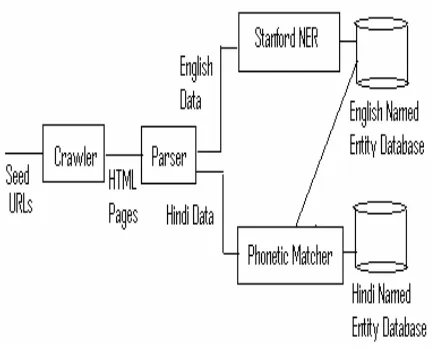
The system architecture is shown in Figure 1. It consists of the following modules:
Figure 1: System Architecture
2.1 Crawler
The crawler is a web-bot or spider which browses the web in an automated manner. It starts with a list of Uniform Resource Locators (URL) that it is to visit, called the seeds. As the crawler visits these URL’s it collects all the hyperlinks and adds them to a queue. URL’s from the queue are crawled fur-ther. Since the crawler collects the data from web, the data collection is fully automated. The crawler gathers data for both English and other Indian lan-guages. The data collected for English is used to populate the English named entity database which is significantly accurate. We have used the freely
available Stanford Named Entity Recognizer (Finkel, Grenager, and Manning, 2005) in our en-gine. The data collected for Indian languages will be used to build a database of named entities for the given language.
2.2 Parser
The crawler saves the content in an html form onto the system. The parser parses these html files. Additionally the parser can also parse the PDF as well as RTF files. The output of the parser is passed to the corresponding modules for the two different languages.
2.3 Phonetic Matcher
Phonetic matching is the task of matching two rep-resentations of the same name. A name may have more than one representation in its native script itself. If the name is represented in a script other than its native script, there may be large number of potential variants for its representation. Phonetic matching is a fuzzy string matching technique in which we match strings on the basis of their simi-lar sounding property and not identity. Most com-mon phonetic matching techniques are Soundex and Editex. These techniques are used to match two representations of the same name in English. We survey the techniques in the following subsec-tions.
2.3.1 Soundex
Soundex algorithm was designed by Odell and Russell in 1918 to find spelling variation of names. It represents classes of sounds which can be lumped together. The classes for the algorithm are shown in Appendix A. These classes are placed for phonetic matching according to the following algo-rithm:
1. Replace all but the first letter of the string by its phonetic code.
2. Eliminate any adjacent representation of codes.
3. Eliminate all occurrences of code 0 i.e. eliminate all vowels.
4. Return the first four characters of the re-sulting string.
for vowels and hence is not accurate for cross-lingual matching.
2.3.2 Editex
The Editex algorithm was designed by Zobel and Dart (Zobel and Dart,1996). It is an enhancement of the Levenshtein (Levenshtein, 1966) edit dis-tance algorithm. The Levenshtein algorithm meas-ures the edit distance between two strings where edit distance is defined as the minimum number of basic operations required to match one string to the other where the basic operations are insertion, de-letion and substitution. Insertion and dede-letion costs are 1 and substitution cost is given by a function subst_cost (Xi, Yj) which returns 0 if the two char-acters Xi and Yj are same and 1, if they are differ-ent. The score dist [m, n] is returned as the edit distance between two strings. A score of zero im-plies a perfect match.
The algorithm has O (mn) time and space com-plexity where m and n are the lengths of the two strings respectively. The pseudo code for the Levenshtein edit distance algorithm is described in Appendix B. Editex groups similar sounding pho-nemes into equivalence classes. The substitution cost is determined by a function S (Xi, Yj) that returns 0 if the two characters Xi and Yj are same, 1 if they lie in the same equivalence class and 2 otherwise. The insertion and substitution costs are determined by a function D (Xi-1, Xi) which is almost same as S (Xi, Yj) except for the difference that it compares letters of the same string and it returns 1 if Xi-1 is ‘h’ or ‘w’ and Xi-1 is not equal to Xi. The editex equivalence classes and the ed-itex pseudo-code are given in Appendix C.
Editex performs fairly better than Soundex and Leveinshtein edit distance algorithms. However further enhancements in Editex are also possible. “Tapering” is one enhancement in which we weigh mismatches at the beginning of the string with higher score than mismatches towards the end (Zobel and Dart, 1996). Other enhancements are those in which input strings are mapped to their phonemic representation, called phonometric methods (Zobel and Dart, 1996).
3
Transliteration rules
To perform phonetic matching of two different representations of a named entity, we need both of
them in a common script. We choose to transliter-ate the named entity in Indian language to English. The transliteration rules for a language must be written for the same. We have written our own set of transliteration rules for Hindi. These can be de-scribed briefly as under
The entity to be transliterated is scanned character by character from left to right. Each character of Hindi is mapped to an equivalent character/set of character in English according to a mapping function. The charac-ter set generated by the function is appended into a string as per the rules. E.g. का = क् + अ is a single
character representation in Unicode (‘क’) and maps to ‘Ka’.
1. Start with an empty string. When a conso-nant or singleton vowel (not as ‘matra’) is encountered append the set of characters returned by mapping function.
2. When a consonant is followed by a vowel the preceding ‘a’ should be removed and the character set for the vowel should be appended. E.g. के consists of two
charac-ters क + . Once we encounter क we
append ‘ka’ and when is encountered next we remove the ‘a’ and append the
mapping for i.e. ‘e’. This rule applies in general to all the vowels.
3. If the transliterated string has ‘a’ as its last character while it doesn’t have the vowel
as last character of Hindi string, re-move this occurrence of ‘a’. The last vowel in Hindi is very important as two al-together different words may have the only difference in the last vowel. E.g. “कमल”
and “कमला” are proper nouns having dif-ferent genders. Their English representa-tions are “Kamal” and “Kamla” respec-tively.
The transliteration always performs a one to one mapping of a character in Hindi to a set of charac-ters in English. However the English representa-tion may have different character sets for the same Hindi character in different names. E.g. “कमल” is
English names and by ‘Q’ for Urdu names. The Editex algorithm groups these letters in the same equivalence class.
4
Baseline Task
At the core of our method lies the phonetic match-ing algorithm. We have modified the Editex algo-rithm as mentioned in Appendix C. Editex can be modified to take into account that there can be more than three (0, 1, 2) levels of acceptability for substitutions due to the inherent properties of par-ticular languages. For example, say “ckq” is one equivalence class in Editex. ‘c’ and ‘k’ have a sub-stitution cost of 1. We may reduce this subsub-stitution cost to 0.5 for a language in which it is highly probable that the same character maps to ‘c’ and ‘k’ in the English representation of its names. Thus the equivalence classes and the substitution costs in Editex can be modified for cross-lingual phonetic matching. There can also be further lan-guage specific enhancements. The following algo-rithm along with some language specific enhance-ments was implemented for Hindi.
4.1 Abbreviation Check
Abbreviations form an important class of named entities. So, we first check whether the Hindi string is an abbreviation in which the English characters are spelled individually. For each English alphabet we have some unique Hindi representation. The function performs accurately most of the time and extracts such named entities. If we are able to find out that the string is an abbreviation, the corre-sponding English representation can be returned by the function itself, hence there is no need of further matching. If the string is not an abbreviation, we proceed to the actual matching algorithm.
4.2 4.2. First letter matching
The first letters of the two strings must either be the same or should belong to the same equivalence class. The equivalence classes for first character matching are:
"ckq", "wbv", "iy”,"jz", "aeiou"
The English named entity database must be in-dexed according to the first letter of the named en-tity so that we only search for matches in those indexes which fall into the same equivalence class.
This is very important for the computational effi-ciency of the engine as it reduces the search space.
4.3 Preprocessing
Often the phonetic inconsistencies in English lead to low matching score for two representation of the same name. To take this into account, before matching the two strings the named entity retrieved from English Named entity database is preproc-essed to form a new string. We have used the fa-mous “Mark Twain’s plan for the improvement of English spelling” (http://grammar.ccc.commnet.edu/ grammar/twain.htm) added with some more rules. This way we tackle the problem of more than one possible character sets for some vowels since only one of them can be chosen during transliteration. We also tackle some other problems like silent-alphabets and repeated silent-alphabets so that the prob-ability of generating high matching score in-creases. The following set of rules for preprocess-ing was used.
1. Change all occurrences of “oo” to “u”. (both character sets are for the vowel ) 2. Change all occurrences of “ee” to “i”
(both character sets are for the vowel ) 3. Change all occurrences of “f” to ph” 4. Change all occurrences of “au” to “o” 5. If a word starts with "x", replace the "x"
with a "z". Change all the remaining "x"s to "ks"s.
6. If a "c" is directly followed by an "e" or "i", change the "c" to an "s"
7. If a "c" is directly followed by a "k", re-move the "c". Keep applying this rule as necessary (Example: "cck" becomes "k".)
8. If a word starts with "sch", change the "sch" to a "sk".
9. If a "ch" is directly followed by an "r", change the "ch" to a "k".
10. After applying the above rules, change all "c"s that are not directly followed by an "h", to a "k". (This includes all "c"s that are last letter of a word)
11. If a word starts with "kn" change "kn" to“n”
applying this rule as necessary (Example: "zzz" becomes "z".)
4.4 Editex Score
Now the transliterated string and the preprocessed string are compared to generate an editex score. The equivalence classes we used were similar to as proposed in the original editex algorithm except for some language specific changes for Hindi. Length of the two strings has to be considered while deciding the threshold score for a match oth-erwise there can be greater number of mismatches for small strings. So we normalize editex score as d = [1- {editex(X, Y) / (length(X) + length(Y)}]
The decided threshold for match was 0.86. A score above threshold guarantees equivalence of the two representations. The results are shown in Table-1.
Hindi NE
English NE
Transliteration Output
Editex Score
िहन्दी Hindi Hindi 1.0
फ़लःतीनी Philistini Phalastini 0.9
बांगलादेश Bangladesh Bangladesh 1.0
झारखण्ड Jharkhand Jharakhand 0.894
पिश्चम Pashchim Pashchim 1.0
बंगाल Bengal Bangal 0.916
भारत Bharat Bharat 1.0
िबकेट Cricket Kriket 0.923
मेग Greg Greg 1.0
चैपल Chappel Chaipal 0.857
महेंि Mahendra Mahendr 0.933
राहलु Rahul Rahul 1.0
ििवड Dravid Dravid 1.0
छत्तीसगढ Chattisgarh Chattisagadh 0.866
Table-1: Hindi named entities with transliteration output and normalized Editex scores
5
Results and Analysis
We have tested our system with a parallel corpus which consisted of both English and Hindi lan-guage data. Further we used the web crawler to populate our NE list of both the languages thus embedding the concept of comparable corpus. The results for English obtained using parallel corpus are:
Precision: 81.40% and Recall: 81.39%
This corpus carried named entities from the do-main of travel, tourism and culture. Further for classifying the results for Hindi we used the defini-tion of named entities as given by Chinchor (Chin-chor, 1997) as for entity names organizations (OE), person names (PE) and location names (LE). The results for numeric expressions (monetary values and percentages) and temporal expressions (dates and times) were not considered for results because it is a trivial task to build grammar rules for such entities which appear quite regularly.
We have focused on OE, PE and LE named enti-ties for Hindi so that we can analyze the perform-ance on new and hitherto undiscovered entities which come into existence with the passage of time. This premise provides the real basis for chal-lenging the performance of any NER technique for Indian Languages.
The testing on the corpus of around 1000 sen-tences revealed the following results for Hindi:
• Precision for all named entities
(PE+OE+LE): 80.2%
• Recall for PE (person entity names): 47.4%
• Recall for OE (organization entity names): 42.9%
• Recall for LE (location entity names): 74.6%
the native entities available from tourism informa-tion from India. This gives good credence to the phonetic matching approach used above. Causes for the comparatively lower recall percentage among person entity names and organization entity names are under further investigation.
6
Conclusions
We have used the phonetic matching technique to match the strings of different languages on the ba-sis of their similar sounding property. As the Pho-netic Matcher module is tested for more data, more generic rules can be made to improve its accuracy. The Engine should be improved so that it may rec-ognize phrasal named entities and abbreviations. The engine will work for any language if the pho-netic matching rules are written for that language. We can also develop a crawler which will be fo-cused upon a certain domain of interest. Fofo-cused crawlers are very important for generating re-sources for natural language processing. A focused crawler application is an intelligent agent that crawls the web for content related to a specific domain. This kind of crawler could be used in the future for purposes of data collection for a particu-lar domain.
7
Acknowledgements
The authors gratefully acknowledge financial assis-tance from TDIL, MCIT (Govt. of India).
References
Chinchor, N. 1997. MUC-7 Named entity task defini-tion. In Proceedings of the 7th Message Understand-ing Conference (MUC-7)
Finkel, Jenny Rose, Grenager, Trond and Manning, Christopher. 2005. Incorporating Non-local Informa-tion into InformaInforma-tion ExtracInforma-tion Systems by Gibbs Sampling. Proceedings of the 43rd Annual Meeting of the Association for Computational Linguistics (ACL 2005), pp. 363-370.
Kim, J. and Woodland, P.C. 2000a. Rule Based Named Entity Recognition. Technical Report CUED/ FIN-FENG/TR.385, Cambridge University Engineering Department, 2000.
Malouf, Robert. 2002 Markov models for language-independent named entity recognition. In Proceed-ings of CoNLL-2002 Taipei, Taiwan, pages 591-599.
Levenshtein, V.I. 1966. Binary codes capable of cor-recting deletions, insertions, and reversals. Soviet Physics Doklady 10: 707–710.
Zobel, Justin and Dart, Philip. 1996. Phonetic string matching: Lessons from information retrieval. In Proceedings of the Eighteenth ACM SIGIR Interna-tional Conference on Research and Development in Information Retrieval, Zurich, Switzerland, August 1996, pp. 166-173.
Appendix A: Soundex classes
Code Letters Code Letters
0 aeiouyhw 4 l
1 bpfv 5 mn
2 cgjkqsxz 6 R
3 dt
Appendix B: Pseudo code for Leveinshtein edit dis-tance:
Input: Two strings, X and Y Output: The minimum edit dis-tance between X and Y
m ← length(X)
n ← length(Y)
for i =0 to m do
dist[i, 0] ← i
for j = 0 to n do
dist[0, j] ← j
for i = 1 to m do for j = 1 to n do
dist[i, j] = min{
dist[i-1, j]+inser_cost, dist[i-1, j-1]
+ subst_cost[Xi, Yj],
dist[i, j-1] + delet_cost }
end
Appendix C: Editex Equivalence Classes:
Pseudo code for Editex Algorithm
Input: Two strings, X and Y Output: The editex distance between X and Y
m = length(X) n = length(Y)
editex_dist[0, 0] = 0
for i = 1 to m do
editex_dist[i, 0]
= editex_dist[i-1, 0] + D(Xi-1, Xi)
for j = 0 to n do
editex_dist[0, j]
= editex_dist[0, j-1] + D(Yj-1, Yj)
for i = 1 to m do for j = 1 to n do
editex_dist[i, j] =
min { editex_dist[i-1, j] + D(Xi-1, Xi),
editex_dist[i-1, j-1] + S(X, Yj),
editex_dist[i, j-1] + D(Yj-1, Yj)