S-clause Segmentation for Efficient Syntactic Analysis
Using Decision Trees
Mi-Young Kim Jong-Hyeok Lee
Div. of Electrical and Computer Engineering
Pohang University of Science and Technology (POSTECH) and Advanced
Informa-tion Technology Research Center(AlTrc)
San 31 Hyoja-dong, Nam-gu, Pohang 790-784, R. of Korea
[email protected]
[email protected]
fax: +82-54-279-5699 fax: +82-54-279-5699
Keywords : S-clause segmentation, Decision trees, Syntactic analysis, Long sentence analysis
Abstract
In dependency parsing of long sentences with fewer subjects than predicates, it is difficult to recognize which predicate governs which subject. To handle such syntactic ambiguity between subjects and predicates, this paper proposes an “S-clause” segmentation method, where an S(ubject)-clause is defined as a group of words containing several predicates and their common subject. We propose an automatic S-clause segmentation method using decision trees. The S-clause information was shown to be very effective in analyzing long sentences, with an improved performance of 5 percent.
1 Introduction
The longer the input sentences, the worse the parsing results are, since problems with syntactic ambiguity increase drastically. In our parser, subject errors form the second largest error portion, as 24.15% of syntactic parsing errors (see Table 1). Although the dependency errors in NP form the largest error portion, these errors are not significant since many applications (e.g. MT sys- tems) using parsers deal with the NP structure as a one unit and do not analyze the syntactic relations within NP. So, this paper proposes a method to resolve subject dependency error problems. To improve the dependency parsing
performance, we need to determine the correct dependency relations of subjects.
In most cases, a long sentence has fewer subjects than predicates. The reason is that several predicates can share one subject if they require the same word as their subject, or that the subject of a predicate is often omitted in a Korean sentence. So, in a long sentence, it is difficult to recognize the correct subject of some subjectless VPs. This paper proposes an S(ubject)-clause segmentation method to reduce ambiguity in determining the governor of a subject in dependency parsing. An S(ubject)-clause is defined as a group of words containing several predicates and their common subject. An S-clause includes one subject and several predicates which share the subject. The S-clause segmentation algorithm detects the boundary of predicates which share a common subjective word. We employ the C4.5 decision tree learning algorithm for this task.
2
dependency
tree errors subject-predicate dependency
Table 1. Dependency Tree Errors for 10,000 Test Sentences (avg 19.27 Words/sentence)
Previous
Work
A considerable number of studies have been conducted on the syntactic analysis of long sen-tences. First, conjunctive structure identification methods have been proposed (Agarwal 1992;Jang 2002;Kurohashi 1994;Yoon 1997). These methods are based on structural parallelism and the lexical similarity of coordinate structures. While they perform well in detecting the boundary of a coor-dinate structure, they cannot determine the bound-ary of predicates that share a common subject. In addition, some papers insist that coordinate struc-ture identification is impossible since Korean co-ordinate sentences do not maintain structural parallelism (Ko 1999).
the syntactic analysis of long sen-tences. First, conjunctive structure identification methods have been proposed (Agarwal 1992;Jang 2002;Kurohashi 1994;Yoon 1997). These methods are based on structural parallelism and the lexical similarity of coordinate structures. While they perform well in detecting the boundary of a coor-dinate structure, they cannot determine the bound-ary of predicates that share a common subject. In addition, some papers insist that coordinate struc-ture identification is impossible since Korean co-ordinate sentences do not maintain structural parallelism (Ko 1999).
Second, several studies have been made on clause segmentation (identification, splitting) (Sang and Dejean 2001). The clause seems to be a natural structure above the chunk (Ejerhed 1998). Clause identification splits sentences that center around a verb. The major problem with clause identification concerns the sharing of the same subject by different clauses (Vilson 1998). When a subject is omitted in a clause, Vilson(1998) at-tached the features of the previous subject to the conjunctions. However, the subject of a clause is not always the nearest subject. Therefore, a new method is required to detect the correct subject of a clause.
Second, several studies have been made on clause segmentation (identification, splitting) (Sang and Dejean 2001). The clause seems to be a natural structure above the chunk (Ejerhed 1998). Clause identification splits sentences that center around a verb. The major problem with clause identification concerns the sharing of the same subject by different clauses (Vilson 1998). When a subject is omitted in a clause, Vilson(1998) at-tached the features of the previous subject to the conjunctions. However, the subject of a clause is not always the nearest subject. Therefore, a new method is required to detect the correct subject of a clause.
In addition, many studies have focused on seg-mentation in long sentences. Some try to segment a long sentence using patterns and rules and to analyze each segment independently (Doi 1993; Kim 1995; Kim 2002 ;Li 1990). Similarly, an in-trasentence segmentation method using machine learning is proposed (Kim 2001). Although this method reduces the complexity of syntactic analy-sis by segmenting a long sentence, the ambiguity problem with the dependency of subjects remains unsolved. Further, Lyon and Dickerson take ad-vantage of the fact that declarative sentences can almost always be segmented into three concatena-
In addition, many studies have focused on seg-mentation in long sentences. Some try to segment a long sentence using patterns and rules and to analyze each segment independently (Doi 1993; Kim 1995; Kim 2002 ;Li 1990). Similarly, an in-trasentence segmentation method using machine learning is proposed (Kim 2001). Although this method reduces the complexity of syntactic analy-sis by segmenting a long sentence, the ambiguity problem with the dependency of subjects remains unsolved. Further, Lyon and Dickerson take ad-vantage of the fact that declarative sentences can almost always be segmented into three concatena-
ted sections (pre-subject, subject, predicate) which can reduce the complexity of parsing English sen-tences (Lyon and Dickerson 1995; Lyon and Dickerson 1997). This approach is useful for a simple sentence that contains a subject and a predicate. A long sentence generally contains more than a subject and a predicate. Therefore, the segmentation methods proposed by Lyon and Dickerson are inefficient for parsing long sen-tences. In studies on segmenting long sentences, little attention has been paid to detecting the boundaries of predicates which share a common subject.
ted sections (pre-subject, subject, predicate) which can reduce the complexity of parsing English sen-tences (Lyon and Dickerson 1995; Lyon and Dickerson 1997). This approach is useful for a simple sentence that contains a subject and a predicate. A long sentence generally contains more than a subject and a predicate. Therefore, the segmentation methods proposed by Lyon and Dickerson are inefficient for parsing long sen-tences. In studies on segmenting long sentences, little attention has been paid to detecting the boundaries of predicates which share a common subject.
To determine the correct subject of some sub-jectless VPs, we define the ‘S-clause’ and propose an S-clause segmentation method. In previous work, a clause is defined as a group of words con-taining a verb, and previous researchers split sen-tences centering around a verb to detect clauses. By contrast, we split sentences centering around a subject. So we call the proposed segment ‘S(ubject)-clause’ to distinguish it from a clause.
To determine the correct subject of some sub-jectless VPs, we define the ‘S-clause’ and propose an S-clause segmentation method. In previous work, a clause is defined as a group of words con-taining a verb, and previous researchers split sen-tences centering around a verb to detect clauses. By contrast, we split sentences centering around a subject. So we call the proposed segment ‘S(ubject)-clause’ to distinguish it from a clause.
3
3.1
3
3.1
Dependency Analysis in Korean
Lan-guage
Dependency Analysis in Korean
Lan-guage
Dependency Analysis Procedure Dependency Analysis Procedure
This section overviews our dependency analysis procedure for the Korean language.
This section overviews our dependency analysis procedure for the Korean language.
1. Chunking 1. Chunking 2. Detect clauses 2. Detect clauses
(Using clauses, determine the heads of ar-guments(except subjects)
(Using clauses, determine the heads of ar-guments(except subjects)
3. Detect S-clauses 3. Detect S-clauses
(Using S-clauses, determine the heads of subjects and the heads of non-arguments(adjuncts))
(Using S-clauses, determine the heads of subjects and the heads of non-arguments(adjuncts))
First, we determine NP- and VP-chunks follow-ing the method of Kim (Kim et al, 2000). Next,
we bind a predicate and its arguments to deter-mine the heads of arguments using subcategoriza-tion and the selecsubcategoriza-tional restricsubcategoriza-tion informasubcategoriza-tion of predicates. This procedure is similar to the clause detection procedure. In this procedure, we also determine the grammatical function of unknown case words according to Lee’s method (Lee et al, 2003).
It is important to identify the subject grammati-cal function of unknown case words correctly, since one S-clause is constructed per subject.
In Korean, arguments of predicates, especially subjects, are often omitted in a sentence. We leave the dependency relations of subjects unconnected, since ambiguity occurs when detecting the heads of subjects.
Third, using predicate information and gram-matical function detection results after clause de-tection, we detect clauses. And then, using S-clauses, we determine the dependency relations between subjects and predicates. It can be also helpful in determining the heads of adjuncts, since their heads can be found within an S-clause boundary.
3.2
4
4.1
4.2
Dependency Analysis based on S-clausesBefore S-clause segmentation, we have deter-mined the dependency relations between argu-ments (except subjects) and predicates. Next, we determine the heads of subjects after S-clause segmentation. Although we assume that all the predicates in an S-clause require the subject within the S-clause, some S-clause segmentation errors may exist. To recover the S-clause segmen-tation errors, we use selectional restriction information to find the relevant head of a subject. We regard the head of the subject within an S-clause as the farthest predicate in the S-S-clause which requires the concept of the subject.
Still, the dependency relations of adjuncts and those of predicates are not determined. The heads of adjuncts and those of predicates are dependent on the nearest head candidate not giving rise to crossing links. Using S-clauses, we can accom-plish dependency parsing simply and effectively.
S-clause Segmentation based on
Deci-sion Tree Learning
The C4.5 Learning Algorithm
Decision tree induction algorithms have been successfully applied to NLP problems such as parsing (Magerman 1995;Haruno et al 1998), dis-course analysis (Nomoto and Matsumoto 1998), sentence boundary disambiguation (Palmer 1997), phrase break prediction (Kim 2000) and word segmentation (Sornertlamvanich et al 2000). We employed a C4.5 (Quinlan 1993) decision tree induction program as the learning algorithm for S-clause segmentation.
The induction algorithm proceeds by evaluating the information content of a series of attributes and iteratively building a tree from the attribute values, with the leaves of the decision tree repre-senting the values of the goal attributes. At each step of the learning procedure, the evolving tree branches from the attribute that divides the data items with the highest gain in information.
Branches will be added to the tree until the deci-sion tree can classify all items in the training set. To reduce the effects of overfitting, C4.5 prunes the entire decision tree after construction. It recur-sively examines each subtree to determine whether replacing it with a leaf or branch will re-duce the expected error rate. Pruning improves the ability of the decision tree to handle data which is different from the training data.
Features
This section explains the concrete feature set-ting we used for learning. The S-clause is a broader concept than the clause. In order to de-termine the S-clauses, we must choose the clauses that are suitable for addition to the S-clause. Since the head word of a clause is the predicate in the clause, we merely use predicate information. The feature set focuses on the predicates.
An clause can be embedded in another S-clause. Therefore, we should learn two methods to detect the left boundary and right boundary of an S-clause independently.
We should include one subject between the left boundary and the right boundary of an S-clause. We call the subject to include in an S-clause the ‘target subject’.
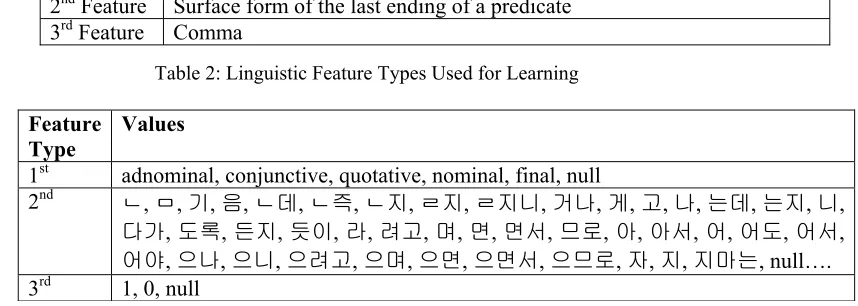
1st Feature Type of a predicate
2nd Feature Surface form of the last ending of a predicate 3rd Feature Comma
Table 2: Linguistic Feature Types Used for Learning
Feature Type
Values
1st adnominal, conjunctive, quotative, nominal, final, null
2nd ㄴ
, ㅁ, 기, 음, ㄴ데, ㄴ즉, ㄴ지, ㄹ지, ㄹ지니, 거나, 게, 고, 나, 는데, 는지, 니,
다가, 도록, 든지, 듯이, 라, 려고, 며, 면, 면서, 므로, 아, 아서, 어, 어도, 어서,
어야, 으나, 으니, 으려고, 으며, 으면, 으면서, 으므로, 자, 지, 지마는, null…. 3rd 1, 0, null
Table 3: Values for Each Feature Type
‘target subject’ and the nearest subject which pre-cedes the ‘target subject’.
Each predicate has 3 features, as shown in Ta-ble 2. The 1st feature concerns the type of a predi-cate. Next, the 2nd feature takes the value of the surface form of the last ending of a predicate. Ko-rean is an agglutinative language and the ending of a predicate indicates the connective function with the next VP (e.g. ‘으므로(because)’ indi-cates it functions as a reason for the next VP).
The 3rd feature deals with the information whether a predicate is followed by a comma or not. The use of a comma to insert a pause in a sentence is an important key to detect an S-clause boundary.
We use 12 features for left boundary detection — 4 predicates, and 3 features for each predicate as summarized in Table 2. The class set consists of 5 values (0~4) to indicate the position of the predicate that becomes a left boundary. If the class value is 0, it means the S-clause includes no predicates preceding the ‘target subject’. Other wise, if the class value is 1, it means that that the S-clause includes one nearest predicate which ap-pears preceding the ‘target subject’.
The window size of predicates for the left boundary is 4. If there are less than 4 predicates, then we fill the empty features with ‘null’.
For right boundary detection, we consider the predicates between the ‘target subject’ and the next subject following the ‘target subject’.
We use 15 features for right boundary detection — 5 predicates, and the same 3 features for each predicate as in Table 2. Among the predicates be-tween ‘target subject’ and the next subject follow-ing the ‘target subject’, we consider 4 predicates
which appear near the ‘target subject’ and 1 predi-cate which lopredi-cates last. The reason that 1 predipredi-cate which locates last is considered is as follows: If all the predicates between ‘target subject’ and the next subject following the ‘target subject’ require the ‘target subject’ as their common subject, the right boundary becomes the last predicate among them, since Korean is a head-final language.
Although the feature set is the same as that for right boundary detection, the window size for the right boundary is 5, which is larger than that for the left boundary. The reason is that Korean is a head-final language and the predicates of a subject appear after the subject.
The detailed values of each feature type are summarized in Table 3.
We first detect the S-clause which includes the last subject of an input word set. If an S-clause is detected, we exclude the words which are in-cluded in the S-clause from the input word set. Then, we recursively detect the S-clause including the last subject in the remaining word set until there are no subjects in the modified word set.
5
Experimental Results
We evaluated the proposed S-clause segmenta-tion method using the Matec99’1 test set. We evaluated the following 2 properties of the S-clause segmentation program.
1. The amount of training data vs. S-clause segmentation accuracy vs. parsing accuracy
1 Morphological Analyzer and Tagger Evaluation Contest in
Number of training sentences 5000 10000 20000 30000 40000 50000 S-clause Precision 82.14% 83.68% 83.70% 84.10% 84.06% 84.40%
S-clause Recall 81.98% 83.54% 83.61% 84.02% 83.98% 84.30%
Parsing Accuracy 86.28% 87.53% 87.86% 88.79% 89.09% 89.12%
Table 4: The Amount of Training Sentences vs. S-clause Accuracy vs. Parsing Accuracy for the 10000 test sentences
Our parser without S-clause segmentation procedure
Our parser with S-clause segmentation procedure
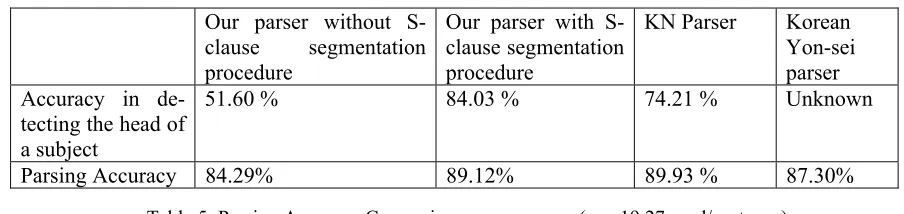
KN Parser Korean Yon-sei parser Accuracy in
de-tecting the head of a subject
51.60 % 84.03 % 74.21 % Unknown
Parsing Accuracy 84.29% 89.12% 89.93 % 87.30%
Table 5: Parsing Accuracy Comparison (avg 19.27word/sentence)
2. Significance of features
5.1
The Amount of Training Data vs. S-clause Segmentation Accuracy vs. Pars-ing AccuracyThe test set is different from the training set and the average length of the test sentence is 19.27 words/sentence while that of the training sentence is 14.63 words/sentence. We selected longer sen-tences as a test set since the S-clause segmentation method is proposed to improve the performance of syntactic analysis in long sentences.
The parsing accuracy is calculated as (correct dependency links)/(all the dependency links). The number of detected dependency links and that of the true dependency links are equal, so parsing accuracy is the same as parsing recall. For the rea-son, we do not measure the parsing recall sepa-rately. However, in the case of clauses, the S-clause precision is different from the S-S-clause re-call, since the subject grammatical function detec-tion results for unknown case words are not perfectly correct. We measured the S-clause preci-sion as (correct clauses)/(all the detected clauses), and the clause recall as (correct S-clauses)/(all the true S-clauses).
To show the effectiveness of S-clauses, we com-pare the parsing result using S-clauses and without S-clauses, and also compare our parser perform-ance with others which analyze similar languages with Korean.
In the experiments, we obtained the following two results.
1. The better the S-clause segmentation per-formance, the better the parsing accuracy that re-sults.
2. The maximum S-clause accuracy is 84.40% and the maximum parsing accuracy is 89.12% with 50000 training sentences. The test set size is 10,000 sentences.
We will discuss the maximum accuracy of 89.12% compared with the Japanese KN parser, which shows the highest performance in Japanese dependency parsing.
The characteristics of Japanese are similar to the Korean language. So, the mechanism of syn-tactic analysis in Korean can also be applied to Japanese. In Japanese dependency parsers and Korean dependency parsers, the KN parser shows the highest performance. In addition, we can freely obtain the programs. So, we compare the performance of our parser with that of the KN parser. To do this, we need a bilingual test corpus. We obtain 10,000 Japanese test set by translating the 10,000 Korean test set using Korean-to-Japanese machine translation system of our own. Then, several researchers specializing in Japanese manually corrected the translation results. We ex-perimented on the performance of the KN parser using these 10,000 Japanese sets.
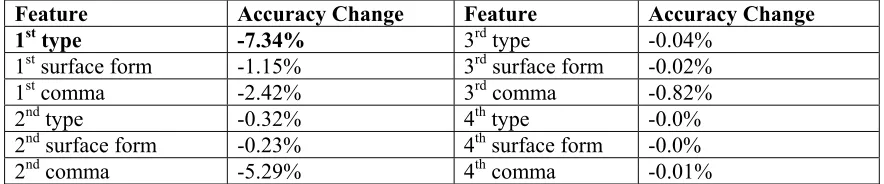
Feature Accuracy Change Feature Accuracy Change 1st type -7.34% 3rd type -0.04%
1st surface form -1.15% 3rd surface form -0.02%
1st comma -2.42% 3rd comma -0.82%
2nd type -0.32% 4th type -0.0%
2nd surface form -0.23% 4th surface form -0.0%
2nd comma -5.29% 4th comma -0.01%
Table 6: S-clause Accuracy Change When Each Attribute for Left Boundary Removed
Feature Accuracy Change Feature Accuracy Change
1st type -3 % 3rd comma -3 %
1st Surface form. -0.8 % 4th type -0.2 %
1st comma -2.7 % 4th surface form -0.3 %
2nd type -0.3 % 4th comma 0.0 %
2nd surface form -1.3 % 5th type -0.8 %
2nd comma -1.9 % 5th Surface form. -0.1 %
3rd type 0.0 % 5th comma 0.0 %
3rd surface form 0.0 %
Table 7: S-clause Accuracy Change When Each Attribute for Right Boundary Removed
S-clause
errors Subject detection errors
Pos-tag
errors Double subject errors
Left boundary errors
Right boundary errors
Predicate role of adverbials
Other-wise
Error % 25.15% 20.66% 11.38% 16.47% 20.96% 2.00% 3.38%
Table 8: The Type of S-clause Errors
without S-clause segmentation is worse than that of the KN parser. In our parser without S-clause segmentation, a word simply depends on the near-est head not giving rise to crossing links. However, after S-clause segmentation, the performance of our parser is similar to that of the KN parser. The accuracy of our parser in detecting the head of a subject is also better than that of the KN parser.
We also compare the performance of our parser with a Korean Yon-sei dependency parser, as shown in Table 5. The parser using S-clauses out-performs the Yon-sei parser by 1 percent. Since the Yon-sei dependency parser is not an open re-source, we simply compare the performance of our parser with that of Yon-sei parser written in Kim (2002). Therefore, the comparison of the per-formance between our parser and the Korean Yon-sei dependency parser may not be so reasonable.
5. 2 Significance of Features
Next, we will summarize the significance of each feature introduced in Section 4.2. Table 6 and Ta-ble 7 illustrate how the S-clause accuracy is re-duced when each feature is removed. Table 6 clearly demonstrates that the most significant fea-ture for the left boundary is the type of the previ-ous 1st predicate— we obtain the information from the decision rules that, especially, the ‘adnominal’ type of the previous 1st predicate is a significant feature. As shown Table 6, 4th predicate informa-tion has no effect on the left boundary.
Table 7 demonstrates that the most significant feature for the right boundary is comma informa-tion, since the S-clause accuracy without 1st, 2nd or 3rd comma information shows high accuracy de-crease. The 5th predicate information is more use-ful than the 4th predicate. In other words, the last predicate can be the head of a subject than the in-termediate predicate.
their subjects (other predicates are preceded by their subjects). Next, after the comma, a boundary mostly occurs. In particular, we need to concen-trate on the types of predicates to attain a higher level of accuracy. To some extent, most features contribute to the parsing performance.
In our experiment, only the surface form of the endings of conjunctive predicates, rather than other predicates, is effective on performance. The reason is that the surface form of the ending of the non-conjunctive predicates does not indicate the connective function with the next VPs.
5.3 Discussion about S-clause Errors
We classify the S-clause errors, as shown in Table 8. Table 8 shows that many S-clause errors are due to the Korean characteristics.
Among the S-clause errors, subject detection errors rank first, which occupy 25.15%. So, the clause accuracy result is different from the S-clause recall result.
Next, POS tagging errors result in the S-clause segmentation errors of 20.66 percent.
These two errors occur before S-clause seg-mentation. So, this is another issue that remains for future work.
Also, double subject errors are 11.38%. Some Korean predicates can require two subjects. This is contrary to our assumption of S-clauses. Since 11.38% is large portion of all the errors, we should consider double subject construction and identify the characteristics of the predicates in double subject constructions.
The right boundary errors are more than left boundary errors. It means that the right boundary detection is more difficult.
Finally, some adverbials, not predicates, can function as predicates of subjects. Since we only detect boundaries focusing on predicates, these adverbials information cannot be used. We should include these adverbials that function as predi-cates into the S-clause boundary candidates.
6 Conclusion
This paper proposes an S-clause segmentation method to reduce syntactic ambiguity in long sen-tences. An S(ubject)-clause is defined as a group of words containing several predicates and their
common subject. An S-clause includes one subject and several predicates that share the subject.
We have described an S-clause segmentation method that uses decision trees. The experimental results show that the parser using S-clauses out-performs the parser without S-clauses by 5% and also outperforms conventional Korean depend-ency parsers by 1 percent. To improve the S-clause accuracy, we should detect double subject constructions and adverbials which function as predicates. We plan to continue our research in two directions. First, we will combine our S-clause segmentation method with a coordinate structure detection method and test the parsing results. Second, we will apply it to a machine translation system and translate each S-clause in-dependently and test the translation performance.
Acknowledgements
This work was supported by the Korea Science and Engineering Foundation (KOSEF) through the Ad-vanced Information Technology Research Cen-ter(AITrc) and by the Brain Korea 21 Project in 2003.
References
Rajeev Agarwal, Lois Boggess. A simple but useful approach to conjunct identification. In Proceedings
of the 30th Annual Meeting of the Association for
Computational Linguistics, p.15-21, 1992.
Orasan Constantin. A hybrid method for clause splitting
in unrestricted English texts. In Proceedings of
ACIDCA 2000
Shinchi Doi, Kazunori Muraki, Shinichiro Kamei and Kiyoshi Yamabana. Long sentence analysis by do-main-specific pattern grammar, In Proceedings of the 6th Conference on the European Chapter of the
Association of Computational Linguistics, p.466,
1993.
Eva Ejerhed. Finding clauses in unrestricted text by finitary and stochastic methods. In Proceedings of
the 2nd Conference on Applied Natural Language
Processing, p.219-227, 1998.
Jaechol Jang, Euikyu Park, and Dongryeol Ra. A Ko-rean conjunctive structure analysis based on sen-tence segmentation (In Korean). In Proceedings of
14th Hangul and Korean Information Processing,
p.139-146, 2002.
Byeongchang Kim and Geunbae Lee. Decision-Tree based Error Correction for Statistical Phrase Break Prediction in Korean. In Proceedings of the 18th In-ternational conference on Computational Linguis-tics, p.1051-1055, 2000
Kwangbaek Kim, Euikyu Park, Dongryeol Ra and Jun-tae Yoon. A method of Korean parsing based on sentence segmentation. In Proceedings of 14th
Han-gul and Korean Information Processing, p.163-168,
2002
Miyoung Kim, Sin-Jae Kang and Jong-Hyeok Lee.
Text Chunking by Rule and Lexical Information. In
proceedings of the 12th Hangul and Korean Infor-mation Processing Conference, Chonju, Korea. pp 103~109. 2000
Sungdong Kim and Yungtaek Kim. Sentence analysis using pattern matching in English-Korean machine translation, In Proceedings of the International Con-ference on Computer Processing of Oriental Lan-guages, p.199-206, 1995.
Sungdong Kim, Byungtak Zhang and Yungtaek Kim. Learning-based intrasentence segmentation for effi-cient translation of long sentences. Machine Trans-lation 16:151-174, 2001.
Kwangju Ko. Review of coordinate sentences (in Ko-rean), Journal of Korean, 9:39~80, 1999.
Sadao Kurohashi and Makoto Nagao, A syntactic analysis method of long Japanese sentences based on the detection of conjunctive structures, Computa-tional Linguistics, 20(4):507-534,1994
Vilson. J. Leffa. Clause processing in complex sen-tences. In Proceedings of the 1st International
Con-ference on Language Resources and Evaluation,
1998.
Wei-Chuan Li, Tzusheng Pei, Bing-Huang Lee and Chuei-Feng Chiou. Parsing long English sentences with pattern rules. In Proceedings of the 13th Inter-national Conference on Computational Linguistics, p.410-412, 1990.
YongHun Lee, Mi-Young Kim and Jong-Hyeok Lee. Grammatical Role Determination of Unknown
Cases in Korean Coordinate Structures. In
Proceed-ings of the 30th Korea Information Science Society Spring Conference, p.543-545, 2003.
Caroline Lyon, and Bob Dickerson. A fast partial parse of natural language sentences using a connectionist
method, In Proceedings of the 7th conference on the European Chapter of the Association of Computa-tional Linguistics, p.215-222, 1995
Caroline Lyon, and Bob Dickerson. Reducing the com-plexity of parsing by a method of decomposition. In
Proceedings of the 6th International Workshop on
Parsing Technology, 1997.
David M. Magerman. Statistical Decision-Tree Models for Parsing, In Proceedings of the 33rd Annual
Meet-ing of Association for Computational LMeet-inguistics,
p.276-283. 1995
Tadashi Nomoto and Yuji Matsumoto. Discourse Pars-ing: A Decision Tree Approach. In proceedings of the 6th Workshop on Very Large Corpora, p.216-224, 1998
David D. Palmer, Marti A. Hearst. Adaptive Multilin-gual Sentence Boundary Disambiguation, Computa-tional Linguistics, 27:241-261, 1997
J. Ross Quinlan. C4.5 Programs for Machine Learning.
Morgan Kaufmann Publishers. 1993
Erik F. Tjong Kim Sang and Herve Dejean. Introduc-tion to the CoNLL-2001 Shared Task: Clause Identi-fication. In proceedings of CoNLL-2001, p. 53-57, 2001.
Virach Sornertlamvanich, Tanapong Potipiti and That-sanee Charoenporn. Automatic Corpus-Based Thai Word Extraction with the C4.5 Learning Algorithm, In Proceedings of the 18th International Conference on Computational Linguistics, p.802-807, 2000 Juntae Yoon, M. Song. Analysis of coordinate