Frontier Pruning for Shift-Reduce
CCGParsing
Stephen Merity
and
James R. Curran
School of Information Technologies
University of Sydney
NSW 2006, Australia
{
smerity, james
}
@it.usyd.edu.au
Abstract
We apply the graph-structured stack (GSS) to shift-reduce parsing in a Combinatory Cate-gorial Grammar (CCG) parser. This allows the shift-reduce parser to explore all possible parses in polynomial time without resorting to heuristics, such as beam search. The GSS-based shift-reduce parser is 34% slower than CKYin the finely-tuned C&C parser. We per-formfrontier pruningon theGSS, increasing the parsing speed to be competitive with the C&C parser with a small accuracy penalty.
1
Introduction
Parsing is a vital component of sophisticated natu-ral language processing (NLP) systems that require deep and accurate semantic interpretation, including question answering and summarisation. Unfortu-nately, the complexity of natural languages results in substantial ambiguity. For even a typical sentence, thousands of potential analyses may be considered by a wide-coverage parser, making parsing imprac-tical for large-scale applications.
Several methods have been proposed to improve parsing speed, including supertagging (Bangalore and Joshi, 1999; Clark and Curran, 2004; Kummer-feld et al., 2010), coarse-to-fine parsing (Charniak and Johnson, 2005; Pauls and Klein, 2009), chart repair (Djordjevic, 2006), chart constraints (Roark and Hollingshead, 2009), structure caching (Daw-born and Curran, 2009) and chart pruning (Zhang et al., 2010). These heuristic methods offer a trade-off between accuracy and speed. A* parsing (Klein and Manning, 2003) offers speed increases with no
reduction in accuracy. For parsers optimised for speed, the overhead required by additional efficiency techniques can exceed the speed gains they provide (Dawborn and Curran, 2009). As mistakes made in the parsing phase propagate to later stages, high speed but low accuracy parsers may not be useful in NLPsystems (Chang et al., 2006).
In this paper, we modify theC&C(Clark and Cur-ran, 2007) Combinatory Categorial Grammar (CCG) parser to enable shift-reduce (SR) parsing. The Cocke-Kasami-Younger (CKY) algorithm (Kasami, 1965; Younger, 1967) is replaced with the shift-reduce algorithm (Aho and Ullman, 1972). How-ever, back-tracking in shift-reduce parsers make them exponential in the worst case.
To eliminate this duplication of work, a graph-structured stack (GSS; Tomita, 1988) is employed. This is the equivalent, for shift-reduce parsing, of the chart in CKY parsing, which stores all possible parse states compactly and enables polynomial time worst-case complexity. Due to the incremental na-ture of shift-reduce parsing, we can perform prun-ing of the parse state in the process of considerprun-ing the next word (the frontier). Our frontier pruning model is an averaged perceptron trained to recognise the highest-scoring derivation that the C&C parser would have selected. By eliminating unlikely derivations , we substantially decrease the amount of ambiguity that the parser is required to handle.
2
CCGParsing
Combinatory Categorial Grammar (CCG; Steedman, 2000) is a lexicalised grammar formalism that incor-porates both constituent structure and dependency information into its analyses.
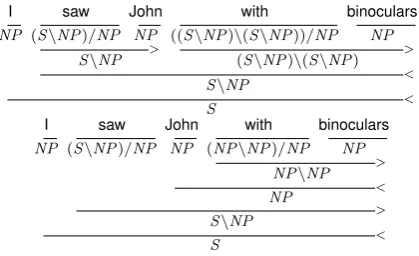
In CCG, each word is assigned a category which encodes sub-categorisation information. Categories may beatomic, such asN andS; orcomplex, such asNP/N for a word that requires anN to the right to produce an NP. Similarly, S\NP is an intran-sitive verb and produces a sentence when anNP is found to the left. Finally, a transitive verb receives (S\NP)/NP as it consumes an NP on the right, producing a verb phrase. Figure 1 shows two exam-ples of CCG derivations with lexical categories as-signed to each word. Both examples also provide the wordsawwith the(S\NP)/NPcategory.
Lexicalised grammars typically have a small set of rules (thecombinatory rulesin CCG) and instead rely on categories that describe a word’s syntactic role in a sentence. In Figure 1, the wordwith con-tains two separate categories indicating whether it modifiessaw(first example) orJohn(second exam-ple). In a highly lexicalised grammar, a parser may need to explore a large search space of categories in order to select the correct category for each word.
Bangalore and Joshi (1999) proposed supertag-ging, where each word is assigned a reduced set of categories by a sequence tagger, rather than all of the categories previously seen with that word. Our supertags areCCGcategories, and so are much more detailed than POS tags. By limiting the number of supertags for each word, there is a massive reduc-tion in the number of derivareduc-tions. The effectiveness of supertagging (Clark and Curran, 2004) demon-strates the influence of lexical ambiguity on parsing complexity for lexicalised grammars.
Hockenmaier and Steedman (2007) developed CCGbank, a semi-automated conversion of the Penn Treebank (Marcus et al., 1993) to the CCG formal-ism. A number of statistical parsers (Hockenmaier and Steedman, 2002; Clark et al., 2002) have been created forCCGparsing using CCGbank.
2.1 TheC&CParser
Clark and Curran (2007) describe the three stages of the high-performance C&C CCG parser. First, the
I saw John with binoculars NP (S\NP)/NP NP ((S\NP)\(S\NP))/NP NP
I saw John with binoculars NP (S\NP)/NP NP (NP\NP)/NP NP
Figure 1: TwoCCGderivations with PP ambiguity.
supertagger provides each word with a set of likely categories, reducing the search space considerably. Second, the parser combines the categories, using the CKYchart-parsing algorithm andCCG’s combi-natory rules, to produce all derivations that can be constructed with the given categories. Finally, the decoder finds the best derivation from amongst the spanning analyses in the chart.
TheC&Cparser uses a maximum-entropy model to score each derivation, using a wide range of fea-tures defined over local sub-trees in the derivation, including the head words and theirPOStags, the lo-cal categories, and word-word dependencies. We use the default normal-form mode with the deriva-tions decoder (Clark and Curran, 2007) and a maxi-mum of 1,000,000 categories in the chart.
Clark and Curran (2004) describe the role of su-pertagging in the C&C parser and its impact on parser speed. The supertagger initially assigns as few supertags as possible per word. If the parser is unable to provide a spanning analysis, the parser re-quests more supertags for each word. By restricting the number of supertags considered, this provides substantial pruning at the lexical level. Recent work by Kummerfeld et al. (2010) has shown that by train-ing the supertagger on parser output, the parser’s speed can be substantially increased whilst achiev-ing the same accuracy as the baseline system. This exploits the idea that the only supertags the parser needs are those used by the highest-scoring deriva-tion, reducing the search space even more than tra-ditional supertagging.
∅ NP (S\NP)/NP NP ((S\NP)\(S\NP))/NP NP
S\NP (NP\NP)/NP (S\NP)\(S\NP)
S S\NP
S
I saw John with binoculars
PRP VBD NNP IN NNS
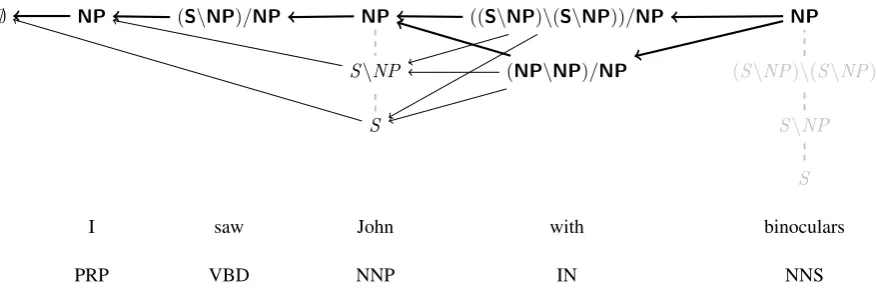
Figure 2: A graph-structured stack (GSS) representing an incomplete parse of the sentences found in Figure 1. The nodes and lines in bold were provided by the supertagger, whilst the non-bold nodes and lines have been created during parsing. The light gray lines represent what reduce operation created that lexical category.
3
Shift-Reduce Parsing
In its deterministic form, a shift-reduce parser per-forms a single left-to-right scan of the input sen-tence, selecting one or more actions at each step. The current state of the parser is stored in a stack, where the partial derivation is stored and the pars-ing operations are performed. For the actions, either weshift the current word onto the stack or reduce the top two (or more) items at the top of the stack (Aho and Ullman, 1972). As the scoring model can be defined over actions, this can allow for highly efficient parsing through greedy search (Sagae and Lavie, 2005). This has made shift-reduce parsing popular for high-speed dependency parsers (Yamada and Matsumoto, 2003; Nivre and Scholz, 2004).
Unfortunately, a deterministic shift-reduce parser cannot handle ambiguity because it only considers a single derivation. A simple extension is to elim-inate determinism and perform a best-first search, backtracking if the parser reaches a dead end. This backtracking leads to duplicate construction of sub-structures and complete exploration is exponential in the worst case. Beam search has been used to han-dle this exponential explosion by discarding a large portion of the search space.
In Zhang and Clark (2011), a direct comparison is made between their shift-reduceCCG parser and the chart-based C&C parser. As CCG allows for a limited number of unary rules, specifically type-changing and type-raising, Zhang and Clark extend
the shift-reduce algorithm to consider unary actions. In order to handle the exponential search space, their parser performs beam search, only keeping the top 16 scoring states. Whilst this approximate search may potentially lose the best scoring parse, they achieve competitive accuracies compared to the
C&Cchart parser.
3.1 Advantages of Semi-Incremental Parsing
Shift-reduce parsing allows for fully incremental parsing that does not require the full sentence. Whilst theC&Cparser could be modified to perform in this fashion,POStagging and supertagging accu-racy would likely decrease, leading to lower overall parsing accuracy as mistakes propagate up the pars-ing pipeline.
3.2 Graph-Structured Stack
Back-tracking shift-reduce parsers are worst case exponential, preventing a full exploration of the search space. A graph-structured stack (GSS) is a general structure that allows for the efficient han-dling of non-determinism in shift-reduce parsing (Tomita, 1988). TheGSSallows for polynomial time non-deterministic shift-reduce parsing and has been shown to be highly effective for dependency pars-ing (Huang and Sagae, 2010). The use of GSS al-lows for the incremental construction of the parse tree without being forced to discard large segments of the search space.
Here we will show an example of using aGSSto augment shift-reduce parsing and then show how it can be applied toCCGparsing. In the example gram-mar below, all three reduction rules are possible on the given stack. By performing backtracking and pursuing all possible reductions, shift-reduce pars-ing becomes worst-case exponential as previous re-sults must be re-computed.
∅ A B C D E
Reduction Rules
F ← D E
G ← D E
H ← C D E
TheGSS solves this by storing multiple possible derivations in a single structure. Note that all pos-sible rules have been applied and are now stored in the GSS. These reduce operations are also non-destructive, leaving the original structure from the above figure in place. Thus, theGSScan store mul-tiple possible derivations. Note that there is only a single bottom node,∅, representing an empty stack.
F
G
∅ A B C D E
H
When a new node is pushed onto the stack, we combine it with the heads of all of the existing stacks
stored in theGSS. This means that only a single shift action is necessary for the GSS instead of one for each possible derivation.
F
G
∅ A B C D E I
H
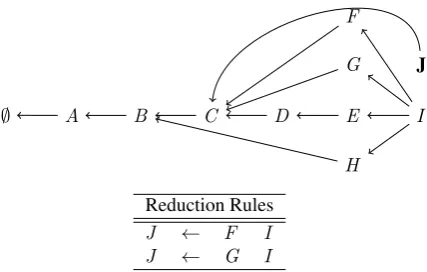
Finally, to prevent an exponential explosion due to local ambiguity, we check if a new partial deriva-tion is equivalent to any existing partial derivaderiva-tions. If it is, we keep track of the ways the given node can be generated and then merge them into a single node. This is referred to as local ambiguity packing by Tomita (1988) and allows shift-reduce parsing to be performed in polynomial time. In the example below, the new reduction rules result in two newJ
nodes. These two nodes are merged to form a single node as they are equivalent.
F
G J
∅ A B C D E I
H
Reduction Rules
J ← F I
J ← G I
When parsing an n word sentence, there are n possible stages in theGSS. We refer to these stages asfrontiers, with thekthfrontier containing all
par-tial derivations that contain a total span ofk. InCKY
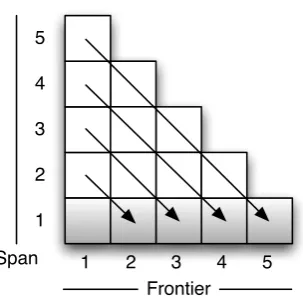
chart terms, a frontier can be considered as repre-senting all cells on the diagonal from the top left to the bottom right, as seen in Figure 3.
Figure 2 represents an incomplete sentence processed using a GSS-based shift-reduce CCG
parser. The frontier for the word with con-tains two heads, ((S\NP)\(S\NP))/NP and
1 2 3 4 5 2
3 4 5
1
Frontier Span
Figure 3: An illustration of the relation between the chart inCKYand the graph-structured stack inSR
wordbinocularsis shifted on to theGSS, it connects to both of the previous heads. As the category for the word binocularsis anNP, we can then reduce the stack by applying combinatory rules from CCG to both of the heads found in the previous frontier. In light gray, we show the full derivation for “John with binoculars”.
During the parsing process, we start with an empty GSS. During the shift step, we add all the
possibleCCGcategories provided by the supertagger for thekthword to the GSSand connect each
cate-gory to all of the head categories on theGSS. Next,
we attempt all possiblereduceoperations on the par-tial derivations in the current frontier. InCCG shift-reduce parsing, these shift-reduce operations are theCCG combinatory rules. If a reduction is possible, we cre-ate a new top partial derivation from the result and place it in thekthfrontier.
4
Frontier Pruning
The purpose of frontier pruning is to cut down the search space of the parser by only considering par-tial derivations that are likely to be in the highest-scoring derivation. Like adaptive supertagging, it exploits the idea that the only partial derivations the parser needs to generate are those used by the highest-scoring derivation. The model is trained us-ing the parser’s initial unpruned output and aims to distinguish between partial derivations that are necessary and those that are not. By eliminating a large number of those unnecessary partial
deriva-tions, parsing ambiguity is significantly decreased. This approach is similar to beam search as frontier pruning removes partial derivations once it is likely they will not be used in the highest-scoring deriva-tion. Beam search prunes nodes that are below a multiple (β) of the highest-scoring node in the fron-tier. For certain instances, such asn-best re-ranking, beam search would be preferred as derivations with-out the highest score are still useful in the parsing process. For one best parsing, however, the parser may waste time generating these additional deriva-tions when it could be known in advanced that they will not be used. This could occur during attach-ment ambiguity where, although the parser is guar-anteed to select one attachment, the other attachment may be constructed as it is valid and still competitive when considered by beam search’s criteria.
5
Experiments
The only modifications are to the core parsing al-gorithm, which involves replacing CKY with SR, and to the parsing process via pruning. As the de-coder and base models used for selecting the best-scoring derivation remain unchanged, any improve-ments seen are from an improved parsing process.
TheC&Ccode base has been optimised forCKY parsing and we have made only limited attempts to optimise specifically for the shift-reduce approach. Due to this, the speed of theSRparser is 34% slower
than theCKYparser. As the frontier pruning is im-plemented on the SRparser, all speeds will be
rela-tive to the SRbaseline. For the frontier pruning SR
parser to be competitive with theCKYparser, a speed improvement of 34% or more must be achieved.
5.1 Training and Processing
We train a binary averaged perceptron model (Collins, 2002) on parser output generated by theSR C&Cparser using the standard parsing model. Once the base parser has successfully processed a sen-tence, all partial derivations that lead to the highest-scoring derivation are marked. For each partial derivation in theGSS, the perceptron model attempts
to classify whether it was part of the marked set. If the classification is incorrect, the perceptron model updates the weights appropriately.
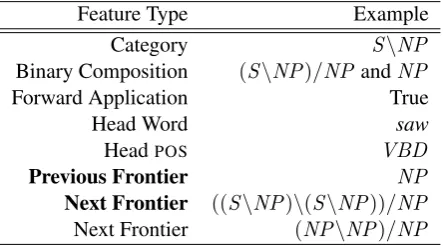
fron-Feature Type Example Category S\NP Binary Composition (S\NP)/NPandNP Forward Application True
Head Word saw
HeadPOS VBD
Previous Frontier NP
Next Frontier ((S\NP)\(S\NP))/NP Next Frontier (NP\NP)/NP
Table 1: Example features extracted fromS\NP in the third frontier of Figure 2. For the frontier features, bold represents the highest-scoring feature selected for contri-bution to the classification decision.
tier is developed. For each partial derivation, the per-ceptron model classifies whether the partial tion is likely to be used in the highest-scoring deriva-tion. If not, the partial derivation is removed from the frontier, eliminating any paths that the partial derivation would have generated. Perfect frontier pruning would allow only a single derivation, specif-ically the highest-scoring one, to develop.
5.2 Model Features
For frontier pruning to be effective, the model must be able to accurately distinguish between partial derivations that will be used in the highest-scoring derivation and those that shall not. As the features of theC&Cparser dictate the highest-scoring deriva-tion, the features used for frontier pruning have been chosen to be similar. For a full description of the features used in theC&Cparser, refer to Clark and Curran (2007).
Each partial derivation is given a base set of fea-tures derived from the current category. The initial features include a NULL which all categories re-ceive, theCCG category itself and whether the cat-egory was assigned by the supertagger. There are also features that encode rule instantiation, includ-ing whether the category was created by type rais-ing, a lexical rule, or anyCCGcombinatory rule. If the category was created by aCCGcombinatory rule, the type of rule (such as forward/backward applica-tion and so on) is included as a feature.
Features representing the past decisions the parser has made are also included. Note thatcurrent
rep-resents the current category andleft/rightis the cur-rent category’s left or right child respectively. For unary categories, a tuple of [current,current→left] is included as a feature. For binary categories, a tu-ple of [current→left, current, current→right] is in-cluded. If a category is a leaf, then two features [cur-rent, word] and [cur[cur-rent,POS] are included. Features representing the root category of the partial deriva-tion are also included, encoding the category head’s word andPOStag.
Finally, additional features are added that repre-sent the possible future parsing decisions. This is achieved by adding information about the remain-ing partial derivations on the stack (the past fron-tier) and the future incoming partial derivations (the next frontier). These do not exist in theC&Cparser and are only possible due to the implementation of the GSS. For each category in the previous fron-tier, a feature is added of the type [previous, cur-rent]. For the next frontier, which is only composed of supertags at this point, the feature is [current, next]. These features allow the pruning classifier to determine whether the current category is likely to be active in any other reductions in future parsing work. As we only want to score the optimal path us-ing the previous and next features, only the highest weighted of these features are selected. The rest of the previous and next features are discarded and do not contribute to the classification.
An example of this can be seen in Table 1, where the features for the partial derivation ofS\NP are enumerated.
These features differ to the traditional features used by shift-reduce parsers due to the addition of the GSS. As traditional shift-reduce parsing only considers a single derivation at a time, it is trivial to include history further back than the current cat-egory’s previous frontier. AsGSS-based shift-reduce parsing encodes an exponential number of states, however, the overhead of unpacking these states into a feature representation is substantial. Our ap-proximation of selecting the highest weighted previ-ous and next frontier features approximates the non-deterministic shift-reduce solution.
5.3 Improving Marked Set Recall
derivation is small. If a single CCG category from the marked set is pruned accidentally, the accuracy may be negatively impacted. The loss of a single category may even mean it is impossible to form a spanning analysis.
To prevent this loss of accuracy and coverage, the recall of the marked set needs to be improved. This can be achieved by biasing the binary perceptron al-gorithm towards a certain class, trading precision for recall. Traditionally, a binary perceptron classifier returns true ifw·x > 0, else false, withw being a vector of weights for each feature andxbeing a bi-nary vector indicating whether a feature was active.
By providing a manual biasλ,w·x > λ, we can bias the classifier towards a class. The value of λ modifies the perceptron threshold level, allowing us to improve the recall of the marked set by lowering the precision. The value forλis obtained manually through the use of a development set.
Identifying the optimal threshold value is impor-tant. Too high a recall value would prevent pruning any parts of the parse tree whilst too low a threshold reverts back to traditional unpruned parsing. Due to the overheads involved in the frontier pruning pro-cess, ineffective frontier pruning may also be slower than traditional parsing, especially for an optimised parser such as theC&Cparser. This value is deter-mined experimentally using a development dataset.
5.4 Balancing Pruning Features and Speed
For frontier pruning to produce a speed gain, enough of the search space must be pruned in order to com-pensate for the additional computational overhead of the pruning step itself. This is a challenge as the
C&Cparser is written inC++with a focus on effi-ciency and already features substantial lexical prun-ing due to the use of supertaggprun-ing.
For this reason, there were instances where ex-pressive features needed to be traded for simpler fea-tures in the frontier pruning process. Whilst these simpler features may not prune as effectively, they take far less time to compute and result in higher speed gains than complex features with a further re-duced search space. The complexity of the frontier pruning features may be dictated by the speed of the core parser itself, with more expressive features be-ing possible if the core parser is slower.
The implementation of these features also had
to focus on efficiency. To decrease the stress and improve memory locality of the hash table storing the feature weights, only a subset of features were stored. This feature subset was obtained from the gold standard training data as it contains far less am-biguity than the same training data which uses lexi-cal categories supplied by the supertagger.
Hash tables were used for storing the relevant fea-ture weights. Simple hash based feafea-ture representa-tion were used for associating features with weights to reduce the complexity of equivalence checking. The hash values of features that were to be reused were also cached to prevent recalculation, substan-tially decreasing the computational overhead of fea-ture calculation.
6
Evaluation
Our experiments are performed using CCGbank which was split into three subsets for training (Sec-tions 02-21), development (Section 00), and the final evaluation (Section 23). The performance is mea-sured in terms of sentence coverage, accuracy and parsing time. The accuracy is computed as F-score over the extracted labeled and unlabeled CCG de-pendencies found in CCGbank. All unmarked ex-periments use gold standardPOStags whilst experi-ments markedAutouse automatically assignedPOS tags using theC&CPOStagger.
7
Results
7.1 Training the Frontier Pruning Algorithm
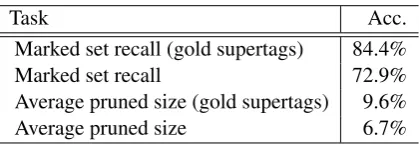
To establish bounds on the potential search space re-duction, the size of the marked set compared to the total tree size was tracked over all sentences in the training data. This represents the size of the tree af-ter optimal pruning occurs. Two figures are pre-sented, one with gold supertags and the other with supertags supplied by the C&C supertagger. Gold represents the reduction in search space possible when only the correct CCG categories are used to parse the sentence. In contrast, theC&C supertag-ger may apply multiple CCGcategories to improve supertagging accuracy, resulting in higher ambigu-ity and greater potential search space reductions.
Task Acc. Marked set recall (gold supertags) 84.4%
Marked set recall 72.9%
Average pruned size (gold supertags) 9.6%
Average pruned size 6.7%
Table 2: Recall of the marked set from the frontier prun-ing algorithm across all trees and the size of the pruned tree compared to the original tree.
This places an upper-bound on the potential speed improvement the parser may see due to aggressive frontier pruning.
The recall of the marked set was low for both gold supertags and automatically assigned supertags. This suggests the need for a modified perceptron threshold level in order to increase the recall of the marked set.
7.2 Tuning the Perceptron Threshold Level
Tuning the perceptron threshold level, as described in the previous section, has an important impact on frontier pruning. If the baseline parser cannot form a spanning analysis with the supertags initially sup-plied by the supertagger, it requests more supertags. Aggressive frontier pruning may counter-intuitively result in a slower parser as the parser spends more time attempting to unsuccessfully parse the sentence with an increasingly large number of supertags. By tuning the perceptron threshold level we can prevent potential slow-downs caused by aggressive pruning. To optimise the threshold level, experiments were performed on the development portion of CCGbank, Section 00. The results are shown in Table 3. De-creasing the perceptron thresholds level (λ) is shown to decrease the speed of the parser substantially without increasing the accuracy. For extremely low values ofλ, frontier pruning will keep partial deriva-tions previously discarded as the perceptron classi-fier becomes biased towards recall. For a sufficiently low value, the accuracy would reach the same levels as theCKYandSRC&Cparsers, but the speed would be far too slow due to the computational overhead of frontier pruning added to the small reduction in the search space. More work on fine-tuning the feature representation and allowing for more expressive fea-tures in a faster manner will be required.
Model Coverage lf. uf. Speed (%) (%) (%) (sents/sec)
CKYC&C 99.01 86.37 92.56 55.6
SRC&C 98.90 86.35 92.44 48.6 FPλ= 0 99.01 86.11 92.25 61.1 FPλ=−1 99.06 86.16 92.23 56.4 FPλ=−2 99.01 86.13 92.19 53.9 FPλ=−3 99.06 86.15 92.21 49.0
CKYC&C Auto 98.90 84.30 91.26 56.2 SRC&C Auto 98.85 84.27 91.10 47.5 FPλ= 0Auto 98.80 84.09 90.97 60.0
Table 3: Comparison to baseline parsers and analysis of the impact of threshold levels on frontier pruning (FP). The perceptron threshold level is referred to asλ. All results are against the development dataset, Section 00 of CCGbank, which contains 1,913 sentences.
Forλ= 0, however, frontier pruning increases the parser’s speed by 25.7% compared to the baseline GSS-based SR parser on which the frontier pruning operates. There is also a small 9.8% speed increase compared to the CKY baseline parser. The F-score for both labeled and unlabeled dependencies is neg-atively impacted though.
7.3 Speed Improvements during Evaluation
Table 4 reports the impact frontier pruning has on speed compared to the baseline CKY and SR C&C parsers. Frontier pruning has improved the speed of theGSS-basedSRC&Cparser by 39%, an improve-ment over the speed increase seen during evaluation. Longer sentences seem to have a higher impact on the speed of the frontier pruning algorithm due to the increased computational complexity of feature gen-eration. This indicates that implementing a form of beam search on top of this may be beneficial, keep-ing on the top k scoring states in a frontier. Cur-rently all partial derivations that are greater than the perceptron threshold levelλare kept.
8
Discussion and future work
Model Coverage lf. uf. Speed (%) (%) (%) (sents/sec)
CKYC&C 99.34 86.79 92.50 96.3 SRC&C 99.58 86.78 92.41 71.3 FPλ= 0 99.38 86.51 92.25 95.4 CKYC&C Auto 99.25 84.59 91.20 82.0 SRC&C Auto 99.50 84.53 91.09 61.2 FPλ= 0Auto 99.29 84.29 90.88 84.9
Table 4: Final evaluation on Section 23 of CCGbank for the top performing models from Table 3, containing 2,407 sentences.
More work needs to be done on reducing the number of computationally intensive feature look-ups and calculations. Even when using the gold-standard subset of the features, the feature look-up process accounts for the majority of the slow-down that the frontier pruning algorithm causes.
TheC&Ccode has been highly optimised to suit
CKY parsing. It should be possible to improve
the GSS parser to be directly competitive with the
CKYimplementation. The frontier pruning provides
speed increases for theGSSparser, allowing it to be
competitive with the originalCKY parser, but with
an improvedGSSparser, we could expect further
im-provements over the originalCKYparser.
Finally, we are still using the separate maximum entropy model and decoder to find the best
deriva-tion. If we add more features to the perceptron
model, it may be possible to use it for frontier prun-ing and findprun-ing the best derivation.
9
Conclusion
We present a shift-reduce CCG parser that can
explore all possible analyses in polynomial time
through the use of a graph-structured stack (GSS).
Whilst this parser is 34% slower than theCKYparser
on which it is based, it can parse 60 sentences per second whilst exploring the full search space. We
show that by performing frontier pruning on theGSS
and reducing this search space, the speed of theGSS
parser can be improved by 39% whilst only incur-ring a small accuracy penalty. This allows for shift-reduce parsing to attain speeds directly competitive with theCKYparser, whilst allowing all the potential
advantages of a semi-incremental parser.
We have also shown that whilst pruning is
occur-ring at the lexical level due to supertagging, substan-tial speed-ups are still possible by performing prun-ing durprun-ing the parsprun-ing process itself. This has also illustrated the difficulty in balancing expressive fea-tures and feature calculations overhead that frontier pruning needs to achieve.
Our approach uses the output of the originalC&C parser as training data, and so we can use any amount of parser output to train the system. This self-training has been shown to be highly effective in adaptive supertagging for increasing parser speed (Kummerfeld et al., 2010). The final result will be
a substantially faster wide-coverageCCGparser that
can be used for large-scaleNLPapplications.
Acknowledgements
This work was supported by the Capital Markets Co-operative Research Centre, an Australian Research Council Discovery grant DP1097291 and a Univer-sity of Sydney Honours Scholarship. We thank the anonymous reviewers for their insightful feedback.
References
Alred V. Aho and Jeffrey D. Ullman. 1972. The The-ory of Parsing, Translation, and Compiling. Volume I: Parsing. Prentice-Hall.
Srinivas Bangalore and Aravind K. Joshi. 1999. Su-pertagging: An Approach to Almost Parsing. Com-putational Linguistics, 25(2):237–265.
Ming-Wei Chang, Quang Do, and Dan Roth. 2006. Mul-tilingual Dependency Parsing: A Pipeline Approach. In Nicolas Nicolov, editor,Recent Advances in Natu-ral Language Processing.
Eugene Charniak and Mark Johnson. 2005. Coarse-to-Fine n-Best Parsing and MaxEnt Discriminative Reranking. InProceedings of the 43rd Annual Meet-ing of the Association for Computational LMeet-inguis- Linguis-tics (ACL-05), pages 173–180, Ann Arbor, Michigan, USA, June.
Stephen Clark and James R. Curran. 2004. The Impor-tance of Supertagging for Wide-CoverageCCG Pars-ing. In Proceedings of the 20th International Con-ference on Computational Linguistics (COLING-04), pages 282–288, Geneva, Switzerland, August. Stephen Clark and James R. Curran. 2007.
Stephen Clark, Julia Hockenmaier, and Mark Steedman. 2002. Building Deep Dependency Structures using a Wide-CoverageCCG Parser. InProceedings of the 40th Annual Meeting of the Association for Computa-tional Linguistics (ACL-02), pages 327–334, Philadel-phia, Pennsylvania, USA, July.
Michael Collins. 2002. Discriminative Training Meth-ods for Hidden Markov Models: Theory and Experi-ments with Perceptron Algorithms. InProceedings of the 2002 Conference on Empirical Methods in Natural Language Processing (EMNLP-03), pages 1–8. Tim Dawborn and James R. Curran. 2009. CCGparsing
with one syntactic structure per n-gram. In Proceed-ings of the Australasian Language Technology Associ-ation Workshop 2009 (ALTA-09), pages 71–79, Syd-ney, Australia, December.
Bojan Djordjevic. 2006. Efficient Combinatory Cate-gorial Grammar Parsing. InProceedings of the 2006 Australasian Language Technology Workshop (ALTW-06), pages 3–10, Sydney, Australia, December. Julia Hockenmaier and Mark Steedman. 2002.
Gen-erative Models for Statistical Parsing with Combina-tory Categorial Grammar. InProceedings of the 40th Annual Meeting of the Association for Computational Linguistics (ACL-02), pages 335–342, Philadelphia, PA.
Julia Hockenmaier and Mark Steedman. 2007. CCG-bank: A Corpus ofCCGDerivations and Dependency Structures Extracted from the Penn Treebank. Com-putational Linguistics, 33(3):355–396.
Liang Huang and Kenji Sagae. 2010. Dynamic program-ming for linear-time incremental parsing. In Proceed-ings of the 48th Annual Meeting of the Association for Computational Linguistics (ACL-10), pages 1077– 1086, Uppsala, Sweden, July.
Tadao Kasami. 1965. An efficient recognition and syntax analysis algorithm for context-free languages. Techni-cal Report AFCRL-65-758, Air Force Cambridge Re-search Laboratory, Bedford, MA.
Dan Klein and Christopher D. Manning. 2003. A* Pars-ing: Fast Exact Viterbi Parse Selection. In Proceed-ings of the Human Language Technology Conference and the North American Association for Computa-tional Linguistics (HLT-NAACL-03), volume 3, pages 119–126.
Jonathan K. Kummerfeld, Jessika Roesner, Tim Daw-born, James Haggerty, James R. Curran, and Stephen Clark. 2010. Faster Parsing by Supertagger Adapta-tion. InProceedings of the 48th Annual Meeting of the Association for Computational Linguistics (ACL-10), pages 345–355, Uppsala, Sweden, July.
Mitchell P. Marcus, Beatrice Santorini, and Mary Ann Marcinkiewicz. 1993. Building a Large Annotated
Corpus of English: The Penn Treebank. Computa-tional Linguistics, 19(2):313–330.
Stephen Merity. 2011. Integrated Tagging and Pruning via Shift-ReduceCCG Parsing. Honours Thesis, The University of Sydney, Sydney, Australia.
Joakim Nivre and Mario Scholz. 2004. Determinis-tic Dependency Parsing of English Text. In Proceed-ings of the 18nd International Conference on Com-putational Linguistics (COLING-04), pages 64–70, Geneva, Switzerland, August.
Adam Pauls and Dan Klein. 2009. K-Best A* Pars-ing. InProceedings of the Joint Conference of the 47th Annual Meeting of the ACL and the 4th International Joint Conference on Natural Language Processing of the AFNLP, pages 958–966, Singapore, August. Brian Roark and Kristy Hollingshead. 2009. Linear
Complexity Context-Free Parsing Pipelines via Chart Constraints. InProceedings of 2009 Human Language Technology Conference of the North American Chap-ter of the Association for Computational Linguistics (HLT/NAACL-09), pages 647–655, Boulder, Colorado, June.
Kenji Sagae and Alon Lavie. 2005. A Classifier-Based Parser with Linear Run-Time Complexity. In Pro-ceedings of the Ninth International Workshop on Pars-ing Technology (IWPT-05), pages 125–132, Vancou-ver, British Columbia, Canada, October.
Mark Steedman. 2000. The Syntactic Process. MIT Press, Cambridge, Massachusetts, USA.
Masaru Tomita. 1988. Graph-structured Stack and Nat-ural Language Parsing. In Proceedings of the 26th Annual Meeting of the Association for Computational Linguistics, pages 249–257, Buffalo, New York, USA, June.
Hiroyasu Yamada and Yuji Matsumoto. 2003. Statis-tical Dependency Analysis with Support Vector Ma-chines. Proceedings of International Conference on Parsing Technologies (IWPT-03), pages 195–206. Daniel H. Younger. 1967. Recognition and Parsing of
Context-Free Languages in Timen3.Information and Control, 10(2):189–208, February.
Yue Zhang and Stephen Clark. 2011. Shift-ReduceCCG Parsing. In Proceedings of the 49th Annual Meet-ing of the Association for Computational LMeet-inguistics: Human Language Technologies (ACL-11:HLT), pages 683–692, Portland, Oregon, USA, June.