1
Robust H
∞Synchronization of a hyper-chaotic system
with disturbance input
Bo Wang a,b, Peng Shi c,d *
a School of Electrical and Information Engineering, Xihua University, Chengdu, 610096, China b School of Applied Mathematics, University Electronic Science and Technology of China, Chengdu 610054, China
c School of Engineering and Science, Victoria University, Melbourne, Vic 8001, Australia d School of Electrical and Electronic Engineering, The University of Adelaide, Adelaide, SA 5005, Australia e Department of Engineering, Faculty of Engineering and Science, University of Agder, N-4898, Grimstad, Norway
f School of Automation, Chongqing University, Chongqing, 400044, China
Abstract
, Hamid Reza Karimi e, Yongduan Song f, Jun Wang a
This paper concerns the robust control problems on the synchronization of a hyper-chaotic system with disturbance input. Using an appropriate Lyapunov function, we design the multi-dimensional and the single-dimensional robust H∞ synchronization controllers in terms of linear matrix inequalities for the application in practical engineering. Corresponding theoretical derivations are given subsequently. Finally, some numerical simulations are provided to demonstrate the effectiveness of the proposed techniques.
Keywords: hyper-chaotic; synchronization; H∞ performance, Lyapunov function.
1. Introduction
Chaos synchronization has powerful application in chemical reactions, power converters,
biological systems, information processing, secure communications, etc. During the last decade,
many techniques for handling chaos synchronization have been studied [1-11]. In [4], through
separation between linear and nonlinear terms of the chaotic system, an adaptive synchronous
controller for a general class of non-autonomous chaotic systems is proposed. In [5], based on
delayed feedback control and intermittent linear state delayed feedback control, the
synchronization problem on non-autonomous chaotic systems is discussed. In [6], an adaptive
controller with parameter update laws is designed to realize the projective synchronization of
two different chaotic systems. In [7], based on the time-domain approach, the tracking
synchronization control method is proposed for the uncertain Genesio-Tesi chaotic systems with
dead zone nonlinearity. In [8], the projective synchronization problem for different fractional
order chaotic systems is investigated. In [9], some adaptive control schemes are developed to
anti-synchronize two chaotic complex systems. However, in practical control systems,
2
disturbance inputs exist widely, which make the real control problem much more complicated.
H∞ theory is an efficient approach to handle such problem and has received increasing attentions
in recent years, corresponding research outcomes can be seen in [12-31] and references therein.
In this paper, an H∞ method will be introduced to solve the robust synchronization control
problem for a hyper-chaotic system with disturbance input.
Hyper-chaotic systems, characterized as a chaotic attractor with more than one positive
Lyapunov exponents, can generate much more complicated dynamics. Therefore, the relative
research, especially for new one, is an interesting and challenging issue. In [32], a new
hyper-chaotic system is introduced, and the dynamical equation is described by
1 1 2 1 1
2 1 2 3
3 2 2 4
4 3 3 5
5 4 4 5 5
( ( ))
[ ]
[ ]
[ ]
z r z z g z
z z z z
z r z z
z r z z
z r z r z
= − −
= − +
= − −
= − +
= −
(1)
with
1 1
1 1
( )[ 1 1 ]
( )
2
a b z z
g z =bz + − + − −
where zi, 1, 2,i= , 5 is the system state variable, and ri >0, 1, 2,i= , 5 is the system
parameter.
Such chaotic system has two positive Lyapunov exponents when a= −1.27,b= −0.68,
1 10, 2 14, 3 0.2, 4 20, 5 0.03
r = r = r = r = r = , and will produce the complicated dynamics. Unfortunately,
to our knowledge, such system is not paid much attention and corresponding investigations are
seldom found so far. This motivates our research.
In this paper, we will study the robust synchronization control problem on the hyper-chaotic
system (1) with disturbance input, corresponding theoretical derivations will be presented to
support the results obtained. Finally some simulation examples will be included to validate the
effectiveness of our synchronization methods.
Notations used in this paper are fairly standard. Let n
R be the n-dimensional Euclidean space,
n m
R× denotes the set of n m× real matrix, the symbol * represents the symmetric part in a
matrix, I represents an identity matrix with appropriate dimensions, the superscript T stands for
matrix transposition, and diag{...} represents a block diagonal matrix. ⋅2 refers to the
Euclidean vector norm or the induced matrix 2-norm. By A>0 we mean that A is a real
3
2. System description and preliminaries
First, based on the hyper-chaotic system (1), we construct the following master-slave systems
1 1 2 1 1
2 1 2 3
3 2 2 4
4 3 3 5
5 5 4 4 5
( ) ( ( ) ( ) ( ( ))) ( ) ( ) ( ) ( ) ( ) [ ( ) ( )] ( ) [ ( ) ( )] ( ) [ ( ) ( )]
x t r x t x t g x t
x t x t x t x t
x t r x t x t
x t r x t x t
x t r x t r x t
= − − = − + = − − = − + = − (2) and
1 1 2 1 1 1 1
2 1 2 3 2 2
3 2 2 4 3 3
4 3 3 5 4 4
5 5 4 4 5 5 5
( ) ( ( ) ( ) ( ( ))) ( ) ( )
( ) ( ) ( ) ( ) ( ) ( )
( ) [ ( ) ( )] ( ) ( )
( ) [ ( ) ( )] ( ) ( )
( ) [ ( ) ( )] ( ) ( )
y t r y t y t g y t w t u t
y t y t y t y t w t u t
y t r y t y t w t u t
y t r y t y t w t u t
y t r y t r y t w t u t
= − − + + = − + + + = − − + + = − + + + = − + + (3)
where ( ) ( ( ),1 2( ), 3( ), 4( ), 5( ))
T
x t = x t x t x t x t x t
and
( ) ( ( ),1 2( ), 3( ), 4( ), 5( ))T
y t = y t y t y t y t y t
are
the state vectors of the master and slave systems, respectively, ( ) ( ( ),1 2( ), 3( ), 4( ), 5( ))T
u t = u t u t u t u t u t is the
multiple-dimensional synchronization controller, ( ) ( 1( ), 2( ), 3( ), 4( ), 5( ))
T
W t = w t w t w t w t w t is the
disturbance input.
Define the synchronization error vector of the master-slave systems (2) and (3) as
E t( )=y t( )−x t( ) (4)
where ( ) ( ( ),1 2( ), 3( ), 4( ), 5( ))
T
E t = e t e t e t e t e t .
Then the error dynamics can be expressed by
1 1 2 1 1 1 1
2 1 2 3 2 2
3 2 2 4 3 3
4 3 3 5 4 4
5 5 4 4 5 5 5
( ) ( ( ) ( ) ( ) ( )) ( ) ( )
( ) ( ) ( ) ( ) ( ) ( )
( ) [ ( ) ( )] ( ) ( )
( ) [ ( ) ( )] ( ) ( )
( ) [ ( ) ( )] ( ) ( )
e t r e t e t M t e t w t u t
e t e t e t e t w t u t
e t r e t e t w t u t
e t r e t e t w t u t
e t r e t r e t w t u t
= − − + + = − + + + = − − + + = − + + + = − + + (5)
where a≤M t( )≤b.
In this paper, the following lemmas and definition are concerned
Lemma 1 [33]. If f t( )∈L∞∩L2 andf t( )∈L∞, we have
lim ( ) 0
4
Lemma 2 [34]. Given any real vectors D and E with appropriate dimensions, and any positive
scalar k>0, the following inequality holds
1
T T T T
DE E D kDD E E
k
+ ≤ + (7)
Definition 1: Under the assumption of zero initial condition, the systems (3) can synchronize to
system (2) with an H∞ norm bound γ, if there exists a scalar γ >0 such that
2 2
( ) ( )
E t ≤γ w t (8)
for any nonzero w t( )∈L t2[ , ]0 ∞
3. Main Results
In this section, based on Lyapunov method and LMI technique, the following theoretical results
are proposed.
Theorem 1. If there exist scalars γ >0, Ki >0,i=1, 2,, 5, we design an H∞ synchronization
law with the following control regulation
( ) T ( )
u t = −K E t (9)
with
1 2 3 4 5
{ , , , , }
K=diag k k k k k
1 1 1
2 1
2 2
2 2
3 3
2 2 3
4 4
2 5 3
5 5 4 5
(1 ) 4,
( 1) 3, 16 (1 )
4, 16
( )
4, 16
( )
16
k K r a
r
k K
r
k K
r r
k K
r r
k K r r
= − + +
+
= + +
−
= + +
−
= + +
−
= + −
(10)
2 0
*
I K I
I
γ −
<
−
(11)
then, system (3) with any initial conditions can synchronize to system (2) with H∞ norm
bound γ .
Proof. Choose the following Lyapunov function candidate
2 2 2 2 2
1 2 3 4 5
1
( ) ( ( ) ( ) ( ) ( ) ( ))
2
5
The time derivative of V t( ) along trajectories of error model (5) is
1 1 2 2 3 3 4 4 5 5
1 1 2 1 1 1 1 1
2 1 2 3 2 2 2
3 2 2 4 3 3
( ) ( ) ( ) ( ) ( ) ( ) ( ) ( ) ( ) ( ) ( )
( )[ ( ( ) ( ) ( )) ( ) ( )]
( )[ ( ) ( ) ( ) ( ) ( )]
( )[ ( ( ) ( ))
V t e t e t e t e t e t e t e t e t e t e t
e t r e t e t Me t k e t w t
e t e t e t e t k e t w t
e t r e t e t k e
= + + + + = − − − + + − + − + + − − − 3
4 3 3 5 4 4 4
5 5 4 4 5 5 5 5
2 2 2
1 1 1 1 2 2 2 2 2 3 3 3
2 3
( ) ( )]
( )[ ( ( ) ( )) ( ) ( )]
( )[ ( ( ) ( )) ( ) ( )]
(1 ) ( ) ( 1) ( ) ( ) (1 ) ( ) (1 ) ( ) ( ) ( )
( )
t w t
e t r e t e t k e t w t
e t r e t r e t k e t w t
r M e t r e t e t k e t r e t e t k e t
r r e
+
+ − + − +
+ − − +
= − + + + − + + − −
+ − 2 2
3 4 4 4 5 3 4 5 5 4 5 5
2
2 1 2 2 1 2
1 1 1 1 2 2
2
2 2
2 3 2
1 3 3 3
( ) ( ) ( ) ( ) ( ) ( ) ( ) ( ) ( ) ( )
( 1) ( ) ( 1)
[ (1 ) 4 ] ( ) [2 ( ) ] [ 3 ] ( )
4 16
(1 ) ( ) (1 )
[2 ( ) ] [ 4 ] ( ) [2 ( )
4 16
T
t e t k e t r r e t e t k r r e t W t E t
r e t r
r M k e t e t k e t
r e t r
e t k e t e t
− + − − + +
+ +
≤ − + − + − − − − − +
− −
− − − − − + − − 2 3 4 2
2
2 2
2 3 5 3 5
4 4 4
2
2 5 3
4 5 5 5
( ) ( )
] 4
( ) ( ) ( )
[ 4 ] ( ) [2 ( ) ]
16 4
( )
[ ] ( ) ( ) ( ) 16
T
r r e t
r r r r e t
k e t e t
r r
r r k e t W t E t
−
− −
− − − + − −
−
− − + + + (13)
From the conditions (10), we have
V t( )= −ET( )t KE t ( )+WT( ) ( )t E t (14)
Consider the following H∞ performance index
0 0 2 2 0 [ ( ) ( ) ( ) ( )] [ ( ) ( ) ( ) ( ) ( )] ( ) ( ) T T
t T T
t
t T T
T
t dt
J E t E t W t W t dt
E t E t W t W t V t V t V t
γ
γ
= −
= − + + −
∫
∫
(15)For V t( )0 =0 and V t( )T ≥0, we have
0 0 2 [ ( ) ( ) ( ) ( ) ( )] ( ) ( ) T T t T T t t T t
J E t E t W t W t V t dt
t t dt
γ η η ≤ − + = Ω
∫
∫
(16) where( )t [E t WT( ), T( )]t T
η =
2 *
I K I
I γ − Ω = −
Consider LMI (11), we haveJ≤0 for any nonzero W t( )∈L t2[ , ]0 ∞ . According to Definition 1,
6
Next, we design a single-dimension H∞ synchronization controller. Constructing the following
master-slave systems
1 1 2 1 1
2 1 2 3
3 2 2 4
4 3 3 5
5 4 4 5 5
( ) ( ( ) ( ) ( ( ))) ( ) ( ) ( ) ( ) ( ) [ ( ) ( )] ( ) [ ( ) ( )] ( ) [ ( ) ( )]
x t r x t x t g x t
x t x t x t x t
x t r x t x t
x t r x t x t
x t r x t r x t
= − − = − + = − − = − + = − (17) and
1 1 2 1 1
2 1 2 3
3 2 2 4
4 3 3 5
5 4 4 5 5
( ) ( ( ) ( ) ( ( ))) ( ) ( ) ( ) ( ) ( ) ( )
( ) [ ( ) ( )] ( ) [ ( ) ( )] ( ) [ ( ) ( )]
y t r y t y t g y t w t u t
y t y t y t y t
y t r y t y t
y t r y t y t
y t r y t r y t
= − − + + = − + = − − = − + = − (18)
where x ti( ) and y ti( ), 1, 2,i= ,5
are
the state variables of the master and slave systems, respectively, u(t) is the single-dimension synchronization controller, and w(t) is the disturbanceinput.
Then we can get the following error dynamical system model
1 1 2 1 1
2 1 2 3
3 2 2 4
4 3 3 5
5 4 4 5 5
( ) ( ( ) ( ) ( ) ( )) ( ) ( ) ( ) ( ) ( ) ( )
( ) [ ( ) ( )] ( ) [ ( ) ( )] ( ) [ ( ) ( )]
e t r e t e t M t e t w t u t
e t e t e t e t
e t r e t e t
e t r e t e t
e t r e t r e t
= − − + + = − + = − − = − + = − (19)
where a≤M t( )≤b.
Based on Lyapunov method and LMI technique, the following theoretical result can be
concluded.
Theorem 2. If there exist scalars γ >0, n>0, and ε >0, we design an H∞ synchronization
law with the following control regulation
1
( ) ( )
u t = − ⋅L e t (20)
with
1
1
( 1 )
L r a
n ε
7 1 5 2 1 1
1 0 0
2
0 1 0 0
0
0 0 0
1 0 0 2 r n r r ε γ − − + < − − (22)
then, system (18) with any initial conditions can synchronize to system (17) with H∞ norm
bound γ .
Proof. Choose the following Lyapunov function candidate
2 2 2 2 2
1 2 3 4 5
1 2 3 4
1 1 1 1 1
( ) ( ) ( ) ( ) ( ) ( )
2 2 2 2 2
V t e t e t e t e t e t
r r r r
= + + + + (23)
The time derivative of V t( ) along trajectories of error model (19) is given by
1 1 2 2 3 3 4 4 5 5
1 2 3 4
1 2 1 1 1
1 1
2 1 2 3
3 2 4
1 1 1 1
( ) ( ) ( ) ( ) ( ) ( ) ( ) ( ) ( ) ( ) ( ) 1 ( )[ ( ) ( ) ( ) ( ) ( ) ( )] ( )[ ( ) ( ) ( )] ( )[ ( ) ( )]
V t e t e t e t e t e t e t e t e t e t e t
r r r r
L
e t e t e t M t e t e t w t
r r
e t e t e t e t
e t e t e t
= + + + +
= − − − +
+ − +
− −
4 3 5
5 4 5 5
2 2 2
1 2 1 2 5 5 1
1 1
2 2 2
1 2 5 5 1
1 1
( )[ ( ) ( )]
( )[ ( ) ( )]
1
( )[1 ( ) ] ( ) 2 ( ) ( ) ( ) ( ) ( )
1 1
( )[1 ( ) ] (1 ) ( ) ( ) ( ) ( )
e t e t e t
e t e t r e t
L
e t M t e t e t e t r e t w t e t
r r
L
e t M t n e t r e t w t e t
r n r
− +
+ −
= − + + − + − +
≤ − + + − − − − +
(24)
Consider condition (21), we have
1
1
1
( ) T( ) ( ) ( ) ( )
V t E t KE t w t e t
r
≤ − +
(25)
where
5
{ ,1 , } 0
K=diag ε −n r ≥
1 2 5
[ ( ), ( ), ( )]T
E= e t e t e t
8 0 0 2 2 1 2 2 1 0 [ ( ) ( ) ( )] [ ( ) ( ) ( ) ( )] ( ) ( ) T T t T t t T T t dt
J e t w t w t dt
e t w t w t V t V t V t
γ
γ
= −
= − + + −
∫
∫
(26)For V t( )0 =0 and V t( )T ≥0, we have
0 0 2 2 1 [ ( ) ( ) ( ) ( )] ( ) ( ) T T t T t t T t
J e t w t w t V t dt
t t dt
γ η η ≤ − + = Ω
∫
∫
(27) where( )t [ET( ),t w tT( )]T
η = 1 5 2 1 1
1 0 0
2
0 1 0 0
0 0 0
1 0 0 2 r n r r ε γ − − + Ω = − −
Consider LMI (22), we haveJ≤0 for any nonzeroW t( )∈L t2[ , ]0 ∞ . According to Definition 1,
the proof of theorem 2 is thus completed.
Remark 1. r ii, =1, 2,, 5 are the system parameters of the hyper-chaotic system. From the
proof of Theorem 2 we can see, through constructing Lyapunov function (23) with ri based on
the characteristic of the hyper-chaotic system, chaos synchronization is achieved via a
single-dimensional controller u t( )= − ⋅L e t1( ), which is only suitable for this system.
4. Example and simulation
In this section, we include some examples to validate the effectiveness of our chaotic
synchronization method. The numerical simulation is with step size 0.001 second and the
following initial parameters
x0=[0.7557 0.0957 -0.2801 0.0164 0.1498]T
y0 =[1.1306 -0.0411 -0.1034 -0.0354 -0.4042]T
γ =0.2
( ) 2 cos(2 ) sin( 1) t 20 s 0 else
t
i
e t
w t t
≥
= +
9
First, we consider the multi-dimension synchronization law in (9). Based on Theorem 1, we get
{
}
diag 8.7028,12.5653,16.5653,17.9053,25.9053
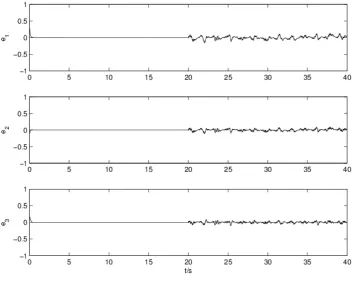
K= . The numerical simulation result can be seen
in Fig 3.
Next, we consider the single-dimension synchronization law in (20). Based on Theorem 2, we
get L=14.7076. The numerical simulation result can be seen in Fig. 4.
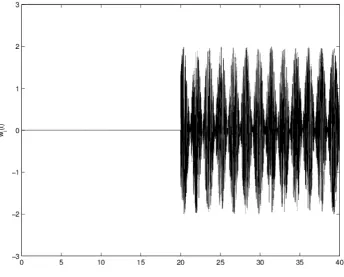
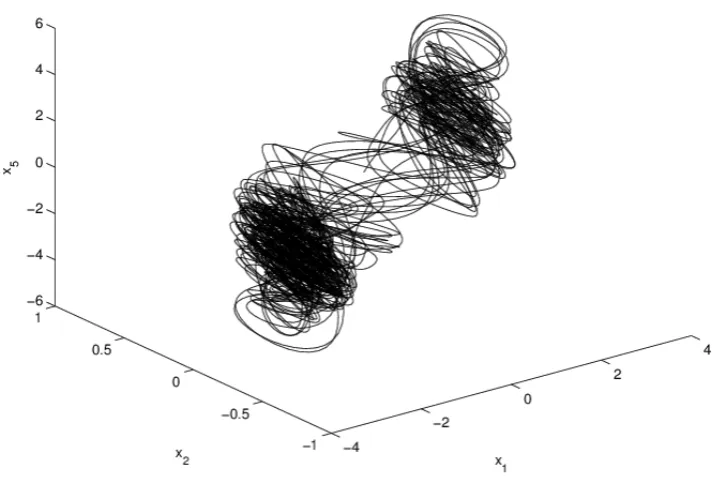
Remark 2. Fig. 1 depicts the time response of system disturbance input. Fig. 2 depicts the
attractor of the hyper-chaotic system. It can be seen the hyper-chaotic system (1) possesses
complicated dynamics. Figs. 3 and 4 depict the time response of synchronization error variables
of master-slave systems based on our H∝ synchronization laws. At the first stage there is no
disturbance input, we can see the slave system achieves following the master system during 10
seconds. Later the disturbance is added at the 20th second, we can see the synchronization error
variables jitter in a small range, which satisfy the given H∞ performance index. Compared to
multi-dimensional H∞ synchronization controller, the single-dimensional H∞ synchronization
controller has the simpler structure due to the requirement only for one system state variable. In
numerical simulation, we notice that the multi-dimensional H∞ synchronization controller has
the better control performance at the cost of complicated structure with much more system state
information, which may cause the generating of the new disturbances and will make a
difference to the synchronization control. Therefore, both synchronization methods are
meaningful and can be utilized in accordance with the practical requirements.
5. Conclusion
In this paper, we have studied the robust control problems for the synchronization of
hyper-chaotic systems with disturbance input. Based on Lyapunov method, we have designed
the multi-dimensional and the single-dimensional H∞ robust synchronization controllers in
terms of linear matrix inequalities for the application in practical engineering. Corresponding
theoretical derivations were also presented. Finally, some numerical simulations were carried
out to illustrate the effectiveness of the proposed techniques.
Acknowledgements
The authors would like to thank the editor and reviewers for their constructive comments and
suggestions which have greatly helped improve the presentation of the paper. This work was
partially supported by the Key projects of Xihua University (Z1120946), the National Key
Basic Research Program, China (2012CB215202), the 111 Project (B12018), and the National
10 Reference
[1] H. Fujisaka, T. Yamada, Stability theory of synchronized motion in coupled-oscillator systems,
Progress of theoretical physics, 69 (1983) 32–47.
[2] L. Pecora, T. Carroll, Synchronization in chaotic systems, Phys Rev Lett, 64 (1990) 821–824.
[3] B. Wang, P. Shi, H.R. Karimi, J. Wang, H∞ robust controller design for the synchronization of
master-slave chaotic systems with disturbance input, Modeling, Identification and Control, 33 (2012)
27-34.
[4] Z. Ye, C. Deng, Adaptive synchronization to a general non-autonomous chaotic system and its
applications, Nonlinear Analysis: Real World Applications, 13 (2012) 840-849.
[5] T. Botmart, P. Niamsup, X. Liu, Synchronization of non-autonomous chaotic systems with
time-varying delay via delayed feedback control, Communications in Nonlinear Science and Numerical
Simulation, 17 (2012) 1894-1907.
[6] Y. Yu, H. Li, Adaptive generalized function projective synchronization of uncertain chaotic systems,
Nonlinear Analysis: Real World Applications, 11 (2010) 2456-2464.
[7] Y. Sun, Chaos synchronization of uncertain Genesio-Tesi chaotic systems with dead zone nonlinearity,
Physics Letters A, 373 (2009) 3273-3276.
[8] G. Si, Z. Sun, Y. Zhang, W. Chen, Projective synchronization of different fractional-order chaotic
systems with non-identical, Nonlinear Analysis: Real World Applications, 13 (2012) 1761-1771.
[9] S. Liu, P. Liu, Adaptive anti-synchronization of chaotic complex nonlinear systems with unknown
parameters, Nonlinear Analysis: Real World Applications, 12 (2011) 3046-3055.
[10] H.R. Karimi, P. Maass, Delay-range-dependent exponential synchronization of a class of delayed
neural networks, Chaos, Solitons and Fractals, 41 (2009) 1125-1135.
[11] H.R. Karimi, Robust synchronization and fault detection of uncertain master-slave systems with
mixed time-varying delays and nonlinear perturbations, Int. J. of Control Automation and Systems, 9
(2011) 671-680.
[12] H.R. Karimi, A sliding mode approach to H∞ synchronization of master-slave time-delay systems
with Markovian jumping parameters and nonlinear uncertainties, Journal of the Franklin Institute, 349,
(2012) 1480-1496.
[13] H.R. Karimi, H. Gao, Mixed H 2/ H∞ output-feedback control of second-order neutral systems with
time-varying state and input delays, ISA Transactions, 47 (2008) 311-324.
[14] D. Wang, P. Shi, J. Wang, W. Wang, Delay-dependent exponential H∝ filtering for discrete-time
switched delay systems, Int. J. of Robust and Nonlinear Control, 22 (2012) 1522–1536.
[15] J. Lian, Z. Feng, P. Shi, Robust H ∞ filtering for a class of uncertain stochastic hybrid neutral systems
with time-varying delay, Int. J. of Adaptive Control and Signal Processing, early view, (2012).
[16] D. Wang, W. Wang, P. Shi, Exponential H∞ filtering for switched linear systems with interval
time-varying delay, Int. J. Robust and Nonlinear Control, 19 (2009) 532–551.
[17] L. Hou, G. Zong, Y. Wu, H∞ finite-time control for switched delay systems via dynamic output
feedback, International Journal of Innovative Computing, Information and Control, 8 (2012) 4901-4913.
[18]H∞ sliding mode control for a class of uncertain switched
delay systems, International Journal of Systems Science, 40 (2009) 855-866.
11
random delays and packet dropouts, IEEE Trans on Automatic Control, 56 (2011) 2655-2660.
[20] M. Basin, P. Shi, Central suboptimal H∞ filtering for nonlinear polynomial systems with
multiplicative noise, J. of Franklin Institute, 347 (2010) 1740-1754.
[21] L. Zhang, P. Shi, E. Boukas, C. Wang, H∞ model reduction for switched linear discrete-time systems
with polytopic uncertainties, Automatica, 44 (2008) 2944-2949.
[22] L. Zhang, P. Shi, Stability, L2-Gain and asynchronous H∞ control of discrete-time switched systems
with average dwell time, IEEE Trans on Automatic Control, 54, (2009) 2193-2200.
[23] Z. Wu, P. Shi, H. Su, J. Chu, Reliable H∞ control for discrete-time fuzzy systems with
infinite-distributed delay, IEEE Trans on Fuzzy Systems, 20 (2012) 22-31.
[24] H. Gao, W. Sun, P. Shi, Robust sampled-data H∞ control for vehicle active suspension systems,
IEEE Trans on Control Systems Technology, 18 (2011) 238-245.
[25] G. Wang, Y. Liu, C. Wen, W. Chen, Delay-dependent Stability criterion and H∞ state-feedback
control for uncertain discrete-time switched systems with time-varying delays, International Journal of
Innovative Computing, Information and Control, 7 (2011) 2473-2484.
[26] H. Karimi, N. Luo, M. Zapateiro, L. Zhang, H ∞ control design for building structures under seismic
motion with wireless communication, International Journal of Innovative Computing, Information and
Control, 7 (2011) 5269-5284.
[27] P. Shi, X. Luan, F. Liu, H ∞ filtering for discrete-time systems with stochastic incomplete
measurement and mixed delays, IEEE Trans on Industrial Electronics, 59 (2012) 2732-2739.
[28] Z. Wu, P. Shi, H. Su, J. Chu, Reliable H ∞ control for discrete-time fuzzy systems with
infinite-distributed delay, IEEE Trans on Fuzzy Systems, 20 (2012) 22-31.
[29] C. Hsu, C. Chiu, J. Tsai, Master-slave chaos synchronization using an adaptive dynamic
sliding-mode neural control system, International Journal of Innovative Computing, Information and
Control, 8 (2012) 121-138.
[30] T. Lin, K. Hsu, A new adaptive H∞ control for chaos synchronization between two different chaotic
systems, International Journal of Innovative Computing, Information and Control, 8 (2012) 701-714.
[31] D. Chen, P. Shi, X. Ma, Control and synchronization of chaos in an induction motor system,
International Journal of Innovative Computing, Information and Control, 8 (2012) 7237-7248.
[32] L. Hao, J. Liu, R. Wang, Analysis of a fifth-order hyperchaotic circuit, IEEE Int. Workshop VLSl
Design & Video Tech, China, May, (2005) 28-30.
[33] K. Narendra, A. Annaswamy, Stable adaptive systems, Prentice-Hall, Englewood Cliffs, (1989).
[34] S. Boyd, L. El Ghaoui, E. Feron, V. Balakrishnan, Linear matrix inequalities in systems and control
12
13
14
15