
Electromagnetic physics vectorization in the GeantV
trans-port framework
Guilherme Amadio1, Ananya1, John Apostolakis1, Marilena Bandieramonte1,2,∗, S. P.
Behera3, Abhijit Bhattacharyya3, Rene Brun1, Philippe Canal4, Federico Carminati1,
GabrieleCosmo1,VitaljiDrohan1,Victor DanielElvira4,KrzysztofGenser4,AndreiGheata1,
MihaelaGheata1,5,IliasGoulas1,FarahHariri1,VladimirIvanchenko1,6,Gul RukKhattak1,
DmitriKonstantinov1,HarpoolKumawat3,Jose GuilhermeLima4,JesusMartinez Castro8,
PereMato1,PatriciaMendez1,AldoMiranda Aguillar8,KatalinNikolics1,MihalyNovak1,
Elena Orlova1, Kevin Pedro3, Witold Pokorski1, Alberto Ribon1, Dmitry Savin1, Ryan
Schmitz1, Raman Sehgal3, OksanaShadura1,7, Shruti Sharan1, Sofia Vallecorsa1, Sandro
ChristianWenzel1, andSoonYung Jun4
1CERN, Meyrin 1211, Switzerland
2University of Pittsburgh, PA 15260, USA
3Bhabha Atomic Research Centre, Mumbai 400085, IN
4Fermi National Accelerator Lab, IL 60510, US
5Institute of Space Science, Magurele 077125, RO
6Tomsk State University, Tomsk 634050, Russia
7University of Nebraska, NE 68588, US
8Centro de Investigación en Computación, 07738 Gustavo A. Madero, Mexico
Abstract. The development of the GeantV Electromagnetic (EM) physics package has evolved following two necessary paths towards code moderniza-tion. A first phase required the revision of the main electromagnetic physics models and their implementation. The main objectives were to improve their ac-curacy, extend them to the new high-energy frontier posed by the Future Circu-lar Collider (FCC) programme and allow a better adaptation to a multi-particle flow. Most of the EM physics models in GeantV have been reviewed from theoretical perspective and rewritten with vector-friendly implementations, be-ing now available in scalar mode in the alpha release. The second phase con-sists of a thorough investigation on the possibility to vectorise the most CPU-intensive physics code parts, such as final state sampling. We have shown the feasibility of implementing electromagnetic physics models that take advantage of SIMD/SIMT architectures, thus obtaining gains in performance. After this phase, the time has come for the GeantV project to take a step forward towards the final proof of concept. This takes shape through the testing of the full sim-ulation chain (transport+physics+geometry) running in vectorized mode. In this paper we will present the first benchmark results obtained after vectorizing a full set of electromagnetic physics models.
1 Introduction
Large Hadron Collider (LHC) experiments rely heavily on Monte Carlo simulations of par-ticle transport and interaction with detector material. These simulations are among the most time consuming parts of the HEP software work-flow, since the simulated data-sets have to be accurate and extensive, and each simulation is computationally expensive. The increase in the integrated luminosity, expected in the next decade of the future LHC runs (HL-LHC), and the consequent increase in the amount of experimental data to be analyzed, implies the need to simulate larger and more accurate samples to avoid that the systematic errors due to the simulations will become dominant. The GeantV R&D activity [1, 2] is underway with the goal of speeding up the detector simulation by exploiting modern computing architecture platforms, in order to bring the HEP community a step forward towards accomplishing the goals posed by the compelling future physics programmes. The project investigates potential computational benefits of using a multiple track transportation approach instead of the classi-cal single particle transportation flow. This is done in order to improve code and data loclassi-cality in the process, and artificially enhance the data-level parallelism (DLP) of the simulation software enabling SIMD/SIMT execution models to combine the benefits of vectorization
and multithreaded approaches. In a typical HEP simulation, geometry and transportation take a significant portion of the total execution time. However, the execution time is usu-ally dominated by the physics components, and mainly by the electromagnetic physics. An important fraction of the simulations, in fact, is normally spent on the simulation of electro-magnetic showers inside calorimeters. Jets simulations, having electroelectro-magnetic components deriving from the decay of neutral pions, have also a significant weight in the total simula-tion time. While working on the performance, the GeantV project aims also at revising the physics models, in order to improve where possible their accuracy and extend their range of validity to the new high-energy frontier, that will be reached with the FCC programme. Most of the EM physics models in GeantV have been reviewed from a theoretical perspective and rewritten with vector-friendly implementations. The next step towards the final demonstra-tion of the performances obtainable from the GeantV prototype consists in the vectorizademonstra-tion of the electromagnetic physics models.
In this paper we present several benchmarks obtained from the vectorization of the main electromagnetic physics models. They have been tested by running the full simulation chain, i.e. transport, physics and geometry, and verifying the results in comparison with the corre-sponding Geant4 [3] simulations. This paper is organized as follows: Sect. 2 gives a generic introduction to vectorization with some additional consideration on what speedup factors can be reasonably expected when using SIMD registers. Sect. 3 gives an overview of the status of implementation of the electromagnetic physics library in GeantV. Sect. 4 describes what solutions have been designed and implemented to speed up the simulation physics code. Benchmark results are presented in Sect. 5. Lastly, Sect. 6 presents final conclusions.
2 Vectorization is good, when it happens
In recent years, the stall in the CPU frequency with the consequent advent of multi-core ar-chitectures, has led to an increasing need for performance and energy efficiency exploitation
1 Introduction
Large Hadron Collider (LHC) experiments rely heavily on Monte Carlo simulations of par-ticle transport and interaction with detector material. These simulations are among the most time consuming parts of the HEP software work-flow, since the simulated data-sets have to be accurate and extensive, and each simulation is computationally expensive. The increase in the integrated luminosity, expected in the next decade of the future LHC runs (HL-LHC), and the consequent increase in the amount of experimental data to be analyzed, implies the need to simulate larger and more accurate samples to avoid that the systematic errors due to the simulations will become dominant. The GeantV R&D activity [1, 2] is underway with the goal of speeding up the detector simulation by exploiting modern computing architecture platforms, in order to bring the HEP community a step forward towards accomplishing the goals posed by the compelling future physics programmes. The project investigates potential computational benefits of using a multiple track transportation approach instead of the classi-cal single particle transportation flow. This is done in order to improve code and data loclassi-cality in the process, and artificially enhance the data-level parallelism (DLP) of the simulation software enabling SIMD/SIMT execution models to combine the benefits of vectorization
and multithreaded approaches. In a typical HEP simulation, geometry and transportation take a significant portion of the total execution time. However, the execution time is usu-ally dominated by the physics components, and mainly by the electromagnetic physics. An important fraction of the simulations, in fact, is normally spent on the simulation of electro-magnetic showers inside calorimeters. Jets simulations, having electroelectro-magnetic components deriving from the decay of neutral pions, have also a significant weight in the total simula-tion time. While working on the performance, the GeantV project aims also at revising the physics models, in order to improve where possible their accuracy and extend their range of validity to the new high-energy frontier, that will be reached with the FCC programme. Most of the EM physics models in GeantV have been reviewed from a theoretical perspective and rewritten with vector-friendly implementations. The next step towards the final demonstra-tion of the performances obtainable from the GeantV prototype consists in the vectorizademonstra-tion of the electromagnetic physics models.
In this paper we present several benchmarks obtained from the vectorization of the main electromagnetic physics models. They have been tested by running the full simulation chain, i.e. transport, physics and geometry, and verifying the results in comparison with the corre-sponding Geant4 [3] simulations. This paper is organized as follows: Sect. 2 gives a generic introduction to vectorization with some additional consideration on what speedup factors can be reasonably expected when using SIMD registers. Sect. 3 gives an overview of the status of implementation of the electromagnetic physics library in GeantV. Sect. 4 describes what solutions have been designed and implemented to speed up the simulation physics code. Benchmark results are presented in Sect. 5. Lastly, Sect. 6 presents final conclusions.
2 Vectorization is good, when it happens
In recent years, the stall in the CPU frequency with the consequent advent of multi-core ar-chitectures, has led to an increasing need for performance and energy efficiency exploitation
in modern processors. This promoted a resurrected interest in the Single Instruction Multi-ple Data (SIMD) vector units. SIMD instruction set extensions are quite popular today and commonly available in most instruction sets of both high-performance and embedded mi-croprocessors. The major vendors support vector architectures and the trend goes towards increasingly wide and powerful vector units [4]. However, the real challenge is to use these instructions effectively, writing code that can truly take advantage of the ever increasing size
of the underlying vector registers [5]. Vectorization requires often not only to change the algorithmic structure but also to modify the data layout. Two solutions to exploit vector-ization are commonly used: the first is to implicitly achieve it with compiler-based auto-matic vectorization. The second is to explicitly enforce vectorization by using intrinsics: compiler-known functions that are built-in and can be directly expanded to machine instruc-tions. Auto-vectorization can typically be applied in two main categories of algorithms: one are loop-based algorithms [6] where the multiple iterations of a loop can be converted in a single vector iteration. The second one, the super-word level parallelism (SLP) [7], can be applied in more general cases as it is directed to straight-line code and operates on repeated sequences of scalar instructions outside a loop. However, compiler-based vectorization is often not powerful enough and has a limited scope of applicability. On the other hand, the use of intrinsics is complex and significantly decreases the readability and maintainability of the code, leading to platform-specific implementations, to the detriment of code portability. GeantV project implements an innovative approach to vectorization, based on the combined use of VecCore [8] and the concept of templated backends [9, 10]. VecCore is a wrapper library that provides an abstraction layer on top of existing SIMD libraries, such as Vc [11] and UME::SIMD [12], that facilitate users to write generic vectorized code. The use of tem-plated backends allows to write code that is generic and transparent to the platform-specific implementation details. Only at compilation time the code is specialized for a specific type of backend (scalar, SSE, AVX, AVX2...), allowing to enable vectorization while maintaining readability, maintainability and portability. This vectorization model is at the base of the suc-cess of the vectorized geometry library developed in the framework of the GeantV project, VecGeom [10], that is also integrated in the production version of Geant4 since release 10.2 and is being progressively adopted by the major LHC experiments. The same vectorization model is being applied to the EM physics library, focusing on computationally expensive physics calculations.
However, before discussing performance, it is fundamental to analyze and understand what speedup factors can be expected from vectorization, beyond the ideal value given by the vector width. In fact, benefits of vectorization are not always easy to exploit and the gain obtainable depends heavily on the algorithmic structure. Several are the factors that have to be taken into account. Functions with many math computations are likely to pro-duce high speed-up factors, while functions bounded by memory accesses are not the best use-case to vectorize. Branching plays also an important role in vectorization: functions with minimal branching are more suitable for vectorization, because conditional statements usually reduce the vector registers population and may require, in most cases, to evaluate both branches for vectorized code. Even in presence of math-bounded algorithms without any branching, the maximum speed-up achievable is generally less than the vector register width. Some vector operations are in fact slower than the corresponding scalar ones in some CPUs. Consider, as an example, the reciprocal throughput for double precision division in an IntelR SandyBridge. This operation takes 10−20 cycles to be executed in scalar mode
3 Electromagnetic physics modelling
As mentioned in the introduction, the ultimate goal of the GeantV R&D activity is to ex-ploit the possible computational benefits of applying vectorisation techniques on high energy physics (HEP) detector simulation codes. From physics modelling point of view, the most intensively used and computationally most demanding part of these simulations is the descrip-tion of electromagnetic (EM) interacdescrip-tions ofe−,e+andγparticles with matter. This is what
motivated the choice of selecting EM shower simulation in HEP applications to demonstrate the possible computational benefits of applying track level vectorisation on HEP detector simulation codes.
Geant4 provides a unique variety of EM physics models to describe particle interactions with matter from the eV to PeV energy range with different level of physics accuracy. Each
application areas can find a suitable set of models with the appropriate balance between the required accuracy of the physics description and the corresponding computational complex-ity. Moreover, Geant4 provides a pre-defined collection of EM physics models and processes for different application area in the form of EM physics constructors [13]. Among these the
so-called EMstandardphysics constructor (i.e. EM Opt0) is the one that is recommended by the developers for HEP detector simulations. The corresponding Geant4 EM physics pro-cesses and models are summarised in Table 1. (right) [13].
According to the goal of the project, this EMstandardphysics constructor served as a guide line for the GeantV EM physics development. The physics processes and the corre-sponding models implemented in the GeantV framework are also listed in Table 1. (left). As it can be seen, all the EM processes are available in the GeantV physics framework apart from coherent scattering of photons and energy loss fluctuation. The latter was decided not to be implemented since the development of an alternative model is under investigation, while coherent scattering of photons does not play a significant role in case of general HEP appli-cations. Moreover, all the physics processes are described by EM models based on exactly the same theoretical framework both in GeantV and Geant4 except the Coulomb scattering ofe−/e+for which the Goudsmit-Saunderson Geant4 model [14] was selected to be
imple-mented in GeantV. Nevertheless, all the GeantV models are available in Geant4 that makes possible the one-to-one comparison of the results. Furthermore, these differences do not
af-fect at all the final goal of the GeantV R&D activity and the GeantV physics list can provide reliable EM physics shower simulations in case of HEP applications.
The accuracy of each GeantV model implementation was carefully tested through indi-vidual model level tests by comparing both the computed final states as well as the inte-grated quantities (e.g. cross sections, stopping power) to those produced by the correspond-ing Geant4 version of the given model. Moreover, several simulation applications have been developed to test and verify the GeantV EM shower simulation accuracy including both a general, simplified sampling calorimeter and a complete CMS detector setups. In all cases, the GeantV simulation results (regarding quantities such as energy deposit distributions in a given part of the detector, number of charged and neutral particle steps, secondary particles, etc.) agreed to the corresponding Geant4 simulation results within the impressive 0.1 % dif-ference. This level of accuracy provided a solid and reliable starting point for thestandard
EM physics vectorisation. More about the implementation details of the EM models and their vectorisation will be given in the following sections.
4 Vectorization of the electromagnetic physics code
simula-3 Electromagnetic physics modelling
As mentioned in the introduction, the ultimate goal of the GeantV R&D activity is to ex-ploit the possible computational benefits of applying vectorisation techniques on high energy physics (HEP) detector simulation codes. From physics modelling point of view, the most intensively used and computationally most demanding part of these simulations is the descrip-tion of electromagnetic (EM) interacdescrip-tions ofe−,e+andγparticles with matter. This is what
motivated the choice of selecting EM shower simulation in HEP applications to demonstrate the possible computational benefits of applying track level vectorisation on HEP detector simulation codes.
Geant4 provides a unique variety of EM physics models to describe particle interactions with matter from the eV to PeV energy range with different level of physics accuracy. Each
application areas can find a suitable set of models with the appropriate balance between the required accuracy of the physics description and the corresponding computational complex-ity. Moreover, Geant4 provides a pre-defined collection of EM physics models and processes for different application area in the form of EM physics constructors [13]. Among these the
so-called EMstandardphysics constructor (i.e. EM Opt0) is the one that is recommended by the developers for HEP detector simulations. The corresponding Geant4 EM physics pro-cesses and models are summarised in Table 1. (right) [13].
According to the goal of the project, this EMstandardphysics constructor served as a guide line for the GeantV EM physics development. The physics processes and the corre-sponding models implemented in the GeantV framework are also listed in Table 1. (left). As it can be seen, all the EM processes are available in the GeantV physics framework apart from coherent scattering of photons and energy loss fluctuation. The latter was decided not to be implemented since the development of an alternative model is under investigation, while coherent scattering of photons does not play a significant role in case of general HEP appli-cations. Moreover, all the physics processes are described by EM models based on exactly the same theoretical framework both in GeantV and Geant4 except the Coulomb scattering ofe−/e+for which the Goudsmit-Saunderson Geant4 model [14] was selected to be
imple-mented in GeantV. Nevertheless, all the GeantV models are available in Geant4 that makes possible the one-to-one comparison of the results. Furthermore, these differences do not
af-fect at all the final goal of the GeantV R&D activity and the GeantV physics list can provide reliable EM physics shower simulations in case of HEP applications.
The accuracy of each GeantV model implementation was carefully tested through indi-vidual model level tests by comparing both the computed final states as well as the inte-grated quantities (e.g. cross sections, stopping power) to those produced by the correspond-ing Geant4 version of the given model. Moreover, several simulation applications have been developed to test and verify the GeantV EM shower simulation accuracy including both a general, simplified sampling calorimeter and a complete CMS detector setups. In all cases, the GeantV simulation results (regarding quantities such as energy deposit distributions in a given part of the detector, number of charged and neutral particle steps, secondary particles, etc.) agreed to the corresponding Geant4 simulation results within the impressive 0.1 % dif-ference. This level of accuracy provided a solid and reliable starting point for thestandard
EM physics vectorisation. More about the implementation details of the EM models and their vectorisation will be given in the following sections.
4 Vectorization of the electromagnetic physics code
Particle transport simulation codes solve the Boltzmann transport equation numerically by us-ing the Monte Carlo technique which determines the stochastic nature of the detector
simula-Electromagnetic physics description
particle processes GeantV model(s) Geant4
e−
ionisation Møller [100eV-100TeV] Møller [100eV-100TeV]
bremsstrahlung Tsai (Bethe-Heitler) w. LPM. [1GeV-100TeV]Seltzer-Berger [1keV-1GeV] Tsai (Bethe-Heitler) w. LPM. [1GeV-100TeV]Seltzer-Berger [1keV-1GeV]
Coulomb sc. GS MSC model [100eV-100TeV] WentzelVI mixed model [100MeV-100TeV]Urban MSC model [100eV-100MeV]
e+
ionisation Bhabha [100eV-100TeV] Bhabha [100eV-100TeV]
bremsstrahlung Tsai (Bethe-Heitler) w. LPM. [1GeV-100TeV]Seltzer-Berger [1keV-1GeV] Tsai (Bethe-Heitler) w. LPM. [1GeV-100TeV]Seltzer-Berger [1keV-1GeV]
Coulomb sc. GS MSC model [100eV-100TeV] WentzelVI mixed model [100MeV-100TeV]Urban MSC model [100eV-100MeV]
annihilation Heitler (2γ) [0-100TeV] Heitler (2γ) [0-100TeV]
γ
photoelectric Sauter-Gavrila+EPICS2014 [1eV-100TeV] Sauter-Gavrila+EPICS2014 [1eV-100TeV]
incoherent sc. Klein-Nishina+[100eV-100TeV] Klein-Nishina+[100eV-100TeV] e−e+pair production Bethe-Heitler+[100eV-80GeV] Bethe-Heitler+[100eV-80GeV]
Bethe-Heitler+w. LPM [80GeV-100TeV] Bethe-Heitler+w. LPM [80GeV-100TeV]
coherent sc. - Livermore
+ energy loss fluct. - Urban
Table 1: Electromagnetic physics modelling in the GeantV prototype (left) compared to the Geant4standard(Opt0) EM physics constructor [13] (right) .
tion algorithms. It implies generating samples of stochastic variables according to their prob-ability distributions determined by the underlying physics, conditional branches depending on the actual outcome of such stochastic variables and further nondeterministic components in each simulation step. As mentioned in Section 2, the stochastic nature and conditional branches do not make these algorithms straightforwardly vectorizable.
A simulation step, limited by a discrete physics interaction, can be divided into two dis-tinct parts from the physics modelling point of view: selecting the physics interaction with the corresponding interaction point and invoking the interaction itself. The former is driven by the integrated cross section values of the physics processes assigned to the given particle. In the EM physics modelling part, it practically means using cross section table lookups and interpolations, which are memory bounded operations with very little mathematical computa-tions that, according to Section 2, do not make this part suitable for vectorization. However, the second part, that includes the computation of the post-interaction kinematical state of the primary particle if any as well as the generation of possible secondary particles, usually contains significantly more mathematical operations which makes it more appropriate for vectorization. Therefore, the final state computation part of the EM physics models is the primary target for exploring vectorization benefits in the context of EM physics simulation.
The final state computation usually includes generation of stochastic variables such as energy transfer, scattering or ejection angles from their probability distributions determined by the corresponding differential (in energy, angle) cross sections (DCS) of the underlying
physics interaction. Since these probability density functions (PDF) are proportional to the DCS, which is usually a complex function of the primary particle, target material properties and very often available only in numerical form, the analytical inversion of corresponding cu-mulative distribution function (CDF) is unknown. Since analytical inverse transform method cannot be used, different numerical techniques need to be utilized to generate samples of
these stochastic variables according to their probability distributions.
vectorized over primary particle tracks, the exit condition is reached unpredictably for the different tracks filled into the vector register, resulting in undesired divergence and eventually
loss of potential computational gain. Therefore, composition-rejection algorithm is not very suitable for vectorization.
Alternative techniques, with perfectly deterministic behaviour, have been investigated and will be discussed shortly in Section 4.1. As it will be shown, using these table-based sampling methods can accompany with significant memory overhead, that can restrict their general applicability. Therefore, a solution to overcome the vectorization barrier posed by the nondeterministic exit condition of the rejection-based sampling algorithm will be discussed in Section 4.2.
4.1 Deterministic sampling algorithms: sampling tables
A frequently used deterministic algorithm to efficiently generate samples of discrete
stochas-tic variables is the alias method [15]. Since the stochasstochas-tic variables used in the final state computations are all continuous, this method cannot be applied directly on the correspond-ing PDFs. Instead, an intermediate discrete random variable is introduced by partitioncorrespond-ing the range of the original continuous variable into distinct intervals and defining the new dis-crete variable as the probability of having the original continuous variable lying in a given interval. The alias method can then be applied for fast, deterministic sampling of this new discrete variable. The outcome of this first step will determine one of the distinct intervals of the original continuous variable. A sample value of the original continuous random vari-able can be obtained by sampling from the corresponding continuous PDF over the selected interval. This can be done in a very efficient way by assuming linear behaviour of the PDF
over each discrete interval. This approximation can be always fulfilled by choosing an appro-priate partition of the original variable range and/or applying clever variable transformations
to transform the original PDF to a smooth function. The smoother the transformed PDF the better the linear approximation, which implies less intervals that directly translates to smaller memory requirement.
Another possibility to obtain deterministic sampling algorithm is the numerical inverse-transform of the CDF by using a higher order interpolation scheme based on a discrete set of numerical values of the CDF. Since the inverse-transform method starts with a uniformly distributed random sample, this solution will include a search to identify the corresponding CDF interval to be used in the interpolation. Unfortunately, the search algorithm terminates after nondeterministic number of steps depending on the actual value of the initial uniform random variable. However, this issue can be resolved by combining the numerical inverse-transform with and appropriate alias method for the fast, deterministic sampling of this CDF interval.
vectorized over primary particle tracks, the exit condition is reached unpredictably for the different tracks filled into the vector register, resulting in undesired divergence and eventually
loss of potential computational gain. Therefore, composition-rejection algorithm is not very suitable for vectorization.
Alternative techniques, with perfectly deterministic behaviour, have been investigated and will be discussed shortly in Section 4.1. As it will be shown, using these table-based sampling methods can accompany with significant memory overhead, that can restrict their general applicability. Therefore, a solution to overcome the vectorization barrier posed by the nondeterministic exit condition of the rejection-based sampling algorithm will be discussed in Section 4.2.
4.1 Deterministic sampling algorithms: sampling tables
A frequently used deterministic algorithm to efficiently generate samples of discrete
stochas-tic variables is the alias method [15]. Since the stochasstochas-tic variables used in the final state computations are all continuous, this method cannot be applied directly on the correspond-ing PDFs. Instead, an intermediate discrete random variable is introduced by partitioncorrespond-ing the range of the original continuous variable into distinct intervals and defining the new dis-crete variable as the probability of having the original continuous variable lying in a given interval. The alias method can then be applied for fast, deterministic sampling of this new discrete variable. The outcome of this first step will determine one of the distinct intervals of the original continuous variable. A sample value of the original continuous random vari-able can be obtained by sampling from the corresponding continuous PDF over the selected interval. This can be done in a very efficient way by assuming linear behaviour of the PDF
over each discrete interval. This approximation can be always fulfilled by choosing an appro-priate partition of the original variable range and/or applying clever variable transformations
to transform the original PDF to a smooth function. The smoother the transformed PDF the better the linear approximation, which implies less intervals that directly translates to smaller memory requirement.
Another possibility to obtain deterministic sampling algorithm is the numerical inverse-transform of the CDF by using a higher order interpolation scheme based on a discrete set of numerical values of the CDF. Since the inverse-transform method starts with a uniformly distributed random sample, this solution will include a search to identify the corresponding CDF interval to be used in the interpolation. Unfortunately, the search algorithm terminates after nondeterministic number of steps depending on the actual value of the initial uniform random variable. However, this issue can be resolved by combining the numerical inverse-transform with and appropriate alias method for the fast, deterministic sampling of this CDF interval.
In all above cases, the nondeterministic nature of the rejection-based sampling algorithm can be completely eliminated by employing these table-based alternative techniques making them more suitable for vectorization. Moreover, these sampling tables are prepared at initial-isation incorporating all the complexity of the underlying distributions then used at run-time for generating samples with very simple computations. In case of computationally complex or numerical DCSs this can result in significant reduction of the run-time computation of sam-pling compared to rejection since the latter requires the evaluation of these complex functions at each time (possibly more than once) whenever a sample needs to be produced. Vectoriza-tion of the table based sampling will enhance this computaVectoriza-tional gain even further in these cases. On the other hand, the computation is usually more determined by memory accesses in case of using such tables compared to the composition-rejection algorithm because the values
at different table indices need to be gathered into vector registers before making use of them.
This makes these sampling table based algorithms less ideal for vectorization.
The biggest disadvantage of using sample tables however is their memory requirement. An appropriate set of discrete samples from the approximated function (PDF or inverse CDF) need to be stored in these tables together with some additional parameter values for the fast sampling that can satisfy the corresponding approximation. Furthermore, the fact that all the dependences of the underlying probability distribution need to be incorporated in the sam-pling tables at initialisation time in order to obtain fully deterministic samsam-pling algorithm, indicates that multiple set of tables needs to be prepared when the corresponding DCS shows atomic number or material dependence. Moreover, the situation is even worse when alias method is involved in the sampling since the loss of monotonicity makes impossible to pro-duce samples of the original continuous variable lying within an arbitrary restricted interval. This makes necessary to build separate set of sampling tables whenever a simple restricted interval sampling would be appropriate e.g. incorporating secondary production threshold dependence. As a final consequence, different sets of sampling tables need to be prepared
very often as a function of the atomic number, material or material-secondary production threshold pairs available in the detector which can make these methods memory-consuming.
4.2 Making use of vectorization in case of composition-rejection
Rejection sampling is a widely used algorithm for generating random samples according to a given PDF. Its popularity lies in the fact that efficient algorithms i.e. with low rejection
rate can be relatively easily composed even in case of complex PDFs while the algorithms usually have negligible memory requirements. However, as it has already been mentioned, the nondeterministic number of sampling loop executions results in unpredictably reached termination condition for the different tracks filled into the vector register: this causes
un-desired divergence and eventually loss in the efficiency of employing the full width of the
vector register. A so-calledlane refillingalgorithm has been developed to overcome this is-sue. The algorithm makes sure that the full capacity of the available vector register is used in each rejection sampling loop iteration. It is achieved by replacing those track variables in the vector register for which the stochastic loop termination condition has been reached in the current iteration, with variables taken from untouched tracks while keeping for the next iteration those for which the sampling has not been completed yet. This algorithm ensures that the full width of vector register is exploited in each sampling loop iteration at the price of some data movements needed to refill the holes. It should be noted that a vectorized ran-dom number generator [16] is also necessary to be used in order to achieve the maximum performance gain offered by vectorization.
5 Performance results and discussion
Model level tests allow to execute specific components of the implemented EM physics mod-els, such as the final state generation part, without the need of the whole simulation frame-work. Such test has been developed for each EM model for testing and verifying the GeantV implementation against the corresponding Geant4 one, as well as thesampling tablebased final state generation against the one usingrejection. These model level tests also include the possibility to test and verify thevectorizedimplementations against thescalarversions. Speed-up factors, comparing thescalarimplementations of the different sampling techniques
0 1 2 3 4 5 6 7 8
KleinNishina MollerBhabha SeltzerBerger RelBrem BetheHeitler RelPair Pos2Gamma SauterGavrila
Spe
edU
p
ScalTable/VecTable ScalRej/VecRej ScalRej/VecTable
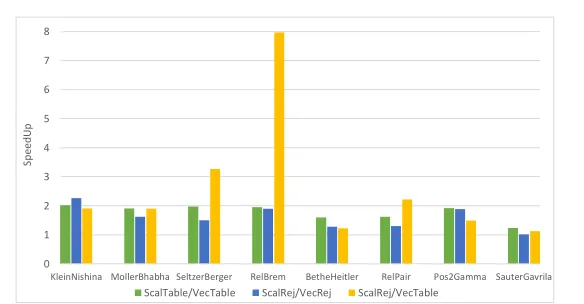
Figure 1: Speedup of the final state generation of different electromagnetic physics models
obtained with SIMD vectorization in case of different sampling algorithms. The results were
obtained by using Google Benchmarks [17] on an IntelRHaswell CoreTMi7-6700HQ, 2.6
GHz, with Vc backend and AVX2 instruction set processing 256 tracks.
In particular, green bars refer to thetable, the blue to therejectionbased sampling algo-rithms and they show the speed-up values obtained by thevectorizationof the corresponding codes in case of different EM physics models. Yellow bars show the combined,tablebased
sampling plusvectorization, gain compared to thescalar,rejectionbased implementations. Since the values behind the green and yellow bars share the same denominator, the relation of their heights indicate the speed difference between thescalarimplementations of thetable
andrejectionbased sampling algorithms. Similarly, since the blue and the yellow bars values share the same numerator, the relation of their heights shows the difference between the speed
achievable vectorizing thetableor therejectionbased sampling algorithm.
As it was expected after the discussion given in Section 4, a wide range of performance variation of the algorithms as well as their vectorization gain can be observed in Fig.1. This is due to the fact that each of the investigated EM physics model translates to a finale state sampling algorithm with unique computational characteristics that will be more favourable for one sampling technique compare to the other.
Taking for example the Klein-Nishina model [18, 19] for Compton scattering of photons, one can see that therejectionbased solution is faster than the samplingtablebased one since the green bar is higher than the yellow one. This is due to the fact that the computationally simple Klein-Nishina DCS makes possible the composition of a very efficientrejectionbased
final state generation with a very low rejection rate and computational complexity that cannot be beaten by the sampling tablebased version. On the contrary, the DCS (in total energy transferred to one of thee−/e+ pair) in case of the high-energy model fore−/e+pair
pro-duction [18, 20–22] (RelPair) is significantly more complex compared to the Klein-Nishina DCS for Compton scattering. This results in a computationally more demandingrejection
based final state generation compared to thetablebased one where all such complexities are handled at initialisation time as discussed in Section 4.1. Moreover, further advantage of us-ing samplus-ingtableover the composition-rejectioncan be observed in case of the high-energy bremsstrahlung model (RelBrem), where the computationally expensive nature of the DCS comes together with a higher rejection rate due to the inclusion of the LPM suppression effect
-0 1 2 3 4 5 6 7 8
KleinNishina MollerBhabha SeltzerBerger RelBrem BetheHeitler RelPair Pos2Gamma SauterGavrila
Spe
edU
p
ScalTable/VecTable ScalRej/VecRej ScalRej/VecTable
Figure 1: Speedup of the final state generation of different electromagnetic physics models
obtained with SIMD vectorization in case of different sampling algorithms. The results were
obtained by using Google Benchmarks [17] on an IntelRHaswell CoreTM i7-6700HQ, 2.6
GHz, with Vc backend and AVX2 instruction set processing 256 tracks.
In particular, green bars refer to thetable, the blue to therejectionbased sampling algo-rithms and they show the speed-up values obtained by thevectorizationof the corresponding codes in case of different EM physics models. Yellow bars show the combined,tablebased
sampling plusvectorization, gain compared to thescalar,rejectionbased implementations. Since the values behind the green and yellow bars share the same denominator, the relation of their heights indicate the speed difference between thescalarimplementations of thetable
andrejectionbased sampling algorithms. Similarly, since the blue and the yellow bars values share the same numerator, the relation of their heights shows the difference between the speed
achievable vectorizing thetableor therejectionbased sampling algorithm.
As it was expected after the discussion given in Section 4, a wide range of performance variation of the algorithms as well as their vectorization gain can be observed in Fig.1. This is due to the fact that each of the investigated EM physics model translates to a finale state sampling algorithm with unique computational characteristics that will be more favourable for one sampling technique compare to the other.
Taking for example the Klein-Nishina model [18, 19] for Compton scattering of photons, one can see that therejectionbased solution is faster than the samplingtablebased one since the green bar is higher than the yellow one. This is due to the fact that the computationally simple Klein-Nishina DCS makes possible the composition of a very efficientrejectionbased
final state generation with a very low rejection rate and computational complexity that cannot be beaten by the sampling tablebased version. On the contrary, the DCS (in total energy transferred to one of thee−/e+ pair) in case of the high-energy model fore−/e+ pair
pro-duction [18, 20–22] (RelPair) is significantly more complex compared to the Klein-Nishina DCS for Compton scattering. This results in a computationally more demandingrejection
based final state generation compared to thetablebased one where all such complexities are handled at initialisation time as discussed in Section 4.1. Moreover, further advantage of us-ing samplus-ingtableover the composition-rejectioncan be observed in case of the high-energy bremsstrahlung model (RelBrem), where the computationally expensive nature of the DCS comes together with a higher rejection rate due to the inclusion of the LPM suppression effect
[18, 21, 22]. This makes therejectionbased algorithm significantly (∼4×) slower compared to the samplingtable based one. This gain further enhanced up to 8.4 thanks to the effi
-cient vectorization of the samplingtablebased algorithm. In general, the combined effects
of choosing the appropriate sampling algorithm and its vectorization for a given EM physics model provides a speedup factor of 1.8-3.
The final state generation algorithm of some EM models follows different computational
paths depending on some external conditions. For example, some corrections are computed only above a given primary particle energy but not below; or selecting a target atom for the interaction is necessary only in case of materials with multiple elements. These directly trans-late to particular computing paths with different computational complexities favouring one or
the other sampling technique within the same model. This is demonstrated in Fig.2, where the benchmark results are shown for the high energye−/e+pair production model (RelPair)
under different primary energy and target material (Pb or PbWO4) conditions. One can see
that the observable speed-up for therejectionbased sampling depends on these conditions. At the same time, thetablebased sampling algorithms do not depend on these conditions, as it was discussed in Section 4.1., showing a constant speedup factor.
While the samplingtablebased final state generations have a constant runtime under any external conditions, the efficiency of a givenrejectionalgorithm can change significantly with
the primary particle energy. This is illustrated in Fig. 3 where the relative speed of applying these two techniques in case of the Bethe-Heitlere−/e+ pair production model [18, 23] is
shown as a function of the primaryγparticle energy. It can be seen that the two algorithms perform similarly at lower primaryγparticle energies while therejectionalgorithm becomes
∼35 % faster at higherγenergies simply due to the smaller rejection rate.
These results indicate that one needs to investigate all the available final state generation algorithms in order to select the most efficient one, depending on many conditions such as the
complexity of the underlying DCS, target material composition or primary particle energy. The GeantV physics framework have been designed by taking all these considerations into account, allowing to choose the most efficient algorithm for final state generation depending
on the primary particle energy or detector region. This makes possible to obtain the maximum performance gain while keeping the memory consumption of the algorithms under control even in the case of the most complex HEP detector simulation applications.
0 0.2 0.4 0.6 0.8 1 1.2 1.4 1.6 1.8 2
RePair RelPair RelPair RelPair
80GeV-100GeV 101GeV-500GeV 80GeV-100GeV 101GeV-500GeV
PbWO4 Pb
SP
EED
UP
ScalarTable/VectorTable ScalarRej/VectorRej ScalarRej/VectorTable
Figure 2: Microbenchmark results for final state generation in case of the high energye−/e+
pair production model under different primary energy (80-100 [GeV] and 101-500 [GeV])
0.97 1.00 1.17
1.33 1.35 1.36
0.9 0.95 1 1.05 1.1 1.15 1.2 1.25 1.3 1.35 1.4
5MeV 10 MeV 100 MeV 1GeV 10GeV 70GeV
Spe
edU
p
ScalarTable/ScalarRej
Figure 3: Speedup of therejectionbased final state sampling compared to the samplingtable
based one in case of the Bethe-Heitlere−/e+pair production model [18, 23] as a function of
the primaryγparticle energy.
6 Conclusions
The ultimate goal of the GeantV R&D activities is to show the potential benefits of applying track level vectorization on HEP detector simulation codes. Taking into account its compu-tational significance, EM shower generation was selected as the target for providing the final proof-of-concept to demonstrate the computational advantage of vectorization under realistic HEP detector simulation conditions. To this end, a complete set of vectorized EM physics models, recommended for HEP applications, has been implemented fore−,e+andγparticles
within the GeantV multi-particle transportation environment. This provides the possibility of vectorized EM shower simulation in HEP applications with a difference in the relevant
observables of less than per mille level compared to the corresponding Geant4 results. In order to achieve the maximum available performance, different algorithmic solutions for the
final state generations have been investigated in case of all implemented EM models. As it has been shown, the computational diversity of these physics models directly translates to a variation of the optimal algorithmic solution as a function of the models. Moreover, the dependence of the underlying physics on some external conditions such as target material composition or primary particle energy can introduce further variations on the selection of the most suitable algorithm even in the case of a single model. The flexibility of the GeantV physics framework can fully cope with this diversity allowing to use the most optimal so-lutions as a function of primary particle energy or detector region. These bring the GeantV R&D activity to a stage of possessing all physics modelling related requirements to fulfil its final goal.
References
[1] G. Amadio, J. Apostolakis, M. Bandieramonte, A. Bhattacharyya, C. Bianchini, R. Brun, P. Canal, F. Carminati, L. Duhem, D. Elvira et al., Journal of Physics: Confer-ence Series664, 072006 (2015)
0.97 1.00 1.17
1.33 1.35 1.36
0.9 0.95 1 1.05 1.1 1.15 1.2 1.25 1.3 1.35 1.4
5MeV 10 MeV 100 MeV 1GeV 10GeV 70GeV
Spe
edU
p
ScalarTable/ScalarRej
Figure 3: Speedup of therejectionbased final state sampling compared to the samplingtable
based one in case of the Bethe-Heitlere−/e+pair production model [18, 23] as a function of
the primaryγparticle energy.
6 Conclusions
The ultimate goal of the GeantV R&D activities is to show the potential benefits of applying track level vectorization on HEP detector simulation codes. Taking into account its compu-tational significance, EM shower generation was selected as the target for providing the final proof-of-concept to demonstrate the computational advantage of vectorization under realistic HEP detector simulation conditions. To this end, a complete set of vectorized EM physics models, recommended for HEP applications, has been implemented fore−,e+andγparticles
within the GeantV multi-particle transportation environment. This provides the possibility of vectorized EM shower simulation in HEP applications with a difference in the relevant
observables of less than per mille level compared to the corresponding Geant4 results. In order to achieve the maximum available performance, different algorithmic solutions for the
final state generations have been investigated in case of all implemented EM models. As it has been shown, the computational diversity of these physics models directly translates to a variation of the optimal algorithmic solution as a function of the models. Moreover, the dependence of the underlying physics on some external conditions such as target material composition or primary particle energy can introduce further variations on the selection of the most suitable algorithm even in the case of a single model. The flexibility of the GeantV physics framework can fully cope with this diversity allowing to use the most optimal so-lutions as a function of primary particle energy or detector region. These bring the GeantV R&D activity to a stage of possessing all physics modelling related requirements to fulfil its final goal.
References
[1] G. Amadio, J. Apostolakis, M. Bandieramonte, A. Bhattacharyya, C. Bianchini, R. Brun, P. Canal, F. Carminati, L. Duhem, D. Elvira et al., Journal of Physics: Confer-ence Series664, 072006 (2015)
[2] G. Amadio, J. Apostolakis, M. Bandieramonte, S. Behera, A. Bhattacharyya, R. Brun, P. Canal, F. Carminati, G. Cosmo, V. Drogan et al., Journal of Physics: Conference Series1085, 032037 (2018)
[3] J. Allison, K. Amako, J. Apostolakis, P. Arce, M. Asai, T. Aso, E. Bagli, A. Bagulya, S. Banerjee, G. Barrand et al., Nuclear Instruments and Methods in Physics Research Section A: Accelerators, Spectrometers, Detectors and Associated Equipment835, 186 (2016)
[4] T. Sato, H. Mori, R. Yano, T. Hayashida, pp. 107–114 (2012) [5] M. Hassaballah, S. Omran, Y.B. Mahdy, Comput. J.51, 630 (2008) [6] D. Nuzman, I. Rosen, A. Zaks, SIGPLAN Not.41, 132 (2006)
[7] J. Shin, M. Hall, J. Chame, Superword-Level Parallelism in the Presence of Control Flow, inProceedings of the International Symposium on Code Generation and Opti-mization(IEEE Computer Society, Washington, DC, USA, 2005), CGO ’05, pp. 165– 175, ISBN 0-7695-2298-X,http://dx.doi.org/10.1109/CGO.2005.33
[8] G. Amadio, P. Canal, D. Piparo, S. Wenzel, Journal of Physics: Conference Series1085, 032034 (2018)
[9] J. Apostolakis, M. Bandieramonte, G. Bitzes, G. Cosmo, J. de Fine Licht, L. Duhem, A. Gheata, G. Lima, T. Nikitina, S. Wenzel, First experience with portable high-performance geometry code on GPU, inProceedings, GPU Computing in High-Energy Physics (GPUHEP2014): Pisa, Italy, September 10-12, 2014(2015), pp. 95–102 [10] J. Apostolakis, M. Bandieramonte, G. Bitzes, R. Brun, P. Canal, F. Carminati,
G. Cosmo, J.C.D.F. Licht, L. Duhem, V.D. Elvira et al., Journal of Physics: Confer-ence Series608, 012023 (2015)
[11] M. Kretz, V. Lindenstruth, Softw. Pract. Exper.42, 1409 (2012)
[12] P. Karpi´nski, J. McDonald,A High-performance Portable Abstract Interface for Explicit SIMD Vectorization, inProceedings of the 8th International Workshop on Programming Models and Applications for Multicores and Manycores(ACM, New York, NY, USA, 2017), PMAM’17, pp. 21–28, ISBN 978-1-4503-4883-6,http://doi.acm.org/10. 1145/3026937.3026939
[13] Geant4 documentation: Guide for Physics Lists, http://geant4-userdoc.web. cern.ch/geant4-userdoc/UsersGuides/PhysicsListGuide/html/index. html, accessed: 2018-12-09
[14] S. Incerti, V. Ivanchenko, M. Novak, Journal of Instrumentation13, C02054 (2018) [15] A.J. Walker, ACM Trans. Math. Softw.3, 253 (1977)
[16] J. Apostolakis, S.Y. Jun, Parallel random number generators: Vecrng (2018),
https://indico.cern.ch/event/727112/contributions/3097294/ attachments/1708255/2753368/VRNG-Geant42018.pdf
[17] G. LLC, Google benchmarks, https://github.com/google/benchmark (2016-2018)
[18] Geant4 documentation: Physics Reference Manual,http://geant4-userdoc.web. cern.ch/geant4-userdoc/UsersGuides/PhysicsReferenceManual/html/ index.html, accessed: 2018-12-09
[19] W. Heitler,The quantum theory of radiation(Courier Corporation, 1984) [20] Y.S. Tsai, Reviews of Modern Physics46, 815 (1974)
![Table 1: Electromagnetic physics modelling in the GeantV prototype (left) compared to theGeant4 standard (Opt0) EM physics constructor [13] (right) .](https://thumb-us.123doks.com/thumbv2/123dok_us/7996777.1327935/5.482.60.445.79.240/electromagnetic-physics-modelling-prototype-compared-thegeant-standard-constructor.webp)
![Figure 2: Microbenchmark results for final state generation in case of the high energy e−/e+pair production model under different primary energy (80-100 [GeV] and 101-500 [GeV])and target material conditions (left: PbWO4, right: Pb).](https://thumb-us.123doks.com/thumbv2/123dok_us/7996777.1327935/9.482.128.357.431.598/figure-microbenchmark-generation-production-dierent-primary-material-conditions.webp)
![Figure 3: Speedup of the rejectionthe primary based final state sampling compared to the sampling tablebased one in case of the Bethe-Heitler e−/e+ pair production model [18, 23] as a function of γ particle energy.](https://thumb-us.123doks.com/thumbv2/123dok_us/7996777.1327935/10.482.127.360.66.220/rejectionthe-sampling-compared-tablebased-heitler-production-function-particle.webp)
