Practical attacks against the Walnut digital
signature scheme
Ward Beullens1 and Simon R. Blackburn2 1
imec-COSIC KU Leuven,
Kasteelpark Arenberg 10 - bus 2452, 3001 Heverlee, Belgium [email protected]
2
Department of Mathematics, Royal Holloway, University of London, Egham, Surrey TW20 0EX, Royal Holloway, UK
Abstract. Recently, NIST started the process of standardizing quantum-resistant public-key cryptographic algorithms. WalnutDSA, the subject of this paper, is one of the 20 proposed signature schemes that are be-ing considered for standardization. Walnut relies on a one-way function called E-Multiplication, which has a rich algebraic structure. This paper shows that this structure can be exploited to launch several practical attacks against the Walnut cryptosystem. The attacks work very well in practice; it is possible to forge signatures and compute equivalent secret keys for the 128-bit and 256-bit security parameters submitted to NIST in less than a second and in less than a minute respectively.
Keywords: WalnutDSA, NIST PQC, post-quantum digital signatures, cryptanalysis, group based cryptography
1
Introduction
achieve widespread usage of the Walnut signature scheme in the booming IoT market through standardization, partnerships with manufactures like Intel and STMicroelectronics and by providing free toolkits for popular low end platforms. Because of this potential for widespread use, it is crucial to analyze the Walnut scheme for potential weaknesses.
Related work. For its security, Walnut relies on problems taken from the theory of infinite non-commutative groups (more precisely, problems based on an action of a braid group on a finite set via the coloured Burau representation). The idea of using infinite groups in cryptography goes back at least as far as Wagner and Magyarik [26] in 1985; see Gonz´alez Vasco and Steinwandt [25] for an attack on this proposal. Problems in braid groups have been proposed as hard problems for cryptographic primitives for about 20 years now: key agreement protocols due to Ko et al. [18] and Anshel, Anshel and Goldfeld [3] (which is in a more general setting) are the best known examples. The Algebraic Eraser [4] is a more recent proposal, also promoted by SecureRF, which uses many of the same algebraic techniques as Walnut. Early cryptanalyses of these schemes used length-based attacks [15, 16], but the most convincing attacks [11, 10, 12, 17, 23] have generally been based on representation theory (where ‘linearisation’ techniques reduce the underlying security to a problem in linear algebra). Walnut is interesting because these linearisation techniques do not seem to apply.
The first attack on (an earlier version of) Walnut [6] is due to Hart et al. [14]. The attack forges signatures in minutes for the suggested parameters, but the resulting signatures are significantly longer than legitimately produced signa-tures. So the Hart et al. attack can be blocked by imposing a length limit on valid signatures. In their submission to NIST, the designers of Walnut impose such a length limit in order to block the Hart et al. attack, but also modify the scheme in a significant way (in particular changing the form of the public and private keys) in an attempt to block the attack altogether.
keys in under one second for 128-bit security parameters, and in less than a minute for 256-bit security parameters. This shows that the parameter sets sub-mitted to the NIST PQC standardization project are totally insecure, and that the corresponding implementation (which is freely available on the SecureRF website) should not be used. Our attacks exploit various algebraic properties of the one-way function called E-Multiplication, which is fundamental for the Walnut scheme (and other SecureRF methods). In fact, we give a practical algo-rithm to break the one-wayness of this function for the parameters submitted to NIST. In order to avoid the attacks given here, the parameters of Walnut need to be increased significantly (see the conclusion at the end of the paper for de-tails). However, with these increased parameter sizes, it seems that Walnut loses its performance advantage over other post-quantum signature schemes such as lattice-based, code-based, multivariate and hash-based signatures.
Outline. In Sect. 2 we explain some necessary preliminaries such as distin-guished point collision finding, a very short introduction to braid groups, and an explanation of E-Multiplication and the workings of the Walnut signature scheme. The following sections, Sections 3, 4 and 5, each introduce a practical attack against the Walnut scheme and discusses the feasibility of countermea-sures. Sect. 3 contains an adaptation of the factorization attack of [14] that applies to the updated version of Walnut that was submitted to NIST. Sect. 4 describes an attack where we use a generic distinguished point collision finding method to find two documentsd1andd2 such that a signature that is valid for d1 is automatically valid for d2 and vice versa. In Sect. 5 we give an algorithm that breaks the one-wayness of the E-Multiplication map. This algorithm can be used to forge signatures and compute equivalent secret keys, even for the 256 bits of security parameters. The last section presents the conclusions of the paper.
2
Preliminaries
2.1 Distinguished point collision finding
The algorithm repeatedly chooses a random starting pointx1 ∈ D and it-eratively applies the function f to obtain a chain of values x1, x2,· · ·, where xi=f(xi−1) for alli >1. This process continues until adistinguished valuexk is reached. This is a value which satisfies some easily verified property, such as having a fixed number of leading zero bits. This property is chosen such that it is satisfied by a fractionϑof the elements ofD. When the distinguished point is reached the starting pointx1, the distinguished pointxkand the lengthkof the chain is stored in a table. Assumingf behaves like a random function, after an expected number of O(p|D|) function calls the current chain will collide with one of the previously computed chains. From this point on we will follow the same chain and we will end up at the same distinguished point. We read the starting poins x1, x01 and the corresponding chain lengths k, k0 from the table. Without loss of generality, we assume thatk≥k0. We then know that for some i < k0
xk−k0+i6=x0i and f(xk−k0+i) =f(x0i),
unless the starting point x00 appears in the chain starting at x0 (which only happens with a very small probability). This collision can be extracted with k−k0+ 2ifunction calls. If we require more than one collision we can continue the process, maintaining the contents of the table. Since over time the table will contain more and more chains, the rate at which collisions are found will also increase.
2.2 Braid groups
Informally, the braid group on N strands is a group whose elements are repre-sented by a configuration of N non-intersecting vertical strands in three di-mensional space, where 2 configurations are considered equal if one can be transformed continuously into the other configuration without intersecting the strands. The group multiplication is defined as the concatenation of the strands. E. Artin [9] showed that there is an equivalent definition of braid groups, given by the presentation
b1,· · ·, bN−1
bibj=bjbi for 1≤i < j < N andj−i≥2 bibi+1bi=bi+1bibi+1 for 1≤i < N−1
.
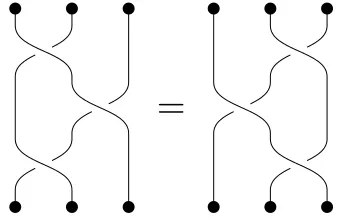
Here, theArtin generator bi represents the braid where thei-th strand crosses over the (i+ 1)-th strand. The relationsbibj =bjbi for|i−j| ≥2 correspond to the fact that crossings that involve different strands are free to move past each other. The relationsbibi+1bi=bi+1bibi+1correspond to moving one strand over the crossing of two other strands. The Artin generators and their relations are graphically represented in Fig. 1, 2 and 3.
Fig. 1. The three Artin generators b1, b2 and b3 that generateB4.
=
Fig. 2. Crossings that do not share strands com-mute, i.e.b1b3=b3b1
=
to the transpositionσ(bi) = (i i+ 1). Elements in the kernel of this homomor-phism are called pure braids, the kernel itself is called the pure braid group on
N strands and is denoted byPN.
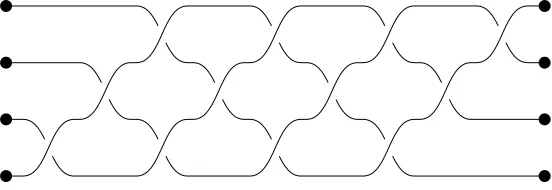
The braid groupB2 on two strands is the infinite cyclic group, so this group is its own center. For N > 2 the center of the braid group on N strands is generated by the full-twist braid which is obtained by grabbing the ends of the strands of the identity braid and rotating them by 360 degrees [13]. This braid is commonly denoted by∆2and is depicted in Fig. 4.
Fig. 4.The full-twist braid∆2 in the braid group on 4 strands.
2.3 The colored Burau representation and E-multiplication
The Walnut digital signature algorithm relies heavily on a group action called
E-Multiplication. To define this group action we need the colored Burau Repre-sentation (see, for example, Anshel et al. [2]) which is a homomorphism from the braid group BN to the colored Burau group GLN(Z[t1±1,· · ·, t±N1])oSN. This group is defined as a semidirect product, by letting the symmetric group SN act onGLN(Z[t±11,· · ·, t
±1
N ]) by permuting the variablesti. More concretely, the elements of the colored Burau group are pairs (A(t1,· · · , tN), π) whereπ∈SN is a permutation and whereA(t1,· · ·, tN) is an invertibleN×N matrix whose entries lie inZ[t±11,· · ·, t
±1
N ]. Multiplication in the colored Burau group is defined by
(A(t1,· · ·, tN), π)·(B(t1,· · · , tN), τ)..= (A(t1,· · ·, tN)·π(B(t1,· · · , tN)), πτ) = (A(t1,· · ·, tN)·B(tπ(1),· · ·, tπ(N)), πτ).
The colored Burau representation CB : BN → GLN(Z[t±11,· · ·, t
±1
N ])oSN is defined at each Artin generator as CB(bi) = (CBM(i), σ(bi)), whereCBM(i) is a matrix andσ(bi) is a permutation, defined as follows. The permutationσ(bi) is the transposition (i i+ 1). We defineCBM(b1), the colored Burau matrix of b1, as
CBM(b1) =
−t11 0
0 1 0
0 0 1N−2
where1N−2is the (N−2)×(N−2) identity matrix. Fori >1 the colored Burau matrix ofbi is defined as
CBM(bi) =
1i−2 0 0 0 0
0 1 0 0 0
0 ti−ti1 0
0 0 0 1 0
0 0 0 01N−i−1
.
This definition of CB(bi) is compatible with the relations of the braid group, so it can be extended to define a homomorphism on the entire group BN. For a braid b, the matrix component of CB(b) is called the colored Burau matrix
of b and is denoted byCBM(b), the permutation component ofCB(b) is sim-ply equal toσ(b). This implies that pure braids are mapped into the subgroup GLN(Z[t±11,· · · , t
±1
N ])⊂GLN(Z[t
±1 1 ,· · ·, t
±1
N ])oSN.
Now we fix a finite fieldFq, and for any integerkwith 1< k≤N we define Ak to be the group of invertibleN-by-N matrices of the form
Ak=
X Y 0
0 1 0
0 0 1N−k
|X ∈GLk−1(Fq), Y ∈Fkq−1
.
Given a listT = [τ1,· · · , τN] ofN values in a finite field we can define an entry-wise evaluation map GLN(Z[t±11,· · ·, t
±1
N ]) → GLN(Fq). The evaluation of a matrixM(t1,· · ·, tn) atT is denoted by
M ↓T..=M(τ1,· · ·, τN).
For a list T containing N non-zero finite field elements, we can now define a right group action, called E-Multiplication and denoted by?, of the braid group BN on the setAN×SN. A braidbacts on the first component of the pair (M, π) by multiplying from the right with a matrix obtained from the colored Burau matrix ofbby permuting the variablesti usingπand then evaluating atT. The second component of the acvtion is obtained by multiplying on the right byσ(b). Written out symbolically, this is
(M, π)? b..= (M·π(CBM(b))↓T, πσ(b)).
AlgorithmE-Multiplication
input: (M, π) — a pair inAN×SN to act on
s— a braid to act with
T ={τ1,· · ·, τN}— a list of T-values
output: (M, π) — the resulting pair
1: while|s|>0do
2: b±1
i ||s←s .split the first generatorb ±1
i from the rest ofs
3: N←CBM(bi)±1 .The CB Matrix ofbi, inverted if necessary.
4: N←N(τπ(i)) .Evaluate inτπ(i) 5: M ←M·N
6: π←π◦σ(bi)
7: end while
8: return(M, π)
Alg. 1.The algorithm for computing the E-Multiplication action.
By lettingBN act on (1N, e)∈AN×SN we define a mapP
P :BN →AN ×SN :s7→(1N, e)? s .
When restricted to the subgroup of pure braidsPN, the second component ofP always maps to the identity permutation, so we can think of it as a mapP|PN : PN →AN. The mapP|PN is actually a homomorphism because it is the com-position of the colored Burau representation CB:PN →GLN(Z[t±11,· · · , t
±1 N ]) and the evaluation homomorphism|T :GLN(Z[t±11,· · ·, t
±1
N ])→AN. Moreover, if we further restrictP to the subgroup Pk of pure braids where only the first k strands cross over each other, i.e. the intersection of PN with the subgroup generated by b1,· · ·, bk−1, the homomorphism P|Pk : Pk → Ak maps into the subgroupAk. This fact will be exploited in the attack of Sect. 5.
2.4 The Walnut signature scheme
We now introduce the Walnut signature scheme, which is the subject of our cryptanalysis. Before we describe the key generation, signing and verification algorithms (Alg. 2, 4 and 5) in detail we will summarize the scheme very briefly: the secret key consists of two braidss1, s2and the public key is (M1, π1) =P(s1) and M2 = mat(P(s2)), the matrix component of P(s2). To sign or verify a document d it is hashed and encoded as a pure braid E(d) with an encoding mechanismE. The Walnut design [5] defines a braidsigto be a valid signature for the documentdif and only if the verification equation
is satisfied. However, this equation is equal to the matrix component of
P(s1)?sig=P(E(d))? s2, (2) and the permutation component of equation (2) is also satisfied by all the le-gitimately produced signatures. In this document we define a valid signature as a braid sig that satisfies the stronger verification equation (2). It is clear that sig = s−11E(d)s2 would be a valid signature. In order to prevent length-based attacks [16, 19] cloaking elements, namely braids that do not affect E-Multiplication, are inserted into the signature and the braids are put through a rewriting algorithm so that s1 and s2 cannot easily be extracted from the signature.
Parameters. The scheme is parametrized by:
– The order of the braid group that is being usedN. – The sizeqof a finite fieldFq.
– A rewriting algorithmR:BN →BN.
– Landl, the length of certain random braid words. – A hash functionH.
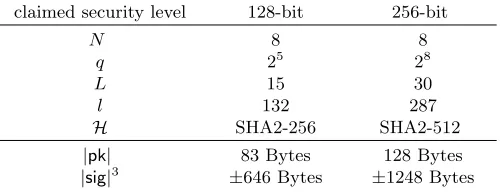
Table 1.The Walnut parameter sets submitted to the NIST Post Quantum Cryptog-raphy project, and the corresponding public key and signature sizes.
claimed security level 128-bit 256-bit
N 8 8
q 25 28
L 15 30
l 132 287
H SHA2-256 SHA2-512
|pk| 83 Bytes 128 Bytes |sig|3 ±646 Bytes ±1248 Bytes
Key generation. The private key consists of two randomly chosen braids s1, s2∈BN of lengthl. The braids are chosen such that their underlying permu-tationsσ(s1) andσ(s2) are distinct and not equal to the identity permutatione. The public key contains a list T ={τ1= 1, τ2 = 1, τ3,· · ·, τn} ∈FNq ofN ele-ments of the finite field Fq such that the first two elements are equal to 1, and such that the remaining values are non-zero and different from 1. The public key also containsP(s1) and the matrix component ofP(s2).
3
AlgorithmGenerateKeys
input: random bits to generates1, s2 andτi
output:pk— a public key
sk— a corresponding secret key
1: s1, s2←a randomly chosen braid words of lengthl. 2: τ1, τ2←1
3: for ifrom 3 toN do
4: τi←a randomly chosen field element, not equal to 0 or 1
5: end for
6: T ← {τ1,· · ·, τN}
7: (M1, π1)← P(s1) 8: (M2, π2)← P(s2)
9: returnpk= (T, M1, M2, π1) andsk= (s1, s2)
Alg. 2.The Walnut key pair generation algorithm
Encoding a document. In order to sign a documentdor verify a signature the document is converted to a pure braidE(d)∈PN. This conversion consists of two stages. First, a hash digest ofdis computed with a standard hash function (SHA2-256 or SHA2-512), then this hash is converted to a braid. To make the second conversion 4 pure braidsg1, g2, g3, g4 are fixed such that they generate a free subgroup ofPN. The Walnut specification document [8] defines
g1=bNbN−1· · ·b2·b21·b− 1 2 · · ·b−
1 N−1b
−1 N g2=bNbN−1· · ·b4·b23·b
−1 4 · · ·b
−1 N−1b
−1 N g3=bNbN−1· · ·b6·b25·b
−1 6 · · ·b
−1 N−1b
−1 N g4=bNbN−1· · ·b8·b27·b−
1 8 · · ·b
−1 N−1b
−1 N .
The encoding process starts from the trivial braid. Two bits are taken from the hash digest to choose one gi of the 4 generators, and the next two bits of the digest define an exponente∈ {1,2,3,4}. Thenge
i is appended to the braid, and four bits are removed from the digest. This is repeated until the entire hash output is consumed.
Signing algorithm. The signing algorithm produces a signature which is a braid word of the form
AlgorithmEncodeDocument
input: A documentd
output:b— a pure braid 1: h← H(d)
2: b←e
3: for afrom 0 to|h|/4−1 do
4: i←h[4a: 4a+ 1] .Select index 5: e←h[4a+ 2 : 4a+ 3]+1 .Select exponent 6: b←b·ge
i
7: end for
8: returnb
Alg. 3.The document encoding mechanism.
where v1, vand v2 are so called cloaking elements, which are braids in the sta-bilizer ofP(s1),(1N, e) andP(E(d)s2) respectively. Therefore we have
(1N, e)? s1·sig0=P(s1)? s−11·v·E(d)·s2·v2 = (1N, e)? v·E(d)·s2·v2 =P(E(d)s2)·v2
= (1N, e)? E(d)·s2,
sosig0 is a valid signature. To hide the secret keys1 ands2which are substrings ofsig0one of three proposed rewriting algorithms (BKL + Dehornoy, Stochastic + Dehornoy or Stochastic) is used to produce a different braid word sigwhich represents the same braid as sig0. The various rewriting algorithms differ in performance and in the length of the signatures that are produced.
The cloaking elements are generated using the following lemma.
Lemma 1. Suppose that τ1 = τ2 = 1. Take any pair (M, π) ∈ AN ×SN, an Artin generator bi, and any braid wsuch that
π◦σ(w)(i) = 1 and π◦σ(w)(i+ 1) = 2.
Then the braid v=w·b2i ·w−1 is in the stabilizer of(M, π).
To produce a cloaking element for P(s1),(1N, e) or P(E(d)s2) we first pick a random integer i such that 1 < i < N, then we choose a random braid w satisfying the conditions of Lemma 1 and we set v = wb2
AlgorithmSign
input:d— a document to sign
sk= (s1, s2) — a secret key
output:sig— a signature for documentd
1: v1←GetCloakingElement(σ(s1)) 2: v←GetCloakingElement(e) 3: v2←GetCloakingElement(σ(s2)) 4: Ed←EncodeDocument(d)
5: sig0←v1·s−11·v·Ed·s2·v2 6: sig← R(sig0)
7: returnsig
Alg. 4.The Walnut signature generation algorithm
Verification Algorithm. Given a documentd, a public keypk= (T, M1, M2, π1) and a signaturesig. The verification algorithm simply calculates the encoding of the message E(d) and the matrix components of (M1, π1)?sigandP(E(d)). It then accepts the signature if the computed matrices satisfy the equation
mat((M1, π1)?sig) =mat(P(E(d)))·M2.
AlgorithmVerify
input:d— a document
pk= (T, M1, M2, π1) — a secret key
sig— a signature
output:Trueifsigis a valid signature ford,Falseotherwise 1: Ed←EncodeDocument(d)
2: LHS←mat( E-Multiplication((M1, π1),sig, T)) 3: RHS←mat( E-Multiplication((1N, e), Ed, T))·M2 4: if LHS equals RHSthen
5: return True
6: end if
7: return False
Alg. 5.The Walnut signature verification algorithm
3
A factorization attack
newer construction where the two secret braidss1ands2are equal. This means that the secret key essentially consists of only a single braid s, and that the public key is a single matrix-permutation pair (M, π) =P(s). The signing and verification algorithms of the earlier version are the same as the algorithms de-scribed in the previous section after substitutingsfors1ands2, and substituting M forM1 andM2. The attack of Hart et al. exploits the following malleability property:
Theorem 1. (for the earlier version of Walnut with s1 = s2) Suppose
d, d1, d2are three documents. Leth, h1, h2be the matrix part ofP(E(d)),P(E(d1))
andP(E(d2))respectively. Then we have
1. Ifh=h−11andsig1 is a valid signature ford1, thensig−11is a valid signature
ford.
2. If h=h1·h2 and sig1,sig2 are valid signatures for d1 and d2 respectively, thensig1sig2 is a valid signature for d.
This opens up the following strategy to attack the signature scheme. First we collect a set of valid document-signature pairs (di,sigi) and we let hi =
mat(P(E(di))). Then, if we want to forge a signature for a document d with h=mat(P(E(d))) it suffices to writeh as a productQk
j=1h ej
ij of the hi. Once we have this, a valid signature fordis given byQk
j=1sig ej
ij. This reduces breaking the signature scheme to breaking the factorization problem inAN:
Factorization problem in a groupG.Given a list of elementsg1,· · ·, gkthat generate the groupGand a target elementg, write the targetgas a (preferably short) product of thegi and their inverses.
The paper of Hart et al [14] proposes an algorithm to solve the factorization problem inAN, exploiting a chain of subgroups. This allows them to forge sig-natures in minutes, but the factorizations that are found by the algorithm are very long, so this results in very long signatures. The forged signatures are many orders of magnitude longer than legitimate signatures, so the Walnut scheme can be saved by imposing an upper limit to the length of the signatures.
3.1 Signature malleability of Walnut
Walnut has the following malleability property, which is a generalization of the property discovered by Hart et al. (Theorem 1).
Theorem 2. Supposed, d1, d2 are three documents. Let h, h1, h2 be the matrix
part ofP(E(d)),P(E(d1))andP(E(d2))respectively. Lets1, s2, s3∈BN be three
braids. Then
1. Ifh=h−11andsig1is a valid signature ford1under the public key(P(s1),P(s2)), thensig−11 is a valid signature fordunder the public key(P(s2),P(s1)). 2. Ifh=h1·h2andsig1,sig2are valid signatures ford1andd2under the public
keys(P(s1),P(s2))and(P(s2),P(s3))respectively, then sig1·sig2 is a valid signature fordunder the public key(P(s1),P(s3)).
Proof. We start by proving 1. Sincesig1 is a valid signature ford1we have P(s1)?sig1=P(E(d1))? s2.
Acting on this bysig−11and using the definition of P we get (1N, e)? s1= (h1, e)? s2·sig−11,
where we have used the fact thatE(d1) is a pure braid. Multiplying the matrix part of this equality by h−11 from the left (multiplying on the left by a matrix commutes with?), we get
(h−11, e)? s1= (1N, e)? s2·sig−11, or equivalently
P(E(d))? s1=P(s2)?sig−11,
which shows thatsig−11is a valid signature fordfor the public key (P(s2),P(s1)). To prove 2 we start by acting withsig2 on the verification equation forsig1 to get
P(s1)?sig1·sig2=P(E(d1))? s2·sig2
= (h1·CBM(s2)↓T ·σ(s2)(CBM(sig2))↓T, σ(s2)◦σ(sig2)).
Using the fact thatsig2is a valid signature ford2under the public key (P(s2),P(s3)), we see that
P(s1)?sig1·sig2= (h1·h2·CBM(s3)↓T, σ(s3)) = (h1·h2, e)? s3
=P(E(d))? s3,
3.2 The factorization attack
Given an oracle Of (which can be instantiated by the algorithm of [14]) that solves the factorization for the groupAN, we can now break Walnut as follows. Suppose we want to forge a signature for a document d under the public key (P(s1),P(s2)). Leth be the matrix part of P(E(d)). We start by collecting a number of document-signature pairs (d1,sig1),· · ·,(dk,sigk) that are valid under the same public key, and we compute the matrix parthi of each pairP(E(di)). Now it suffices to find a factorizationh=hi1·h
−1
i2 ·hi3· · ·h
−1
im−1·himwhose factors
have powers that alternate between 1 and −1. Indeed, combining properties of Theorem 2 we see that sigi1 ·sig−i1
2 is a valid signature for any document
d0 such that mat(P(E(d0))) = hi1 ·h
−1
i2 under the public key (P(s1),P(s1)).
Adding an extra factor, we get that sigi1·sig
−1
i2 ·sigi3 is a valid signature for
an appropriate document under the public key (P(s1),P(s2)). Continuing the same argument for the odd number m of factors of the product we get that
sigi
1 ·sig
−1
i2 ·sigi3· · ·sig
−1
im−1·sigim is a valid document for dunder the desired public key (P(s1),P(s2)).
We can use the oracleOf to find the factorizationh=hi1·h
−1
i2 ·hi3· · ·h
−1 im−1·
him. We construct the list of generators
gens={hi·h−j1 | i6=j∈ {1,· · · , k}}
and call the oracle Of to obtain a factorization for h·h−11 with factors in this set of generators. Appending the factorh1to the resulting factorization we then get a factorization ofhof the desired form.
3.3 Implications and countermeasures
The factorization algorithm of [14] has a time complexity of OqN2−1
and for the 128 bit security parameters of Walnut (i.e.N = 8,q= 25) the algorithm finds a factorization in minutes. However, these factorizations contain roughly 225 factors, so the forged signatures are the concatenation of roughly 225legitimate signatures. This implies that the forged signatures are many orders of magnitude longer than legitimate signatures and so they can be detected easily by the verifier. To protect against this attack it suffices to impose a limit on the length of signatures. Interestingly, when the WalnutDSA scheme was updated to counter the attack of [14], no such upper limit was included in the design. Our adaptation of the attack shows that this limit is necessary for the security of the scheme, because long forgeries can be produced in a matter of minutes.
This effectively limits the signature braids to be at most 216 Artin generators long. Therefore the attack cannot be used to break the NIST implementation of WalnutDSA.
4
A collision search attack
From the verification equation
P(s1)?sig=P(E(d))? s2
it is clear that the only dependence on the document d is through the encod-ing mechanism E and the mapping P. This implies that if d1 and d2 are two documents such that P(E(d1) =P(E(d2)), then any signature that is valid for d1 is automatically valid for d2 and vice versa. Therefore breaking EUF-CMA security reduces to finding such a pair of documents. Once an attacker has found two such documents he can ask the signing oracle to produce a signaturesigfor d1, and return (sig, d2) to win the EUF-CMA game. Since the first step of the encoding function E is the application of a cryptographically secure hash func-tion to the document d we cannot reasonably expect to have a more efficient way of finding collisions than with a generic collision search. A generic collision search requires roughly |P(E({0,1}∗))|1/2 evaluations of P ◦E. In the rest of this section we give an upper bound for this quantity and we demonstrate with computer experiments that a collision attack is practical.
4.1 Sizes of orbits of E-multiplication
To estimate the time complexity of the collision search attack we need to find the size ofP(E({0,1}∗)). Without much motivation the designers of WalnutDSA
claim thatqN(N−3)N! is a conservative lower bound on the number values thatP can take [5]. For 128-bit and 256-bit security parameters this number is roughly 2216 and 2336 respectively, which means that finding a collision should require roughly 2108and 2168evaluations ofP ◦E. Note that this is already significantly less than the claimed security levels. Moreover, an elementary analysis will reveal that this “conservative lower bound” is actually much larger than the true value of |P(BN)|. Even worse, when P is restricted to the set of braids that can be produced by the encoding mechanism E, the number of values that can be reached is much smaller still.
identity matrix, but for a randomly chosen set of T-values P(∆2) is typically not the identity matrix. This means that P(AN) sits inside the centralizer of P(∆2), which is typically a proper subspace ofhA
Ni. This begs the question of what the dimension ofhP(PN)iis. From computer experiments we can conclude that for randomly chosen T-values this is equal to the dimension of the central-izer ofP(∆2), which is equal to (N−1)2+ 1 (sinceP(∆2) has one eigenspace of dimension N −1 and one of dimension 1). However, if we impose the extra condition that the first two T-values are equal to one,P(PN) is contained in an affine subspace of dimension (N−2)2+ 1, so|P(PN)|is at mostq(N−2)2+1. Our computer experiments suggest that this upper bound is reasonably tight, and so we estimate|P(PN)| ≈q(N−2)2+1. SincePN is a subgroup ofBN of indexN! we have|P(BN)|< q(N−2)2+1N!. Note that this upper bound is strictly lower than the lower bound which was claimed by the designers of Walnut.
Any braid output by the encoding mechanismE is a product of the genera-tors g1, g2, g3, g4. From computer experiments we conclude that when applying P to braids of this form we end up with matrices in an affine subspace of sur-prisingly low dimension. We found that they live in a subspace of dimension 13, independent of the values ofq orN (provided thatN2>13). This means that |P(E({0,1}∗))|is at mostq13, and that finding a collision cannot take much more thanq13/2 evaluations ofP ◦E. For 128-bit security parameters this number is as low as 232.5, and for 256-bit security parameters this is 252.
4.2 Implementation
We implemented the generic collision finding algorithm of van Oorschot and Wiener [24] (briefly explained in Sect. 2.1) and used it to find collisions for the function g◦ P ◦E, where g is a function that takes the ouput of P, and converts it to some plausible documentd. Even though the method is completely generic, it is still efficient enough to find colliding documents in practice. It took approximately 232.2 evaluations off (which agrees very well with the expected value of 232.5) or one hour on a standard desktop PC to find the following pair of colliding documents.
d1="I would like to receive 7181666883746416503 free samples of delicious cookies."
d2="I pledge to donate 3519533052089988469 USD to Ward Beullens."
4.3 Implications and countermeasures
This practical attack shows that the Walnut signature scheme should not be used with the parameters that are submitted to the NIST PQC project.
Increasingqto raiseq13/2to the required security level would lead toq= 220 andq= 240for 128-bit and 256-bit security parameters respectively. For 256-bit security parameters this would increase the size of the public key by a factor of 5 and we estimate that this would slow down the verification algorithm by a factor of 25. A better approach would be to change the encoding algorithm to output pure braids that are not restricted to the subgroup generated byg1, g2, g3, g4(or any other proper subgroup). SinceP(PN) is contained in an affine subspace of dimension (N−2)2+ 1, this would lead to an upper bound on the complexity of the attack of pq(N−2)2+1
evaluations of P ◦E. We would then only need a slight increase in the parameters. For example, 256 bits of security would be achieved (against this attack) by the parameters q= 28 andN= 10, leading to an increase of the key size of roughly 50%, the signature size by at least 25% and an expected slowdown of the verification algorithm by a factor of 2.
5
Reversing E-multiplication
A fundamental hard problem underlying the Walnut signature scheme is the “Reversing E-Multiplication” (REM) problem. This problem asks, given a pair (M, σ)∈AN×SN, such that (M, σ) = (1N, e)? sfor some braids∈BN, to find a braids0 ∈BN such that (1N, e)? s0 = (M, σ). In other words, the problem is to break the one-wayness of the function
P :BN →AN ×SN :s7→(1N, e)? s.
The secret key in Walnut consists of two braidss1, s2∈BN. The corresponding public key is P(s1) and the matrix part of P(s2). The fact that the permuta-tion part of P(s2) is not available to the attacker is not a problem, because given a single signaturesigwhich is valid for any message (which might be un-known to the attacker), the attacker can deduce the permutation ofs2from the permutation component of the verification equation (2)
σ(s1)◦σ(sig) =σ(s2).
5.1 Birthday attack
A brute force attack would repeatedly pick a randoms∈BN, compute (1N, e)?s and check if this is equal to the target (M, σ). This attack would takeO(|P(BN)|) attempts, where |P(BN)| is the size of the orbit of (1N, e). A more efficient approach is to look fors1, s2∈BN such that
(M, σ)? s1= (1N, e)? s2.
If suchs1ands2are found, the solution to the REM problem is given bys2s−11. A naive way of findings1ands2is to compute a large table containingp|P(BN)| values ofs1and the corresponding values of (M, σ)?s1and check for random val-ues ofs2whether (1N, e)? s2lies in this table. This method takesO(
p
|P(BN)|) E-Multiplications, but requires a lot of memory. The problem can be reduced to collision finding for a function f :P(BN)→ P(BN). Then, distinguished point methods (see Sect. 2.1) can solve the REM problem with the same time com-plexity as the naive approach but with constant memory comcom-plexity. Concretely, suppose b:P(BN)→ {0,1} ands:P(BN)→BN are hash functions that take a matrix and a permutation from the orbit of (1N, e) as input, and output a bit or a braid respectively. Then we can define
f(x) =
(
(1N, e)?s(x) ifb(x) = 0, (M, σ)?s(x) ifb(x) = 1.
If s outputs sufficiently long braids such that P(s(x)) is distributed uniformly in the orbit of (1N, e), then the distinguished point method will yield colli-sions f(x1) = f(x2) such that b(x1) 6=b(x2) with probability 1/2. Once such a collision is found, a solution to the REM problem is given by s(x1)s(x2)−1 or s(x2)s(x1)−1 when b(x1) is 0 or 1 respectively. For the security parameters aiming for 128 bits of security, the size of the orbit P(BN) is bounded by 2200 (see Sect. 4.1), so the number of E-multiplications required to solve REM is not much more than 2100, considerably less than 2128 but still far from practical. For the 256 bit security parameters the number of E-multiplications is not much more than 2157.
5.2 Subgroup chain attack
We next propose a practical method for solving the REM problem that improves the attack above by exploiting the following chain of subgroups ofBN:
{e}=P1⊂P2⊂ · · · ⊂PN ⊂BN.
{e} P2 · · · PN BN
{(1N, e)} A2 · · · AN AN×SN
P P P P
The meet-in-the-middle attacks in the previous subsection attempt to find a braidssuch that (M, σ)? s= (1N, e) in one step. Given this subgroup structure, it is more efficient to solve REM in several steps. The first step is to find a braid s0 ∈ BN such that (M, σ)? s0 = (M0, e) ∈ AN. This is trivial because any s0 ∈ BN whose underlying permutation is σ−1 will do the job. The next step is to find a pure braid sN ∈ PN such that (M0, e)? sN ∈ AN−1. Then, one continues iteratively to findsi ∈Pi such that (M, σ)? s0sN· · ·si∈Ai−1. After the last step we have found s0sN· · ·s2 such that (M, σ)? s0sN· · ·s2 = (1N, e), so (s0sn· · ·s2)−1 is a solution to the REM problem.
One caveat when using this method is that, a priori, it is possible to get stuck. After each step, we get a new target (M, σ)? s0sN· · ·siwhich is sampled randomly from P(Pi)∩Ai−1. However, from that point on, we will only act on this taget with pure braids fromPi−1. This means that if the new target is not in P(Pi−1) we will not be able to complete the attack. If we assume for each i that
P(Pi)∩Ai−1=P(Pi−1),
then the attack is guaranteed to work. In practice, this assumption seems to hold with large probability for the parameter sets that are proposed, because the algorithm works without having to backtrack. We encounter this problem when instantiating the Walnut scheme with a smaller finite field such as F5. Then, it occurs for a small but noticeable fraction of the choices of T-values that for some small i all the generators of P(Pi−1) have determinant 1 or -1, while the subgroupP(Pi)∩Ai−1 contains matrices with any determinant. This problem is unlikely to occur in large finite fields and with largei, because then there are many generators of P(Pi−1) that all have to map to a matrix with determinant±1.
Each step can be solved with a collision search in the spaceAi−1P(Pi)\Ai−1 of cosets of Ai−1 in Ai−1P(Pi). Let b : Ai−1P(Pi)\Ai−1 → {0,1} and s : Ai−1P(Pi)\Ai−1 → Pi be hash functions that take a right coset and output a bit or a pure braid respectively. Then we can define f : Ai−1P(Pi)\Ai−1 → Ai−1P(Pi)\Ai−1as
f(x) =
(
Ai−1P(s(x)) ifb(x) = 0, Ai−1M0P(sN· · ·si+1s(x)) ifb(x) = 1.
earlier that P(Pi)∩Ai−1 = P(Pi−1) this is equal to
p
|P(Pi)|/|P(Pi−1)| E-Multiplications.
If we plug the estimate of|P(Pi)| ≈q(i−2)2+1from Sect. 4.1 into this formula, we get an estimate of
r
q(i−2)2 +1
q(i−3)2 +1 = q
i−5/2 E-Multiplications to find s i. The runtime of the algorithm is dominated by the step that searches forsN, which is estimated to require qN−5/2 E-Multiplications. For 128-bit security parameters this number is 227.5 and this agrees very well with our computer experiments. For 256-bit security parameters, the required number of E-Multiplications is estimated to be 244.
5.3 Representing and manipulating cosets of Ak.
In order to implement the hash functionsbandswe need to be able to uniquely represent right cosets with respect toAk. We give a method to do this efficiently in this subsection. Suppose,X,Yare two matrices inAN, that are in the same right coset ofAN−1. That is, there exists a matrixA∈AN−1such thatAX=Y. If we split up the matrices to make their structure visible we get:
A1A20 0 1 0 0 0 1
X1X2 X3X4 0 1
=
Y1Y2 Y3Y4 0 1
.
From this it is obvious that the (N −1)-th row of X and Y are identical, and that the first (N−1) rows ofXandY span the same (N−1)-dimensional subspace. It is easily checked that the converse also holds, which implies that the right coset of AN−1 that contains a matrix X∈ AN is completely determined by the (N−1)-th row ofXand the subspace spanned by the first N−1 rows ofX. In turn, this subspace is uniquely represented by the row reduced echelon form of the upper (N−1)-by-N submatrix of X, which will be of the form
IN−1v
for somev∈FN−1. Therefore, the coset containingXis completely determined by the (N−1)-th row ofX, and the last column of the firstN−1 rows ofX after putting it in row reduced echelon form. More generally, we have the following lemma.
Lemma 2. A right coset ofAk\Ak−1 with representative X∈Ak is completely
determined by the pair of vectors(v1,v2)∈FNq ×Fqk−1, wherev1is the(k−1)-th
row ofXandv2 is thek-th column of the matrixX0, which is obtained from X
This lemma gives a method for deciding whether two matricesXandYare in the same coset. One simply computes the pair of vectors for both matricesX and Y and checks whether they are equal. To run the algorithm we also need a way to act on cosets by multiplying on the right by matrices. One way to do this is to work with a representative from the coset and carry out a matrix multiplication to get a representative from the next coset. It is more efficient to compute directly with the two-vector representation of the coset. The following lemma gives a way to do this.
Lemma 3. Suppose M is a matrix in Ak for some k with 1 < k ≤ N. Let
A∈GLk−1(Fq)andb∈Fkq−1 be submatrices ofMsuch that
M=
A b 0 0 1 0 0 01N−k
.
If (v1,v2)is the representation of a cosetS as in Lemma 2, then the represen-tation of the cosetSM is given by(v1M,A−1(b+v2)).
Proof. It is clear that if v1 is the (k−1)-th row of a representative ofS, then v1Mis the (k−1)-th row of a representativeSM. For the second vector, suppose that the subspace spanned by the firstk−1 rows of a representative of Sis the row subspace of
1v20
.
Then there is a representative of SMwhose firstk−1 rows span the rowspace of
1v20M= A b+v20.
Putting this in row reduced echelon form we get 1A−1(b+v
2)0
,
which shows that the second vector in the representation of SM is equal to A−1(b+v
2).
5.4 Permuting T-values to improve the attack
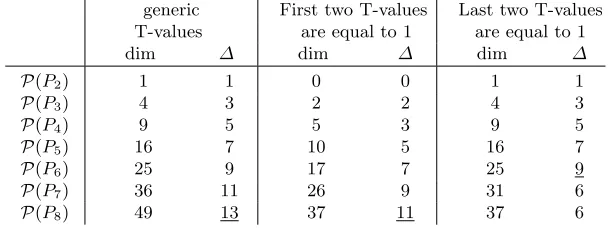
been the first step, where we would have to perform a collision search in a set of at mostq13 elements. However, Walnut fixes the two first T-values to be 1, so the most expensive step consists of a collision search in a space of at most q11 elements. In the last column of Tab. 2 we see that if the designers had chosen to fix the last two T-values to one instead, the complexity of the subgroup chain attack would be reduced: the most expensive step would have been a collision search in a space with only at most q9 elements. It turns out that we can first apply a transformation to the REM instance to reduce it to an instance of the REM problem where the final two T-values are set to one. Solving this REM instance then only takes pq9 E-Multiplications, so this approach reduces the amount of work by a factor of q. For general values of N, the new method requires approximately qN−7/2 E-Multiplications. The reduction relies on the following lemma.
Lemma 4. Lets1, s2 be braids, let(M, π)be a matrix-permutation pair and let
T be a set of T-values. Then s1s2 is a solution for the REM problem for the pair (M, π) with respect to the list of T-values T if and only if s2 is a solution for the REM problem for the pair ((CBM(s1) ↓T)−1M, σ(s1)−1π)with respect
to the permuted list of T-valuesσ(s1)(T).
Proof. By applying the definition of E-Multiplication we find that
(1N, e)?Ts1s2= (CBM(s1)↓T ·σ(s1)(CBM(s2)↓T), σ(s1s2)).
By multiplying from the left byCBM(s1)↓T−1andσ(s1)−1we see that the value above is equal to (M, π) if and only if
(σ(s1)(CBM(s2)↓T), σ(b2)) = ((CBM(s1)↓T)−1M, σ(s1)−1π).
The main insight is that permuting the variables ti 7→ tσ(b1)(i) and then
eval-uating at the values of T leads to the same result as evaluating at the set of permuted valuesσ(s1)(T). Therefore the left hand side is equal to
(CBM(s2)↓σ(b1)(T), σ(s2)) = (1N, e)?σ(s1)(T)s2.
Table 2.The dimension of the subspaces containing various subgroups, depending on the T-Values
generic First two T-values Last two T-values T-values are equal to 1 are equal to 1
dim ∆ dim ∆ dim ∆
P(P2) 1 1 0 0 1 1
P(P3) 4 3 2 2 4 3
P(P4) 9 5 5 3 9 5
P(P5) 16 7 10 5 16 7
P(P6) 25 9 17 7 25 9
P(P7) 36 11 26 9 31 6
P(P8) 49 13 37 11 37 6
5.5 Using a finer chain of subgroups
With a complexity ofO(qN/2), the factorization algorithm of Hart et al. is more efficient (asymptotically) than the REM solving algorithm that we have de-scribed so far. This is due to the fact that Hart et al. use a finer chain of subgroups, which leads to smaller spaces of cosets to search in. In the next para-graph we describe a faster variant of our REM solving algorithm that uses a finer chain of subgroups, similar to the chain used by Hart et al. This variant is much faster than the previous REM solver, but yields solution braids that are longer.
In each step of our REM solving algorithm we have a matrix M ∈ Ai and we are looking for a braid si ∈ Pi such that mat((M, e)? si) lies in Ai−1. To speed this process up, we can split each step in two substeps. Let Ci−1 be the subgroup of invertibleN-by-Nmatrices that only differ from the identity matrix in the upper left (i−1)-by-(i−1) submatrix. This is a proper subgroup ofAi, which itself containsAi−1 as a proper subgroup. To solve the step of the REM solving algorithm we can first search for an s0i ∈Pi such that mat((M, e)? s0i) lies in the intermediate group Ci−1, then we search for a braid s00i such that
mat((M, e)? s0isi00) lies in Ai−1. The first substep of finding s0i can be carried out with a meet in the middle search. In order to be able to complete the second substep we start by searching for a list of braidsc1, c2,· · ·, ck such that
mat(P(ci)) ∈ C1. Then, to solve the second substep, we search for a braid s00i in the subgroup generated by the braids ci such thatmat((M, e)? s0is00i) lies in Ai−1.
5.6 Implications and countermeasures
the REM problem that are produced are longer than those produced by the original algorithm. This is because the solution now contains braids s00i which are themselves a concatenation of several slightly longer braids ci. To avoid inflating the size of the output signature needlessly, it is best to only use this technique for solving the most expensive steps. For 128-bit security parameters the signatures output are longer than legitimately produced signatures, but still small enough to be accepted by the NIST implementation. For 256-bit security parameters, the forged signatures are smaller than some legitimately produced signatures, depending on which variant of the signing algorithm is used. Hence, we cannot defend Walnut against this attack by imposing an upper limit on the length of the signatures. Note that it is trivial to convert a short signature into a longer signature, so imposing a lower bound does not help either.
With this method the most expensive step of the algorithm requires only qN/2−1E-Multiplications. The attack is very efficient in practice. We can produce a forgery for 128-bit security parameters in less than one second. Even for 256-bit security parameters we can forge signatures for any document in less than a minute.
There does not seem to be a better way to block the attack other than just increasing the parameters to ensure thatqN/2−1 is higher than the desired security level. One way to do this is to takeN = 10, q= 232to achieve 128 bits of security, and N = 10, q = 264 for 256 bits of security. For 128-bit security parameters, this leads to a public key of 762 Bytes (a×9 increase ), signatures of about one kB (an increase of roughly 50%) and an expected slowdown of the signing and verification algorithms by a factor 2 and a factor 30 respectively.
6
Conclusion
opinion of the authors that E-Multiplication can not be credibly used as a basis for cryptography until this structure and its implications for cryptography are better understood.
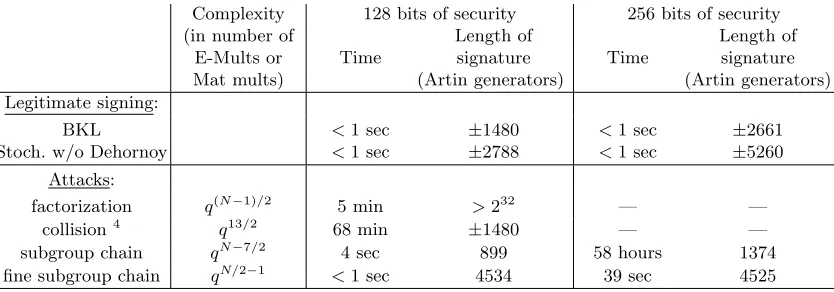
Table 3. An overview of the attacks introduced in this paper, compared with the legitimate signing algorithms.
Complexity 128 bits of security 256 bits of security
(in number of Length of Length of
E-Mults or Time signature Time signature Mat mults) (Artin generators) (Artin generators) Legitimate signing:
BKL <1 sec ±1480 <1 sec ±2661
Stoch. w/o Dehornoy <1 sec ±2788 <1 sec ±5260 Attacks:
factorization q(N−1)/2 5 min >232 — —
collision4 q13/2 68 min ±1480 — —
subgroup chain qN−7/2 4 sec 899 58 hours 1374 fine subgroup chain qN/2−1 <1 sec 4534 39 sec 4525
The security of the parameter sets submitted to the NIST PQC project is completely broken by the attacks. We show that it is possible to forge signatures or compute equivalent secret keys in under a second for 128-bit security parame-ters. Even for 256-bit security parameters this takes less than a minute. Updating the parameters to resist the best known attack (see Sect. 5) would significantly increase the public key and signature sizes. This would make the scheme more difficult to implement on the low-resource processors that SecureRF is targeting and destroy the size advantages of Walnut over other post-quantum signature schemes such as lattice-based, hash-based and multivariate signature schemes. We note also that these latter schemes have been subject to much more scrutiny, which improves our confidence in their security.
AcknowledgementsThis work was supported in part by the Research Council KU Leuven: C16/15/058. In addition, this work was supported by the European Commission through the Horizon 2020 research and innovation programme un-der grant agreement No.H2020-ICT-2014-645622 PQCRYPTO. This project was partially supported by the FWO through the WOG Coding Theory and Cryp-tography. Ward Beullens is funded by an FWO fellowship.
References
1. About SecureRF. https://www.securerf.com/about-us/, accessed: 2018-03-08
4
2. Anshel, I., Anshel, M., Fisher, B., Goldfeld, D.: New key agreement protocols in braid group cryptography. In: Cryptographers’ Track at the RSA Conference. pp. 13–27. Springer (2001)
3. Anshel, I., Anshel, M., Goldfeld, D.: An algebraic method for public-key cryptog-raphy. Mathematical Research Letters 6, 287–292 (1999)
4. Anshel, I., Anshel, M., Goldfeld, D., Lemieux, S.: Key agreement, the algebraic eraserTM, and lightweight cryptography. Contemporary Mathematics 418, 1–34 (2007)
5. Anshel, I., Atkins, D., Goldfeld, D., Gunnells, P.E.: WalnutDSATM: A quantum-resistant digital signature algorithm. IACR eprint 2017/058 (version: 30-Nov-2017) 6. Anshel, I., Atkins, D., Goldfeld, D., Gunnells, P.E.: WalnutDSATM: A quantum-resistant digital signature algorithm. IACR eprint 2017/058 (version: 18-Sept-2017) 7. Anshel, I., Atkins, D., Goldfeld, D., Gunnells, P.E.: A class of hash functions based
on the algebraic eraserTM. Groups Complexity Cryptology 8(1), 1–7 (2016) 8. Anshel, I., Atkins, D., Goldfeld, D., Gunnells, P.E.: The Walnut digital signature
algorithmTMspecifcation. Submitted to NIST PQC project (2017) 9. Artin, E.: Theory of braids. Annals of Mathematics pp. 101–126 (1947)
10. Ben-Zvi, A., Blackburn, S.R., Tsaban, B.: A practical cryptanalysis of the algebraic eraser. In: Annual Cryptology Conference. pp. 179–189. Springer (2016)
11. Ben-Zvi, A., Kalka, A., Tsaban, B.: Cryptanalysis via algebraic spans. IACR eprint 41 (2014)
12. Cheon, J.H., Jun, B.: A polynomial time algorithm for the braid diffie-hellman conjugacy problem. In: Annual International Cryptology Conference. pp. 212–225. Springer (2003)
13. Garside, F.A.: The braid group and other groups. The Quarterly Journal of Math-ematics 20(1), 235–254 (1969)
14. Hart, D., Kim, D., Micheli, G., Perez, G.P., Petit, C., Quek, Y.: A practical crypt-analysis of WalnutDSATM(2018)
15. Hughes, J.: A linear algebraic attack on the aafg1 braid group cryptosystem. In: Australasian Conference on Information Security and Privacy. pp. 176–189. Springer (2002)
16. Hughes, J., Tannenbaum, A.: Length-based attacks for certain group based en-cryption rewriting systems. arXiv preprint cs/0306032 (2003)
17. Kalka, A., Teicher, M., Tsaban, B.: Cryptanalysis of the algebraic eraser and short expressions of permutations as products. Arxiv preprint (2008)
18. Ko, K.H., Lee, S.J., Cheon, J.H., Han, J.W., Kang, J.s., Park, C.: New public-key cryptosystem using braid groups. In: Annual International Cryptology Conference. pp. 166–183. Springer (2000)
19. Myasnikov, A.D., Ushakov, A.: Length based attack and braid groups: cryptanal-ysis of anshel-anshel-goldfeld key exchange protocol. In: International Workshop on Public Key Cryptography. pp. 76–88. Springer (2007)
20. National Institute for Standards and Technology (NIST): Post-quantum crypto standardization (2016), http://csrc.nist.gov/groups/ST/post-quantum-crypto/ 21. Pollard, J.M.: A monte carlo method for factorization. BIT Numerical Mathematics
15(3), 331–334 (1975)
22. Sedgewick, R., Szymanski, T.G., Yao, A.C.: The complexity of finding cycles in periodic functions. SIAM Journal on Computing 11(2), 376–390 (1982)
24. Van Oorschot, P.C., Wiener, M.J.: Parallel collision search with cryptanalytic ap-plications. Journal of cryptology 12(1), 1–28 (1999)
25. Vasco, M.I.G., Steinwandt, R.: A reaction attack on a public key cryptosystem based on the word problem. Applicable Algebra in Engineering, Communication and Computing 14(5), 335–340 (2004)