Hardware-Supported ORAM in Effect: Practical
Oblivious Search and Update on Very Large Dataset
∗
Thang Hoang
†Muslum Ozgur Ozmen
†Yeongjin Jang
†Attila A. Yavuz
‡Abstract
The ability to query and update over encrypted data is an essential feature to enable breach-resilient cyber-infrastructures. Statistical attacks on searchable encryption (SE) have demonstrated the importance of sealing information leaks in access patterns. In response to such attacks, the community has proposed the Oblivious Random Access Machine (ORAM). However, due to the loga-rithmic communication overhead of ORAM, the composition of ORAM and SE is known to be costly in the conventional client-server model, which poses a critical barrier toward its practical adaptations. In this paper, we propose a novel hardware-supported privacy-enhancing platform calledPractical Oblivious Search and Update Platform(POSUP), which enables oblivious keyword search and update operations on large datasets with high efficiency. We harness IntelSGXto realize efficient oblivious data structures for oblivious search/update purposes. We implementedPOSUPand evaluated its per-formance on a Wikipedia dataset containing≥229keyword-file pairs. Our implementation is highly efficient, taking only 1 ms to access a 3 KB block withCircuit-ORAM. Our experiments have shown thatPOSUPoffers up to 70×less end-to-end delay with 100×reduced network bandwidth consump-tion compared with the tradiconsump-tional ORAM-SE composiconsump-tion without secure hardware. POSUP is also at least 4.5×faster for up to 99.5% of keywords that can be searched compared with state-of-the-art Intel SGX-assisted search platforms.
1
Introduction
The data privacy and utilization dilemma is a common problem in various applications, including, but not limited to, data outsourcing and breach-resilient systems. Recent data breach incidents targeting online applications (e.g., Apple iCloud, Equifax, British Airways) have shown the importance of protecting data confidentiality on the untrusted cloud environment. A naive approach is to leverage standard encryption techniques such as AES. Unfortunately, such techniques also prevent the user from performing even simple queries (e.g., search or update) on encrypted data, thereby diminishing the data utilization.
Searchable Encryption (SE) techniques have been proposed to offer data confidentiality, search and update functionalities simultaneously. This is achieved by creating an encrypted index (EIDX), which represents the keyword-file relationships in encrypted files (EDB), both of which are outsourced to the cloud. One area of SE research focuses on designing new SE schemes (e.g., [14,55,68,43]) with provable security that offer various trade-offs in terms of security, functionality, and efficiency. The other area of research aims to enable encrypted queries that are compliant with legacy infrastructure such as database management systems (e.g., mySQL, mongoDB) [33, 47,41, 59,4,1, 2, 58,60]. Despite their merits, all these techniques leak access patterns, which results in statistical analysis attacks (e.g., [40, 50, 82, 13,
54,31,13,61]).
The Oblivious Random Access Machine (ORAM) [29] can hide access pattern and, therefore, it can seal the leaks in SE. Unfortunately, becauseORAMis bandwidth-heavy, usingORAMfor SE is costly
∗Full version of the paper appeared in PETS 2019. This work is supported by the NSF CAREER Award CNS-1652389. †Oregon State University,{hoangmin, ozmenmu, yeongjin.jang}@oregonstate.edu.
in the conventional client-server model. To reduce this communication overhead, recent studies have investigated the support of ORAM with secure hardware [51, 24, 63, 3, 65]. Initial studies designed custom hardware (e.g., FPGA) to enhanceORAMperformance, and therefore, they might not be easily integrated into commercial server systems with a legacy architecture (e.g., [51,24,63]). With the advent of trusted execution environments on commodity hardware, the deployment of such hardware-supported cryptographic primitives becomes more feasible. IntelSGX [37, 38, 17] has been explored to enable efficient cryptographic operations such as oblivious memory access primitives [65, 3] and functional en-cryption [23].
Our Objective. The goal of this paper is to take theORAMsupported by a commodity secure
hardware to the next level, in which we develop oblivious data structures using IntelSGX to offer practical oblivious search/update operations on very large datasets. We implemented our techniques to demonstrate their efficiency compared with state-of-the-art approaches.
1.1
Motivation
We elaborate on some of the key challenges of enabling oblivious search and update operations on large encrypted outsourced data as follows.
ORAM-SE Composition in Standard Client-Server Model. Due to the ORAM logarithmic
bandwidth blowup, the performance of ORAM and SE composition in the standard network setting was shown to be inefficient [53, 35, 7]. Naveed et al. [53] conducted an analytical analysis and concluded that this combination is worse than streaming the entire outsourced data for some keyword distributions. Hoang et al. [35] performed real experiments on the cloud environment and further demonstrated the inefficiency of a direct ORAM and SE composition in the client-server model. Our experiment in this paper further confirms that the ORAM and SE composition incurs high delays for a large dataset with standard network settings. Our experiment in§6 has shown that this approach incurs one to two orders of magnitude more client-server bandwidth overhead for both keyword search and update operations.
State-of-the-art Hardware-Supported Oblivious Search Platforms. Existing systems [25,73] re-quire secure hardware (e.g., Intel SGX) to process the entire outsourced data (e.g., encryption/decryption) for each search query to completely hide the access pattern. Unfortunately, this approach might also incur a high delay when dealing with a large amount of outsourced data since its cost growslinearlywith the database size. Moreover, state-of-the-art solutions did not fully investigate the update capability, which seems an essential feature of data-outsourcing applications.
ZeroTrace [65] proposed efficient oblivious memory primitives by harnessing recursiveCircuit-ORAM
with IntelSGX. This design is efficient for generic oblivious access purposes, where it does not require storing the position map and usesCircuit-ORAM, which is more computation-efficient thanPath-ORAM
when harnessed with secure hardware. Since the authors focus on generic oblivious memory primitives, oblivious search and update functionalities were not investigated in this work.
1.2
Our Contributions
In this paper, we design a new hardware-assisted privacy-enhancing platform that we refer to asPractical Oblivious Search and Update Platform(POSUP). Our proposedPOSUPenables oblivious (single/multi)-keyword search and update operations on very large datasets in a much more efficient and practical manner compared with existing techniques.
without being restricted by IntelSGXmemory as in [3]. This composition also enables efficient oblivious keyword update capacity. We further outline our contributions as follows:
(1) New oblivious search and update platform design with SGX: We construct ODS instantiations for
EIDX andEDBby harnessing IntelSGXwithPath-ORAM[71] andCircuit-ORAM[76]. POSUP al-lows for some query types such as single keyword and multi-keyword queries. Moreover, POSUP
supports an efficient oblivious update via our optimization tricks that exploit some special charac-teristics of the underlying oblivious data structures.
(2) Full-fledged implementation and evaluation:We implementedPOSUPand evaluated its performance on commodity hardware with a large dataset (e.g., a full-size Wikipedia English corpus) containing hundreds millions of keyword-file pairs and millions of files. Our implementation is efficient, taking only 1 ms to obliviously access a 3 KB block withSGXhardware. Our experimental results showed
that POSUP incurs much lower end-to-end delay than state-of-the-art solutions as follows:
• Compared with the ORAM-SE composition in the conventional client-server model (without a secure hardware),POSUPincurs 100×less network bandwidth overhead and and 1000×fewer network communication round-trips. As a result, the end-to-end delay ofPOSUPis two orders of magnitude lower than that of this approach for both keyword search and update operations (see§6for detailed experiments).
• Compared with processing the entire database in IntelSGX (e.g., [25,73]), POSUPrequires less data to be processed by the enclave (i.e. O(logN) vs. O(N), where N is the size of outsourced database). This results in POSUP having 10× lower end-to-end delay than the existing techniques for up to 99.5% of keywords (see §6). If the number of searched files is small, POSUP can be 100×faster. Moreover, POSUPallows oblivious updating, which does not seem to be fully investigated in state-of-the-art SGX-assisted platforms (e.g., [25]).
(3) Putting hardware-supported ORAM in real effect: We take the concept of hardware-supported
ORAM primitives to the next level, wherein we develop oblivious data structures and routines
with optimizations to provide practical search and update functionalities on large databases, which was not investigated by existing hardware-supported memory primitives (e.g., ZeroTrace). Our implementation will be available at: www.github.com/thanghoang/POSUP.
2
POSUP
Overview
We first outline our objective and then describe our system model followed by our threat model.
Objective. POSUP’s objective is to utilize a public cloud server, which is equipped with commodity secure hardware, as secure storage that supports search and dynamic update operations over very large encrypted datasets. To this end, POSUP aims at deploying a practical oblivious encrypted search and update platform to guarantee data confidentiality and no access pattern leakage during search and update operations, along with a trusted execution. Specifically, to defeat attacks against data confidentiality and access pattern leakages, POSUP creates a commodity hardware-supported ORAM and Oblivious Data Structure (ODS) platform, which enables oblivious searches and updates efficiently, even for very large datasets. To defeat attacks against the server’s execution logic,POSUPruns its ORAM and ODS controllers in an enclave protected by IntelSGX.
2.1
System Model
We first describe our system composition and then summarize ourPOSUPworkflow.
System Composition. Figure 1 illustrates the components ofPOSUPand its composition: a client, an untrusted server, and a trusted enclave on the server.
Untrusted Memory
ODS Access
SERVER
Recursive ORAM
Index Paths
File IDs
File Paths
4
5
6
7
Files
2
Files 8
3 1
File Position Map
+ ODS-DB
Stash
ODS Access
Session key𝐾𝑠 ORAM key𝑘𝑜
Enclave
CLIENT
ODS-IDX Stash+ Keyword Hash Table
Keywords 𝑤 Keywords 𝑤
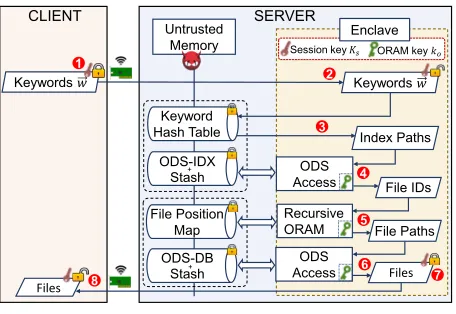
Figure 1. An overview of POSUPworkflow. Encrypted data structures (e.g.,ODS-IDX,ODS-DB) stored at the server’s untrusted memory are created by the client in the initialization phase (described in§4.1). 1–2: The client encrypts the (search/update) query with session key (Ks) and sends it to the enclave. 3–6: The
enclave performs oblivious accesses (e.g., ODS, recursive ORAM) on encrypted data structure components to retrieve/update files involved with the query. 7–8: The enclave encrypts the query results withKs and sends
back to the client.
the client can send a query to update data on the server or to search data and then receive the search results from the server.
The server comprises two parts: an untrusted server and a trusted enclave. (i) The untrusted server provides storage for recursive ORAM and ODS data structures. (ii) The enclave is a trusted part of the server and executes ORAM and ODS controller (while protected by IntelSGX). On behalf of the client, the enclave performs all oblivious search/update operations upon the client’s request on the encrypted data structures stored on the untrusted server. To do this, the enclave receives the encryption key ko
from the client via a secure channel at the initialization.
POSUP Workflow. Figure 1outlines the overview of oblivious search and update inPOSUP.
•Initialization: The client first performs the remote attestation of the enclave (provided by IntelSGX), which is running on the untrusted server. This attestation step not only verifies that the program running in the enclave is intact but also exchanges cryptographic keys (a session keyKs) to establish a secure
(encrypted) channel between the client and the enclave. After establishing the secure channel, the client also sends a keyko to the enclave, which will be used for ORAM operations.
Upon receiving the key, the enclave on the server will initialize encrypted data structures. Our
POSUPis composed of two main encrypted data structures: ODS-IDX, which is an encrypted index that
represents keyword-file relations, and ODS-DB, which stores encrypted files. Both data structures are stored in the server’s untrusted memory. We employ the ODS techniques proposed in [77] to instantiate
ODS-IDX and ODS-DB. This data structure initialization step happens only at the first connection. In other words, to perform search and update operations, the client requires only that a session key (Ks) be exchanged with the enclave.
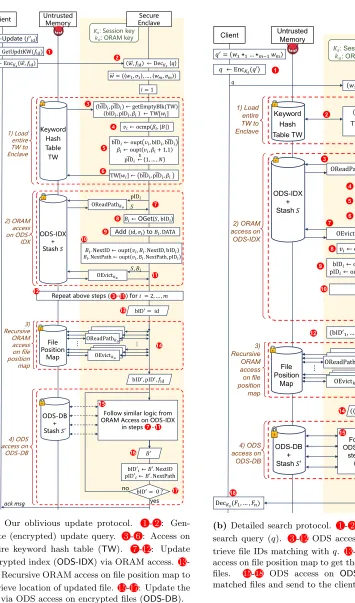
• Oblivious Search/Updates Queries: 1 The client encrypts the search (resp. update) query with the session keyKs, and sends it to the enclave (through the untrusted server). 2 Upon receiving the
encrypted query, the enclave decrypts it with Ks. 3 The enclave scans the entire keyword hash table1 to retrieve block IDs and their location (path) inODS-IDX that correspond to the query. 4 If the query is to search, the enclave performs ODS accesses onODS-IDX using the ORAM keyko to get matching
file IDs. 5 The enclave determines the location of file IDs in ODS-DB by executing recursive ORAM accesses with ORAM keykoon the file position map structure. 6 The enclave performs ODS accesses on
ODS-DBwithkoto retrieve file(s) associated with the query. 7 The enclave encrypts retrieved files with
Ksand sends them to the client. 8 The client recovers encrypted files withKs. The enclave performs the same procedure as search for handling the update query, where it first performs a keyword hash table scan and ODS accesses on ODS-IDX to update blocks in the encrypted index, followed by a recursive ORAM access on the file position map and an ODS access on ODS-DB to update file blocks in the encrypted files.
All these strategies enable us to achieve oblivious keyword search/update operations more efficiently than processing the entireODS-DBandODS-IDXin the enclave [25,73]. Our system is also more efficient than the direct application of existingSGX-ORAMmemory primitives [65] because we harness the ODS technique for both ODS-DBand ODS-IDX, which reduces the number of recursive calls when executing an oblivious keyword search/update query.
2.2
Threat Model
We buildPOSUPbased on the following assumptions as its threat model. The client is fully trusted and transfers only the ORAM encryption key ko to the enclave after establishing a secure channel with the enclave (Therefore, untrusted parts of server cannot obtain this key). To establish this secure channel, we rely on the remote attestation protocol provided by IntelSGX. Thus, we need a trusted authority (right now, it is Intel) for this remote attestation protocol; however, this does not have to be Intel if we utilize a different kind of secure enclave (e.g., Sanctum [18]). We assume the server is untrusted except for the enclave. Specifically, we do not trust any of the server’s logic that includes a virtual machine monitor, operating system and drivers, software that manages storage, etc. This is a general assumption for a system that utilizes an enclave because IntelSGXisolates and applies encryption to the enclave’s memory space using hardware mechanisms.
Side-channel attacks against Intel SGX. IntelSGXdoes not come without limitations; it suffers from various side-channel attacks in cache access [32, 49,10, 30], memory access [81, 11], registers [48], etc [80, 42]. Unfortunately, preventing side-channel attacks against IntelSGX entirely is a very chal-lenging task. Instead of makingPOSUP side-channel free, we aim only to make POSUPsecure against several known side-channel attacks on IntelSGX, which are mentioned above. For simplicity, we do not focus on securingPOSUPagainst size and timing information leakage, which can be easily achieved via padding. We refer the reader to§4.4for a more detailed discussion.
3
Building Blocks
3.1
ORAM
The security of ORAM can be defined as follows.
Definition 1(ORAMsecurity [71]). Let~x= (opi, ui,datai) q
i=1 be a data request sequence, where opi∈
{read(ui,datai),write(ui, datai)},ui is the logical address to be read/written and datai is the data at ui
to be read/written. LetAP(~x)be an access pattern observed by the server given data request sequence~x. An ORAM scheme is secureif for any two data request sequences ~xand~y of the same length, their access patterns AP(~x)andAP(~y) are (computationally or perfectly or statistically) indistinguishable.
Path-ORAM. Stefanov et al. proposedPath-ORAM[71], the most efficient and simple ORAM scheme,
access a block withPath-ORAM, the client retrieves its path fromposand then performs a read operation (ReadPath) on its path, in which all real blocks in the path are fetched into S. The client updates the retrieved block with a new random path inposand then performs an eviction operation (Evict) to push the blocks in S back to the read path such that each block resides somewhere in an intersection node between the read path and its assigned path toward the leaf. Notice that the pos component can be stored on the server in the form of smaller ORAMs via recursion [66,71]. InPath-ORAM, the stash size was proven to be upper-bounded by the security parameterλas |S|=O(λ) blocks, which characterizes the overflow probability and statistical security. We describe the detailed algorithms of Path-ORAM in the Appendix.
Circuit-ORAM. Circuit-ORAM [76] reduces the circuit complexity of Path-ORAM by minimizing the
number of blocks that are involved during read and eviction. Each bucket has meta-data that store the information about real blocks and their path ID.
Read: Similar to the original tree ORAM in [66], the client reads all data in the path, but keeps only the block of interest in the stash and removes it from the path. The removal process can be implemented efficiently by flipping only one bit in the bucket meta-data.
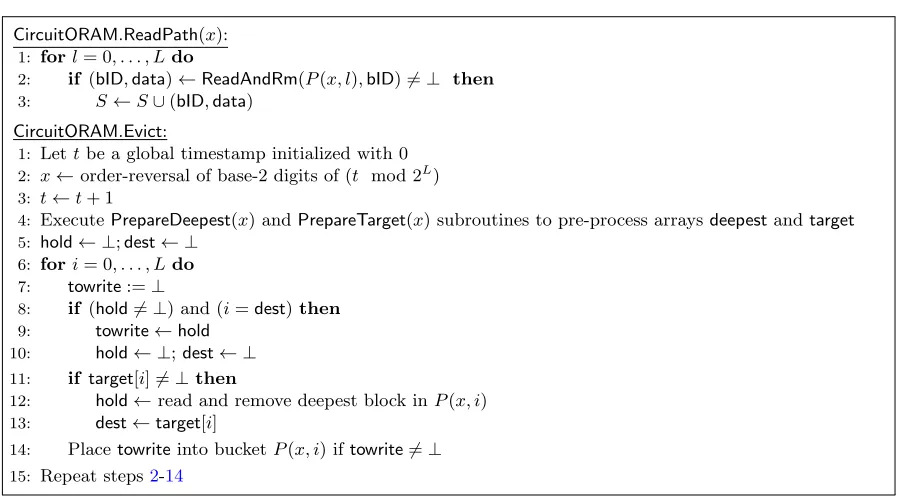
Eviction: The client prepares a list of blocks to be pushed down in the eviction path by scanning the meta-data of buckets in the path. The client picks one block in the stash (if any) that can be pushed to the deepest level of the tree and then traverses from the root to the leaf node. In each level, the client drops the on-hold block and picks at most one block to be put into a deeper level. For each data access, the client invokes two eviction procedures, with the eviction path being selected randomly or deterministically, as in [28] (see the Appendix for details).
Circuit-ORAM incurs approximately 1.25× more I/O accesses than Path-ORAM. However, it has a
smaller circuit size, and therefore, it is more efficient to be implemented with IntelSGX[65]. Circuit-ORAM
has a smaller bucket size (Z = 2 vs. Z = 4 in Path-ORAM) and, therefore, incurs less server storage. Similar toPath-ORAM, the stash size inCircuit-ORAM was proven to be upper-bounded by the security parameter, i.e.,|S|=O(λ) blocks.
3.2
System Building Blocks
We use IntelSGXas a trusted execution environment to protect the execution of theORAMcontroller on the untrusted server. We run the logic in an SGX enclave, which guarantees the isolation and confidentiality of its execution, to protect theORAMcontroller logic from attacks. We utilize the remote attestation protocol of IntelSGX to check the integrity of our logic and securely exchange/provision secret keys for storing ORAMdata structures, as well as to protect communication channels between the enclave and the client. We also implement our logic in the enclave using oblivious primitives in the Intel processor such asCMOV andSETEinstructions to prevent potential access pattern leakage.
As building blocks ofPOSUP, we utilize the following components of Intel SGX:
• Enclave: An enclave is a trusted execution unit of IntelSGX, and it is protected by isolation and integrity/confidentiality guarantees. IntelSGX isolates the enclave’s execution by providing a private memory called theenclave page cache(EPC), which resides in a reserved space in DRAM (the processor reserved memory, PRM) [17]. The EPC is isolated from the other software security domains bySGX’s hardware mechanism. Thus, SGX blocks any software attempt to read/write enclave’s memory from user-level as well as privileged-level (including operating systems and virtual machine monitor) attackers. Moreover, because SGX encrypts (with integrity check) the data before storing it on to DRAM, EPC stores only encrypted data on it. Therefore, any hardware attempt to read enclave’s memory will not leak any meaningful information, and any tampering to enclave’s memory will be detected (and then
SGXstops the enclave’ execution).
a measurement (i.e., hash of configurations, loaded program with a nonce, and a public key material for key exchange) of the enclave and signs it (with the quoting enclave’s key). This measurement will be submitted to the Intel Attestation Service (IAS) to verify the quoting enclave’s signature; the result will be signed by IAS and then will be delivered to the client. By verifying IAS’s signature on the result, the client ensures that a correct enclave is running on the server. The attestation message also includes public key parameters of the Diffie-Hellman key exchange of the client and the enclave so that a client can securely communicate with the enclave after this process, by encrypting data using the shared secret. •Privacy concerns on relying on Intel SGX: The root of trust of Intel SGX relies on an infrastructure provided by Intel (e.g., the Intel Attestation Service and the quoting enclave). Our current implementa-tion uses Intel SGX for its secure enclave; therefore, its privacy is bound to Intel’s discreimplementa-tion. However, we believe that this is just an implementation-specific issue and that the use of alternative open-source secure enclaves such as Sanctum [18] on the RISC-V architecture [79] could relax this restriction, e.g., by distributing trust over the Public Key Infrastructure (PKI), similar to how Transport Layer Security (SSL/TLS) works in practice.
•System calls: Because an enclave is a part of the user-level process, IntelSGXdoes not provide any protection on privileged operations such as system calls, e.g., file and network I/O, etc. Because such operations have to be performed by the untrusted OS, the enclave must encrypt data before transferring them to the OS. For example, a network communication between the client and the enclave should apply encryption to their connection, and a file write operation should store only encrypted data. For this purpose, Intel provides cryptographic libraries and tools for secure data migration between the enclave and the OS so the enclave can securely communicate across the security boundary if it is provisioned with a secret key for the encryption; this can be done securely via remote attestation.
Secure operations inside enclave. We implement oblivious assignment (oupt) and oblivious equality comparison (ocmp) functions based onCMOVandSETEinstructions proposed in prior works [62,57], which do not leak access patterns via control-flow side-channel attacks when POSUP executes the ORAM controller inside the enclave as follows.
• pred ←ocmp(x, y): It takes as input two values x, y, and outputs pred = 1 if x=y or pred = 0 otherwise.
• z ← oupt(pred, x, y): It takes as input two values x, y and a boolean pred. It assigns z ← y if
pred= 1, and z←xotherwise.
We refer interested readers to prior works [62, 57] for a detailed description of these functions. Note that ourocmpfunction slightly differs from what was originally proposed in [57], where we employSETE instead ofSETGinstruction for equality checking.
ZeroTrace [65] proposed OReadPath and OEvict, which are secure versions of ReadPath and Evict
tree-based ORAM functions, respectively, both of which are executed by the enclave without leaking side-channel access patterns. We implemented our version ofOReadPathandOEvict and refer readers to
ZeroTrace [65] for a detailed description. In OReadPathand OEvict, we scan the entire stash and path
and then useocmpandoupt to put real blocks from the path to the stash, or vice versa. This results in
Path-ORAMbeing more computation-expensive thanCircuit-ORAMas follows. SincePath-ORAMpushes
all real blocks from the path to the stash or vice-versa, itsOReadPathandOEvictincur two nested loops, where we must scan the entire stash for each path slot access to hide the access pattern. Circuit-ORAM
B←OGet(S,bID): 1: B←⊥
2: fori= 1, . . . ,|S|do 3: v←ocmp(S[i].bID,bID) 4: B←oupt(v, S[i], B) 5: returnB
ODS-IDX
Real file blocks ODS-DB
Real index blocks
Pointer to next block Pointer to next block
Block ID (bID) (pID)Path
1 1
2 4
Keyword Block ID(bID) (pID)Path Count(𝜎)
hello 1 2 15
world 2 3 8
Keyword position map File position map
(stored at the server recursively in small ORAMs) (stored at the server
in encrypted form)
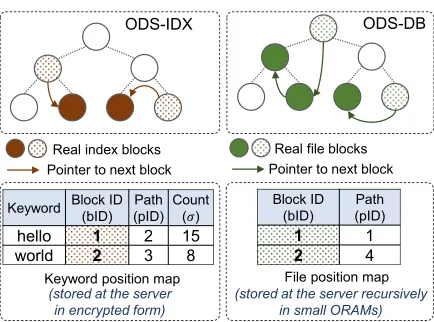
Figure 3. Illustration ofODS-IDXand ODS-DB packaged into ORAM tree inPOSUP. Blanked nodes denote dummy blocks, while colored nodes denote real file/index blocks. In colored nodes, pattern-filled nodes denote the head block of linked lists.
processes only one targeted block at a time and only incurs two separate loops that scan the entire path once to get target blocks and the entire stash. As a result, Circuit-ORAM is more computation-efficient
than Path-ORAM when dealing with a large dataset and large block size (see§6). We then implement
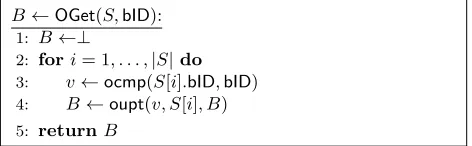
theOGetfunction (Figure 2), which reads a block ID from the stash S into the enclave without leaking access patterns viaocmpandoupt.
4
The Proposed Platform
We first describe the oblivious data structures in POSUP. We then present the oblivious search and update protocol in detail.
4.1
Oblivious Data Structures
Figure 3presents the overview ofODS-IDXandODS-DBinPOSUP. ODS-IDXandODS-DBfollow the tree ORAM paradigm in [66] becausePOSUP harnesses Path-ORAM and Circuit-ORAM as oblivious access cryptographic primitives. We create a search index (IDX) from a set of plaintext files (DB) and then packageIDXandDBintoODS-IDX,ODS-DB, respectively, as follows.
Encrypted index. We constructIDXas an inverted index, in which givenDBas the input, we extract unique keywords and associate each keywordwiwith the list of corresponding file IDsidijthatwiappears in as wi := idi1. . . ,idin
. We divide the list of each keyword in IDX into multiple chunks of the same size and package them into separate tree ORAM blocks. We use the pointer trick (i.e., linked list in [78]) to connect these blocks with each other, where the information of successive blocks is stored in their predecessors. Thus, each block is in the form ofB := bID,DATA,NextID,NextPath
, wherebIDis the block ID; DATA:= (hid1, σ1i, . . . ,hidn0, σn0i) is the block data, which contains a partial list of file IDs (id) as well as their state (σ ∈ {0,1}) indicating whether they are added or deleted; NextID and
NextPathare the ID and the path of the next block, respectively. Finally, we createODS-IDXby putting all constructed blocks into a tree ORAM structure.
ODS.Setup(DB): 1: B ← ∅;B0← ∅
2: W:= (w1. . . , wM)←Extract all unique keywords inDB
3: Construct inverted indexIDX← hwi, ~idiiMi=1, where~idi:= (hidi1,1i. . . ,hidin,1i) are file IDs containingwi
4: foreach filefi∈ F do
5: Splitfiintomichunks of size|B|
6: Bij.DATA←j-th chunk;Bij.pID
$
←−[2L]∀j∈[m]
7: forj= 1, . . . , mi−1do
8: Bij.NextID←Bij+1.bID 9: Bij.NextPath←Bij+1.pID 10: posf[Bi1.bID]←Bi1.pID 11: B ← B ∪ {Bi1, . . . , Bimi}
12: ODS-DB←BuildORAMTreeko(B)
13: BuildRecursiveORAM(posf) 14: foreach keywordwi∈ Wdo
15: id~i←IDX[wi]
16: Splitid~itom0i chunks (ci1, . . . , cim0i) each being of size|B
0|
17: B0ij.DATA←cij;Bij0 .pID
$
←−[2L0]∀j∈[m0] 18: forj= 1, . . . , m0i−1do
19: B0ij.NextID←Bij0+1.bID 20: B0j.NextPath←B
0
ij+1.pID 21: B0← B0∪ {
Bi01, . . . , B 0
im0
i}
22: ODS-IDX←BuildORAMTreeko(B
0 )
23: TW[wi]←(Bi1.bID, Bi1.pID,|ci1|) for eachwi∈ W
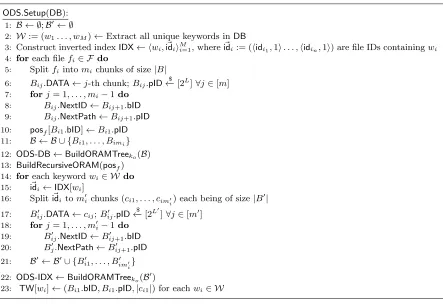
Figure 4. Setup procedure to construct oblivious data structures in our system. 2-3: Construct inverted index (IDX) from files (DB). 4-12: BuildODS-DBfromDB. 13: Build recursive ORAM structure for file position map (posf). 14-22: BuildODS-IDX fromIDX. 23: Build keyword hash table (TW). All data in ORAM structures
(12,22) are encrypted with ORAM keyko. B, B0 denote an ORAM block inODS-DBandODS-IDX, resp. Land
L0 denote the height ofODS-DBandODS-IDX, resp. |B|denotes the size ofB. [x] denotes{1, . . . , x}.
the access operation to thevaluecomponent inTWas (bID,pID, β)←TW[wi].
InPOSUP, we maintainTWunder the encrypted form in the storage server. This allows the client to
bestateless and easily extensible to the multi-client setting (see§4.3for further discussion). Since, to the best of our knowledge, there is no oblivious hash table mechanism, the enclave performs a linear scan on
TW for reading/writing component(s) in TW to hide the access pattern. Notice that recursive-ORAM might not be applied onTW because it requires deterministic indexes to operate, while keywords to be accessed are arbitrary.
Encrypted files. We apply the same principle as in the encrypted index construction to buildODS-DB
from DB. Since each file is organized into a linked list, we set B.bID=id, whereB is the first block in the list andidis the ID of the file thatB represents. Given that the size ofIDXis generally smaller than that ofDB, we build ODS-IDXand ODS-DBas two separate oblivious data structures, where the block size ofODS-IDX is smaller than that ofODS-DB.
We present the detailed algorithm to construct ODS-IDX and ODS-DB in Figure 4. We encrypt
ODS-IDXandODS-DBwith ORAM keykoand store bothODS-IDXandODS-DBon the server’s untrusted memory. The stash components required by underlying ORAM schemes are also encrypted withkoand stored in the server’s untrusted memory. They are loaded and decrypted in the enclave when needed.
4.2
Update and Search Protocols
Since search operations require us to clear stale data that might arise due to previous update operations, we first introduce the oblivious update protocol inPOSUPand then describe the oblivious search.
4.2.1 Oblivious Update
For simplicity, we assume that the file to be updated (fid) is already present at the client side. The
update operation incursfid to be added/deleted/modified fromEDB, and some keyword-file pairs to be
added/deleted fromEIDX. Intuitively, for each keyword (wi) to be updated infid, the client requests the
enclave to addidalong with the update state (add/delete) to an empty data slot in the head block of the linked list, which represents the search result ofwiinEDB. If there is no available slot, the enclave picks an empty block2 in EDB, adds update information into it and then links it with the current head block
of the linked list by updating itsNextIDandNextPathvalues. This strategy results in blocks close to the head of the list containing the latest updated file IDs. Figure 5a outlines the oblivious update protocol with the following details.
1) Update ODS-IDX: The client updates the file content, and forms a list of keywords (−→w) to be added or deleted in the updated file (fid) (1). The client encrypts the update query (q) containing id and
−
→w with Ks and sends it to the enclave. The enclave decrypts q with Ks (2) and then accesses the
entire keyword position map (TW) to retrieve the block ID (bID), path (pID), and current counter (β) of updated keywords (3). For each updated keyword (wi), the enclave checks whether there is an empty slot in the head block ofwi inODS-IDX(3). If this does not hold, the enclave gets the ID and the path of an empty block in ODS-IDX (5) and updates this block as the new head of the linked list of wi in
TW (6). Notice that POSUPperforms all comparison and update operations in the oblivious manner usingocmpandouptfunctions described in§3.2to prevent instructional leakage. Once the target block is determined, the enclave performs an ORAM access onODS-IDX to addidand the update state (σ) into it (7–11). Specifically, for each updated keyword (wi), the enclave first executesOReadPathwith path
pIDi (7) to fetch the block (Bi) of IDbIDi from ODS-IDX into the stash (S). Second, it readsBi from S viaOGet(8) and then addshid, σito the block data (Bi.DATA) (9). If Bi was previously empty, it updates the pointer ofBito link it with the current block head ofwi(10). Finally, the enclave performs
OEvictto write the updatedBiback to ODS-IDX(11).
2) Update ODS-DB: Given the ID (id) of the updated file (13), the enclave executes recursive ORAM accesses on the file position map to retrieve the location of id in ODS-DB (14). The enclave splits the updated filefid into several chunks and then executes ODS access onODS-DBto update the ORAM data
blocks in the linked list offid with these chunks (15–17).
We can see that the deletion in POSUP does not actually delete some real data in ODS-IDX but instead performs addition with the state bit (σ = 0). This lazy deletion enables the efficient update, which only requiresO(1) access on the encrypted index compared withO(r) in the actual deletion due to the search, whereris the number of files in which the updated keyword appears. The price to pay for this efficiency is the cost of increasing theactual size of the search index and the search complexity. To mitigate this impact, afterk (system parameter) successive updates,POSUPperforms a dummy search on the most frequently updated keyword to do garbage collection, since the search operation in POSUP
will clear stale data appearing in blocks toward the tail of the linked list, as described in the next section.
𝐾𝑠: Session key
𝑘𝑜: ORAM key
Client Untrusted Memory
𝑤,𝑓id ←Dec𝐾𝑠(𝑞)
𝐵𝑖←OGet(𝑆,bID𝑖)
Add (id,𝜎𝑖)to𝐵𝑖. DATA OReadPath𝑘𝑜 𝑆
pID𝑖
OEvict𝑘𝑜
7 8 ODS-IDX + Stash𝑆 ODS-DB + Stash𝑆′ 𝑆,𝐵𝑖 File Position Map
⋮ OReadPath𝑘𝑜 ⋮
OEvict OEvict
OEvict𝑘𝑜
bID′, pID′,𝑓id 1 2) ORAM access on ODS-IDX 3) Recursive ORAM access on file position map 4) ODS access on ODS-DB Secure Enclave
𝑤 ←GetUpdtKW(𝑓id)
𝑓id←Update (𝑓′id)
𝑞 ←Enc𝐾𝑠𝑤,𝑓id
bID′= id
Keyword Hash Table TW
(bID�𝑖, pID�𝑖)←getEmptyBlk(TW) bID𝑖, pID𝑖,𝛽𝑖 ←TW[𝑤𝑖]
bID�𝑖←oupt𝑣𝑖, bID𝑖, bID�𝑖
𝛽𝑖←oupt𝑣𝑖,𝛽𝑖+ 1,1 pID�𝑖←$ 1, … ,𝑁
𝑣𝑖←ocmp(𝛽𝑖, |𝐵|)
TW𝑤𝑖 ← bID�𝑖, pID�𝑖,𝛽𝑖
𝑤= 𝑤1,𝜎1, … ,𝑤𝑚,𝜎𝑚
𝐵𝑖. NextID←oupt𝑣𝑖,𝐵𝑖. NextID, bID𝑖
𝐵𝑖. NextPath←oupt𝑣𝑖,𝐵𝑖. NextPath, pID𝑖
Follow similar logic from ORAM Access on ODS-IDX
in steps
-no
bID′𝑖← 𝐵′. NextID pID′𝑖← 𝐵′. NextPath
𝐵′ yes 1) Load entire TW to Enclave ack msg
𝑖= 1
Repeat above steps ( - ) for 𝑖 = 2, … ,𝑚 2 3 4 5 6 9 10 11 13 14 15 16 17 bID′= 0 ? 3 11
7 11 12
(a) Our oblivious update protocol. 1-2: Gen-erate (encrypted) update query. 3-6: Access on entire keyword hash table (TW). 7-12: Update encrypted index (ODS-IDX) via ORAM access.13
-14: Recursive ORAM access on file position map to retrieve location of updated file. 15-17: Update the file via ODS access on encrypted files (ODS-DB).
𝐾𝑠: Session key 𝑘𝑜: ORAM key
Client Untrusted Memory
OReadPath𝑘𝑜 𝑆 pID𝑖
OEvict𝑘𝑜
ODS-IDX + Stash𝑆 ODS-DB + Stash𝑆′ 𝑆,𝐵 File Position Map
⋮ OReadPath𝑘𝑜 ⋮ OEvict OEvict
OEvict𝑘𝑜 1 2) ORAM access on ODS-IDX 3) Recursive ORAM access on file position map 4) ODS access on ODS-DB Secure Enclave Keyword Hash Table TW
Follow similar logic from ODS Access on ODS-IDX in
steps - for each pair
bID𝑖′, pID𝑖′, 1≤ 𝑖 ≤ 𝑛
1) Load entire TW to Enclave 2 11 13 14 15 16
𝑞 ←Enc𝐾𝑠(𝑞′)
𝑞′= 𝑤1⋆1…⋆𝑚−1𝑤𝑚
𝑞 𝑤
1⋆1…⋆𝑚−1𝑤𝑚 ←Dec𝐾𝑠(𝑞)
bID𝑖, pID𝑖 ←TW[𝑤𝑖] TW𝑤𝑖. pID𝑖←$ 1, … ,𝑁
(for 1≤ 𝑖 ≤ 𝑚)
𝐵𝑖←OGet(𝑆,bID𝑖)
Update block 𝐵𝑖
Add 𝐵𝑖.DATA to 𝑅𝑖
𝑖=𝑚? bID𝑖←oupt𝑣𝑖,𝐵𝑖. NextID, bID𝑖+1
pID𝑖←oupt𝑣𝑖,𝐵𝑖. NextPath, pID𝑖+1 𝑣𝑖←ocmp(𝐵𝑖. NextID, 0)
bID′
1, … , bID𝑛′ ←(𝑅1⋆1…⋆𝑚−1𝑅𝑚) 12
bID1′, pID1′, … , bIDn′, pID𝑛′
𝐹1, … ,𝐹𝑛
Enc𝐾𝑠𝐹1, … ,𝐹𝑛 Dec𝐾𝑠(𝐹1, … ,𝐹𝑛)
3 4 5 6 7 8 9 17 18 yes no 𝑖 ←oupt𝑣𝑖,𝑖,𝑖+ 1
10
3 11
(b) Detailed search protocol. 1-2 Generate encrypted search query (q). 3-12ODS access on ODS-IDXto re-trieve file IDs matching withq. 13-14Recursive ORAM access on file position map to get the location of matched files. 15-18 ODS access on ODS-DB to retrieve all matched files and send to the client.
4.2.2 Oblivious Search
Figure 5bpresents the oblivious search protocol inPOSUP. First, the client executes the remote attesta-tion protocol with the enclave to establish a secure communicaattesta-tion channel with a session key (Ks). The
client then encrypts the search query of the formq=w1?1· · ·?m−1wmwithKs, where?i∈ {∨,∧}(1)
and sends it to the enclave. The enclave decryptsqwithKsto obtain the list of searched keywords (wi)
and performs the following operations.
1) Access on keyword hash table (TW):The enclave scansTWentirely to get the block ID (bIDi) and its
path (pIDi) in the index (ODS-IDX) of eachwi (2).
2) ODS access onODS-IDX:For eachhbIDi,pIDiipair, the enclave performs an ODS access onODS-IDX
(containing multiple ORAM accesses) to retrieve all blocks in the linked list, all of which form the entire list of file IDs (Ri) matchingwi (3–11). According to our update strategy (see§4.2.1), blocks toward the head of the oblivious linked list will contain file IDs with themost up-to-date update state. Hence, during the block update operation (5), the enclave will clear stale file IDs in the accessed block if they are already present inRi, or their most recent update status is “delete.” Once the block becomes empty (meaning it does not contain any file IDs left), the enclave will store its ID in the empty list inTWso that it can be re-used later in the update operation. After the block is accessed with ORAM, the enclave determines if it links with another block via ocmp (8). If this holds, the enclave gets the next block information (9) and continues the oblivious access as above. Otherwise, it processes the next searched keyword (10).
Note that we perform all these conditional checks and processing in an oblivious manner viaocmpand
ouptfunctions. This preventsPOSUPfrom leaking the information regarding size of individual searched keywords (11) but only the total amount of data that are processed due to the search query.
3) Recursive ORAM access on file position map: After the file IDs (stored inRi) of each keywordwiare
retrieved, the enclave performs union/intersection onRi according to ?i to get the final list of file IDs matchingq(12)3. For each blockbID0iin the joint list, the enclave performs recursive ORAM access (13) on the file position map structure to retrieve the corresponding pathpID0i ofbID0 in ODS-DB(14).
4) ODS access onODS-DB: The enclave performs a sequence of ODS accesses onODS-DBwith the same logic asODS-IDX accesses to retrieve the file content of eachbID0i (15–16). Finally, the enclave encrypts all the retrieved files with the session keyKs (17), and sends them to the client for decryption (18).
Discussion. One might observe that although POSUP can support boolean queries, the strategy we have applied is simple, in which we conduct an oblivious search on each keyword present in the query first, followed by taking the union/ intersection over all the search results. This trivial strategy is not (sub)optimal and might be inefficient for some complex boolean forms, in which each keyword appears in a large proportion of databases, but the final combination only returns a few results. Nonetheless, our main focus in this paper is to demonstrate the effectiveness of using secure hardware to improve the performance of searchable encryption and ORAM composition in practice. Therefore, we build the
POSUPplatform by leveraging a simple oblivious data structure in the form of a single linked list, which seems only optimal for single keyword queries and efficient update. We leave the POSUPoptimization for other query functionalities (e.g., ranked query, conjunctive query) as open research questions.
Another limitation of POSUPis the linear scan of the keyword hash table in the enclave due to our collision concern when obliviously mapping arbitrary keywords to a finite set (block IDs). To improve this, one might consider usingthe power of two choices hashing technique [64] to minimize the collision probability, thereby enabling (recursive) ORAM operations atop the keyword hash table. We will also leave this as an open research question to be investigated in the future work.
4.3
Extension to Multi-user Setting
InPOSUP, the client is stateless. Thus, it is easy to extendPOSUPinto the multi-user setting including a data owner (who ownsnoutsourced files), a storage server, andkusers (who want to search/update on
nfiles) as follows. The data owner creates an access control data structure (ACDS) to grant permission (e.g., search/update) forkusers onnfiles. The data owner encrypts and sendsACDSto the enclave, along with the encrypted index (ODS-DB) and encrypted files (ODS-DB) that are constructed, as described in
§4.1, all of which are stored in the server’s untrusted memory (e.g., SSD).
Given that a user wants to search for a keyword, he/she will authenticate with the enclave using, for example, the user identifier and password. If authenticated, the enclave performs oblivious access on
ODS-IDX (as described in §4.2.2) to obtain file IDs matching the query. For each file ID, the enclave accesses ACDS with ORAM to check whether the user has the read permission on the file. If so, the enclave performs oblivious access on ODS-DB to retrieve the file and sends it to the user. The same principle applies to the file update procedure. Roughly speaking, the enclave first authenticates the user and then obliviously accessesACDSto check whether the user has the update permission on the file. If permitted, the enclave executes the oblivious update protocol as presented in§4.2.1.
4.4
Security
ODS and ORAM. We design and buildPOSUPby using ODS and ORAM, and therefore, its security
is inherited from the security of these tools. Specifically, these tools guarantee that POSUP hides all access patterns onODS-IDX andODS-DB, given that they have the same length as inDefinition 1.
In POSUP, we can observe from Figure 5a and Figure 5b that search and update operations incur
the same oblivious access procedures on encrypted data structures. In particular, given a search/update query, the enclave first performs (i) access on the entire keyword hash table and then, (ii) ODS access(es) onODS-IDX, followed by (iii) recursive ORAM access(es) on the file position map, and finally (iv) ODS access(es) onODS-DB. In the update protocol, add and delete operations also invoke the same oblivious access procedure, where they differ from each other only in terms of the state bit value (σ), which is encrypted in the view of the attacker. Hence, in general, any search/update queries that are of thesame
size and incur thesamenumber of (recursive) ORAM and ODS accesses areindistinguishable.
Size information leakage. Since ORAM and our linked list ODS do not hide the number of oblivious accesses, POSUP might leak the size of the query, which can allow the attacker to distinguish access patterns, thereby learning information about the query. The size information can be inferred in several points when the enclave performs oblivious operations as follows. In the search protocol (Figure 5b), the size can be learned by an attacker from (i) the search query (1); (ii) the number of accesses on the keyword hash table (2) and the encrypted index (11,12); (iii) the number of recursive ORAM accesses on the file position map (13,14) and encrypted files (16); (iv) and the result returned to the client (17). Similarly, in the update protocol (Figure 5a), the size can be leaked from the update query (1,2), or the number of accesses on encrypted data structures (12,17).
To mitigate the impact of size leakage, we can apply padding to all aforementioned positions. For instance, for the query that requires less than n0 total ORAM accesses, one can add dummy ORAM accesses on bothODS-IDXandODS-DB, and dummy recursive ORAM accesses on the file position map to quantize the total number to be n0, thus making the query size indistinguishable by the attacker. We can further apply padding to obfuscate the actual size of the search/update query as well as the size of (search) results being sent from the enclave to the client at the end of the protocol. However, we notice that such padding strategies are generally application-specific, which fully depends on the characteristics of a particular dataset and user preferences, and also might incur heavy bandwidth and processing overhead as the trade-off. This is because padding will increase the cost of oblivious operations less thann0 (suppose the number of required operations isn) to be equal to that ofn0 actual operations (wheren0> n). We refer the reader to Ryoan [36] for its parts of data-oblivious communication as well as quantizing processing time to learn more on how the size quantization by padding can thwart such a side channel attack.
seems to be a very difficult task; instead, we try to build POSUPas a best-effort approach to make it secure against known side-channel attacks. The use of recursive ORAM and ODS in POSUPnaturally defeats side-channel attacks on data access patterns such as cache side-channel attacks [32, 10, 30]. Employing oblivious data comparison (ocmp) and oblivious data assignment (oupt) inPOSUP(see§3.2) defeats attacks on the control-flow side channel [49,81,11] because these primitives eliminate conditional branches on processing secrets. Therefore, such attacks cannot measure a difference in control-flow for different secrets.
5
Implementation
We implemented POSUPwith C/C++ using the IntelSGXSDK v1.7. Our implementation contains a total of around 4.9K lines of code for trusted and untrusted modules. For cryptographic operations inside the enclave, we leveraged IntelSGXSDK library functions includingsgx aes ctr encryptfor encrypting ORAM with AES-CTR mode andsgx read randfor pseudo-random number generation. We implemented
Path-ORAMandCircuit-ORAMcontrollers in an enclave to execute ODS access onODS-DBandODS-IDX.
As mentioned in§4, our platform storesORAMstashes encrypted in the untrusted memory (RAM/SSD), and they are loaded into the enclave when needed.
6
Evaluation
We first describe our configuration and evaluation methodology, followed by the main experimental results.
6.1
Configuration and Methodology
Hardware. We evaluated the performance of our system on a commodity HP Desktop, which supports IntelSGXand is equipped with Intel E3-1230 v5 @ 3.4 GHz CPU, 16 GB RAM and 512 GB SSD.
Dataset. Our dataset is the full Wikipedia English corpusenwiki v.20180120. To extract text data from the corpus, we used WikiExtractor [5] Python script and extracted 5,554,594 distinct text-only articles (i.e., files in our term) fromenwiki. To collect the keywords for the search, we implemented a standard tokenization method to extract unique alphabetical and non-alphabetical keywords from the dataset. The total number of unique keywords in the dataset is 7,075,917 and the total number of keyword-file pairs is 863,782,383. The total size of the database (DB) is 27 GB (on the disk), and the total size of the search index (IDX) is 6.9 GB.Figure 6presents the size distribution of text articles in theenwikidataset.
Network. To assume a general use case of a mobile client and a cloud server, we use Wi-Fi as the communication channel between the client and the server and then mimic the bandwidth and latency of using Amazon EC2 from our lab. The average network latency and transmission throughput are 18 ms and 150 Mbps, respectively.
Configurations and Methodology. We comparePOSUPwith the implementation of existing designs, namely ORAM-SE and EntireSGX. The following represents the configuration of each implementation and how we compare each withPOSUP.
•POSUPconfiguration We constructedODS-IDXandODS-DBwith ORAM tree structures with 24 and 23 levels, respectively, to store the entire files (7,075,917 ≤223). Because more than 50% of files in our
20 22 24 26 28 210 212 214 216 218 220 1
0.9
0.8
0.7
0.6
0.5
0.4
0.3
0.2
0.1
0
File size (bytes) in log scale
F
raction
of
files
Figure 6. File size distribution inenwiki dataset in CDF. An (x, y) point denotes thatyfraction of files are sized larger thanxbytes. Based on this distribution, we choose the block size ofODS-DBas 3 KB because more than 50% of files are smaller than 3 KB.
• ORAM-ODS-SE - Direct ORAM-SE composition in a traditional client-server model (without secure hardware). In this setting, we used the same configuration as in POSUP, where we integrate ODS into the ORAM-SE composition for fair comparison with POSUP. We also set the size of ODS-IDX
and ODS-DB to be identical toPOSUP. ORAM-ODS-SE differs from POSUPin terms of the ORAM communication channel (over network vs. local bus) and the keyword position map location (client vs.
server). For the ORAM scheme, we employedPath-ORAM forORAM-ODS-SE because it requires less access to ORAM, so it is more efficient than Circuit-ORAM in the conventional client-server network setting. For the evaluation, we measured all delays when a client is accessing ODS and recursive ORAM onODS-IDX and ODS-DBstored on the Amazon EC2 with the above network throughput and latency (18 ms and 150 Mbps). Note that our analysis isconservative, because we tend not to take into account the impact of side factors (e.g., disk I/O).
• EntireSGX - Processing the entire outsourced data in Intel SGX. We measured the search delay by decrypting the entireEIDX andEDBinside the enclave. We used the maximum heap size (i.e., 95 MB) allowed to the enclave to subsequently decryptEIDX and EDBto maximize its performance. In other words,EIDX andEDBare loaded and processed (decrypt/encrypt) in 95 MB chunks sequentially inside the enclave. For the update cost, we measured the delay of decryption and re-encryption of the entire
EIDXandEDBinside the enclave. Notice that inPOSUP, we selected the size ofODS-IDXandODS-DB
that have sufficient empty spaces for later addition of the same amount of dataset size in the setup phase (i.e., 27 GB file with 6.9 GB index). Hence, we double the size ofEIDXandEDBinEntireSGXto assume it can also support addition, similar toPOSUP, for fair comparison between two techniques.
6.2
Experiment Results
6.2.1 Micro Benchmark
POSUPis efficient, where it takes less than 1 ms to access a 3 KB block inCircuit-ORAM-sized 107 GB.
Table 1. Execution time of a single ODS onODS-IDXandODS-DB, and recursive ORAM on file position map inPOSUP. We ran each operation 500 times and took the average value.
Operation Execution Time (µs)
Path-ORAM Circuit-ORAM
ODS access on ODS-IDX
I/O Access 134 144
Enclave Process 2,362 686
Total 2,496 830
ODS access on ODS-DB
I/O Access 156 285
Enclave Process 3,909 746
Total 4,065 1,031
Recursive ORAM on file position map
I/O Access 34 41
Enclave Process 13,246 4,631
Total 13,280 4,672
to secure ORAM operations, such as applying encryption and decryption on the data (i.e., encryption overhead); (iii) the amount of data to be processed in each ODS operation on ODS-IDX and ODS-DB, expressed as:
DODS=H· |B| ·Z·k (1)
where H and |B| are the height and block size of ODS-IDX (or ODS-DB), respectively; and (Z, k) = (4,2) are the bucket size and the number of read/write operations in Path-ORAM, respectively. When
Circuit-ORAM is used, (Z, k) = (2,5). The amount of data (in bytes) to be processed for each recursive ORAM on the file position mapposf is:
Dposf =
l
X
i=1
|B| ·Z·k·log2
N
Ri
+ 1, (2)
where N is the total number of files, R = |B|/4 is the compression ratio (assume that a path ID is represented by 4 bytes) andl=blogRNc.
Table 1presents the execution time of each ODS access onODS-IDXandODS-DBand recursive ORAM on posf in our current configuration. Note that the performance changes for the different parameter configurations (e.g., for a differentH,|B|,Z, ork) according to Equation 1andEquation 2.
I/O Access. The I/O access in POSUP is efficient because we implemented the caching technique proposed in [51], where we cache the first K levels of the ORAM tree structures on the RAM. In this experiment, we used 4 GB of memory to cache 2/3 levels of bothODS-IDX and ODS-DB, which signif-icantly reduced I/O delay from 520-767µs to≤285µs. Compared to Path-ORAM, Circuit-ORAM incurs 1.25×more I/O access, and therefore, its I/O latency is slightly higher than that ofPath-ORAM. Because the recursive ORAM structure of the file position map is small (i.e.,≈0.2 GB), we store the entire map directly on the RAM. This results in its I/O access delay being negligible (i.e.,≤41µs).
Enclave Process. Processing data in the enclave has more effect on the access delay than I/O access because it handles encryption and decryption when reading data from ORAM. Another point that we observed from Table 1 is that the cost of executing the Path-ORAM controller in the enclave is much higher than that ofCircuit-ORAM because its read/eviction is more aggressive. Specifically, when using
with secure hardware is much less efficient than Circuit-ORAM due to the multiplied factor |S|, which is 80. The processing delay of recursive ORAM is high because this requires the enclave to perform additional ORAM encryptions and decryptions onO(logN) recursion levels. Table 1also illustrates that it takes 830µs to obliviously access a 512 B block inODS-IDX withCircuit-ORAM. That is, the latencies of performing single-keyword searches on ODS-IDX in many cases are likely similar to each other, and they are mostly dominated by the number of files to be returned (see§6.2.2).
We now illustrate the formula for calculating the number of ODS and recursive ORAM accesses incurred in each search and update query. Given a search queryqwithnkeywordswi, letmi andm0 be the number of files matchingwi and the finalq, respectively. The searchqonPOSUPincursP
n i=1d
mi
|B|e accesses on ODS-IDX plus m0 recursive ORAM accesses on posf and plus
Pm0
i=1d
|fi|
|B0|e accesses on
ODS-DB, whereB, B0 are block sizes ofODS-IDX andODS-DB, respectively, and|fi|is the size of filefi
in m0 files. Given an updated filef withmupdated keywords in it, the cost ism accesses onODS-IDX
plus one recursive ORAM access onposf plusd||Bf||eaccesses on ODS-DB.
Because the delay in I/O access and encryption in an enclave is stable (i.e., does not change between accesses), our measurement of the actual search and update delay inPOSUPrespected the above formulas and the micro benchmark in Table 1. Moreover, as explained in §4.1, each search/update operation
in POSUPadditionally incurs one-time decryption and re-encryption of the entire keyword hash table
(TW), which costs 210 ms for 188 MB-sized TWconstructed from theenwikidataset.
In the following, we present actual benchmarked delay for search and update operations to showcase the efficiency of our system compared with other techniques.
6.2.2 Search Delay
POSUPconsumes 100×less network bandwidth and requires 1,000×fewer communication round-trips
thanORAM-ODS-SE.POSUPincurs 4.5×- 245×less processing time in the enclave thanEntireSGXfor returning < 212 files as the search result, which falls in > 99.5% fraction of keywords that can be
searched in our dataset. This results in the search delay ofPOSUPbeing up-to 74×and 232×lower
thanORAM-ODS-SEandEntireSGX, respectively.
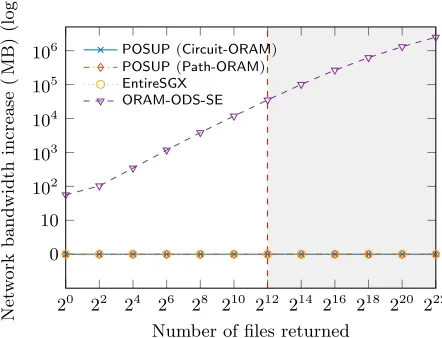
Figure 7a presents the end-to-end delay of processing a keyword search query inPOSUP, compared
withORAM-ODS-SEand EntireSGXtechniques. POSUP(the blue line) is hundreds of times faster than
ORAM-ODS-SE(the purple line) for any search query being performed. This is mainly because POSUP
performs ORAM-controlling operations in an enclave, so it does not incur significant network communi-cation overhead like ORAM-ODS-SE, as shown inFigure 7b; instead, the enclave reads a large amount of data from the memory, which is faster and cheaper than accessing over the network. ORAM-ODS-SE
incurs overhead not only in bandwidth (i.e., 100× more than POSUP) but also in generating a large number of network round-trips (i.e., 1000×more than POSUP) due to multiple rounds incurred in the recursive ORAM and ODS operations. This is the main bottleneck of ORAM-ODS-SE, given that the network latency is hard to improve in practice.
When compared with EntireSGX, POSUP is one to two orders of magnitude faster than EntireSGX
for more than 99.5% of keywords that can be searched. In Figure 7a, when searching keywords that returns ≤ 212 files, POSUP is more efficient than EntireSGX. Figure 7c presents the (accumulative)
keyword distribution onenwiki. The Zipf’s law distribution [56] shown inFigure 7cindicates that the cases returning ≤ 212 files are the majority (99.5%), and this indicates that POSUP is more efficient
thanEntireSGXfor a large fraction of keywords in practice. This is because the enclave in POSUPonly
works with a small amount of data perORAMaccess, whileEntireSGXworks with the entire index and dataset as its working set, as presented in Figure 7d. For a small fraction of keywords (< 0.5%), the end-to-end delay of POSUPis slower than that ofEntireSGX.This is because a large number of ORAM and ODS accesses on ODS-IDX and ODS-DB require data processing in enclave more than processing the entire dataset. The cost of executingPath-ORAM and Circuit-ORAM in POSUP is C·r·8 log2(N) and C·r·10 log2N, respectively, where r is the number of file blocks matched with the search query,
20 22 24 26 28 210 212 214 216 218 220 222 103
105 107 109
Number of files returned
Dela
y
(ms)
(log)
POSUP(Circuit-ORAM)
POSUP(Path-ORAM)
EntireSGX
ORAM-ODS-SE
(a) End-to-end delay in POSUPand its counterparts regarding how many files are returned in a single-keyword search.
20 22 24 26 28 210 212 214 216 218 220 222 0 10 102 103 104 105 106
Number of files returned
Net w ork bandwidth increase ( MB) (log)
POSUP(Circuit-ORAM)
POSUP(Path-ORAM)
EntireSGX
ORAM-ODS-SE
(b) Network bandwidth increase of POSUP and its counterparts. Hardware-assisted techniques do not in-cur network overhead.
20 22 24 26 28 210 212 214 216 218 220 222 0.1
0.2 0.3 0.4 0.5 0.6 0.7 0.8 0.9 1
99.5%
Number of files returned
F raction of k eyw ords (CCDF)
(c)Keyword distribution inenwikidataset. An (x, y) point denotes that y fraction of keywords appear in less thanxfiles.
20 22 24 26 28 210 212 214 216 218 220 222 0 10 102 103 104 105 106 107
Number of files returned
Amoun t of da ta ( MB)
(log) POSUP(Circuit-ORAM)
POSUP(Path-ORAM)
EntireSGX
ORAM-ODS-SE
(d) Amount of data being accessed and processed by SGXofPOSUPand its counterparts.
Figure 7. Detailed search delay of POSUP and its counterparts. In (a), the delay ofPOSUP and EntireSGX was included with the time to transmit files to the client with 150 Mbps network throughput and 18 ms latency. POSUPis more efficient than bothEntireSGXandORAM-ODS-SEfor 99.5% of keywords, as indicated by thered dashed lines.
that ifr≥ N
C·k·log2N, wherek∈ {8,10}, then processing the entire database in the enclave is better than
performing ORAM. Our benchmark result in Figure 7a respects this formula. Theoretically, POSUP
should incur more memory accesses than accessing the entire memory when it processes more than 215
files. The graph shows that overhead start to become significant when 213 files are returned, we can
assume the constantCas 4, and thenPOSUPprocesses more than N
4·k·log2N file blocks in the enclave.
20 22 24 26 28 210 212 214 102
103 104 105 106 107
Number of updated keywords
Dela
y
(ms)
(log)
POSUP(Circuit-ORAM)
POSUP(Path-ORAM)
EntireSGX
ORAM-ODS-SE
Figure 8. End-to-end delay of updating a 290 KB file with a different number of updated keywords involved.
6.2.3 Update Delay
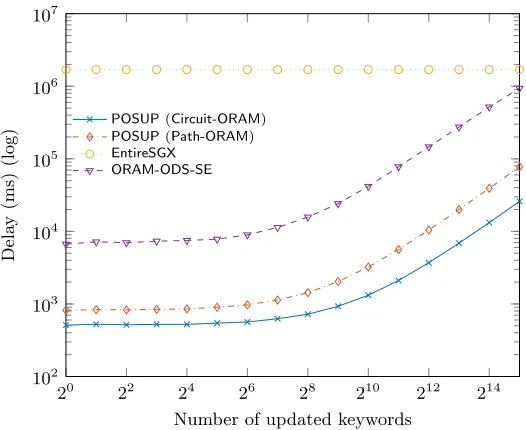
The update delay of POSUP is 40× lower than ORAM-ODS-SE. This is because of the network bandwidth and round-trip overhead ofORAM-ODS-SE, as discussed in§6.2.2.
We selected the file with the largest size (i.e., 290 KB) inenwikiand performed the update benchmark on that file for a different number of unique keywords that can be updated (add/delete) in it. Figure 8
presents the end-to-end update delay ofPOSUPand its counterparts. POSUPis one order of magnitude faster (40×) than ORAM-ODS-SE because it does not increase bandwidth and round-trip overhead, as analyzed in§6.2.2. POSUPwithCircuit-ORAM produces the highest throughput so that it achieves the lowest update delay among its counterparts. POSUPis up to 3,300×faster thanEntireSGXdue to the inevitable overhead in I/O writing required by the design ofEntireSGX. An update inEntireSGXrequires re-encrypting the entire data and write them back to the disk. Therefore, the update delay ofPOSUPis
three orders of magnitudefaster thanEntireSGX.
6.2.4 Storage Overhead
The server storage overhead of EntireSGX is more efficient than that of POSUP and ORAM-ODS-SE. This is because, inPOSUP andORAM-ODS-SE, IDX and EDBare arranged as tree-ORAM structures, which incur a constant (e.g., 1.5×-2×) size blowup. Specifically, the total server storage of POSUPis |TW|+|ODS-IDX|+|ODS-DB|+|posf|= 0.19 + 34 + 97 + 0.19≈131 GB ifPOSUPusesCircuit-ORAM. The corresponding overhead is 0.19 + 68 + 194 + 0.38≈262 GB ifPOSUPusesPath-ORAM. Note that some capacity of the ORAM structure is reserved to enable oblivious update (e.g., addition/deletion). Therefore, our server storage overhead presented above can allow the further addition of 3× more IDX
andDBpresented in§6.1.
7
Related Work
[12, 72, 75]) and security (e.g., [16, 46]). Kamara et al. [44] proposed a Dynamic SSE (DSSE) scheme that supports update functionality. Afterward, several DSSE schemes proposed offering different features in terms of security (e.g., [9]), efficiency (e.g., [14,45, 22]), and query functionalities (e.g., [15, 43,74]). Another line of research focuses on developing encrypted query techniques that are compliant with legacy systems. For instance, ShadowCrypt [33] and Mimesis Aegis [47, 41] propose encrypted search/update operations as an intermediate cryptographic service layer, which allows the client to interact with online applications without modifying server infrastructure. CryptDB [59] and its variants (e.g., [4,1,2,58,60]) leverage property-preserving encryptions (e.g., [8,6]) to perform encrypted structured queries (e.g., SQL) to legacy database management systems (e.g., MongoDB).
Security vulnerability of encrypted search solutions. All the aforementioned techniques leak
access pattern, which results in various types of statistical inference attacks. For instance, by exploit-ing access pattern leakages in DSSE, it is possible to determine which keyword has been searched with high probability (e.g., [40,50,82,13]). The legacy-compatible encrypted search techniques leak substan-tial additional information beyond the access pattern because of property-preserving encryption tech-niques [54,31,13, 61].
Solutions to remedy security vulnerabilities. ORAM [29] can hide both read and write access patterns, and therefore, it has been considered to seal such leakages in oblivious storage [70, 7, 69] and searchable encryption [26, 53]. Despite its merits, ORAM incurs a poly-logarithmic bandwidth blowup [71,76], which has been shown to be costly for searchable encryption in the standard client-server network setting [53,68,7]. Although ORAMs with constant client-server bandwidth blowups have been proposed recently (e.g., [20, 34]), they either incur higher delay than bandwidth-logarithmic ORAMs because of homomorphic encryption (e.g., [27]), or require multiple computing servers, which increases the deployment cost in practice.
The ORAM communication lower bound has been well-established [29, 76]. Thus, recent studies start to look for the support of secure hardware to make ORAM for client-server applications more practical. The idea of ORAM and secure-hardware composition was first suggested by concurrent studies in [51, 24, 63]. With the advent of widely available trusted execution environments on commodity hardware (e.g., Intel SGX), the deployment of hardware-supported cryptographic primitives has become more feasible. For instance,ZeroTrace[65] and Obliviate [3] leveraged IntelSGXwith ORAM to enable oblivious memory primitives and file access operations, respectively. IntelSGXwas also used to design a functional encryption framework in [23]. Eskandarian and Zaharia proposed ObliDB [21], which harnesses IntelSGXandPath-ORAMto enable oblivious SQL queries on database systems. Concurrent with this work, Mishra et al. proposed Oblix [52], an oblivious search and update platform that harnesses Intel
SGX,Path-ORAMand oblivious data structures as similar toPOSUP.
8
Conclusion
In this paper, we developed a newSGX-supported oblivious search and update platform calledPOSUP. We achieved this by realizing efficientSGX-assisted oblivious data structures that enable practical obliv-ious search and update operations. We implemented and deployedPOSUPon commodity hardware and evaluated its performance on a very large dataset (full-size English Wikipedia corpus). The experiments showed thatPOSUPachieves two to three orders of magnitude less bandwidth blowup and communica-tion round-trips than the convencommunica-tional client-server models for oblivious search and updates. Similarly,
POSUP offers one order of magnitude less processing blowup over alternatives that process the entire
outsourced database insideSGX.
Acknowledgments
References
[1] Always encrypted. https://docs.microsoft.com/en-us/sql/relational-databases/security/encryption/
always-encrypted-database-engine/.
[2] Google encrypted big query. https://github.com/google/encrypted-bigquery-client/.
[3] A. Ahmad, K. Kim, M. I. Sarfaraz, and B. Lee. Obliviate: A data oblivious file system for intel sgx. In Symposium on Network and Distributed System Security (NDSS), 2018.
[4] A. Arasu, S. Blanas, K. Eguro, R. Kaushik, D. Kossmann, R. Ramamurthy, and R. Venkatesan. Orthogonal security with cipherbase. InCIDR. Citeseer, 2013.
[5] attardi. WikiExtractor. https://github.com/attardi/wikiextractor.
[6] M. Bellare, A. Boldyreva, and A. O’Neill. Deterministic and efficiently searchable encryption. In Annual International Cryptology Conference, pages 535–552. Springer, 2007.
[7] V. Bindschaedler, M. Naveed, X. Pan, X. Wang, and Y. Huang. Practicing oblivious access on cloud storage: the gap, the fallacy, and the new way forward. In Proceedings of the 22nd ACM SIGSAC Conference on Computer and Communications Security, pages 837–849. ACM, 2015.
[8] A. Boldyreva, N. Chenette, Y. Lee, and A. O’neill. Order-preserving symmetric encryption. InAnnual Inter-national Conference on the Theory and Applications of Cryptographic Techniques, pages 224–241. Springer, 2009.
[9] R. Bost, B. Minaud, and O. Ohrimenko. Forward and backward private searchable encryption from con-strained cryptographic primitives. Technical report, IACR Cryptology ePrint Archive 2017, 2017.
[10] F. Brasser, U. M¨uller, A. Dmitrienko, K. Kostiainen, S. Capkun, and A. Sadeghi. Software Grand Exposure: SGX Cache Attacks Are Practical. InProceedings of the 11th USENIX Workshop on Offensive Technologies (WOOT), Vancouver, BC, Canada, Aug. 2017.
[11] J. V. Bulck, N. Weichbrodt, R. Kapitza, F. Piessens, and R. Strackx. Telling Your Secrets without Page Faults: Stealthy Page Table-Based Attacks on Enclaved Execution. InUSENIX Security, 2017.
[12] N. Cao, C. Wang, M. Li, K. Ren, and W. Lou. Privacy-preserving multi-keyword ranked search over encrypted cloud data. IEEE Transactions on parallel and distributed systems, 25(1):222–233, 2014.
[13] D. Cash, P. Grubbs, J. Perry, and T. Ristenpart. Leakage-abuse attacks against searchable encryption. In Proceedings of the 22nd ACM CCS, pages 668–679. ACM, 2015.
[14] D. Cash, J. Jaeger, S. Jarecki, C. S. Jutla, H. Krawczyk, M.-C. Rosu, and M. Steiner. Dynamic searchable encryption in very-large databases: Data structures and implementation. IACR Cryptology ePrint Archive, 2014:853, 2014.
[15] D. Cash, S. Jarecki, C. Jutla, H. Krawczyk, M.-C. Ro¸su, and M. Steiner. Highly-scalable searchable symmetric encryption with support for boolean queries. In Advances in Cryptology–CRYPTO 2013, pages 353–373. Springer, 2013.
[16] M. Chase and S. Kamara. Structured encryption and controlled disclosure. In Advances in Cryptology -ASIACRYPT 2010, volume 6477 ofLecture Notes in Computer Science, pages 577–594, 2010.
[17] V. Costan and S. Devadas. Intel SGX explained. Cryptology ePrint Archive, Report 2016/086, 2016.
http://eprint.iacr.org/2016/086.pdf.
[18] V. Costan, I. Lebedev, S. Devadas, et al. Secure Processors Part II: Intel SGX security analysis and MIT Sanctum Architecture. Foundations and TrendsR in Electronic Design Automation, 11(3):249–361, 2017.
[19] R. Curtmola, J. Garay, S. Kamara, and R. Ostrovsky. Searchable symmetric encryption: improved definitions and efficient constructions. InProceedings of the 13th ACM CCS, pages 79–88. ACM, 2006.
[20] S. Devadas, M. van Dijk, C. W. Fletcher, L. Ren, E. Shi, and D. Wichs. Onion oram: A constant bandwidth blowup oblivious ram. InTheory of Cryptography Conference, pages 145–174. Springer, 2016.
[21] S. Eskandarian and M. Zaharia. An oblivious general-purpose SQL database for the cloud. CoRR, abs/1710.00458, 2017.