Impact of Intensive and Passive Exercise Among Junior
Badminton Players in Achieving Offensive and Defensive
Skills at Hyderabad
Mr. Abdalzahrh Falh Harb
Master of Physical Education University College of Physical Education, Osmania University ABSTRACT:
The present study suggests that the game has become more intensive and consequently argues for a change in the metabolic demands on all the bioenergy systems necessitating a higher resting time. To the best of our knowledge, this study was the first longitudinal study on elite Badminton game. It clearly showed a change of the temporal structure of the Badminton game with significant fluctuations in the rally time, resting time, number of shots per rally and an important increase in the shot frequency (+34.0%), and a decrease in the effective playing time (-34.5%). Moreover, this work showed that the notational analysis may could be very useful for coaching and training.
Keywords: Badminton game coaching and training;Bioenergy systems; shot frequency. INTRODUCTION:
The study discusses the about the collection of subjects and data for the research analysis. It also explains the tools and methods used for the analysis of the subject skill performance in offensive and defensive. The exercises effect on the performance is analysed, through a longitudinal study, the Olympic Badminton Men’s singles finals to assess some changes of the Badminton game characteristics. The results show a change in the game’s temporal structure: a significant difference in the rally time, rest time and number of shots per rally (all p<0.0001; 0.09 < η2 < 0.16).
Badminton is a recreational sport played using rackets to hit a shuttlecock across a net. Although it may be played with larger teams, the most common forms of the game are "singles" (with one player per side) and "doubles" (with two players per side). Badminton is often played as a casual outdoor activity in a yard or on a beach; formal games are played on a rectangular
indoor court. Points are scored by striking the shuttlecock with the racket and landing it within the opposing side's half of the court. Each side may only strike the shuttlecock once before it passes over the net. Play ends once the shuttlecock has struck the floor or if a fault has been called by the umpire, service judge, or (in their absence) the opposing side.
The shuttlecock is a feathered or (in informal matches) plastic projectile which flies differently from the balls used in many other sports. In particular, the feathers create much higher drag, causing the shuttlecock to decelerate more rapidly. Shuttlecocks also have a high top speed compared to the balls in other racket sports. OFFENSIVE & DEFENSIVE SKILLS
practice after a summer of working on individual skills and we ask them to integrate those skills into a team concept. The various types of offenses are designed to use teamwork to free up or isolate players for good shots against a multitude of defenses. Offenses must be simple with the emphasis on execution and fundamentals. Offensive spacing should provide for strong offensive rebounding position as well as allowing for defensive balance. Offenses must be flexible to meet various types of defensive pressure. They must also have counter options that take advantage of any defensive overplays and traps. Offenses can be categorized into Early, Set, Motion, Zone, and Spread. In a badminton doubles rally you will either be attacking or defending, and it’s important to understand which tactical situation you’re in, where you and your partner should be standing, and the effect your shot will have on the situation. In other words, it is important to understand basic badminton tactics! So if you are uncertain about these tactical aspects, read on.
RESEARCH DESIGN:
The movements of the players were from a front-on and up-side perspective. Two categories of variables were recorded:
(i) the temporal variables were defined as proposed in the literature and include the rally time (time elapsed from the serve until the shuttlecock hits the ground or one of the players makes a mistake), number of shots per rally (total number of times the shuttle is hit by both players during the rally time), stroke time (rally time divided by the number of shots per rally), the shots’ frequency, the resting time (the time
Figure 3.1: Design of the study 3.2 SLECTION OF SUBJECTS:
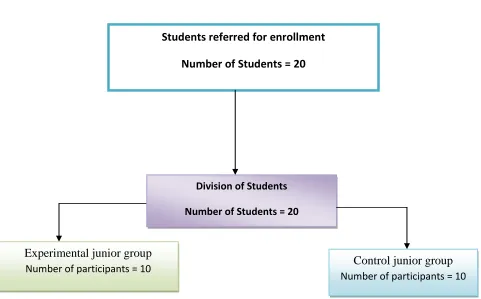
The study sample included 20 physical education students (10Jr.boys (experimental group), 10 boys (control group); age: 20.71 ± 0.4). Participants were selected from students with no formal training in invasion games and without any experience in officially governed competition. Subjects were evaluated through a 5 vs. 5 invasion game each participant took part in an 8-minute game, which was divided into two four-minute halves. Rules were minimized and modifications were made to potentially increase the subjects’ success with skill execution. The game form was selected based on the subjects’ developmental abilities and prior experience with the goal that students would be able to reach maximum achievement in the decision-making component. In performing offensive and defensive skills of badminton sport.
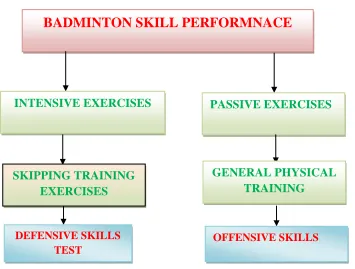
BADMINTON SKILL PERFORMNACE
INTENSIVE EXERCISES PASSIVE EXERCISES
GENERAL PHYSICAL TRAINING SKIPPING TRAINING
EXERCISES
OFFENSIVE SKILLS DEFENSIVE SKILLS
Figure 3.1.1: Flow diagram of the study process, indicating student selection. Table 3.1: Descriptive statistics (Means – mean; SD – standard deviation; Min – minimum; Max – maximum), physical fitness
Mean SD
Age (kg) 23.4 14.3
BH (cm) 176.92 6.31
Weight (kg) 63.42 10.4
BM (kg) 84.31 9.46
AS (cm) 194.99 7.60
BH - body height, BM - body mass, AS - arm span, TrSF – triceps skinfold; SsSF – subscapular skinfold; 3.3SELECTION OF VARIABLES:
For this purpose, a grid representing the court and the different areas has been drawn on the software and the observer simply have to select the name of the shot and to start the chronometer (accuracy: ±0.01s) and stop it for each sequence of game (temporal structure).
Students referred for enrollment
Number of Students = 20
Division of Students
Number of Students = 20
Experimental junior group
Number of participants = 10 Control junior group
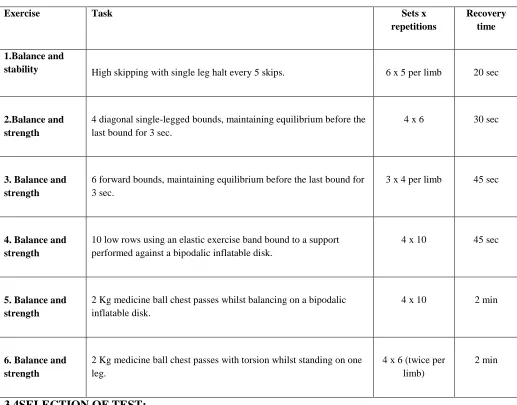
Table 3.2 Balance training scheduling
Exercise Task Sets x
repetitions
Recovery time
1.Balance and
stability High skipping with single leg halt every 5 skips. 6 x 5 per limb 20 sec
2.Balance and strength
4 diagonal single-legged bounds, maintaining equilibrium before the last bound for 3 sec.
4 x 6 30 sec
3. Balance and strength
6 forward bounds, maintaining equilibrium before the last bound for 3 sec.
3 x 4 per limb 45 sec
4. Balance and strength
10 low rows using an elastic exercise band bound to a support performed against a bipodalic inflatable disk.
4 x 10 45 sec
5. Balance and strength
2 Kg medicine ball chest passes whilst balancing on a bipodalic inflatable disk.
4 x 10 2 min
6. Balance and strength
2 Kg medicine ball chest passes with torsion whilst standing on one leg.
4 x 6 (twice per limb)
2 min
3.4SELECTION OF TEST:
In order to ensure the validity of the data coding process, two independent observers expert in Badminton (trainers having the qualification required by the French Federation of Badminton) have coded the same sequence twice, allowing to measure the inter- and intra-observer validity (Triolet et al., 2013). The observers’ measure reliability has been assessed by measuring the coefficient of variation (CV %), the intraclass correlation (ICC) and a Student-T test was performed for the temporal data.
variations between 1.0% for the net and 5.0% for the drive while the intra-coder CV is 2.4% and with variations between 0.4% for the net and 3.9% for the smash. This proves a significant validity of the method used (CV< 5% and ICC >80%).
3.5 DATA COLLECTION:
The groups selected are the Men’s jr.players (experiment group) and control group. The different finals were recovered from the archives of Osmania Universityof Badminton. The mean age of the players is 25.8 ± 2.78 years. In total, 137 rallies and 137 strokes have been analyzed. To be more accurate as possible, we choose to study only balanced high level matches. This was not the case for one of the semi-final.
BADMINTON EXERCISES
Table 3.3: Intensive exercises Training Schedule
SL.NO INTENSIVE EXERCISES TRAINING SCHEDULE
(4 WEEKS)
1. General Physical Training System:
a. General physical preparation which aims to improve the working ability of the body's organs, thus facilitating the development effort and improving all aspects of training at a later stage.
b. Special physical preparation aimed at improving the physical capabilities and movement toward a better match. c. Improving the ability of a special motion quality players. At this stage of training aims to memahirkan complex and harmonious movement required each player to face the match.
30 Min per day
2. Aerobic And Anaerobic 45 per day
3. Gymnastics Exercise Program 1hr per day
4. Jump Rope Exercise Program/
Joint Exercise Program/
Skipping Badminton Training Exercises
1hr per day
5. Badminton Drills 2-3hrs per day
to fit in all these exercises your game will not only improve but it will keep you in great physical condition.
TEST PROCEDURE:
Subjects were evaluated through a 5 vs. 5 invasion game each participant took part in an 8-minute game, which was divided into two four-minute halves. Rules were minimized and modifications were made to potentially increase the subjects’ success with skill execution. The game form was selected based on the subjects’ developmental abilities and prior experience with the goal that students would be able to reach maximum achievement in the decision-making component. In performing offensive and defensive skills of badminton sport.
Test Name:
Number of shots per rally (total number of times the shuttle is hit by both players during the rally time)
Stroke time (rally time divided by the number of shots per rally)
The resting time (the time elapsed from when the shuttlecock hits the ground until the next serve)
Test purpose:
The tests are conducted to check the smash is an aggressive overhead shot with downward trajectory, the clear is an overhead shot with a flat (offensive clear) or rising trajectory (defensive clear) towards the back of the opponent’s court, the drop is a smooth shot from above the head with downward trajectory towards the front of the court, the net shot is a precise shot from near the net which includes the net drop, the lob (offensive with a flat trajectory towards the back of the opponent’s court and defensive with a rising trajectory) and the kill (aggressive shot with downward trajectory), the drive is a powerful shot made at middle body height and in the middle of the court with a flat trajectory, In order to facilitate the data acquisition process and accuracy, a software using macro on Excel has been build, allowing data collection. The performance has been analyzed twice: in a first analysis, the observer used the software to time the temporal structure of the game and in the second analysis, the observer took notes on the category of the shots.
TOOL USED:
1. INTRACLASS CORRELATION (ICC) 2. T - TEST
3. DEFENSIVE AND OFFENSIVE PERFORMANCE 4. DROP SHOT
RESULTS:
Table 4.1: Change in temporal structure of Badminton Men’s singles final during Jr. group. Data are means (±SD).
Variabl es
JR.GROU P-92
JR.GROU P-96
JR.GROU P-00
JR.GROU P-04
JR.GROU P-08
JR.GROU P-12
F Effe
ct size (η2
Rest Time (s)
22.0 (1.5) 14.8(1.4) 22.6 (1.6) 21.6 (1.7) 30.3(2.0) 33.5 (1.5) 24. 4
.164
Rally Time (s)
12.9 (1.0) 5.5(.6) 9.6 (.7) 8.4 (.7) 9.3 (.9) 10.1 (.7) 11. 8
.094
N° of
shots per rally
12.3 (.9) 5.4 (.3) 9.7 (.8) 9.8 (.9) 10.8 (1.0) 12.0 (.9) 12. 5
.100
EPT 34.7 (1.4) 26.8 (1.2) 30.8 (1.5) 26.6 (1.5) 25.3 (1.8) 22.7 (1.4) 8.3 .069 Shot
frequen cy
.9 (.2) 1.0 (.3) 1.1 (.3) 1.2 (.2) 1.2 (.2) 1.3 (.3) 23. 8
.175
*p < 0.001, ** p < 0.0001, EPT= effective playing time.
For instance, the number of shots shows a twofold increase from 12.3 ± 0.9 at the JR.GROUP-92 to 12.0 ± 0.9 at the JR.GROUP-12 (p < 0.0001; [4.57;8.46], Cohen’s D = 0.40). The size effects are small to large for all significant post-hoc (from 0.3 to 1.1). The rally time and the resting time double between the JR.GROUP-92 and the JR.GROUP-12 respectively from 12.9 ± 1.0s to 10.1 ± 0.7s (p<0.0001; [2.74;6.56], Cohen’s D = 0.30) and 14.8 ± 1.4s to 33.5 ± 1.5s (p<0.0001; [14.9;22.4], Cohen’s D = 0.70) meaning a difference in the time management with large effect size. At the same time, the effective playing time from 34.7 ± 1.4 % at the JR.GROUP-92 to 22.7 ± 1.4 % at the JR.GROUP-12 (p<0.0001; [7.9;15.9], Cohen’s D = 0.84).
The rally time and the resting time changes reveal significant curvilinear fluctuations, showing that the rally time decreases between JR.GROUP-92 and JR.GROUP-96, then increases between JR.GROUP-96 and JR.GROUP-00, and stays stable until JR.GROUP-08, before increasing again. The resting time reveals the same trend but with a shorter phase of stabilization (only between JR.GROUP-00 and JR.GROUP-04). In addition, we found a significant correlation between the intensity of the exercise through the shot frequency and the resting time just after this rally (r = 0.25; p< 0.01).
Notational analysis
The percentages of the repartition of the strokes are presented. The χ2
test revealed only a difference for the clear (χ2
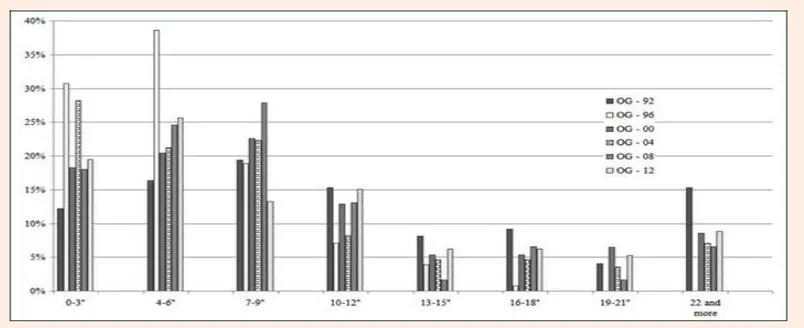
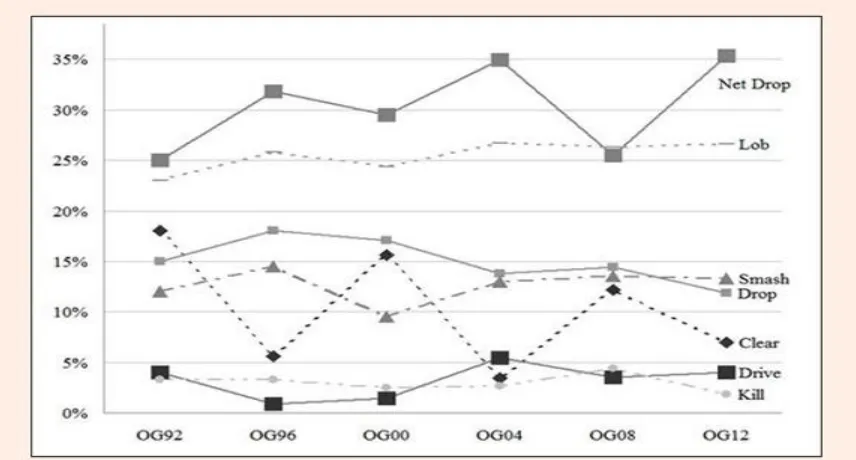
(5) = 16.5; p<0.001) with a variability from 3.0% at the JR.GROUP-04 to 18.0% at the JR.GROUP-92, while the other strokes show low and insignificant fluctuations of their values through all the JR.GROUP finals. The net drop is the most used stroke (from 25.0% at the JR.GROUP-92 to 35.0% at the JR.GROUP-04), followed by the lob (from 23.0% at the JR.GROUP-92 to 27.0% at the JR.GROUP-04). The smash is used in about 10.0% to 14.0% of the strokes, whereas the drives are the less frequent (1.0% to 5.0%). Finally, 36.6% of the strokes come from the back of the court and 60.3% from the net.
Figure 4.2: Change of the distribution of various types of strokes throughout the different jr.group and control group in Men’s Singles, χ2 significant for the clear (p < 0.05)
Offensive variables
As reported in Table 2, participants in the attacker on-the-ball variables achieved higher offensive scores. Scores were higher than 90% of efficiency in the decision-making of three skills: pass decision-making in the penetrating-the-defense context (93.38%), shooting decision-making (93.8%) and moving with the ball decision-making in the keeping-the-ball context (93.75%). With the exception of passing scores in the keeping-the-ball context, participants showed higher efficiency in the decision-making component than in skill execution. The biggest difference was found also in passing, but in the penetrating-the-defense context (decision-making: 89.24; execution: 69.63).
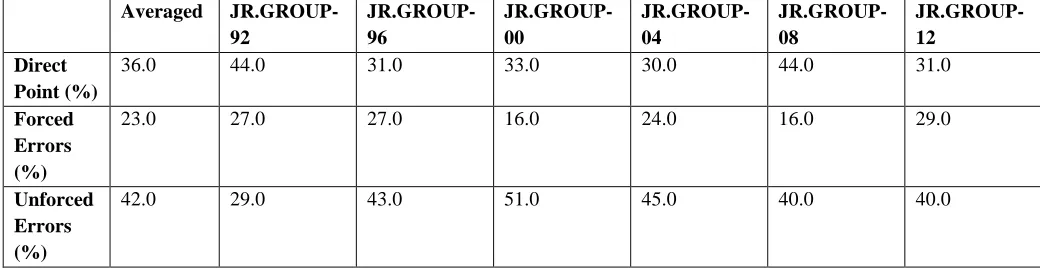
Regarding the way the points are won, the χ2 test did not reveal any changes throughout the different Osmania university finals with an average of 36.0% for the direct points, 23.0% for the forced errors and 41.0% for the unforced errors. The forced error predicts 100.0% of the inning winner whereas the players with the most direct points win the inning in only 20.0% of the cases.
Offensive variables Actions (Average) Decision making Skill execution Attacker
Control 73.79(21.68)
Pass (total) 9.93(3.8) 89.24(20.17) 69.63(27.01)
Pass in 1A 64.81(44.44) 67.59(36.43)
Pass in 2A 93.38(15.39) 72.84(28.61)
Shoot (total) 1.84(2.29) 93.8(12.14) 80.31(25.65)
Shoot in 3A 84.96(22.89)
Moving with the ball / dribbling (total) 5.42(5.96) 88.49(16.61) 85.39(18.04)
Moving with the ball / dribbling in 1A 93.75(17.67) 87.48(19.41)
Moving with the ball / dribbling in 2A 88.47(18.53) 87.5(18.49)
Attacking player
Get free (total) 28(6.98) 72.52(18.48) 60.02(19.82)
Get free in 1A 65.63(25.74) 58.68(30.17)
Get free in 2A 73.58(19.65) 60.04(20.83)
Defender to attacker
Mark 10.37(9.41) 80.61(18.9) 24.52(27.09)
Blocked shot 2.42(2.71) 93.59(11.23) 10.4(14.62)
Tackle 1.47(1.47) 75.38(36.35) 29.49(37.98)
Double team 0.58(1.02) 92.86(18.89) 46.43(46.61)
Defender to attacker
Mark 26.37(7.51) 64.91(19.28) 44.22(22.22)
Interception 1.69(1.77) 86.92(29.82) 53.08(42.26)
Double team 3.32(2.81) 62.21(37.27) 30.72(34.4)
Table 4.3: Repartition of direct points, forced and unforced errors (%) during Badminton Olympic Men’s singles Final
Averaged JR.GROUP-92
JR.GROUP-96
JR.GROUP-00
JR.GROUP-04
JR.GROUP-08
JR.GROUP-12
Direct Point (%)
36.0 44.0 31.0 33.0 30.0 44.0 31.0
Forced Errors (%)
23.0 27.0 27.0 16.0 24.0 16.0 29.0
Unforced Errors (%)
Discussion hypothesis
1. There is a positive impact and effective approach to the user in the search .
2. To use intensive exercise effect in the regulation and control of the rest periods between occurrences leading to lift the level.
CONCLUSION:
This confirms the importance of a lactic as well as aerobic energy production, due to the intermittent nature of this sport and the fluctuations of several physiol jr.groupical variables, such as heart rate, blood lactate concentration and oxygen consumption. A couple of studies have promoted the aerobic profile of Badminton, with a high VO2max (e.g, 61.8 ± 5.9 ml•min-1•kg-1 in international men) and 54.5 ± 2.5 ml•min-1•kg-1 in elite male players and high percentage (89.0%) of maximum heart rate during a match. The increase in the duration of the exchanges reinforces the need for the players to have aerobic profile. The increase in the resting time supports the necessity to develop the anaerobic ablactate system described previously.
RECOMMENDATIONS:
The first study recommendation indicates a high shot frequency, about 1.26 shots per second, which is one of the characteristics of the modern Badminton, in accordance with other recent studies. That means that this parameter has to be included in the training design to be as close as possible to the reality of a game and to be highly competitive for elite level. This could be done by using flat trajectories rather than high trajectories, especially in the game of backcourt. The second main recommendation of this study is the change of the temporal structure of the game, with an increase of the rest time and a decrease of the effective playing time due to the increase of the intensity of the game. The training design for a metabolic purpose has to
take into account this new data, by using a ratio of working time on rest time about 1:3 with a high intensity of the rallies.
1. Emphasis on the use of intensive exercise method in the development of badminton skills.
2. Better to use intensive exercise method in the development of feature of physical strength.
3. Better to use intensive exercise in teaching smash and blocking smashes in the seam time.
4. Better to use intensive exercise method in the development of fatigue resistance feature.
REFERENCES:
[1] Bebetsos, E., & Antoniou, P. (2003). Psychological skills of Greek badminton athletes. Perceptual and Motor Skills, 97(3f), 1289-1296.
[2] Blomqvist, M., Luhtanen, P., & Laakso 1, L. (2001). Comparison of two types of instruction in badminton. European Journal of Physical Education, 6(2), 139-155.
[3] Blomqvist, M., Luhtanen, P., & Laakso, L. (2000). Expert‐Novice Differences in Game Performance and Game Understanding of Youth Badminton Players. European Journal of Physical Education, 5(2), 208-219.
ability in soccer. Physical Education and Sport Pedagogy, 10(2), 107-119.
[5] BRADY, F. (1997). Contextual interference and teaching golf skills. Perceptual and Motor Skills, 84(1), 347-350.
[6] Brunel, P. C. (1999). Relationship between achievement goal orientations and perceived motivational climate on intrinsic motivation. Scandinavian journal of medicine & science in sports, 9(6), 365-374.
[7] Burdeshaw, D., Spragens, J. E., & Weis, P. A. (1970). Evaluation of general versus specific instruction of badminton skills to women of low motor ability. Research Quarterly. American Association for Health, Physical Education and Recreation, 41(4), 472-477.
[8] Butler, J., & McCahan, B. J. (2005). Teaching games for understanding as a curriculum model. Teaching games for understanding: Theory, research and practice, 33-54.
[9] Fang, S. H. E. N., & De Wen, Z. H. O. U. (2012). Comprehensive Evaluation of Technology and Tactics Ability of Football Teams in the 19th World Football Cup. Journal of Guangzhou Sport University, 2, 018.