Performance Analysis of Some
Password Hashing Schemes
Donghoon Chang, Arpan Jati, Sweta Mishra, Somitra Kumar Sanadhya
February 20, 2015
Abstract
In this work we have analyzed some password hashing schemes for performance under various settings of time and memory complexities. We have attempted to benchmark the said algorithms at similar levels of memory consumption. Given the wide variations in security margins of the algorithms and incompatibility of memory and time cost settings, we have attempted to be as fair as possible in choosing the various parameters while executing the benchmarks.
Keywords: Password hashing, benchmark, PHC
1
Benchmarking setup
In order to get consistent results for the different algorithms we performed all the test on a single machine with the code compiled by the same compiler. The details are as follows:
• CPU:Intel Core i7 4770 (Turbo Boost: ON) - Working at 3.9 GHz
• RAM:Double Channel DDR3 16 GB (2400 MHz)
• Compiler: gcc / g++ v4.9.2 ( -march=native and -O3 flags were set if not already in the makefiles). This would cause the compiler to use the AVX-2 instructions.
• OS: UBUNTU 14.04.1, on HYPER-V, on Windows-8.1 with 8 GB allocated RAM to the VM. We also performed benchmarks on native Linux OS to make sure that the virtualization does not cause any changes in the results.
2
Performance Analysis
In this section we provide the benchmarking results and details of the setup and considerations. For consistency we used single threaded versions of the algorithms.
All the experiments were run at-least 5 times and the average timings were taken.
2.1
Catena v3 - Butterfly and Dragonfly [6]
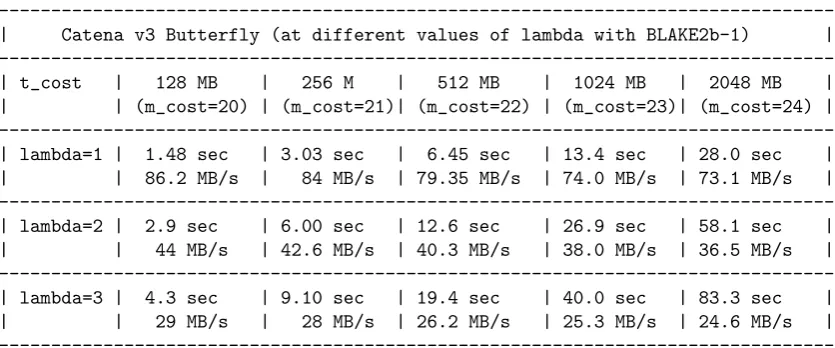
---| Catena v3 Butterfly (at different values of lambda with BLAKE2b-1) | ---| t_cost | 128 MB | 256 M | 512 MB | 1024 MB | 2048 MB | | | (m_cost=20) | (m_cost=21)| (m_cost=22) | (m_cost=23)| (m_cost=24) | ---| lambda=1 ---| 1.48 sec | 3.03 sec | 6.45 sec | 13.4 sec | 28.0 sec | | | 86.2 MB/s | 84 MB/s | 79.35 MB/s | 74.0 MB/s | 73.1 MB/s | ---| lambda=2 ---| 2.9 sec | 6.00 sec | 12.6 sec | 26.9 sec | 58.1 sec | | | 44 MB/s | 42.6 MB/s | 40.3 MB/s | 38.0 MB/s | 36.5 MB/s | ---| lambda=3 ---| 4.3 sec | 9.10 sec | 19.4 sec | 40.0 sec | 83.3 sec | | | 29 MB/s | 28 MB/s | 26.2 MB/s | 25.3 MB/s | 24.6 MB/s |
---Table 1: Catena v3 - Butterfly
The Catena-Dragonfly is much faster than Catena-Butterfly, but, the Dragonfly version is shown not to be memory-hard in [4], [2].
The latest version of code at the time of benchmark was cloned from ‘https://github.com/cforler/catena/’ (75 commits).
Optimized SSE implementation was used for both the benchmarks.
---| Catena v3 Dragonfly (at different values of lambda with BLAKE2b-1) | ---| t_cost | 128 MB | 256 MB | 512 MB | 1024 MB | 2048 MB | ---| lambda=1 ---| 0.237 sec ---| 0.495 sec ---| 0.989 sec ---| 1.96 sec | 4.0 sec | | | 539 MB/s | 516 MB/s | 517 MB/s | 520 MB/s | 511 MB/s | ---| lambda=2 ---| 0.29 sec | 0.592 sec | 1.205 sec | 2.374 sec | 4.855 sec | | | 437 MB/s | 431 MB/s | 424 MB/s | 431 MB/s | 421 MB/s | ---| lambda=3 ---| 0.46 sec | 0.954 sec | 1.932 sec | 3.834 sec | 7.837 sec | | | 273 MB/s | 268 MB/s | 264 MB/s | 267 MB/s | 261 MB/s | ---| lambda=4 ---| 0.534 sec ---| 1.073 sec ---| 2.146 sec ---| 4.288 sec ---| 8.694 sec ---| | | 239 MB/s | 238 MB/s | 238 MB/s | 238 MB/s | 235 MB/s |
---Table 2: Catena Dragonfly
Catena-The Catena-Dragonfly (Table 2) is much faster due to the significantly reduced number of rounds as compared to Catena-Butterfly (Table 1). Also, the way it operates, every node in the BRG graph has dependency on two previous ancestors as opposed to three of Catena-DBG. This leads to reduced number of random memory accesses and faster speeds.
2.2
Gambit[10]
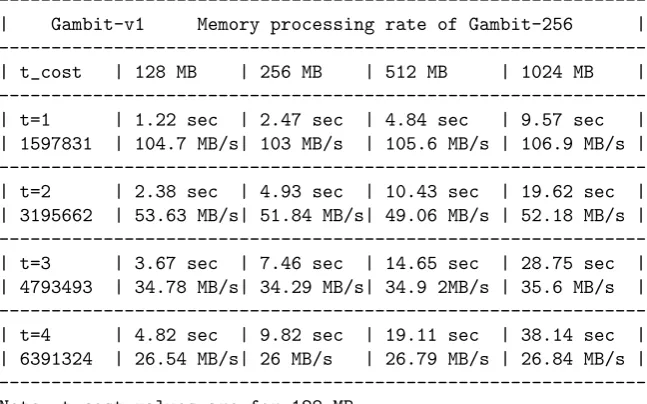
For the benchmarking of Gambit we used v1 of the source code from [1]. No optimized version of the code was available, and we used the reference implementation for this analysis. The speeds are particularly slow due to the slow performance of Keccak sponge in software and small memory access chunks. One peculiarity of Gambit is that the Time Cost and Memory Cost is bound by the assertion (cost m×2 ≤cost t×(r/8)) andr= 136 for Gambit−256. For the benchmark we set t costto the lowest possible value for a required m costfor fixed memory consumption and defined it as t= 1, for higher values oft we doubled thet costfor every subsequent values oft. This was done to have a consistent range of possible speeds with increasingt. Results are shown in Table 3.
---| Gambit-v1 Memory processing rate of Gambit-256 | ---| t_cost | 128 MB | 256 MB | 512 MB | 1024 MB | ---| t=1 | 1.22 sec | 2.47 sec | 4.84 sec | 9.57 sec | | 1597831 | 104.7 MB/s| 103 MB/s | 105.6 MB/s | 106.9 MB/s | ---| t=2 | 2.38 sec | 4.93 sec | 10.43 sec | 19.62 sec | | 3195662 | 53.63 MB/s| 51.84 MB/s| 49.06 MB/s | 52.18 MB/s | ---| t=3 | 3.67 sec | 7.46 sec | 14.65 sec | 28.75 sec | | 4793493 | 34.78 MB/s| 34.29 MB/s| 34.9 2MB/s | 35.6 MB/s | ---| t=4 | 4.82 sec | 9.82 sec | 19.11 sec | 38.14 sec | | 6391324 | 26.54 MB/s| 26 MB/s | 26.79 MB/s | 26.84 MB/s | ---Note: t_cost values are for 128 MB.
Table 3: Gambit v1
2.3
Lyra2 - v3[7]
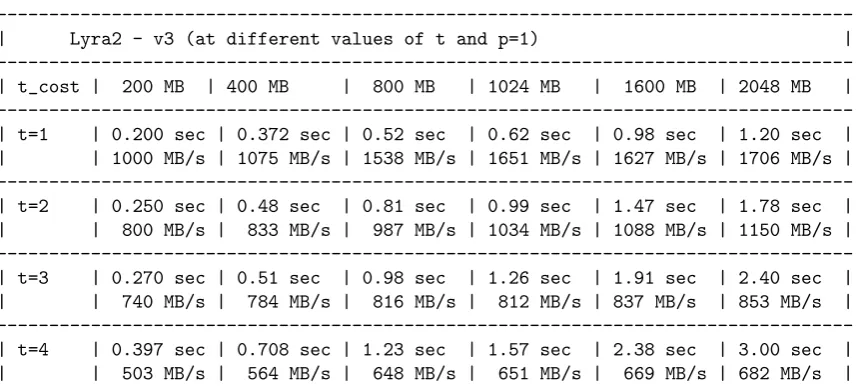
For benchmarking Lyra-2 we used the v3 code from [1]. We used the SSE version of Lyra2-v3 with nPARALLEL=1 for consistency. We noticed that the speed of Lyra-2 with multiple threads is faster than the single thread ones (as expected), but for consistency, we choose to use the single threaded version. The default Makefile was used with linux-x86-64-sse, with nThreads=1. This would result in fast AVX implementation being used with Blake2b as sponge function. We did receive a warning for large-memory-usage for the 2 GiB test, but, the timings are as expected.
---| Lyra2 - v3 (at different values of t and p=1) | ---| t_cost ---| 200 MB | 400 MB | 800 MB | 1024 MB | 1600 MB | 2048 MB | ---| t=1 | 0.200 sec | 0.372 sec | 0.52 sec | 0.62 sec | 0.98 sec | 1.20 sec | | | 1000 MB/s | 1075 MB/s | 1538 MB/s | 1651 MB/s | 1627 MB/s | 1706 MB/s | ---| t=2 | 0.250 sec | 0.48 sec | 0.81 sec | 0.99 sec | 1.47 sec | 1.78 sec | | | 800 MB/s | 833 MB/s | 987 MB/s | 1034 MB/s | 1088 MB/s | 1150 MB/s | ---| t=3 | 0.270 sec | 0.51 sec | 0.98 sec | 1.26 sec | 1.91 sec | 2.40 sec | | | 740 MB/s | 784 MB/s | 816 MB/s | 812 MB/s | 837 MB/s | 853 MB/s | ---| t=4 | 0.397 sec | 0.708 sec | 1.23 sec | 1.57 sec | 2.38 sec | 3.00 sec | | | 503 MB/s | 564 MB/s | 648 MB/s | 651 MB/s | 669 MB/s | 682 MB/s |
---Table 4: Lyra2 - v3
2.4
Rig v2[3]
For this work we used the latest version of Rig from ‘https://github.com/arpanj/Rig’. We used the optimized implementation with the Blake2b round using AVX-2.
---| RIG v2 (BlakeExpand, BlakePerm, Blake2b) AVX-2 x86-64 | ---| m => | 13 (128 M) | 14 (256 M) | 15 (512 M) | 16 (1024 M) | 17 (2048 M) | ---| n = 1 ---| 0.065 sec | 0.127 sec | 0.259 sec | 0.519 sec | 1.035 sec | | | 1966 MB/s | 2007 MB/s | 1971 MB/s | 1973 MB/s | 1978 MB/s | ---| n = 2 ---| 0.091 sec | 0.181 sec | 0.360 sec | 0.718 sec | 1.442 sec | | | 1405 MB/s | 1410 MB/s | 1421 MB/s | 1425 MB/s | 1422 MB/s | ---| n = 3 ---| 0.122 sec | 0.243 sec | 0.474 sec | 0.947 sec | 1.903 sec | | | 1045 MB/s | 1050 MB/s | 1079 MB/s | 1081 MB/s | 1076 MB/s | ---| n = 4 ---| 0.144 sec | 0.297 sec | 0.588 sec | 1.168 sec | 2.295 sec | | | 883 MB/s | 861 MB/s | 870 MB/s | 876 MB/s | 892 MB/s |
---Table 5: RIG v2
All default settings were used as described in the code and Makefile. One source code improvement was the removal of writing of the data back to the memory in the last row, this change resulted in around five percent improvement in overall performance for small values of N.
2.5
Scrypt[8]
Scrypt is the first memory-hard algorithm for password-hashing. There are several implementations of Scrypt available, we used one of the fastest variants of the implementation by @floodyberry in this work. Table 6 shows the results of the AVX2 implementation with Blake2b and Salsa64/8.
Scrypt @floodyberry’s https://github.com/floodyberry/scrypt-jane
---| Scrypt ( AVX2, Blake2b, Salsa 64/8, x86-64 ) | ---| Memory (MB) | Time (second) | Speed (MB/s) |
---| 128 | 0.076 | 1684 |
| 256 | 0.162 | 1580 |
| 512 | 0.332 | 1542 |
| 1024 | 0.7 | 1530 |
---Table 6: scrypt: floodyberry/scrypt-jane
2.6
TwoCats[5]
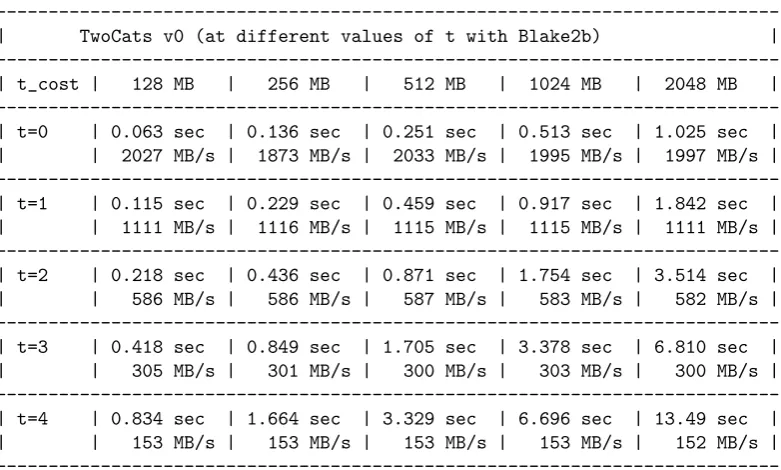
TwoCats is one of the fastest and one of the most complex entries of [1]. It is highly optimized to use the CPU and memory subsystem to the full extent by having several modes and multi-threading support. For the purpose of this analysis, we used the single threaded mode of TwoCats with Blake2b compiled with AVX2 support. Defaults were used among them MULTIPLIES=2, LANES=8, BLOCKSIZE=16384 and PARALLELISM=1.
Thet costparameter of TwoCats is quite sensitive as it increases the iteration count of the number of small writes in cache using 2t cost.
The results are shown in Table 7.
2.7
yescrypt [9]
For benchmarking yescrypt, we used version 0.7.1 of the code from [1]. Yescrypt is another fast and complex submission to the PHC. There are several modes and settings available. For this work we used the default configuration (r=8, p=1 and YESCRYPT RW=1). 64 bit version was used with -march=native in gcc (which essentially would have enabled AVX2 intrinsic support). The code however uses 128 bit intrinsics, so SSE4.1 should be enough to compile and enable SIMD optimizations.
---| TwoCats v0 (at different values of t with Blake2b) | ---| t_cost ---| 128 MB | 256 MB | 512 MB | 1024 MB | 2048 MB | ---| t=0 | 0.063 sec | 0.136 sec | 0.251 sec | 0.513 sec | 1.025 sec | | | 2027 MB/s | 1873 MB/s | 2033 MB/s | 1995 MB/s | 1997 MB/s | ---| t=1 | 0.115 sec | 0.229 sec | 0.459 sec | 0.917 sec | 1.842 sec | | | 1111 MB/s | 1116 MB/s | 1115 MB/s | 1115 MB/s | 1111 MB/s | ---| t=2 | 0.218 sec | 0.436 sec | 0.871 sec | 1.754 sec | 3.514 sec | | | 586 MB/s | 586 MB/s | 587 MB/s | 583 MB/s | 582 MB/s | ---| t=3 | 0.418 sec | 0.849 sec | 1.705 sec | 3.378 sec | 6.810 sec | | | 305 MB/s | 301 MB/s | 300 MB/s | 303 MB/s | 300 MB/s | ---| t=4 | 0.834 sec | 1.664 sec | 3.329 sec | 6.696 sec | 13.49 sec | | | 153 MB/s | 153 MB/s | 153 MB/s | 153 MB/s | 152 MB/s |
---Table 7: TwoCats v0
---| yescrypt v1 (at SHA256, r=8, p=1 and YESCRYPT_RW=1) | ---| t_cost ---| 128 MB | 256 MB | 512 MB | 1024 MB | 2048 MB | ---| t=0 | 0.9 sec | 0.180 sec | 0.368 sec | 0.720 sec | 1.46 sec | | | 1422 MB/s | 1422 MB/s | 1391 MB/s | 1422 MB/s | 1402 MB/s | ---| t=1 | 0.110 sec | 0.222 sec | 0.448 sec | 0.898 sec | 1.782 sec | | | 1163 MB/s | 1153 MB/s | 1143 MB/s | 1140 MB/s | 1149 MB/s | ---| t=2 | 0.132 sec | 0.272 sec | 0.544 sec | 1.05 sec | 2.1 sec | | | 969 MB/s | 941 MB/s | 941 MB/s | 975 MB/s | 975 MB/s | ---| t=3 | 0.192 sec | 0.394 sec | 0.786 sec | 1.576 sec | 3.15 sec | | | 666 MB/s | 649 MB/s | 651 MB/s | 649 MB/s | 650 MB/s | ---| t=4 | 0.286 sec | 0.510 sec | 1.016 sec | 2.052 sec | 4.146 sec | | | 447 MB/s | 501 MB/s | 503 MB/s | 499 MB/s | 493 MB/s |
128 256 400 512 800 1,024 1,600 2,048 0
0.5 1 1.5 2 2.5 3 3.5 4 4.5 5 5.5 6
Memory in MiB
Time
in
seconds
CatenaB (λ= 1) CatenaB (λ= 2) CatenaB (λ= 3) Gambit (t= 1) Gambit (t= 2) Gambit (t= 3) Lyra2 (t= 1) Lyra2 (t= 2) Lyra2 (t= 3) Lyra 2(t= 4) Rig (n= 1) Rig (n= 2) Rig (n= 3) Rig (n= 4)
Scrypt TwoCats (t= 0) TwoCats (t= 1) TwoCats (t= 2) TwoCats (t= 3) yescrypt (t= 0) yescrypt (t= 1) yescrypt (t= 2) yescrypt (t= 3)
3
Conclusions
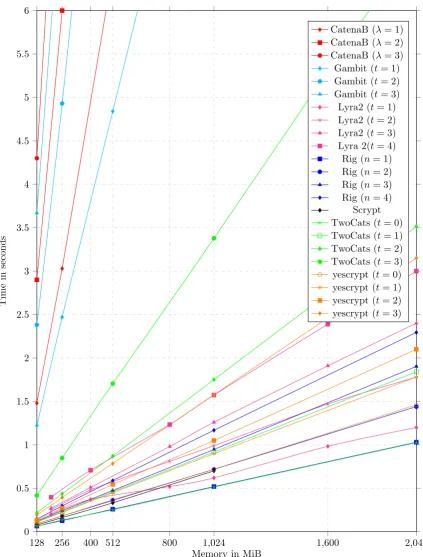
The performance graph in figure 1 shows the execution time vs. memory for all the memory-hard algorithms benchmarked. It is clear that Gambit (reference code) and Catena-Butterfly are among the slowest and take significant amount of time in hashing passwords with moderate to large amounts of memory. The performance of Gambit may be improved using a better implementation, but, the performance of Catena is unlikely to significantly improve even with native assembly implementation.
As noted before, the time cost of TwoCats is very sensitive, it may be changed with some minor tweaks to allow for better tradeoff control.
Lyra2, Rigv2, TwoCats and yescrypt provide good performance in a wide range of use cases. No, attacks are currently known against them which reduce the claimed TMTO defense.
As far as side-channels are concerned, Catena, Gambit and Rig are fully resistant; Lyra2 and TwoCats are partially resistant whereas Scrypt and yescrypt are not resistant.
References
[1] Password Hashing Competition (PHC), 2014. https://password-hashing.net/index.html.
[2] Alex Biryukov and Dmitry Khovratovich. Tradeoff Cryptanalysis of Memory-Hard Functions, 2015. http://orbilu.uni.lu/handle/10993/20043.
[3] Donghoon Chang, Arpan Jati, Sweta Mishra, and Somitra Kumar Sanadhya. Rig: A simple, secure and flexible design for Password Hashing. Submission to Password Hashing Competition (PHC), 2014. https://password-hashing.net/submissions/specs/RIG-v2.pdf.
[4] Donghoon Chang, Arpan Jati, Sweta Mishra, and Somitra Kumar
Sanadhya. Time memory tradeoff analysis of graphs in password hashing constructions. Preproceedings of PASSWORDS’14, pages 256–266, 2015. http://passwords14.item.ntnu.no/Preproceedings Passwords14.pdf.
[5] Bill Cox. TwoCats (and SkinnyCat): A Compute Time and Sequential Memory Hard Password Hashing Scheme. Submission to Password Hashing Competition (PHC), 2014. https://password-hashing.net/submissions/specs/TwoCats-v0.pdf.
[6] Christian Forler, Stefan Lucks, and Jakob Wenzel. The Catena Password-Scrambling Framework. Submission to Password Hashing Competition (PHC), 2015. https://password-hashing.net/submissions/specs/Catena-v3.pdf.
[7] Marcos A. Simplicio Jr, Leonardo C. Almeida, Ewerton R. Andrade, Paulo C. F. dos Santos, and Paulo S. L. M. Barreto. The Lyra2 reference guide. Submission to Password Hashing Competition (PHC), 2015. https://password-hashing.net/submissions/specs/Lyra2-v3.pdf.
[8] Colin Percival. Stronger key derivation via sequential memory-hard functions. InBSDCon, 2009. http://www.bsdcan.org/2009/schedule/attachments/87 scrypt.pdf.
[9] Alexander Peslyak. yescrypt - a Password Hashing Competition submission. Submission to Password Hashing Competition (PHC), 2015. https://passwordhashing.net/submissions/specs/yescrypt-v1.pdf.