RESEARCH REPORT
Competency progression and
completion: how is the policy
being enacted in three trades?
Berwyn Clayton
Hugh Guthrie
Pam Every
Victoria University
Regan Harding
Publisher’s note
The views and opinions expressed in this document are those of the author/project team and do not necessarily reflect the views of the Australian Government, state and territory governments or NCVER. Any interpretation of data is the responsibility of the author/project team.
Additional information relating to this research is available in Competency progression and completion: how is the policy being enacted in three trades? — support document. It can be accessed from the supporting documents at <http://www.ncver.edu.au/publications/2813.html>.
To find other material of interest, search VOCEDplus (the UNESCO/NCVER international database <http://www.voced.edu.au>) using the following keywords: apprenticeship; assessment; competence; completion; employers; participation; policy; skills and knowledge; supervisors; vocational education and training
© Commonwealth of Australia, 2015
With the exception of the Commonwealth Coat of Arms, the Department’s logo, any material protected by a trade mark and where otherwise noted all material presented in this document is provided under a Creative Commons Attribution 3.0 Australia <http://creativecommons.org/licenses/by/3.0/au> licence.
The details of the relevant licence conditions are available on the Creative Commons website (accessible using the links provided) as is the full legal code for the CC BY 3.0 AU licence <http://creativecommons.org/licenses/by/3.0/legalcode>.
The Creative Commons licence conditions do not apply to all logos, graphic design, artwork and photographs. Requests and enquiries concerning other reproduction and rights should be directed to the National Centre for Vocational Education Research (NCVER).
This document should be attributed as Clayton, B, Guthrie, H, Every, P & Harding, R 2015, Competency progression and completion: how is the policy being enacted in three trades?, NCVER, Adelaide.
COVERIMAGE:GETTYIMAGES/iSTOCK
ISBN 978 1 925173 26 TD/TNC 121.08
Published by NCVER, ABN 87 007 967 311
Level 11, 33 King William Street, Adelaide SA 5000 PO Box 8288 Station Arcade, Adelaide SA 5000, Australia
Phone +61 8 8230 8400 Fax +61 8 8212 3436
Email [email protected] Web <http://www.ncver.edu.au> <http://www.lsay.edu.au>
About the research
Competency progression and completion: how is the policy being
enacted in three trades?
Berwyn Clayton, Hugh Guthrie and Pam Every, Victoria University, and
Regan Harding, TAFE NSW North Coast Institute
This paper examines how competency progression and completion is implemented in practice in three trades. In particular, it focuses on: interactions between teachers and/or assessors and workplace supervisors; the different approaches used to integrate on- and off-the job training; assessment and sign-off practices; and the ways by which workplace supervisors and teachers and/or assessors ensure the outcomes meet the standards outlined in the respective training packages.
In addition to a literature review and situational analysis, the research method includes interviews with 26 TAFE teacher—assessors teaching Certificate III in Commercial Cookery, Carpentry, and Engineering — Metal Fabrication. Twenty-one workplace supervisors in the cookery, engineering, and building and construction industries were also interviewed.
The concepts of competency-based progression and completion are aligned with the notion that progression through training should be based on the skills attained rather than on the time served. The authors show that competency progression and completion is not a new phenomenon and was an early feature of competency-based approaches to vocational education and training (VET) in Australia. Indeed, trends in the data from the National Centre for Vocational Education Research (NCVER) show that over the past decade there has been a gradual increase in the number of apprentices and trainees across all trades completing their qualifications in shorter periods of time. This report investigates some of the interrelated factors that affect progression and completion and shows that a gap remains between the policy construct and real practice, where the time-based approach to apprentice training is still dominant.
Key messages
Some of the barriers to competency progression include a lack of flexibility in training providers and employer attitudes to allowing apprentices to complete early.
Variations to training generally occur through informal negotiations and are not always recognised in the apprentice’s training plan, suggesting that the training plans are not necessarily the dynamic document they are intended to be.
The most important enabler for competency progression and completion is good communication and information flow between teacher—assessors/and workplace supervisors. However, teacher—assessors are more likely than workplace supervisors to claim that communication between the two is adequate.
While assessment and validation are generally the collective responsibility of teachers—assessors and workplace supervisors, there is now greater involvement of apprentices in their own assessment through collecting evidence and making decisions about whether they are ready to progress.
Dr Craig Fowler
i
$
Contents
Tables 6
Executive summary 7
Introduction 11
Research purpose and questions 11 Research methods and procedures 12
Insights from our context and situational analysis 15
Evolution of competency-based progression and completion 15 Defining competency-based progression and completion 15 The training plan and its role 16 Competency-based progression and completion: some issues 16
In summary 18
Findings 19
Communication between providers and the workplace 19 Getting it together: integration of training and assessment 22 Competency progression: the impact on teaching 26 Assessment: a critical factor in facilitating progression 27 Making the decision about overall competence 34 Competency completion: perceptions, influences and issues 36
Conclusions and implications 45
Communication between teacher—assessors and workplace supervisors 45 Integration of training and assessment on and off the job 45 Assessment and validation 46 Competency progression and completion: implications for policy
and practice 47
References 49
Tables
Tables
1 Ranked reasons for communicating: teacher—assessors and
workplace supervisors 20
2 Teacher—assessor views on organisational communication
policies and processes 21
3 Workplace supervisor views on communication policies and
processes 21
4 Teacher—assessor views on roles and responsibilities in training
and assessment of apprentices 36
5 Workplace supervisor views on roles and responsibilities in
Executive summary
In 2006 a Council of Australian Governments (COAG) policy sought to remove any ‘artificial time construct’ as a pivotal feature in apprenticeship progression and completion, the aim being to allow apprentices to work as qualified tradesmen and tradeswomen as soon as they had demonstrated competency to industry standards.
The research presented in this report was designed to identify and describe the impacts of the COAG policy on assessment, assessors and workplace supervisors in three trade qualifications: commercial cookery, engineering — metal fabrication and carpentry.
The study examined the approaches being used to integrate training on and off the job and the ways by which teacher—assessors and workplace supervisors were ensuring that the outcomes being achieved met the standards set out in the respective training packages. Four research questions formed the basis of the research. These focused on: the extent and quality of communication between teacher—assessors and workplace supervisors; the integration of apprentice training and assessment; the methods of assessment used to determine competence; and, finally, the processes used to validate assessment.
The research involved a context and situational analysis (including a review of relevant literature), a pre-interview questionnaire and a total of 47 semi-structured interviews. These were undertaken with 26 teacher—assessors in seven TAFE (technical and further education) institutes spread across three states and one territory and 21 workplace supervisors who were directly responsible for providing the work-based learning component for one or more of the apprentices being trained and assessed by the participating teacher—assessors.
The context and situational analysis showed that competency progression and completion is, in reality, not a new phenomenon and was an early feature of competency-based
approaches to vocational education and training (VET). Trends in data show that across all trades there has been a gradual increase in the number of apprentices and trainees completing their qualifications in shorter periods of time. While there is a range of reasons for these increases, this report explores one component — competency-based progression and completion. The report investigates the key factors which affect progression and competency in small number of cases and shows that there remains a gap between the policy construct and the lived reality, which has preserved, largely intact, a time-based approach to apprentice training.
The analysis also shows that the key factors affecting the uptake of competency-based progression include employer attitudes and a lack of provider flexibility in adopting the administrative, teaching and assessment approaches that facilitate progression and completion. Assessment is identified as critical to successful apprentice progression and completion, and the literature highlights industry concerns over assessment practices and quality. The quality of the relationship between providers and individual employers is identified as another critical factor.
This study has found that the successful implementation of competency progression and completion policy is affected by a complex set of interrelated factors. The first of these is the uneven level of support for the policy from employers and workplace supervisors. This is caused in large part by concerns about the financial implications of apprentices attaining
qualified tradesperson status before employers have gained full value from a reasonably skilled worker at a relatively low cost. Also influential is the view many workplace supervisors hold that apprentices must develop a breadth of experience and demonstrate a level of maturity prior to being signed off. These attributes, they suggest, can only be attained over time and with more opportunities to build their expertise, perhaps to higher and broader levels. Linked to this is the view of supervisors that apprentices on completion are only ‘work-ready’ rather than being competent tradespersons, with full competence taking further time to develop. Finally, the research found that the traditional ‘time served’ remains the standard against which an apprenticeship is measured by many supervisors of apprentices.
A major factor raised by participants is the impact of TAFE funding on the organisations’ ability to provide the flexibilities required to facilitate the progression of apprentices through the off-job components of their training. Indeed, the study highlights the challenges to assessment of the broader conception of the particular trades studied and their often more narrow workplace reality. Finally, the evidence suggests that information about competency progression and completion has not been effectively disseminated to teacher— assessors, workplace supervisors and apprentices. As a result, awareness of the policy and its practice is distinctly lacking.
In relation to communication between teacher—assessors and workplace supervisors, the research found that a variety of media are used and that the frequency of communication met mandated requirements, but more was undertaken, according to need. Teacher— assessors felt that communication processes worked well. Workplace supervisors were more circumspect, with some reporting that the processes, expectations and provision of
information about training and assessment were not well communicated to them. The ‘VET language’ and the overall ‘busyness’ of the work environment hindered good
communication, and it was particularly problematic in carpentry, where the workplace supervisors and apprentices work on a variety of sites. Communication helped the teacher— assessors establish the training that could be covered at the workplace and where the workplace could be used effectively as a source of assessment evidence. Knowledge of the employer’s business is critical here, but complicated for providers by the large number of small employers with whom they often have to deal. In this case, providers are well served if there are administrative staff focused on record keeping to advise about the units of competency completed and yet to be attained and to help support the training and assessment process.
Training plans can be useful but tend in practice not to be the ‘living’, dynamic documents envisaged in policy and guidelines. Rather, our informants generally saw them as more static, providing a basis for planning training and assessment. Variations tended to be negotiated more informally but not all supervisors realised that negotiation was a possibility and just accepted what the provider proposed. In other cases, mainly larger organisations, a training plan existed, but its influence tended to be subsumed by their own in-house learning and development plans.
Assessment is essential in promoting progression and judging when completion has been achieved. Practices in theory-based assessment do not seem to have changed markedly with the introduction of competency-based progression and completion, but an increase in online assessment is enabling more continuous access to assessment opportunities. Practical assessment continues to rely on the traditional approaches of observation and oral
Training plans can be useful but tend in practice not to be the ‘living’, dynamic documents
questioning, checklists, logbooks and portfolios, but these are being enhanced by the use of technology. While authenticated photographs of completed work are valued in both carpentry and metal fabrication, this is less so in cookery, where more concrete evidence is more highly valued. Photographic evidence, however, could be problematic where there was sensitivity at the work site about the work being photographed. What was very clear, however, was that apprentices now need to take considerable responsibility for collecting assessment evidence. Workplace supervisors varied in the role they played in the assessment process and some, especially those in larger companies, were very active, as they themselves were qualified assessors and trainers. The key role for all workplace supervisors was to provide opportunities for the apprentice to practise skills and prepare for and undertake on-the-job assessment. At the very least, supervisors sign off on all of the competencies, including those undertaken only in TAFE. This required a knowledge of, and trust in, TAFE’s training and assessment processes on the part of workplace supervisors, particularly where they could only offer a more limited range of training and work experiences.
Both teacher—assessors and workplace supervisors were highly confident in their assessment decision-making. Assessment was validated through internal and external processes, most often involving panels of teachers with occasional involvement by industry, although their busyness could prevent this even if they were willing. In relation to the final decision regarding competency completion, both on- and off-job evidence was drawn upon, but informants varied on whether one or the other was privileged. In the view of teacher— assessors, the quality of the evidence and the benchmarks and performance levels expected of apprentices by workplaces were more important, but this potentially opened the door to debate about what ‘the standard’ was. Context in competency completion was critical, particularly to workplace supervisors. In making their decisions with confidence they drew both on their own considerable experience as a tradesperson and what they had witnessed of the apprentice’s performance over the duration of their apprenticeship. They also looked for not only tangible trade skills in reaching their final decision, but also for more intangible attitudinal and other attributes.
Signing an apprentice off early was supported by over half of the workplace supervisors. Of the remainder, a number preferred to offer additional opportunities to broaden or deepen the apprentices’ skills rather than participate in early sign-off. When they did agree to early sign-off, the prime candidates were the gifted or more mature apprentices, and these tended to be in the minority. Most apprentices were seen as needing to run the full course of the apprenticeship, or close to it. Others required extra time, often because of learning and other difficulties.
While it is not possible to generalise the findings of this study, there are some important aspects that are worthy of further consideration by those involved in apprentice training, as well as for VET policy-makers who are interested in policy outcomes. Firstly, successful competency progression and completion is dependent upon the broad dissemination of quality information and employer support, together with flexibility in teaching, resourcing, monitoring and the management of apprentice progression. Good working relationships and communication between training providers, individual workplaces and apprentices are essential.
Secondly, for apprentices to progress and complete in a timely way, assessment needs to be viewed as a collective responsibility, with teacher—assessors, workplace supervisors and
Successful competency progression and completion is dependent upon the broad dissemination of quality information and employer
support, together with flexibility in teaching, resourcing,
apprentices acknowledging the important roles that each plays in it. Understandings of assessment requirements and what constitutes competence and acceptable workplace performance must be agreed so that wherever the evidence is gathered each stakeholder knows their role in the process. Online assessment, project-based collaborative assessment activities and ‘just-in-time’ assessment approaches are essential for apprentices seeking to progress more rapidly through their training. Also important is the monitoring of apprentice progress and the validation of the assessment tools and decisions when the determination of competence is made.
Thirdly, as apprentices are increasingly being required to act as evidence gatherers of their own performance in the workplace, they need to be able to self-assess and decide whether they are ready to progress. These abilities do not necessarily reside in all apprentices. Therefore, it is important that teacher—assessors and workplace supervisors provide apprentices with guidance on what constitutes quality evidence, what benchmarks for performance apply, how knowledge as well as skills are to be demonstrated, and how readiness for assessment can be determined.
Competency progression and early completion are viewed as a means of moving the most able of apprentices through their training in a shorter period of time than the stated duration of a contract of training. This research reaffirms that neither competency progression nor early sign-off are appropriate for any but the most gifted apprentices or those who are mature-aged and come with prior work experience. The findings also make clear that, for competency progression and completion to be successfully implemented, there needs to be support, close cooperation and commitment on the part of employers and training providers for the apprentices they serve.
This research reaffirms that neither competency
progression nor early sign-off are
i
Introduction
Assessment in vocational education and training is a highly complex task, particularly where training and assessment is occurring in both off- and on-job environments, as is the case with apprentices. Not only do such assessments involve a wide range of assessors with diverse skills, they also draw on evidence gathered from a diversity of contexts and require assessors to exercise considerable professional judgment. There have been major concerns in recent years that the tasks and processes in the assessment of apprentice learning have been poorly designed and do not, collectively, validly establish that competence has been attained. Part of the answer, it is suggested, lies in the extent of the understanding that teacher—assessors and the apprentices’ workplace supervisors have of what constitutes valid, reliable, flexible and fair assessment. The other part lies in the quality of the relationship and the levels of collaboration between the teacher—assessors based in providers and workplace supervisors.
In 2006, the assessment of apprentices became even more challenging with the introduction of the Council of Australian Governments policy on competency progression and completion. Once this policy was implemented, the time-served approach, formerly seen as a key feature in apprenticeship completion, was deemed redundant. Under the new arrangements an apprentice’s progression is now based on the skills attained and the quality of work performance, rather than on the time they have served as an apprentice. As a result the policy is intended to enable them to move through their training at a pace that suits their individual abilities. In addition, employers can potentially gain fully qualified and
productive tradespeople in a shorter timeframe. While these are significant benefits, in practice there are also risks associated with the policy, and assessments that follow accepted rules of evidence become even more crucial to judging successful apprentice progression and completion.
The significance of the COAG policy was to require all jurisdictions to actively implement it and use it to progress and sign off apprentices in a timely manner. This not only led to a reassessment of teaching, learning and assessment processes, but also, and perhaps more importantly, adjustments to industrial relations agreements and regulations to enable wage progression in recognition of competencies gained. This adjustment process took some time to implement, however, and the changed arrangements were often not publicised
effectively, so that employers and providers alike were not informed of their new obligations. This research is an attempt to determine the extent to which the policy of apprentice progression and completion is being implemented in three traditional trades.
Research purpose and questions
The aim of this research was to provide teacher—assessors and training providers in
vocational education and training with an enhanced understanding of apprentice assessment in a competency progression and completion environment. The purpose of the research was to examine the impacts that the 2006 COAG policy has had on assessment, assessors and workplace supervisors training apprentices undertaking three traditional trade qualifications; namely, the Certificate III in Commercial Cookery (SIT30812), the Certificate III in Engineering — Metal Fabrication (MEM30305) and the Certificate III in Carpentry (CPC32011).
The research was designed to examine, first of all, the approaches being used to integrate institution-based training with that taking place in workplaces and, secondly, the ways in which teacher—assessors and workplace supervisors were ensuring that the outcomes being achieved met the standards set out in the respective training packages.
The study was framed around the following research questions:
How and to what extent are teacher—assessors and workplace supervisors
communicating with each other about their roles and responsibilities in the assessment process for apprentices?
To what extent and in what ways is off-job training and assessment being integrated with learning in the workplace to ensure that the rules of evidence for assessment are met?
What assessment methods are used to collect evidence of apprentice performance from the workplace and how is apprentice competence being determined and validated?
What views do teacher—assessors and workplace supervisors hold about the assessment of the apprentices with whom they are engaged and how might assessment practices be improved?
Research methods and procedures
As this study sought to explore the experiences and perceptions of participants in relation to various aspects of apprentice training and assessment as well as the impacts of competency progression and completion, a predominantly qualitative research approach was adopted. Through the collection of both qualitative and a small amount of quantitative data researchers are able to:
participate in a dialogue about multiple ways of seeing and hearing, multiple ways of making sense of the social world, and multiple standpoints on what is important and to be valued and cherished. (Greene 2007, p.20)
To illuminate the multiple standpoints and ways of seeing of those participating in this study, the research methods used were a context and situational analysis, including a review of relevant literature and policy documents, a pre-interview questionnaire composed of forced-response items, followed by semi-structured interviews comprising open-ended questions. A copy of the context and situational analysis, pre-interview questionnaire and the interview questions are contained in the support document that accompanies this report.
Sample details
The latter also tend to have closer relationships with a more limited range of employer clients and often operate by providing training solely on the job. The particular trade areas and qualifications were selected because chefs, carpenters and metal fabricators are occupations identified on the National Skills Needs List, and training of apprentices in these areas is acknowledged as a priority in each of the industry sectors.
The process of inviting participation was facilitated by the recruitment of a liaison person in each TAFE institute. The liaison person was nominated by the chief executive and their role was to disseminate invitations and project information to participants and to assist in establishing suitable times and locations for interviews.
The first group of participants was made up of 26 TAFE teacher—assessors who taught and assessed the designated trades. Nine of the teacher—assessors were involved with the Certificate III in Commercial Cookery, nine with the Certificate III in Carpentry and eight with the Certificate III in Engineering — Metal Fabrication. All TAFE-based informants indicated that they fulfilled the role of both teacher and assessor and the majority were teaching and assessing across a wide range of units of competency. Teacher—assessors were involved in the training of between 70 and 350 apprentices, all of whom were at various stages of their apprenticeships programs. The apprentices were employees of a large number of quite diverse enterprises across the three trades.
The second group of participants consisted of 21 workplace supervisors1 drawn from
commercial cookery, building and construction and engineering enterprises. The supervisors were those who were directly responsible for providing the work-based learning component for one or more of the apprentices being trained and assessed by the participating teacher— assessors. All had direct responsibility for managing the training of apprentices in the workplace and more than half had more than ten years experience supervising apprentices. Only two were new to the task. Supervisors were employed in enterprises ranging in size from a sole operator with one carpentry apprentice, to niche businesses with small numbers of apprentices, through to large companies, mainly in the engineering industry, where apprentice numbers were as high as 130, 135 and 150. Over half of the companies from which the workplace supervisors were drawn had more than a ten-year history of employing apprentices.
Data collection and analysis
Interview protocols and schedules were developed to ensure that information was gathered in a consistent way, given that the data were being collected by a team of researchers located in different states. A total of 47 face-to-face interviews were undertaken in TAFE colleges and in workplaces. The interview questions for each of the participant groups were clustered around the following topics:
integration of on- and off-job training and assessment
assessment methods and evidence
assessment decision-making and validation
implementation of competency progression and completion policy in practice.
1 Workplace supervisor is used in this research as a generic term. It encapsulates a range of roles in the
participating enterprises including HR manager, employer, trainer, trainer—assessor.
Pre-interview questionnaires collected demographic data and included questions about communication between teacher—assessors and workplace supervisors on issues related to training and assessment, and their individual roles and responsibilities in the training and assessment of apprentices.
Interviews were electronically recorded, backed up by hand-written notes and transcribed. Both pre-interview questionnaires and interview transcriptions were analysed by hand, and major themes relating to the research questions as well as illustrative quotes and vignettes were identified. A cross-analysis of these data was carried out to identify consistencies, variations and interrelationships between responses from within the teacher—assessor group and the group of workplace supervisors, within each of the trade groups and across all informants. To maintain confidentiality, in this report all participants and the organisations for which they work have been de-identified.
National and state and territory policy, regulations and guidance on competency progression and completion were also examined via a summative content analysis using keywords as a frame (Stemler 2001). These are outlined in the accompanying support document.
Limitations of the study
In developing the sample, researchers were very dependent upon TAFE institutes, nominated liaison people, teacher—assessors and workplace supervisors being willing to participate in the study. To gain access to workplace supervisors, invitations had to be extended by teacher—assessors. The intent was to conduct ‘paired’ interviews; that is, individual interviews with teacher—assessors and workplace supervisors who were together directly engaged in training a single apprentice or group of apprentices. Unfortunately, in the setting-up of interviews, this direct relationship was not always achieved and in four cases, the relationship between teacher—assessor and workplace supervisor was somewhat more distant. Further, the mode of recruitment for both informant groups meant that the sample achieved was likely to be biased towards the better examples of teacher—supervisor relationships within each provider.
While the original intention was to capture and analyse provider-based assessment documentation, this was deemed to be too difficult and the information relating to assessment is that provided through interviews alone.
Insights from our context and
situational analysis
This section provides a brief overview of our analysis of the limited research literature as well as jurisdictional and other documentation. It has been drawn from a more extensive examination of literature and policy documents relevant to competency-based progression and completion and its practice. Both sources have helped us to shape this study. Research and good practice literature on competency-based assessment was also surveyed. A copy of this full analysis is included in the support document accompanying the report. We
recommend it be read to expand the snapshot provided here.
Evolution of competency-based progression and completion
Competency-based progression and completion has arguably been a feature of VET practice since the introduction of competency-based training (CBT) in the late 1980s and early 1990s. It was one of a number of national and industry-based initiatives designed to improve the flexibility and responsiveness of the VET system (Dawkins 1989). One of the features with which competency-based training was first ‘sold’ was the opportunity to free some of those being trained from a rigid time-served system and to shorten the training time. Thus training time and the length of an apprentice’s indenture, potentially, became variable. However, there was what the Workplace Research Centre (2012, p.6) has described as a policy ‘breach’, which represents ‘a gap, or chasm between the policy construct and the lived workplace reality’. A time-served apprenticeship system has effectively remained in place for the great majority of apprentices since that time.
Competency completion was given a strong and renewed impetus in the Council of Australian Governments’ communique of 10 February 2006, which stated (p.14):
By December 2006 all governments will have put in place arrangements that allow apprentices and trainees to work as qualified tradesmen and tradeswomen as soon as they have demonstrated competency to industry standards, without having to wait out a set time period or make special application.
Defining competency-based progression and completion
Competency-based progression discounts the ‘artificial time construct’ as a pivotal feature in apprenticeship completion, places emphasis on the skills and work performance and recognises the apprentice’s achievements and contributions, not the time served (Dickie, McDonald & Pedic 2011). Competency-based wage progression ‘… permits access to wage increases as skill milestones are achieved, assessed and verified’ (Workplace Research Centre 2012, p.5).
Competency completion is about the final judgment made by the employer, the registered training organisation (RTO) and the apprentice (NCVER 2011). It is the administrative process which formally concludes the apprentice’s contract of training and completes their indenture. A valid process of assessment, supported by appropriate documentation, is fundamental to the final sign-off process. This involves a holistic and final judgment of
Competency-based progression discounts the ‘artificial time
construct’ as a pivotal feature in
apprenticeship completion, places emphasis on the skills and work
competence and consists of evidence gathered through a variety of methods by a range of parties who have observed and tested the knowledge, skills and personal attributes of the apprentice in both the workplace and off-site environments.
Taken collectively, competency-based progression and completion is often conceived in terms of producing qualified tradespeople more quickly: it allows completion at or before the contract of training has reached its nominated finish date and at the point at which the apprentice is deemed fully competent. Equally, therefore, full competence for some might only be finally achieved beyond that time if there are factors impeding
competency attainment.
The training plan and its role
According to the Victorian Department of Education and Early Childhood Development website, the training plan outlines who will deliver the training, and when and where the apprentice needs to go to receive the structured component of their training. The training plan is seen as a working document; it should be flexible and be used as a basis for
discussion between employers and registered training organisations at any stage during the training. It is based on, and advised by, both the business needs of the employer and the learning needs of the apprentice. Regular contact between the employer and registered training organisation is expected and during these contacts the apprentice’s progress should be reported and discussed. The support document provides a more detailed examination of training plans and their content and also describes jurisdictional approaches to progression and completion.
Competency-based progression and completion: some issues
In their final report (Commonwealth of Australia 2011) the Apprenticeships for the 21st Century Expert Panel outlined the advantages they saw for a competency-based training progression system. Nevertheless, the panel acknowledged the low take-up of competency-based progression and completion and believed a major reason for this was resistance by trainers to embrace the competency‐based methodologies of workplace evidence-gathering and workplace assessment, along with a prevailing culture of resistance to competency-based progression and completion by many employers. Critically, competency-competency-based progression is also dependent on providers having implemented the training arrangements that make it possible for apprentices to undertake their training in a flexible way and progress through their apprenticeship at varying rates.
The implementation of competency-based progression and completion is a challenge for those on the ground who are charged with making the policy a ‘practical and operational reality’ (Workplace Research Centre 2012, p.26). This reality is dependent in large measure on the quality of the relationship between individual employers and the registered training organisation providing the off-job training (see, for example, Precision Consulting 2008).
The Australian Industry Group (AiG; 2013) believes that the fundamental impediments to successful implementation are due to jurisdictions continuing to manage apprenticeships as if they were time-based, while the administrative and teaching practices of registered training organisations lack the flexibility required to facilitate effective progression and completion. Other factors identified by the Workplace Research Centre (2012) as impacting on successful
implementation of the policy include employers signing apprentices off early to ‘get them off the books’, employers disregarding the need for the comprehensive skill formation required of the apprenticeship, and employers delaying sign-off to avoid paying qualified tradesperson wages. In addition, employers have a preference for the time-served approach because they experienced it themselves, while others are concerned that early completers are not competent or do not have the experience required (NCVER 2011). In reality, and dependent on circumstance, the poor rates of competency progression may be attributed to the attitudes and practices of employers or providers or a combination of both.
The issue of competence and what it is
Competence seems on the surface to be a simple concept. However, Guthrie (2009) argues that this apparent simplicity masks something which is conceptually far more complex. He also suggests that the attainment of competence is actually a journey, not an end point, and competencies go beyond formal education and training and experience. They are developed through the integration of all that has been learnt or experienced formally and informally, and in some cases relate to capacities which have been developed over a life span.
Competence can be conceptualised in two broad ways. One takes a view that competence is a personal construct, while the other grounds competence in the context of an occupation and even a particular workplace. In determining competence, and progression towards it, a balance needs to be struck between these two constructs. This is a potential dilemma for assessment processes and their design.
At an individual level the notion of competence stresses work performance and outcomes which are observable, measurable and assessable. However, performance is also
underpinned by other constituents of competence: personally held skills, knowledge and abilities which collectively underpin and enable performance.
Competence is also context-dependent, and the competencies that individuals display or that individual employers value vary in these different contexts. The competencies an employer requires of their apprentice may be broad or narrow and depend on the nature of their business. Therefore, while broad descriptions of competence such as those described in a training package may hold up, the relative emphasis put on their component parts will vary across workplaces and for particular individuals, given the pool of skills and other attributes deemed to be required by a particular employer. Thus, while there are
competency standards, they are not necessarily uniformly or universally applied, and their various components have different emphases, dependent upon circumstance (Guthrie 2009).
Assessment
An extensive number of reports have raised concerns about the quality of assessment in the VET sector (National Skills Standards Council 2013). For example, the National Quality Council commissioned research because of reports of concerns on the part of industry and regulators about the quality and integrity of registered training organisation assessments (for example, Australian Chamber of Commerce and Industry 2008). In particular there was concern among these parties that learners were being deemed competent inappropriately (Precision Consulting 2008). Work by the Workplace Research Centre in 2012 for Group Training Australia also identified ‘ensuring quality in competency-based assessment practice’ as a key challenge.
Competence is also context-dependent, and the
Skills Australia (2010) noted that confidence in VET qualifications is undermined if assessment practices are considered weak and lack independent scrutiny. In a similar vein, Precision Consulting (2008) reported that industry confidence in assessment decisions was high if the employer worked hard to locate a registered training organisation that was responsive to their business needs and with which they developed a close working relationship.
While some employers do not want to become more involved than they already are in the assessment process, others are willing to do so. Suggestions for increased involvement in assessment included employer input into final competency assessments and more scope for supervisor feedback and observation of competence (Halliday-Wynes & Misko 2013). Maintaining open and effective lines of communication with registered training
organisations and informing employers regularly of the progress of its employees were felt to be important (Precision Consulting 2008). In essence, the effectiveness of the
assessment process is dependent on the quality of the relationship between employers and registered training organisations.
In summary
In relation to this study, the literature review and situational analysis has led us to conclude that:
While the construct of competency progression and completion is enshrined in national policy, its successful implementation is dependent on VET providers and the individual employers with which they work. The success or failure of the policy is locally based and depends on their collective practices and attitudes.
Training contracts and training plans are important parts of an apprenticeship. The training plan is seen as a living document, but critical to its effectiveness is whether the training arrangements are merely broadly guided by it or more closely controlled and the extent to which the plan, once formulated and signed, is actually formally changed.
The concept of competence is difficult to define and even when enshrined in competency standards it is subject to local interpretation and contextual issues. Likewise, where and how competence can be assessed is very much dependent on the nature of the work apprentices undertake and the opportunities they have to
demonstrate their competence to the (often variable) standards expected by their respective workplaces.
A wide range of assessment approaches are possible, and the choice of them is key to ensuring that competence is validly assessed, both in assessing progression and making the final judgments about completion and sign-off. Both the workplace supervisor and the teacher—assessors have a key role to play. Also important is the nature and extent of the relationship between the registered training organisation and the apprentice’s workplace.
Findings
This section sets out the findings from the analysis of the pre-interview questionnaires and semi-structured interviews completed by the 47 participants in this study. The aspects covered in the following pages include the modes and effectiveness of communication, the integration of the on- and off-job training of apprentices and the impact of competency progression and completion on teaching, assessment and the overall decision about apprentice competence. Finally, participant views on the implementation of competency progression and completion are highlighted, with a particular focus on how the policy plays out in practice.
Communication between providers and the workplace
As previously noted, the literature emphasises the criticality of close working relationships and good communication between the teachers managing the provider-based training for apprentices and those who have responsibility for the workplace component of the training (Commonwealth of Australia 2011). Given the importance placed on the quality of the relationships, communication was a focus of both the pre-interview questionnaire and interviews. In particular, participants were asked to describe the modes and frequency of their communication with each other and the major reasons for doing so. They were also asked to rate the effectiveness of the communication in which they were engaged.
Modes and reasons for communicating
Teacher—assessor contact with apprentices tended to be weekly during the off-job component of training, but once apprentices returned to their workplaces communication dropped back to once every couple of months. Most teacher—assessors used a combination of face-to-face, telephone, email and text messaging to keep in touch with apprentices, while two teacher—assessors met regularly with apprentices in their workplaces. Teacher interactions with workplace supervisors were mostly via telephone and email, with face-to-face site visits occurring four times a year (as mandated) or more if the need arose. Confirming that email and telephone were the regular means of communication between themselves and the TAFE providers, workplace supervisors noted that workplace visits generally occurred quarterly. A few supervisors suggested that, when there was an issue with an apprentice, this contact with TAFE teachers could be more frequent.
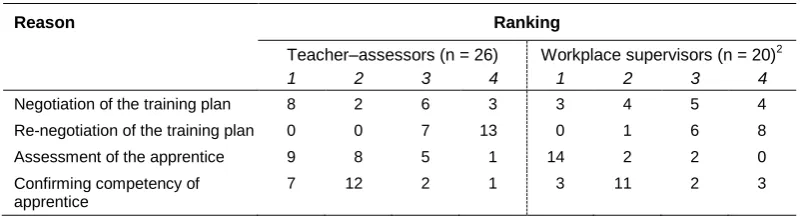
Table 1 Ranked reasons for communicating: teacher–assessors and workplace supervisors
Reason Ranking
Teacher–assessors (n = 26) Workplace supervisors (n = 20)2
1 2 3 4 1 2 3 4
Negotiation of the training plan 8 2 6 3 3 4 5 4
Re-negotiation of the training plan 0 0 7 13 0 1 6 8
Assessment of the apprentice 9 8 5 1 14 2 2 0
Confirming competency of apprentice
7 12 2 1 3 11 2 3
Note: Rank 1 = most common reason for communicating, rank 4 = least commonly used reason for communicating. Not all participants provided a full set of responses.
As table 1 shows, assessment and discussions relating to the confirmation of apprentice competency prior to sign-off were given as the major reasons for communication between the two. Other reasons identified by teacher—assessors were issues relating to non-attendance at TAFE, apprentice progress (or lack of it) and attitudinal issues. What was of particular interest in these responses was the low rating of the training plan as a reason for teacher—assessors to be talking to workplace supervisors. This was largely due to the fact that the initial discussions about training plans were sometimes undertaken by business development personnel rather than the teachers themselves.
Effectiveness of communication processes
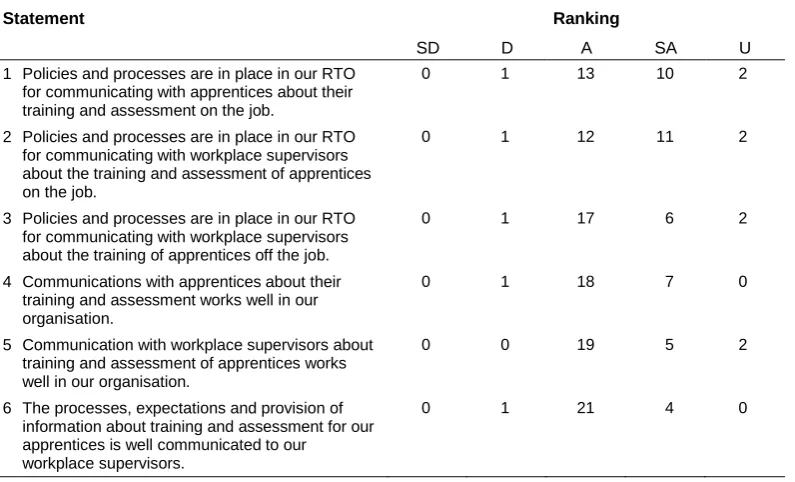
Teacher—assessors were also asked to comment on the extent to which they agreed or disagreed with a set of statements about the effectiveness of their organisation’s policies and procedures for supporting their communication with workplaces about apprentices’ training and assessment. A similar set of questions was asked of workplace supervisors. The provider-based participants were in strong agreement that sound policies and processes were in place for communicating with apprentices and workplace supervisors. Further, they strongly agreed that the communication processes worked well and they believed that information about apprentice training and assessment was well communicated to workplace supervisors. The responses from workplace supervisors, however, were somewhat different. While they agreed or strongly agreed that they understood what training would occur in TAFE and that communication with apprentices worked well in their own organisation, six of the 20 respondents disagreed that the processes, expectations and provision of information about training and assessment for apprentices was well communicated by teachers or the training provider. A summary of the ratings from both groups of participants on
organisational communication policies and processes is set out in tables 2 and 3.
2 One of the 21 workplace supervisors elected not to complete a pre-interview questionnaire.
The provider-based participants were in strong agreement that sound policies and processes were in place for
Table 2 Teacher–assessor views on organisational communication policies and processes
Statement Ranking
SD D A SA U
1 Policies and processes are in place in our RTO for communicating with apprentices about their training and assessment on the job.
0 1 13 10 2
2 Policies and processes are in place in our RTO for communicating with workplace supervisors about the training and assessment of apprentices on the job.
0 1 12 11 2
3 Policies and processes are in place in our RTO for communicating with workplace supervisors about the training of apprentices off the job.
0 1 17 6 2
4 Communications with apprentices about their training and assessment works well in our organisation.
0 1 18 7 0
5 Communication with workplace supervisors about training and assessment of apprentices works well in our organisation.
0 0 19 5 2
6 The processes, expectations and provision of information about training and assessment for our apprentices is well communicated to our workplace supervisors.
0 1 21 4 0
Key: SD = strongly disagree, D = disagree, A = agree, SA = strongly agree, U = unable to rate. N = 26.
Table 3 Workplace supervisor views on communication policies and processes
Statement Ranking
SD D A SA U
1 Clear processes are in place for teachers to communicate with me about the on-the-job training and assessment of my apprentice(s).
1 2 9 4 4
2 I understand what training and assessment of my apprentice(s) is to occur off the job.
0 1 11 7 1
3 Communication with apprentices about their training and assessment works well in our workplace.
0 1 13 6 0
4 Communication with teachers about the training and assessment of our apprentices works well in our workplace.
0 3 10 4 3
5 The processes, expectations and provision of information about training and assessment for apprentices is well communicated by teachers and the RTO.
0 6 10 4 0
Key: SD = strongly disagree, D = disagree, A = agree, SA = strongly agree, U = unable to rate. N = 20.
During interview, both participant groups were asked about impediments to good communication between themselves and their contacts in the workplace or TAFE. While many participants agreed that communication was good, a number of workplace supervisors suggested that the ‘VET language’ was sometimes a barrier to their understanding of what was expected. From the workplace side, a supervising chef acknowledged that good
communication was not necessarily something that chefs did, explaining ‘that’s why they are out back and not out front’. Therefore, it was important that teacher—assessors were very clear in the way they interacted with workplaces. Moreover, to maintain good connections, workplace supervisors wanted to be able to engage with the people who knew what they were doing and who were prepared to be flexible in order to meet their business needs.
Everyone’s so busy and difficult to get hold of. Everyone wants to communicate by a different method. Some people you can email and they’re straight back to you while some people never ever reply … people in business just don’t have time. Time is
money, too busy. (Cookery teacher)
While busyness was perceived as a barrier to communication at times, there was general agreement that apprentices played a critical role in keeping the lines of communication open. Apprentices acted as conduits by sharing what was happening in each sphere. Through this process teachers and supervisors were able to make the most of learning and
assessment opportunities as they arose.
Getting it together: integration of training and assessment
The training plan outlines the key details of the apprentice’s training and assessment. Developed prior to the commencement of any structured training, the plan takes into account the learning needs of the apprentice as well as the business needs of the employer. Generally in template form, a training plan sets out the competencies to be completed, the timeframe for completion, the training to be undertaken, when and where it is to occur, the modes in which the training is to be delivered and the arrangements for assessment. Initial discussions between training providers and workplaces and apprentices about training plans are therefore a critical starting point in ensuring that the training and assessment for apprentices are well integrated.
Negotiating the training plan
As noted earlier, these early discussions were not always carried out by the teacher— assessors participating in this study. Rather, the registered training organisation personnel whose specific role was to meet with employers to discuss roles, responsibilities and expectations were involved in negotiating agreement of a training plan. Where teacher— assessors were involved in the training plan’s development, the majority considered it was relatively easy to achieve good integration between training in the workplace and the structured training off the job. This was seen to be particularly true in cases where long-term relationships existed between provider and employer and where employer and teachers had a good understanding of the nature of the businesses with which they were dealing. One metal fabrication teacher, for example, suggested that his team had built a strong rapport with most of the businesses with which they dealt and both TAFE and the enterprises were very familiar with how each other operated. This understanding ensured that the provider-based training could be well aligned to what was occurring in the apprentices’ workplaces. The same teacher, however, offered a proviso:
It is the initial conversation that guides the training. We have a standard training plan, but the real key is not about the competencies, it is how they want it delivered. Although they [employers] all have the chance to negotiate on the training plan, not all take that opportunity.
With newer workplaces, discussions between teachers and workplace supervisors centred on the nature of the business and the current work being undertaken. From this, decisions were made about what training and assessment for an apprentice would occur in the workplace and what would need to happen in TAFE. A cookery teacher explained: ‘it’s just a matter of talking through each of the competencies and questioning what they do and how much they
do’. She indicated that integration was easier to explain and achieve if the units of
competency were clustered so that apprentices and employers could see the connections with the tasks they were performing in the workplace. In a similar vein, several metal fabrication teachers emphasised the importance of walking through the workshop to determine what equipment was used and the frequency of that use. The most important thing was to determine that a workplace was in a position to offer the broadest range of competencies and provide sufficient opportunity for the competencies to be effectively learned on the job. ‘After all, it is critical that the off-job training can be reinforced in the workplace.’
In contrast, the interviews revealed that discussions with employers and workplace
supervisors in the building and construction industry were viewed as problematic by all but a few teacher—assessors. One suggested that, despite using various means to keep in contact, communication with employers working in the domestic housing sector was nearly impossible for a number of reasons:
It is difficult to get out on site when you have 200 students. It is really hard because we have no real idea about what each of the employers is doing. In this industry people work all over the place and change from day to day, so being on site is difficult. Besides, some employers don’t want us on site.
As a consequence, teachers relied on emails to transmit generic information about the training and assessment of apprentices to employers or workplace supervisors. But, as one teacher noted, this was not necessarily considered satisfactory because it did not have what he called ‘the personal connection’ with an employer, which he considered essential for effective integration of training. The majority of carpentry teacher—assessors were of the view that they had no other choice but to adopt a standard training plan for every
apprentice and to use a fairly traditional approach to the way they delivered the training. Moreover, they were relying on apprentices letting them know what work was or was not happening in their workplaces. Armed with this information, they were sometimes able to connect some facets of learning in one environment to the training occurring in the other.
Ensuring all units of competency are covered
Despite some suggesting that integration was reasonably easy, there was general agreement among all participating teacher—assessors that it was a rare workplace that could provide apprentices with the opportunity to practise all the competencies required for a full trade qualification. The type of work undertaken in businesses varied markedly and many were quite narrow in focus. Reflecting the views of a number of teacher—assessors, one participant suggested that about 80 per cent of the competencies for metal fabrication apprentices were covered in TAFE and 20 per cent in the workplace. Some companies — usually the larger ones — could move the apprentice to another work site or production line but generally the employers supported gap training off the job. Workplace supervisors in the larger engineering firms confirmed this viewpoint, but suggested that in fact all but a few competencies could be taught and practised in the workplace.
Like their counterparts in metal fabrication, cookery supervisors agreed that they were able to provide apprentices with experience in most of the competencies by rotating the
apprentices through the various sections in the restaurant; namely, cold larder, entrees, mains and then pastries and desserts. Carpentry apprentices, on the other hand, were less likely to be able to get experience in all of the competencies in the qualification unless they
were employed by a large company, which meant they could access different construction sites. As a consequence, the majority of apprentices in this trade covered all their
competencies at TAFE. This was particularly the case for the apprentice employed by a sole trader engaged in domestic renovations and maintenance. This meant that the breadth of experiences available to this apprentice depended upon the range of work his employer took on.
In responding to a question about how gap training was managed in practice, responses varied. It was seen not to present any difficulties for those teacher—assessors delivering in lock-step mode; however, for those who had implemented fully flexible strategies to facilitate competency progression, such training needed to be closely monitored to ensure that every apprentice picked up the required elements of their program in a timely way. In three institutes, administrative staff were employed to track apprentice progress and to alert teachers and employers when apprentices needed to attend TAFE to complete a particular unit or cluster of competencies. This information was also valuable if teacher— assessors undertook workplace-based training and assessment.
To ensure that all competencies were covered, cookery apprentices were encouraged by some of the teachers and their workplace supervisors to complete units of competency in workplaces other than their own.
They [the employers] either ask the student to go there on their days off and get paid from the other place or they let them go during work hours. It depends how well the chefs know each other from the businesses. (Cookery teacher)
It was suggested that some employers were very supportive of this approach, although it was acknowledged that there were insurance implications. Also, as apprentices were considered to be a critical part of the business, they were always needed on the job and release to other businesses was therefore problematic.
Training plans: a ‘living’ document?
Both groups of participants were asked about the extent to which an apprentice’s training plan was adapted to suit changes that might occur in the workplace. Responses to this question were highly consistent, with the majority of teacher—assessors indicating they used standard plans, and that these were rarely revisited and almost never physically changed. This was despite the suggestion in the policy governing training plans that they were meant to be a dynamic and changeable ‘living’ document. In fact, the mere suggestion that training plans be modified in some way immediately raised the issue of work overload and the problems associated with inflexible institute policies and complex management systems. This view was most vociferously expressed by those teacher—assessors with 200 to 300 apprentices to train, monitor and assess.
It was suggested, however, that if changes did occur in the nature of the work being undertaken in the workplace, a conversation would occur between the workplace supervisor and teacher, and agreement would be reached informally about how to address the
variation in training demanded by the change.
There is an expectation that the training plan is reviewed during the time of the apprenticeship, but in actual fact that tends not to occur. If an employer wants to
‘tweak’ what is happening, the schedules can be changed, but not the plan itself. (Metal fabrication teacher)
Similarly, an engineering company’s workplace supervisor agreed that the registered training organisation was happy to make modifications to the training plan should changes arise; however, this tended to be change in the way delivery occurred rather than any real change to the plan (for example, when there was a shift change for an apprentice).
A number of teacher—assessors emphasised that the majority of the workplaces they were dealing with were reasonably stable in terms of work and the likelihood of minor changes would be just part of the normal day-to-day communication between the teacher and the workplace supervisor. In the case of carpentry, there appeared to be no negotiation on the training plan at all. Given that most of the carpentry businesses in this study were engaged in domestic house construction and renovation and that the employer pool from which the apprentices were drawn was extensive, this lack of negotiation around training plans was understandable. The view amongst teachers across metal fabrication and carpentry was that, while training plans were generic, they were sufficiently broad to cover all types of companies and all types of work.
Confirming this viewpoint, a majority of the workplace supervisors suggested that the fact that TAFE covered skills in a different order from that in the workplace was not an issue. They could see no value in making changes to training plans, as the competencies could be covered another time or revisited during the period of the apprenticeship. There were, however, divergent views expressed by some of the cookery supervisors. While several suggested that plans had been modified to meet the needs of their businesses, one commented that the plan had not been tailored to suit what was needed in his
establishment and another declared that he did not realise that he had any say in what was included in the training plan for his apprentice.
By way of contrast, the workplace supervisors in large engineering enterprises noted that training plans played a somewhat lesser role than the learning and development plans they developed specifically to suit the work undertaken in their companies. While the
apprenticeship mandated the development of a standard training plan, teacher—assessors had little or no involvement in the actual training plan the company put together for each of their own apprentices. On occasions, TAFE teachers may have been asked to provide specific training for individual apprentices to address particular skill needs. But beyond those occasions, there was a clear separation between what was learned in the workplace and what was occurring in the off-job training. The justification for adopting this approach generally centred on TAFE not having the required equipment or not having teacher— assessors with the skills, knowledge or experience to train in what were niche areas of the industry. As a consequence, the needs of the current workplace took precedence over what was set out in an apprentice’s official training plan.
Even where this lack of integration existed, it was acknowledged by many of the workplace supervisors that apprentices had to learn the foundation skills of their trade and that this learning was best done at TAFE. The off-job training was seen to provide the essential theory and skills that gave apprentices a good understanding of how to do things ‘the right way’ and how to do them in different contexts. For example, TAFE often delivered clusters of competencies that formed an induction to the trade. Apart from TAFE instilling the trade
fundamentals in a disciplined way, one chef suggested that apprentices at TAFE also learned about the industry through mixing with their peers, many of whom were undergoing
different experiences in often quite varied settings from their own.
Despite these positive comments, a number of workplace supervisors questioned the breadth of the competencies that apprentices were required to learn off the job. For example, one engineering company supervisor suggested that many of the competencies apprentices were required to achieve were irrelevant and ‘a waste of time when they are not going to use these things in their current work’. This view was reiterated by several of the carpentry supervisors who were involved in narrow areas of the domestic building industry such as framing. In their opinion, apprentices would be better off back in the workplace rather than ‘being bored at Tech’.
Competency progression: the impact on teaching
As competency progression means that apprentices can be undertaking training across a broad range of units of competency and be at various stages in their programs, teacher— assessors were asked what impact this had had on the way they taught. The responses to this question proved to be markedly different across the three trades.
Most metal fabrication teacher—assessors, who had been working within a competency progression and completion framework for the longest period of time, were generally teaching and assessing is a highly flexible manner. In one TAFE engineering department, for example, the attendance patterns available to employers and to apprentices in any stage included block release, one day a week, and ‘any time or any day’. To address the
complexities that this approach inevitably brought to the teaching process, classrooms and workshops were co-located and the teaching completely integrated. A bank of computers was set within the workshop, and apprentices at various stages were being taught by one teacher in the classroom and another in the workshop. At various times, maths and computer-aided design (CAD) support were also present in the same teaching and learning space. Apprentices were using a combination of computer-enabled learning and assessments, and paper-based workbooks. They undertook online research, completed online quizzes and moved freely between the classroom and the workshop area, where they carried out individual and collaborative practical projects. While the majority of apprentices were engaged in individual activities, time was also available for intensive teaching in small groups. All of these options were freely available over extended hours and e-learning was available 24/7. Such flexibility did have its drawbacks, as one teacher—assessor explained:
Tuesday is the hardest for me. Stage 1, 2 and 3 apprentices are in on the one day. Sometimes it gets so hard it might mean requesting an apprentice come in on a different day for say nine weeks.
Somewhat similar approaches were adopted by teachers in two of the other TAFE institutes offering the Certificate III in Engineering — Metal Fabrication. The apprentices were generally mixed so that stages 1, 2 and 3 were often working together in the workshop, each at their own pace and on their own projects. The training was a blend of small-group or one-on-one activities. The apprentices worked through their workbooks and were assessed when they considered they were ready. The value of the approach was that it was seen as providing employers with flexibility, which was particularly important if they